Research Article
1
Augmented Lagrangian Algorithm for Hydrothermal
Scheduling
R. Subramani
1,* and C.Vijayalakshmi
21Department of Mathematics, St. Joseph’s College of Engineering, Chennai 2SAS, Mathematics Division, VIT University, Chennai
Abstract
This paper mainly deals with a new algorithm for solving hydrothermal scheduling problem with transmission and environmental constraints using Augmented Lagrangian(AL) method. Hydrothermal scheduling is a most important task in power management system. Transmission capacity and environmental constraints are relaxed by using Lagrangian multipliers. The existing methods are provided suboptimal solutions from the computational burden due to the large number of variables involved in the problem. This paper ensures efficient technique that involves a reduced number of decision variables for hydrothermal scheduling to reduce the total operating cost through AL method. The ultimate aim of hydrothermal scheduling is to ensure the optimal generation in both hydro and thermal units in order to fulfill the demands over a scheduled horizon. In this paper optimal hourly schedule for power generation in hydrothermal scheduling system applying Augmented Lagrangian Relaxation (ALR) technique.
Keywords: Augmented Lagrangian, Scheduling, Power demand, Hydro electric sources, Thermal generation cost.
Received on 03 May 2018, accepted on 20 May 2018, published on 12 June 2018
Copyright © 2018R. Subramani and C.Vijayalakshmi et al., licensed to EAI. This is an open access article distributed under the terms of the Creative Commons Attribution licence (http://creativecommons.org/licenses/by/3.0/), which permits unlimited use, distribution and reproduction in any medium so long as the original work is properly cited.
doi: 10.4108/eai.12-6-2018.154815
*Corresponding author. Email:[email protected]
1. Introduction
In day to day life hydro-thermal scheduling is an important activity for electric utilities to meet the future demand. In overall energy utility of India, more than 70% of the electricity requirements are contributed from thermal sources. Hydro electric sources contributes a major share than any other sources whereas in India utilize below 24% of hydropower sources. In spite of this low share of the hydroelectric sources the overall generation of country is reduced due to more demand on peak hours of the customers. Studies on Hydro-thermal scheduling are carried out by many researchers. Some of the studies are mentioned here: The general structure of a unit commitment problem for power generation operation and management was discussed by Allen [1]. A fuel constrained based unit commitment problem was designed by Lee [2], Viramani
[3] implemented a Lagrangian Relaxation based and based on genetic algorithm Rudolf et al [4] designed a unit commitment problem for hydro thermal power system. Researchers have developed methods to solve hydro subproblems like Dynamic Programming (DP), network flow, and standard Mixed Integer Programming (MIP) methods. Lagrangian framework is a successful method discussed by Cohen et al [5], Shaw et al [6]. Xiaohong et al [7] proposed a nonlinear. approximation method for hydrothermal scheduling using Lagrangian Relaxation. Baslis et al [8] proposed a MIP approach to the yearly scheduling problem of a mixed hydro thermal system. Rodrigues et al [9] solved the short-term scheduling problem of hydrothermal systems via Lagrangian Relaxation and augmented Lagrangian Methods. Borghett et al [10] proposed a MILP approach for short-term hydro scheduling and unit commitment with head-dependent reservoir. Cheng et al [11] analyzed the Comparison of Particle Swarm Optimization and Dynamic
on
Energy Web and Information Technologies
EAI Endorsed Transactions on
Programming for Large Scale Hydro Unit Load Dispatch. Pousinho et al [12] discussed the Scheduling of Hydro Producer Considering Head-De pendency, Price Scenarios and RiskAversion. Pérez-Díaz et al [13] conducted an Assessment of the Economic Impact of Environmental Constraints on Short Term Hydro power Plant Operation. PerézDíaz et al [14] analyzed a study on the Contribution of Regulation Reservoirs Considering Pumping Capability to Environmentally Friendly Hydro power Operation. The above mentioned studies helped the present study on arriving minimum production cost and maximum power utility period for the generating units.
Subramani et al [15-17] proposed Lagrangian Decomposition algorithms for power management systems. These algorithms are formulated based on generation, storage and distribution systems in various power plants. Thillainathan et al [18] combines LR simultaneously Evolutionary Algorithm (EA) to provide a hybrid algorithm for the real time energy environments. Hari et al [19] proposes a Ant Line Optimization algorithm whose inspiration from the hunting behaviour of ant lions, six step hunting behaviour is modelled using six easier operations for solution procedure with a variety of difficult constraints.
2. Mathematical Model Formulation
In the present study, the optimization model that have been designed for power generation by using thermal and hydro units with respect to various parameters and generating conditions of the power system. The objective of Hydro-thermal scheduling is to generate the number of units that would satisfy the expected demand and to give the minimum power production cost in the planning time interval. Thesecalculation includes a set of energy constraints such as range of thermal and hydro units, water discharge rate, demand and energy consumption constraints, transmission loss constraints etc.
2.1. Parameters
Na – Set of all thermal units Nb – Set of all hydro units Nt – Total Study intervals (in hrs) k – Set of all time slots
N – Total number of (Thermal and Hydro) units CiPi(k) – Thermal generation cost
FCi – Fuel cost for thermal unit i Cs i(k) – Startup cost for unit i at k Csd i(k) – Shut down cost for unit i at k Cm i(k) – Maintenance cost for unit i k
Pi(k) – Power output of thermal unit i at k (MW) Pj(k) – Power output of hydro unit j at k (MW)
Pimax(k) –Upper limits of thermal units i in time slot k (MW) Pimin(k) –Lower limits of thermal units i in time slot k (MW) Pjmax(k) – Upper limits of hydro units j in time slot k (MW) Pjmin(k) – Lower limits of hydro units j in time slot k (MW)
PR(k) –Spinning reserved requirement of unit i at time slot k (MW)
PD(k) – Load demand for whole System (MW) PL(k) – System loss at time slot k (MW)
WD j(k) – Discharged water for hydro generation in unit j at k (MW)
Wv j – Available volume of water in hydro unit j (MW) WF j(k) – Rate of water flow in hydro unit j at k
Pt(k) – Power flow in transmission line t at k (MW)
Ptmax(k) – Upper limit of power flow unit i at time slot k (MW)
Ptmin(k) – Lower limits of power flow unit i at time slot k (MW)
Na ion/off – On/Off time duration for unit i at k Tion/off – Minimum on/off time for unit i ERi – Emission rate
Hi – Heat function for the thermal unit i (lb/Mbtu)
EM – Maximum emission rate for the whole system over Nt Ii(k) – Commitment unit i at time slot k
λi ,μj – Lagrangian Multipliers
2.2. Optimization Model Formulation
Hydrothermal generation scheduling can be formulated as a Non Linear Programming Problem (NLPP) based on the energy constraints and various system parameters. The objective of these scheduling is to minimize the cost of power produced by generation units Given a power station that contains Na thermal units and Nb hydro units the best generation commitment at each time k over a time horizon Nt are calculated. Cost optimization consists of startup cost, normal operational cost maintenance cost and shutdown costs. Since the marginal costs are so small for the hydro electric generation therefore they are negligible. Hence the objective function is defined by f:×I→ (m×n, I = {0 or 1}m×na where n and na are denoted by the number of
generated units in Na and
N
=
N
a
N
brespectively).( )
1 1 1
( , ) ( ) ( ) ( )(1 ( )) ( ) ( ) ( ) ( )
Nt Na Nb
i i i i i s i sd i m i m j
k i j
f I C P k I k I k I k C k C k C k C k
= = =
= + − + + +
(1) where is a m×n matrix each row of represents the power loading units (both thermal and hydro) at each time hour in Nt and I is m×nt each row of this represents the status of thermal units at each hour in Nt. It is a nonconvex mixed integer non linear programming problem. Fuel cost for thermal unit is calculated by array equation numbers.
( )
21 1 1
i i i i
C P k
=
x
+
y F
+
z F
iNa (2) Subject to the Constraints
System Power Balance Constraints:
,
( ) ( ) ( )
i i D
i j N
I k P k P k
=
(3)3
max max
1 1
( ) ( )
( ) ( )
( )
( ) 0
Na Nb
i i j j D L
i j
P
k I k
P
k I k
P k
P k
= =
+
−
−
=
(4)
(Spinning Reserved constraint)
Transmission loss can be calculated by
0 00
1 1 1
( )
( )
( )
( )
Na Nb Na Nb Na Nb
L i ij j i i
i j i
P k
P k L P k
L P k
L
+ + +
= = =
=
+
+
(5) (Transmission Loss Constraint)
Where Lij , L0i , L00 are the loss formula coefficients of the transmission lines.
Spinning reserved requirement:
max max
1 1
( ) ( )
( ) ( )
( )
( )
Na Nb
i i j j D R
i j
P
k I k
P
k I k
P k
P k
= =
+
+
(6)
Unit Generation limit:
Pimin ≤ Pi(k) ≤ Pimax i=1,2,3,…,Na (7)
(Thermal unit bounds)
Pjmin ≤ Pj(k) ≤ Pjmax j=1,2,3,…,Nb (8)
(Hydro unit bounds)
Relationship between water discharge and Power flow:
Water availability is
1 1
( ).1
Nt Nb
D j v j
k j
W
k
hr W
= =
=
(9)
(Water conservation constraint)
The rate of water flow is calculated by
2
F j 2 2 2
W (k)
=
x
+
y F
j+
z F
j(10) where x2, y2, z2 are water discharge coefficients for hydro unit j.
Startup and Shut down time for Thermal units:
(Na ion(k-1) - Tion).(Ii(k-1) – Ii(k)) ≥ 0 (11)
(Na ioff(k-1) - Tioff).(Ii(k) – Ii(k-1)) ≥ 0 (12)
Transmission line capacity limit:
Ptmin(k) ≤ Pt(k) ≤ Ptmax(k) (13)
Emission Constraints:
1 1
(
( )) ( )
Nt Na
i i i i
k i
ER H p k I k
EM
= =
(14)1
( ( ))
( )
Nt
i i i
k
q C P k
EM k
=
(15)The NOx, SO2, CO2 emission objective can be defined as:
( )
21i
1 1 i
1 i
(
/
)
F k
=
+
F
+
F
Kg hr
( )
22i
2 2 i
2 i
(
/
)
F
k
=
+
F
+
F
Kg hr
( )
23i
3 3 i
3 i
(
/
)
F
k
=
+
F
+
F
Kg hr
where θ1, τ1, δ1 are the coefficients for NOx emission; θ2, τ2, δ2 are the coefficients for SO2 emission and θ3, τ3, δ3 are CO2 emission coefficients.
3. Augmented Lagrangian (AL) Method
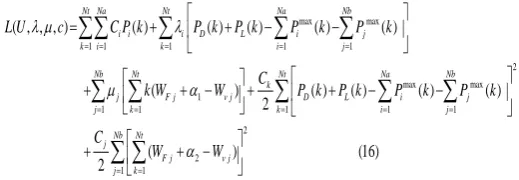
An AL method is implemented to solve this problem. Therefore the primal problem becomes, From the proposed problem both thermal and hydro units are independent but together must met the overall system demand. The total operating cost to be minimized hence this attains Lagrangian Relaxation technique to exploit the decomposability of the proposed problem. The solution of the subproblems are piecewise linear cost functions which attains the optimal solution only in bounds and it may oscillates the small changes of the multipliers. To overcome this difficulty Lagrangian a quadratic penalty function is added associated with demand constraint is known as Augmented Lagrangian Relaxation technique. The Augmented Lagrangian function for the proposed problem is denoted by,
max max
1 1 1 1 1
2 max max 1
1 1 1 1 1
2 1 ( , , , ) ( ) ( ) ( ) ( ) ( ) ( ) ( ) ( ) ( ) ( ) 2 ( ) 2
Nt Na Nt Na Nb i i i D L i j k i k i j
Nb Nt Nt Na Nb k
j F j v j D L i j j k k i j
Nt j
F j v j k
L U c C P k P k P k P k P k
C
k W W P k P k P k P k
C W W = = = = = = = = = = = = + + − − + + − + + − − + + −
2 1 (16) Nb j=
Here Ck, Cj are positive penalty coefficients and α1, α2 are the slack variables. The quadratic penalty terms in are relaxed by Lagrangian decomposition.
4. Numerical Calculations and Graphical
Representations
The proposed ALR method is solved in MATLAB2010a, the computations were done in HP Laptop. Computational results enforces from best among 50 runs of the ALR algorithm. Minimum, maximum limits and fuel cost for the generation of thermal units calculated by using ALR method over hourly planning horizon and it is depicted in Table 1.
Table 1. Generation cost for thermal units
Plant x1 ($/MW hr) y1 ($/MW hr) z1 ($/MW hr)
Pimin(k)
(MW)
Pimax(k)
(MW)
1 0.01 0.1 100 50 200
2 0.02 0.1 120 40 170
3 0.01 0.2 150 30 215
EAI Endorsed Transactions on
For optimal hydrothermal generation schedule in both plants met the load demand and transmission losses are calculated using ALR algorithm is shown in Table 2.and Table 3. over one day hourly planning horizon.
Table 2. Load demand
Hour
PD
(MW) Hour
PD
(MW) Hour
PD
(MW)
1 175 9 440 17 425
2 190 10 475 18 400
3 220 11 525 19 375
4 280 12 550 20 340
5 320 13 565 21 300
6 360 14 540 22 250
7 390 15 500 23 200
8 410 16 450 24 180
Table 3. Generation cost for hydro units
Figure1. reflects that the system demand over one day scheduling period and it attains maximum in 13th hour. For hydro units the corresponding power generation limits and water availability and its discharge rate coefficients are calculated in table -3
Figure 1. Hourly demand of the system
The efficiency of the Augmented Lagrangian Relaxation Technique is tested for a hydrothermal plant. The purpose of applying Augmented Lagrangian method is minimize the loss of the system as well as maximize the generation utility over a planning horizon. In order to fulfill the demand (load) of the system generation scheduling offers to schedule the units for generation by satisfying all the system constraints. In spite of achieving maximum profit for the power generating utility supply and demand are utilized in a reliable manner.
Fig 2 classifides that the unitwise generation of both thermal and hydro units; the maximum load is utilized by using ALR technique over one day planning horizon.
Figure 2. Unit wise Generation
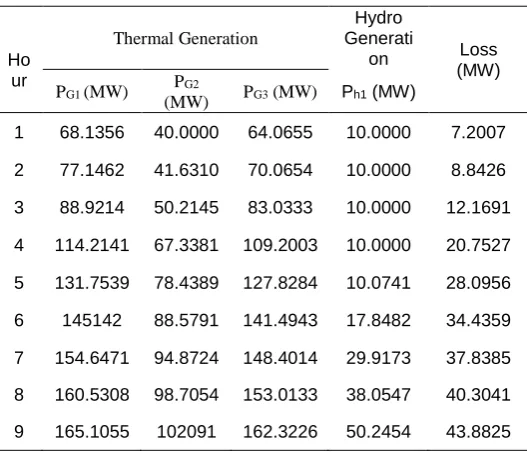
The energy losses are calculated in quadratic nature over hourly planning horizon and it is depicted in Table 4.
Table 4. Power loss obtained from AL Technique
Ho ur
Thermal Generation
Hydro Generati
on Loss
(MW)
PG1 (MW) PG2
(MW) PG3 (MW) Ph1 (MW)
1 68.1356 40.0000 64.0655 10.0000 7.2007
2 77.1462 41.6310 70.0654 10.0000 8.8426
3 88.9214 50.2145 83.0333 10.0000 12.1691
4 114.2141 67.3381 109.2003 10.0000 20.7527
5 131.7539 78.4389 127.8284 10.0741 28.0956
6 145142 88.5791 141.4943 17.8482 34.4359
7 154.6471 94.8724 148.4014 29.9173 37.8385
8 160.5308 98.7054 153.0133 38.0547 40.3041
9 165.1055 102091 162.3226 50.2454 43.8825
Pl ant
P
j min
(k) P
j max
(k) Water
Volume (m3)
x
j yj zj
5
10 175.8352 113.1778 169.6516 64.9265 48.5912
11 188.4399 123.3503 183.0102 81154 55.9155
12 194.9369 129.0775 189.3461 92.4565 59.9155
13 200.0000 134.1211 193.8283 100.00 62.9491
14 191.6835 127.1509 184970 92.6519 57.9831
15 182.4302 118.2798 173102 75.2374 52.2576
16 167.5452 108.4111 164.5151 54.6059 45.0773
17 162.1553 102.7916 158.2515 43.8912 42.0896
18 157.9871 96312 150.7118 33.8157 39.9440
19 149.6308 92.4476 144.9175 23.9481 35.9440
20 141.1155 85.3907 135.2588 10.2154 31.9807
21 123.4245 72.6379 118.2341 10.0000 24.2965
22 101.6896 57.8784 96686 10.0000 12363
23 80.5810 44.9917 74.2655 10.0000 9.8386
24 71.7041 40.0000 60655 10.0000 7.7696
Figure 1. Hourly system loss
Figure.3 reveals that the calculated overall system losses (MW) over one day planning horizon. From this maximum loss are obtained in 13th hour which leads up to 62.9491MW energy losses due to peak demand of the consumers.
Figure. 4 ensures that the water discharge rate for a single hydro generation unit based on ALR technique over one day planning horizon.
Figure 4. Hourly water discharge rate
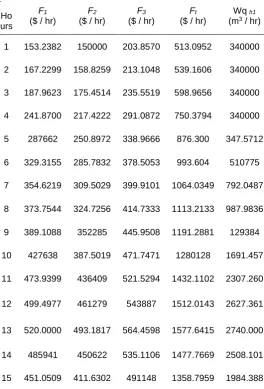
Table 5. ensures that the generation cost for one hydro unit and three thermal units obtained by ALR technique. From the below table it is clear that generation cost is increased from 1 – 13th hours based on the peak demand and it is decreased from 13 – 24 due to off peak demand.
Table 5. Generation cost for thermal and hydro plants over hourly planning horizon
Ho urs
F1 ($ / hr)
F2 ($ / hr)
F3 ($ / hr)
Ft ($ / hr)
Wq h1
(m3 / hr)
1 153.2382 150000 203.8570 513.0952 340000
2 167.2299 158.8259 213.1048 539.1606 340000
3 187.9623 175.4514 235.5519 598.9656 340000
4 241.8700 217.4222 291.0872 750.3794 340000
5 287662 250.8972 338.9666 876.300 347.5712
6 329.3155 285.7832 378.5053 993.604 510775
7 354.6219 309.5029 399.9101 1064.0349 792.0487
8 373.7544 324.7256 414.7333 1113.2133 987.9836
9 389.1088 352285 445.9508 1191.2881 129384
10 427638 387.5019 471.7471 1280128 1691.457
11 473.9399 436409 521.5294 1432.1102 2307.260
12 499.4977 461279 543887 1512.0143 2627.361
13 520.0000 493.1817 564.4598 1577.6415 2740.000
14 485941 450622 535.1106 1477.7669 2508.101
15 451.0509 411.6302 491148 1358.7959 1984.388
EAI Endorsed Transactions on
16 397.4685 365.9007 453.5553 1219245 1411.026
17 379.1589 341.6012 432.0856 1152.8457 1133.410
18 365.3979 314148 407.2829 1089.0956 884.9241
19 338.8569 300.1758 388.9942 1028.0269 653.3727
20 313.2474 274.3705 360.0013 947.6192 350.5693
21 264.6784 232.7892 313.4398 810.9074 340000
22 213.5766 192.7861 262.7819 669.1446 340000
23 172.9911 164.9841 229.0067 569819 340000
24 158.5851 150000 298596 611.4447 340000
Table – 6 Comparative study results
Method Total Fuel Cost
($)
Computational Time (Sec)
PSO 24378.7028 15.32
GA 24378.0589 18.14
ALR 24337.7032 10.23
The proposed results are compared with other heuristic algorithms such as Particle Swam Optimization (PSO) and Genetic Algorithm (GA). Based on the numerical calculations and graphical representations proposed Augmented Lagrangian Relaxation techniques leads to the acceptable solutions. Particle Swarm Optimization and Genetic Algorithm are the populations based soft computing techniques, attains convergence limit at 15.32 seconds and 18.14 seconds whereas proposed ALR technique attains convergence limit in 10.23 seconds with 50 iterations.
5. Conclusion
In order to solve hydrothermal generation and scheduling problem a new ALR algorithms has been proposed as a Nonlinear Integer Programming Problem. With the help of Lagrangian multipliers the complicating constraints such as demand and reserve requirements are decomposed. These Lagrangian multipliers act as a price resources to concentrate the generation limits and reserve contribution in both individual and hybrid configurations. The algorithm has been modified to reduce the number of variables and hence problem
minimizes the computational burden. The reservoir level and the maintenance scheduling are optimized, simultaneously, to minimize the thermal generation complement and to maximize the future water value. Test results shows that this algorithm is fast efficient and provides reasonable results in practical size systems.
References
[1] Book :J. ALLEN WOOD, F. BRUCE and WOLLENBRG, (2013) Power Generation Operation and Control, 2nd ed. (John Wiley & Sons, New York. ISBN: 978-0-471-79055-6) [2] Journal article: F.N. LEE (1989) A Fuel-Constrained Unit
Commitment Method, IEEE Transaction on Power Systems, Vol.4(3): pp. 1208 – 1218.
[3] Journal article: S.VIRAMANI, K. CADRIN, S. IMHOF and MUKHERJEE, (1989) Implementation of a Lagrangian Relaxation Based Unit Commitment Problems, IEEE Transaction on Power Systems, Vol. 4(4) : pp. 692 – 698. [4] Journal article: R. RUDOLF and BAYRLEITHNER, (1999)
A Genetic Algorithm for Solving the Unit Commitment Problem of a Hydro Thermal Power System, IEEE Transactions on Power Systems, Vol. 14(4) : pp. 1460-1468. [5] Journal article: I. COHEN and S.H. WAN, (1985) An
Algorithm for Scheduling a Large Pumped Storage Plant, IEEE Transaction on Power Apparatus and Systems, Vol. PAS-104 (8) : pp. 2099 – 2104.
[6] Journal article: J.J. SHAW and D.P. BERTSEKAS, (1985) Optimal Scheduling of Large Hydro thermal Power Systems, IEEE Transactions on Power Apparatus and Systems, Vol. PAS-104, pp.286 –293
[7] Journal article: X. GUAN and P.B. LUH, (1995) Nonlinear Approximation method in Lagrangian Relaxation based algorithms for Hydrothermal Scheduling, IEEE Transactions on Power Systems, Vol. 10(2) : pp. 772 – 778.
[8] conference: C.G. BASLIS and A.G. BAKIRTZIS, (2008) A MIP Approach to the Yearly Scheduling Problem of a Mixed Hydro thermal System, In Proceedings of the 5th
International conference on the European Electricity Market, ( Lisboa, Portugal ) pp. 1 – 6.
[9] Journal article: R.N. RODRIGUES, E.C. FINARDI and E.L. SILVA, (2012) Solving the Short-Term Scheduling Problem of Hydro thermal Systems Via Lagrangian Relaxation and Augmented Lagrangian, Mathematical problems in Engineering, Vol. 2012, Article ID 856178, 18 pages. [10] Journal article: A.I. BORGHETT, D’AMBROSI, A. LODI
and S. MARTELLO, (2008) An MILP Approach for Short-Term Hydro Scheduling and Unit Commitment with Head-Dependent Reservoir, IEEE Transactions on Power Systems, Vol.23(3) : pp.1115–1124.
[11] Journal article: C. CHENG, S. LIAO, Z. TANG and M. ZHAO, (2009) Comparison of Particle Swarm Optimization and Dynamic Programming for Large Scale Hydro Unit Load Dispatch, Energy Conversion and Management, Vol.50(12) : pp.3007 –3014.
[12] Journal article: H.M.I. POUSINHO, V.F. MENDES and J.P.S. CATALO, (2012) Scheduling of a Hydro Producer Considering Head-Dependency, Price Scenarios and Risk-Aversion, Energy Conversion and Management, Vol. 56, pp.96 – 103.
7 Environmental Constraints on Short Term Hydropower Plant Operation, Energy Policy, Vol. 38(12) : pp.7960 –7970. [14] Journal article : J.I. PERÉZ-DÍAZ, R. MILLÁN, D. GARCÍA,
I. GUISÁNDEZ and J.R. WILHELMI, (2011) Contribution of Regulation Reservoirs Considering Pumping Capability to Environmentally Friendly Hydropower Operation, Energy, Vol.48(1) : pp.144 –152.
[15] Journal article : R. SUBRAMANI and C. VIJAYALAKSHMI, (2016) Design of Lagrangian Decomposition Model for Energy Management using SCADA Systems, Smart Innovation, Systems and Technologies, Vol. 49 : pp. 353 – 361.
[16] Journal article : R. SUBRAMANI and C. VIJAYALAKSHMI, (2016) Implementation of an Optimization Model for Pump Scheduling, International Journal of Pure and Applied Mathematics, Vol. 109(5) : pp. 41 – 49.
[17] Journal article : R. SUBRAMANI and C. VIJAYALAKSHMI, (2016) A Review on Advanced Optimization Techniques, ARPN Journal of Engineering and Applied Sciences, Vol. 11(19) : pp. 11675 – 11683.
[18] Journal article : T. LOGENTHIRAN, W.L. WOO and V.T. PHAN (2015), Lagrangian Relaxation Hybrid with Evolutionary Algorithm for Short-term Generation Scheduling, Electrical power and Energy Systems, Vol. 64 : pp.356 – 364. [19] Journal article : H.M. DUBEY, M. PANDIT and B.K.
PANIGRAHI, (2016) Ant lion Optimization for Short-term Wind Integrated Hydrothermal Power Generation Scheduling, Electrical Power and Energy Systems, Vol. 83 : pp. 158–174.
EAI Endorsed Transactions on