warwick.ac.uk/lib-publications
A Thesis Submitted for the Degree of PhD at the University of Warwick
Permanent WRAP URL:
http://wrap.warwick.ac.uk/109824
Copyright and reuse:
This thesis is made available online and is protected by original copyright.
Please scroll down to view the document itself.
Please refer to the repository record for this item for information to help you to cite it.
Our policy information is available from the repository home page.
BRITISH THESIS SERVICE
COPYRIGHT
Reproduction of this thesis, other than as permitted under
the United Kingdom Copyright Designs and Patents Act
1988, or under specific agreement with the copyright
holder, is prohibited.
This copy has been supplied on the understanding that it
is copyright material and that no quotation from the thesis
may be published without proper acknowledgement.
REPRODUCTION QUALITY NOTICE
The quality of this reproduction is dependent upon the
quality of the original thesis. Whilst every effort has been
made to ensure the highest quality of reproduction, some
pages which contain small or poor printing may not
reproduce well.
Previously copyrighted material (journal articles, published
texts etc.) is not reproduced.
The Temporal Development of Strategy:
Patterns in the UK Insurance Industry
b y
David Langston W ebb
thesis subm itted in partial fulfilm ent o f the requirem ents f o r the degree o f D octor o f Philosophy in M anagement.
Warwick Business School, University o f Warwick
T A B L E O F C O N T E N T S ... ii
Listof Figures... vi
Listof Tables... vii
A C K N O W L E D G E M E N T S ...viii
D E C L A R A T IO N ...ix
A B S T R A C T ...x
CHAPTER 1________________________________________________________________________ 1 INTRODUCTION___________________________________________________________________ 1 O U T L IN E O F T H IS T H E S IS ...3
C H A P T E R 2 ___________________________________________________________________________________6 T O W A R D S A D Y N A M IC P E R S P E C T IV E O F T H E C O N T E N T O F S T R A T E G Y --- 6
IN T R O D U C T IO N ... 6
T H E C O N T E N T O F S T R A T E G Y ... 8
The Positioning School... 8
Industrial Organisation Economics... 9
Strategic Positioning and Generic Strategies...10
Strategic G ro u p s...11
Empirical Evidence... 12
How much does Industry Structure M atter?... 13
The Resource-based View o f the Firm... 15
Firm Heterogeneity and Strategic Groups... 16
Empirical Evidence... 12
C R IT IC IS M S O F S T R A T E G Y C O N T E N T R E S E A R C H ... 18
Single and M ulti Levels o f Analysis... 19
Static Views o f Strategy Content... 19
Developments in the Positioning S chool... 21
Developments in the Resource-based View ... 21
Empirical Lim itations...22
Summary...24
D Y N A M IC S T U D IE S O F S T R A T E G Y C O N T E N T ...27
Summary...32
A L T E R N A T IV E C O N C E P T U A L P E R S P E C T IV E S ... 33
Research on the Adoption o f Innovations...34
Institutional Perspective...37
Contextual Perspective... 38
Comparison o f Alternative Perspectives... 39
T H E M E S A N D Q U E S T IO N S F O R E M P IR IC A L R E S E A R C H ... 40
CHAPTER 3 _______________________________________________________________________ 44 METHODOLOGY...44
IN T R O D U C T IO N ... 44
O N T O L O G IC A L A S S U M P T IO N S ... 45
E P IS T E M O L O G IC A L S T A N C E ... 48
C O N T E X T U A L IS M ... 53
M E T H O D O L O G Y ...54
M ultiple M ethods and M ultiple Levels ofAnalysis... 54
Longitudinal Research M ethods... 57
Earlier longitudinal Quantitative Research on Strategy Content.... 59
R E S E A R C H S T R A T E G Y A N D D E S IG N ...60
L O N G IT U D IN A L M A PPIN G A N D A N A LY SIS P H A S E ... 62
Sector and Sample Selection... 62
Study Period.... 64
Data Collection...64
The Use o f Secondary D ata...65
Operational Experience o f Data Collection M ethod...67
Strategy Content Typology.... 69
Data M apping... 73
Quantitative Data A nalysis... 76
Interview Support fo r our Mapping and Analysis Findings... 82
C A S E STU D Y P H A S E ... 82
Interviewee Selection...85
Gaining A ccess.... 86
Data Collection... 87
Timing... 87
Case Study Protocol...88
Data Types... 89
Case Study Interviews... 89
Documentary D ata...94
Observational N otes... 95
Case Analysis... 95
Validity and Limitations o f the Case Studies....100
The Role of the Researcher and Bias...102
Bias Introduced by the Interview Subjects... 104
Bias introduced by the Research Strategy...105
S U M M A R Y ... 108
CHAPTER 4 ______________________________________________________________________ H I THE UK INSURANCE INDUSTRY... I l l IN T R O D U C T IO N ...I l l M A R K E T S T R U C T U R E ... 112
Professional and Trade Associations... 115
Summary... 116
A B R IE F H IS T O R Y O F T H E U K IN SU R A N C E IN D U S T R Y ... 117
Long Term Insurance...117
Genera! Insurance... 119
Government Regulation... 121
Summary... 121
T H E IN S U R A N C E M A R K E T IN T H E 1980S AN D 1990S - PO L IT IC A L . E C O N O M IC A ND S O C IA L F A C T O R S ... 122
Summary... 128
T H E C H A N G IN G C O M P E T IT IV E L A N D SC A PE IN T H E I980S A N D 1990S...129
Falling Entry Harriers and New Entrants....129
Rising Claims and the Insurance C ycle...133
The Response o f the Insurers... 134
Summary... 138
A H Y P E R C O M P E T IT IV E E N V IR O N M E N T ?...139
P A T T E R N S O F S T R A T E G Y IN T H E U K IN S U R A N C E IN D U S T R Y _______________________ 145
IN T R O D U C T IO N ... 145
PR E V IO U S R E S E A R C H A N D C O N T R A ST IN G M O D EL S O F C H A N G E ... 146
T H E S T R A T E G IC IN IT IA T IV E S O F T H E S A M P L E D F IR M S ... 152
Prudential... 152
Norwich Union... 155
Eagle S ta r...157
Royal Insurance...160
Sun A lliance... 163
Guardian Royal Exchange... 165
Legal <5 G eneral...168
General Accident.... 170
Commercial Union...173
P A T T E R N S O F TN-FTRM ’ ST R A T E G IC B E H A V IO U R ... 176
P A T T E R N S O F S T R A T E G Y T Y PE S A C R O S S T H E SA M PLE G R O U P ... 179
C R O S S -C O R R E L A T IO N T IM E SER IES A N A L Y S IS ...181
T IM E V A R Y IN G A N A L Y S IS ...184
A N A L Y SIS O F T H E O B S E R V E D P A T T E R N S ... 185
IN - FIR M A N D A C R O S S IN D U STR Y P A T T E R N S O F S T R A T E G Y - S U M M A R Y ...190
C H A P T E R 6 ________________________________________________________________________________ 192 C A S E S T U D Y A N A L Y S IS - P R U D E N T IA L ...192
IN T R O D U C T IO N ... 192
O R G A N IS A T IO N A L L E V E L IN F L U E N C E S O N STR A TE G IC A G IL IT Y ... 193
C A SE S T U D Y N A R R A T IV E A N D O R D E R IN G D E V IC E S ... 196
P R U D E N T IA L ...197
Orientation - Strategic Activity in the 1980s and 1990s... 197
The Company before 1980 In the Vanguard o f Change... 199
The Corby E ra...204
Leadership and Management... 207
Prudential Property Services... 212
The Continuing Rise of Investment - What Market are We In?...217
The Newmarch Era.... 219
Changes in Senior Management...220
Management and Leadership... 221
Contact with Other Insurers...229
Trouble with the Regulator...230
S U M M A R Y ...234
CHAPTER 7______________________________________________________________________ 239 CASE STUDY ANALYSIS - GUARDIAN ROYAL EXCHANGE...239
IN T R O D U C T IO N ... 239
G U A R D IA N R O Y A L E X C H A N G E ... 239
O rientation Strategic Activity in the 1980s and 1990s...239
The Company before 1980 Tradition and Co-operation... 241
The Dugdale Era... 246
Management and lead ersh ip ... 249
Contact with Other Insurers... 251
Strategic Planning...251
The Hopkins E ra... 253
Management and lead ersh ip ... 254
Contact with other insurers... 257
Strategic A ction... 257
Guardian Direct...262
The Succession of John Robins... 264
The Robins E ra... 265
Management Style and Leadership... 266
Reviewing Group Strategy...268
S U M M A R Y ... 271
C H A P T E R 8 _______________________________________________________________________________ 276 S T R A T E G IC A G IL IT Y A N D R E C E P T IV E C O N T E X T S ... 276
IN T R O D U C T IO N ...276
O R G A N IS A T IO N A L IN FLU E N C E S O N A D O P T IV E N E S S ...277
Research on the Adoption o f Innovations...I l l The Influence of the Characteristics of Individuals on Innovativeness... 278
The Influence of the Characteristics of Organisations on Innovativeness...282
Summary...283
The Institutional and Contextual Perspectives...284
Overview o f the Organisational and Individual Influences on adoptiveness... 290
C R O SS C A S E A N A L Y S IS ...293
Degree o f Formalisation and Centralisation o f Strategic D ecision-M aking... 295
Prudential... 2 %
Guardian Royal Exchange... 301
Strategic Agility and Degree o f Formalisation and Centralisation...303
Embeddedness in the Industry M acroculture... 305
Prudential...307
Guardian Royal Exchange...310
Strategic Agility and Embeddedness within the Industry M acroculture... 311
Dynamics and Individual Characteristics o f the Dominant Coalition...313
Demographics o f the Top Management Team... 313
Dynamics of the Dominant Coalition... 320
Dynamics and Demographics of the Dominant Coalition and Strategic Agility... 326
Capacity fo r A ction... 328
Willingness to Question the Nature o f the Firm and its Sector... 332
Vision o f the Future...333
Bias for Action...335
Comparison o f Strategic A gility between Prudential and O RE... 340
Strategic A gilitv and Receptive Contexts...346
SO M E C O N TE X TU A L D IL E M M A S ... 350
S U M M A R Y ... 351
CHAPTER 9______________________________________________________________________ 356 CONCLUSION...356
IN T R O D U C T IO N ... 356
K E Y ISSU ES R A ISED IN TH IS S T U D Y ... 357
ST R A T E G IC A G IL IT Y ... 363
C O N T R IB U T IO N S O F T H IS R E S E A R C H ...364
M ethodological Contributions...364
Empirical Contributions...365
Theoretical Contributions... 368
L IM IT A T IO N S O F T H IS STU D Y A N D R E C O M M E N D A T IO N S F O R F U R T H E R R E SEA R C H .370 C O N C L U S IO N ...373
REFERENCES ,375
Figure 2.1: Figure 3.1 Figure 3.2 Figure 3.3 Figure 3.4 Figure 4.1 Figure 4.2 Figure 4.3 Figure 4.4 Figure 4.5 Figure 4.6 Figure 4.7 Figure 4.8 Figure 4.9 Figure 4.10 Figure 5.1 Figure 5.2 Figure 5.3 Figure 5.4 Figure 5.5 Figure 5.6 Figure 5.7 Figure 5.8 Figure 5.9 Figure 5.10 Figure 5.11 Figure 5.12 Figure 5.13 Figure 5.14 Figure 5 .15 Figure 5.16 Figure 8.1 Figure 8.2 Figure 8.3 Figure 8.4 Figure 8.5 Figure 8.6 Figure 8.7 Figure 8.8 Figure 8.9 Figure 8.10 Figure 8.11 Figure 8.12 Figure 8.13 Figure 8.14
Concepts of Strategy Content: Dominant Perspectives and Recent Developments
Map of Strategy Initiatives
Realised Strategy - Consolidating Actions Cross Correlation Functions - Prudential and GRE Schematic Example of Mind Map
Structure of the UK Insurance Industry
Economic Indicators and UK Insurance Premiums Macro Influences on Long Term Insurance UK Premiums Long Term Insurance - New UK Premiums
Market Penetration by Foreign Insurers and Bancassurers Market Penetration of Foreign Insurers and Direct Distribution General Insurance Underwriting and Investment Performance Financial Performance of the Sample
Overseas Real Net Premium Income of UK Insurers Market Share of New Long Term Premium Income Alternative Models of Change
Summary of Strategic Initiatives 1990 to 1996 - Prudential Summary of Strategic Initiatives 1990 to 1996 - Norwich Union Summary of Strategic Initiatives 1990 to 1996 - Eagle Star Summary of Strategic Initiatives 1990 to 1996 - Royal Insurance Summary of Strategic Initiatives 1990 to 1996 - Sun Alliance Summary of Strategic Initiatives 1990 to 1996 - Guardian Royal Exchange
Summary of Strategic Initiatives 1990 to 1996 - Legal & General Summary of Strategic Initiatives 1990 to 1996 - General Accident Summary of Strategic Initiatives 1990 to 1996 - Commercial Union Map of Strategy Initiatives
Realised Strategy - Consolidating Actions Realised Strategy - Internationalising Actions
Delay Distributions of Realised Strategy - Prudential and GRE Summary of Lag Distributions for Sample
Variations in Speed of Strategy Adoption
Degree of Formalisation and Centralisation - Prudential Degree of Formalisation and Centralisation - GRE Embeddedness in the Industry Macroculture - Prudential Embeddedness in the Industry Macroculturc - GRE
Top Management Team Demographics - Prudential and GRE Top Management Team Demographics - Prudential and GRE (Normalised)
Dynamics of the Dominant Coalition - Prudential Dynamics of the Dominant Coalition - GRE Capacity for Action - Prudential
L ist o f T ab les
Table
Table Table Table Table Table
4.1 The UK Insurance Industry - Worldwide Net Premiums and Investments (1990-1996)
4.2 The World’s and The UK's Largest Insurance Companies 5.1 Sample Companies - Key Data
5.2 Rank Order and Pearson Correlation Coefficients
8.1 Adoption of Common Strategy Content - Summary of the Literature 8.2 Demographics of Executive Directors
I would like to thank my supervisor, Professor Andrew Pettigrew He provided
invaluable guidance and advice throughout my research. Without his encouragement
and enthusiasm, 1 may well have sunk under the overwhelming weight of information
and complexity produced by the case studies I am also grateful to the members of the
NOFIA team, especially Professors Arie Lewin and Erich Frese for their valued
comment and encouragement during the process of undertaking this research.
I also wish to thank the ESRC and the IBM Consulting Group for the funding they
provided Without their help, I would never have been able to start this research
Finally, but by no means last, I would like to thank my wife, Fiona She has shared
with me the highs and lows of the last four years Her encouragement and patience
have been a constant support. Without her quiet confidence that I would get there, I
could never have completed this study During the last year o f my studies, our
daughter, Emily, has joined us in our life. If ever 1 was down or needed to forget the
worries of pressing deadlines for this thesis, her wonderful smile would always melt
Declaration
The following declarations are made as required by the University o f Warwick
Graduate School’s guide to examination for higher degrees by research
1. No material is contained in this thesis which was published or submitted for
publication before the start of this study
2. All material used in this thesis originated from the research conducted for the
purpose of this thesis.
3 It is confirmed that this thesis or part o f it has not been submitted for a degree
at another university.
4 The work described by this thesis is the candidate’s own work
5. No collaborative work has been included in this thesis.
Much writing in the field o f strategic management remains an exercise in comparative
statics. Cross sectional research methods are combined with the notion of stable
equilibria to analyse the fit between the positioning or resource base o f the firm and its
performance However, the inadequacies of this tradition are increasingly being
recognised even by the scholars who created it (Porter 1991). Strategy can no longer
be conceived through the static language o f states or positions and must be understood
as an innovation contest where the bureaucratic and inflexible will not survive (Webb
and Pettigrew 1999).
This study takes up the challenge to explore the dynamics o f strategy development.
The empirical focus of the paper is the UK insurance industry in the 1980s and 1990s,
a period of considerable upheaval. By means of an innovative cross-correlational time
series analysis, we are able to show the ebb and flow of strategic change in the
industry and the patterns o f initiation and imitation as certain firms lead in areas of
strategy and others follow A comparative case study analysis enabled the micro
processes and internal contexts of consistent early and late adopters o f strategy to be
investigated The findings o f our case studies were interrogated and interpreted by
developing theoretical ideas from three literatures which historically have not talked
to one another These are the literatures on innovation, institutionalism and
contextualism
The empirical results show firms pursuing multiple strategies at one point in time and
altering the strategic agenda over time Our analysis of nine firms reveals the
existence o f leaders and laggards in the development of a variety of strategic
initiatives The comparative case studies indicate that the ‘strategic agility’ o f a firm
depends both on management having the ability to act and the context in which such
action occurs being receptive
Chapter I - Introduction
Chapter 1
Introduction
As ever, the rhetoric of organisational change is ahead of our empirical
understanding of actual change in firm strategy and structure We are variously
informed about the consequences o f hypercompetition (D’Aveni 1994), the rise o f
'individualised' corporations (Ghoshal and Bartlett 1998) and the new rigours o f
'competing on the edge of chaos' (Brown and Eisenhardt 1998) Behind such claims
li® a new interest in the dynamics of organising and strategizing There is a
recognition that strategy can no longer be conceived through the static language o f
states or positions, but must now be understood as an innovation contest where the
bureaucratic and inflexible will not survive (Webb and Pettigrew 1999).
Amongst those who champion the new dynamic view of the firm, there is the belief
that managers are unable to influence, or even to comprehend, their rapidly changing
environment (Stacey 1993 and Peters 1987, 1992). Hence, they urge for the adoption
of flexible structures and systems which react to change automatically. This is a
highly deterministic view - the actions of the manager being limited merely to
making adjustments to the structure and systems Others (e g D’Aveni 1994) suggest
a more proactive role for the manager in which he does have the ability to influence
the environment in which the firm operates.
Despite these emerging dynamic views, much strategic management writing, like a
good deal o f the social sciences, is still an exercise in comparative statics Cross
sectional research designs are combined with the static metaphors of contingency
thinking to analyse the fit between the positioning and resource base of the firm and
its performance in differing environments. The inadequacies of this tradition are now
well recognised even by those scholars who created it (Porter 1991). Thus Rumelt et
al (1991) ask for more dynamic explanations o f strategy and Porter (1991) applauds
research which utilises historical data to reveal the chains o f causality that help to
make up a more dynamic theory o f strategy development.
Recognition o f the dynamic character of the content of strategy raises a number of
important questions concerning the emergence, development and demise of types of
strategy over time and the factors that trigger these changes. In particular, what are
the characteristic patterns of strategy development that occur at both firm and
industry level over time? Do firms pursue single dominating strategies at any point in
time, or is the process of strategic evolution a pattern of changing emphases between
different strategic initiatives and pathways? In any industry, are certain firms leaders
and others followers in this process of strategy change? Is it possible that a firm
could be an early adopter of a strategic initiative in one area of strategy but a later
adopter in some other strategy area? If some firms are indeed consistent early or late
adopters in an industry, why? What mixture of internal and external features o f firm
and industry conditions creates such industry leaders and laggards9 Does the early
adoption of strategies depend on the firm quickly reacting or flexing to match change
or does proactive management action play a role?
This study takes up the challenge to explore the dynamics o f industry and firm
strategy development The empirical focus of the paper is the UK insurance industry
Chapter 1 - Introduction
in the 1980s and 1990s. This was an era of considerable upheaval in an industry with
a long history o f tradition and continuity We explore patterns in the strategic
development of nine of the largest firms in the UK insurance industry. Our analysis
draws upon a combination of secondary and primary data By means of an innovative
cross-correlational time series analysis, we are able to show the ebb and flow of
strategic change in the industry and the patterns o f initiation and imitation as certain
firms lead areas o f strategy and others follow. The internal micro processes and
contexts of two firms, one a consistent early adopter of strategy and one a consistent
late adopter, were investigated using the comparative case study method
Outline of this Thesis
Chapter 2 presents and critiques the two main schools o f strategy content - the
positioning school and the resource based view o f the firm. Two main criticisms are
described Firstly, these schools have tended to adopt a static view o f strategy content
due to their belief in the notion of stable equilibria and because of the methodologies
they have utilised. Secondly, each school has tended to concentrate on a single level
of analysis, e g. the firm, and to exclude, or even dismiss, the influence of factors at
other levels We describe how three alternative literatures - innovation (e g
Damanpour 1991), institutionalism (DiMaggio and Powell 1983) and contextualism
(Pettigrew and Whipp 1991) - can be used to build a more dynamic and multilevel
view of strategy content. These literatures also raise several issues about the patterns
of strategy content that occur across an industry group and the firm level factors that
influence these patterns. These issues led to the three main research questions that
were investigated by this study:
1. Do common strategies emerge and diffuse through an industry over time?
2. Are there consistent early and late adopters o f common strategies or does the
order of adoption depend on the nature o f the strategy?
3. Why are certain firms consistent early or late adopters of common strategies?
What factors influence a firm’s strategic agility?
Chapter 3 describes the methodology adopted for our empirical research A dual
phase research strategy was used which incorporated the strengths o f the comparative
case study method and those of an innovative mapping and analysis technique.
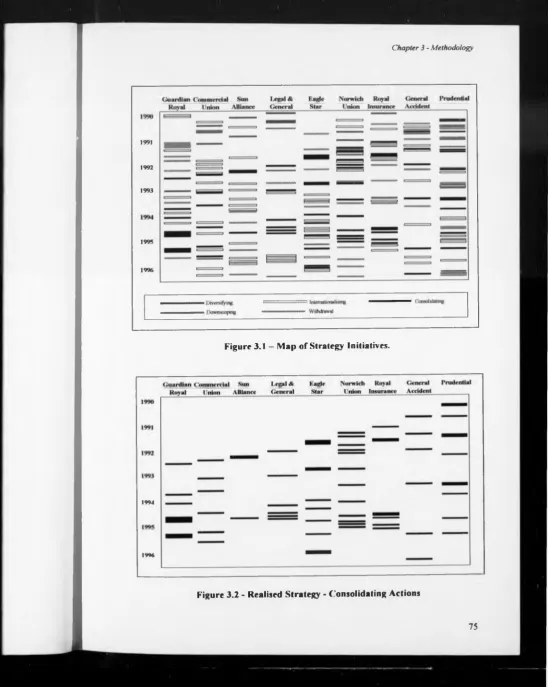
Strategy types were mapped through time for each of nine UK insurers to allow cross
industry patterns to be detected A cross-correlation analysis technique was
developed for this study which allowed the quantitative recognition o f consistent
early and late adopters of strategy The case study approach allowed the internal
micro processes and contexts of these early and late adopters o f strategy to be
investigated. The chapter provides details of this unique approach and the steps that
were taken to ensure validity
In Chapter 4 we begin our multi-level analysis of the UK insurance industry by
analysing the macro and competitive environment faced by insurers in the 1980s and
1990s We describe how this environment changed from one of protection and
collaboration to one of hypercompetition (D’Aveni 1994). We show that some firms
were able to cope with the environment better than others
Chapter 1 - Introduction
Chapter 5 focuses on the patterns o f strategy development and diffusion among our
sample of insurers. We describe how certain strategies emerged and spread to the rest
o f the sample. Through the use of the innovative cross correlation analysis we show
that certain firms were consistent early adopters of strategy, while others were
consistent late adopters.
The results o f our comparative case study analysis are described in Chapters 6, 7 and
8. Chapters 6 and 7 provide a narrative o f the significant strategic and organisational
issues within the two case study firms - Prudential and Guardian Royal Exchange.
Chapter 8, compares the two companies and describes the factors that our analysis
identified as influencing strategic agility i.e. the speed with which a firm adopts new
strategies.
The final chapter, Chapter 9, concludes this thesis Having summarised our findings
we discuss the contributions made by this research to the study of strategy. We also
comment on its limitations and suggest areas for future research to address these
limitations and to further utilise the methodology described
Chapter 2
Towards a Dynamic Perspective of the Content of Strategy
“All this is true, i f time stood still”
Francis Bacon (1561 - 1621)
Introduction
Strategy researchers have frequently distinguished been the content, process and
context of strategy (Pettigrew 1985, Mintzberg 1990 and De Witt and Meyer 1994).
This fragmentation of the strategy field has led to the development o f separate content
and process research traditions. While this has proved analytically beneficial, several
authors have argued that it ignores the fact that strategy process, content and context
are strongly interrelated Hence, focusing on any one of the three in isolation will give
only a limited view (Mintzberg 1990 and De Witt and Meyer 1994). Pettigrew (1992)
makes the same point and calls for the reintegration of research on these three
dimensions of strategy. However, for such reconciliation to occur, each stream of
thinking must develop in commensurable lines and there must be the academic
motivation to attempt such reconciliation.
Having dominated academic research on strategy during the 1970s and 1980s, interest
in the content of strategy has waned over the last decade Researchers have turned
their attention to the process o f strategy and this has led to significant progress in this
area (Mintzberg et al 1998). However, the development o f thinking on strategy
content has slowed This has led some authors to express concern that it is lagging
behind other areas of management science, including strategy process (Montgomery et
Chapter 2 - Toward a Dynamic View o f the Content o f Strategy
al 1989 and Porter 1991). Others claim that current views are inadequate to deal with
today’s competitive environment (D’Aveni 1994 and Brown and Eisenhardt 1998) It
is these concerns that form part of the subject o f this chapter
In this chapter, we first review the main streams of literature on the content of
strategy: the positioning school and the resource-based view Through this review two
critical themes become apparent. Firstly, that research on strategy content has tended
to take a highly static view based upon the notion of stable equilibria Secondly, that
this research concentrates on a single level o f analysis, i.e. the industry or the firm,
and fails to develop a multi-level view.
While some progress has been made in addressing these criticisms, comparison with
the highly dynamic views that have emerged within the strategy process literature
reveals significant conceptual and empirical gaps. In particular, with the exception of
a small and eclectic group of empirical studies, research that takes a dynamic view of
strategy across an industry is limited
Research from other streams of management thinking suggests that cross industry
patterns of strategy content will reveal important aspects of firm behaviour that are
linked to performance. This insight leads to the development o f a number of research
questions relating to such cross industry patterns which our empirical study will seek
to explore.
This chapter comprises six sections. After this brief introduction, the second section
discusses the main schools of thought within the strategy content literature - the
positioning school and the resource-based view of the firm. The third section
describes significant criticisms of these two schools o f thought. Section four explores
a small group o f studies of strategy content that address the concerns raised in section
three Section five describes three ‘alternative literatures’ - innovation diffusion,
institutionalism and contextualism - which offer important insight into the nature of
strategy content The final section, demonstrates how our research questions emerge
from this review o f the literature.
The Content of Strategy
Two fundamentally different streams of research - the positioning school (Mintzberg
1990) and the resource-based view of the firm (Wemerfelt 1984) have dominated the
strategy content literature (De Witt and Meyer 1994). The positioning school is most
closely associated with the work of Porter (1980 and 1985) and has had a significant
impact on strategic management since the 1970s In contrast, the resource-based view
is relatively new and less well developed (Grimm and Smith 1997).
The Positioning School
The positioning school emphasises the importance of the strategies themselves i.e. the
content of strategy (Mintzberg 1988 and 1994, Mintzberg et al 1998) It assumes that
the structure o f the industry in which a firm operates largely determines the firm’s
freedom to manoeuvre (De Witt and Meyer 1994, Teece et al 1997). Hence,
understanding the structure of the industry and then positioning the firm to take
advantage of the insights gained are of prime importance Management’s aim must be
Chapter 2 - Toward a Dynamic View o f the Content o f Strategy
to discover or create a defensible and sustainable position within which the firm can
generate above average profits.
Industrial Organisation Economics
The Harvard stream of industrial organisation economics has heavily influenced the
positioning school. This micro-economic perspective has its theoretical roots in
Chamberlin’s (1933) model of monopolistic competition and Robinson’s (1933)
concept o f imperfect competition. At the core of industrial organisation economics is
the structure-conduct-performance (S-C-P) paradigm (Mason 1939, Bain 1958)
In the S-C-P framework, structure refers to industry structure in terms of the number,
size and distribution o f firms in that industry, the elasticity of demand and the
existence o f barriers to entry. Conduct refers to the behaviour of firms, whilst
performance, to the industry’s performance in terms of profitability and growth in
output. Originally, a one way causation was implied with structure determining
conduct and hence industry performance Later work questioned this linearity (Scherer
1970) and suggested interdependency among the three elements of the S-C-P
paradigm
The primary aim of the early industrial organisationalists (Mason 1939 and Bain
1956) was to improve performance at an industry level by the use of public policy to
manipulate industry structure Governments were urged to counter monopoly power
by removing barriers to entry and promoting competition - thus preventing individual
firms from seeking defensible positions that exploited imperfections in competition
and thereby gaining above average profits (monopoly rents)
Strategic Positioning and Generic Strategies
From the early 1970s strategy researchers began to adopt the S-C-P paradigm
Reversing the intent of the Harvard industrial organisation theorists, it was seen as a
model which managers could use to assess competition, develop monopoly positions
and maximise profits.
Porter (1980) argued that the performance o f a firm is determined by the strength of
five structural forces - the threat of new entrants, supplier bargaining power, customer
bargaining power, the threat o f substitute products and the intensity o f rivalry among
competing firms. Firms achieve competitive advantage by adopting advantageous
positions relative to these five forces or by shaping them to their own benefit
Porter (1980 and 1985) suggests that, regardless of industry context, there are two
basic types of competitive advantage a firm can possess: low cost and differentiation.
These combine with the scope of the firm’s activities to produce “three generic
strategies for achieving above average performance: cost leadership, differentiation
and focus” (Porter 1985 and Mintzberg et al 1998).
Focusing on a single generic strategy is seen as essential to maximising firm
performance (Ketchen et al 1996). Firms that have no coherent strategy or try to
Chapter 2 - Toward a Dynamic View o f the Content o f Strategy
pursue two generic strategies simultaneously are described as ‘stuck in the middle’.
According to Porter (1985), the profitability of such firms will be below average.
The belief that there are a limited number of viable strategies is an essential feature of
the positioning school and has practical implications for firms. Senior management is
advised to target a defensible product/market position identified through a careful
industry analysis. A generic strategy that matches the conditions at hand is selected
(Hofer and Schendel 1978 and Mintzberg et al 1998) and the organisation adjusted to
deliver that strategy
Strategic Groups
The Harvard stream of industrial organisation economics asserts that industry
structure determines firm conduct and assumes that firms are homogeneous in all
respects but size (Cool and Schendel 1988). This suggests that there will be one
optimal strategy that all firms in an industry will adopt (McGee et al 1995) However,
empirical studies show that groups of firms cluster around different strategies or
positions on a range of strategic dimensions (Porter 1980, McGee and Thomas 1986
and Cool and Schendel 1988) These industry sub-groupings are termed strategic
groups (Hunt 1972/Fiegenbaum and Thomas 1990).
Caves and Porter (1977) suggested that strategic groups are formed partly as a result
o f variations within the industry structure and partly as a result of similar investment
decisions made by firms in the past. Mobility barriers, a ‘downsized version of entry
barriers’ (Mintzberg et al 1998), were seen as impeding firms from freely changing
their competitive positions and changing groups (Cool and Schendel 1988).
Porter (1979 and 1980) argued that firm profitability depends on the structure o f the
group in which the firm operates The higher the inter-industry mobility barriers and
the lower the degree of rivalry between group members the lesser competition and the
greater the opportunity to generate higher than average profits. However, group
structure does not replace industry structure. Rather it defines segments within an
industry (Caves and Porter 1977).
Empirical Evidence
The cross sectional and quantitative analysis o f questionnaire surveys or existing data
bases (e g. PIMS) have dominated empirical work on generic strategies. Typically
such analyses have used either single or multi variable linear regression analysis
(Ginsberg and Venkatraman 1985) to propose generalisations and imply causation
(Aharoni 1993).
Using the typologies proposed by Porter and others (e g. Henderson 1979, Hambrick
1983 and Miller and Friesen 1986) researchers have attempted to find the optimal
match between generic strategy and environmental conditions (Hambrick 1983, Kim
and Lim 1988 and Kumar and Subramanian 1997). Others have sought to determine
the effect of strategy type on financial performance, and the influence of intermediate
variables such as organisational structure (e g. Miller 1988 and 1992).
Chapter 2 - Toward a Dynamic View o f the Content o f Strategy
Opinion as to the success o f this research is varied. Ketchen et al (1996), Miller and
Dess (1993) and Mehra (1996) suggest that strategy content research has been unable
to establish a clearly defined relationship between strategy and performance Ginsberg
and Venkatraman (1985) on the other hand state that research relating strategy to firm
performance has been consistent and significant when studies have used industry
structure and environmental factors as contingent variables However, similar studies
where the link between performance and strategy is contingent on organisational
variables have produced inconsistent findings.
Research on strategic groups has concentrated on identifying clusters of firms within
an industry or on attempting to prove the relationship between group conduct or the
height of mobility barriers, and firm performance (Day et al 1995 and Dranoe et al
1998). Strategic groups are identified either by using a simplistic manual inspection of
key attributes or by cluster analysis based on existing data bases (e g. COMPUSTAT)
(McKee et al 1995 and Day et al 1995). However, the results from this research have
been mixed (Dranove et al 1998) - leading some to question whether there is a link
between strategic groups and firm performance or even to doubt the existence of
strategic groups (Barney and Hoskisson 1990 and Peteraf and Shanley 1997).
How much does Industry Structure Matter?
The Harvard approach to industrial organisation economics asserts that industry
structure determines firm performance Other industrial organisation researchers do
not share this view. The Chicago School was particularly critical o f the notion of
it is the efficient exploitation of heterogeneous and immobile resources at the firm
level that generates above average profits (Jacobson et al 1996).
The conflicting views on the importance o f industry and firm factors have led a
number of researchers to ask ‘how much does industry matter?’ (Rumelt 1991).
Conflicting results have emerged Schmalensee (1985) showed that 75% of the
variance in industry rates of return was due to industry influences, while firm level
factors had negligible impact In contrast, Rumelt (1991) and Roquebert et al (1996)
indicate that industry level influences were responsible for only 10% o f differences in
firm performance, while firm level factors accounted for around 50% of such
variance.
Responding to Rumelt’s (1991) findings McGahan and Porter (1997) used a more
sophisticated statistical approach (Mintzberg et al 1998) to address this issue. They
found that industry level influences accounted for 19% of variation in firm
performance However, differences due to firm level factors were more significant,
accounting for 36%.
In the light of Rumelt’s (1991) findings, McWilliams and Smart (1993) suggest that
the positioning school misdirects managers to expend resources on influencing
industry structure because the firm’s performance will not be greatly affected by the
changes that result. Black and Boal (1994) argue that strategy should primarily be
concerned with firm level factors rather than seeking industry level positions Such an
internal focus is adopted by the resource-based view of the firm
Chapter 2 - Toward a Dynamic View o f the Content o f Strategy
The Resource-based View o f the Firm
Like the positioning school, the resource-based view also has its origins in economics
and Penrose’s (1959) characterisation of the firm as a collection o f productive
resources is widely acknowledged (Peteraf 1993 and Foss et al 1995). It also has
affinity with the Chicago School of industrial organisation economics (Conner 1991).
Building on Penrose’s insight, Wemerfelt (1984) argues that the fundamental
determinant of a firm’s performance is the distinctive resources it controls. These
resources could be physical assets, capabilities, information, knowledge or other
assets. To be strategically relevant they must be rare, inimitable, and non-substitutable
and have a high utility (Barney 1991). Barney (1991) highlights the problems o f
resource inimitability and this has led many researchers to consider intangible
resources or bundles o f resources as the source of sustainable competitive advantage.
The pattern and quality of the bundle of resources controlled by each firm will vary
Imperfections in the market for such resources will restrict their mobility and hence,
differences between firms will persist (Barney 1986 and Peteraf 1993). Hence, the
possession of scarce and valuable assets will be the source of sustainable competitive
advantage, allowing firms to earn above average profits (scarcity rents).
While the resource-based view is primarily concerned with firm level factors, there
has been some attempt to integrate the key aspects of industrial organisation
economics (Grimm and Smith 1997) Peteraf (1993) provides an example She
suggests that there are four cornerstones of competitive advantage Two, the
heterogeneity of resources and the imperfect mobility o f key resources, both well
developed in the work of Barney (1991) and Wernerfelt (1984), are at the firm level
The other two are industry level cornerstones - ‘ex ante limits to competition’ and ‘ex
post limits to competition’. In essence, on their own valuable resources cannot
generate above average profits, it is only through their interplay with market forces
that their value is released (Collis and Montgomery 1995 and Russo and Fouts 1997).
The resource-based view sees strategy making in terms of senior management
rationally identifying and exploiting the firm’s resources and capabilities to gain
competitive advantage. Content o f strategy is therefore the unique collection of
valuable resources that senior management identify and deploy rather than a set of
product-market positions (Wemerfelt 1984, Barney 1986 and Teece et al 1997).
The resource-based view of strategy is relatively young and its theoretical approach is
yet to be fully developed (Black and Boal 1994 and Peteraf 1993). Foss et al (1995)
argue that as a result researchers are unable to identify a priori what resources or
bundle of resources might lead to competitive advantage
Firm Heterogeneity and Strategic (7roups
The assumption that resource bundles, and therefore firms, are heterogeneous is at the
heart of the resource-based view o f the firm. However, as we have seen other research
has noted the presence of strategic groups within an industry, the members of which
pursue similar strategies (Caves and Porter 1977) Despite the apparent contradiction a
Chapter 2 - Toward a Dynamic View o f the Content o f Strategy
number o f researchers have adopted the resource-based view in defining strategic
groups (Mehra 1993 and McGee and Thomas 1985).
Amit and Schoemaker (1993) provide an answer to this apparent contradiction. They
suggest that there are two types of valuable resources - ‘strategic industry resources’
and ‘firm idiosyncratic resources’ Firms that possess similar configurations of
strategic industry resources can constitute a strategic group (Mehra 1993). Cool and
Schendel (1987 and 1988) suggest that whilst in total a firm’s bundle of valuable
resources may be unique, components of that bundle will be found across a strategic
group. However, while strategies may be similar, firm performance will vary across
the group due to firm idiosyncratic resources (ibid).
Empirical Evidence
Empirical research relating to the resource-based view has concentrated on
determining what features identify strategically valuable resources (Barney 1986 and
Maijoor and Witteloostuijn 1996). Such work has typically employed cross sectional
analysis to identify resources or clusters of resources associated with above average
firm profitability. However, due to the often intangible nature of the resources being
studied and a wide variation in the definitions and statistical methods used, empirical
results are mixed (Rouse and Daellenbach 1999). Beyond stating that resources and
combinations of resources can confer a competitive advantage, evidence for the
resource-based view of the firm remains largely theoretical (Pettigrew et al 1999).
Criticisms of Strategy Content Research
The positioning approach to strategy has come under significant criticism since the
1980s. Typically the positioning school has been grouped with the earlier planning
and design schools (Mintzberg 1990) and variously described as being ‘prescriptive’
(Mintzberg 1990), linear (Chaffee 1985) or economically rational (Knights and
Morgan 1991). Similar comments have been made about the resource-based view
(Conner 1991 and Oliver 1997). Often the perspective is then used as a ‘straw man’
against which to extol the virtues of an alternative approach.
Much o f the criticism relates to the adoption by both the positioning school and
resource-based view o f ideas stemming from the planning school. In particular, the de
coupling of strategy making from strategy implementation has been widely criticised,
as has the notion that senior management, armed with the necessary information and
analysis, rationally and deliberately select the appropriate strategy to pursue
(Pettigrew 1985 and Mintzberg and Waters 1985).
However, critics have also raised two particular conceptual and empirical concerns
that relate directly to the content of strategy Firstly, that research on strategy content
focuses unduly on either firm or industry factors rather than taking a multi-level view
(Mintzberg et al 1998 and Pettigrew 1985) Secondly, that both the positioning school
and the resource-based view promote a static view of the firm and its environment
(Jacobson 1992, Grimm and Smith 1997 and Mintzberg et al 1998) This static view is
amplified by the research methods utilised
Chapter 2 - Toward a Dynamic View o f the Content o f Strategy
Single and Multi Levels of Analysis
Strategy content, for the positioning school, is a defensible position defined by
competitive forces at the industry and strategic group level. In its quest to investigate
industry structure and define generic strategies, this stream of research, as we have
seen, has tended to ignore firm level and macro environment factors (Pettigrew 1985
and Mintzberg et al 1998).
The resource-based view is perhaps equally guilty o f taking a blinkered view
Emphasis is heavily on firm level factors, often to the exclusion of industry effects
and certainly macro environmental issues. While firm level differences contribute
most significantly to performance, industry level factors are not without influence.
With the rise of the resource-based view in the 1990s, the internal focus has become
dominant. This has led some authors to suggest a more balanced view is needed
(Mintzberg et al 1998). Through the work of Peteraf (1993), Mehra (1996) and others
such a view has begun to emerge.
Static Views of Strategy Content
Central to neo classical economics and intrinsic to both the positioning school and the
resource-based view o f the firm is the notion that a firm is in a state of equilibrium,
i.e. the economic forces acting on it are exactly balanced. Small displacements away
from this equilibrium are self corrected and a state o f balance restored (Bettis and
Prahalad 1995). Hence, there is no tendency for the firm to change Different
defensible positions, generic strategies or bundles of resources reflect alternative
equilibrium states.
The implicit assumption of much o f the strategy content research is that management
rationally identifies a new and more attractive equilibrium position as a result of
extensive analysis. The organisation will then be swiftly moved to this new position.
This shift will be ‘step like’ or quantum.
Over the last decade the notion of long periods of environmental stability has been
challenged (D’Aveni 1994 and Brown and Eisenhardt 1998). Increasing globalisation,
deregulation and blurring industry boundaries have led many researchers to envisage
continuously changing and chaotic markets (Kanter et al 1992, D’Aveni 1994, Brown
and Eisenhardt 1998). In responding to the chaos, organisational change is seen as
‘continuous and never discrete, fragmented or broken’ (Sztompka 1993).
Strategy process researchers have responded to the demands o f this new environment
by adopting more adaptive models that stress flexibility and change (Chaffee 1985 and
D’Aveni 1994). However, it is apparent that thinking on strategy content has been
slow to take a similar step (D’Aveni 1994 and Webb and Pettigrew 1999).
The static natures of the positioning school and the resource-based view have been the
subject of extensive criticism (Pettigrew 1992, Mintzberg 1994 and Grimm and Smith
1997) The failure to address how organisations create and develop market positions
or resources over time receives particular attention (Fiegenbaum et al 1990, Black and
Chapter 2 - Toward a Dynamic View o f the Content o f Strategy
Boal 1994, Peteraf and Shanley 1997 and Lieberman and Montgomery 1998).
Recently, researchers from both schools have begun to recognise these concerns.
Developments in the Positioning School
A number o f writers from the positioning school have urged their colleagues to take
more dynamic perspectives (Porter 1991, Bogner and Thomas 1993 and McGee et al
1995). However, very few researchers from this school have taken up this challenge
Fiegenbaum et al (1990) McGee et al (1995) do suggest a more dynamic view,
proposing a punctuated equilibrium model o f strategic groups. Stable periods where
the membership o f a group and the strategies pursued are invariant are interrupted by
periods of disturbance during which there is change in both group membership and
strategy. Fiegenbaum et al (1990) and McGee et al (1995) urge researchers to identify
strategic groups during periods of stability and investigate subsequent change. They
identify a small number of studies that take this approach
Developments in the Resource-based View
Researchers have begun to recognise that in a dynamic environment any advantage
provided by an unchanging bundle of resources will be dissipated or bypassed as
competitors imitate or find alternatives (Benasko et al 1996). Hence, firms must
continuously adapt and renew their strategically valuable resources. This realisation
has led a number of writers (Foss et al 1995, Levinthal 1995 and Chang 1996) to
suggest that evolutionary economics (Nelson and Winter 1982) could be used to
provide a dynamic perspective of the resource-based view.
Foss et al (1995) suggests that such an amalgam was evident in Penrose’s work but
was ignored by early resource-based view theorists An evolutionary view implies that
a bundle of resources will evolve over time through a continuing process of variation,
selection and retention within the firm (Levinthal 1995).
Teece et al (1997) also stress the importance of adapting to a changing environment
They suggest that firms must have the ability - which they refer to as dynamic
capability - to adapt, integrate and reconfigure skills and resources in response to
change. A similar dynamic perspective is evident in Prahalad and Hamel’s (1990)
construct o f core competencies. Here core competencies relate to both tangible assets
and less tangible resources such as organisational learning and knowledge
The development o f an evolutionary approach to the resource-based view suggests
that strategy content will comprise continually changing bundles of firm level
resources Although this approach focuses narrowly on the firm, it does provide a
highly dynamic view of strategy content However, it is in its infancy (Teece et al
1997) and little empirical testing has taken place
Empirical Limitations
The bias towards a static view of strategy content has been partly driven by the
methodologies adopted. The use of cross sectional analysis at single points in time
Chapter 2 - Toward a Dynamic View o f the Content o f Strategy
dominates empirical work (Huber and Van de Ven 1995 and Rouse and Daellenbach
1999). Researchers aim to uncover statistical correlation between various sets of
variables and imply generalisations o f causality.
While such an approach will have a place during stable conditions it will fail to detect
change (Delacroix and Swaminathan 1991 and Tuma and Hannan 1984). This is a
significant problem when continuous change in the firm and its environment is
envisaged.
As criticism has grown of this static orientation, some researchers have begun to adopt
longitudinal research methods. Typically, cross sectional analyses are repeated at
several discrete points in time and the differences between each time point used to
demonstrate change However, this approach may assume that equilibrium has been
reached at the points at which variables were sampled. Quantum change between
states o f equilibrium occurs sometime between the sample points (Meyer et al 1993
and Colemen 1981). Thus, a quantum or punctuated equilibrium model of change is
implied by the method used, though not necessarily by the data.
Various researchers have suggested that methods that are more dynamic should be
applied to strategy content research (Russo and Fouts 1997 and Rouse and
Daellenbach 1999). Quantitative methods, such as event history analysis (Tuma and
Hannan 1984), and qualitative approaches, including case studies and interview
programs (Rouse and Daellenbach 1999) have been proposed. However, the
application of such approaches to strategy content research is still rare (Van de Ven
and Huber 1995).
Summary
Two critical themes of the research on the content of strategy have been discussed.
The first highlights that both the positioning school and the resource-based view focus
on a single level o f analysis.
From a positioning perspective strategy content is a defensible position within the
structure o f the industry in which it operates While sub-structures are revealed
through work on strategic groups, the emphasis is on industry level attributes often to
the exclusion of firm and macro environmental factors
The central tenet of the resource-based view is that firm level factors determine
performance. Industry and macro environmental factors have largely been ignored.
However, there has been some attempt to introduce industry level effects into the
resource-based view. Peteraf (1993) offers a model that includes both firm and
industry level factors and various researchers have attempted to use firm level
resources to define strategic groups (Mehra 1993 and Cool and Schendel 1988).
The second critical theme addresses the static nature of the positioning school and
resource-based view. The static nature o f these constructs is inherited from the
economic traditions upon which the two approaches are based. Central to neo-classical
economics is the notion of stable equilibria, which implies little or no change.
Consequently, little attention is paid to how strategies emerge and develop over time
Assumptions of economic rationality and a linear view o f the strategy process imply
that a firm’s management identify new and attractive markets or resource positions
Chapter 2 - Toward a Dynamic View o f the Content o f Strategy
and then quickly shift the organisation to a new position Change, if it occurs, is
quantum or ‘step like’ and possibly unproblematic
Authors in both content schools (Porter 1991 and Foss et al 1995) have called for the
development of more dynamic perspectives. Within the positioning school, there has
been some response from strategic group researchers by way of the adoption o f a
punctuated equilibrium model (Fiegenbaum et al 1990, McGee et al 1995).
A dynamic view o f strategy has recently emerged in the resource-based view
Evolutionary or adaptive views are taken o f a firm and its resources to develop
concepts such as core competencies (Prahalad and Hamel 1990) or dynamic
capabilities (Teece et al 1997). Despite the growing popularity o f these concepts, they
are still in their infancy and empirical work is limited
The adoption o f more dynamic research has been hindered by the research methods
commonly utilised. Cross sectional methods with data collected from a single point in
time dominate research on strategy content. These methodologies are biased towards a
static perspective.
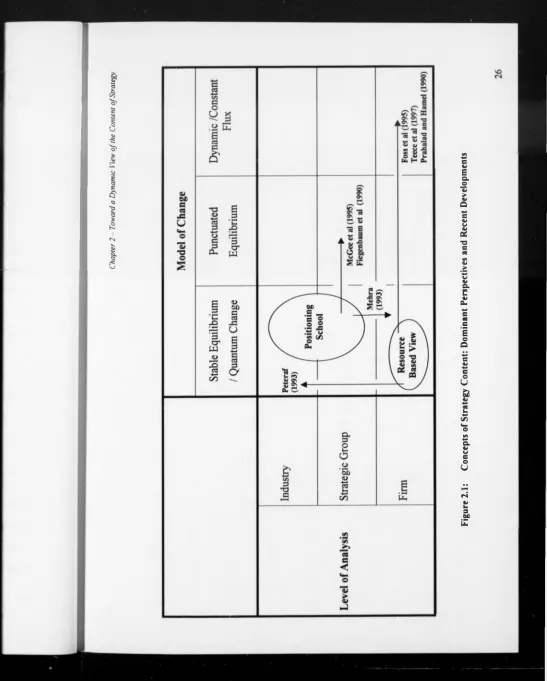
The main areas o f strategy content research together with recent developments have
been mapped in relation to the two critical themes (Figure 1). This schematic
representation o f the literature demonstrates the lack o f research that takes a dynamic
view, particularly at the industry level. The diagram also highlights the lack o f multi
level research; i.e. that covers both firm and industry factors.
Chapter 2 - Toward a Dynamic View o f the Content o f Strategy
Dynamic Studies of Strategy Content
In addition to the mainstream content research, there is a small and eclectic group of
empirical studies that have taken a dynamic view o f the content o f strategy while
pursuing wider research issues. Notably, these studies have used methodological
approaches that attempt to maintain a dynamic perspective. We will review four
studies that take a multi-level view
The prime thrust of Miller and Friesen’s (1984) quantum view is on organisational
and strategic configurations However, this study is augmented by their ‘transition
survey’. This survey aims to identify common evolutionary patterns or sequences that
characterise periods of change (which they refer to as transition periods). While this
view is similar to the punctuated equilibrium model o f change, Miller and Friesen
(1984) concentrate on the transition periods during which continuous and major
change is apparent.
Given the study’s goal o f identifying generalisable types of organisational adaptation
(ibid) a longitudinal methodology that incorporated a broad sample of firms was
required. Miller and Friesen (1984) suggest that the ‘only manageable way to do this’
was through the use o f ‘detailed published organisational histories in the form of
books’. Histories were compiled for 36 firms covering a 20-year period and, from
these, transition periods were identified The reliability o f the histories obtained was
checked using questionnaires sent to the chief executives of 12 of the firms
Twenty-four variables were coded at the beginning and end o f each transition period
and a ‘transition score’ for each variable obtained by taking the difference in each
case Six significant transition archetypes were then identified using a cluster analysis
of the scores.
Miller and Friesen’s (1984) study is mainly concerned with organisational variables,
e g centralisation and delegation, and strategy making However a few of the
variables relate to strategy content, e g differentiation and product-market innovation,
and it is implied that during transition periods strategy content is in a state o f flux
The transition survey has several strengths In particular it utilises an effective and, at
the time novel way o f investigating large samples of firms over long time periods.
However, it also has a number of weaknesses The reliance on books to create
organisational histories restricts the number o f firms that can be studied and it limits
the accuracy of the timing o f change events to, at best, the year in which they
occurred. A further weakness is the use of difference scores to characterise transition
periods. In effect having carefully collected data over a continuous time period, the
temporal component o f this data is removed by the coding and scoring process
Smith, Grimm and colleagues (Grimm and Smith 1997, Smith et al 1989,1991 and
1992) conducted a series of six investigations that take a dynamic view of strategy
content. These studies are based on an action-reaction model developed by action
theorists (Parson 1937/Grimm and Smith 1997)
Chapter 2 - Toward a Dynamic View o f the Content o f Strategy
This model holds that strategic actions taken by a firm to improve or defend its
competitive position are countered by reactions by competitors Any competitive
advantage gained is temporary and dependent on the time taken for competitors to
respond (Smith et al 1992). Speed of response is linked to an organisation’s ability to
learn and a set of organisational variables: external orientation, structural complexity,
organisational slack and management experience (ibid). Later work (Smith et al 1997)
adopts a resource-based view, linking speed of response to tangible and intangible
firm resources.
O f the six studies, five targeted individual industries while the sixth investigated pairs
of industry leaders and challengers in 41 industries Methodologies varied between the
studies Two were based on field interviews and questionnaires In the other four
investigations archival studies of industry publications and/or national newspapers
were utilised. Key word searches were used to identify responses, which were then
linked to an initial action (Smith et al 1992).
Regression and correlation analyses related firm performance to average response
time and firm order of response, and linked speed o f response to organisational
variables.
The approach taken by Smith and Grimm suggests a highly dynamic view of strategy
content. In addition, it links industry level patterns of strategy content to firm level
factors that explain the phenomena observed. While this must be applauded, there are
a number of concerns.