25-6-2018
Exceptions to the
code of the street:
Circumstances
that legitimize
snitching
Name:
Annemijn Ijzer
First supervisor:
R. Geurts
Second supervisor:
S. Oleszkiewicz
Table of contents
Abstract 3
Abstract (Dutch) 4
Introduction 5
Circumstances that may legitimize snitching 6
The difference between judging oneself and someone else 8
The present study 9
Method 10
Participants 10
Design 11
Materials 11
Procedure 13
Data-analysis 13
Results 14
The influence of the different circumstances on acceptability 14
The influence of payment on acceptability 16
The influence of condition on acceptability 16
Exploratory analyses 16
Discussion 17
Limitations and strong points 21
Recommendations 21
Conclusion 22
References 23
Abstract
According to the ‘Code of the street’, one should never snitch on someone else. Therefore, snitches often have to face retribution from the criminal community. Up until now, this no-snitching code has been perceived as a very strict norm. This study attempted to demonstrate that the no-snitching norm is in fact more nuanced than it may seem, by investigating
Abstract (Dutch)
Volgens de ‘Code of the street’ mag iemand nooit de politie informeren over de criminele activiteiten van een ander (klikken). Hierdoor krijgen criminele informanten vaak te maken met wraak vanuit de criminele gemeenschap. Tot nu toe werd deze Code of the street gezien als een strikte norm. Dit onderzoek poogde te demonstreren dat de niet-klikken norm echter genuanceerder is dan deze lijkt, door omstandigheden te onderzoeken die wellicht een invloed hebben op de perceptie van klikken. Tevens is het verschil tussen groepsnormen en
Introduction
Criminal informants can be useful to the police, especially when it comes to finding the perpetrators of crimes that have no obvious victims (e.g. fraud; Greer, 1995) and drug-related crimes (Miller, 2011). Revealing incriminating information about criminals to the police is called “snitching” or “ratting” (Rosenfeld, Jacobs & Wright, 2003). This can be information about past events, but the snitch can also provide information about planned events that might occur in the future (Natapoff, 2004).
It is hard to define what behavior should be classified as snitching. The broadest definition includes criminals that reveal information about others, witnesses that testify in court, and community members who call the police about illegal activity in their neighborhood (Clampet-Lundquist, Carr & Kefalas, 2015). Snitching by the latter is perceived differently than snitching by criminals. Criminals noted that conventional people do not have to follow the same rules and therefore do not have to face as severe retaliations as criminals do (Clampet-Lundquist et al., 2015). The various types of snitches differ greatly, which is why this research defines a snitch as someone who informs on a criminal (from here on: the subject). Snitches can be criminals that were arrested for their crimes, and that subsequently are pressured by the police to inform on others. It is also possible to be an ‘active snitch’: someone that gives up information on others with little or no duress, for example to take out rivals (Rosenfeld et al., 2003).
Snitching has some advantages for the snitcher, as he or she can be rewarded for the information they shared. In exchange for information about other suspects (e.g. naming accomplices or others that are involved in a gang) they could be rewarded with a reduced sentence or even no sentence at all (Natapoff, 2009). Although the rewards differ per country, possible benefits could also include preferential treatment, lenience for someone else, a flat fee or a percentage of the take in a deal (Natapoff, 2004). Although prohibited in some
countries, snitches can also be rewarded with toleration of unlawful actions, such as probation violations and street-level dealing (Miller, 2011).
Rosenfeld et al., (2003) found that criminals condemn snitching, and mostly active snitching. This is largely due to the fact that snitching is considered selfish, as it is betraying the trust of another for one’s own gain (Asbury, 2011).
Talking to the police, and thus going against the Code of the Street, is accompanied by the risk of revenge from fellow criminals. These risks are fueled by the fact that informant deals are often not completely secret, as parts are transparent and public. Additionally, the possibility exists that the informant is asked to testify in court (Natapoff, 2004). When other gang members find out that someone has snitched, violence is often used to achieve
retribution (Woldoff & Weiss, 2010).This punishes the snitch, while also ensuring loyalty from others by showing them what the possible consequences of snitching are (Natapoff, 2004).
Rosenfeld et al. (2003) interviewed criminals about their snitching habits. Their findings reveal an inconsistency: Most of the interviewees claimed to never have been involved with the police, yet they also indicated that almost all other people snitch. This inconsistency may be partly due to the fact that most offenders conceal or deny their involvement in snitching activities in fear of losing face (Rosenfeld et al., 2003). Another explanation may be that people feel the need to explain away snitching, as it is against the norms in their community (Topalli, 2005). This implies that snitching may be legitimate under certain circumstances. If these circumstances are indeed correct, this would suggest that informants might not always see their behavior as snitching and think that their behavior is acceptable. It could be that snitching under the right circumstances is less frowned upon. This claim is supported by the fact that snitches interviewed by Rosenfeld et al. (2003) initially stated that they had never snitched. However, when asked follow-up questions, they indicated that they had snitched but found their own behavior acceptable. This further supports that there may be practical exceptions to the Code of the Silence. The question would then be: what are the accepted circumstances? The aim of this study is to identify and test these circumstances, in order to find if snitching indeed becomes more acceptable if they apply.
Circumstances that may legitimize snitching
some of their respondents were willing to call the police if someone close to them was in immediate danger. Another form of higher loyalty is snitching on someone when it is thought that this will be beneficial for the whole group (e.g. group of inmates or a gang) when the actions of a subject would put the group at risk (Akerström, 1989). In these two cases, snitching can be legitimized by saying that it protected something more important.
Another circumstance that may make snitching acceptable is ‘Denial of a victim’. This occurs when a person feels that the subject they are informing on deserved to be punished (Rosenfeld et al., 2003). If others are successful, the desire can arise to bring them down (Jacobs, 2002). Snitching is thus used as a means to punish people that the snitch wants to get rid of, like competitive rivals (Rosenfeld et al., 2003). This may deem snitching
acceptable, as it comes from a position of strength (Rosenfeld et al., 2003). It conveys the message that the snitch should not be messed with. Instead of snitching, such behavior may be perceived as solely protecting one’s rank.
Reciprocity may justify snitching as well. This means snitching is deemed acceptable if the subject snitched on the snitch first (Topalli, 2005), as this makes snitching payback.
The Severity of the concerned crime could also make snitching more acceptable. Criminals are more willing to call the police when a subject has done something more severe, such as murder, rape, domestic violence or harm to young children (Rosenfeld et al., 2003; Clampet-Lundquist et al., 2015), implying that the type of a crime can justify snitching. Clampet-Lundquist et al. (2015) found that in such cases the motivation of the snitch is of value. With serious crimes, the police are called to protect the victim, which makes it more acceptable. With less serious crimes (e.g. selling drugs), the police are called in order to rat on the criminal, which is not acceptable.
When it is possible to deny injury, this may legitimize snitching. ‘Denial of injury’ means that the consequences of the given information are played down, for example by claiming that the police had enough information on the subject to begin with (Akerström, 1989). According to criminals, it is not that bad to get a sentence reduced by giving
information that the police already knew (Akerström, 1989). Topalli (2005) and Rosenfeld et al. (2003) found that criminals justified snitching by giving the police misleading or false information, as this would not help their investigation. Hunt, Riegel, Morales and Waldorf (1993) speak of dry snitching when information is supplied without sharing names. If
Aside from denying injury, one may also deny responsibility. ‘Denial of
Responsibility’ means that the behavior was due to forces not within the control of the person (McCabe, 1992; Akerström, 1989). A snitch may deny responsibility by saying that the police pressured them and they had no choice but to snitch. Topalli (2005) found that criminals talk about said pressure in a way that makes them still seem tough.
Another potentially relevant circumstance is being a member of the outgroup.
Snitching seems to be more acceptable when the snitch does not belong to the same group as the subject (Woldoff & Weiss, 2010). If a person does not betray one of their own, they might be seen as merely doing their duty to the community. Topalli (2005) spoke to a
criminal that made a distinction between ingroup and outgroup, stating that it was acceptable to snitch on the latter. Also, Akerström (1989) found that defining oneself as a nonmember of the group makes the snitching label not applicable.
Payment is a final factor that may influence how acceptable snitching is. Payment is used by the police to reward snitches and persuade them to snitch. Thus, informing seems to be lucrative for snitches, as they can be awarded by the police with a good sum of money for it (Curriden, 1991). However, payment might not be so lucrative at all. After all, receiving payment would mean that the criminal would betray his peers for personal gain. This could mean that others find it less acceptable to snitch if payment is a motive.
The difference between judging oneself and someone else
In practice, it might be more relevant to focus on group norms as opposed to individual norms. It is, after all, the group that a snitch has to face retribution from. If the snitch feels the group accepts their behavior, they might be more inclined to work with the police because they perceive snitching as relatively safe. Therefore, it is relevant to
investigate how these two different norms differ.
Additionally, availability heuristic may be of relevance. People estimate the likelihood of the occurrence of an event with how easy associations and examples come to mind
(Schwarz et al., 1991). As part of the self-serving bias, people externalize their own faults and failures and internalize their strengths and weaknesses, in order to enhance their self-esteem (Forsyth, 2008). As they internalize said strengths, they become more available than their externalized weaknesses. Snitching is often perceived as bad behavior and is thus
externalized. Therefore, examples of similar behavior do not come to mind easy, so people feel that they are unlikely to snitch. If they subsequently do end up snitching, they will likely feel that the chances of this happening were small, so circumstance must have had a role in them snitching anyway. Thus, the influence of circumstance when judging oneself might be perceived as relatively large.
Both the fundamental attribution error and availability heuristic contribute to a difference in standards that are used to judge the behavior of others as compared to the behavior of oneself.
The present study
While other studies have identified circumstances that potentially make snitching more acceptable, most of these circumstances were found using qualitative methods. The added value of this research is that it quantifies said circumstances, and tests how relevant they are when judging the acceptability of snitching behavior. This study also aims to find out whether or not there is a difference between how people judge other snitches and how they judge their own snitching behavior.
The aim of this study was to identify and test factors that potentially affect the acceptance of snitching. The corresponding research question is as follows: ‘Under which circumstances is snitching more or less acceptable?’. To find an answer to this question, the following hypotheses were tested. These hypotheses correspond with the previously identified factors that potentially have an influence.
H1: Snitching is significantly more acceptable if the snitch has a higher loyalty. H2: Snitching is significantly more acceptable if denial of a victim is possible. H3: Snitching is significantly more acceptable if it is for reciprocity.
H7: Snitching is significantly more acceptable when denial of responsibility is possible.
H8: Snitching is significantly less acceptable when payment is involved as compared to when no payment is involved.
Additionally, it was found that people judge the behavior of others in a different way than they judge their own behavior. This could also specifically apply to snitching behavior. The corresponding research question is as follows: ‘Do people use more lenient standards when it concerns themselves compared to others?’. To answer this question, a hypothesis was tested:
H9: People find their own snitching behavior significantly more acceptable than the snitching behavior of others.
Method
Participants
The participants were selected through opportunity sampling. The participants were recruited through the SONA-system of the University of Twente, making the study accessible to all psychology students at the University. Participants were also recruited through the Facebook page of the researcher. In total, 145 participants took part in this study. The data of eight of the participants were unusable, as they reported that their English proficiency was below average. Thus, the data of 137 participants was used.
do not think this is okay, so you decide to call the police and tell them what you saw. Also, you received a good payment in exchange for the information. How acceptable do you find your own behavior?’ if this payment variable is added. This was done to test how payment affects the acceptability of a particular circumstance, as it is expected that payment lowers the effect on acceptability of a circumstance. The study was presented to and approved by the BMS Ethics Committee of the University of Twente.
Design
To examine the first research question, this study used a within-subjects design, as each participant had to rate every scenario. The independent variables for this research question are the circumstances that are the subjects of the different scenarios (e.g. ‘presence of a higher loyalty’), the dependent variable is the acceptability of the snitching behavior.
To examine the second research question, this study used a between-subjects design, as participants were split into two different conditions.The independent variable for this research question is the condition (judge someone else; judge yourself), the dependent variable is the acceptability of the snitching behavior.
Materials
A questionnaire (including scenario’s) was developed by the researcher for the purpose of this study. The questionnaire was distributed using Qualtrics software.
Baseline attitude towards snitching. To measure the participants’ general attitude towards snitching (the baseline) a question on this topic was added, in which participants had to rate how acceptable they find it for a criminal to snitch on another criminal, using a seven-point Likert scale (1 = Very unacceptable; 7 = Very acceptable). This was always the first question that participants had to answer.
commits petty crimes, like street level dealing. A fellow street criminal confesses to you that he has sold drugs to high school kids. You feel like his behavior goes too far, so you tell the police about it. How acceptable do you find your own behavior?’, (ii) ‘You are a thief. You find out that a fellow thief has repeatedly abused his wife and kids. This is something you do not approve of, so you call the police to tell them about this. How acceptable do you find your own behavior?’, (iii) ‘While dealing drugs, you see that someone is trying to rape a girl in an alley you pass. You do not think this is okay, so you decide to call the police and tell them what you saw. How acceptable do you find your own behavior?’. In total, each participant rated 21 scenarios.
The scenarios were phrased slightly different in the two conditions, in order to test the difference between how people judge others (group norms), and how people judge themselves (individual norms). Participants in the judge others condition had to judge scenarios in which a random criminal cooperated with the police (The informant…), while participants in the
judge self condition had to judge scenarios in which they themselves (hypothetically) were the criminal that cooperated with the police (You…). See the appendix for the complete list of scenario items. Denial of injury had a Cronbach’s alpha of .30, and being outgroup had a Cronbach’s alpha of .58. The Cronbach’s alphas for the other circumstances were .64, .65, .66, .71 and .80.
Ethics Position Questionnaire. Three questions from the Ethics Position Questionnaire (Forsyth, 1980) were added. This questionnaire measures individual
differences in moral thought, by presenting statements to participants. Participants had to rate how much they agree with these statements using a seven-point Likert scale (1 = Strongly disagree; 7 = Strongly agree). The statements used in this study were: ‘Whether a lie is permissible or not totally depends on the situation.’, ‘If an action could harm an innocent other, then it should never be done.’ and ‘What is ethical varies form one situation and society to another.’. These questions measure if someone is more an ‘idealist’ or a
‘relativist’. The questions were added to measure how one’s ethics influence how acceptable they find snitching with an excuse.
Demographics. The first questions the participants had to answer were about their neighborhoods. For both the neighborhood they grew up in and the neighborhood they currently live in, they had to rate 1) how much criminal activity there was/is in said
were designed to measure if there is a correlation between the characteristics of the
participant’s neighborhood and the participant’s attitude towards snitching. Participants also had to answer other demographic questions about their age, gender and education level.
Procedure
An online questionnaire was used to collect the data for this study. Before starting the questionnaire, participants were informed what the study was about. They were told that they would be participating in a study on snitching.
When starting the study, participants were shown an informed consent. They were told that their data would solely be used for scientific purposes and that the data would be stored anonymously and handled confidently. By clicking a bullet point and continuing, participants declared that they understood the informed consent and that they participated voluntarily.
Participants were randomly assigned to one of two conditions. Only the scenarios differed between the conditions. All the other questions were the same for all participants.
Filling out the questionnaire took participants generally 10-20 minutes. After they completed the questionnaire, the participants were shown a screen containing a written debriefing. This debriefing explained the topic of the study, the research questions and the two different conditions. After this, the participants were thanked for their participation and provided with the contact details of the researcher for further questions.
Data-analysis
the analysis, the random factors, ‘payment’ and ‘circumstance’ were used, and the fixed factor ‘intercept’ was used.
Results
The influence of the different circumstances on acceptability
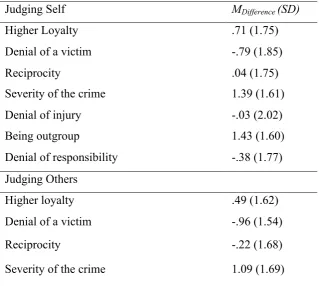
A repeated measures ANOVA was conducted to test the effect of the different circumstances on the acceptability of snitching in both the judge yourself and judge others
conditions. This was done by comparing the general opinion on snitching (the baseline; M = 4.71, SD = 1.72) with the different circumstances to see if there was a significant difference. All mean difference scores and their standard deviations for each circumstance are presented in Table 1.
According to expectations, a significant difference between the general opinion on snitching and the circumstance Higher loyalty was foundfor both the judge yourself
condition, F(1,63) = 10.60, p = .002, and the judge others condition, F(1,72) = 6.71, p = .012. For both conditions, the score was significantly higher than the baseline and thus rated more acceptable. This means that snitching is found to be more acceptable if there is a higher loyalty, meaning that another norm can indeed overrule the no-snitching norm. H1 was therefore accepted.
For the circumstance Being outgroup, the results lined up with the corresponding hypothesis as well. For both the judge yourself condition, F(1,63) = 51.41, p = .001, and the
judge others condition, F(1,72) = 41.03, p = .001), the scores for acceptability were
significantly higher than the general opinion on snitching. This means that being a member of the outgroup makes snitching more acceptable. H6 was therefore accepted.
For the circumstance Severity of the crime, both the scores for the judge yourself
conditionand judge others condition were higher than the baseline. For this circumstance, the difference in the judge others condition, F(1,72) = 30.71, p = .001, was significant. The difference in the judge yourself condition, F(1,63) = 47.76, p = .001, was significant as well. This means that snitching is more acceptable if the concerned crime is severe. Hypothesis 4 was therefore accepted.
.01, p = .981. This means that snitching is more acceptable if Denial of injury applies, but only when judging others. Therefore, H5 is partially accepted (only when judging others).
For the circumstance Denial of a victim, the results contradicted the expectations. The
judge yourself condition, F(1,63) = 11.77, p = .001, and judge others condition, F(1,72) = 28.17, p = .001 were both rated significantly less acceptable than the baseline. This means that snitching was actually less acceptable if denial of a victim applies. Therefore, H2 was rejected.
The scores in the Reciprocity circumstance refute the hypothesis. The scores for the
judge yourself condition, F(1,63) = .04, p = .840, were higher than the baseline but did not reach significance. The scores for the judge others condition, F(1,72) = 1.30, p = .258, were lower and did not reach significance either. This means that when reciprocity applied, there was no effect found on the acceptability of snitching. Therefore, H3 was rejected.
[image:15.595.72.392.484.770.2]The scores in the Denial of responsibility were lower than the baseline in both conditions. The scores in the judge yourself condition did not reach significance, F(1,63) = 2.96, p = 0.901, and the scores in the judge others condition, F(1,72) = .32, p = .571, did not reach significance either. This means no effect was found for Denial of responsibility on the acceptability of snitching. Hypothesis 7 was therefore rejected.
Table 1
Mean and SD of the difference scores of the different circumstances in both conditions
Judging Self MDifference (SD)
Higher Loyalty .71 (1.75)
Denial of a victim -.79 (1.85)
Reciprocity .04 (1.75)
Severity of the crime 1.39 (1.61)
Denial of injury -.03 (2.02)
Being outgroup 1.43 (1.60)
Denial of responsibility -.38 (1.77)
Judging Others
Higher loyalty .49 (1.62)
Denial of a victim -.96 (1.54)
Reciprocity -.22 (1.68)
Denial of injury -.50 (1.89)
Being outgroup 1.21 (1.61)
Denial of responsibility -.11 (1.65)
Note: MDifference = Circumstance - Baseline
The influence of payment on acceptability
A Mixed Model Analysis was conducted to see if payment influenced the results. This was done by using the random factors ‘payment’ and ‘circumstance’ and the fixed factor ‘intercept’. This analysis compared the normal items with the same items that had an added payment variable. Items without an added payment variable were found to be significantly more acceptable(M = 4.95, SD = .80) than items with an added payment variable (M = 4.58, SD = 1.74; F(2733,1) = 5.106, p = .024). This means that circumstances become less
acceptable when there is payment involved as compared to when there is no payment involved. Therefore, H8 was accepted.
The influence of condition on acceptability
The repeated measures ANOVA revealed that, for one out of the seven circumstances, there was a difference between the judge yourself condition and the judge others condition (see “the influence of the different circumstances on acceptability”). In addition, a One-way ANOVA was conducted on the total scores of the conditions to test if the two conditions significantly differed from each other overall. No significant difference was found between the judge yourself condition (M = 4.86, SD = .76)and the judge others condition (M = 5.03,
SD = .83; F(1,134) = 1.58, p = .105). This means that, even though the scores for the judge others condition were higher, no overall difference was found for how people rate their own snitching behavior as compared to the snitching behaviors of others. There was however one out of the seven circumstances in which the scores of the two conditions differed from each other. Therefore, H9 was predominantly rejected.
Exploratory analyses
To get an overview of how the factors neighborhood and ethics influence the results, it was tested how they correlate with each other and with he perceived acceptability of
A negative correlation was found between how wealthy the current neighborhood of participants is and how much criminal activity there is in the current neighborhood of the participants (r = -.49, p = .001). A correlation was also found between how wealthy the neighborhood the participants grew up in was and how much criminal activity there was in the neighborhood the participants grew up in (r = -.29, p = .001). This indicates that wealthy neighborhoods have less criminal activity.
Two significant correlations were found between the participants’ opinion on snitching and neighborhood questions. One negative correlation was between the overall opinion on snitching (total score of all of the circumstances) and how much criminal activity there was in the neighborhood participants grew up in (r = -.19, p = .26), meaning that participants found snitching more acceptable if there was less criminal activity in their neighborhood. The other significant negative correlation was between the opinion on snitching and how wealthy the neighborhood is that participants currently live in (r = .17, p = .042), meaning that people find snitching more acceptable if their neighborhood is wealthier.
One positive correlation was found between a question in the Ethics Position Questionnaire and the opinion on snitching. The question ‘What is ethical varies from one situation and society to another’ significantly correlates with the opinion on snitching (r = .21, p = .013), meaning that people who think that ethics is conditional find snitching more acceptable.
Discussion
The aim of the present study was to examine the influence of different circumstances on the acceptability of snitching behaviors. In existing literature, mainly qualitative studies can be found on this topic. This study aimed to investigate this topic in a quantitative manner, by testing how acceptable participants found snitching if the different circumstances applied. The different circumstances were derived from existing literature. These circumstances are presented in Table 2. The expectation was that for each of the seven circumstances (higher loyalty, denial of a victim, reciprocity, severity of the crime, denial of injury, being outgroup, denial of responsibility) snitching would be found more acceptable if said circumstance applied as compared to the general opinion on snitching. While this expectation was
Snitching was found to be less acceptable if denial of a victim or denial of injury (only when judging others) applied.
It was expected that snitching would be more acceptable if the circumstance Higher loyalty applied, because in that case there is a norm that is more important than the no-snitching norm (Akerström, 1989). The results from the present study confirm this, suggesting that another family- or gang-related norm indeed takes precedence over the no-snitching norm.
The expectations for the Being outgroup circumstance were also confirmed.
Akerström (1989) found that being a non-member makes the snitching label not applicable and Woldoff & Weiss (2010) found that snitching is more acceptable if the snitch is outgroup. This means that snitches do not see their behavior as snitching or at least find it acceptable if they do not belong to the same group as the subject. The results of this study are in line with the literature, as the findings also confirm that snitching is more acceptable when the snitch is not part of the ingroup.
For Severity of the crime, the results confirmed the hypothesis as well. Literature suggested that snitching is more acceptable when the concerned crime is severe (Rosenfeld et al., 2003; Clampet-Lundquist et al., 2015). In this current study, this is confirmed. The scores in both conditions were significantly higher, meaning that snitching is more acceptable if the concerned crime is particularly severe.
When the circumstance Denial of injury applied, snitching was expected to be more acceptable. If criminals did not give any relevant information, they found their own snitching more acceptable according to Rosenfeld et al. (2003). The present results partly refute this. In the judge others circumstance, snitching was found to be significantly less acceptable. In the
When Denial of a victim applies, snitching was expected to be more acceptable as it is done from a position of strength (Rosenfeld et al., 2003). Denial of a victim applies when the informant snitches in order to punish others or to eliminate competitive rivals (Rosenfeld et al., 2003). In this present study however, snitching was found to be less acceptable if this circumstance applied. An explanation could be that the study was conducted with non-criminal participants, while the literature mostly described acceptability within the non-criminal community. For a criminal, punishing others from a position of strength can be a crucial thing as it makes them more respected. Eliminating competitive rivals shows that they are strong and not to be messed with, raising their rank on the street. The participants in this study were from a general population however, and not a criminal one. For a non-criminal, this behavior might be perceived as self-centered. Acting only for one’s own gain is not commonly
perceived as respectable, which could explain the results.
For the circumstance Reciprocity, the expectation was that snitching would be more acceptable if this circumstance applied, as it is more acceptable if the concerned person snitched on the snitch first (Topalli, 2005). The results indicate no such thing: for both conditions, snitching is not found to be more or less acceptable. This might be due to the fact that the participants were not from the criminal community themselves. For the non-criminal community, reciprocity is undesirable as it is payback. For the criminal community this might differ, as it shows that the snitch is not to be messed with.
For the circumstance Denial of responsibility, no significant effects were found. It was expected that snitching would be more acceptable if this circumstance applied, as it would make the snitching behavior due to forces not within control of the person (McCabe, 1992; Akerström, 1989). Thus, the snitch could not be held responsible for their actions. The present study did however not confirm this, as denial of responsibility had no real influence on the acceptability of snitching.
Table 2
An overview of the different circumstances
Circumstance Explanation
Higher loyalty Another norm takes precedence over the no-snitching norm (e.g.
family in danger, protecting gang).
Denial of a victim The subject deserves to be punished or the snitch wants to get rid
Reciprocity The subject snitched on the snitch first.
Severity of the crime The subject did something severe (e.g. murder, rape, harm to children).
Denial of injury The snitch gives irrelevant, incorrect or incomplete information
and does therefore not harm the subject.
Being outgroup The snitch is not part of the same group as the subject is.
Denial of responsibility The behavior of the snitch due to forces out of their control. The snitch is therefore not responsible.
Additionally, this study aimed to investigate the influence of payment on the
acceptability of snitching. The expectation was that the presence of payment would moderate the findings, making snitching less acceptable if there was a payment involved as compared to when there was no payment involved. The results reflected this expectation, as scenarios with payment were found to be significantly less acceptable as compared to scenarios without payment. This indicates that an additional, personal motive like payment weakens the added acceptability provided by a good excuse. The excuse becomes less relevant if the snitch gained something personally. After all: was the excuse the real reason the snitch snitched or was it solely because of the payment they received?
Limitations and strong points
This study has a few limitations. The main limitation is that the study was conducted with non-criminal participants, that did not grow up in criminal environments. As they are not part of the criminal community, their views on snitching may differ as it is not something they have experienced or fear to experience themselves. Because it was expected that the
participants would be mostly non-criminal, questions about their neighborhood were added. These showed that only eight participants indicated that the criminal activity in the
neighborhood they grew up in was above average or higher. Sixteen participants indicated that the criminal activity in their current neighborhood was above average or higher. Because participants were asked about their neighborhood, findings of this study can be used to compare the attitudes of criminals to those of non-criminals in the future. The study therefore does give a good, exploratory overview of acceptability of snitching, but the results might differ if a study would be conducted within a criminal population.
Secondly, the payment hypothesis was of a very explorative nature. Every participant had to answer one question with payment and 20 questions without payment. This makes that for every question, there were only 3 or 4 participants that answered the question with added payment variable, while about 65 participants answered the same question without payment variable. This made this hypothesis difficult to assess. Even though a significant effect was found, this effect cannot really be generalized as the design for this particular hypothesis was constructed for a bigger sample. However, this was not the main question for this study. While the results may not be generalizable at this point, they did explore the topic and provide direction for future research.
A strong point of this research is that it does not aim to undo the code of silence or to trick perpetrators into breaking this code, as dangers are associated with this. Instead, the research aims to identify circumstances that form an exception to the code of silence, thus making snitching more accepted by the criminal community if they apply. Recognizing these circumstances could help the police in assessing which informants are acceptable to use, as it helps them more adequately estimate the potential danger that informants may face. This way, the police can use opportunities when they arise, without exposing perpetrators to
unacceptable risks.
Recommendations
the influence of payment. In this way, this can be investigated in a more reliable manner. Additionally, it is encouraged to look at other forms of personal gain (e.g. a reduced sentence), to see how these play into the acceptability of snitching, and to see if there is a difference between different forms of personal gain.
Secondly, it is suggested to investigate the difference between judging yourself and judging others further. No significant difference was found between these two conditions, and it might be interesting to look further into why this is. Additionally, it might be of value to investigate if there are other situations in which there is a difference between these two groups.
Another recommendation is to investigate if the factors that legitimize snitching also facilitate this behavior. This present study has found that some circumstances make snitching more or less acceptable, but it might be of added value to test if these circumstances
subsequently make someone more or less likely to snitch. This could provide added practical implications, as it offers knowledge about which people are more willing and likely to co-operate with the police.
Finally, it is encouraged that a similar study is conducted with participants with a criminal background to examine if the results differ from a general population. This might be interesting, as the opinion of criminals has the most practical consequences (e.g. punishing of snitches, deciding whether to co-operate with the police). Furthermore, this present study could be used to compare the attitudes of the general population to the attitudes of the criminal community.
Conclusion
References
Akerström, M. (1989). Snitches on Snitching. Society, 26(2), 22-26. doi:10.1007/BF02698329 Asbury, B. D. (2010). Anti-snitching norms and community loyalty. Oregon Law Review, 89,
1257-1312. Retrieved from: https://core.ac.uk/download/pdf/36686003.pdf
Clampet-Lundquist, S., Carr, P.J., & Kefalas, M. J. (2015). The sliding scale of snitching: A qualitative examination of snitching in three Philadelphia communities. Sociological Forum, 30(2), 265-285.
Cohen, J. (1988). Statistical Power Analysis for the Behavioral Sciences. (2nd ed.). Hillsdale, NJ: Lawrence Erlbaum.
Forsyth, D. R. (1980). A taxonomy of ethical ideologies. Journal of Personality and Social Psychology, 39, 175-184.
Forsyth, D. R. (2008). Self-Serving Bias. In W. A. Darity (Ed.), International Encyclopedia of the Social Sciences (429). Detroit, United States of America: Macmillan Reference USA.
Greer, S. (1995). Towards a Sociological Model of the Police Informant. The British Journal of Sociology, 46(3), 509-527. doi:10.2307/591854
Hunt, G., Riegel, S., Morales, T., & Waldorf, D. (1993). Changes in Prison Culture: Prison Gangs and the Case of the “Pepsi Generation”. Social Problems, 40(3), 398-409. Jacobs, B. A. (2000). Robbing Drug Dealers: Violence Beyond the Law. Hawthorne, United
States of America: Aldine de Gruyter.
McCabe, D. L. (1992). The Influence of Situational Ethics on Cheating Among College Students. Sociological Inquiry, 62(3), 365-374.
Miller, J. (2011). Becoming an Informant. Justice Quarterly, 28(2), 203-220.
Moore, D. A., & Cain, D. M. (2007). Overconfidence and underconfidence: When and why people underestimate (and overestimate) the competition. Organizational Behavior and Human Decision Processes, 103(2), 197-213.
Morris, E. W. (2010). “Snitches End Up in Ditches” and Other Cautionary Tales. Journal of Contemporary Criminal Justice, 26(3), 254-272. doi:10.1177/1043986210368640 Natapoff, A. (2004). Snitching: The Institutional and Communal Consequences. University of
Cincinnati Law Review, 73, 645-703.
Natapoff, A. (2006). Beyond Unreliable: How Snitches Contribute to Wrongful Convictions.
Golden Gate University Law Review, 37(1), 107-129.
Rosenfeld, R., Jacobs, B. A., & Wright, R. (2003). Snitching and the Code of the Street. The British Journal of Criminology, 43(2), 291-309. doi:10.1093/bjc/43.2.291
Schwarz, N., Bless, H., Strack, F., Klumpp, G., Rittenauer-Schatka, H., & Simons, A. (1991). Ease of retrieval as information: Another look at the availability heuristic. Journal of Personality and Social psychology, 61(2), 195.
Tetlock, P. E. (1985). Accountability: A social check on the fundamental attribution error.
Social Psychology Quarterly, 48(3), 227-236.
Topalli, V. (2005). When being good is bad: An expansion of neutralization theory.
Criminology, 43(3), 797-835. doi:10.1111/j.0011-1348.2005.00024.x
Walters, G. D. (1990). The Criminal Lifestyle: Patterns of Serious Criminal Conduct.
Newbury Park, United States of America: SAGE Publications.
Appendix A: Scenarios
Judge yourself condition Higher loyalty
- You deal with soft drugs. One of your rivals has threatened your sister and you believe she may be in serious danger. To protect her, you decide to call the police and reveal incriminating information about your rival. How acceptable do you find your own behavior?
- Another criminal tried to hurt your parents – in order to scare you - but he was unable to enter their house. You fear that he may do this again. In order to protect your parents, you tell the police about the other criminal’s illegal activities so that the police will imprison him. How acceptable do you find your own behavior?
- You are a member of a gang. One of your fellow gang members keeps taking big
risks, such as stealing from powerful rival gangs. He does this despite several
warnings by others. You feel that his behavior may put the gang at risk, so you decide to expose him to the police in order to protect the gang. How acceptable do you find your own behavior?
Denial of a victim
- You are a drug dealer. One of your rivals is trying very hard to take over your buyers. You decide to inform the police about him in order to punish him. How acceptable do you find your own behavior?
- You are a member of a gang that deals drugs. One of your fellow gang members is
trying to take over your position in the group. You do not tolerate this, so you tell the police where he deals his drugs. How acceptable do you find your own behavior?
- You are a thief. You decide to inform on one of your rivals, because he is going for the same targets as you are. This way, you can down his status while you protect your own position. How acceptable do you find your own behavior?
Reciprocity
- You had a lot of trouble because someone talked to the police about your plan to steal something. You decide to punish this person by informing on him too. How
acceptable do you find your own behavior?
- You are a drug dealer. A member of your gang is known to talk to the police. You find out where he hides his drugs. In order to get back at them for their own snitching habits, you decide to share information about them with the police as well. How acceptable do you find your own behavior?
Severity of the crime
- You are a criminal that only commits petty crimes, like street level dealing. A fellow street criminal confesses to you that he has sold drugs to high school kids. You feel like his behavior goes too far, so tell the police about it. How acceptable do you find your own behavior?
- You are a thief. You find out that a fellow thief has repeatedly abused his wife and kids. This is something you do not approve of, so you call the police to tell them about this. How acceptable do you find your own behavior?
- While dealing drugs, you see that someone is trying to rape a girl in an alley you pass. You do not think this is okay, so you decide to call the police and tell them what you saw. How acceptable do you find your own behavior?
Denial of injury
- You are arrested by the police for robbery. The police offer you a reduced sentence if you share information about one of your fellow gang members. You decide to provide some details that the police are very likely to know anyways. How acceptable do you find your own behavior?
- You are in prison for fraud. One of the guards asks you for information about a fight between gangs that happened earlier that week. You give him some general
information about relationships between gangs and on norms that exist on the streets, but you leave out names. How acceptable do you find your own behavior?
- You are a drug dealer and a member of a gang. The police know that sometime soon, a
decide to give them false information, to make it seem like you are cooperating. How acceptable do you find your own behavior?
Being outgroup
- You are not a criminal. There is a group of drug dealers active near where you live. You are not a member of this group. Their activity bothers you, so you decide to call the police. How acceptable do you find your own behavior?
- You are not a criminal. You witness two people rob a store. You know neither of them. As they are strangers, you call the police about what you saw. How acceptable do you find your own behavior?
- You were in a gang, but got out of it. You see a few members of your previous gang beat up someone. You decide to call the police. After all, you are not part of their gang anymore. How acceptable do you find your own behavior?
Denial of responsibility
- You are arrested by the police for assault. They want you to give information about the crimes of some of your fellow gang members. You initially don’t want to, but they put a lot of pressure on you by interrogating you for several days. This makes you share information. How acceptable do you find your own behavior?
- You were arrested for robbery, along with another criminal. However, a few people that were part of the robbery got away. The police try to persuade you to share information about them. They tell you that your accomplice has already told them some information, and that you will be in big trouble if you do not do the same. You tell them about the whereabouts of the others. How acceptable do you find your own behavior?
- You are arrested for smuggling. The police offer you a reduced sentence in exchange for information about the whereabouts of a thief. You decide to tell the police about him, as you feel like it is his own fault that he committed a robbery, not yours. How acceptable do you find your own behavior?
Payment
Judge others condition Higher loyalty
- The informant deals with soft drugs. One of his rivals has threatened his sister and the informant believes she may be in serious danger. To protect her, he decides to call the police to reveal incriminating information about his rival. How acceptable do you find his behavior?
- Another criminal tried to hurt the informant’s parents – in order to scare him - but he was unable to enter their house. The informant fears that he may do this again. In order to protect his parents, he tells the police about the other criminal’s illegal activities so that the police will imprison him. How acceptable do you find his behavior?
- The informant is a member of a gang. One of his fellow gang members keeps taking
big risks, such as stealing from powerful rival gangs. He does this despite several warnings by others. The informant feels that his behavior may put the gang at risk, so he decides to expose him to the police in order to protect the gang. How acceptable do you find his behavior?
Denial of a victim
- The informant is a drug dealer. One of his rivals is trying very hard to take over his buyers. The informant decides to inform the police about him in order to punish him. How acceptable do you find his behavior?
- The informant is a member of a gang that deals drugs. One of the informant’s fellow gang members is trying to take over his position in the group. The informant does not tolerate this, so he tells the police where his fellow gang member deals his drugs. How acceptable do you find his behavior?
- The informant is a thief. He decides to inform on one of his rivals, because he is going for the same targets the informant is. This way, the informant feels like he can protect his own position. How acceptable do you find his behavior?
Reciprocity
- The informant found out that one of his fellow gang members has snitched on him.
- The informant had a lot of trouble because someone talked to the police about his plan to steal something. The informant decides to punish this person by informing on him too. How acceptable do you find his behavior?
- The informant is a drug dealer. A member of his gang is known to talk to the police. The informant finds out where he hides his drugs. In order to get back at this gang member for their own snitching habits, the informant decides to share information about them with the police as well. How acceptable do you find his behavior?
Severity of the crime
- The informant is a criminal that only commits petty crimes, like street-level dealing. A fellow street criminal confesses to him that he has sold drugs to high school kids. The informant feels that his behavior goes too far, so he tells the police about it. How acceptable do you find his behavior?
- The informant is a thief. He finds out that a fellow thief has repeatedly abused his wife and kids. This is something the informant does not approve of, so he calls the police to tell them about this. How acceptable do you find his behavior?
- While dealing drugs, the informant sees that someone is trying to rape a girl in an alley he passes. He does not think this is okay, so he decides to call the police and tell them about this. How acceptable do you find his behavior?
Denial of injury
- The informant is arrested by the police for robbery. The police offer him a reduced sentence if he shares information about one of his fellow gang members. He decides to provide some details that the police are very likely to know anyways. How acceptable do you find his behavior?
- The informant is in prison for fraud. One of the guards asks him for information about a fight between gangs that happened earlier that week. The informant gives the guard some general information about relationships between ganga and on norms that exist on the streets, but he leaves out names. How acceptable do you find his behavior?
Being outgroup
- The informant is not a criminal. There is a group of drug dealers active near where the informant lives. He is not a member of this group. Their activity bothers him, so he decides to call the police. How acceptable do you find his behavior?
- The informant is not a criminal. He witnesses two people rob a store. He knows neither of them. As they are strangers, he calls the police about what he saw. How acceptable do you find his behavior?
- The informant was in a gang, but got out of it. He sees a few members of his previous gang beat up someone. He decides to call the police. After all, he is not part of their gang anymore. How acceptable do you find his behavior?
Denial of responsibility
- The informant is arrested by the police for assault. The police want him to give information about the crimes of some of his fellow gang members. The informant initially does not want to, but they put a lot of pressure on him by interrogating him for several days. This makes him share information. How acceptable do you find his behavior?
- The informant was arrested for robbery, along with another criminal. However, a few people that were part of the robbery got away. The police try to persuade the
informant to share information about them. The police tell him that his accomplice has already told them some information, and that he will be in big trouble if he does not do the same. He tells them about the whereabouts of the others. How acceptable do you find his behavior?
- The informant is arrested for smuggling. The police offer the informant a reduced sentence in exchange for information about the whereabouts of a thief. The informant decides to tell the police about him, as he feels like it is his own fault that he
committed a robbery, not the informant’s. How acceptable do you find his behavior?
Payment