University of Warwick institutional repository: http://go.warwick.ac.uk/wrap
A Thesis Submitted for the Degree of PhD at the University of Warwick
http://go.warwick.ac.uk/wrap/66359
This thesis is made available online and is protected by original copyright. Please scroll down to view the document itself.
Computer Simulation and Analysis Methods
in the
Development of the Hydraulic Ram Pump
Eur Ing Peter B.M. Glover BSc MSc C.Eng MIMechE
Thesis submitted for PhD by Research
IMAGING SERVICES NORTH
Boston Spa, WetherbyWest Yorkshire, LS23 7BQ www.b/'uk
BEST COpy AVAILABLE.
TEXT IN ORIGINAL IS
CLOSE TO THE EDGE OF
IMAGING SERVICES NORTH
Boston Spa, WetherbyWest Yorkshire, LS23 7BQ www.bl,uk
TEXT BOUND CLOSE TO
THE SPINE IN THE
IMAGING SERVICES NORTH
Boston Spa, WetherbyWest Yorkshire, LS23 7BQ www.bl.uk
TEXT CUT OFF IN THE
IMAGING SERVICES NORTH
Boston Spa, WetherbyWest Yorkshire, LS23 7BQ www.bl,uk
PAGE NUMBERING AS
Dedication
To Stephanie
Declaration
The research described in this thesis has been undertaken as part of an ongoing research,
development and dissemination programme undertaken at the University of Warwick by its
Development Technology Unit. The work described in this thesis represents original work
carried out in collaboration with the Development Technology Unit. Except where otherwise
t
!
\
t
!
i
!
Acknowledgments
The author would like to particularly acknowledge Dr Adrian Boldy for his inspiration and motivation throughout the research programme.
Further acknowledgment is offered to Mott MacDonald for providing the author with the financial support required to undertake this research; and to the University of Warwick's Civil Engineering Research Fund for providing research funds.
Table of Contents
Chapter 1: Introduction
1.1
1.1 Research Objectives. 1.3
1.2 The Need. 1.4
1.3 History of Hydraulic Ram Pump Analysis 1.5
1.4 The Simulation 1.5
1.5 The Predictive Model 1.5
1.6 Other Hydraulic Ram Pump Designs 1.6
1.7 Further Research 1.6
Chapter 2: How The Hydraulic Ram Pump Operates
2.1
2.1 Simple Description of the Operation of the Hydraulic Ram Pump. 2.1
2.2 The Acceleration Period 2.4
2.3 Delivery Period 2.4
2.4 Recoil Period 2.5
2.5 Detail Function of the Hydraulic Ram Pump 26
2.6 Acceleration Period in Detail 2.6
2.7 Valve Closure Period in Detail 2.7
2.8 Delivery Period in Detail 2.9
2.9 Recoil Period in Detail 212
2.10 The Snifter Valve 2.13
2.11 The Significance of This Understanding on Pump Design 2.14 2.11.1 Two Modes of Recoil Effect Pump Performance 2.14
211.2 Acceleration Efficiency 2.14
2.11.3 Delivery Efficiency 2.15
2.11.4 High Frequency Oscillations. 2.15
2.11.5 Snifter Valve Sizing. 2.16
2.11.6 Time For Valve Closure 2.16
2.11.7 Impulse Valve Failure To Close 2.17
2.11.8 Drive Pipe Length 2.17
2.12 Summary 2.18
Chapter 3: History of The Hydraulic Ram Pump And Analyses.
3.1
3.1 Experimental Research 3.2
3.2 Theoretical Analyses 3.2
3.3 Summary of More Recent Analyses of The Hydraulic Ram Pump 3.3
3.3.1 O'Brien And Gosline(26)1933 3.3
3.3.2 Krol(27)1947 3.4
3.3.3 Rennie And Bunt(7) 1981 3.4
3.3.4Yau-chung Chiang (29)1984 University of Wisconsin-Madison 3.5
Chapter
4:Computer Simulation of The Hydraluic Ram Pump
4.1
4.1 Summary of Simulation 4.1
4.2 The Modelling of Pressure Transients in a Pipe 4.1
4.3 The Reservoir Boundary 4.3
4.4 The Three Way Junction 4.4
4.5 The Deli very Valve Boundary 4.5
4.6 The Air Vessel Boundary 4.5
4.7 The Impulse Valve Boundary 4.7
4.7.1 Experimental Procedure. 4.9
4.7.2 curve Fitting 4.11
4.7.3 The Production of a Valve Boundary Algorithm 4.14
4.8 Summary 4.16
4.9 Further Development of the Simulation 4.16
4.10 Valve Recalibration 4.18
4.11 Dynamic Modelling of the Impulse Valve 4.22
4.12 Analysis of the Hydraulic Ram Pump Geometry 4.24
4.13 Pump Performance Prediction 4.26
4.14 Use of Simulation in the Creation of a Predictive Model. 4.27 4.14.1 Partial Differential Coefficient of Pipe Length with respect to Time 4.30
4.15 ConclUSions. 4.34
Chapter 5: Development Of Pump Performance Model.
5.1
5.1 The Need For a Model.
5.2 Solutions to the Design Vacuum .
5.3 The Development of Pump Prediction Algorithms. 5.4 The Acceleration Cycle.
5.5 Friction
5.6 Acceleration Time
5.7 Using The Acceleration Algorithms 5.7.1 Acceleration Efficiency 5.7.2 Acceleration Power 5.8 The Delivery Cycle
5.8.1 Recoil
5.8.2 Modelling of The Delivery Cycle 5.8.3 Modeling of Delivery Valve Losses 5.9 Performance Characteristic.
5.10 Using the Model
5.11 Valve Closure Modelling 5.12 Head Reduction Modelling
5.12.1 The Method Used For Head Reduction Modelling 5.13 Accuracy of the Model
5.14 limitations of the Model
5.14.1 Delivery Valve Modelling
Chapter 6: Hydraulic Ram Pump Design Charts
6.1
6.1 Acceleration Efficiency Chart. 6.1
6.2 The Impulse Valve Calibration Chart 6.3
6.3 Overall Pump Operation Chart 6.5
6.4 Hydraulic Ram Pump Flow Charts. 6.6
6.5 Summary 6.10
Chapter 7: Other Hydraulic Ram Pump Designs.
7.1
7.1 The rubber disc (BLAKE) impulse valve 7.1
7.2 Pivoting Valve 7.4
7.3 Summary 7.5
Chapter 8: Areas for Further research
8.1
8.1 Development of the Computer Model of the Hydraulic Ram Pump 8.1
8.2 Further Developements of Simulation 8.2
8.3 Hydraulic Ram Development 8.3
8.3.1 The Flexible Hydraulic Ram (flexiram) 8.3
8.3.2 Hydraulic Ram Pump Performance Enhancement 8.5
8.3.3 Internal Hydraulic Ram Pump 8.7
8.3.4 Tailrace 8.8
8.4 Summary 8.8
Chapter 9: Conclusions
9.1
Appendix A
AppendixB
AppendixC
AppendixD
AppendixE
AppendixF
AppendixG
AppendixH
Appendix I
Publications
The Method Of Characteristics
Computer Methods Used
Programme Listings - Pascal
Programme Listings - C
Spreadsheet Formulae
Impulse Valve Calibration Data
D.T.U. hydraulic ram pump drawings
List of Figures
Figure 2.2 The Acceleration Period
Figure 2.3 Delivery Period
Figure 2.4 Recoil Period
F!gure 2.5 The Impulse Valve
F~gure
2.6 The Beginning of the Cycle
Figure 2.7 Impulse Valve Oosure
F~gure
2.8 Velocity History for Acceleration Period
F~gure
2.9 Delivery Cycle
F~gure
2.10 Drive Pipe Velocity History
F~gure
2.11 Drive Pipe Velocity History
Figure 2.12 The Snifter Valve
F!gure 2.13 Simulated Pressure Transient in Ram Pump
F~gure
3.1 The Hydraulic Rani Pump after John Whithurst
F~gure
3.2 Representation after O'Brien
&Gosline
F~gure
4.1 Experimental Rig
F~gure
4.2 Three Way Junction
F~gure
4.3 PositionlTime History for Impulse Valve
Figure 4.4 Valve Calibration
Figure 4.5 Variation of head loss coefficient
F!gure 4.6 Variation of force coefficient with position
Figure 4.7 Head loss characteristic curve fits
F!gure 4.8 Enhanced Experimental Equipment
Figure 4.9 Force Calibration Results
Figure 4.10 Head loss calibration results
Figure 4.11 Curve Fit to Force Coefficients
Figure 4.12 Curve fit to head loss coefficients
F!gure 4.13 Valve plunger in free pipe
Figure 4.15 Simulated Pressure Transient MK6.4
Figure 4.16 Simulated Pressure Transient Mk8
F!gure 4.17 D.T.U. Mk 8 Hydraulic Ram Pump
Figure 4.18 Pump Performance &
Joukowsky Ratio
Figure 4.19 Valve Oosure Time with fixed acceleration
Figure 4.20 Impulse Valve Oosure Times.
Figure 4.21 Valve Oosure and Wave Reflection Times
Figure 4.22 Valve Oose Time varying with acceleration
Figure 4.23 Simulated Pressure Trace
Figure 4.24 Measured Pressure Trace
Figure 5.1 Velocity History (zero friction)
Figure5.2
Velocity History (normal friction)Figure 5.3 Calculating Acceleration from Velocity
Figure 5.4 Accounting for Friction
Figure 5.5 Velocity History (normal friction)
Figure5.6
Calculation of elapsed timeFigure 5.7 Velocity History
F~gure
5.9 Waste Volume during Acceleration
F~gure5.10 Volumetric Efficiency of Acceleration
FIgure 5.11 Maximum Power h=3m D=50mm
Figure 5.12 Simulated Drive Pipe Velocity
Figure 5.13 Mode 1
Figure 5.14 Mode 2
Figure 5.15 Mode 1
Figure 5.16 Mode 2
F~gure
5.17 Simulated Velocity
F~gure
5.18 Velocity after each delivery step
F~gure
5.19 Pump Performance against Cut off Velocity
FIgure 5.20 Impulse Valve Mk6.4 Calibration
Figure 5.21 Input Table for Model
Figure 5.22 Valve Oosure L VDT trace
Figure 5.23 Impulse Valve calculation
Figure 5.24 Calculated Valve Parameters
F~gure
5.25 Head Reduction Delivery Modelling
F~gure
5.26 Experimental Comparison
F~gure
5.27 Experimental Comparison
F~gure
5.28 Experimental Comparison
F~gure
5.29 Experimental Comparison
F~gure
5.30 Experimental Comparison
F~gure
5.31 Experimental Comparison
F~gure
6.1 Acceleration Efficiency
Figure 6.2 D.T.U. Mk 6.4 Valve Calibration Chart
F~gure
6.3 Pump Tuning Chart
Figure 6.4 Flow Chart for 3m Drive Head
Figure 6.5 Flow Chart for 5m Drive Head
Figure 6.6 Flow Chart for 8m Drive Head
F~gure
7.3 Illustration of a typical pivoting valve
F~gure
8.1 Delivery Valve Types
F~gure
8.2 Flexible Insert Hydraulic Ram Pump
FIgure 8.3 Hydraulic Ram Pumping Cycle
Nomenclature
a
=
Wave propagation velocity (m/s) a=
Acceleration (ms-2)A
=
Area (m2) Cd=
Drag coefficientCL
=
Head loss coefficientfor fittingsD
=
Diameter (m,mm) E=
Youngs Modulus (Nm-2) F=
Force (N)g
=
Acceleration due to gravity (9.80665 ms-2)y
=
Ratio of isobaric and isochoric specific heat capacity for air and dynamic viscosityh
=
Delivery head (m) H=
Drive head (m)Kh.Kt=
Coefficients of head loss andforceL
=
Drive pipe length (m) M=
Mass (kg)J.1
=
Poissons RatioN
=
Integer number of velocity steps in cut-offvelocityq
=
Delivery flow (lis, m3/s)Q
=
Flow, total drive pipe flow (lis, m3/s) t=
Pipe wall thickness (mm)T,t
=
Time (s) V=
Velocity (m/s)Chapter 1:
Introduction
The work described in this thesis was undertaken on behalf of the University of Warwick's Development Technology Unit, under the auspices of the HYDROtransient SIMulation unit.
The HYDROtransient SIMulation Unit in the Department of Engineering represents a centre
of excellence in the modeling of hydraulic transients in pressure systems. The unit has its foundations in the expertise of Dr Adrian Boldy whose research and consultancy has
ordained his position among the world leaders in the field. Much of the work undertaken by
the unit uses the simulation package PTRAN developed by Dr Boldy for the simulation of
transients in complex networks.
The Development Technology Unit (D.T.V.) is run by a group of professionals and volunteers committed to promoting third world development. The unit is the brain child of Dr Terry
Thomas, and operates on many different levels. The majority of work undertaken is in the
form of research and development of technologies appropriate to the needs, skills and
resources of developing countries. In recent years, this has involved the development of
technologies for solar refrigeration, water pumping, micro hydro, and biomass ..
The D.T.V. has also been involved in the dissemination of these and similar technologies
working with local organisations throughout the world including: Sri Lanka, Zaire, South
Africa, Nigeria, Zambia, Zimbabwe, and Rwanda. Much of this dissemination has involved
the setting up of teaching programmes and providing consultancy on hydraulic ram pump
projects.
The D.T.V. first became involved with the development of hydraulic ram pumps in the early
1980s when it undertook the assessment of the LT.D.G. hydraulic ram pump (Intermediate
Technology Development Group-S.B.Watt(1». This design was cheap to manufacture, and
could be manufactured in a small, poorly equipped workshop and in this respect was highly
attractive. The design was found to give poor performance, poor reliability, and was found to
The D.T.U then started a series of parallel research and development programmes
investigating plastic pumps, rubberised rocking valves, the use of hydraulic ram pumps in
irrigation channels.
The above work culminated in the initiation of the main D.T.U. hydraulic ram pump
(hydram) development programme. This was initially co-funded by the Overseas
Development Administration and Tear Fund, and comprised a research and development
component together with a dissemination component.
The objective of the research and development programme was to improve current hydraulic
ram pump designs to make them more suitable for manufacture and maintenance in a third
world environment and to identify design parameters and means of performance prediction.
The dissemination programme initially involved direct support for a hydraulic ram pump
orientated water programme in Zaire, but then included further training in Zimbabwe, and
consultancy on projects in other countries.
This thesis outlines the ways in which computer methods in
simulation and analysis have been deployed by the author to
contribute to the objectives of the above programmes. The
author has undertaken the described work in conjunction with
the above development programmes, and within the research
programme has visited hydraulic ram pump projects in
Columbia, Zaire, and South Africa, and has further provided
consultancy for projects in other countries.
A century of scientific analyses and experimental work had
hydraulic ram pump, and provide reliable means for performance prediction. This thesis describes how the author has used modem computing methods to gain a full understanding of pump operation, identify methods of pump calibration, and performance prediction.
1.1
Research Objectives.
The research described in this thesis has been undertaken in conjunction with a research and development programme at the University of Warwick to develop the Hydraulic Ram Pump to allow its wider deployment and manufacture in developing countries. Many of the research objectives have thus been set by the needs of the programme, although significant aspects have been undertaken with regard to wider deployment of hydraulic ram pumps generally.
A summary of some of the research objectives is given below. These are:
• To provide an improved understanding of the hydraulic ram pump so as to provide an educated environment for development of the device.
• To provide and improve the accuracy of simulation methods to reliably predict pump behaviour, and provide these for detail design and development purposes.
• To identify and execute procedures for hydraulic ram pump calibration, and to document these to enable their use by manufacturers of various types of hydraulic ram pump.
• To provide a means for predicting hydraulic ram pump performance in order to allow engineers and technicians to reliably deploy hydrams in water projects at the conceptual stage of design.
• To identify guidelines for hydraulic ram pump system operation.
1.2
The Need.
The main motivation behind this research programme was the opportunity to enhance the accessibility of a technology that is ideally suited to small scale third world water supply programmes. The hydraulic ram pump is basically a very simple and reliable device capable of operating continuously over long periods of time with the minimum of maintenance.
In many developing countries there is a massive need for reliable water pumping. In addition to this, sophisticated technologies are not generally suitable because of inadequately trained technicians, and poor maintenance capability. Also in many rural areas the availability of electrical supplies is poor and where supplies are available, connection to the supply is usually prohibitively expensive. Alternative prime mover technologies such as diesel or petrol engines are also expensive, require maintenance, and have a requirement for regular supplies and storage of expensive fuels.
The hydraulic ram pump is a water pump that uses the energy present in water falling naturally, to pump some of the falling water to a higher elevation than it originated. As such, the hydraulic ram represents a renewable energy device. It operates around two simple valves and therefore, is theoretically adaptable for manufacture in developing countries, and maintenance at village level.
There is significant potential for wider deployment of hydraulic ram pumps within the developed world, but the main motivation behind this research programme is to allow their wider deployment in developing countries.
The following quotations come from papers published at a 1985 conference on the hydraulic ram pump in Tanzania:
"From the point of view of water supply design, the engineers
are only awaiting a hydraulic ram with established
performance data so as to confidently incorporate it in their
schemes." - T.5.A. Mbwette and E.Th.Protzen(3)1986
1.3
History of hydraulic ram pump analysis
Chapter 3 summarises the previous research work undertaken on the hydraulic ram pump.
The difficulty of this is due to the large number of investigations undertaken over the last
century, and the great degree of replication within these. Very few of the analyses have used
the more modem computational techniques, but the results of those which did are also
discussed.
1.4
The simulation
Chapter 4 describes the computer simulation that was developed as part of the author's MSc
research, and then significantly enhanced during this research. The chapter describes the
detail of the simulation, and the applications for which the simulation has given the most
insight. Much of the understanding described in chapter 2 was only achieved as a result of
being able to visualise pump operation through simulation, in the knowledge that the
simulation provided a reliable representation of reality. Experimental data demonstrating the
accuracy of the simulation is given.
1.5
The Predictive Model
A major development described in this thesis is the development of the predictive model.
This is described in detail in chapter 5. The described model is able to provide the quantity of
data required to produce design charts. It became apparent that the computational overhead associated with the simulation of a single pumping condition made the simulation package
unsuitable for generating the required volume of data. For this reason, the predictive model
was developed using the insight provided by the computer simulation.
The main purpose for developing the predictive model was the creation of design charts as
illustrated in chapter 6. These are already being used in the field. The predictive model can
1.6 Other Hydraulic Ram Pump Designs
The majority of the analyses described in the following chapters relate to the D.T.V. Pumps, the designs of which are given in Appendix H. It is anticipated that the described methods will be adaptable to all currently available designs of hydraulic ram pumps, and that
manufacturers adopting the methods will benefit greatly by improving the accessibility of
their products. Chapter 7 attempts to identify possible approaches to adopt the described
methods to some of the more difficult designs.
1.7
Further Research
The research has identified areas of further research, and these are summarised in Chapter B.
It is hoped that the results of this research will provide the tools by which hydraulic ram pumps can become more accessible and understandable to the water engineer and the
Chapter 2:
How The Hydraulic Ram Pump Operates
Although the operation of the hydraulic ram pump is in principle very simple, the interaction of all its eleme~ts make a full understanding of its operation somewhat more complex. For this reason, a simple description of the pump's operation is given first, followed by a more complex analysis of the detail of its operation. It is necessary to fully understand this chapter in order to follow the steps that have been taken to provide perfonnance prediction, and system design tools.
2.1
Simple description of the operation of the hydraulic ram pump
The hydraulic ram pump is a simple water powered pumping device that uses the phenomenon of waterhammer to transfer the potential energy of a large body of fluid to a small quantity of the same fluid. Essentially, it removes the energy from a large flow of water falling through a small distance, and transfers it to a small body of the same fluid, pumping it to a great height.
A typical installation is presented in figure 2.1. It illustrates a drop between the water source and the waste level, which supplies the energy to pump some of the water to the delivery reservoir. This is achieved by cyclically inducing a pressure transient in the drive pipe by successive rapid halting of its natural flow.
Ram Pump
Delivery Reservoir
'"
'"
'"
v'"
'"
'"
'"
'"
'"
v,
"
'"
'"
'"
'"
~
'"
'"
'"
'"
'"
'"
'"
'"
Water Source
Drive Pipe
It is helpful to understand the operation of the hydraulic ram pump as a series of consecutive periods. This has been the approach of many authors on the hydraulic ram pump, which
have differed greatly in their detail, accuracy, and number of cycles discussed. For simplicity, it is helpful to consider the hydraulic ram pump to function in three consecutive cycles, and
to account for other factors within these. The cycles are: the acceleration period in which
water accelerates in the drive pipe; the delivery period in which water is delivered to the
pressure system; and the recoil period which is experienced before the whole cycle
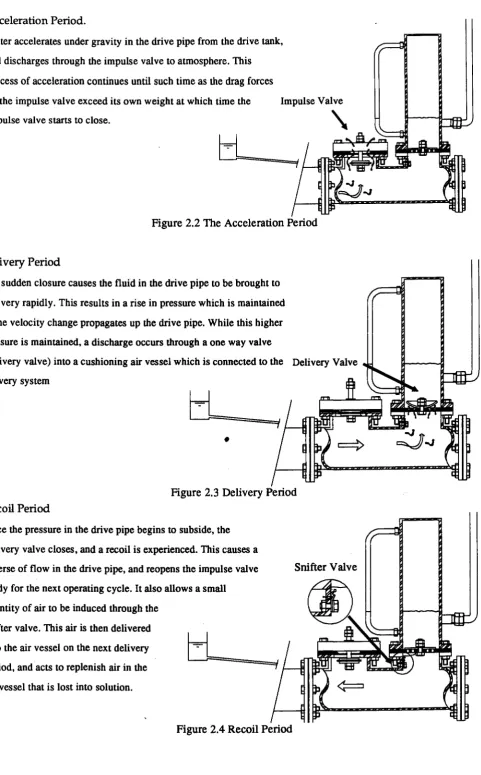
Acceleration Period.
Water accelerates under gravity in the drive pipe from the drive tank,
and discharges through the impulse valve to atmosphere. This
process of acceleration continues until such time as the drag forces
on the impulse valve exceed its own weight at which time the
impulse valve starts to close.
Impulse Valve
[image:26.566.36.517.0.775.2]H::
====JFigure 2.2 The Acceleration Period
Delivery Period
The sudden closure causes the fluid in the drive pipe to be brought to
rest very rapidly. This results in a rise in pressure which is maintained
as the velocity change propagates up the drive pipe. While this higher
pressure is maintained, a discharge occurs through a one way valve
\.
(delivery valve) into a cushioning air vessel which is connected to the Delivery Valve
delivery system
Q
======1
•
Figure 2.3 Delivery Period Recoil Period
Once the pressure in the drive pipe begins to subside, the delivery valve closes, and a recoil is experienced. This causes a
reverse of flow in the drive pipe, and reopens the impulse valve
ready for the next operating cycle. It also allows a small
quantity of air to be induced through the
snifter valve. This air is then delivered
into the air vessel on the next delivery
period, and acts to replenish air in the
air vessel that is lost into solution.
CL
====J
Figure 2.4 Recoil Period
2.2
The Acceleration Period
During this cycle, water accelerates from a source or collection tank, through a length of pipe
known as the drive pipe (see Figure 2.1). This pipe allows the water to fall through a small
distance, accelerating under the force of gravity, and is allowed to discharge at a lower level
[image:27.573.123.429.178.398.2]through a valve known as the impulse valve.
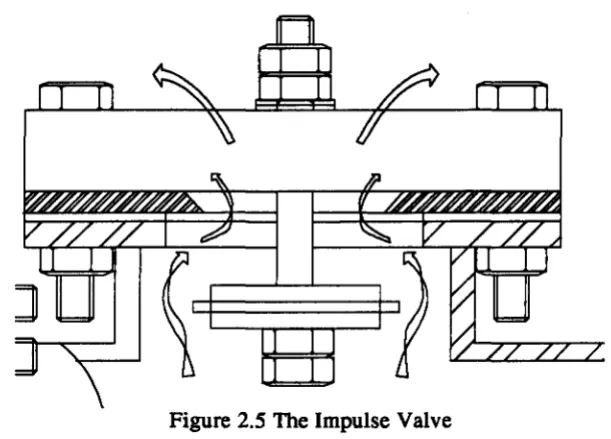
Figure 2.S1be Impulse Valve
The impulse valve is a simple valve (see Figure 2.5) that is closed by the drag force induced
by a high through flow. The geometry of the valve is such that these drag forces increase
rapidly as the valve moves towards its closed position, so inducing a rapid "snap" closure. See
Figure 2.2.
2.3
Delivery Period
The sudden closure of the impulse valve induces a pressure rise in the drive pipe that is
proportional to the velocity of the fluid in the pipe immediately before the valve closure. This
pressure is maintained while pressure waves propagate along the drive pipe.
During this period in which the drive pipe sustains a high pressure, a small discharge occurs
through a non-return valve (delivery valve) into a vessel containing air at a pressure
approximating to the delivery pressure of the pump. This discharge continues until such time
as the pressure in the drive pipe subsides, at which stage, the non-return valve closes, and the
2.4
Recoil Period
A small remaining velocity in the drive pipe fluid induces a recoil, which in turn induces a
pressure drop at the impulse valve, so allowing it to reopen, and the cyclic operation to recur.
A small air inlet valve (snifter valve) allows a small quantity of air into the drive pipe during
low pressure periods. This is forced through the delivery valve and into the air vessel on the
delivery cycle. This air replaces air that is lost into solution in the air vessel.
The device operates with a cyclic operation of typically 1Hz. The three described phases are
2.5
Detail Function of the Hydraulic Ram Pump
The detailed operation of a hydraulic ram pump as described in the following sections has been determined as a result of a long term study of hydraulic ram pumps involving extensive experimental measurement, computer modelling and simulation.
2.6
Acceleration Period in Detail
The acceleration cycle commences with the opening of the impulse valve. This will usually open under the force of gravity, but is often assisted by the recoil of the previous pumping cycle. The fluid is either stationary, or travelling up the drive pipe towards the feed tank following a velocity recoil in the drive pipe at the end of the previous cycle (this recoil is covered in the following sections).
The fluid in the drive pipe then accelerates under gravity towards the impulse valve. If it is initially in recoil, it decelerates under the differential pressure along the length of the drive pipe imposed by the water level in the drive tank, and this deceleration is increased by friction effects. The equation given in Figure 2.6 gives the deceleration force on the column of fluid in the drive pipe at any instant in time. It should be noted, that this equation assumes the fluid to be a rigid column, and as the wave propagation time is very short compared with
•
the deceleration period, this gives an acceptable approximation for most purposes.
I
~ Ml
l...---J~~==========~
~:celerating
Force _- L
I
M(tJ{ +
M)
A 2dg
Once the fluid is flowing towards the impulse valve, and discharging from it, it accelerates under the action of gravity. This acceleration is reduced by frictional effects.
[image:30.580.69.518.478.725.2]Time (sees)
Figure 2.8 Velocity History for Acceleration Period
The described acceleration may not be linear because of residual transients propagating in
the drive pipe from the previous pumping cycle as well as changing friction effects. Figure 2.8
illustrates the shape of the velocity history that results from a typical acceleration phase.
2.7
Valve Closure Period in Detail
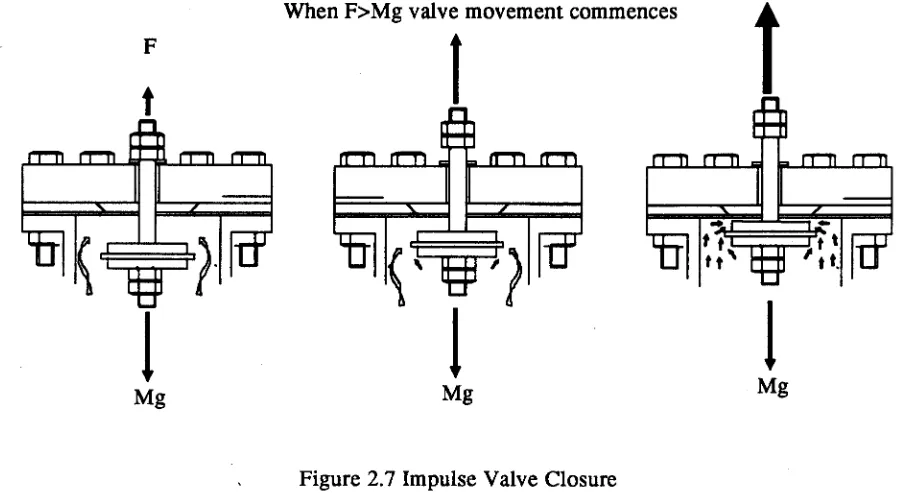
The impulse valve disc experiences a drag force as a result of the fluid flowing past it. This
drag force is approximately proportional to the square of the velocity of the fluid flow, and
F
I
t
When F>Mg valve movement commences
t
1
Mg1
1
Mg Mg
proportional to a coefficient of drag for the valve. Once the flow in the drive pipe reaches a level at which the drag force on the valve exceeds the force keeping it open (typically its weight), the impulse valve accelerates towards its closed position.
As the impulse valve disc starts to move, the coefficient of drag increases as the distance
between the valve disc and its seat reduces. Similarly the head loss coefficient across the valve will also increase. This increase in head loss coefficient will act to reduce the acceleration of the flow. The increase in the coefficient of drag will act to increase the acceleration of the impulse valve towards its position of closure.
The valves coefficient of drag increases exponentially as the valve face moves towards the valve seat (this is a characteristic of the type of valve, but is common to the majority of hydraulic ram pumps). This causes an exponentially increasing acceleration on the valve, which in turn leads to a very rapid closure. This valve acceleration is reduced by drag forces restraining the movement of the valve through the fluid in the final stages of closure when the valve velocity exceeds that of the fluid.
The increasing head loss coefficient is significant with respect to the length of the drive pipe, and the acceleration of the fluid. If the drive pipe is relatively short, or the fluid acceleration relatively low, it is possible that the increasing head loss will reduce the velocity of the fluid to such an extent that the drag force on the valve is no longer sufficient to maintain the closure. In this situation, the impulse valve will "bob" up and down, but not reach its seat.
Once the impulse valve reaches its seat, the fluid immediately upstream is brought to a halt.
2.8
Delivery Period in.Detail
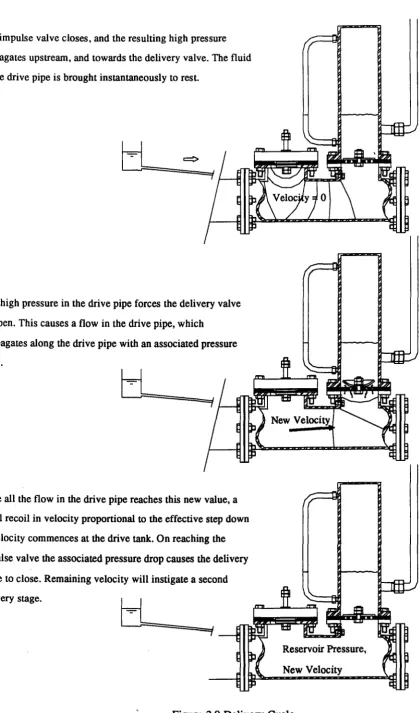
The velocity drop and pressure rise propagate upstream in the opposite direction to the
direction of flow. A high pressure wave is also communicated from the three way junction
towards the air vessel. The high pressure wave front will generally reach the delivery valve
well before it reaches the feed tank. The pressure rise experienced is related to the initial
velocity by the equation:
M{=aVo
g - (2.1)
where: I1H = the rise in pressure head (m); a = the velocity of sound in the drive pipe (mls); g
=
the acceleration due to gravity (mls·2); Vo=
the velocity of the fluid before closure(mls).This is generally referred to as the Joukowsky(4) (1904) pressure head. When this pressure rise reaches the delivery valve, the valve is forced open and fluid is free to flow into the air
vessel. The pressure in the air vessel at this stage is at the delivery head. This flow causes an instantaneous drop in pressure in the main body of the pump. A high frequency pressure
oscillation is induced between the impulse valve and the air vessel water surface on account
of the compressibility of the fluid in the body of the ram.
The opening of the delivery valve causes a new pressure to be sustained. This new pressure
is slightly higher than the pressure in the air vessel on account of the head losses occuring through the delivery valve. The first pressure wave to propagate up the length of the drive
pipe causes a large pressure rise, and brings the' velocity in the drive pipe to a halt. The
opening of the delivery valve causes a second pressure wave to travel up the drive pipe. This
wave front will induce a velocity increase in the drive pipe to allow the delivery flow to
continue, and an associated drop in pressure that is proportional to the increase in velocity.
When the wave front meets the feed tank, the pressure rise is no longer maintained, as there is no inertial change experienced at the reservoir. This effectively transfers a constant head to
the drive pipe. The effect is a wave reflection. The high pressure in the drive pipe is relieved by this pressure wave reflection, and as this wave form propagates back down the drive pipe,
The impulse valve closes, and the resulting high pressure
propagates upstream, and towards the delivery valve. The fluid
in the drive pipe is brought instantaneously to rest.
The high pressure in the drive pipe forces the delivery valve
to open. This causes a flow in the drive pipe, which
propagates along the drive pipe with an associated pressure
drop.
Once all the flow in the drive pipe reaches this new value, a
small recoil in velocity proportional to the effective step down
in velocity commences at the drive tank. On reaching the
impulse valve the associated pressure drop causes the delivery
valve to close. Remaining velocity will instigate a second
delivery stage.
t:i
-====="4=::J' [image:33.576.46.466.12.725.2]New Velocity
valve, the magnitude of the relieving pressure becomes smaller because of the friction that
exists in the drive pipe. The pressure that finally arrives at the delivery valve is equal to the
static head supplied by the feed tank, less the friction losses at the new reduced velocity. (See
Figure 2.9).
This new pressure is not sufficient to maintain the delivery pressure, and so the delivery
valve moves towards its dosed position. The nature of the delivery valve is such that there
will be a degree of back flow, and this will vary with operating conditions, but will typically
be equal to the swept volume of the valve. At this stage, the delivery period has undergone its first delivery cycle. There remains a new reduced steady state velocity in the drive pipe.
This velocity effectively meets a closed valve as the delivery valve closes under the
normalised pressures. A pressure rise is induced at the delivery valve that is proportional to
the new velocity in the drive pipe. A new pressure wave then propagates down the drive
pipe, incorporating a Joukowsky pressure rise, and an associated halting of the velocity in the
pipe. This wave propagates up the drive pipe towards the feed tank, but is followed by
another wave front of reduced pressure, and increased velocity associated with the
>.
...
....
g
~
>
[image:34.574.72.498.402.704.2]Delivery subcycle 1
reopening of the delivery valve.
A typical drive pipe velocity history for the delivery period is given in Figure 2.10. This
illustrates the multiple delivery subcycles. The shaded area represents the volume of water
delivered when multiplied by the drive pipe area.
2.9 Recoil Period in Detail
As before, these waves are reflected at the reservoir, in a normalising pressure wave which
also induces a drop in velocity. When this arrives at the delivery valve, the delivery valve once again closes ( or starts to), and the above cycle recurs. This process of velocity steps
continues until such time as the velocity remaining in the drive pipe is such that the induced
pressure is smaller than the delivery pressure. If this occurs, the whole of the drive pipe becomes pressurised at the new lower pressure and the pressure wave propagates up the
drive pipe. On reaching the reservoir, there is again a reflection involving a reduction in
velocity, and a normalisation of pressure. As the velocity reduction associated with the previous pressure wave travelling up the drive pipe reduced the fluid velocity to zero, this
>.
~
....
uo
-
Co)>
Delivery subcycle 1
Delivery subcycle 2
Time
pressure reduction induces a negative velocity known as the recoil. This propagates down the drive pipe towards the delivery valve. This represents an entire wave reflection in which
no deli very occures.
When this negative velocity and pressure normalisation ~rrives at the delivery valve, the delivery valve closes. A negative pressure is then created at the delivery valve, the
downward pressure transient being proportional to the magnitude of the recoil velocity. This
low pressure allows a quantity of air to be induced through a snifter valve located at the
delivery valve. This in turn acts to reduce the magnitude of the drop in pressure, and allows
some of the recoil velocity to be sustained.
When this negative pressure is communicated to the delivery valve, the impulse valve will
typically open under its own weight. If this negative pressure wave is of insufficient magnitude, the valve will fail to reopen. This represents a common reason for pump failure.
This negative velocity pressure wave then proceeds up the full length of the drive pipe. On
reaching the feed reservoir, a reflected wave propagates down the drive pipe normalising the
pressures to reservoir pressure. Small damped pressure oscillations then occur on account of
friction effects. This marks the beginning of the next acceleration cycle.
The velocity history given in Figure 2.11 illustrates the recoil period as described above. This
recoil can be seen to differ from that illustrated in Figure 2.10. In Figure 2.10, the velocity
drop associated with a reflected pressure wave from the reservoir brings the drive pipe
velocity negative which allows the delivery valve to close and the impulse valve to reopen as
above. In this case, there is no residual forward velocity and no additional pressure rise, and
the next cycle can begin immediately. This will marginally increase the frequency, and
therefore the power ouput of the device.
2.10
The Snifter Valve
As mentioned in the above section, the snifter valve operates during the recoil period to allow
a small quantity of air to be induced into the body of the hydraulic ram pump. This will rest
as an air pocket just below the delivery valve. This air will then be transfered to the air vessel
as soon as the delivery valve next opens. The effect of this is to sustain the volume of air in the
Atmospheric
Figure 2.12 The Snifter Valve
There are a number of snifter valve designs used, and the most typical of these is illustrated in Figure 2.12 . It incorporates a simple flap seal over an air inlet orifice. The sizing of this orifice directly influences the volume of air induced on each cycle. It also effects the severity of the negative pressure associated with the recoil, and the magnitude of recoil velocity
attained.
The_orifice is sized empirically to ensure that the quantity of air induced is in excess of that lost into solution. This results in a continuous air discharge into the delivery pipe. This can cause problems downstream, so an air release valve is required immediately downstream of
the air vessel.
2.11 The Significance of this Understanding on Pump Design.
2.11.1 Two modes of recoil effect pump performance.
The observation that there are two ways in which the hydraulic ram pump cycle finishes is
helpful in interpreting sudden frequency shifts in operating pumps and unreliable behaviour
at some delivery heads, and also provides important insight necessary to reliably predict ram
pump performance.
2.11.2 Acceleration efficiency
The concept of acceleration efficiency in this thesis represents the amount of potential energy
The acceleration efficiency in a hydraulic ram pump is closely dependent on the friction experienced in the drive pipe. Similarly, it is also dependent on the acceleration of the fluid
in the drive pipe. This is because with a low acceleration that diminishes significantly with
speed the acceleration period is greatly extended, while the resulting kinetic energy of the
fluid in the pipe is the same for a given final velocity. The result is a significant quantity of
wasted water, and therefore a reduction in pump efficiency and power.
2.11.3 Delivery Efficiency
The concept of delivery efficiency was also invented by the author, and represents the
potential energy attained through the discharge of water to the delivery head as a proportion
of the kinetic energy in the drive pipe at the beginning of the delivery cycle (closure of the
impulse valve).
The efficiency of the delivery cycle has been found to be of some significance. A direct
influence on this is the friction coefficient of the delivery valve. However, other very
significant factors include the swept volume of the delivery valve, and the mode of delivery.
If a hydraulic ram pump incorporates a delivery valve which has a returning force applied to it, the head loss associated with delivery may be much increased, however, the loss of water
as a result of back flow is also greatly reduced. This may compensate for the extra losses
associated with delivery. The significance of this effect increases with higher delivery heads.
2.11.4 High Frequency Oscillations.
The·high frequency oscillations visible in the pressure history given in Figure 2.13, can be
seen to be oscillations between the impulse valve and the air vessel. il, for reasons of
durability, it is necessary to alter the frequency or magnitude of the oscillations, this can be
achieved by dimensional changes within the pump itself. A study of this is illustrated in
chapter 4. A lower frequency oscillation is obtained by increasing the distance between the
impulse valve and the air vessel. The magnitude of the oscillations are reduced by increasing
.
the diameter of the pipework connecting the two. This study was the cause of major changes
60 --
'"1---,
..-.
e
' - '
'g
Q)
==
50
40 30
20
10
0
-10
0 100 T' ( ) 200
[image:39.574.119.425.57.276.2]Ime ms
Figure 2.13 Simulated Pressure Transient in Ram Pump
2.11.S
Snifter Valve Sizing
300
The quantity of air induced into the drive pipe through the snifter valve is quite critical. Too
large a quantity will result in failure of operation of the pump as air will travel up the drive
pipe, and affect the behaviour of the propagating transients. A snifter valve orifice which is
too small will result in insufficient air being induced into the air vessel to replenish that lost
into the delivered water. The result of this will be an empty air vessel, which can potentially
cause significant damage to the pump and delivery pipe work, and will certainly have a
negative effect on performance.
It is evident from the explanation that the quantity of air induced into the drive pipe is also
dependent on the magnitude of the recoil velocity that occurs in the drive pipe. The snifter
valve should therefore be sized or adjusted accordingly.
2.11.6 Time for Valve Closure
From the description of the valve closure period, it is possible to perceive that the major
factor effecting this is the acceleration of the fluid in the drive pipe. As this has a direct effect
on the performance of the pump, it is important that the acceleration of the fluid column is of
a suitably high magnitude when the impulse valve begins to close, to ensure rapid closure of
2.11.7 Impulse Valve Failure To Close
From the description of the delivery valve closure it is possible to understand the interaction
between the impulse valve and the drive pipe during the closure. As the impulse valve
begins to close, the head loss across the valve increases, and this will slow down the fluid in
the drive pipe after a wave reflection time of 2L/ a. A lower velocity will reduce the drag force
on the valve causing it to close, however, the movement of the valve will have increased the
force coefficient for the valve. The net effect is a trade off between an increasing drag
coefficient and a decreasing flow. If the net effect is a force that is less than the weight of the valve, the valve will decelerate. Depending on the severity of the deceleration, and the
velocity of the valve, the valve may never reach its seat, but only ''bob'' up and down.
The above illustrates a problem that is highly dependent on a particular valve's
characteristics. The problem is exacerbated on installations in which the fluid acceleration is
small. Minimum drive pipe lengths and fluid accelerations during the closure cycle should be
quantifiable for a given impulse valve geometry and settings.
2.11.8 Drive Pipe Length
The drive pipe length greatly effects the nature of operation of a hydraulic ram pump.
However, many of the factors that are greatly affected by drive pipe length are cancelling.
For example, a long drive pipe will have a relatively long and inefficient acceleration period,
but will require fewer ram cycles for a given delivery volume. So increased losses associated
with inefficient acceleration are cancelled by reduced losses associated with each valve
closure. For this reason, within a design operating range, the overall performance is largely
unaffected by drive pipe length.
An enhanced understanding of the operation of the hydraulic ram pump enables this
operating range to be more usefully specified.
The acceleration cycle is greatly affected by the length of the drive pipe. The longer the drive
pipe, the more mass that exists to be accelerated by the drive head, and so the slower the
acceleration. Similarly the longer the drive pipe, the more friction that exists on the column of
The valve closure period is affected by the length of the drive pipe. This affects pump performance as a short valve closure period will generally be more efficient. The interaction
between the two is discussed in the above explanation, and more detail is given in Chapter 4
which refers to a study undertaken by the author on this effect using the method of
characteristics simulation.
The delivery cycle is also significantly affected by the length of the drive pipe. The longer the
drive pipe, the longer each of the delivery phases, as each delivery phase lasts a full wave reflection period. A longer delivery phase will deliver proportionately more water.
The recoil period is also directly affected by the length of drive pipe. A recoil on a long drive
pipe will involve more kinetic energy, and will therefore take longer to slow down. This will
reduce the pump beat frequency, and so reduce the output power of the device.
2.12
Summary
This chapter has given a detailed description of the operation of the hydraulic ram pump, and
the interaction of the parameters affecting its performance. Chapter 3 gives a summary of
other analyses undertaken on the hydraulic ram pump, while Chapters 4 and 5 illustrate the
methods employed to obtain and use the described understanding of hydraulic ram pump
Chapter 3:
History of the Hydraulic Ram Pump and Analyses.
The hydraulic ram in its earliest form was invented by John Whithurst of Derby (5) 1772. The
device he created bears little resemblance to the devices of today, and was discovered by chance. He found that a length of pipe that discharged from a reservoir to a low level valve was prone to failure adjacent to the valve. To solve the problem, a small air vessel was connected to the system. This was connected through a one way valve, and a delivery pipework was connected to it. To the surprise of many, water was delivered in this pipe to a level higher than the original source. Unfortunately a continuous delivery was only possible if an individual was deployed to continuously open and close the discharge valve.
Delivery
I
Water Source
Air Vessel
Figure 3.1 The Hydraulic Ram Pump after John Whithurst
A wide variety of hydraulic ram pump devices followed, and hydraulic rams were very
widely deployed, and a large quantity of literature produced before the turn of the century.
Manufacturers also produced dual flow ram pumps capable of pumping clean potable water
using the energy available in falling waste water. Even air compressors were produced that
compressed air by the same operation as a conventional hydraulic ram pump.
3.1
Experimental Research
In the early days of hydraulic ram pumps, extensive experimental work was undertaken on
the device. Documented works include: Eytelwein(7)1805, d' Aubuisson(S)1840, Morin(9)1863,
Tresca(10)1864, Carpenter(11)1894, Richards(12)1898, Church(13)1899, Cia rk(14) 1900,
Anderson(1S)1922 and Clavert(16)1957.
These analyses were invariably based on a single experimental facility and often resulted in
the drawing of sweeping conclusions on hydraulic ram pump design ana operation. A
helpful summary of these is offered by Rennie and Bunt (17)1981. Some of these conclusions
were of significant value in design, but with the lack of theoretical analyses, the conclusions
were often adopted completely regardless of their validity.
3.2
Theoretical Analyses
A number of theoretical analyses of the hydraulic ram pump developed alongside the above
research. Significant works were provided by Montgolfier(6), Venturoli(1S)1818,
Navier(19)1839, Weissbach(20)1897, Rankine(21)1872, Mirapeix(22)1907, Lorenz(23)1910, and
Bergeron(24)1932. None of the above were based on empirical data, and all involved some
erroneous assumptions. A summary of these is also available in the work by Rennie and
Bunt(17).
The above analyses differed in the sophistication with the pumping cycle being subdivided
to varying degrees, from two divisions in the theory proposed by Navier to typically four
divisions adopted by the majority to represent a range of different theoretical periods.
Although the above theories offered a wider perspective than the purely empirical studies,
errors in assumptions and the crudeness of the analyses severely hampered their usefulness.
An attempt to combine experimental data with theoretical analyses was first undertaken by
but he was able to confirm a correlation between experimental and theoretical behaviour
during the acceleration period.
As measurement technologies became more sophisticated, the understanding of the transient
behaviour in the hydraulic ram pump developed. In the 1930's O'Brien and Gosline(26) using the research undertaken by Harza (25), provided a theoretical and experimental investigation
into hydraulic ram pumps which in retrospect was inspired. They provided a theoretical
analysis of the transient behaviour in the drive pipe during the delivery cycle. The simulation
work undertaken in this study largely verifies the analysis proposed. Unfortunately many
subsequent analysis did not acknowledge or adopt the development attained, and later work
by Krol(27)1947 provided a detailed analysis that was widely adopted, but failed to
incorporate the work of O'Brien and Gosline.
A brief summary of the analytical results obtained by O'Brien and Gosline is given in the following section. Beyond this analysis, there were attempts to utilise the graphical method
of transient analysis for which Schyder(28)1932 and Bergeron(24) are famed. The work of Krol
has been adopted by a number of more recent studies.
3.3 Summary of more recent Analyses of the Hydraulic Ram Pump
3.3.1
O'Brien and Gosline(26)1933
A diagrammatic summary of O'Brien and Gosline's theoretical analysis of the hydraulic ram
pump given in Figure 3.2 shows that the researchers were able to predict the characteristic
behaviour identified by the simulation developed within this research. In this respect, their
research is unique, and unfortunately largely unrecognised except within the work of Rennie
and Bunt. The analysis offered for much of the hydraulic ram cycle was typical of such
analyses, but their analysis of the delivery cycle was unique, and they were able to predict the
intricacies of the delivery cycle that are modelled in detail in chapter 5 of this thesis.
O'Brien and Gosline avoid providing a prediction of overall efficiency on the grounds that
such a calculation would be excessively complex. However, they do offer an expression for
acceleration efficiency. This is a valuable concept, and is covered in the proposed design charts in Chapter 6. The reason given for this is that acceleration efficiency dominates in
but is, however, fundamentally flawed, as other inefficiencies such as poor valve closure times can rapidly dominate.
e
=
en en
e
Il..
Drive Head
~~--====~---+---
8-it
Q)
>
·c
Cls::
....
Delivered Volume
Wasted Volume '
Time
Figure 3.2 Representation after O'Brien & Gosline
3.3.2 Krol(27)1947
A very detailed analysis was provided by Krol using calibrated data from a hydraulic ram pump. It is interesting to note Krol's use of friction and head loss coefficients to determine closure times and flows. It is also interesting to note the degree of success he attained with these. The major failings of his analysis were as a result of his denial of the transient wave propagation during the delivery cycle. His modelling of the impulse valve was valuable, but limited in that it assumed constant drag coefficients. It is possible to see from the calibrations undertaken in chapter 4 that this is clearly an unacceptable assumption.
3.3.3
Rennie and
8unt(17)1981
)
Krol, they adopted the graphical method(24) to solve the behaviour of the impulse valve during closure and the transient regime that followed. In spite of the difficulty involved with representing complex transients using the graphical method, useful results were obtained.
3.3.4 Yau-Chung Chiang(29)
1984
University of Wisconsin-Madison
This was an interesting study into simulation and optimisation of transient oscUlation flow and sound in complex piping systems. The study utilised the hydraulic ram pump as a case study, and created a crude "method of characteristics" simulation of the device, and then proceeded to apply the optimisation routines to the device. The study suffered considerably as a result of the crudeness of the hydraulic ram model adopted. Further problems found were similar to those described in chapter 4, where the quantity of data and variables existing in a single simulation are so great that attempts at optimisation are severely hampered. Chiang attempted to overcome this by considering aspects of design in isolation. This was a valuable approach, but the results obtained suggested improvements in efficiencies to levels far below those currently attained.
3.4
Summary
It is clear that there has been significant research into the hydraulic ram pump, and much of it highly replicatory. The reason for this is largely due to the massive complexity of interacting variables that are involved in an apparently very simple phenomenon. Poor results in much of the early work were a result of poor measurement technologies.
It is interesting to note that as the measurement technologies improved so did the theoretical analyses. The theoretical success of O'Brien and Gosline seemed to be closely related to their ability to measure transient pressures. The work of Krol some years later however, failed to achieve the insight offered by O'Brien and Gosline.
Rennie and Bunt where able to progress Krol's understanding with an improved understanding of hydraulic transients, although the methods used to analyse these are somewhat antiquated, and not without their inadequacies.
Chapter 4:
Computer Simulation of the Hydraulic Ram Pump
4.1
Summary of simulation
An important tool in the analysis of the hydraulic ram pump was a computer simulation of
the device. The development of the simulation was initiated during the author's MSc
research. This simulation utilised the extensively documented "method of characteristics" to
solve the partial differential equations of motion and continuity together with standard
algorithms for the modelling of boundary conditions for the reservoir and air vessel present
in a hydraulic ram. Some innovation was required with respect to modelling some of the
more dynamic boundary elements.
4.2
The modelling of pressure transients in a pipe
A method of characteristics simulation enables an accurate modelling of pressure transients
in a pipe. Although developed during the 1950's the method was popularised by Victor
Streeter and Ben Wylie(30)1993 of the University of Michigan. The majority of modem
transient simulation work currently undertaken utilises this explicit finite difference method
known as the "method of characteristics". The equations used to determine transient flows
and pressures in a pipe using a fixed time step are given in Appendix B.
Recent attempts have been made to employ finite element techniques for transient analysis,
but these have involved severe limitations (Watt and Boldy(31» . The decision to use a
method of characteristics simulation was made for the following reasons:
• The finite element methods available are not readily suited to sharp wave front
transients of the type induced in a hydraulic ram pump.
• The use of finite element techniques for complex pipe systems involves the
production of some highly sophisticated shape functions which although quick
to solve, do not allow minor modifications at a later stage.
• It was anticipated that drastic modification to both program structure and boundary conditions would be carried out in an evolutionary manner. Such
modifications are well suited to a "method of characteristics" simulation as it
effecting the integrity of the rest of the simulation.
• The "method of characteristics" is used widely in the simulation of hydraulic
transients in water pumping systems, and much research has been published
on the most accurate means to represent various commonly occurring
boundary conditions. Streeter and Wylie(30),Chaudry(32),Fox(33) ,5waffield and
Boldy(34), Thorley(35).
The "method of characteristics" requires a good estimate for the transient wave propagation
velocity for each pipe section. To determine this, Joukowsky(4)(1898) and Gibson(36)(1908)
developed a concept of a 'Virtual Bulk Modulus of Elasticity" which also accounts for the
pipe materials and dimensions. Joukowsky's calculation assumed. a linear constraint on the
pipe, and so has become the more widely adopted solution. This led to the following equation for pressure wave propagation velocity of:
-;::::===1
=:;:==-a - .
- " p
[1.
+
_DCI ]K tE
where:
a
=
propagation velocity (m/s)p
=
the density of the fluid (kglm3)(4.1)
K
=
the fluid' s bulk modulus (2.1 x 1r! Nlm2 for water at 20deg)D
=
the pipe diameter(mm) t=
the pipe wall thickness(mm)E
=
the Young's modulus for the pipe material (Nlm2 ) in which C1 may take one of the following values dependent on themeans by which the pipe is restrained:
For pipes restrained at one end only :CI
=
1 -~
For pipes anchored throughout their length: Cl
=
1-J.l2For pipes with expansion joints along their entire length: Cl
=
1Equation (4.1) has been used extensively in this study to predict the speed of pressure wave propagation. The wave speed propagation time was also monitored using sequentially placed pressure transducers which were sampled using a 500kHz analogue to digital converter. This system was used to verify the calculated pressure wave propagation speeds as well as experimentally monitor pressure transients in pipelines.
4.3
The Reservoir Boundary
Submersible Pump
Counesy 01 KSB
Figure 4.1 Experimental Rig
The reservoir boundary condition used is a standard boundary condition used for transient simulation. The equation that describes the boundary condition for outflowing water is simply
v
2Hx = Reservoir Level - 2g (4.2)
where Hx is the pressure at the exit from the reservoir; V is the exit velocity, and g is the acceleration due to gravity.
4.4
The three way junction
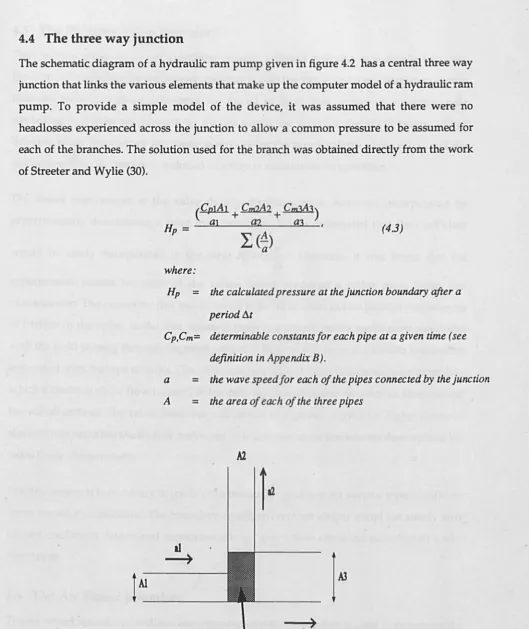
The schematic diagram of a hydraulic ram pump given in figure 4.2 has a central three way
junction that links the various elements that make up the computer model of a hydraulic ram
pump. To provide a simple model of the device, it was assumed that there were no
headlosses experienced across the junction to allow a common pressure to be assumed for
each of the branches. The solution used for the branch was obtained directly from the work
of Streeter and Wylie (30).
(4.3)
where:
Hp
=
the calculated pressure at the junction boundary after a period lltCp,Cm
=
determinable constantsjor each pipe at a given time (seedefinition in Appendix B).
a = the wave speedjor each oj the pipes connected by the junction
A
=
the area oj each oj the three pipesA2
!M
- - -
l~
[image:51.551.11.540.18.647.2]13)
4.5
The Delivery Valve Boundary
The delivery valve boundary condition initially adopted was one of a simple two way
junction with a facility for a diameter variation across the valve, and a mechanism to ensure
that any backward flows calculated are forced to zero. This represents a highly crude
modelling as it does not account for friction across the valve, or the swept volume of the
delivery valve. No attempt was made to account for the swept volume of the valve until the
model described in chapter 5 included a facility to account for its operation.
The losses experienced at the valve during discharge were, however, incorporated by
experimentally determining a head loss coefficient. It was anticipated that the coefficient
would be easily incorporated in the form Hf=
Ct
~
.
However, it was found that the experimental results for some of the valves tested produced a rather more linear losscharacteristic. The reason for this was believed to be on account of two parallel' mechanisms
of friction in the valve. In the first instance, there is a simple orifice mechanism associated
with the fluid passing through the valve orifice(s). Beyond this there is a friction mechanism
associated with the type of valve. The most common type of valve incorporates a rubber disc,
which distorts to allow flow through in the delivery direction, and recovers its shape to seal
the valves orifices. The valve, therefore will distort to a greater degree for higher flows, so
significantly reducing the friction coefficient. It is this part of the mechanism that explains the
more linear characteristic.
For this reason, it is necessary to modify the boundary condition for various typesof delivery valve boundary conditions. The boundary condition can then simply adopt the steady state
friction coefficient determined experimentally for every flow condition experienced under
simulation.
4.6
The Air Vessel Boundary
The air vessel boundary condition incorporated into the simulation is used to determine the
quantity of fluid delivered per pumping cycle and the continuous delivery flow rate. The