warwick.ac.uk/lib-publications
A Thesis Submitted for the Degree of PhD at the University of Warwick
Permanent WRAP URL:
http://wrap.warwick.ac.uk/109415
Copyright and reuse:
This thesis is made available online and is protected by original copyright.
Please scroll down to view the document itself.
Please refer to the repository record for this item for information to help you to cite it.
Our policy information is available from the repository home page.
Retrieving information
about a group
from its character table
Sandro Mattarei
Thesis submitted for the degree o f D octor o f Philosophy
o f the University o f Warwick
Mathematics Institute
University o f Warwick
Coventry
C V 4 7 A L
Contents
1 In tro d u ctio n 6
2 Technica l resu lts 12
2.1 C o m m u ta to rs ... 12
2.2 Linear and bilinear maps arising from com m u ta tion ... 13
2.3 Irreducible modules for abelian g r o u p s ... 17
2.4 Homogeneous m o d u l e s ... 22
2.5 Induction and tensor induction ...24
2.6 Basic c o m m u ta to r s ...29
2.7 Character table isom orp h ism s...34
3 L o o k in g fo r a co u n te r e x a m p le 35 3.1 In trod u ction ... 35
3.2 Structure o f a minimal coun terexam p le...36
3.3 Chief fa c to r s ... 38
3.4 More about the action o f Q on H ' ... 44
3.5 The smallest cases which can o c c u r ... 48
4 C o m p a r in g ch a r a c te r ta bles 54 4.1 Our p h ilo s o p h y ...54
4.2 Vanishing o f character values ...59
4.3 A tool for comparing character t a b l e s ...61
4.4 A generalization...66
5 C o u n te r e x a m p le s 70 5.1 In trod u ction ... 70
5.2 General c o n s tr u c tio n ... 72
CONTENTS 2
5.3 The unary c a s e ... 78
5.4 M atrix representations for the unary c a s e ... 84
5.5 The binary c a s e ... 90
5.6 M atrix representations for the binary c a s e ...97
5.7 P o w e r -m a p s...101
6 N ilp o te n t co u n te r e x a m p le s 107 7 W re a th p r o d u c ts 117 7.1 Characters o f wreath p r o d u c ts ...117
7.2 Conjugacy classes o f wreath p r o d u c ts ... 124
7.3 Character tables o f wreath p rodu cts... 128
Acknowledgements
I would like to thank my research supervisor Dr T. O. Hawkes for his constant support.
I acknowledge the financial support o f CNR (Consiglio Nazionale delle Ricerche, Italy).
Summary
Chapter 1
Introduction
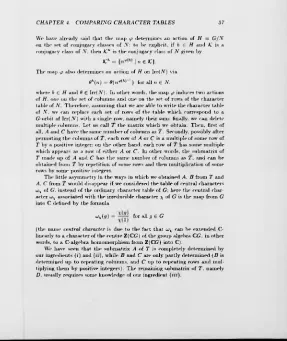
Representation theory, and in particular character theory, have proved to be powerful tools for the study o f finite groups. Furthermore, character theory provides a practical way of gathering a lot o f information about a group G in a very condensed form, by means of a matrix with complex entries, called the character table of G. This is especially true for simple groups. In fact, character tables are perhaps the main information provided by the Atlas o f finite simple groups [4], which is an indispensable reference for the classification of the finite simple groups. Each finite simple group is uniquely identified by its character table, and some sporadic simple groups were known through their character tables even before their existence was proved.
CH APTER 1. INTRODUCTION 7
namely the so-called power-maps, will be considered occasionally, but this will be explicitly stated as character table with powermaps.
Unlike simple groups, soluble groups are not uniquely identified by their character tables. The easiest example is given by the two non-abelian groups of order eight, namely the dihedral group Dg and the quaternion group Q$\ in fact, their common character table is the following matrix T.
1 1 1 1 1
1 1 1 -1 - 1 1 1 -1 1 - 1 1 1 -1 - 1 1
2 - 2 0 0 0
We may notice that the first row o f T corresponds to the trivial character o f G. and the first column corresponds to the identity class o f G. Apart from this, which we shall adopt as a convention, there is no natural rule for ordering the conjugacy classes of G and its irreducible characters (though practical rules are used in [4], for the sake o f convenience). Consequently, the character table T of a group G is defined up to permutations o f its rows and o f its columns. Hence, we shall say that the character tables T\ and T2 o f two groups are identical if it is possible to obtain T2 from T\ by permuting rows and columns o f T\. Later we shall give a more handy definition of having identical character tables, namely Definition 2.7.1.
We shall see in Chapter 4 that Dg and Q s form just a special case o f a more general situation in which two groups have identical character tables.
Although a group G is not uniquely determined by its character table T , a lot o f properties o f G can be read off from T. We shall give a brief review of some o f these properties, after noticing that each property can usually be obtained from T in several ways.
A first class o f properties employs the so-called second orthogonality re lation, part o f which is the formula
C H A PTE R 1. INTRODUCTION 8
identity class ACj, the above formula becomes
|G| = E*,(1)’,
and thus yields the order o f G. As a consequence, the length o f each conju- gacy class K j o f G can be computed, because |ACj| = |G : Cc(<7>)|- Also, the columns o f T which correspond to central elements of G can b e determined, and thus the order of the centre of G can be computed. It follow s that it can be decided whether G is abelian (though a simpler m ethod for this is checking that all characters o f G have degree 1). If this is the case, then G is determined by T up to isomorphism. More generally, Z (G ) is always determined by T up to isomorphism.
The second class of properties which we are going to exam ine employs the fact that the kernels o f the irreducible characters can be read off from the character table (meaning that it can be decided which classes o f G are contained in the kernel o f a given irreducible character); in fact, it is easy to see that
ker * = <9 e G l x ( f ) = * ( ! ) } .
if X € Irr(G). Now, kernels of characters are normal subgroups o f G, and conversely, each normal subgroup N of G is the kernel of som e character of G , for instance the character afforded by the regular representation of G/N, viewed as a representation o f G. Since the kernel of a reducible character is the intersection o f the kernels o f its irreducible constituents, it follows that all normal subgroups of G can be found from T , as intersections o f kernels o f irreducible characters. Moreover, since each normal subgroup N of G is found as a union o f conjugacy classes o f G, its order can be com puted, and inclusion relations with other normal subgroups can be determined.
CH APTER 1. INTRODU CTION 9
The knowledge o f the lattice o f normal subgroups o f G , together with tin* character tables of the corresponding factor groups, allows one to decide about the nilpotency, supersolubility, or solubility of G. In fact, G is nilpo- teut, respectively supersoluble, or soluble, if and only if there is a normal series
1 = No < N t < • • • < AT. = G,
such that all factors Ni/Ni-i are central, respectively cyclic o f prime order, or p-groups; all of these conditions can be checked on the character table T o f O .
The terms o f the upper central series of G can be inductively located in T, by taking centres and factor groups in turns; in particular, if G is nilpotent, its nilpotency class is determined by T.
The lower central series o f G can also be found, for instance b y inspecting all central series descending from G and finding the fastest descending one. However, another method is available, which yields even more. In fact, it follows by induction from [13, Problem 3.10(a)] that the character table of G allows one to decide which conjugacy classes o f G contain elements o f the form g = [aq, . . . , x,] with X i, . . . , x, € G; these conjugacy classes generate 7,(G ), the ith term o f the lower central series, though their (set-theoretical) union may be properly contained in 7,(G ).
Inspection o f the lattice o f normal subgroups o f G (w ith orders) shows which normal subgroups N are nilpotent: they are exactly those which con tain normal subgroups o f G o f order | JV|P for all prime divisors p o f |7V| (here, as usual, |JV|p denotes the biggest power of p which divides the order o f N ). As a consequence, the Fitting subgroup of G can be found (as the biggest nilpotent normal subgroup o f G); hence, if G is soluble, the Fitting series of G can be determined inductively, and the Fitting length can b e computed.
What about the derived series of G (and in particular the derived length o f G , if G is soluble)? The derived subgroup G' can certainly be read off from T , as the smallest normal subgroup N o f G such that G / N is abelian, or equivalently as the intersection o f the kernels of all linear characters of G. The problem o f finding the second derived subgroup G " amounts to being able to tell whether G' is abelian from the character table o f G. The following more general question appeared as Problem 10 in R. Brauer's report on representations o f finite groups, in [19, page 141]:
CHAPTER 1. INTRODUCTION 10
classes o f G which make up a normal subgroup N o f G, can it be decided whether or not N is abelian?
As Brauer then remarked, a positive answer t o this question would allow one to identify the terms of the derived series o f G by looking at its character table, and in particular to compute the derived length of G , for G soluble.
Unfortunately, the answer to Brauer's Prob lem 10 is negative, as an nounced by A. I. Saksonov in [20], A com putational approach to this problem has been used recently by K. Dockx and P. Igo d t in [7], which led to the same conclusion and produced additional examples. However, neither Saksonov, nor Dockx and Igodt, answered Brauer's question about the derived length.
One o f the main results in this thesis is the construction o f groups G and H with identical character tables and derived lengths 2 and 3 respectively, which proves that the derived length of a solu ble group cannot be read off from its character table. This will be done in Chapter 5.
The discovery o f the above mentioned exam ples was a consequence o f the close study o f the structure o f a minimal exam p le o f groups with identical character tables and different derived lengths. This study is also part o f this thesis, and will be carried out in Chapter 3.
Chapter 6 is devoted to the construction o f another example o f groups with identical character tables and derived lengths 2 and 3. The groups of this example are p-groups, unlike those o f C hapter 5, which are not nilpotent. The existence o f this chapter is justified by th e fact that the discussion o f a minimal example in Chapter 3 is carried out under the assumption that the groups in question are not nilpotent.
A tool for the comparison o f character tables will be developed in Chapter 4. Being suited to our examples of Chapters 5 and 6, it concerns a rather special configuration, that o f Camiua groups. However, since Camina groups have been studied extensively, and seem to arise in many different situations, the results o f this chapter may prove useful elsewhere.
Early and shorter versions of Chapters 4 a nd 5 will appear together as an article (namely [17]), in the Journal o f the London Mathematical Society.
CH APTER 1. INTRODUCTION 11
Chapter 2
Technical results
2.1
C om m u ta tors
We shall use the standard notation o f [10] for commutators. In particular, if A and B are subsets o f a group G , we set
[A, B\ = ([a,b] | a € > t, b € B ).
However, it will lx* useful to have a notation also for the set of commutators [a, 6] with a & A and b 6 B . Thus, we shall occasionally use the following non-standard notation:
[A ,B \ = {[a , 6] | a 6 A, b e B } .
If G \, . . . , G „ are subsets o f G , we set
[G...« . ] - < [ * ...9.] I S. € G.>,
where [^ i,. . . ,</„] is defined recursively by the formula
[01...0n] = [[01...0n—1] ,0» ]
-We observe that
[G,...G„] < [...[[G,,G„],G3]...G n],
though equality does not hold in general.
We shall need the following well-known lemma about coprime actions.
CH APTER 2. T ECH N IC AL RESULTS 13
L em m a 2 .1 .1 Let A be a Q-group, with (|A|. |Q|) = 1. Then
(|A,Q],<J| = \A,Q],
and
A = [A ,Q \Ca(Q ). Furthermore, i f A is abelian, then
A = [ A , Q ]xCa(Q ).
P r o o f Our first statement is [10, Kapitel III. Hilfssatz 13.3 b )], from whose proof our second statement follows. Our third statement is [10, Kapitel III.
Satz 13.4 b)]. □
2.2
L in ear a n d bilinear m aps arising fro m c o m
m u ta tio n
L em m a 2 .2 .1 Suppose that H\. H2, H3, K\, K 2, A'3 are subgroups o f a group G. Suppose that Ki <3 H, and that H ,/Ki is abelian (i = 1 ,2 ,3 ). Suppose also that [H ^,H 2) < H3 and that [H U K 2], [A'i, H 2] , [H ,,H2,H X] and [H\. H2, H2\ are all contained in A3. Then there exists a Z -bilinear map 7 : H\/K\ x H2/ K2 —* H3/K3 such that
( x K i , y K 2y = [x,j/]A'3 fo r all x G H\ and fo r all y G H2.
Furthermore, i f H\ = H2 and K\ = K 2, then the map 7 is skew-symmetric, in other words (x A ’ i, x l\ 2)y = A3 fo r all x G H1.
P r o o f This lem m a is a slightly more general form o f [11, Chapter VIII, Lemma 6.1] and can b e proved in the same way. The last statement o f the
lemma is obvious. □
CH APTER 2. TECHNICAL RESULTS 14
A different formulation of Lemma 2.2.1 is that (w ith the given hypotheses) the map
<Pt/ : H\/K\ —* H3/K3
such that (tKi)*" = [x,y] A3 is a well-defined group homomorphism for all y € Hz. and the map
7 : Hz/ Kz - Hom(H\/ K\, H3/ K3)
such that (y A j ) -* = <Pv *s also a well-defined group homomorphism. More generally we have the following result.
L e m m a 2 .2 .2 Assume the hypotheses o f Lemma 2.2.1. In addition, suppose that Q is a group o f operators fo r G and that H, and Ki are Q-subgroups o f G , whence in particular H ,/ K, becomes a 7 Q -module (i = 1 ,2 ,3 ). Suppose also that Q centralizes Hz/Kz ■ Then the map
Vw : Hi/h'i - H3/K3
such that (xK\)'fiy = [x,y]A'3 fo r all x E H\ is well defined and a 7,Q-module homomorphism fo r all y E Hz, and the map
7 : Hz/Kz — HomZQ( H, / A ',, H:i/AT*)
such that (yKz)*1 = ^Py fo r all y E Hz is well defined and a group homomor phism.
P r o o f The fact that ipy is a group homomorphism for all y E Hz follows easily from Lemma 2.2.1. In order to show that the maps <py are actually ZQ-homomorphisms it is sufficient to notice that for all x 6 Hi, y E Hz and £ E Q we have
{{x K x Y « )^ = [x ,y ]( K3 = [x( , y t]K3
= (x*K x,y*K zT = (x«A '„yA '2r = (***.)*•
This proves that ipy E H.omiq(H\lK\, H3/K3). It is an easy consequence of
Lemma 2.2.1 that 7 is a group homomorphism. □
CH APTER 2. TECHNICAL RESULTS 15
we are interested in obtaining a single homomorphism <pw : H\ / K\ —* H3/K3
(defined as in Lemma 2.2.2) for a fixed 10 G Hi- We may apply Lemma 2.2.2 with Hz = (w) and K% = 1, but since now we do not care anymore about the linearity o f with respect to w we may find the hypotheses o f Lemma 2.2.2 too restrictive (for instance we may wish to replace [H\, (10)] < H3 with the weaker assumption [¿7i,w] < H \). In the following lemma we shall also drop the assumption that the factor groups H\ / K\ and H3/K3 are abelian (notice that the subgroups H3 and K3 will be renumbered).
L em m a 2 .2 .3 Suppose that H \, Hz, K\, Kz are subgroups o f a group G, with Ki <3 Hi (i = 1,2). Let us fix an element w o f G and suppose that [H\, 10] < Hz and that \K\, u>] and [H\, w, H\ ] are contained in Kz ■ Then the map
: H\/K\ -> Hz/Kz
such that (x K i)* '“ = [x,w ]K z f o r all x 6 H\ is well defined and a group homomorphism. Furthermore, i f Q is a group o f operators fo r G which cen tralizes w and if H\, H2, K\, Kz are Q -subgroups o f G, then the map <pw is a Q-homomorphism.
P r o o f Since [H \, 10] < Hz. we have (x, te] G Hz for all x G H\. The following commutator identity holds for all x, y G G:
[xy, 10] = (x, w)v [y, 10) = [x, 10] [x, 10, y ] [y, 10).
If x G H\ and y G K\, then we have [x, 10, y] G Kz because [H\,w,K\] < Kz, and [y,i0] G Kz because [K\,w] < Kz; hence [xy,w\Kz = [x,tej/vj, and this shows that the map ipw is well defined. For x , y E H1 we have [x,t0,y] G Kz since [H\,w, H\\ < K z, and this proves that <pw is a group homomorphism. Now suppose that the group Q acts on G by automorphisms normalizing H \. Hz, A'i, Kz and centralizing w. In particular Q acts on H\/K\ and Hz/Kz- Then, for all x G H\ and ^ G Q , we have
( ( x A ' i D4 = (x ,i0]eA' 2 = [x€,t0f )A'2 = [x*,w]Kz = (x i A'i)'^“'.
CHAPTER 2. TECHNICAL RESULTS 16
The special case of Lemma 2.2.3 in which K\ = K2 = 1 will be most useful; in this case, the hypothesis [ K \, u>] < I\ 2 o f Lemma 2.2.3 is trivially satisfied, and thus only the hypotheses [i?|,w] < H2 and \H\,w,H\\ = 1 survive. If we also drop the hypothesis [//], u>, f /i ] = 1, then the map is not a group homomorphism in general, but it satisfies the rule
(ary)*" = (x v'’ )vy*~ for all x , y G H\.
It is clearly possible to obtain a group homomorphism from <pw by restricting its domain; in fact, the restriction o f ipw to any subgroup H\ o f H\ is a group homomorphism exactly when H\] = 1. Though there may not be in general a unique subgroup H\ o f G which is maximal among those which satisfy this property, a sensible choice o f H\ will be given in Lemma 2.2.4.
To proceed systematically, let us first remark that while the image o f ipw is not in general a subgroup o f i / 2, the inverse image o f the trivial subgroup under is C « , (w ), and thus it is a subgroup o f H \, although not necessarily normal. (Let us also notice that C //, (w ) satisfies one o f the properties o f the kernel o f a homomorphism, namely
x * “ = y Vw < = > *y~' e C Hl(w ),
though ipw is not a homomorphism.)
More generally, if H2 is a subgroup of H2 such that [H\, H2] = 1, and if H\ denotes the inverse image o f H2 under tpw, then H\ is a subgroup of H \, and the restriction o f to Hi is a group homomorphism. Both assertions are straightforward consequences o f the commutator formula
[iy , u-j = [x, w] (x, w, y] (y, u>].
In fact, for x , y £ Ht we have that
[x ,w ,y] G [H i,w ,H i] < [H2,Hi] = 1;
therefore H i is a subgroup o f G and the restriction o f to Hi is a group homomorphism.
CHAPTER 2. TECHNICAL RESULTS
L em m a 2 .2 .4 Let H ,. Hj be. Q-subgroup* o f the Q-group G (with Q possibly the trivial group), and let w be an element o f G which is centralized by Q and such that [/f| ,w ] < H L e t us put H2 = Ch7(H\), and
Hi = { h e Hx I [h, ti>] € Hi}.
Then Hi is a Q -subgroup o f H i, the map
ipw : Hi -> Hi I « [x,w ]
is a Q-homomorphism, and the kernel o f ipw is C Ht( w ) = C w,(u>).
2.3
Irredu cible m od u les fo r abelian groups
The following theorem describes all irreducible modules for a finite abelian group over a finite field. With an abuse o f language, by a faithful FG-module we shall always mean an FG-module which is faithful for G (that is to say, no non-identity element of G acts trivially on it), but not necessarily for the group algebra FG.
T h e o re m 2.3.1 Let Fp/ be the finite field o f order p f , let A be an abelian group and let V be a faithful irreducible Fp/ A-module o f dimension n over Fp/ . Then:
(i) A is cyclic o f order prime to p;
(it) n is the smallest positive integer such that |,4| divides (p "f — 1) (we also say that n is the multiplicative order o f modulo \A\); thus Fpn/ is the smallest extension field o f Fp/ which contains a primitive \A\-th root o f unity £, in particular we have Fp/ ( e ) = Fp«/:
( iii) i f rt0 is a generator o f A, then there exists a primitive \A\-th root o f unity e in Fp» / such that V is isomorphic to the Fp/ A-module Vt whose underlying vector space over Fp/ is the field Fpn/ and where the action o f A on Vt is given by
CH APTER 2. TECHNICAL RESULTS 18
( i v ) the ring Eud|-p//«( V ) is a field isomorphic to Fp../ , and consists o f the maps
f v ' V —* V
v Vy ,
f o r y G Fp/A .
P r o o f Statements (*), ( « ) , and (i n ) of the theorem follow from [10, Kapitel II, Satz 3.10] and its proof. Let us observe that [10, Kapitel II, Satz 3.10] only states that the actions o f A on V and on Ve are permutation isomorphic, but it is clear from its proof that V and Ve are actually isomorphic as Fp/ ,4- modules.
In order to prove assertion (iv ) o f the theorem, we may take V = Ve, according to statement (iii). Then each o f the maps <py : Ve —► Ve is the multiplication by some fixed element o f Fp- / , and thus it is clearly an en domorphism of Ve as an Fp/-4-m odule. Hence the set of the maps <pu for y G Fp/ A is a field isomorphic to Fp../, and is a subring o f Endrp/-4( l « ) . A c cording to Maschke’s Theorem, Endr ¿ ¿ ( K ) is a division ring; therefore, Ve is a vector space over Endp^ ¿(V^). From the fact that Ve has order p',f it follows now that V, has dimension 1 over Eudrp//i( K ) , and that
EndV -4( K ) = { ^ l y e F p / - 4 } .
The p roof is complete. □
We observe that the choice o f the primitive |-4|-th root o f unity e in statement (iii) is not arbitrary. In fact, different choices o f e may give rise to non-isomorphic Fp/ -4-module structures on Fpn /. More precisely, we shall see that V€ and Ve> are isomorphic if and only if e and e', which are primitive |-4|th roots o f unity in Fpn/, are Galois conjugate over Fp/.
Let m (x ) G Fp/ [j-] be the minimal polynomial of the Fp/-linear transfor mation induced by <to on V (via the module action). According to Theorem 2.3.1, our m (x ) is also the minimal polynomial o f the Fp/-linear transforma tion o f Fp../ given by multiplication by e. It follows that rn(x) is the minimal polynomial o f e over Fp/ , in particular e is an eigenvalue o f a0 on V .
Furthermore, the eigenvalues o f «o on V are exactly the Galois conjugates
CH APTER 2. TECHNICAL RESULTS 19
In fact, since £ is a root o f m (x ), and because the coefficients o f m (x ) belong to the field F;, / , we have
m (e p,/) = m(£)p,/ = 0 for all i = 0, . . . , n — 1;
hence e, £p /, epJ/, . . . , £p<"-,,/ are roots o f m (x ). They are pairwise distinct as Fp/(£ ) = Fpn/ has dimension n over Fp/ . Since the degree o f m (x ) does not exceed the dimension n of V, they are exactly all the roots o f m (x ), that is to say, all the eigenvalues o f «o on V .
Now let us extend the ground field Fp/ o f V to E = Fpn/. The tensor product V E = V , E is a vector space over E and becom es an E4-module in a natural way (see [10, Kapitel V , Hilfsatz 11.1 and Hilfsatz 11.3]). The E-linear transformation induced by a0 on V1 can be put into diagonal form, because it has all its eigenvalues in E, and they are all distinct. Hence there exist an E-basis t»0i • • • ,vn- i of such that
UiOo = £p , v,i for all i = 0, . . . , n — 1.
We have seen that an irreducible faithful module for a cyclic group over a finite field Fp/ determines a Galois conjugacy class o f roots o f unity over F,,/. The following result is stronger.
T h e o r e m 2 .3 .2 Let A = {ao) be a cyclic group and let E be a splitting field fo r the polynomial x ''4! — 1 over Fp/ . The isomorphism classes o f irreducible Fp/ A-modules are in a bijective correspondence with the orbits o f \A\th roots o f unity in E under the Galois group o f E over Fp/ . This correspondence associates to each irreducible Fp/ A-module V the set o f the eigenvalues o f a0
on V.
P r o o f Let us first prove the theorem under the assumption that |j4| is not divisible by p.
Let TL be the set of the |A|th roots o f unity in E. Since E is a splitting field for x ^ — 1, and since p does not divide |v4|, the field E contains |/1| distinct |j4|th roots o f unity, and therefore \R.\ = |A|. If £ € the extension field Fp/ (e) can b e regarded as a vector space over Fp/ and becomes an Fp/ A- module if one defines
CH APTER 2. TECHNICAL RESULTS 20
This Fp/A-module, which we shall denote by Ve, is irreducible, because any Fp/ A-submodule o f Ve is an ideal of the field Fp/(e ), and hence is either 0 or K .
If V is any irreducible Fp/ A-module, then V can be regarded as a faithful irreducible module for A = A/K over Fp/ , where
K = {a € A | va = v for all d6V (
is the kernel of the representation o f A on V. It follows from statement (Hi) o f Theorem 2.3.1 that there exists a primitive |j4|th root of unity e (in particular £ is an |A|th root of unity and we may assume that £ € 7?) such that V is isomorphic to Ve as an Fp/ A-module, and hence as an Fp/ A-module. Thus the set o f modules Ve for £ 6 contains a complete set o f represen tatives for the isomorphism classes of irreducible Fp/ A-modules. As we have seen above, the eigenvalues of a0 on Ve are exactly all the distinct Galois conjugates of e. In particular if V, and Ve> are isomorphic (for £ ,£ ' € H ), then £ and e' are Galois conjugate, in other words they belong to the same orbit o f the Galois group of E over Fp/ on 7?.
Conversely, let us assume that £ and e' are Galois conjugate. Then since the Galois group of E over Fp/ is generated by the automorphism c •-» c?*, we have e' = £p> for some integer i. In particular Ve and Vt> have the same underlying vector space over Fp/ , namely the field F,,/ (£) = Fp/ ( f ') . The map 9 : Ve —► Ve' such that v° = vp is then an isomorphism o f Fp/ A-modules, because it is an isomorphism o f vector spaces over Fp/ and it satisfies
(vao)0 = (ve)p,/ = vp,f£p’J = vea0
for all v e V,. Hence Ve and Ve< are isomorphic if and only if £ and e' are Galois conjugate.
Thus the theorem is proved under the additional assumption that |A| is not divisible by p. Now let us drop this assumption, and let pr be the highest power o f p which divides |A|. Let us put A = A/P, where P = (a{)‘4|/p ) is the Sylow //-subgroup o f A.
According to [10, Kapitel V, Satz 5.17] P is contained in the kernel of every irreducible representation of A over Fp/ ; hence each irreducible Fp/ A- module V can be regarded as an irreducible Fp/A-m odule. On the other hand, since
CHAPTER 2. TECHNICAL RESULTS 21
the splitting field E for — 1 over Fp/ is also a splitting field for — 1 and the set 7? o f |A|th roots o f unity in E coincides with the set o f |A|th roots o f unity in E.
Since p does not divide |A|, the theorem is true for the group A, as we have proved above. Thus, in view o f these observations, its conclusion holds
for the group A too. □
We observe here that Theorem 2.3.2 in disguise says that the isomorphism classes o f irreducible Fp/ /1-modules are in a bijective correspondence with the Galois conjugacy classes over Fp/ o f irreducible E-characters o f A; thus Theorem 2.3.2 may also be deduced from [13, Theorem 9.21] together with [13, Corollary 9.7].
An important consequence o f Theorem 2.3.2 is that the isomorphism class o f an irreducible Fp/ A-module V (for a cyclic group A — (a0) ) is uniquely determined by the isomorphism class o f the (not necessarily irreducible) E.4- module V 1. In fact, we saw that VrE has an E-basis whose elements are eigenvectors for a0 and, according to Theorem 2.3.1, the corresponding eigen values form an orbit under the Galois group o f E over Fp/ and determine the Fp/ A-module V up to isomorphism. We shall need the following m ore general result.
C o r o lla r y 2 .3 .3 Let W be a semisimple module fo r the cyclic group A over Fp/ and let E be a splitting field fo r the polynomial — 1 over Fp/ . Then the isomorphism class o f W as an Fp/ A-module is uniquely determined by the isomorphism class o f W1 as an E 4 -module.
P r o o f Since W is semisimple, we have W = © ¡_ , V,, where the V, are irre ducible Fp/ A -modules. It is easy to see that = © ]_ , V*. Since we saw that V]1 determines V, uniquely up to isomorphism, the conclusion follows. □
CH APTER 2. TECH SICAL RESULTS 22
2.4
H om og en eou s m odules
An FQ-module V (where F is a field and Q is & group) is said to be homoge neous if it is semisimple and all its FQ-composition factors are isomorphic.
If V is a semisimple FQ-module (for instance V is always semisimple when the characteristic o f F is 0 or a prime not dividing the order o f Q. according to Maschke’s Theorem), then by definition V is a direct sum of irreducible FQ-submodules. A submodule of V which is the sum o f all ir reducible submodules isomorphic to a fixed irreducible FQ-module is called a homogeneous component o f V. It is easy to see that each homogeneous component o f V is invariant under FQ-endomorphisms o f V', and that V is the direct sum o f its homogeneous components (see for instance [13, Lemma (U 3 ) ] ) .
L em m a 2 .4 .1 Let ¥ be a field, Q an abelian group and S a semisimple FQ-module. Then the following assertions are equivalent:
(i ) every cyclic ¥Q-submodule o f S is irreducible;
(ii) S is the union o f its irreducible ¥Q-submodules;
(Hi) S is ¥Q-homogeneous.
P r o o f ( (i)= > ( i i ) ) If each element o f 5 generates an irreducible submodule o f 5 , then S is clearly a union of irreducible submodules.
((«)=£■ ( i ii )) Since S is semisimple, 5 is the direct sum o f its ¥Q- homogeneous components and every irreducible FQ-submodule o f S is con tained in some ¥ Q -homogeneous component o f S. Hence S has only one F(^-homogeneous component, or in other words, 5 is F Q - homogeneous.
((iii)=£- ( i ) ) Since 5 is semisimple, 5 can be written as an internal direct sum 5 = V\ © • • • ® Vk of irreducible FQ-submodules V i ,. . . , V*., which are all isomorphic because S is ¥ Q -homogeneous. W e may therefore assume that S = V © — © V , the external direct sum o f k isomorphic copies of an irreducible FQ-m odule V .
Let ( » ! , . . . ,Vk) be a non-zero element of 5 . W e may assume t’i 0. Since V is irreducible we have i>|F(^ = V’ , in particular for each i = 2 , . . . . k there exists an element «, of FQ such that ei«, = V;.
Now the map
* : V
-V ►-» 5
CHA P TER 2. TECH S IC A L RES ULTS 23
is clearly F-linear. Furthermore, the map y> is an FQ -homomorphism, be cause Q is abelian.
Since V is irreducible and yp is not the zero homomorphism, is a monomorphism. Thus its image (i>i, . . . , Ujt)FQ. namely the cyclic FQ- submodule o f 5 generated by ( i q ,. . . , u*.), is isomorphic to V , in particular
it is an irreducible FQ-module. □
The notion o f homogeneous component generalizes to a situation in which the modules are not semisimple, namely that o f abelian groups (or in other words, Z-modules) with operator groups o f coprime order. To proceed sys tematically, let us first recall some well-known facts.
T h e o r e m 2 .4 .2 Let A be an abelian p-group, and let Q be a p'-group o f automorphisms o f A. Suppose that A is indecomposable as a Q-group. Then A is homocyclic (in other words, A is the direct product o f cyclic groups o f the same order), and the only Q-subgroups o f A are
n ,(A ) = { « e A I ap‘ = 1),
f o r i = 0 ,1 , . .. ,e , where pr is the exponent o f A. Furthermore, all Q- composition factors o f A are Q-isomorphic.
P r o o f See [11, Chapter VIII, Theorem 5.9 and Theorem 5.10]. The fact that all Q-composition factors of A are Q-isomorpliic is a consequence o f the fact that the map
A —* A
is a Q-endomorphism o f A. □
CH APTER 2. TECHNICAL RESULTS 24
its Q -homogeneous components. (W e observe that the statement of Lemma 2.1.1 which refers to A abelian is a special case of this, Cq(A ) being the (^-homogeneous component o f A which corresponds to the trivial module.)
2.5
In d u ction and ten sor induction
While the reader is certainly familiar with induction o f modules and charac ters, he m ay be not so with tensor induction. This technique is particularly useful for the description o f the representations o f wreath products. In order to show the similarity between ordinary induction and tensor induction we shall give a brief exposition o f both techniques in succession. Expositions of tensor induction can also be found in [5, §13] and [14, Section 4].
Let H b e a subgroup o f the group G, let F be a field and W a right FH- module. Since the group algebra FG is an (FH. FG)-bimodule, the tensor product W ® fn FG becomes a right FG-module according to [10, Kapitel V, Satz 9.8], which is called the induced module and is denoted by W G.
Let T b e a right transversal for H in G. Then FH = ® (e r(F /f )t is a decomposition o f FG as a left F/f-m odu le (which shows that FG is a free left F /f-m odu le). Hence we have the decomposition
W G = W ® rH FG = 0 ( W ® t) ter
o f W G as a vector space over F. where IV 0 1 = {w ® t | ui € H7}. Each W ® t is an F //'-sub m odule o f W G. In fact, for h G H we have
(w <g> t)h ‘ = w ® ht = wh ® t.
Now G acts on the set o f right cosets o f H in G by right multiplication, hence it acts on T. Let us denote this action by (t, g) t-g . In other words, t • g (for t G T and g 6 G ) is the unique element o f T such that tg G H (t ■ g), or equivalently tg(t • g)- 1 G H.
We therefore have
(w <8) t)g = w tg(t ■ g )~1 ® (* • if) G W ® (t ■ g),
CH APTER 2. TECHNICAL RESULTS 25
o f W G has the form £ <e7-(u>i ® t) for some w, € W , and we have
<ier
where x, = l )gt ’ ).
There is an alternative definition of W G which builds it as the direct sum o f F-spaces W ® t , each isomorphic to W via the map in *-» w ® t , and makes it into an FG-module according to the formula above. Although our original definition o f W G is to be preferred as it does not involve any choice o f a transversal T , the formula above will serve as a model for the definition of the tensor induced module W®G.
As we have seen, W G is the direct sum o f the F-subspaces W ® t for t £ T , and each W ® t is an F H ‘ -submodule o f W G. Let us define the F-space
namely is the tensor product over F of the F-spaces W ® t, where we are assuming some fixed but arbitrary total order on T.
The FH1 -m odule structure o f each W ® t can now be used to give W®G an FG-module structure, much in the same way as for W G. We define an action of g G G on the pure tensors ® ier(u ,< ® 0 (for some w, £ W ), as follows:
where x, = w,.g-i ( ( t-g~ 1 )gt~l ). We observe that this formula can be obtained from that which gives the action o f g on W G by replacing with ® , €7 . Consequently, the action o f g on the pure tensors o f W®G can be described in terms of the action o f g on W G as follows:
where the maps irt : W G —► {V ® t are the projections on the summands of w G = e ieT( W ® t ) .
Since the action o f g on the pure tensors is linear in each w ,® t, it extends to a unique and well-defined action o f g on W®G. It is easy to check that
CHAPTER 2. TECHNICAL RESULTS 26
hence W9 0 becomes an FG-module. We observe that
dim W G = |G : i/|dim W ,
and that
d im W80 = (dim
It is not difficult to show that the isomorphism class o f W ®G depends only on the isomorphism class o f W , and not on the transversal T , or on the particular ordering given to it.
Now let ip 1»«* the character of H afforded by W and let ipG and %1>9G be the characters o f G afforded by W <: and W®G respectively. W e shall compute explicit expressions for ipG and 0®c in terms of ip.
L em m a 2.5.1 Let g G G and let ip° denote the function from, the group G to the field F which coincides with ip on the subgroup H and takes the value zero on G \ H . Then we have
I£T
P r o o f Let u q ,. . . , w, be a basis of W . Then a basis o f W G is given by the elements u>, ® t for i = 1 ,. . . sand for t G T. Let us write
Wih = ¿ a0( h ) Wj
for h G H,w’ith a¿j(h)G F. In particular, we have il'(h) = <*,-,■( A). On the other hand, we have
(Wi ® t ) g = Wi (tg(t ■ g)~x) ® ( t ■ g ) = ¿ ah ( t g ( i ■ g ) ~ ' ) Wj ® (< • g) .
7=1
Now we have uq ® t = Wj ® (< • g)exactly when i = j and t = t • g,or equivalently when i = j and tgt~l € H. It follows that
^ a (9) = 5Z S X « * - 1) m ^2^°(*gt~l ),
* € T 'i= ! i€T
where V is the set of the elements t o f T such that tgt~' G H.T h e proof is
CHAPTER 2. TECHNICAL RESULTS 27
We observe that since if is a class function, when F has characteristic zero we can also write
If we choose a set of representatives x \,. . . , x m for the conjugacy classes of H contained in gG (that is to say, g(' fl H = x{*U • ■ • U/^J), we obtain
The following useful formula follows:
t/’“ (s ) = i c0( « ) i f ; i=i
<H*<) | C „(.r,)r
This can also be expressed by saying that iJ'G(g) equals |G : H | times the mean value o f tf° over gG.
Now let us pass to the computation o f the tensor in duced character
L em m a 2 .5 .2 Let g 6 G and let To be a set o f representatives fo r the orbits o f (g) in its action on T via ■. For t 6 T , let n (t) denote the size o f the (g)-orbit which contains t. Then we have
= n « / w * 0* - ') . i€T0
P r o o f Let i l l , • • • .Or he the orbits of (g) on T, let us choose a set
r „ = (< ,... t . )
o f representatives for them (with t, € il,), and let us pu t n (i) = |il,|. Hence (g)/(gn(,)) acts regularly on fi, and we have
0, = { l j • g , . . . ,<,■ • </"*'* = t j} .
Since the isomorphism class of is independent o f the ordering given to T. we are allowed to order T as follows:
CH APTER 2. TECHNICAL RESULTS 28
Now W ® ° regarded as an F(</)-module is isomorphic to the tensor product module 0 | _, IV,, where IV, is the F(g)-m odule
**(•)
Wi = 0 d V ® ( i t- •</>))• j=i
If V’i denotes the character o f (g ) afforded by W ,, we have
^0O( 9 ) = n ■".(«).
according to [13, Theorem 4.1].
Let us fix an index t = 1 ,. . . , r. We shall prove that = il>(tign^Hj )• Let t c j , .. . , w, be an F-basis o f W , then an F-basis o f IV, is given by the tensors
»<•')
g>(«>*,
8
(i. ■
s')),
J=1for ( k i , . . . ,Ar„(,)) G { 1 , . . . ,a }"b ). The action o f g on any element of this basis o f W ^ a is given by the formula
« (ti ■ f’ n j g = ® ( j r , 18 (<■ -J »)),
where x } = ■ g, ~l )g(t, ■ gJ)~*), and the index j is read m od n (i) (in particular, wt0 = «>* .,). Let A j = (a}k i ) k , t = i be the matrix o f the action o f ((ti ■ gJ~l )g(ti • gJ)~l ) on W with respect to the basis wt, . . . , wt ; in other words
«"*((*< = ¿ a jk /tv ,. i=i
Now the coefficient o f the basis element <S>j=i(wkj ® (t, g1)) in the expression of <S>j=l(x j O (f, ■ g1)) as a linear com bination o f the elements o f the given basis o f Wi is
CHAPTER 2. TECHNICAL RESULTS 29
V’i(fl’) = H I I — tr(i4iA2 • • •
y=i
where the sum is taken over (k t , . . . , fcn(,)) £ { 1 , . . . ,$}"•'>. The matrix A\Ai • • • -<4n(i) is the matrix o f the action of
"(0
I I « ' . 1 - s ') -1) “
>=1
on W , with respect to the basis t o » ,. . . , w,. Therefore we have
as claimed. It follows that
= J J V(
which concludes the proof. □
2.6
Basic c om m u ta tors
In Chapter 6 we shall need the notion of basic commutators.
D efinition 2.6.1 [8, p. 178] Let F be a free group o f rank n, generated by * l , . . . ,x „ . The basic commutators on ,x „ are the elements o f the ordered infinite set {c, },eN, defined inductively as follows:
( i ) Ci = x ,, fo r i < n, are the basic commutators o f weight 1, and are ordered by the rule ct < Cj < • • • < c „ ;
CHAPTER 2. TECH N IC AL RESULTS 30
( c ) i f u = [u»,t], then v > t;
furthermore, commutators o f weight l follow all those o f lower weight, and i f [ui, t>i] and [u2, v2] have weight l, then we have
[U|,Vl] < [u2,t>2]
if either v\ < v2 o r = t>2 and u, < u2.
We state without p r o o f the following theorem (see [8, Theorem 11.2.4] for a proof).
T h e o re m 2 .6 .2 If F is a free group with free generators X i ,. . . ,x „ , and if l > 1, then an arbitrary element f o f F has a unique representation
f = c\'<£? ••• c'* m od 7/+i ( F ) ,
where C \ ,. . . ,c( are the. ordered basic commutators o f weight less than or equal to n, and . , e t are integers. In particular, fo r all l > 1, the fa ctor group 7/ ( F ) /7/+i ( F ) is a free abelian group (this is also in [11, Chapter VIII. Theorem 11.15]), and the basic commutators o f weight l form (a set o f representatives of) a basis fo r 7/ ( F ) /7/+i( F ) over Z .
The analysis o f the descending central series o f a free group F in terms o f basic commutators, provided by Theorem 2.6.2, will be used in Chapters 5 and 6 for the construction o f certain groups o f exponent p, where p is a prime. Thus we shall b e mainly interested in the structure o f the descending central series o f the fa cto r group F = F /F p (o f course this is a hard problem in general, directly related to the famous Burnside’s problem, see (10, Kapitel III, Bernerkungen 6^7]).
CH APTER 2. TECHNICAL RESULTS 31
However, the last statement o f Theorem 2.6.2 passes on to F (with the word Z-basis replaced by Fp-basis) for l < p. Let us state this fact as a theorem.
T h e o r e m 2 .6 .3 Let F be a free group with free generators , x n, let p be a prime, and let F = F /Fp. Then, for all l > 1, the fa ctor group
7l(F)/~fi+i ( F ) is a finite elementary abelian p-group, and it is generated by the basic commutators o f weight l. Furthermore, i f l < p. the basic commu tators o f weight l form a basis o f n(F )/ 'n +\ (F ) over Fp .
Theorem 2.6.3 is an easy consequence of a well-known result (see for instance [21, Lem m as 1.11 and 1.12]), which gives Fp-bases, in terms o f basic commutators and their powers, for the factors o f the p-lower central series k/(F ) o f F (w hich is defined in [11, Chapter VIII, Definition 1.10] as
m o = n .>*>/
for an arbitrary group G, and with respect to a fixed p rim ep): k/ ( F ) / /c/+i(F ) is an elementary abelian ;>-group, and (a set o f representatives of) a basis for it over Fp is given by the set of all elements o f F o f the form cp , where pk divides l, and c is some basic commutator of weight l/pk (in particular, the basic com m utators o f weight / form a basis of k/(F )//£ /+i(F ) over Fp for / not a multiple o f p). Now since k/(F ) = F P7/(F ) for l < p, we have /c/(F) = 7/(F ) for / < p, and Theorem 2.6.3 follows.
However, w e shall give here a more self-contained proof of Theorem 2.6.3, after recalling without proof the following lemma.
L em m a 2 .6 .4 I f x , y are elements o f a group G, and p is a prime, then
(x y )p = xpyp m od yi (G )p'rp(G )
(that is to say, the map
G - » G /7a(G )p7p(G) x ~ x p‘r3(G )pi P(G )
C H A P T E R 2. TECHSICAL RESULTS 32
P r o o f This is a special case o f [11, Chapter VIII, Lemma 1.1].
□
P r o o f o f T h e o re m 2 .6 .3 We have 7/(F ) = 7¡ ( F ) F P/FP for / > 1, and thus
7
,(F )/
7,+
i(F )
= ■yi(F)Fp/'ii+i(F)FpH ence 7/(T ')/7j+i ( F ) is isomorphic to a factor group of the free abelian group ~li(F)/~n+i(F ). It follows from Theorem 2.6.2 that the basic commutators o f weight / on X\,. . . , x „ (as elements o f F ) generate 7/ ( / p) /7/+i (F ). Conse quently, and because F has exponent p, the factor group ~ii(F)/~fi+\( F ) is a finite elementary abelian />-group, and its dimension over F;, is at most the rank o f the free abelian group 7/ ( F ) /7/+i (F ).
Now the basic commutators o f weight / on x j , . . . ,x „ clearly form an Fp- basis o f ~n(F)/‘yi(F)p'yi+\(F). Consequently, the conclusion of the theorem will follow if we can prove that
for l < p. Since the inclusion > is clearly true for all /, we only have to prove that, for / < p,
W e shall prove the following equivalent statement, which lends itself to an inductive argument:
T h is is certainly true for k = 0. Now let 0 < k < /, and let assume that
has already been proved. Let g be an element o f '11(F ) fl 7/_ * (F )P; then g can be written as a product
w ith y i , . . . ,y r 67i-k (F ). According to Lemma 2.6.4, we have that 55 7/ ( F ) /7i( F ) n 7/+i( F ) F " = 7l ( F ) / (7l( F ) n Fp)7i+,(F ).
(7i ( F ) n F )7W ( F ) = -u (F )p-n+ l(F )
1 1( F ) (~\ F p < 7i( F )p7i+ ,(F ).
7i(F ) n 7i_ * (F )f < 1,(F )P1,+1( F ) for all k = 0.../.
7/(F) ("17/_fc+i(F)'> < 7i(F )p7i+i(F)
CH APTER 2. TECHNICAL RESULTS 33
where we have put G — 7/_ * (F ). In particular, the above congruence holds
m od7/_*+, (F )p7p(F ),
because according to [10, Kapitel III, Hauptsatz 2.11 b)] we have that
72(7'i-k (F )) < 72(i-k)(E) < 7/-fc+i(F),
and clearly 7p(7i-* ( F ) ) <1P( F ).
Now we shall prove that flj= i Vj € 7/_/t+i(F). According to Theorem 2.6.2, we can write
n Vi = n ° v m° d 7/-* + i(* ’),
where c , , . . . , c, are the basic commutators o f weight / — k, and c 3, . . . , et are integers. As before, Lemma 2.6.4 yields that
( n - n ^ m° d 72(G)p7P(G ),
where G = 7/_* (F ); in particular this holds mod7/_*+ i(F ) (let us notice that here we are not using the fact that / < p, because
7p(7<-*(F)) < 7p(i-k)(F) < 7i_fc+i(F ),
by a repeated application o f [10, Kapitel III, Hauptsatz 2.11 b )]) . Now we
obtain that p
9 = ( I I Vi j = I I CT‘ mod Tl-k+1 (F).
On the other hand, g € 7i ( F ) < 7j_jt+i(F). According to Theorem 2.6.2, c j , . . . ,C( are Z-linearly independent in 7/_ /t(F )/7/_ t+ i(F ); consequently, we have e, = — = e* = 0, and thus
n Vi e 7i-fc+i(F), j= 1
CH APTER 2. TECHNICAL RESULTS 34
it follows that g € 7t - k+i (F )P7P( F ). Now our hypothesis that l < p comes into play, and yields that 7P(F ) < 71+1 (F ). Consequently,
g e 71(F) n ■yl- k+, ( F ) p~f,+l ( F ) = (71(F)
n
7 i -k+i( F ) p)-ti+ i( F ) .By inductive hypothesis, we finally obtain that
g e 7i( F )p7i+i( F ) .
This concludes the proof. □
2.7
C h aracter ta ble isom orph ism s
As promised in Chapter 1, here is a more handy definition of ‘ having identical character tables'.
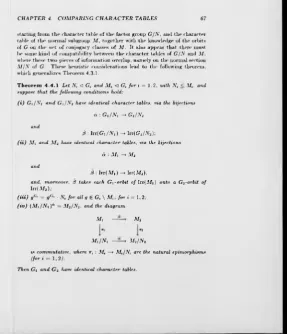
D e fin itio n 2 .7 .1 Let G\, G2 be finite, groups. We will say that G1 and G2 have identical character tables i f there exist bijections
a \ G\ —* G2
and
/ ? : I r r ( G , ) - I r r ( G 2),
such that
X0(9a ) = X(9) f ° r d l 9 € G\ and f o r all \ € Irr(Gi).
We shall also say that (a , ft) is a character table isomorphism from G to H .
Chapter 3
Looking for a counterexample
3.1
In trodu ction
The work o f this thesis began as an attempt to prove that the character table o f a soluble group G determines the derived length of G. Our exposition will follow this approach, and thus this chapter begins with the following conjecture, which will eventually turn out to be false.
C o n je c tu r e 3 .1 .1 Let G and H be groups with identical character tables and assume that G is metubelian. Then H is metabelian.
We shall disprove this conjecture by exhibiting a counterexample. But what could such a counterexample look like? Let us choose a counterexam ple ( G ,H ) to Conjecture 3.1.1 with |G| minimal and let (a , 0 ) be a char acter table isomorphism from G to H . Then H " is the unique minimal normal subgroup o f H. In fart, if this were not true, H would have some non-trivial normal subgroup A' with H " £ K . But then the factor groups G / K , where K = K a~ , and H /K would have identical character tables, and ( H / K )" = H "K / K ± 1; hence (G /A \ H / K ) would be a counterexample to our conjecture with |G/A'| < |G|, a contradiction. Thus H " is the unique minimal normal subgroup o f H. Since G and H have isomorphic lattices of normal subgroups, the subgroup (H " ) a , which we will henceforth call AT, is the unique minimal normal subgroup o f G.
Hence N and H " are elementary abelian p- groups for some prime p, and o f course they are isomorphic as they have the same order (because o is a
CH APTER 3. LOOKIN G FOR A COUN TEREXAM PLE 36
bijection). Throughout this chapter we shall assume that G and H are not /»-groups. More precisely, we shall consider the following hypotheses.
H y p o th e s e s 3 .1 .2 Let G and H be. groups with identical character tables via the bijections (a , 0 ). Let us assume that G and H are not nilpotent, that G is metabelian and that H " is the unique minimal normal subgroup o f H . Thus N = (H ")n is the unique minimal normal subgroup o f G, and in particular N and H " are elementary abelian p-groups f o r some prime p.
Under these hypotheses we shall obtain in the next section a nice descrip tion o f a minimal counterexample ( G , / f ) . Subsequently, in Chapter 6, we shall also construct a counterexample (G , H ) with G and H uilpotent.
3.2
S tru ctu re o f a m inim al cou n terexa m p le
L e m m a 3.2.1 Assume Hypotheses 8.1.2. Then
( i ) G' and H ' are p-groups;
(it) G' has a complement W X Q in G and H' has a complement W X Q in H . where W , H are (abelian) p-groups and Q. Q are cyclic p'-groups; ( i i t ) Q acts regularly on G ' and Q acts regularly on H ';
( i v ) Q acts faithfully and irreducibly on N by conjugation and Q acts faith fully and irreducibly on H " by conjugation;
( v ) C W(G ') = 1 and C w (H ') = 1.
P r o o f Since the Fitting subgroup F(G') o f G is nilpotent, each Sylow sub group o f F(G ) is normal in F (G ) and hence in G. But G has a unique minimal normal subgroup N , which is a /»-group; hence F (G ) is a /»-group.
We have G' < F (G ). Let P be a Sylow /»-subgroup o f G. Then from G ' < F (G ) < P it follows that P < G and hence F (G ) = P . Let us put P = P a . Because o is a bijection, P is a Sylow /»-subgroup of H and of course H ' < P < H. Thus both G and H have a normal Sylow /»-subgroup, which contains the derived subgroup, and assertion (») is proved.
CHAPTER 3. LOOKIN G FOR A COUN TEREXAM PLE 37
nilpotent. Since G and H are soluble groups, we have C<-,-(F(G)) < F(G') and Ch(F (H )) < F (H ) (see [10, Kapitel III, Satz 4.2]); in particular it follows that Cq(P ) = 1 and C <j(P) = 1.
Now we shall prove that Q acts regularly on G'. Let K be a uon-trivial subgroup of Q . Then, according to Lemma 2.1.1, we have G' = [G',K\ X C c ( K ) . Since [G '.A '] = [G '.G 'K ] and C a.(K ) = C c .(G 'A ') are normal subgroups o f G . and since G has the unique minimal normal subgroup N , either [G',K'\ or Cg' ( K ) is trivial. Assume for a contradiction that [G', A'] is trivial. Then we have [P. A', A'] = 1, whence [P, A'] = 1 according to Lemma 2.1.1. This contradicts the fact that Cq(P ) = 1; we conclude that Cg' ( K ) = 1 and [G', A'] = G'. Thus Q acts regularly on G'.
Now let us prove that Q acts regularly on H '. W e cannot apply the same argument as for G, because H ' is not abelian. But since (|P|. |Q|) = 1, asserting that Q acts regularly on G ' is equivalent to saying that all nontrivial coujugacy classes of G contained in G ' have length a multiple of |Q|. From the fact that the bijection « sends each conjugacy class o f G contained in G ' onto a conjugacy class o f H contained in H' , we deduce that all nontrivial coujugacy classes o f H contained in H ' have length a multiple of |Q| = |Q|. This fact in turn is equivalent to saying that Q acts regularly on H '. Thus assertion (in ) is proved. Furthermore, we have that H ' = \H',Q\Ch'(Q ), according to Lemma 2.1.1 again. Since Ch'(Q ) = 1. it follows that [H', Q] = H'.
Now let us put W = C /»(Q ) and W = C p (Q ). We have P = [P, Q ]C/»(Q ). Since G ' = [G ',i? ] < [P,Q ] < G ', we have [P,Q] = G ', and thus P = G 'W . From G'C\W = G'C\Cp(Q) = Cg'(Q ) = 1 it follows that W is a complement for G ' in P. Now W is centralized by Q\ consequently, W Q — W x Q is a complement for G' in G. We obtain similarly that VVr is a complement for H' in P and thus W Q = \V X Q is a complement for H' in H .
Now let us show that Q and Q are cyclic groups. T h e minimal normal subgroup N o f G , like any chief factor o f G, can be regarded as an irreducible FpG-module. B y restriction N can be also regarded as an F,,Q-module, and N is still irreducible as an F;,Q-module. In fact any Fp(^-submodule o f N is an F;,G-submodule, because G = P Q and N < Z (P ). Furthermore, N is a faithful FpQ-m odule, because Q acts regularly on G ', and in particular on N. According to Theorem 2.3.1 then Q is cyclic o f order dividing |iV| — 1.
CH APTER 3. LOOKIN G FOR A COUN TEREXAM PLE 38
faithfully and irreducibly on H " . Thus assertions ( « ) and (iv ) are proved. It remains to prove assertion (v). If the element w o f W centralized G ', then w would be central in G , because W Q is an abelian complement for G' in G. Hence (w) would be a normal subgroup o f G not containing the unique minimal normal subgroup N . Therefore w = 1. Thus we have C iv (G ') = 1. Similarly one proves that C w (H ') = 1. The proof o f the lemma is now
complete. □
Let us notice that W x Q = G/G' and W x Q = H/ H '. From the fact that G and H have identical character tables we deduce that G/G' is isomorphic to H/H'. It follows that W == W and Q ^ Q .
W e also observe, as we already said in the proof of Lemma 3.2.1, that Q and Q are non-trivial, otherwise G and H would be p-groups, contrary to Hypotheses 3.1.2. The groups W and W are not trivial either; if they were, then G would have a normal abelian Sylow p-subgroup (namely G ') and H would not (because H ' is not abelian). This would contradict the fact that G and H have the same character degrees; in fact [13, Corollary 12.34] asserts that a group has a normal abelian Sylow p-subgroup if and only if all its irreducible characters have degree not divisible by p.
3.3
C h ie f factors
We continue our analysis o f groups G and H satisfying Hypotheses 3.1.2. In the next three lemmas we shall be concerned with certain chief factors o f G and H regarded as irreducible G-groups and respectively //-grou p s by conjugation.
CH APTER 3. LOO K IN G FOR A C O U N TE REXA M PLE 39
G-isomorphic exactly when they are Q-isomorphic. Similar assertions hold for chief factors o f H regarded as //-grou p s and as Q -groups.
L e m m a 3.3.1 Assume Hypotheses 3.1.2. Then all chief fa ctors o f G below G ' are G-isomorphic.
P r o o f Let us regard the abelian normal subgroup G' o f G as a Q-group (actually a ZQ -m odule) by conjugation. In view o f the remark which precedes the lemma it suffices to show that all com position factors o f G ' are isomorphic as Q-groups.
As we said in Section 2.4, there exists a unique decom position o f G' (written additively) into the direct sum o f its Q-homogeneous components B\... B m. Now W centralizes Q\ consequently, each element o f W induces b y conjugation an automorphism of G' as a Q-group. According to what we said in Section 2.4, it follows that each B, is normalized by W , and being of course normal in G' because G' is abelian, each B, is a normal subgroup of G.
Since each non-trivial B, contains the unique minimal normal subgroup N o f G, there is a unique non-trivial B,\ consequently, G' is Q - homogeneous, that is to say, all Q-composition factors o f G ' are Q-isomorphic. □
We shall also prove that when Hypotheses 3.1.2 hold, all chief factors of H below H' are //-isom orphic. We cannot use the same arguments as for G because H' is not abelian. Hence we shall split the p roof in two parts: first we shall show that all chief factors o f H lying between H ' and H " are //-isom orphic and then that they are //-isom orphic to H " .
In order to prove the first part we shall employ the fact that G and H have identical character tables, and hence in particular isomorphic lattices o f normal subgroups.
L e m m a 3 .3 .2 Assume Hypotheses 3.1.2. Then all chief fa ctors o f H be tween H ' and H " are H-isomorphic.