Supported by the Ministry of Education, Youth and Sports of the czech republic (Projects no. MSM 6046070904) and the czech Science Foundation (grant. no. 11140 /1411/114105).
This paper is closely related to the paper entitled “Determination of management capacity”, published in the Agrarian Perspectives 2009, 54: 49–55. The paper derives from the working and publication activities from research projects of the MSM 6046070904 and the GACR 11140/1411/114105 focused on Module TM 10 – Knowledge-Based systems Design.There were several themes solved and published in terms of this research projects (besides those in the Agrarian Perspectives proceedings). The initial work was re-garding the classification of the factors of organiza-tional systems (represented by the paper “Ontogenesis – Based Organization of Knowledge” Hron 2008), in terms of the above-mentioned project, and the principles of designing organizational systems (rep-resented by the paper “Design of the Diversification Classifier for Agricultural Entrepreneurs Activities”, Hron et al. 2009). The claims of the development of a new contemporary process were implicit from that initial classification. These new processes concentrate on the optimisation of the food production control (in analytical and also in set forms) – “Control of Food Products´ Quality” (Hron and Macák 2009). Regarding the present control systems or manage-rial systems, it is necessary to consider a common attribute of a typical real system – although its output is not always reliably obtained. This was published
in a paper regarding the formalised organisational and control diagnostics (“Forecast of Demand trough the Differential Description of their Effects”, Hron and Macák 2010). A practical utilization of the basic research outputs is summarized in the monogra-phy “Creating consumer value, through control of product quality and uniqueness of product design” (Macak 2010).
Enterprises experienced significant technological and managerial changes over the last decades. The changes have been forced by various events: global competition, workforce changes, new technology, and continuously changing customers’ preferences. Enterprises must harmonize their structure and deal with the competition in an increasingly complex and vaguely understood business environment (Temponi 1999). A business organization is considered a soci-ety with growth, differentiation, hierarchical order, controls, competition, communications, relationships, etc. The business organization or enterprise is viewed as a socio-cultural system (Von Bertalanty 1968). Managers and leaders should view organizations as flexible work groups with information flow across the business functions, instead of vertically arranged discrete functions with well-defined boundaries Kim (2002) indicated that modelling of organizations in the context of a system involves many difficulties.
Adaptive organization design based on system
integration
Jan HRON, Tomas MACAK
Department of Management, Faculty of Economics and Management,
Czech University of Life Sciences Prague, Czech Republic
Abstract: During the task of projecting an adaptive organizational system whose required output value we know (for in-stance, a minimized overall loss of a system), we use the method referred to as the integration of subsystems into a control structure. As the suggestion content of this contribution is an application of adaptive system into the area of organizatio-nal arrangement of resources, it is primarily necessary to define the elements of this system. The objective of this paper is, consequently, to create, on the basis of system organization of adaptive systems, a methodology for projecting the adaptive organizational systems. Any control and adaptive organizational model could be included into the response of the environ-ment of all situational phenomena or factors which determine or influence the characteristics of an organizational and con-trol system and consequently, in its results, influence an output from the system.
These following problems are given most often in connection with the modelling of organizations in the context of a system:
– Enterprise structures have complex dynamics. Companies are organized by products, processes, hierarchical structures, matrix structures, or hybrids (Malone and Crowston 1999).
– Variables to assess the performance in organiza-tions are difficult to identify and measure, and often they are clouded by the employee and management emotions (Evans and Lindsay 2005).
– The relations between the enterprise components are difficult to identify and quantify. Descriptions are usually qualitative and subjective (Srinivasan et al. 2000).
In the transition from a Newtonian paradigm of control and the equilibrium to one of chaos and dis-equilibrium, organizations have substantially changed their structures (e.g., moving to the diverse project-based teams, advancing knowledge management, and building innovative cultures), but they have only minimally changed their leadership styles and prac-tices (Tetenbaum and Laurence 2011). The research approach to this Newtonian paradigm of control and equilibrium could be theoretically based on the combined application of control theory, operations research, and agent-based modelling (Ivanov and Sokolov 2010). Another possibility how to model the business decisive processes is the possibility to use the fuzzy logic access (Chen and Wang 2010). Originally, the term “adaptive“ signified the quality of a living substance to adapt its behaviour to the changes of the influences of the environment. At the same time, it was observed that each adaptation, as a necessary reaction of the organism to new parameters of the environment. will cause a certain loss which is being increased by repeating the process of adapta-tion (nevertheless, the rise of a loss does not need to increase) (Cernuzzi and Zambonelli 2011). At the situation when a living substance is not capable of further adaptation (for instance, as a result of the non-existence of resources necessary for covering the adaptations of an originated loss), it consequently disappears. The adaptation, however, does not occur during all manifestations of the environment but only in the case when there is a causal relationship between the responses of the environment and a sys-tem loss. This means that, in general, the adaptation is not only useless but also undesirable if the change of parameters of the environment does no cause a system loss (that is, there is no causal relationship between the environment and the loss of the system). That is why the main purpose of any adaptation is minimizing of the overall loss of the system. The
adaptation of a system is not practicable, however, whenever there is a need for its realization owing to a rising loss of a system. For the proper function of an adaptive learning system, it is necessary that this system fulfils both the conditions stated bellow (Natter and Mild 2001):
(1) system can change the state of its elements or its structure;
(2) we can influence the state of the system or the output from the system.
OBJECTIVES AND METHODOLOGY
During the task of projecting an adaptive organiza-tional system whose required output value we know (for instance, a minimized overall loss of a system), we use the method referred to as the integration of subsystems into a control structure. As the suggestion content of this contribution is an application of adap-tive system into the area of organizational arrangement of resources, it is primarily necessary to define the elements of this system. The objective of this paper is, consequently, to create, on the basis of system organization of adaptive systems, a methodology for projecting the adaptive organizational systems. Any control and adaptive organizational model could be included into the response of the environment of all situational phenomena or factors which determine or influence the characteristics of an organizational and control system and consequently, in its results, influence the output from the system. In other words, time differences of the environment responses cause a spontaneous change of the parameters of influences of the environment (not influenced by the output from the system), as a result which is necessary to modify the behaviour of a learning organizational system. If we kept the conventional marking for the controlled (required) quantity – w, and y – for the real output quantity and for the responses of the environment – v, we can formulate an adaptive organization in an axiomatic-deductive way. An organizational system is adaptive if:
(1) There is an aggregate of responses of the environ-ment in which the organization is situated Ω(v) (2) There is an aggregate of pieces of information (aims) about the required behaviour of the or-ganization Ω(v)
(3) There is an aggregate of the (actually reached) output values Ω(v)
y is determined by a change of the environment of v and a change of parameters of the system α, whereas the rules r create relations between the environment and the system.
(5) If the so-called “loss fiction“ is defined as: z = f (v, w, α), then the adaptive organization is such a system which, from the aggregate of admissible parameters of the system, seeks for such ones to conform to the target function: z (v, w, α) ≈ MIN!
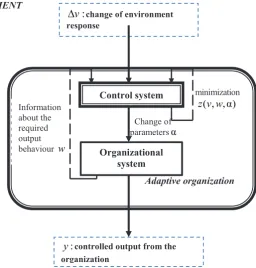
The adaptive learning organization receives the information w of how to behave in relation to the given responses of the environment v. Then it com-pares the required behaviour w to the real response of the organization y to the given responses of the environment v and tries to minimize the loss func-tion z (v, w, α). This minimization is realized by a suitable change of the parameters of the system α for such a long time until it reaches the minimum of the loss function z . This formulation results from the requirements of the practice for management of an organization or its organizational units, when these are the scores of time necessary to manage the organizations with an incomplete knowledge of an organizational and control systems and, at the same time, it is required that, after a certain time of “learning“, the management as well as the organiza-tional set up may be optimal or close to optimal. The adaptive organization characterized above may be
graphically displayed with the assistance of a block diagram in Figure 1.
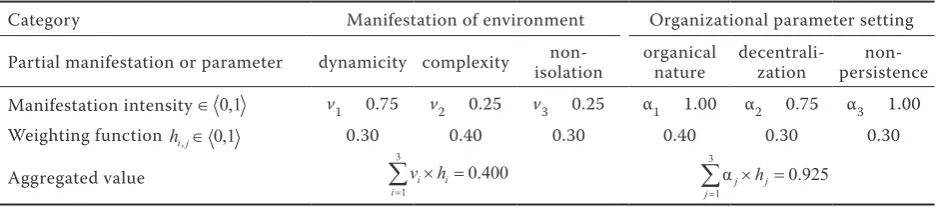
There can be formulated a task of projecting the adaptive organizational system with the use of sys-temic integration after a theoretical presentation of methodology. As an illustration, let us suppose that we are able to express the influence of the manifes-tation of the environment in an aggregated form. This would be possible providing that every partial influence of the environment is a linear function of its value and of a relevant parameter of its weighting function. Under this condition, we can, with the use of the principle of superposition, find out these influ-ences separately from the others and to determine their relevant values, sum them up (to find out the overall (aggregated) influence) with the other influ-ences (Bryant and Temponi 2009) . In the following Table 1, there are presented partial influences for determining the overall influence of the environment and the corresponding regulated quantities (project parameters of a structure).
In terms of preserving the organizational stability, the regulation should be focussed on the attenuation of a control deviation e between an input value of the manifestation of the environment v and an output setting of the project parameters α. The control devia-tion e, nevertheless, equals to the difference between the required value represented by the aggregation of the manifestations of the environment
n
i i i h v
1 and
change of environment response
ENVIRONMENT
Adaptive organization
controlled output from the organization
minimization
Control system
change of parameters
Organizational system
[image:3.595.179.436.481.750.2]information about the required output behaviour
the real (regulated) quantity, represented here by ag-gregation of the organizational setting
m
j1 j hj
α . 525 . 0 925 . 0 400 . 0 α 1 1
mj j j n
i vi hi h
e (1)
It is obvious that the regulation of the organiza-tion is performed by an efficient suggesorganiza-tion of the setting of individual parameters αj, that is why in the equation (1) we will notice the sums of products αj hj. If we transcribe these products αj × hjby the substitution of values from Table 1 and require the minimization of the control deviation, that is e = 0, we receive: 3 . 0 α 3 . 0 α 4 . 0 α α α α 4 . 0 α
0 1 1 2 2 3 3 1 2 3
1 1
h h h h h v e mj j j n
i i i
α α α 0.4 α 0.3 α 0.3
α
4 . 0
α
0 1 1 2 2 3 3 1 2 3
1 1
h h h h h v e mj j j n
i i i (2)
It is obvious from the equation (2) that one (any) of the parameters α1, α2, α3is linearly dependent on the other two. Let us choose, for instance, a variable parameter α1, that is: α1 = f (α2,α3). Then the formula (2) will be modified into the form:
α ,α
1 0.75 (α α)α1 2 3 2 3 (3)
In a similar way, we could choose also the other two variables as dependent on the remaining two variables, which is:
2 3
3 1
2 α,α 34 34 α α
α (4)
1 2
2 1
3 α α
3 4 3 4 α , α α (5)
To find the admissible values of parameters αj in the organization, we have opted in the introduction for the equation (3). Further, we know a definition scope of the values of every parameter α1, α2, α3which is formed by an interval of values from the minimal value possible 0 up to the maximal value possible 1:
1 , 0
α1 (6)
1 , 0
α2 (7)
1 , 0
α3 (8)
By connecting the relations (3) and (6), we receive an area of solutions which are suitable for the pa-rameter α1. This area of solving the parameter α1 can be marked, for instance, as Ω(α1). The area of solution Ω(α1) will be found out in conformity with the synthesis of (3) and (6) during the resolution of the inequality:
α α
175 . 0 1
0 2 3 (9)
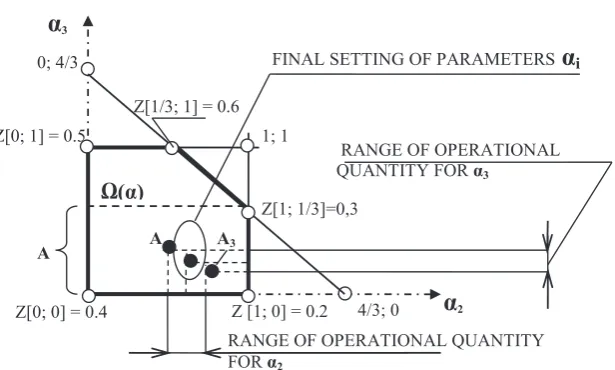
Besides the synthesis of the relations (3) and (6), we can synthesize the definition scopes of parameters α2 and α3, consequently, the formulas (7) and (8) and create in this way an area of solutions of these param-eters. This area of mutual solutions α2 together with α3 can be called Ω(α2,3). Graphically, this method is displayed in Figure 2.
In Figure 2, the area marked Ω(α) represents an aggregate of the admissible settings of parameters α1, α2, α3such ones for which the conditions of stability of an adaptive task are fulfilled. This area was created as an intersection of the aggregate of solution of the parameter α1, that is the area Ω(1), with the aggregate of the solution of the parameters α2, α3 that is the area Ω(α2,3). This area of admissible parametric settings Ω(α2,3) is represented geometrically by a polygon with the vertexes of coordinates of:
PP2,PP3
:
0,0, 0,1, 31,1,1,31,1,0
(10) [image:4.595.64.538.95.204.2]The aggregate Ω(α) presented in Figure 2 expresses all possibilities of parametric setting of the organiza-tion for which the zero control deviaorganiza-tion will be e = 0. Each of these settings, however, does not lead to the same value of the loss function z(v, w, α). The aim of the perfective phase is to find out such setting of parameters of the organization, during which a mini-mal value of loss function will be achieved. Neither the manifestations of the environment Ω(v) nor the Table 1. Partial situational influences and partial project parameters of the Alcan Packaging Ltd. organizational struc-ture
Category Manifestation of environment Organizational parameter setting
Partial manifestation or parameter dynamicity complexity isolationnon- organical nature decentrali- zation persistence
non-Manifestation intensity 0,1 v1 0.75 v2 0.25 v3 0.25 α1 1.00 α2 0.75 α3 1.00
Weighting function hi,j0,1 0.30 0.40 0.30 0.40 0.30 0.30
Aggregated value 0.400
3 1
i vi hi α 0.925
3 1
j j hj
required behaviour Ω(w) can be directly regulated; there remains the option of setting the parameters α. The evaluation of differences between the real and the required properties is, after a prior determination of an admissible aggregate Ω(α) p, realized by measuring of an auxiliary (indirect) quantity – loss function. This
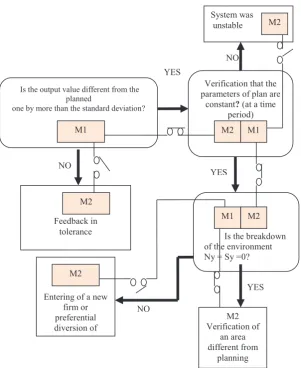
loss function consequently measures, in an indirect way, the effectiveness of parametric setting. This ef-fectiveness will grow with athe decreasing progress of the loss function. Recognition of the progress of the loss function is designed with the use of the integration between two separate systems (for instance, planning and organizational ones). The desirable interaction of these systems is ensured by the means of the already mentioned integration. This integration is schemati-cally described in Figure 3 by the means of meeting three necessary conditions of the origin of interaction between the above stated systems. For the practical interpretation (or realization), there are switching contacts inserted into the scheme of Figure 3 which represent the technical side of the realization of the interconnection of model cooperation.
In Figure 3, the planning system (e.g., for the pre-diction of revenues) is marked as M1 and the model of adaptive organization is marked as M2. To achieve a desirable interaction between both systems, it is necessary to reply positively to three questions: (1) Is the value of the real achievement distinct for
more than is the permitted deviation?
0; 0 1; 0
1; 1/3 1/3; 1
0; 1
α
2α
34/3; 0 1; 1
[image:5.595.71.285.66.234.2]0; 4/3
Figure 2. Area of admissible settings of organizational parameters of the adaptive system at the Alcan Packag-ing Ltd.
YES no
YES no YES
is the output value different from the planned
one by more than the standard deviation?
is the breakdown of the environment ny = Sy =0? Verification that the parameters of plan are
constant? (at a time period)
Feedback in tolerance
M1 M2
M2
M1
M2 M1 System was unstable M2
M2 Verification of
an area different from
planning Entering of a new
firm or preferential diversion of customers
M2
no
[image:5.595.138.440.382.751.2](2) Did the particular parameters of influences vi behave like quasi-constants during the period under consideration?
(3) Did a breakdown of the environment occur dur-ing the period under consideration (e.g., prefer-ential diversion of customers, entering of a new competitor, etc.)?
Positive answering of all these three questions rep-resents a necessary condition of the interaction of the integrated systems for planning and adaptive organiza-tion of resources. Besides the relaorganiza-tions of the inevitable conditions of connectivity of these systems (relations of conditions are represented by arrows), Figure 3 is accompanied by switching and release contacts. These contacts illustrate the mechanism of integration of these two systems. Individual conditions, which must be fulfilled, are connected in the series in the sense from the first system M1 (for planning) to the second one M2 (for adaptive optimization of organizational structure). In case the question is positively answered, there is a switching contact connected between the models, in case of a negative answer, there is a release contact. Individual conditions are connected in the seriatim fashion, they create, consequently, a conjunc-tional bond. For this reason, a purposeful interaction of these systems is practicable only in the situation when all the contacts are connected.
Based of this interaction between the planning and organizational systems, we can measure indirectly the change of the loss function. This loss function could practically be defined as a financial value of the in-crease of the error rate (scrap) from which we deduct the change of the value of overproduction owing to a higher productivity of the production process.
Pi pi i Z i Z
i p q p q
Z
(11)
where: pZi resp. ppi is an average value of the false out-put (scrap) resp. the complete overproduct in i learning period, qZi is the amount of scraps in i learning period and qpi is the amount of the complete overproduct in i learning period.
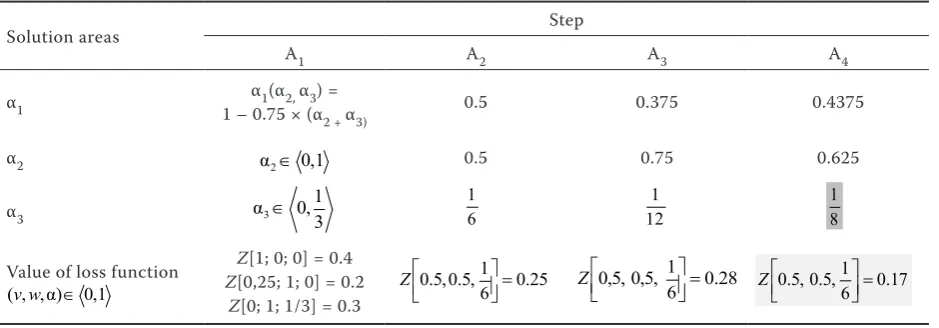
Figure 4 characterizes the procedure for finding the setting of the operational quantity represented by the values of parameters α1, α2, α3under the con-dition that there happened a purposeful integration between the planned system and the system of adap-tive organization. For the final setting of parameters represented by the point A4, it is primarily necessary in the aggregate of the admissible setting to assess Ω(α) the values of the loss function (see formula (11)), namely in a vertex of the polygon of the ag-gregate Ω(α). These experimentally identified val-ues of the loss function are stated in Table 2. After this first step, it is necessary to further limit the area Ω(α) in the sense of determining of the small-est aggregate of the parametric setting. Providing that the loss function has, between two vertexes, a monotonously increasing/decreasing development, there should be vertexes belonging to this tapered area demonstrating a lower value of the loss function than that of the other vertex at the respective side. If we decide between the vertexes of the base of the polygon, that is, between Z[0; 0] = 0.4 and Z [1; 0] = 0.2, we choose Z [1; 0], because the loss function in it reaches a lower value. If we decide between Z [1; 0] = 0.2 and Z[1; 1/3] = 0.3, we choose again Z [1; 0], pertaining to a tapered aggregate. We apply this procedure to the three remaining parts of the polygon, consequently, we choose Z[1; 1/3], where there is a lower value of loss function and Z[0; 1], where there is a lower value of l the oss function in comparison with the point Z[1/3; 1]. The
condi-z[0; 0] = 0.4 z [1; 0] = 0.2 z[1; 1/3]=0,3 z[1/3; 1] = 0.6
z[0; 1] = 0.5
α
2α
3A
4/3; 0 1; 1
0; 4/3
Ω(α)
A A3 A4
rAngE oF oPErATionAL QUAnTiTY For α2
rAngE oF oPErATionAL QUAnTiTY For α3
[image:6.595.142.450.561.746.2]FinAL SETTing oF PArAMETErS
α
ition of this overall procedure of parametric setting is a purposeful integration between the planning system and the system of adaptive organization. It is so because we perform the parametric setting in the organizational system, whereas the value of the loss function is measured at the output from the planning system.
CONCLUSION
In this paper, there is a suggestion of the integra-tion between two separately working systems, serv-ing durserv-ing its implementation into plannserv-ing and organizational tasks as managerial tools at the Alcan Packaging Ltd. In the sense of this paper, adaptation means the capability of the control and organiza-tional system, with the use of its resources, to adapt its behaviour to the changes of the environment where it realizes its transformation processes. Every adaptation represents for the system a certain loss in the form of energy, information or mass (Jenssen, 2009). During the observation of a repeated adapta-tion as a reacadapta-tion to the change of the manifestaadapta-tion of the environment, there can occur a phenomenon when we measure the value of a loss of adaptation in a system which is a different form than where we perform the adaptation. In this case, it is efficient to use a systemic integration, the design of which has been introduced in this contribution.
REFERENCES
Bryant M.O., Temponi C. (2009): Integration of business function models into an aggregate enterprise systems model. European Journal of Operational Research, 199: 793–800.
Cernuzzi L., Zambonelli F. (2011): Adaptive organizational changes in agent-oriented methodologies. Knowledge Engineering Review, 26: 175–190.
Chen T.Y., Wang H.P. (2010): A multi-criteria group deci-sion-making approach based on interval-valued intui-tionist fuzzy sets: A comparative perspective. Expert Systems with Applications, 38: 47–58.
Evans J.R., Lindsay W. (2005): The Management and Con-trol of Quality. 6th ed. Thomson-South-Western College Publishing, Cincinnati, Ohio.
Hron J. (2008): Ontogeneze v organizaci znalostí (Ontogen-esis-Based Organization of Knowledge). In: Agrární perspektivy XVII. Výzvy pro 21. Století. PEF ČZU, Praha, pp. 229–237; ISBN: 978-80-213-1813-7.
Hron J., Macák T. (2009): Control of Food Products’ Quality. Agricultural Economics – Czech, 55: 221–229. Hron J., Macák T. (2010): Forecast of demand through the
differential description of their effects. Agricultural Economics – Czech, 56: 149–158.
Hron J., Macák T., Huml J. (2009): Design of the diversifica-tion classifier for agricultural entrepreneurs activities. Agricultural Economics – Czech, 55: 565–570. Ivanov D., Sokolov B. (2010): A multi-structural framework
for adaptive supply chain planning and operations con-trol with structure dynamics considerations. European Journal of Operational Research, 200: 409-420. Jensen P.A. (2009): Design integration of facilities
manage-ment: A challenge of knowledge transfer. Architectural Engineering and Design Management, 5: 124–135. Kim S.H., Jang K.J. (2002): Designing performance analysis
and IDEFO for enterprise modeling in BPR. International Journal of Production Economics, 76: 121–134. Macák T. (2010): Vytváření spotřebitelské hodnoty
[image:7.595.66.536.84.248.2]pro-střednictvím řízení kvality výrobku a unikátnosti ná-vrhu produktu (Creating consumer value, through control of product quality and uniqueness of product design). Wolters Kluwer, Praha; ISBN 978-80-7357-570-0.
Table 2. Values of the loss function for determining the parametric setting A1– A4
Solution areas Step
A1 A2 A3 A4
α1 α1(α2, α3) =
1 – 0.75 × (α2 + α3) 0.5 0.375 0.4375
α2 α2 0,1 0.5 0.75 0.625
α3 α3 0,31 61 121 8
1
Value of loss function
1 , 0 )
α
, ,
(vw
z
Z[1; 0; 0] = 0.4 Z[0,25; 1; 0] = 0.2
Z[0; 1; 1/3] = 0.3
25 . 0 6 1 , 5 . 0 , 5 .
0
Z 0.28
6 1 , 5 , 0 , 5 ,
0
Z 0.17
6 1 , 5 . 0 , 5 . 0
Malone T., Crowston K. (1999): Tools for inventing organi-zations: toward a handbook of organizational processes. Management Science, 45: 425–443.
Natter M., Mild A. (2001): The effect of incentive schemes and organizational arrangements on the new prod-uct development process. Management Science, 47: 1029–1045.
Srinivasan S.P., Popkowski-Leszczyc P. (2000): Market share response and competitive interaction: The im-pact of temporary, evolving and structural changes in prices. International Journal of Research in Marketing, 17: 281–305.
Temponi C. (2006): Scalable enterprise systems: Quality management issues. International Journal of Production Economics, 1: 222–235.
Tetenbaum T., Laurence H. (2011): Leading in the chaos of the 21st century. Journal of Leadership Studies, 4: 41–49.
Von Bertalanty L.: (1968): General Systems Theory: Foun-dations, Development, Applications, George Braziller, New York.
Arrived on 11th November 2011
Contact address: