University of Warwick institutional repository: http://go.warwick.ac.uk/wrap
This paper is made available online in accordance with
publisher policies. Please scroll down to view the document
itself. Please refer to the repository record for this item and our
policy information available from the repository home page for
further information.
To see the final version of this paper please visit the publisher’s website.
Access to the published version may require a subscription.
Author(s): Bo Chen Xujin Chen;y Jie Hu Xiaodong Hu
Article Title: Stability vs. Optimality in Selsh Ring Routing
Year of publication: In press
Stability vs. Optimality in Selfish Ring Routing
∗
Bo Chen
aXujin Chen
b,†Jie Hu
cXiaodong Hu
baWarwick Business School, University of Warwick, Coventry CV4 7AL, United Kingdom bInstitute of Applied Mathematics, Chinese Academy of Sciences, Beijing 100190, China
cState Key Laboratory of Rail Traffic Control and Safety, Beijing Jiaotong University, Beijing 100044, China
Abstract
We study the asymmetric atomic selfish routing in ring networks, which has diverse practical ap-plications in network design and analysis. We are concerned with minimizing the maximum latency of source-destination node-pairs over links with linear latencies. We obtain the first constant upper bound on the price of anarchy and significantly improve the existing upper bounds on the price of sta-bility. Moreover, we show that any optimal solution is a good approximate Nash equilibrium. Finally, we present better performance analysis and fast implementation of pseudo-polynomial algorithms for computing approximate Nash equilibria.
1
Introduction
Recent trends in the analysis and design of network routing take into account rational and selfish behaviors
of network users. Selfish routing[23] models network routing from a game-theoretic perspective, in which
network users are viewed as independentplayersparticipating in a non-cooperative game. Each player,
with his own pair of source and destination in the network, aims to establish a communication path
(between his source and destination) along which he experiences latency as low as possible, given the link
congestion caused by all the players. In the absence of a central authority who can impose and maintain
globally efficient routing strategies on the network traffic [19], network designers are often interested in a
(pure) Nash equilibrium that is as close to the system optimum as possible, where theNash equilibrium
is a “stable state” among the players, from which no player has the incentive to deviate unilaterally. The
notion ofprice of anarchy(PoA) (resp.price of stability(PoS)) was introduced in [17] (resp. [2]) to capture
the gap between the worst (resp. best) possible Nash equilibrium and the globally optimal solution. They
respectively quantify the maximum and minimum penalties in network performance required to ensure a
stable outcome.
The PoA and PoS of selfish routing depend on, among others, the network topologies, the number
of players, the latency functions on network links, as well as the system and individual objectives. In
∗Supported in part by the NSF of China under Grant No. 10531070, 10771209, 10721101, and Chinese Academy of Sciences under Grant No. kjcx-yw-s7.
this paper, we are concerned with selfish routing in ring networks with multiple players and linear
load-dependent latencies, whose PoA and PoS are evaluated against the social objective of minimizing the
maximum latency. We denote such aselfish ring routingmodel as the SRR for short.
Motivations and related works The SRR model under consideration falls within the general
frame-work of network congestion games, which are guaranteed to admit at least one Nash equilibrium [14].
In contrast to the symmetric setting of one single strategy set for all the players [10, 13, 15, 17], the
congestion game of the SRR is asymmetric (equivalently, it is a multi-commodity game) and models
more realistic and difficult scenarios where multiple players may have different locations in the network
and thus different sets of strategies to choose from [10, 16]. As splitting the traffic usually causes the
problem of packet reassembly at the receiver and thus is generally avoided [4], the SRR model isatomic
and unsplittable[4, 7] in the sense that the unit traffic demand from a source to a destination must be
satisfied by choosing a single path between the source and the destination.
Our motivation of studying selfish routing on the ring topology is threefold. Firstly, the PoS (hence
the PoA) of selfish routing with respect to minimizing the maximum latency in general networks can be
unbounded even if all latency functions are linear, which can be demonstrated in the following example of
[image:3.595.158.441.375.417.2]an undirected network illustrated in Figure 1. An example of directed network has been provided in [9].
Figure 1. Unbounded PoS in undirected networks.
Example In the selfish routing on the undirected graph Gin Figure 1, there are in total k =h3+ 1
(h≥ 2) players 1,2, . . . , k. Each player i (1 ≤i ≤ k) sends one unit of flow along a path Pi between
nodesiand nodeti, wheres(j−1)h2+1 =s(j−1)h2+2=· · ·=sjh2 =sjandt(j−1)h2+1=t(j−1)h2+2=· · ·=
tjh2 =tj for j = 1,2, . . . , h, meaning that players 1,2, . . . , h3 are evenly partitioned into hgroups, and
allh2players in the jth group (1≤j ≤h) have (sj, tj) as their source-destination pair. Letebe a link
ofG, and xbe the number of players who useein sending their flows. The latency on eishx ife=ej
for some 1≤j≤h, andxife=e′j for some 1≤j≤h, and 0 otherwise. Playeri experiences a latency equal to the sum of latencies on edges of pathPi, 1≤i≤k. It is easy to see that the maximum latency
among all players is minimized when all players experience an identical latency ofh2in such a way that
allPi,i= 1,2, . . . , k−1, avoid usinge1, e2, . . . , eh exceptPk, which uses all of these links. On the other
hand, at any Nash equilibrium of the selfish routing, everyej (resp.e′j), 1≤j ≤h, must be contained
by at leasth−1 (resp. h2−h+ 1) paths inP
1, P2, . . . , Pk; otherwise some playeri could experience a
latency at leasth2−h+ 3 one′
j (resp. a latency at leasth2+honej), and would strictly lower his own
latency by usingej in stead ofe′j (resp.e′j in stead ofej) in his path. Thus playerkalways experiences
onGis greater thanh−1, which turns to infinity ash→ ∞. In light of this negative example, practical
(undirected) network design has to pay much attention to selecting suitable topologies so that small PoS,
as well as small PoA, can be guaranteed.
Secondly, rings have been a fundamental topology frequently encountered in communication networks,
and attract considerable attention and efforts from the research community [3, 5, 6, 8, 24, 25], especially
in design of approximation algorithms for combinatorial optimization problems. Our study of selfish
routing on the ring topology attempts not only to provide a good starting point for evaluating the PoA
and PoS in asymmetric network congestion games, but also to enhance the diversity of network topologies
amenable to the minimax criterion.
Thirdly, even in a ring, the problem of routing in response to communication requests is not trivial.
It has not been known until the present work whether the SRR admits a constant PoA. Upper bounds
of 6.83 and 4.57 on the PoS respectively with linear latency and homogenous linear latency have been
established in [9]. The authors have also proved the existence of an optimal solution which approximates
a Nash equilibrium by a factor of 54. Improving these bounds or showing their tightness is very desirable
for better quantifying the PoS and the instability of efficient solutions, which in turn will provide improved
guidelines for achieving a good balance between stability and efficiency in the SRR network design.
Main contributions With new ideas and techniques in addition to more elaborate analysis, we
con-tribute to the study of the SRR and of atomic selfish routing in multi-commodity networks [4, 20] by
prov-ing four groups of main results: (1) The PoS is at most 3.9, which reduces to 3.5 for homogenous latency;
(2) The PoA has a constant upper bound of 16; (3) Any optimal solution is a 9-approximate Nash
equi-librium (see Definition 2.2); (4) A polynomial-time combinatorial algorithm and pseudo-polynomial-time
convergence combined compute a (1,11.7)-approximate Nash equilibrium (see Definition 2.2). In
sum-mary, our work provides a strong justification on more attractive features of the ring topology compared
with general networks [12], apart from simplicity and fault-tolerance of rings in real-world applications.
Paper organization The SRR model is formally defined and some basic properties are presented in
Section 2. After evaluation of the PoS in Section 3 with improved bounds, we show in Section 4 a constant
bound on the PoA. Then we prove in Section 5 the existence of (9,1)-approximate Nash equilibria. In
Section 6 we provide algorithms for finding good approximate Nash equilibria in pseudo-polynomial time.
Finally, we conclude the paper in Section 7 with computational study of the PoS in the SRR of 2 players
and 3 players, respectively, which shows that the corresponding PoSs are 1.25 and 1.26, respectively.
2
The selfish ring routing model
This section introduces the problem formulation, as well as concepts and notation to be used in the paper.
The basic properties of Nash equilibria established will play an important role in our theoretical proofs
2.1
The model
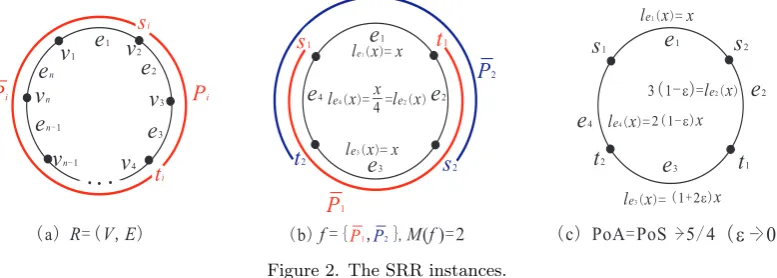
Our selfish ring routing (SRR) model is specified by a triple (R, l,(si, ti)ki=1), usually called an SRR instance. As illustrated in Figure 2, the underlying network is a ringR = (V, E), an undirected cycle,
with node setV ={v1, v2, . . . , vn}ofn nodes and link setE ={ei=vivi+1:i= 1,2, . . . , n}of nlinks,
wherevn+1=v1. By writingP ⊆R, we mean thatPis a subgraph ofR(possiblyRitself) with node set
V(P) and link setE(P). Each link e∈E is associated with a load-dependent linearlatency(function)
le(x) =aex+be, whereae,beare nonnegative constants, andxis an integer variable indicating the load
one.
Without loss of generality, allaeandbe,e∈E, are assumed to be integers. (2.1)
The latency l is said to behomogeneous if be = 0 for alle ∈ E. There are k source-destination node
pairs (si, ti), i = 1,2, . . . , k, corresponding to k players 1,2, . . . , k. Each player i (1 ≤ i ≤ k) has a
communication request for routing one unit of flow from his sourcesi∈V to his destinationti∈V, and
his strategy set consists of two internally disjoint pathsPi and ¯Piin ringRwith endssiandti satisfying
V(Pi)∩V( ¯Pi) ={si, ti}andPi∪P¯i=R,i= 1,2, . . . , k. (2.2)
We set ¯P¯i := Pi for i = 1,2, . . . , k. Different players may have the same source-destination pair, and
vertices si, ti, i = 1,2, . . . , k are not necessarily distinct. On the other hand, k ≥ 2 and si ̸= ti, i =
[image:5.595.105.494.421.560.2]1,2, . . . , k, are assumed to avoid triviality.
Figure 2. The SRR instances.
A (feasible)routing f for the SRR instance is a 0-1 functionf on multiset P :=∪ki=1{Pi,P¯i} such that
fPi+fP¯i = 1 for every i= 1,2, . . . , k. In view of the correspondence between f and player strategies adopted for the SRR instance, we abuse the notation slightly by writingf ={Q1, Q2, . . . , Qk}with the
understanding that, for each i = 1,2, . . . , k, the one unit of flow requested by player i is routed along
pathQi∈ {Pi,P¯i}, and correspondinglyf(Qi) = 1>0 =f( ¯Qi). Also we writeQi∈f fori= 1,2, . . . , k.
Each linke∈E bears a loadwith respect tof defined as the integerfe :=
∑
P∈P:e∈E(P)f(P) =|{Qi :
e∈E(Qi), i= 1,2, . . . , k}|equal the number of paths in {Q1, Q2, . . . , Qk} each of which go through e.
Every P ⊆R is associated with a nonnegative integer lP(f) :=
∑
e∈E(P)le(fe) =
∑
which indicates roughly the total latencies of links on P experienced in f. (The wording “indicates
roughly” changes to “equals” when every link of P is used by some player in the routingf.) Naturally,
the maximum latencies experienced by individuals and the system are
Mi(f) :=lQi(f) fori= 1,2, . . . , k, andM(f) :=
k
max
i=1 Mi(f), (2.3)
whereMi(f) is the(maximum) latency of playeriwith respect tof (the “maximum” can be dropped in
view that the routing is unsplittable), andM(f) is themaximum latency of the routingf. A routing f∗
isoptimalifM(f∗) is minimum among all routings for the SRR instance.
2.2
Approximate Nash equilibria
A Nash equilibrium is characterized by the property that no player has the incentive to change his strategy
unilaterally. A routingf ={Q1, Q2, . . . , Qk}is a Nash equilibriumor simply aNash routing if
lQi(f)≤
∑
e∈E( ¯Qi)
le(fe+ 1) for alli= 1,2, . . . , k. (2.4)
As a network congestion game [14], the SRR possesses at least one Nash routing whose existence can be
proved by usingpotential functionΦ, defined as follows:
Φ(f) =∑
e∈E fe
∑
x=1
le(x). (2.5)
The domain of the potential function is the set of routings for the SRR instance. For routing f =
{Q1, Q2, . . . , Qk}, reversing the summations, the potential off becomes
Φ(f) =
k
∑
i=1 ∑
e∈E(Qi) le
(
|{Qh:h≤i, e∈E(Qh)}|
)
,
from which one can easily derive the following well-known result [21, 18].
Lemma 2.1 Let routing f˜result from routing f due to a single player i changing his adopted strategy
(path). Then the following hold:
(i) Φ(f)−Φ( ˜f) =Mi(f)−Mi( ˜f).
(ii) f is a Nash routing if and only ifΦ(f)is a local minimum of Φ. 2
Definition 2.2 Let f∗ be an optimal routing and α, β ≥ 1 be two real numbers. A routing f =
{Q1, Q2, . . . , Qk}is called an α-approximate Nash routingif
lQi(f)≤α
∑
e∈E( ¯Qi)
le(fe+ 1), for alli= 1,2, . . . , k.
Whenα= 1, routingf is a Nash equilibrium, and thus also referred to as a (1, β)-Nash routing. In
the SRR instance (R, l,(si, ti)ki=1), the price of stability (PoS) is defined as the minimum β for which
(1, β)-Nash routing exists; and theprice of anarchy(PoA) is defined as the minimumβ for which every
Nash routing is a (1, β)-Nash routing. The notions of the PoS and PoA extend to the SRR problemof
all SRR instances, whose PoS (resp.PoA) is set to be the supremum of PoS (resp. PoA) over all SRR
instances.
As an example, for the SRR instance depicted in Figure 2(c), where 0 < ε < 1/2, enumeration
of all four feasible routings shows that its unique optimal routing f∗ = {s1s2t1, s2t1t2} has maximum
latency M(f∗) = 4−ε, and is a (44−−2εε,1)-approximate Nash routing, while its unique Nash routing
f = {s1s2t1, s2s1t2} has maximum latency M(f) = 5−3ε. Hence the PoA and PoS of this instance
both tend to 5/4 asεapproaches 0. In addition, the example suggests a small improvement on the lower
bound of the PoS≥8/7 for 2-player SRR stated in Theorem 2 of [9].
Remark 2.3 The price of stability is at least5/4 for the SRR problem withk= 2players.
2.3
Basic properties
We investigate Nash routings for an arbitrary SRR instance I = (R, l,(si, ti)ki=1). For anyP ⊆R and
any routingf forI, we often consider
lP(f) :=
∑
e∈E(P)
le(fe) =
∑
e∈E(P)
(aefe+be)
as the sum of
lPa(f) := ∑
e∈E(P)
aefe and lbP(f) :=
∑
e∈E(P)
be.
Define notation:
||P||a :=
∑
e∈E(P)
ae, ||P||b:=
∑
e∈E(P)
be, and ||P||:=||P||a+||P||b.
It is worth noting that the equation lb
P(f) = ||P||b always holds, though in contrast the integerlaP(f)
may be smaller or bigger than or equal to||P||a. So for any routingf we particularly have
lP(f) =laP(f) +l b P(f) =l
a
P(f) +||P||b. (2.6)
WhenP (⊆R) is a path, complementary to it is the other path ¯P ⊆Rwhose edge-disjoint union withP
formsR. In particular, we will make explicit or implicit use of the following equations in our discussion:
||P||a+||P¯||a=||R||a, ||P||b+||P¯||b=||R||b, and||P||+||P¯||=||R||. (2.7)
Throughout the paper, we denote by f▽ ={Q1, Q2, . . . , Qk} a given non-Nash routing for the SRR
1≤j ≤k,
fN ={Q¯
1, . . . ,Q¯j, Qj+1, . . . , Qk} is a Nash routing forI, and
γ:= maxji=1||Q¯i||a
||Qi||a =
||Q¯1||a
||Q1||a; sol
a
R(fN)≤max{γ,1}laR(f▽).
(2.8)
If ¯Qp =Qq for somep, qwith 1≤p̸=q≤j, then without loss of generality{p, q}={j−1, j}; it follows
thatQj−1= ¯Qj ∈fN,Qj= ¯Qj−1∈fN, and we can expressfN asfN ={Q¯1, . . . ,Q¯j−2, Qj−1, . . . , Qk}.
This contradicts the minimality ofj, and gives
{Q¯1, . . . ,Q¯j} ∩ {Q1, . . . , Qj}=∅. (2.9)
By (2.7), we see from||Q¯1||a=γ||Q1||a in (2.8) that
||Q1||a= ||
R||a
γ+ 1. (2.10)
SinceRis the edge-disjoint union ofQi and ¯Qi for everyi= 1,2, . . . , k, from (2.6), withRin place ofP,
we derive
lQ¯
i(f
N) +l Qi(f
N) =l
R(fN) =lRa(f N) +lb
R(f N) =la
R(f
N) +||R||
b fori= 1,2, . . . , k. (2.11)
Applying (2.4) to the Nash routingfN ={Q¯1, . . . ,Q¯j, Qj+1, . . . , Qk}, we obtain
lQ¯i(fN)≤lQi(f
N)+||Q
i||a fori= 1,2, . . . , j;
lQi(f
N)≤l
¯
Qi(f
N)+||Q¯
i||a fori=j+1, j+2, . . . , k.
(2.12)
With the definition ofM(fN) given by (2.3), an easy case analysis on (2.12) shows thatM(fN) is bounded
above by
1 2
(
lQ(fN) +lQ¯(fN) + max{||Q||a,||Q¯||a}
)
, forQ∈fN withlQ(fN) =M(fN),
which, in combination with (2.11), gives
M(fN)≤lR(f
N) +||R|| a
2 =
la R(f
N) +||R||
a+||R||b
2 =
la R(f
N) +||R||
2 . (2.13)
Note from (2.11) and (2.12) thatlR(fN) =lQ¯i(fN) +lQi(f
N) ≤2l Qi(f
N) +||Q
i||a fori = 1,2, . . . , j.
Thus the leftmost inequality in (2.13) implies
M(fN)≤lQi(f
N) +||Qi||a
2 +
||R||a
2 , fori= 1,2, . . . , j. (2.14)
These inequalities suggest an approach to upper boundingM(fN): getting an estimation of the smallest
lQi(f
N)+1
2||Qi||aamongi∈ {1,2, . . . , j}. Observe from (2.8) that||Q1||a = min
j
i=1||Qi||a. It is desirable
thatlQ1(f
Lemma 2.4 If positive numbers β and ρ satisfy β =M(fN)/M(f▽), l
R(f▽)≤2ρM(f▽), and β > ρ,
then the following hold:
(i) β ≤ρmax{γ,1}+||R||a/(2M(f▽)).
(ii) (βγ−β−2ρ)lQ1(f
N)≤2ρ(βγ−ρ)M(f▽) + (β+ρ)||Q1||
a+ρ||R||a−(β−ρ)||R||b.
Proof. From (2.13) we haveM(fN)≤12(lRa(f) +||R||a), which in combination of (2.8) implies (i):
β= M(f
N)
M(f▽) ≤
max{γ,1}lR(f▽) +||R||a
2M(f▽) ≤max{γ,1}ρ+
||R||a
2M(f▽).
To prove (ii), we deduce from (2.13) that lRa(fN) ≥ 2M(fN)− ||R|| = 2βM(f▽)− ||R||. Thus
lRa(fN)≥ βρlR(f▽)− ||R||which can be expressed using (2.6) as
j
∑
i=1
||Q¯i||a+
k
∑
i=j+1
||Qi||a≥
β ρ
j
∑
i=1
||Qi||a+
β ρ
k
∑
i=j+1
||Qi||a+
β
ρ||R||b− ||R||a− ||R||b.
By applying (2.7) and substituting ||R||a− ||Q¯i||a for||Qi||a, i= 1,2, . . . , j, in the above inequality we
obtain
j
∑
i=1
||Q¯i||a≥ β
ρ
(
j· ||R||a− j
∑
i=1 ||Q¯i||a
)
+
(
β ρ −1
) ∑k
i=j+1
||Qi||a+
(
β ρ −1
)
||R||b− ||R||a.
Rearranging terms in the above inequality yields
(
β ρ + 1
)∑j
i=1
||Q¯i||a ≥
(
β ρj−1
)
||R||a+
(
β ρ −1
) ∑k
i=j+1
||Qi||a+
(
β ρ −1
) ||R||b.
Sinceβ/ρ >1, ignoring the nonnegative middle term on the right-hand side and dividing both sides by
positive numberβ/ρ+ 1, we derive from the above inequality that
j
∑
i=1
||Q¯i||a≥ βj−ρ
β+ρ||R||a+ β−ρ
β+ρ||R||b. (2.15)
Let us now consider sum∑ji=1||Q¯i∩Q1||a, which equals the total contributions of paths ¯Q1,Q¯2, . . . ,Q¯j
in the Nash routingfN to the value ofla Q1(f
N). Clearly, the sum of the contributions is at least
laQ
1(f
N)− k
∑
i=j+1
||Qi||a≥lQa1(f
N)−la R(f▽),
and thus at leastla Q1(f
N)−l
R(f▽) +||R||b by (2.6). It follows fromlR(f▽)≤2ρM(f▽) that
j
∑
i=1
||Q¯i∩Q1||a≥la Q1(f
N)−2ρM(f▽) +||R||
On the other hand, sinceRis the link-disjoint union ofQ1 and ¯Q1, we have
laQ¯ 1(f
N)≥ j
∑
i=1 ||Q¯
i∩Q¯1||a ≥ j
∑
i=1 (
||Q¯
i||a− ||Q1||a
)
.
In turn, using (2.15) and||R||a = (γ+ 1)||Q1||a in (2.10), we can lower boundlaQ¯1(fN) as follows:
laQ¯1(f
N) ≥ j
∑
i=1 (
||Q¯i||a− ||Q1||a)
≥ βj−ρ
β+ρ||R||a−j· ||Q1||a+ β−ρ β+ρ||R||b
= j
(
β(γ+ 1)
β+ρ −1
)
||Q1||a−
ρ
β+ρ||R||a+ β−ρ β+ρ||R||b
≥ βγ−ρ
β+ρ
j
∑
i=1
||Q¯i∩Q1||a+(β−ρ)||R||b−ρ||R||a
β+ρ .
Furthermore, it follows from (2.16) that
laQ¯1(f
N)≥ βγ−ρ
β+ρ
(
laQ
1(f
N)−2ρM(f▽) +||R|| b
)
+(β−ρ)||R||b−ρ||R||a
β+ρ . (2.17)
Applying (2.12) and (2.6), we have
lQ1(f
N) +||Q1|| a ≥lQ¯
1(f
N) =la
¯
Q1(f
N) +||Q¯1|| b.
Combining the above inequality with (2.17) and using||R||b=||Q1||b+||Q¯1||b ≥ ||Q1||b, we deduce that
lQ1(f
N) +||Q1|| a ≥
βγ−ρ β+ρ
(
laQ1(f)−2ρM(f
▽) +||R||
b
)
+(β−ρ)||R||b−ρ||R||a
β+ρ +||
¯
Q1||b
≥ βγ−ρ
β+ρ
(
laQ1(fN)−2ρM(f▽) +||Q1||b
)
+β(||Q1||b+|| ¯
Q1||b)−ρ||R||a−ρ||R||b
β+ρ
≥ βγ−ρ
β+ρ
(
lQ1(f
N)−2ρM(f▽))+β||R||b−ρ||R||a−ρ||R||b
β+ρ
= βγ−ρ
β+ρ
(
lQ1(f
N)−2ρM(f▽))+(β−ρ)||R||b−ρ||R||a
β+ρ
Thus we obtain
(β+ρ)(lQ1(f
N) +||Q1|| a
)
≥(βγ−ρ)
(
lQ1(f
N)−2ρM(f▽))+ (β−ρ)||R||
b−ρ||R||a,
Lemma 2.5 If lR(f▽)≤8M(f▽)and||R||a≤3.5M(f▽), thenβ=M(fN)/M(f▽)≤16.
Proof. Assume to the contraryβ >16. Withρ= 4, we deduce from Lemma 2.4 that
γ= max{γ,1} ≥ β
ρ −
||R||a
2ρM(f▽)> 16
4 − 3.5
8 = 3.5625, (2.18)
(βγ−β−8)lQ1(f
N)≤8(βγ−4)M(f▽) + (β+ 4)||Q1||
a+ 4||R||a−(β−4)||R||b.
Note from (2.18) thatβγ−β−8>0, and from (2.10) that
||Q1||a= ||
R||a
γ+ 1 ≤3.5
M(f▽)
γ+ 1 .
With (2.14) we get
M(fN) ≤ lQ1(f
N) +||Q1||a
2 +
||R||a
2
≤ 8(βγ−4)
βγ−β−8M(f
▽) +( β+ 4
βγ−β−8 + 1 2
)
||Q1||a+
(
4
βγ−β−8+ 1 2
) ||R||a
≤ 8(βγ−4)
βγ−β−8M(f
▽) + β(γ+ 1)
2(βγ−β−8)·
3.5M(f▽)
γ+ 1 +
β(γ−1)
2(βγ−β−8)·3.5M(f
▽)
= 19.5βγ−64 2(βγ−β−8)M(f
▽).
As γ > 0 by (2.18), the derivative of 2(19βγ.5βγ−β−−648) with respect to β is negative for all β >0. So, using
β >16, we obtain
16< β= M(f
N)
M(f▽) ≤
19.5βγ−64 2(βγ−β−8) ≤
19.5(16γ)−64 2(16γ−16−8) =
312γ−64 32γ−48.
Now 31232γγ−−4864 >16 impliesγ <3.52, a contradiction to (2.18), proving the lemma. 2
3
Tighter bounds on the prices of stability
This section is devoted to the establishment of the following theorem.
Theorem 3.1 The price of stability of the SRR problem is at most 3.9 and is at most 3.5 if the linear
latency functions are homogenous.
To establish Theorem 3.1, we are to use a number of lemmas and theorems. Suppose we are given a
routing f▽={Q1, Q2, . . . , Qk} for an SRR instance I = (R, l,(si, ti)ki=1) and f▽ isnot a Nash routing.
strategies of other players remain the same. It follows that the SRR instance admits a routing f′ =
{Q1, . . . , Qh−1,Q¯h, Qh+1, . . . , Qk}for which we have
0≤lQ¯
h(f
▽) +||Q¯
h||a=lQ¯
h(f
′)< l
Qh(f▽)≤M(f▽), (3.1)
laR(f▽)≤lR(f▽) =lQh(f
▽) +l¯
Qh(f
▽)<2M(f▽)− ||Q¯h||a. (3.2)
SincelQ¯h(f
′)≥ ||Q¯h||andlQ
h(f▽)≥ ||Qh||, it follows from (2.7) and (3.1) that
||Qi||+||Q¯i||=||R||=||R||a+||R||b=||Qh||+||Q¯h||<2M(f▽) fori= 1,2, . . . , k. (3.3)
In the rest of this section we denote by fN an arbitrary Nash routing for the instance I. Let β =
M(fN)/M(f▽). We are to show β ≤ 3.9 for general linear latencies and β ≤ 3.5 for homogeneous latencies. To this end, we assume that
β :=M(f
N)
M(f▽) >3.5, (3.4)
on which we derive a contradiction in either case. Since fN ̸=f▽, we may assume thatfN andf▽ are
as described in Section 2.3. Observe from (3.2) and (3.4) that Lemma 2.4 applies withρ= 1, yielding
β ≤max{γ,1}+ ||R||
2M(f▽), (3.5)
(βγ−β−2)lQ1(f
N)≤2(βγ−1)M(f▽) + (β+ 1)||Q1||
a+||R||a−(β−1)||R||b. (3.6)
The combination of (3.3), (3.4), and (3.5) implies
γ >2.5. (3.7)
Lemma 3.1 la
R(fN)≤2γM(f▽)−(γ−1)||R||a.
Proof. Recall that playerhhas the incentive to change his strategy Qh in f▽ to ¯Qh (see (3.1) and the
paragraph preceding it). The linearity of the latency functions and (3.2) give
laR(fN) =laR(f▽) +
j
∑
i=1 (
||Q¯i||a− ||Qi||a)≤2M(f▽)− ||Q¯h||a+
j
∑
i=1 (
||Q¯i||a− ||Qi||a),
from which laR(fN) can be bounded above by using the maximality ofγ defined in (2.8), and by distin-guishing between two cases: h≤j orh > j. Note from (3.7) thatγ >1. If h≤j, then
laR(fN) ≤ 2M(f▽)− ||Qh||a+ (γ−1) j
∑
i̸=h,i=1 ||Qi||a
≤ 2M(f▽)−γ||Qh||a+ (γ−1)laR(f▽)
≤ 2M(f▽)−γ||Qh||a+ (γ−1)
(
2M(f▽)− ||Q¯h||a
)
= 2γM(f▽)−(γ−1)||R||a− ||Qh||a
Ifh > j, we can similarly obtain
laR(fN) ≤ 2M(f▽)− ||Q¯h||a+ (γ−1) j
∑
i=1 ||Qi||a
≤ 2M(f▽)−(γ−1)||Qh||a+ (γ−1)
(∑j
i=1
||Qi||a+||Qh||a
)
≤ 2M(f▽)−(γ−1)||Qh||a+ (γ−1)lRa(f▽)
≤ 2M(f▽)−(γ−1)||Qh||a+ (γ−1)(2M(f▽)− ||Q¯h||a)
= 2γM(f▽)−(γ−1)||R||a.
The proof is then finished. 2
Based on (3.1)–(3.7) and Lemma 3.1, we establish Theorem 3.1 with two stronger statements in
Theorems 3.2 and 3.3 below, the former dealing with the case of homogeneous latencies, and the latter
general linear latencies.
Theorem 3.2 Given any routing f for an SRR instance with homogeneous linear latency functions,
either f is a Nash routing, orM(fN)≤3.5M(f)holds for all Nash routings fN for the SRR instance.
Proof. In the case of homogeneous linear latency functions,|| · ||=|| · ||a holds, subscript and superscript
acan be dropped, and everything with subscript or superscript b is 0. If the theorem is not true, then
we must havef =f▽ as a non-Nash routing, and a Nash routingfN as studied above. From Lemma 3.1 andM(fN)≤(l
R(fN) +||R||)/2 in (2.13), we derive
M(fN)≤γM(f▽)−γ−2
2 ||R||. (3.8)
Recall from (3.7) thatγ >2.5. Thus the combination of (3.8) and (3.4) implies
γ≥β >3.5. (3.9)
Soβγ−β−2>0 is a positive number. Using it to divide both sides of the inequality in (3.6), we obtain
lQ1(f
N)≤ 2(βγ−1)
βγ−β−2M(f
▽) + β+ 1
βγ−β−2||Q1||+ 1
βγ−β−2||R||,
which implies
lQ1(f
N) + ||Q1||
2 +
||R||
2
≤ 2(βγ−1)
βγ−β−2M(f
▽) +( β+ 1
βγ−β−2 + 1 2
)
||Q1||+
(
1
βγ−β−2 + 1 2
) ||R||
= 2(βγ−1)
βγ−β−2M(f
▽) + β(γ+ 1)
2(βγ−β−2)||Q1||+
β(γ−1)
SinceM(fN)≤lQ1(f
N) +||Q1|| 2 +
||R||
2 by (2.14) and||Q1||=
||R||
γ+1 by (2.10), we obtain
M(fN)≤ 2(βγ−1)
βγ−β−2M(f
▽) + βγ
2(βγ−β−2)||R||. (3.10)
By (3.9), bothβγand (γ−2)(βγ−β−2) are positive numbers. Observe that the coefficients of||R||
in (3.8) and (3.10) are negative and positive, respectively. Let us multiply both sides of (3.8) by βγ,
multiply both sides of (3.10) by (γ−2)(βγ−β−2), and put the two resulting inequalities together. As
a result, we can cancel the terms involving||R||, and get
M(fN)
M(f▽) ≤
3βγ2−4βγ−2γ+ 4
βγ2−2βγ−2γ+ 2β+ 4,
which is true since both βγ2 −2βγ −2γ+ 2β + 4 and M(f▽) are positive as implied by (3.9) and (3.1) respectively. Observe that the right hand side of the above inequality has both numeration and
denominator positive. PluggingM(fN)/M(f▽) =β in (3.4) into the above inequality, we have
(γ2−2γ+ 2)β2−(3γ2−2γ−4)β+ 2γ−4≤0.
Notice from (3.9) thatγ2−2γ+ 2>0, we obtain
β ≤3γ
2−2γ−4 +√(3γ2−2γ−4)2−4(γ2−2γ+ 2)(2γ−4)
2(γ2−2γ+ 2) .
Consider the expression on the right hand side of the above inequality as a function λ(γ) of variable
γ ∈ (3.5,∞) (recalling (3.9)). The unique root of λ′(γ) = 0 in (3.5,∞) is γ = 4. .4562, at whichλ(γ)
attains a local maximum 3.4959. It follows that β <3.496, a contradiction to (3.9). The theorem is then
proved. 2
Theorem 3.3 Given any routing f for an SRR instance, either f is a Nash routing, or M(fN) ≤
3.9M(f)holds for all Nash routings fN for the SRR instance.
Proof. Suppose f = f▽ is not a Nash routing, and there exists a Nash routing fN such that the (in)equalities in (3.1)–(3.7) and Lemma 3.1 are all satisfied. From (2.13) and Lemma 3.1, we obtain
M(fN)≤γM(f▽)−γ−1
2 ||R||a+ 1 2||R||.
Using||R||<2M(f▽) in (3.3), we get an analogue to (3.8):
M(fN)≤(γ+ 1)M(f▽)−γ−1
2 ||R||a. (3.11)
Sinceγ >1 by (3.7) andβ =M(fN)/M(f▽) by (3.4), the inequality in (3.11) further enables us to work
on the following (from which we will derive a contradiction):
Henceβγ−β−2 is positive, which allows us to divide both sides of the inequality in (3.6) byβγ−β−2,
and obtain
lQ1(f
N)≤ 2(βγ−1)
βγ−β−2M(f
▽) + β+ 1
βγ−β−2||Q1||a+
||R||a−(β−1)||R||b
βγ−β−2 .
It follows from (2.14) that
M(fN) ≤ lQ1(f
N) +||Q1||a
2 +
||R||a
2
≤ 2(βγ−1)
βγ−β−2M(f
▽) +( β+ 1
βγ−β−2 + 1 2
)
||Q1||a+
||R||a−(β−1)||R||b
βγ−β−2 +
1 2||R||a
= 2(βγ−1)
βγ−β−2M(f
▽) + β(γ+ 1)
2(βγ−β−2)||Q1||a+
β(γ−1)
2(βγ−β−2)||R||a−
β−1
βγ−β−2||R||b.
Notice from (3.12) that βγβ−−β1−2||R||b≥0, which implies
M(fN)≤ 2(βγ−1)
βγ−β−2M(f
▽) + β(γ+ 1)
2(βγ−β−2)||Q1||a+
β(γ−1)
2(βγ−β−2)||R||a.
Recalling||Q1||a= || R||a
γ+1 in (2.10), we have
M(fN)≤ 2(βγ−1)
βγ−β−2M(f
▽) + βγ
2(βγ−β−2)||R||a. (3.13)
Let us multiply both sides of (3.11) by positive number βγ, multiply both sides of (3.13) by positive
number (γ−1)(βγ−β−2), and then add the resulting inequalities together. The terms involving||R||a
vanish, so we arrive at
βγM(fN) + (γ−1)(βγ−β−2)M(fN)≤βγ(γ+ 1)M(f▽) + (γ−1)·2(βγ−1)M(f▽).
SinceM(fN) =βM(f▽) by (3.4), the above inequality is equivalent to
(βγ2−βγ−2γ+β+ 2)·βM(f▽)≤(3βγ2−βγ−2γ+ 2)M(f▽).
Dividing both sides of the inequality by the positive numberM(f▽) (recall (3.1)), we get
(γ2−γ+ 1)β2−(3γ2+γ−2)β+ 2γ−2≤0.
By (3.12),γ2−γ+ 1>0, which enforces
β≤ 3γ
2+γ−2 +√(3γ2+γ−2)2−4(γ2−γ+ 1)(2γ−2)
2(γ2−γ+ 1) =:λ(γ).
The unique root ofλ′(γ) = 0 in interval (2.9,∞) (recalling (3.12)) isγ = 2. .46, at which λ(γ) attains a
local maximum 3.89. It follows thatβ <3.9, a contradiction to (3.12). The theorem is established. 2
Putting an optimal routing in place off in Theorems 3.2 and 3.3, we immediately obtain the following
Corollary 3.4 Given any SRR instance, either every optimal routing is a Nash routing, or the price of
anarchy of the instance is at most3.9, and at most3.5 if all linear latency functions are homogeneous.
4
A constant upper bound on the price of anarchy
Further to Corollary 3.4, a universal constant upper bound on the PoA of all SRR instances is established
in this section.
Theorem 4.1 The price of anarchy of the SRR problem is at most 16.
Proof. Consider an arbitrary Nash routing fN for an SRR instance I = (R, l,(si, ti)ki=1). For any
subgraphs P and Q of the ring R, by P ∪Q(resp. P∩Q) we mean the subgraph of R with node set
V(P)∪V(Q) (resp. V(P)∩V(Q)) and link set E(P)∪E(Q) (resp. E(P)∩E(Q)). ClearlyI admits
an optimal routingf∗ that is irredundant in the sense that any two paths P, Q ∈ f∗ with P ∪Q =R
are link-disjoint. Set β := M(fN)/M(f∗). It suffices to show β ≤ 16. To this end, we may assume
f∗=f▽̸=fN as described in Section 2.3, as otherwiseβ= 1 and we are done.
If some ¯Qg and ¯Qh with 1 ≤ g < h ≤ j are link-disjoint, then Qg ∪Qh = R, and since f▽ is
irredundant, it must be the case that ¯Qg=Qhand ¯Qh=Qg, a contradiction to (2.9). Hence
E( ¯Qg)∩E( ¯Qh)̸=∅ for all 1≤g < h≤j. (4.1)
With (2.11), we may assume
lQi(f
N) +l
¯
Qi(f
N) =l
R(fN)>16M(f▽) for all i= 1,2, . . . , k, (4.2)
as otherwise (2.3) impliesM(fN)≤l
R(fN)≤16M(f▽) givingβ≤16. By definition,||Qi|| ≤lQi(f▽)≤ M(f▽) for alli= 1,2, . . . , k. For the Nash routingfN, we deduce from (2.12) and (4.2) that
lQi(f
N
)≥lQ¯i(f
N
)−M(f▽) andlQi(f
N
)≥lQ¯i(f
N)+l Qi(f
N)−M(f▽)
2 >7.5M(f
▽) for 1≤i≤j. (4.3)
If some Qg with 1 ≤g ≤j is link-disjoint from ∪ij=1Q¯i, thenlQg(f
N)≤l
Qg(f▽)≤M(f▽) indicates a contradiction to (4.3). So we have
E(Qg)∩
( ∪j
i=1E( ¯Qi)
)
̸
=∅ for all 1≤g≤j; in particularj ≥2. (4.4)
It is not difficult to see from (4.1) and (4.4) that one of the following three cases (illustrated in Figure 3)
must be true:
Case 1: There exist p, q, and r with 1 ≤ p < q < r ≤ j such that ¯Qp ∪Q¯q R, ¯Qq ∪Q¯r R,
¯
Qr∪Q¯p R, and ¯Qp∪Q¯q∪Q¯r=R.
Case 2: There existpandqwith 1≤p < q≤j such that ¯Qp∪Q¯q =R.
Case 1
-Qp
Q
-
q-Qp
Q
-
qCase 3
-Qp
-Q
-
qQ
-
r-Qp
Case 2
[image:17.595.130.471.101.189.2]Figure 3. Possible configurations offN whenlR(fN)>16M(f▽). Our case analysis goes as follows:
Case 1. It is easy to see thatQp∪Qq∪Qr=R, which implies
||R||a≤ ||R|| ≤lR(f▽)≤lQp(f
▽) +l
Qq(f
▽) +l
Qr(f
▽)≤3M(f▽).
Hence Lemma 2.5 guaranteesβ ≤16 as desired.
Case 2. Notice that ¯Qp ⊇Qq and ¯Qq is the link-disjoint union of ¯Qp∩Q¯q andQp. It follows from (4.3)
thatlQp(f
N)≥l
¯
Qp(f
N)−M(f▽)≥l Qq(f
N)−M(f▽)≥l
¯
Qq(f
N)−2M(f▽),yielding
lQ¯p∩Q¯q(fN) =lQ¯q(fN)−lQp(f
N)≤2M(f▽). (4.5)
Observe thatRis the link-disjoint union ofQp,Qq and ¯Qp∩Q¯q, implying
||R||a≤ ||Qp||a+||Qq||a+
1
2lQ¯p∩Q¯q(f
N)≤3M(f▽).
WhenlR(f▽)≤8M(f▽), Lemma 2.5 givesβ ≤16 as desired. When lR(f▽)>8M(f▽), we have
lQ¯p∩Q¯q(f▽) =lR(f▽)−lQp(f
▽)−l
Qq(f
▽)>8M(f▽)−2M(f▽) = 6M(f▽).
Let S := {Q ∈ f▽ : Q ⊆ Q¯p ∩Q¯q} denote the set of paths in f▽ all contained in ¯Qp∩Q¯q. Then
∪Q∈SQ⊆Q¯p∩Q¯q. Note that
l∪Q∈SQ(f▽) + 4M(f▽)≥lQ¯
p∩Q¯q(f
▽)>6M(f▽),
so we have
l∪Q∈SQ(f▽)>2M(f▽),
which, together with lQ¯p∩Q¯q(fN) ≤ 2M(f▽) in (4.5), enforces Q ̸∈ fN for some member Q ∈ S. So
Q = Qi belongs to S for some i with 1 ≤ i ≤ j. However, it follows from (4.5) that lQi(f
N) ≤
lQ¯p∩Q¯q(fN)≤2M(f▽) contradicting to (4.3).
Case 3. In this case∪ji=1Q¯i⊆Q¯p∪Q¯q implieslQp∩Qq(f
N)≤l
Qp∩Qq(f▽)≤lQp(f▽)≤M(f▽). SinceQq is the link-disjoint union ofQp∩Qq and a subpath of ¯Qp, we derive from (4.3) that
lQp(f
N)≥l
¯
Qp(f
N)−M(f▽) ≥ l Qq(f
N)−l
Qp∩Qq(f
N)−M(f▽)
≥ lQq(f
N)−2M(f▽)≥l
¯
Qq(f
yielding
lQ¯p∩Q¯q(f
N) =l
¯
Qq(f
N)−(l Qp(f
N)−l
Qp∩Qq(f
N))≤3M(f▽) +l
Qp∩Qq(f
N)≤4M(f▽). (4.6)
Notice that
||R||a ≤ lQp(f
▽) +l
Qq(f
▽)−l
Qp∩Qq(f
▽) +1
2lQ¯p∩Q¯q(f
N)
≤ 2M(f▽)−lQp∩Qq(f
N) +1
2
(
3M(f▽) +lQp∩Qq(f
N))≤3.5M(f▽).
Similar to Case 2, when lR(f▽)≤8M(f▽), Lemma 2.5 ensuresβ ≤ 16. WhenlR(f▽) >8M(f▽), we
have lQ¯p∩Q¯q(f▽) > 6M(f▽), and set S := {Q ∈ f▽ : Q ⊆Q¯p∩Q¯q}. Thus l∪Q∈SQ(f▽) + 2M(f▽) ≥ lQ¯p∩Q¯q(f
▽) >6M(f▽) gives l∪
Q∈SQ(f▽)> 4M(f▽), which implies Qi ∈ S for some i with 1≤ i ≤j sincelQ¯p∩Q¯q(f
N)≤4M(f▽) by (4.6). Nowl Qi(f
N)≤l
¯
Qp∩Q¯q(f
N)≤4M(f▽) contradicts to (4.3).
We are now able to conclude that β≤16 in all cases, which establishes Theorem 4.1. 2
5
Better evaluation of instability
The instance in Figure 2(c) with 0 < ε < 0.5 has the property that its unique optimal routing is a
4−ε
4−2ε-approximate Nash routing. This instability ratio approaches
7
6 as ε→ 0.5. One natural question
is: Shall the instability ratio grow infinitely when all SRR instances are taken into account? A negative
answer has been provided in [9] that every SRR instance possess an optimal routing that approximates a
Nash routing within a factor of 54. The gap between 7
6 and 54 is large, and it is substantially narrowed
down by the following theorem.
Theorem 5.1 The SRR problem admits a (9,1)-approximate Nash routing.
Proof. Consider an arbitrary instanceI= (R, l,(si, ti)ki=1) on ringR= (V, E). For any two ordered nodes
u, v ∈V, let R[u, v] denote the clockwise path inR from uto v. To simplify description, let us shrink
anye∈E withae+be= 0 into a node, which obviously has no effect on our result. The preprocessing
reduces us to the setting in which
(C1) ae+be>0 for alle∈E.
Let f∗ = {Q1, Q2, . . . , Qk} be an optimal routing for I such that its potential Φ(f∗) is minimum
among all optimal routings. Swappingsi andti if necessary, we assume
(C2) Qi is the clockwise path inR fromsi toti, i.e.,Qi=R[si, ti], for everyi= 1,2, . . . , k.
IfE(Qi)∪E(Qj) =E andE(Qi)∩E(Qj)̸=∅for some 1≤i < j≤k, then the routingf, obtained
fromf∗by replacing Qi with ¯QiandQj with ¯Qj, is optimal, and it can be deduced from condition (C1)
(C3) For all 1≤i, j≤k, eitherE(Qi)∩E(Qj) =∅ orE(Qi)∪E(Qj) Eholds.
For each playeri∈ {1,2, . . . , k}, let routingfibe obtained fromf∗by replacingQ
iwith ¯Qi. Suppose
without loss of generality that
(C4) M1(f
∗)
M1(f1)
=maxk
i=1
Mi(f∗)
Mi(fi)
.
To prove the theorem, we are to show thatf∗ is a (9,1)-approximate Nash routing forI. To this end,
we assume to the contrary that f∗ is not. By definition 2.2, we see from (C4) thatM1(f∗)>9M1(f1),
which yields
(C5) lQ¯ 1(f
∗)≤l¯
Q1(f 1) =M
1(f1)< 19M1(f∗)≤ 19M(f∗).
It follows from inequality (C5) and Theorem 2.1 that 0 < M1(f∗)−M1(f1) = Φ(f∗)−Φ(f1).
The minimality of Φ(f∗) enforces M(f1) > M(f∗). Since M1(f1) < M1(f∗) ≤M(f∗) < M(f1), we
have some i ∈ {2,3, . . . , k}, say i = 2, such that M2(f1) = M(f1) > M(f∗) ≥ M2(f∗). Note from
lQ¯1(f 1) =M
1(f1)< M(f1) =M2(f1) =lQ2(f
1) thatE(Q
1)∩E(Q2)̸=∅, and fromM2(f1)> M2(f∗)
that E(Q2)∩E( ¯Q1) ̸= ∅. If E(Q1)−E(Q2) = ∅, then E(Q2)∩E( ¯Q1) ̸= ∅ implies Q2 ! Q1, in
turn condition (C1) implies M2(f∗)
M2(f2) >
M1(f∗)
M1(f1), contradicting (C4). Hence E(Q1)−E(Q2) ̸= ∅, which
along with E(Q1)∩E(Q2) ̸= ∅ implies that Q2 has one end in V(Q1)− {s1, t1} and the other in
V( ¯Q1)− {s1, t1}. Symmetry allows us to assume without loss of generality thats2 ∈ V(Q1)− {s1, t1}
andt2∈V( ¯Q1)− {s1, t1}. Thereby we arrive at the following configuration.
(C6) Nodes s1, s2,t1 and t2 are distinct, and located on Rin clockwise order (see Figure 4(a)). Hence
lR[t2,s1](f
∗)≤l¯
Q1(f
∗)< 1
9M(f∗) by the string of inequalities in (C5).
s2 Q2
s1
t1
t2 Q1
( )a f*= {Q Q1, 2, . . . ,Qk}
( )b = {Q Q1, 2, ,Qk}
s2
s1
t1
t2
Q
-
1 -s2 s1 t1 t2 sg sh tgth
-f1
... ( )d f= {Q Q1, 2, ,Q-g, ,Q-h,...}
si sj ti
tj s2 s1 t1 t2 sg sh tg
th
Qg Qh
sg sh tg
th
Qg
Qh
... ...
[image:19.595.90.514.469.595.2]( )c f*= {Q Q1, 2,...,Qg,...,Qh,...}
Figure 4. Evaluation of instability.
As Figure 4(a-b) shows, the intersection ofQ1andQ2is the pathR[s2, t1] bearing a latencylR[s2,t1](f 1)
with respect to f1, which equals M
2(f1)−lR[t1,t2](f
1) by (C6). Since M
2(f1) =M(f1)> M(f∗) and
lR[t1,t2](f 1)≤l
¯
Q1(f 1)< 1
9M(f∗) by (C6) and (C5), we see from (C1) that
(C7) 8
9M(f∗)< M2(f 1)−l
R[t1,t2](f 1) =l
R[s2,t1](f 1)< l
R[s2,t1](f
∗)< M
1(f∗)≤M(f∗) and
lR[s1,s2](f
∗) =M
1(f∗)−lR[s2,t1](f