Original citation:
Eubanks, Dawn L. and Mumford, Michael D.. (2010) Leader errors and the influence on performance : an investigation of differing levels of impact. Leadership Quarterly, 21 (5). pp. 809-825. doi:10.1016/j.leaqua.2010.07.009
Permanent WRAP url:
http://wrap.warwick.ac.uk/44527
Copyright and reuse:
The Warwick Research Archive Portal (WRAP) makes this work of researchers of the University of Warwick available open access under the following conditions. Copyright © and all moral rights to the version of the paper presented here belong to the individual author(s) and/or other copyright owners. To the extent reasonable and practicable the material made available in WRAP has been checked for eligibility before being made available.
Copies of full items can be used for personal research or study, educational, or not-for-profit purposes without prior permission or charge. Provided that the authors, title and full bibliographic details are credited, a hyperlink and/or URL is given for the original metadata page and the content is not changed in any way.
Publisher statement:
© 2010 Elsevier, Licensed under the Creative Commons
Attribution-NonCommercial-NoDerivatives 4.0 International http://creativecommons.org/licenses/by-nc-nd/4.0/
A note on versions:
The version presented here may differ from the published version or, version of record, if you wish to cite this item you are advised to consult the publisher’s version. Please see the ‘permanent WRAP url’ above for details on accessing the published version and note that access may require a subscription.
RUNNING HEAD: ERRORS
Leader Errors and the Influence on Performance: An Investigation of
Differing Levels of Impact
Dawn L. Eubanks
University of Bath
Michael D. Mumford
The University of Oklahoma
Running Head: Errors
Journal: The Leadership Quarterly
Leader Errors and the Influence on Performance: An Investigation of
Abstract
Errors will inevitably occur when one is involved in decision making tasks with complex,
ill-defined problems. Qualitative research on this topic has illuminated the complex nature of
problems faced by many leaders and organizations as they make decisions. Although this
research has answered many questions about the nature of errors, empirical research on errors
among leaders remains scarce. To further explore this topic, 170 undergraduates were assigned
to one of five work conditions and asked to read three cases with initiating structure problems
and three cases with consideration problems while taking on the role of the CEO in the scenario.
Errors committed by leaders were examined to answer questions about how work conditions
influence errors committed. Additionally, how these errors influence performance outcomes was
also examined. Results indicated that work conditions paired with errors made by leaders
influenced levels of performance. Under certain conditions, most notably process overload,
errors led to negative performance. We also discuss the implications of these findings for
understanding the influence of work conditions on errors committed and their combined
influence on performance outcomes.
Leader Errors and the Influence on Performance: An Investigation of
Differing Levels of Impact
Being a leader is a difficult, complicated role involving planning and decision making
activities that will impact the lives of many people and organizations. These planning and
decision making activities are not taken lightly; rather organizations often institute leader
development seminars to assist in honing these skills as leaders advance in the organization
(Burke & Collins; 2005; Dexter & Prince, 2007; Fulmer, 1997; Mulec, 2005; Pepe, 2007; Yeo,
2006). Decision making is one of the most important activities a leader engages in with
numerous frameworks and recommendations to assist in developing a better process (Brousseau,
Driver & Hourihan, 2006; Rausch, 2003; Ryan, 1995; Snowdon & Boone, 2007). As leaders
advance they increasingly generate solutions to complex organizational problems. These
problems become more complex and ill-defined as they move up the organizational hierarchy
(Mumford, 2006). When developing solutions to these problems errors may occur due to the
intense pressures faced by leaders. These errors may in turn lead to problems with performance.
Therefore, this study takes a two part approach by first assessing the influence of problem type
and work conditions on errors and then measuring the influence of problem type and work
conditions paired with errors on performance.
We have chosen to look at errors in the context of planning and decision making,
applying a case-based reasoning model because cases are necessary to developing a plan (Berger
& Jordan, 1992; Patalano & Seifert, 1997) and it is often during the planning process that
It is not difficult to cite decision making errors that have occurred among executives,
many of which lead to struggling times for their companies. Finkelstein (2003) outlines the
stories of several companies that once at the top of their game, end up in disarray. Although
these case studies provide valuable information about the errors that leaders make and the
potential for failure of various companies, they do not provide an empirical look at leader errors.
Unfortunately the empirically driven studies that have been completed in this area have not
necessarily focused on complicated leader tasks. Rather, the focus of error research has been
primarily in aviation and the medical field.
There are numerous studies of errors directly related to performance outcomes that are
committed by pilots, resulting in accidents (Baker & Krokos, 2007; Li & Harris, 2006; Li,
Harris, & Chen, 2007; Xu, & Rantanen, 2007). There is also a significant body of research in the
area of medical errors; leading to the deaths of 98,000 Americans each year (Bauer & Mulder,
2007; Henry, 2000; Peters, Slovic, Hibbard, & Tusler, 2006; Veazie, 2006). In fact several error
taxonomies have been developed in the areas of aviation and medicine (Joyce, Boaden, &
Esmail, 2005; Rasmussen, 1982; 1988; Sutcliffe & Rugg, 1998; Zhang, Patel, Johnson, &
Shortliffe, 2004). While these examples show direct error-performance linkages, one could argue
that in business settings there is more distance between the error committed and the performance
outcome. In a similar contrast to aviation and medical errors, outcomes of errors in business
settings are often not readily apparent. For example, it generally takes time to go through the
business cycle and determine the impact on the bottom line. After that, a connection must be
error). Therefore, caution should be taken when generalizing the findings discussed above to
other settings, such as businesses and the errors made by leaders.
With the exception of the work by and Zhao and Olivera (2006), very little has been done
to study leader errors through experimental methods. Recently there was also a historiometric
study of leader errors by Bedell-Avers, et al. (in press). However, we are uncertain what specific
types of errors leaders commit or what effects these errors may have on problem solving. As the
concept of leader errors is somewhat complex, it is essential to first establish a definition of
errors in the leadership domain.
Error Definition
Errors are often described in reflective terms after the outcome is known. Zapf and
Reason (1994) have described errors as occurring when a goal is not reached. Additionally,
others have argued that errors be considered avoidable (e.g., Brodbeck, Zapf, Prumper, & Frese,
1993; Norman, 1981; Reason, 1990). Therefore, Zhao and Olivera (2006, p. 1013) define errors
as decisions and behaviors that “(1) result in an undesirable gap between an expected and real
state and (2) may lead to actual or potential negative consequences for organizational functioning
that could have been avoided”. Hunter, Tate, Dzieweczynski, and Bedell-Avers (in press)
proposed a new definition of leader errors as occurring when “an avoidable action (or inaction) is
chosen by a leader which results in an initial outcome outside of the leader’s original intent, goal,
or prediction”. One could argue that some errors result in larger problems than others. For
instance, there may be some errors made that have little impact or even positively influence
2005). Conversely, there may be other errors that lead to the downfall of a company. Therefore,
errors committed and subsequent performance can be seen as two separate outcomes.
Research Purpose
An experimental design was chosen for the purposes of this study given the limited
understanding of how work conditions, problem types, error types, and performance variables
would interact with one another. Providing undergraduates with scenarios in which they took on
the role of a CEO allowed us to have a high degree of control over these variables of interest.
Thus, in the current study, an attempt was made to identify what types of leader errors, made
during decision making and planning activities, lead to the most severe performance outcomes.
For this reason, both errors committed and performance outcomes were important to consider.
Additionally the type of problems encountered was also considered. In the realm of leadership
research, the questions remain as to how a leader’s cognitive framework, as molded by work
condition and problems encountered, is related to errors and what specific types of errors
subsequently lead to the poorest performance outcomes. Therefore, this project takes a two part
look at leader errors. First, part one addressed the types of errors committed based on problems
encountered and work conditions. Previous efforts in the area of human errors have reflected the
importance of work conditions on the types of errors committed. For example, Rasmussen
(1988) found that internal errors occurring during decision making and planning were related to
highly skilled activities taking place in complex work environments. As work conditions do
appear to be an important influence on errors committed (Rasmussen, 1988), understanding the
advance our understanding of this little explored leadership topic so that the most devastating
work conditions may be altered.
Second, part two addressed how these errors influence performance outcomes.
Behaviorists would claim that all errors are bad and result in punishment which is to be avoided
(Skinner, 1953). Some claim that in terms of training, if individuals are not allowed to make
mistakes, they become sheltered (Lorenzet, Salas, & Tannenbaum, 2005). While the purpose of
this article is not to hail the benefits of errors, we do hope to illustrate that all errors are not
created equally in terms of severity of consequences (Cuschieri, 2003). If there is a difference in
the expression of errors – positive, neutral, negative – it is important to realize the nature of those
errors related to negative outcomes so that they may be minimized.
Decision Making and Planning
Leader errors are often discussed as decisions made during the planning process.
Planning often involves accessing case based knowledge or schema abstracted from past
experiences and adjusting this knowledge when encountering a similar problem. Mumford,
Bedell, and Hunter (2008) describe these schematic representations as a library housing
prototypic cases along with key exceptions. The relevant cases in this “library” include
information about goals, outcomes, causes of outcomes, contingencies and restrictions, and
actions taken. This information found in the “library” and how it is then used influences
decisions that are made. Therefore decision making occurring during leaders planning processes
is relevant in the discussion of errors (Berger & Jordan, 1992; Hammond, 1990; Hershey, Walsh,
Read, & Chulef, 1990; Mumford, Schultz, & Osburn, 2002) and appropriate for the focus of this
Case Based Knowledge
Causal models are often utilized when leaders are interpreting problems and subsequently
engaging in decision making. Creativity is also often used when solving problems. Relying on
familiar causal relationships when interpreting problems may thus lead to case based errors in
creative thought (Blair & Mumford, 2007; Dailey & Mumford, 2006; Dörner & Schaub, 1994;
Hogarth & Makridakis, 1981; Licuanan, Dailey, Mumford, 2007; Mumford, Blair, Dailey,
Leritz, & Osburn, 2006; Woodman, Sawyer, & Griffin, 1993). When these familiar causal
models are being attended to, information falling outside of the extant model will be discounted
(Kuhn, 1970; Watkins, 1983). Lastly, experts tend to have multiple well-structured exemplars
from which to access relevant cases that can result in a decreased influence of new information.
However, new information may have a stronger impact if such exemplars were less well
formulated.
Although some new information may be overlooked, it is necessary for leaders to develop
strategies for handling vast amounts of incoming information. Cognitive shortcuts such as
heuristics are used to overcome the limitations of working memory. These shortcuts allow a
leader to draw from personal experience in a search for information and build an interpretive
framework (Wright, 1974; Hambrick, Finkelstein, & Mooney, 2005; Hambrick & Mason, 1984).
The resulting effect may be the likelihood that experts overlook new information in idea
generation (Mumford, et al., 2006) and it may lead to less complete solutions (Shah &
Oppenheimer, 2008). The strategies used by leaders as well as the work conditions the leaders
experience when engaging in planning and decision making activities may influence errors made
Work Conditions
Different types of errors can occur under particular working conditions which can in turn
lead to varying influences on performance. These work conditions in this study are 1) causal
relationships (the influence of case components on one another is emphasized), 2) understanding
constraints (identifying barriers to success and how to work around them is emphasized), 3)
irrelevant information (distraction information is present that falls outside the general case
framework), and 4) processing overload work conditions (vast amounts of information is
processed in a restricted amount of time). These work conditions play a significant role in
influencing decisions that are made, errors that can occur, and performance levels. For example
when leaders are faced with processing overload it is often not only the overwhelming amount of
information leaders need to synthesize before arriving at a decision, it is the short amount of time
in which this activity must occur that adds to restricted capacity. De Dreu (2003) investigated the
role of time pressure in a negotiation setting. The data from this study indicated that time
pressure hinders success by reducing our motivation to engage in systematic information
processing. Thus, we have our first hypothesis:
Hypothesis one: Leaders will make more errors under work conditions with processing
overload versus work conditions emphasizing causal relationships, understanding
constraints, or irrelevant information.
Although there is little testing of cognitive errors made by leaders, four types will be the
focus of the current effort based on previous studies of information processing among leaders.
The errors that are the focus of this study occur when making decisions during planning
information, and restricted capacity. These errors were selected for several reasons. First, each
can result from an inaccurate processing of information relating to the model of case based
reasoning. Second, there has been a discussion of these errors in cognitive processing in the
leadership literature, but they have not been examined in an empirical study. Although
conducting such a study with leaders in a more natural setting is highly desirable, initially an
experimental setting will allow for more control over these complex processes. Lastly, the
tendency to commit these errors can be manipulated in a controlled environment. We will now
examine these error types in greater detail.
Causes and Goals
Key causes and key goals are abstracted from experience when people access the mental
models related to their current situation. (Strange & Mumford, 2005). The tendency to then
impose an extant causal model on the interpretation of a current circumstance may lead to errors
in creative thought (Woodman, Sawyer, & Griffin, 1993). Moskowitz and Sarin (1983) found
that when manipulating information presented to security analysts, (i.e., causal versus
diagnostic), they found that people tended to rely on known causal relationships when assessing
a situation. This can lead to errors when these familiar causal understandings are not relevant.
Contingencies and Restrictions
The second type of error, contingencies and restrictions relates to the idea that accurate
framing of actions necessary to be successful as well as barriers to success must be present to
avoid errors. In essence, leaders need to be able to identify contingencies and restrictions they
can control or remove (Mumford et al., 2002). It is the careful assessment of restrictions that
problem, accurately identifying restrictions also directs attention to engage in the search for
significant constraints that must be overcome to achieve a successful result to a proposed
solution (Mumford, Baughman, Threlfall, Supinski, & Costanza, 1996; Mumford, Supinski,
Baughman, Costanza, & Threlfall, 1997). According to case based analysis, leader performance
will depend on the accurate framing of critical aspects of the case (Mumford, et al., 2007). When
causes and goals errors are made, the mental model the leader was relying on was not
appropriate in the current situation. However there are many instances in which these mental
models can act as shortcuts and will prove useful and result in appropriate solutions (Wright,
1974; Hambrick, Finkelstein, & Mooney, 2005; Hambrick & Mason, 1984). Conversely,
contingencies and restrictions errors contain many moving pieces (i.e. correctly identifying all
the contingencies and restrictions in a situation, rather than activating a known causal
relationship) and therefore provide more opportunities to commit an error. Thus, we have
hypothesis two:
Hypothesis two: Contingencies and restrictions errors will be committed more
frequently than causes and goals errors.
Incongruent Information
The third type of error that will be investigated is incongruent information. It can be
defined as the relevant information falling outside the individual’s interpretive framework
(Mumford, et al., 2006). As categories for organizing information become sharply defined with
respect to attributes of relevant exemplars information incongruent with their framework can be
discounted (Lee, MacGregor, Bavelas, Mirlin, Lam, & Morrison, 1988). When there is sharp
generation of new ideas are more likely due to the large numbers of concepts that people have to
work with. The challenge is that the more concepts people have to work with, the more difficult
conceptual combinations become. This becomes particularly complex, in that at times anomalous
information may be relevant to the situation while at other times may not. Judgments about the
relevance of information is influenced by both the individual’s intent and the conceptual
structures used to approach available information (Blaylock & Rees, 1984; Hilton & Swieringa,
1982; Lowe & Steiner, 1968). Because at times this incongruent information may indeed be
relevant, these errors may not have the same negative influence on performance as the other
errors described. Therefore we have hypothesis three:
Hypothesis three: Incongruent errors will result in fewer performance detriments
than causes and goals and contingencies and restrictions errors.
Restricted Capacity
Restricted capacity errors relate to the idea that overwhelming attention capacity may
result in an overly extended initial search reducing flexibility and constraining subsequent
processing activities (Mumford, Baughman, & Sager, 2003). Over time categories become
strongly structured through the availability of many well defined exemplars. Thus, the addition
of new exemplars has less impact on category structures (Mumford et al., 2003). This category of
errors occurs as a result of excessive processing demands or high workload (Ayres, 2001;
Veazie, 2006). Rather than fully exploring the library of cases, leaders settle on the first relevant
case that is activated. Because of the high-pressured nature of a leader’s job in terms of amount
of information presented and speed with which complex problems must be solved, we propose
Hypothesis four: Restricted capacity errors will occur more frequently than
causes and goals, contingencies and restrictions, or incongruent information
errors.
Performance
Evaluations of leaders can range from the perceptions of shareholders, stock prices, or
simply the bottom line. Regardless of which measures of performance are used, at some point the
decisions that the leader makes are judged. As previously discussed, these decisions are most
often related to planning activities that can set or change the course of the organization.
Restricted capacity errors may prove most detrimental because the solution may not consider the
newness and unique aspects of the current situation. Therefore the solution provided may not
fully address the problem. The result is a poor decision based on sub-optimal information
searches due to an overwhelmed attention capacity (Bukszar, 2003). This means that the
framework relied on for decision making will be inaccurate. Thus we have hypothesis five:
Hypothesis five: Restricted capacity errors will lead to more performance
problems than causes and goals errors, contingencies and restrictions errors, or
incongruent information errors.
Problem Type
Two dimensions that have been traditionally researched in leadership are that of initiating
structure and consideration. This two-dimensional taxonomy of leader behavior was developed
through a series of studies of studies at Ohio State University and University of Michigan during
the 1950’s (Fleishman, 1953; Halpin & Winer, 1957; Hemphill & Coons, 1957). Problems
different ways. For example, leaders that excel in initiating structure situations think in terms of
standards, rules regarding work duties, and consequences of reaching or not reaching goals
(Judge, Piccolo, & Ilies, 2004). When encountering this type of problem leaders may search for
rules they are aware of that have guided them in similar situations. It would appear that
deviations from these strict rules and standards would be highly visible in leaders exhibiting this
quality. Therefore, their errors may be more obvious and have stronger consequences. Given the
nature of initiating structure problems, one could conclude that there are fewer degrees of
freedom as to what decisions result in error as compared with other types of problems.
Conversely, leaders exhibiting strength in consideration have a tendency to be engaged in
concern for the welfare of others (Judge, Piccolo, & Ilies, 2004). Because consideration
problems include people-oriented, interpersonal issues that allow for greater flexibility in the
solutions that are developed, there may be a tendency for fewer performance problems to appear.
Therefore, we have our final hypothesis:
Hypothesis six: Errors occurring when working on initiating structure
problems will lead to more performance problems than errors occurring
when working on consideration problems.
Method
Sample
To test these hypotheses, 170 undergraduates were recruited from a large southwestern
university. The 69 men, 77 women and 24 gender unreported students enrolled in undergraduate
psychology courses reviewed the experiments available for extra credit and selected to
were in their freshman year. Academic ability was generally high, with Scholastic Aptitude Test
scores falling a quarter of a standard deviation above national norms for freshman entering four
year institutions.
General Procedure
Students recruited to participate in this study were asked to make a series of decisions
and develop problem solutions as if they were CEOs of companies described in the cases.
Individuals were not asked to draw conclusions about their own performance, because there is
evidence that individuals are poor at recognizing cognitive errors such as thinking, decision
making, perception, etc. (Cuschieri, 2003), rather they made decisions and developed novel
problem solutions. Work condition was assigned at random and case order was counterbalanced
to prevent ordering effects. Participants were randomly assigned to one of five work conditions;
causal relationships, understanding constraints, irrelevant information, processing overload, and
a control condition. These work conditions will be described in the upcoming sections. After
paper and pencil materials were distributed, participants signed an informed consent form. The
first half hour of this study consisted of a series of timed individual differences measures. After
completing the timed measures, some participants were provided strategies for identifying
important information in a scenario that could be used when making decisions, thus influencing
their framework and priming them for certain types of errors. Next, participants were allowed to
work through a series of six scenarios in which they were asked to take on the role of a CEO
making decisions and providing problem solutions for a company on the brink of bankruptcy as
described in the case. Questions were then presented to assess their framing of the situation
these scenarios, participants were asked to develop a creative solution to the problem that was
presented in the scenario. Once these scenarios were completed, participants completed another
set of untimed individual differences measures, were debriefed, thanked for their participation,
and dismissed. The study session lasted approximately four hours.
Individual Differences Measures
Several factors that had the potential to influence the results of our study were assessed in
a covariate battery. For example, if a person is particularly conscientious or intelligent they may
perform at higher levels than others. By including a battery of measures that could potentially
influence our results, covarying these influences out of our analysis removes variance associated
with these variables from further analyses. Thus, a true picture of performance differences above
and beyond those resulting from intelligence for example, is obtained. Based on research by
Vincent, Decker, and Mumford (2002), three cognitive capabilities believed to interact with
leadership and creative problem-solving were evaluated. These measures include divergent
thinking, expertise, and intelligence – all shown to influence creative problem-solving.
Divergent thinking was assessed using Guilford’s Consequences A Test (Guilford &
Hoepfner, 1971). This measure includes 5 questions where individuals are asked to anticipate the
outcomes of unlikely events and record them in list form (e.g. “What would be the results if
everyone lost the ability to read and write?”). Answers were scored for fluency, or the number of
unique responses recorded, and flexibility, or the number of categories that responses fall into.
This measure yielded internal consistency coefficients above .80. Evidence for the construct
validity of this measure of divergent thinking may be found in Merrifield, Guilford, Christensen,
Next, a business expertise measure was developed using a variation on the procedures
used by Scott, Lonergan, and Mumford (2005). This measure took the form of 12 background
data questions (Mumford, Stokes, & Owens, 1990) examining exposure to and involvement in
business classes and issues (e.g., “To what extent have you successfully developed a solution to a
problem at work?” or, “To what extent have you worked in a role that included management
and/or leadership?”). After scaling, these questions produced an internal consistency of .81. The
purpose of this experimental measure was to provide information about prior exposure to the
type of problem solving task used in the study.
Then, a measure of wisdom, the 3D-WS (Ardelt, 2003) was administered to participants.
This measure assesses cognitive, reflective, and affective components of wisdom. Additional
information about the reliability and validity of this instrument can be found in Ardelt (2003).
Lastly, intelligence was assessed using an analogical reasoning measure by Ruch and Ruch
(1980). This measure consists of 30 items in which the participant is presented with a series of
facts for which they must determine whether conclusions drawn are true, false, or unclear. The
test-retest reliability coefficients for this measure are in the .80s. Further evidence for the validity
of this test as an appropriate measure of intelligence can be found in Ivancevich (1976) and Ruch
and Ruch (1980).
In the next set of measures, participants completed Goldberg’s Unipolar Measure of
personality (1978) designed to assess the personality traits of neuroticism, extroversion,
openness, agreeableness, and conscientiousness. This instrument presents participants with 100
self-descriptive words (e.g. quiet, bold, kind) and they are asked to indicate on a 9-point scale
scales can be found in Reysen (2005), Saucier (2002), Conway and Peneno (1999), and Becker,
Billings, and Eveleth (1997).
Finally, participants completed a planning measure. This measure developed by Marta,
Leritz, and Mumford (2005) consists of a series of scenarios to which individuals provided
answers to planning related issues such as identification of key causes, restrictions, downstream
consequences, use of opportunistic implementation strategies, and effective environmental
scanning. These questions produced internal consistency ratings in the upper .80’s. A correlation
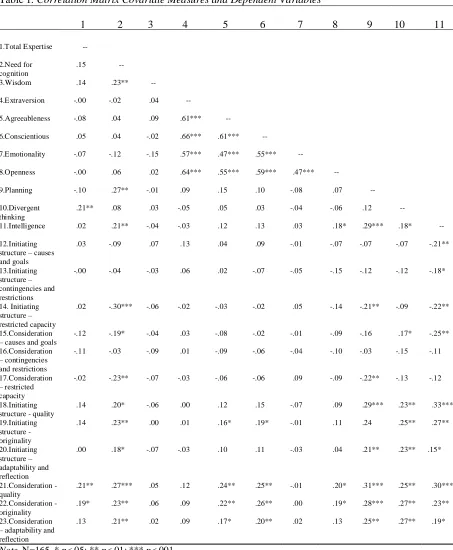
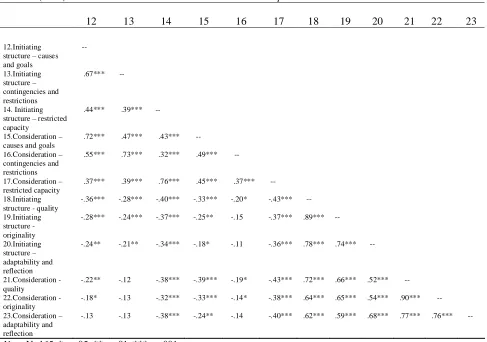
matrix can be found in Table 1 which indicates the relationships between all covariates and core
study variables.
---
Insert Table 1 About Here
---
Problem Type
Six cases were given to each participant. Three of the cases contained process oriented
(initiating structure) problems and three of the cases consisted of interpersonal (consideration)
problems. These two dimensions have been shown to account for leader emergence and
performance (Fleishman, 1953, 1973; Hemphill & Coons 1957; Shartle, 1956) and frequently
appear in leadership studies, providing the groundwork for theory development (Yukl, 2006).
Each of the cases followed a similar format regardless of problem type and were approximately 2
pages in length. Case scenarios were developed based on real companies that have faced many
challenges.
Participants were asked to operate under one of five work conditions. These work
conditions consisted of causal relationships, understanding constraints, irrelevant information,
processing overload, and a control condition in which they only received the scenarios and
questions. Each of the work conditions contained the same scenarios and two sets of questions.
Participants answered the same two sets of questions for each case. The first set included the
following two questions: 1) “What are 5-8 strengths of this company?” and 2) “What are 5-8
weaknesses of this company?” The purpose of these first two questions was to help participants
internalize the case information, but the responses were not scored. The second set included the
following 8 questions: 1) “What 5-8 unforeseen events about the case are important to
consider?”, 2) “What 5-8 limitations about the case are important to consider?”, 3) “What 5-8
details about the case are important to consider? Prioritize these details based on importance by
numbering each detail with 1 being the most important detail.”, 4) “What 5-8 key events in the
case are important to consider?”, 5) “What 5-8 desired outcomes in the case are important to
consider?”, 6) “If you were the leader of this company, what would you do?”, 7) “What kind of
actions would you take to turn this company around?”, and 8) “What kind of improvements
would you implement?” Each work condition is described in detail below.
Causal relationships. Before receiving the six cases, participants that were in the causal
relationships work condition received information in a self-paced format describing these
concepts. They then practiced identifying causes and goals in an example case. Initially,
participants were provided with definitions of causes and goals. Then they read a brief
illustration: “If you study hard for a test you are more likely to earn good grades. The cause in
scenario. There was then a short discussion about identifying causes and goals. Finally,
participants were presented with a longer scenario and asked to identify causes and goals within
the scenario. Once they had recorded their responses, they were able to review the correct
responses agreed upon by three psychologists, appearing on the next page of their materials.
Next these participants received three cases with initiating structure type problems and three
cases with consideration type problems. They were instructed to read each case and answer
question sets one and two following each scenario. These questions were consistent across all
manipulations. They proceeded through each case in the same manner until all six cases were
complete.
Understanding constraints. Upon beginning the task, participants that were in the
understanding constraints work condition received information in a self-paced format describing
the constructs of contingencies and restrictions. First, participants were provided with definitions
of these concepts. Next, they were presented with a brief illustration: “You may really want to go
out to dinner, but are trying to save money. Saving money would represent a restriction on your
desire to go out to dinner.” Then participants were allowed to practice identifying contingencies
and restrictions in an example case. Next they were presented with a small scenario. There was
then a short discussion about identifying contingencies and restrictions in the scenario. Finally,
participants were presented with a longer scenario and asked to once again identify contingencies
and restrictions. Once they had recorded their responses, they were able to review the correct
responses agreed upon by three psychologists appearing on the next page of their materials. As
was the case in the causal relationships work condition, participants received three cases with
instructed to read each case and answer question sets one and two following each scenario. They
proceeded through each case in the same manner until all six cases were complete.
Irrelevant information. Participants in the irrelevant information work condition were
also presented with six cases, three containing initiating structure type problems and three
containing consideration type problems. In this work condition, participants began the task by
reading the first case. They then responded to the two questions in the first question set to help
them absorb the case information. The questions were: 1) “What are 5-8 strengths of this
company?” and 2) “What are 5-8 weaknesses of this company?” After answering these
questions, participants received irrelevant information in the form of bullet points. This
additional information was presented as an anomaly falling outside of the general framework of
the case. After reviewing the irrelevant information, participants received question set two.
Participants then continued through this process with the remaining five cases.
Processing overload. In the processing overload work condition, participants were
presented with the same six cases as all the other manipulations, three cases contained initiating
structure type problems and three contained consideration type problems. At the beginning of the
task, participants were informed that they would be timed and were given 25 minutes to read the
material from the first case and answer all the questions. Pilot studies were conducted to
determine the average amount of time to complete this task. This amount was then reduced by
30% for individuals in this work condition to induce time pressure. Participants were notified
when they had 10 and 5, and 2 minutes left to complete each scenario, so they could manage
their time effectively. Their attention was directed to a clock so they could monitor their time.
are 5-8 strengths of this company?” and 2) “What are 5-8 weaknesses of this company?” with the
intent of internalizing the case information they had read. Next, participants were presented with
a full page of additional details about the case. Finally, participants answered question set two.
Participants continued through the remaining five cases in this manner until they were complete.
Scoring
Each error score was determined using a set of criteria. As previously noted, questions
one and two from the first question set 1) “What are 5-8 strengths of this company?” and 2)
What are 5-8 weaknesses of this company?” were not scored. The responses to questions one
through five in the second question set were 1) “What 5-8 unforeseen events about the case are
important to consider?”, 2) “What 5-8 limitations about the case are important to consider?”, 3)
“What 5-8 details about the case are important to consider? Prioritize these details based on
importance by numbering each detail with 1 being the most important detail.”, 4) “What 5-8 key
events in the case are important to consider?”, 5) “What 5-8 desired outcomes in the case are
important to consider?” were used to assess frequency and extent of each of the errors
committed. The intent of these questions was to assess the framework of those in the study. The
responses to questions six through eight 6) “If you were the leader of this company, what would
you do?”, 7)“What kind of actions would you take to turn this company around?”, and 8) “What
kind of improvements would you implement?” were used to assess performance outcomes.
Responses to these questions presented in each of the 6 cases were evaluated by the four expert
judges on a 5 point Likert scale to determine error types committed. Causes and goals errors
were scored using the following criteria: To what extent was there 1) lack of identification of
consequences, 4) emphasis on threats over opportunities, 5) over-reliance on salient information
source. All of these elements indicate an incomplete or unbalanced causal framework. In
essence, these criteria indicate an unclear understanding of the causal interactions in the case. For
example, focusing only on threats rather than also identifying opportunities indicates a limited
grasp of how threats in one area could lead to opportunities in other areas. The internal
consistency for the five elements making up this measure of causes and goals errors was .68.
Contingencies and restrictions errors were assessed using the following criteria: To what
extent does the solution 1) have quality of contingencies and restrictions (reverse scored), 2)
ignore contingencies, 3) ignore restrictions, 4) focus on wrong contingencies, 5) focus on wrong
restrictions, 6) fail to identify interactions between contingencies and restrictions. All these
elements indicate poor understanding and integration of contingencies and restrictions. The
internal consistency for the six elements making up this measure of contingencies and
restrictions errors was .71. Incongruent information errors were assessed using the following
criteria: To what extent does the solution exhibit 1) concept restriction, 2) over-reliance on
salient incongruent information, 3) discounting incongruent information, 4) failure to integrate
congruent and incongruent information, 5) over-reliance on salient congruent information. These
elements indicate poor understanding of incongruent information. For example, if a participant
has a unbalanced perception of the situation and fails to consider incongruent information or
conversely builds his or her entire solution around one piece of incongruent information, he or
she would not have considered the information presented in a balanced manner. The internal
consistency for the five elements making up this measure of incongruent information errors was
does the solution exhibit 1) failure to prioritize key information, 2) oversimplified responses, 3)
failure to organize information, 4) failure to integrate old and new case information, 5) focus on
limited amount of information. These criteria indicate that an individual has an incomplete or
restricted perception of the situation. The internal consistency for the five elements making up
the measure of restricted capacity errors was .83.
Performance Outcomes
Performance was assessed using several criteria. First creativity was evaluated using
three criteria: quality, originality, and elegance as defined by Besemer & O’Quinn (1999). In
addition, adaptability to changes in the company and reflection on mistakes made by previous
company leaders were assessed. A variation on consensual rating techniques developed by
Redmond, Mumford, and Teach (1993) was employed. Quality solutions were defined as
exceptionally logical and including all necessary elements for establishing solving this
company’s problems in a complete and coherent manner. Original solutions were defined as ones
which are clearly unique containing core elements that appear wholly original with clarity of
what it would look like for the company and what actions would need to be taken. Elegant
solutions were defined as ones in which the elements of the solution fit exceptionally well
together using only the minimum number of elements to achieve maximum effectiveness.
Adaptable solutions were defined as those that consider the changing nature of the company and
its’ environment. Solutions exhibiting Reflection were those that discuss previously committed
errors in reference to current decisions being made. See Figure 1 for example rating scales.
---
---
Rater Training
Four Ph.D. candidates in Industrial Organizational Psychology acted as expert judges to
evaluate level of error committed and performance outcomes. Before beginning the ratings, the
expert judges participated in a 20-hour session where they came to a consensus in identification
of contingencies and restrictions and incongruent information in each of the cases. These two
error types were determined to be less objective constructs for evaluation. These classifications
of information were then used as a reference to aid in the rating process.
Next, judges participated in a 40-hour training session where they practiced rating sample
participant packets representing varying levels of errors and performance outcomes. After the
first set of ratings, internal consistency coefficients were computed and feedback was provided
by one of the investigators. Judges then rated a second set of packets. After these ratings were
completed, discrepancies were discussed and decision rules were clarified. Following this
training, interrater agreement coefficients for evaluations of errors were at satisfactory levels for
causes and goals (.81), contingencies and restrictions (.68), incongruent information (.62), and
restricted capacity (.67) and for evaluations of plan quality, originality, elegance, adaptability,
and reflection were .90, .81, .70, .81, and .80 respectively. These levels were determined to be
satisfactory to ensure reliability among the raters and the remainder of the participant packets
were then evaluated.
Because the internal consistency was high between items comprising each error type,
total error type scores were computed by summing the averaged judges scores from each of the
create an error score for each error type. For example, if an individual received a 5, 5, 4, 3, and 3
for each of the elements making up restricted capacity, these scores would be summed and
divided by 5. The resulting error score for restricted capacity would be 4.
Analyses
Two sets of multivariate analyses were conducted to address the hypotheses. First, for
analysis one the effects of work condition and problem type on error severity were assessed to
test hypothesis one, two, and four. In the first analysis a MANCOVA was conducted with the
independent variables being work condition as a between subjects factor and problem type as a
within factor. The dependent variables were causes and goals, contingencies and restrictions,
incongruent information, and restricted capacity errors.
Then for the second set of analyses to test hypotheses three, five, and six, how errors
committed influence the quality, originality, elegance, adaptability, and reflection were assessed
as exhibited in the solutions developed by the participants taking on the role of the CEO of a
company in a dire situation. Because of the large number of performance variables, five for
consideration problems and five for initiating structure problems, a factor analysis was
conducted to see whether these variables could be grouped in to factors. After conducting the
factor analysis, one performance factor emerged for consideration problems and one
performance factor for initiating structure problems. See the factor analysis results in Table 2.
---
Insert Table 2 About Here
Thus, to address hypotheses three, five, and six another MANCOVA was conducted with
the independent variables being work condition and error committed as between factors and
problem type as a within factor. The performance outcome factors for consideration and
initiating structure problems made up of quality, originality, elegance, adaptability, and
reflection served as the dependent variables. Covariates were only retained if they were
significant at the .05 level for both sets of analyses otherwise they were dropped.
Results
Analysis 1 Results
General findings indicated that contingencies and restrictions errors were made more than
any other type of errors for both initiating structure cases (82) and consideration cases (93). This
finding was in support of hypothesis two as contingencies and restrictions errors were proposed
to be more likely to occur than causes and goals errors. Causes and goals errors were the second
most frequent with 47 errors for initiating structure cases and 39 errors for consideration cases,
followed by restricted capacity with 36 errors for initiating structure cases and 33 errors for
consideration cases. Therefore hypothesis four stating that restricted capacity errors would occur
more frequently than all other error types was not supported. In fact participants appeared to
perform well in regard to integrating and prioritizing all aspects of the cases. It may be that this
error did not occur as frequently as expected since work pressures normally experienced by
leaders were not in place for all work conditions. Finally incongruent information errors with a
total of only five individuals (1 for initiating structure cases and 4 for consideration cases)
committing an incongruent information error to a greater extent than the other three types of
for incongruent information errors. Thus, this variable was removed from remaining analyses.
Because of this, hypothesis three stating that incongruent information errors results in fewer
performance detriments than causes and goals and contingencies and restrictions errors was
unable to be tested.
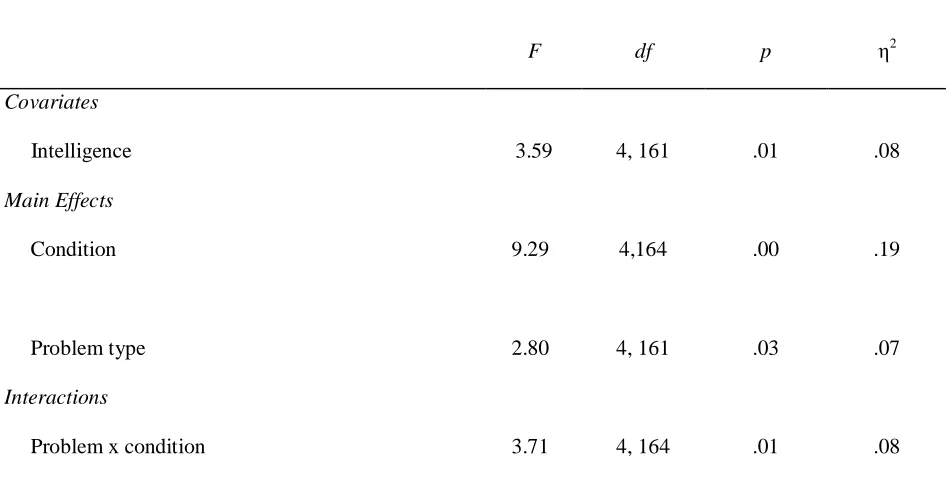
Table 3 presents the results of examining the error frequencies for initiating structure and
consideration problems. Intelligence proved to be a significant covariate F (4,161) = 3.59, p =
.01 and was retained in this analysis. The other covariates did not reach significant levels across
analyses and therefore were not retained. There were significant main effects for work condition
F (4,164) = 9.29, p < .001 and problem type F (4,161) = 2.80, p < .05. Additionally, there was a
significant interaction between problem type and work condition F (4,164) = 3.71, p = .01.
---
Insert Table 3 About Here
---
Next, a separate set of univariate analyses of covariance were conducted to determine
differences among select groups with respect to the extent to which error types were committed.
After examining the results of the ANCOVAs (see Table 4), the central findings indicated that
processing overload work conditions led to high levels of causes and goals errors, and
contingencies and restrictions errors, as compared to error levels occurring in irrelevant
information. A main effect emerged for work condition when causes and goals errors were made
F (4,164) = 7.08, p < .001, with higher levels of causes and goals errors in processing overload
work condition (M=3.31, SE=.08) versus the lowest levels of causes and goals errors when
cognition required and therefore more time needed to engage in a search for causes and goals.
Because of this, search of extant cases was highly influenced by processing overload due to lack
of time for reflection. Irrelevant information work conditions may result in more alternative
causes being revealed which may reduce causes and goals errors thereby explaining the low
levels of causes and goals errors committed.
---
Insert Table 4 About Here
---
A similar main effect for work condition was found when contingencies and restrictions
errors were made F (4,164) = 6.54, p < .001, with higher levels of contingencies and restrictions
errors during processing overload work conditions (M=3.38, SE=.06) than irrelevant information
work conditions (M=2.95, SE=.07). It appears that being in irrelevant information work
conditions did not make much difference to the causes and goals and contingencies and
restrictions errors made. These findings for contingencies and restrictions errors were similar to
those found when causes and goals errors occur in the processing overload work condition, with
more time needed to engage in the search of cases. These findings are consistent with previous
research because leaders identify causes and goals in much the same way as contingencies and
restrictions (Thomas & McDaniel, 1990; Mumford, et al., 2002).
There was a significant interaction between problem type and work condition where
contingencies and restrictions errors F (4,164) = 2.50, p = .05 were being made more in
processing overload work conditions (M=3.42, SE=.07) than in irrelevant information work
consideration problems were encountered with the processing overload work condition
producing more contingencies and restrictions errors (M=3.35, SE=.07) than the irrelevant
information work condition (M=3.01, SE=.08). Contingencies and restrictions require higher
order processing which may be the reason this is impacted to such an extent in processing
overload work conditions. There was no similar significant interaction found between problem
type, work condition, and causes and goals errors. This pattern of results supported hypothesis
one stating that errors are most often made in processing overload work conditions.
Analysis 2 Results
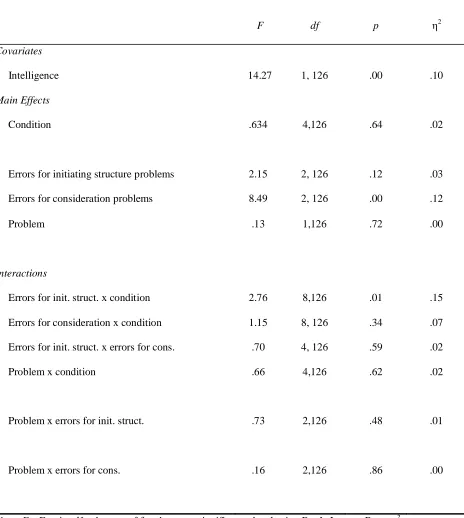
In the second MANCOVA examining the role of errors on performance outcomes in
terms of creative problem solutions, intelligence and errors in consideration type problems
yielded significant main effects F (1,126) = 14.27, p < .001, F (2,126) = 8.49, p = .001,
respectively. A significant interaction was found between work condition and errors in initiating
structure problems F (8,126) = 2.76, p < .01. These results can be seen in Table 5.
---
Insert Table 5 About Here
---
First, a significant main effect was found for individuals facing consideration problems
with restricted capacity errors negatively influencing levels of solution performance F (2,126) =
8.49, p < .001. Lower levels of solution performance were produced when restricted capacity
errors were made (M=2.01, SE=.09) than when contingencies and restrictions errors were made
(M=2.47, SE=.08). When causes and goals errors were made, performance levels were between
faced with consideration problems. Similarly, contingencies and restrictions errors also had less
effect on measures of performance than restricted capacity errors. This is in support of
hypothesis five indicating that restricted capacity errors would have the largest detriment on
performance. There was no main effect found for initiating structure problems.
Next, a significant interaction was found between errors made in initiating structure
problems and work condition on levels of performance F (8,126) = 2.76, p = .01. When
processing overload was induced, level of performance was affected with low levels of
performance when causes and goals errors were made (M=2.28, SE=.13). Even lower levels of
performance were found here when processing overload was induced and restricted capacity
errors were made (M=1.94, SE=.32). Levels of performance remained high when contingencies
and restrictions errors were committed under the same work conditions (M=3.07, SE=.18). These
findings are congruent with previous research (Mumford, Blair, Dailey, Leritz, & Osburn, 2006;
Ayres, 2001) indicating a tendency to overlook new information when capacity is limited. When
in causal relationships work conditions a similar pattern emerges with lowest levels of
performance produced when restricted capacity errors were made (M=2.21, SE=.16) followed by
contingencies and restrictions errors (M=2.35, SE=.20), and causes and goals errors (M=2.40,
SE=.32). Slightly different results were found when primed for understanding constraints, with
lower levels of performance found when causes and goals errors were committed (M=1.92,
SE=.15) than if contingencies and restrictions errors were committed (M=2.09, SE=.24). In this
instance though, performance levels were least affected when restricted capacity errors were
Interestingly, the opposite finding is the case when subjects were in irrelevant
information work conditions, higher levels of solution performance was obtained when causes
and goals errors were committed (M=2.69, SE=.26) than when contingencies and restrictions
errors were committed (M=2.00, SE=.19). When individuals committed restricted capacity
errors, their performance scores fell between those found when causes and goals errors and
contingencies and restrictions errors were made (M=2.55, SE=.22). It is apparent that thinking
about irrelevant information and incorporating incongruent information into solutions provided
assistance with performance levels when causes and goals errors were made. This was not the
case when contingencies and restrictions errors were committed and participants were in
irrelevant information work conditions.
In the control condition, levels of performance were at the lowest levels when causes and
goals errors were made (M=2.13, SE=.17) followed by restricted capacity errors (M=2.36,
SE=.13), and levels of performance were least affected when contingencies and restrictions
errors were made (M=2.45, SE=.12). In the understanding constraints work condition,
performance was also the lowest when causes and goals errors were made. In both of these work
conditions, participants were not receiving information about searching for causes and goals
within a case creating more severe outcomes when these case components were not fully
understood. Generally speaking the control condition appears to act distinctly from other work
conditions and does not simply follow a similar pattern to any of them.
Conclusions cannot clearly be drawn for hypothesis six because initiating structure
problems had significant interactions with work condition but no significant main effects, and
condition. It would therefore appear that work condition is more important to the errors
committed in initiating structure problems versus consideration problems. However we cannot
state with certainty that errors occurring when working on initiating structure problems have a
stronger negative influence on measures of performance than errors occurring when working on
consideration problems. We can merely state that work condition played a significant role in the
results for initiating structure problems, but not for consideration problems.
Discussion
Limitations
Before turning to the implications of this study, several limitations should be noted. First,
this is an experimental study where individuals were placed in particular conditions. As a result,
these findings do not necessarily speak to typical situations for leaders and caution is warranted
when generalizing these findings to understanding planning behaviors and errors occurring in
typical work environments. We believe, however, that this study provides a necessary foundation
for further study of these specific combination effects. An experimental design such as this
proved an important step to have control over the complex elements at play.
Next, this study was conducted in a university setting with undergraduates. Although,
these undergraduates were engaged and able to perform the task, few have had experience
leading an organization. Thus, the question remains as to whether these same results would be
found if the study was conducted with a group of business leaders. However, the valuable
information gained in this study will allow for the next study to take place in a more applied
setting. With the knowledge gained from this initial study, a study in an applied study setting will
not be so lengthy.
Also, although this study measured errors in terms of omission and commission, there is
some ambiguity as to the underlying thought processes for omissions that were made.
Specifically, individuals may have omitted necessary items in their responses that led to an error
being recorded. However, they may have considered including them, but made a determination
to exclude it from the problem solution. In sum, some of these thought processes may have been
better than others, but we were unable to assess them with the current study design.
Finally, in business settings it generally takes some time to measure performance
outcomes. Because of the static nature of the study, there may be more performance outcomes
that could not be considered such as longevity of the solution which could only be evaluated
many years after the decision was made.
Findings
Despite these limitations, we believe there are some noteworthy implications of this study
to the area of leadership. Specifically, we have gained a better understanding of decision making
and planning processes based on case based research. The main findings of this study indicate
that 1) leader’s work conditions and errors paired together have unique influences on
performance, 2) not all leadership errors are created equally, and 3) what a leader is not focusing
on in his or her work environment can cause performance problems.
The first finding that work condition and error in combination influence performance
promotes our understanding of the unique influence of leader’s work conditions on his or her
outcomes, rather it is work condition paired with error that influences a leader’s performance. In
effect, error acts as a moderator rather than a mediator variable in this study. This study
contributes to the gaps in the literature by providing information about how error pairings with
work conditions leaders experience influence various aspects of their performance. Key findings
indicate that there were differences in each of these error pairings based on work condition and
error type, which in turn influenced performance. Specifically the most detrimental pairings of
error and work condition in terms of solution performance include: understanding constraints
work conditions paired with causes and goals errors, processing overload work conditions paired
with restricted capacity errors, irrelevant information work conditions paired with contingencies
and restrictions errors, and causal relationships work conditions paired with restricted capacity
errors.
When working under conditions of processing overload or analyzing causal relationships,
restricted capacity errors had the most negative influence on performance in problem solutions. It
is a logical result that capacity would become restricted under work conditions of processing
overload. Although restricted capacity errors occurred less frequently than other errors they were
consistently related to performance problems. When working under conditions of analyzing
causal relationships, perhaps capacity becomes restricted because of the intense cognitive
activity involved in synthesizing the information into coherent causal relationships. Restricted
capacity errors may be particularly damaging to performance in these situations because of
mental fatigue resulting in a tendency to attempt to arrive at a solution quickly. These solutions
then are not as comprehensive or creative as they could be. This is a noteworthy finding for
were working in the irrelevant information condition, however, it was contingencies and
restrictions errors that resulted in the most performance problems. It may be that exceptional
leaders focus more naturally on contingencies and restrictions and this natural tendency is
inhibited by thinking about irrelevant information. In this instance, contingencies and restrictions
errors should certainly be taken seriously. Examining multi-level influences on leader errors and
performance outcomes would be a valuable undertaking given the current results regarding the
influence of work conditions.
The second main finding that not all leadership errors are created equally echoes previous
findings in the aviation and medical fields (Cuschieri, 2003; Keith & Frese, 2008; Lorenzet,
Salas, & Tannenbaum, 2005). Results clearly indicate that not all leadership errors are equal with
both differences in the frequency of error types committed as well as differences in performance
detriments resulting from different types of errors. In essence, it may be necessary to tolerate
error in some areas because it is not as important to ultimate performance as other errors. For
example, when causes and goals errors are made under work conditions of performance overload
or causal relationships these errors will not have much influence on performance outcomes. This
is of particular interest given the prevalence of action learning type leader development programs
in existence that generally fall into the category of causal relationships type training (Groves,
2007). Although contingencies and restrictions errors occur most frequently in this study, it is
not this error type that has the largest influence on performance problems. Identifying
contingencies and restrictions is a common topic for leadership development perhaps due to the
large number of errors occurring in this area. However perhaps leaders should not focus their
have a strong negative influence across work conditions on levels of performance. Therefore,
contingencies and restrictions errors may present an example of an error that should be
overlooked in most situations. This is noteworthy in that leaders should focus their attention on
those that have the most detrimental consequences. This has implications for our understanding
of what is truly important in the leader decision making process.
Lastly, the third main finding that what a leader is not focusing on can cause problems
has practical implications for leader development training. Therefore, it is of particular note that
in certain instances it is the aspects least emphasized that are most important for performance
and most influenced by what leaders think about. It is more accurate in general that an error is
made because of what leaders are not thinking about rather than what they are thinking about.
For example, contingencies and restrictions and causes and goals errors were most influenced by
processing overload. Perhaps this is a result of the additional time necessary to engage in an
adequate search and active analysis of cases (Licuanan, Dailey, & Mumford, 2007). This
supports the finding by Moskowitz and Sarin (1983) that individuals tend to rely on known
causal relationships when assessing a situation. When these more familiar causal understandings
are not relevant, errors are made. Similarly, in processing overload situations leaders may not
have the time to carefully assess restrictions which can be used in framing the problem. If there
is insufficient time to correctly frame the problem, task performance is negatively influenced
(Baughman & Mumford, 1995). If leaders can more quickly and accurately learn to identify
contingencies and restrictions and causes and goals when faced with processing overload, it may
Participants in the understanding constraints work condition, who were thinking about
contingencies and restrictions, had poor performance when causes and goals errors were made.
Perhaps a leader’s work condition, and subsequently where attention is directed, helps to reduce
the occurrence of some error types and the resulting performance problems. Thus, being primed
to think about contingencies and restrictions helped to avoid making contingencies and
restrictions errors, or if these errors did occur they did not cause performance problems.
Since the aspects of a case that a leader is told to focus on may not necessarily be those
that lead to improved performance, there is a need for a balanced approach. When leaders are
asked to focus on a particular aspect of a case, other aspects are inhibited. Therefore, the
resulting solution may be a more balanced type of training that focuses on many aspects
important to decision making. Given the findings, there should be more emphasis on coping with
the demands of processing overload rather than emphasis being placed on identifying causes and
goals or contingencies and restrictions. In sum, there are several noteworthy conclusions for
those involved in the development of leaders. It is not only important for trainers to realize what
they are priming leaders to think about, but also what the leader is neglecting to focus upon. It
may indeed be what the leader is neglecting that is relevant to the errors that are made rather than
precisely what aspect of the situation the leader is focusing upon.
Future Research
The results of this study suggest a number of avenues for future research. For example,
future research should study leaders working in incongruent information work conditions and
investigate why contingencies and restrictions errors hurt performance in this instance while
this study. For example, it has been demonstrated in studies of medical errors that worry is a
predictor of intentions to take precautionary actions (Peters, Slovic, Hibbard, & Tusler, 2006).
Additionally, rather than necessarily choosing the best course of action, perhaps leaders settle on
a solution that has a safety net thus remediating errors that could occur.
This study once again illuminates the importance of contextual factors in the study of
leadership. Delving into the area of leader errors and realizing that error type must be considered
in conjunction with work conditions will now allow for a study of leader errors to take place in a
business setting and take particular note of the work conditions. Gaining a greater understanding
of leader errors will not only promote our understanding of causal influences of performance
detriments, but can allow us to alter work conditions so that the negative influences on