University of Warwick institutional repository: http://go.warwick.ac.uk/wrap
This paper is made available online in accordance with publisher policies. Please scroll down to view the document itself. Please refer to the repository record for this item and our policy information available from the repository home page for further information.
To see the final version of this paper please visit the publisher’s website. Access to the published version may require a subscription.
Author(s): Arnaud Doucet, Adam M. Johansen, and Vladislav B. Tadić
Article Title: On solving integral equations using Markov chain Monte Carlo methods
Year of publication: 2009
On Solving Integral Equations using Markov
Chain Monte Carlo Methods
Arnaud Doucet
Departments of Statistics and Computer Science, University of British Columbia, Vancouver, BC, Canada
Adam M. Johansen,
Department of Statistics, University of Warwick, Coventry, UK
Vladislav B. Tadi´
c
Department of Mathematics, University of Bristol, Bristol, UK
Abstract
In this paper, we propose an original approach to the solution of Fredholm equations of the second kind. We interpret the standard von Neumann expansion of the solu-tion as an expectasolu-tion with respect to a probability distribusolu-tion defined on a union of subspaces of variable dimension. Based on this representation, it is possible to use trans-dimensional Markov Chain Monte Carlo (MCMC) methods such as Reversible Jump MCMC to approximate the solution numerically. This can be an attractive alternative to standard Sequential Importance Sampling (SIS) methods routinely used in this context. To motivate our approach, we sketch an application to value function estimation for a Markov decision process. Two computational examples are also provided.
Note: Some small corrections were made at the proof stage; the defini-tive version of this manuscript appeared as: Applied Mathematics and Com-putation, 216:2869–2889, 2010.
Key words: Fredholm equation, Trans-dimensional Markov Chain Monte Carlo, Sequential Importance Sampling, Sequential Monte Carlo.
Email addresses: [email protected](Arnaud Doucet),
[email protected] (Adam M. Johansen),[email protected]
1 Fredholm equations and Von Neumann’s Expansion
Fredholm equations of the second kind and their variants appear in many scientific fields including optimal control [1], molecular population genetics [2] and physics [3]. Formally, we are interested in solving the integral equation
f(x0) =
Z
E
K(x0, x1)f(x1)dx1+g(x0) (1)
whereg :E →Rand K :E×E →R are known andf :E →Ris unknown.
Let us define K0(x, y),1, K1(x, y),K(x, y) and
Kn(x, y),
Z
K(x, z)Kn−1(z, y)dz.
If
∞ X
n=0
Z
E
|Kn(x0, xn)g(xn)|dxn <∞ (2)
then the solution of the Fredholm equation (1) admits the following Von Neu-mann series representation; see [4,3] for details:
f(x0) =
Z
E
K(x0, x1)f(x1)dx1+g(x0)
=
Z
E
K(x0, x1)
Z
E
K(x1, x2)f(x2)dx2+g(x1)
dx1 +g(x0)
=
Z
E Z
E
K(x0, x1)K(x1, x2)f(x2)dx1dx2+
Z
E
K(x0, x1)g(x1)dy+g(x0)
and, by iterating, one obtains
f(x0) =g(x0) +
∞ X
n=1
Z
En
n Y
k=1
K(xk−1, xk) !
g(xn)dx1:n (3)
where xi:j ,(xi, . . . , xj) fori≤j.
Introducing the notation
f0(x0) = g(x0) (4)
and, for n≥1,
fn(x0:n) = g(xn) n Y
k=1
K(xk−1, xk) (5)
it is possible to rewrite (3) as
f(x0) =f0(x0) +
∞ X
n=1
Z
We will address two problems in this paper: how to estimate the function
f(x0) over the set E and how to estimate this function point-wise.
There are few scenarios in which a Fredholm equation of the second kind ad-mits a closed-form analytic solution. A great deal of effort has been expended in the development of numerical techniques for the approximate solution of such systems. These fall into two broad categories: deterministic techniques and Monte Carlo techniques. Deterministic techniques typically depend upon quadrature or explicitly obtaining a finite-dimensional representation of the system (by discretisation or projection onto a suitable basis, for example) and then solving that system using numerical techniques. Although good perfor-mance can be obtained by these methods, they typically rely upon obtaining a good finite dimensional characterisation of the solution. This remains an active area of research, see [5,6] and references within. Finding such a representation is somewhat problem-specific and is unlikely to be practical for problems in high dimensions or in which the support of the function of interest is not compact. For this reason, we concentrate on Monte Carlo approaches in the remainder of this paper.
2 Monte Carlo Methods to Solve Fredholm Equations
Computing (3) is challenging as it involves an infinite sum of integrals of increasing dimension. Monte Carlo methods provide a mechanism for dealing with such integrals. A sequential importance sampling strategy arises as a nat-ural approach to this problem and that is the approach which has been taken most often in the literature. Section 2.1 summarises this approach and pro-vides a path-space interpretation of the importance sampling which motivates the development of a novel approach in section 2.2.
2.1 Sequential Importance Sampling
2.1.1 Algorithm
The use of Monte Carlo methods to solve problems of this type can be traced back 50 years. The standard approach consists of using Sequential Importance Sampling (SIS) to numerically approximate (3); see for example [4,3]. Consider a Markov chain with initial distribution/density µ(x) on E and a transition kernel M(x, y) which gives the probability or probability density of moving to state ywhen the current state is x. We selectµand M such that µ(x)>0 over E and M(x, y) > 0 if K(x, y) 6= 0. Moreover, M is chosen to have an absorbing/cemetery state, say†∈/ E, such thatM(x,{†}) =Pdfor anyx∈E.
The algorithm which approximates the function f proceeds as follows:
• SimulateN independent Markov chain pathsnX0:(ik)(i)+1 oN
i=1until absorption
(i.e. Xk(i()i)+1 =†).
• Calculate the associated importance weights
W1
X0:(ik)(i)
= 1 µ
X0(i)
k(i)
Q k=1
K
Xk(i−)1,Xk(i)
M
Xk(i−)1,Xk(i)
g
X(i)
k(i)
Pd if k
(i) ≥1,
g
X0(i)
µ
X0(i)
Pd
if k(i) = 0.
(7)
• The empirical measure
b f(x0) =
1 N N X i=1 W1 X0:(ik)(i)
δx0−X (i) 0
(8)
is an unbiased Monte Carlo approximation of the function f (i.e. for any set A, EhR
Afb(x0)dx0
i
=R
Af(x0)dx0).
If the objective is the estimation of the functionf(x0) at a given point sayx0 =
x, then, by simulating paths nX0:(ik)(i)+1 oN
i=1 starting from X (i)
0 = x according
toM until absorption/death and using the importance weigts
W2
X0:(ik)(i)
= k(i)
Q k=1
K
Xk(i−)1,Xk(i)
M
Xk(i−)1,Xk(i)
g
X(i)
k(i)
Pd if k
(i) ≥1,
g(x)
Pd if k
(i) = 0.
(9)
we obtain the following unbiased estimate of f(x)
b
f(x) = 1
N N X i=1 W2
x, X1:(ik)(i)
2.1.2 Variance Reduction
The following technique applies to both of the algorithms introduced in the previous section. Notice that, as the probability of death at a given iteration is independent of the path sampled, it is possible to use all paths of length at least k to estimate thek-fold integral overEk. That is, the variance is reduced and the estimator remains unbiased if we replace (8) with:
e
f(x0) =
1
N N X
i=1
f W1
X0:(ik)(i)
δx0−X (i) 0
, (11)
where
f
W1(x0:k) =Pd k X
i=0
W1(x0:i). (12)
The same considerations lead us to the conclusion that we should replace (10) with:
e
f(x) = 1
N N X
i=1
f W2
x, X1:(ik)(i)
, (13)
where
f
W2(x0:k) =Pd k X
i=0
W2(x0:i). (14)
Notice that this approach leads to a reduction in the weight associated with each path by a factor of Pd, but each sample now contributes to k(i) (with expectation 1/Pd) trajectories rather than one. A related idea is used in the field of reinforcement learning [7].
Another approach can be used to further reduce the variance of estimator (10). Here the first term in the Von Neumann expansion is known deterministically: it is g(x0). As such, there is no benefit in estimating it via Monte Carlo
ap-proximation: it will reduce the variance if one instead estimates the difference
f(x0)−g(x0) using these techniques. In order to do this, one samples X (i) 1
from the restriction ofM toE:X1(i) ∼M(x0,·)IE(·)/(1−Pd), and subsequent states fromM as before until the chain to enter†at a time≥2. This leads to a collection of samplesX0:(ik)(i) withk
(i) ≥1, and allows the use of the modified
estimator:
¯
f(x) =g(x) + 1
N N X
i=1
¯
W2
x, X1:(ik)(i)
, (15)
where
¯
W2(x, X (i)
1:k(i)) = (1−Pd)Wf2(x, X(i)
1:k(i)). (16)
2.1.3 Importance Sampling on Path Space
To check the unbiasedness of the estimates (8) and (10), we use a slightly non-standard argument which will later prove useful.
The first method to estimate the functionf through (8) can be interpreted as an importance sampling technique using an importance distributionπ1(n, x0:n) defined on the path space F1 ,U∞k=0{k} ×Ek+1 where
π1(n, x0:n) = p1,nπ1,n(x0:n) (17)
withp1,n the probability that the simulated path is of length n+ 1 (i.e.X0:n ∈ En+1 and X
n+1 =†) andπ1,n(x0:n) the probability or probability density of a path conditional upon this path being of length n+ 1. We have
p1,n = Pr
X0:n∈En+1, Xn+1 =†
= (1−Pd)nPd, (18)
and
π1,n(x0:n) =
µ(x0)
n Q k=1
M(xk−1, xk)
(1−Pd)
n . (19)
Now using (6) and importance sampling, this yields
f(x0) =
f0(x0)
π1(0, x0)
π1(0, x0) +
∞ X
n=1
Z
En
fn(x0:n) π1(n, x0:n)
π1(n, x0:n)dx1:n (20)
=Eπ1 "
fk(X0:k) π1(k, X0:k)
#
where the expectation is over both k and X0:k which are jointly distributed according toπ1.
By sampling nk(i), X0:(ik)(i) o
(i = 1, . . . , N) according to π1, we can obtain the
following approximation
b
f(x0) =
1
N N X
i=1
fk(i)
X0:(ik)(i)
π1
k(i), X(i) 0:k(i)
δX(i) 0
(x0). (21)
It is straightforward to check using (4), (5), (7), (17), (18) and (19) that
fk(i)
X0:(ik)(i)
π1
k(i), X(i) 0:k(i)
=W1
X0:(ik)(i)
,
thus establishing the unbiasedness of (8).
U∞
k=0{k} ×Ek. The importance distribution is given byπ2(0, x1:0),π2(0) =
Pd and for n ≥1
π2(n, x1:n) = p2,nπ2,n(x1:n)
with
p2,n = Pr (X1:n∈En, Xn+1 ={†}) = (1−Pd)nPd, (22)
and
π2,n(x1:n) =
M(x, x1)
n Q k=2
M(xk−1, xk)
(1−Pd)
n . (23)
Using the importance sampling identity
f(x) = f0(x)
π2(0)
π2(0) +
∞ X
n=1
Z
En
fn(x, x1:n) π2(n, x1:n)
π2(n, x1:n)dx1:n (24)
=Eπ2 "
fk(x, X1::k) π2(k, X1:k) #
then sampling nk(i), X1:(i)k(i) o
(i = 1, . . . , N) according to π2, we obtain the
following approximation
b
f(x) = 1
N N X
i=1
fk(i)
x, X1:(ik)(i)
π2
k(i), X(i) 1:k(i)
. (25)
Using (4), (5), (9), (22) and (23), we have
fn
x, X1:(i)k(i)
π2
k(i), X(i) 1:k(i)
=W2
x, X1:(ik)(i)
thus establishing the unbiasedness of (10).
Essentially identical arguments hold for (11), (13) and (15) if one considers estimating the integral of eachfn individually, using all available samples and then takes a linear combination of these estimators.
2.1.4 Limitations of SIS
appears in the expression of the weights ifM 6=K 1; its variance typically
in-creases approximately exponentially fast with the length of the paths. Third, if we are interested in estimating the function on E using (21), the initial distribution µappears in the denominator of (7). This distribution has to be selected very carefully to ensure that the variance of the resulting weights will be finite. We note that in those rare instances in which one can obtain a rea-sonable approximation to a time-reversal kernel associated with K one could imagine sampling the sequence backwards according to this kernel and using a distributional approximation of g to initialise each chain.
The performance of SIS algorithms can usually be dramatically improved by introducing a resampling step [8,9]. The basic idea is to monitor the variance of importance weights over time and, when it becomes too large, to discard those paths with small weights and multiply those with high weights, while setting all of the weights to the same value in a principled way which retains the expectation of the estimator.
However, even with an incorporated resampling step, SIS might still be in-efficient in the integral-equation context as we are interested in estimating a function which depends upon the beginning of each trajectory. Each time it is used, the resampling step decreases the diversity in the number of paths left from time 0 to the current time index. In contrast to many other applications in which SIS-type algorithms are employed, the present application is most interested in theinitial rather than final element of the path: due to this elim-ination of trajectories, resampling is an effective technique only when it is the final location(s) that are of interest.
2.2 Importance Sampling using Trans-dimensional MCMC
In this paper, we propose an alternative approach in which we do not limit ourselves to simulating paths sequentially. The importance sampling iden-tity (20) is valid for any distribution π1 such that
R
Enfn(x0:n)dx1:n 6= 0 ⇒ p1,n > 0 and fn(x0:n) 6= 0 ⇒ π1,n(x0:n) 6= 0. Similarly (24) is valid when R
Enfn(x, x1:n)dx1:n 6= 0 ⇒ p2,n > 0 and fn(x, x1:n) 6= 0 ⇒ π2,n(x1:n) 6= 0.
We now show how it is possible to construct efficient importance distributions which can be sampled from using trans-dimensional MCMC methods.
1 In many applications K is not a Markov kernel and it is impossible to select
2.2.1 Optimal Importance Distributions
When doing importance sampling in settings in which one is interested in ap-proximating the probability distribution itself, rather than the expectation of a single function with respect to that distribution, it is usual to define the opti-mal proposal as that which minimises the variance of the importance weights. As our “target measure” is signed, we consider minimising the variance of the absolute value of the importance weights.
In detail, we propose selecting importance distributionsπ1(n, x0:n) [resp.π2(n, x1:n)] which minimize the variance of the absolute value of the importance weights in (21) [resp. (25)] in order to reduce the Monte Carlo variance of these estimates.
Let us first consider the case (21). We define π1(n, x0:n) onF1 as follows. The
renormalized version of the absolute value of fn(x0:n) is given by
π1,n(x0:n) = c1−,n1 |fn(x0:n)| (26)
with
c1,n = Z
En+1|fn(x0:n)|dx0:n.
Note that ifg(x)≥0 and K(x, y)≥0 for any x, y ∈E, then assumption (2) ensures that c1,n < ∞. However, in the more general case, we need to make the additional assumption that c1,n <∞ for any n. We also consider
p1,n =c−11c1,n (27)
where
c1 =
∞ X
n=0
c1,n. (28)
It is assumed here that c1 <∞; this is true if (2) holds. In this case,
f(x0) =c1,0 sgn (f0(x0))π1,0(x0) +
∞ X
n=1
c1,n Z
Ensgn (fn(x0:n))π1,n(x0:n)dx1:n
=c1 sgn (f0(x0))π1(0, x0) +c1
∞ X
n=1
Z
Ensgn (fn(x0:n))π1(n, x0:n)dx1:n
where
sgn (u) =
1 if u≥0,
−1 if u <0.
Given N 1 random samples nk(i), X(i) 0:k(i)
o
possible to approximate (3) by
b
f(x0) =
c1
N N X
i=1
sgnfk(i)
X0:(i)k(i)
δx0−X (i) 0
. (29)
This is clearly the optimal importance distribution as the variance of the absolute values of the importance weights is equal to zero. However, it is usually impossible to sample from π1(n, x0:n) exactly and to compute c1 in
closed-form.
We claim that these two problems can be satisfactorily solved in most cases using trans-dimensional MCMC. To sample from π1, which is a distribution
defined on a union of subspaces of different dimensions, we can use any trans-dimensional MCMC method such as the popular Reversible Jump MCMC (RJMCMC) algorithm [10,11]. This idea involves building an F1-valued
er-godic Markov chainnk(i), X(i) 0:k(i)
o
i≥1 which admits π1 as an invariant
distribu-tion. This is a generalization of the standard Metropolis-Hastings algorithm. Asi→ ∞, one obtains (correlated) samples distributed according toπ1.
More-over, under the standard and realistic assumption that
c1,0 =
Z
E
|g(x)|dx
is known or can be estimated numerically we can obtain the following estimate of c1 namely
b c1 =
c1,0
b p1,0
where pb1,0 is the proportion of random samples such that k
(i) = 0; i.e.
b p1,0 =
1
N N X
i=1
δ0
k(i). (30)
Now consider the case (25). The importance distribution is defined on F20 =
U∞
k=1{k} ×Ek with
π2(n, x1:n) = p2,nπ2,n(x1:n) (31) where
π2,n(x1:n) =c2−,n1 |fn(x, x1:n)|, (32)
c2,n= Z
En|fn(x, x1:n)|dx1:n
and
p2,n =c−21c2,n, (33)
c2 =
∞ X
n=1
It is assumed that c2 <∞; this is true if (2) holds. In this case,
f(x) =f0(x) +
∞ X
n=1
c2,n Z
Ensgn (fn(x, x1:n))πn(x1:n)dx1:n
=f0(x) +c2
∞ X
n=1
Z
Ensgn (fn(x, x1:n))π(n, x1:n)dx1:n.
GivenN 1 random samples nk(i), X(i) 1:k(i)
oN
i=1 distributed according to π2,
it is possible to approximate (3) with
b
f(x) = f0(x) +
c2
N N X
i=1
sgnfk(i)
x, X1:(ik)(i)
. (35)
To sample fromπ2, we can use trans-dimensional MCMC. To estimate c2, we
use the fact that if
c2,1 =
Z
E
|f1(x, x1)|dx1 =
Z
E
|g(x1)K(x, x1)|dx1
is known or can be estimated numerically then we can obtain the following estimate of c2
b c2 =
c2,1
b p2,1
where pb2,1 is the proportion of random samples such that k
(i) = 1; i.e.
b p2,1 =
1
N N X
i=1
δ1
k(i). (36)
2.2.2 A Reversible Jump Markov chain Monte Carlo algorithm
For the sake of completeness, we describe here a simple RJMCMC algorithm to sample from π1 as defined by (26), (27) and (28). A very similar algorithm
could be propose to sample from π2 as defined by (31), (32), (33) and (34).
More elaborate algorithms are discussed in [11].
This algorithm is based on update, birth and death moves. Each move is selected with probabilityuk(i),bk(i) ordk(i), respectively, withuk(i)+bk(i)+dk(i) = 1, at iteration i. We also introduce two proposal distributions on E denoted byqu(x,·) and qb(·). We denote the uniform distribution on A byU(A).
Initialization.
• Set k(1), X(1) 0:k(1)
Iteration i≥2.
• Sample U ∼ U[0,1].
If U ≤uk(i−1)
Update move
· Set k(i) =k(i−1), sampleJ ∼ Un0,1, . . . , k(i)oand XJ∗ ∼qu
XJ(i−1),·.
· With probability
min
1,π1
k(i),X(i−1) 0:J−1, X
∗ J, X
(i−1)
J+1:k(i)
qu
XJ∗, XJ(i−1)
π1
k(i), X(i−1) 0:k(i)
qu
XJ(i−1), X∗ J (37)
set X0:(ik)(i) =
X0:(i−J−1)1, XJ∗, XJ(i−+1:1)k(i)
,otherwise set X0:(ik)(i) =X
(i−1) 0:k(i−1). Else If U ≤uk(i−1)+bk(i−1),
Birth move
· Sample J ∼ Un0,1, . . . , k(i−1)o, sampleXJ∗ ∼qb(·).
· With probability
min
1,π1
k(i−1)+ 1,X(i−1) 0:J−1, X
∗ J, X
(i−1)
J:k(i−1)
dk(i−1)+1
π1
k(i−1), X(i−1) 0:k(i−1)
qb(XJ∗)bk(i−1)
(38)
set k(i) = k(i−1)+ 1, X0:(ik) = X0:(i−J−1)1, XJ∗, XJ(i−:k(1)i−1)
, otherwise set k(i) =
k(i−1), X(i)
0:k(i) =X
(i−1) 0:k(i−1). Else
Death move
· Sample J ∼ Un0,1, . . . , k(i−1)o.
· With probability
min
1,π1
k(i−1)−1,X(i−1) 0:J−1, X
(i−1)
J+1:k(i−1)
qb
XJ(i−1)bk(i−1)−1
π1
k(i−1), X(i−1) 0:k(i−1)
dk(i−1)
(39)
set k(i) = k(i−1) −1, X0:(ik)(i) =
X0:(i−J−1)1, X (i−1)
J+1:k(i−1)
, otherwise set k(i) =
k(i−1), X(i)
0:k(i) =X
(i−1) 0:k(i−1).
To compute (37), (38) and (39), one needs to be able to compute ratios of the form
π1(l, x0:l) π1(k, x0:k)
= clπ1,l(x0:l)
ckπ1,k(x0:k) =
fl(x0:l) fk(x0:k)
.
This can be performed easily asfl(x0:l) andfk(x0:k) are given by (5). It is easy to check that the invariant distribution of this Markov chain isπ1. Ergodicity
must be established on a case-by-case basis.
to design MCMC algorithms which are appropriate for the target distribution and this is no exception. However, this simple approach works adequately in the examples presented below and there is a great deal of literature on the design of efficient MCMC algorithms which can be employed when dealing with more challenging problems.
3 Examples
We begin by motivating the MCMC approach with a simple example in which the optimal importance distribution can be obtained analytically but for which the straightforward SIS estimator could easily have infinite variance. This is followed with a toy example for which the solution can be obtained analytically and a realistic example taken from the econometrics literature.
3.1 Motivation: An Application to Value Function Estimation
Our motivating application is related to control. We consider a Markov process
{Xk}k≥0 on E with transition kernel P. Let us introduce a reward function
r : E → R+ and a discount factor γ ∈ (0,1). When the process is in state x
at time k it accumulates a rewardγkr(x). Thus the expected reward starting fromX0 =xis given by
V (x) =EX0=x "∞
X
k=0
γkr(Xk) #
.
The expected reward is called the value function in the optimal control liter-ature [1]. Under standard regularity assumptions, it can be established that the value function satisfies
V (x) =γ Z
E
P (x, y)V (y)dy+r(x) ;
that is a Fredholm equation of the second kind (1) with f(x) = V (x),
K(x, y) =γP (x, y) and g(x) =r(x).
We present here a simple example for which all calculations can be performed analytically that emphasizes the limitations of SIS in this context. We denote byN (m, σ2) the Gaussian distribution of mean m and variance σ2 and
N x;m, σ2= √1
2πσexp −
(x−m)2 2σ2
We set P(x, y) = N(y;αx, σ2
1) (with|α|<1) and r(x) =N (x; 0, σr2). In this case, one has
Xk|(X0 =x)∼ N
mk(x), σ2k
with m0(x) = x, σ02 = 0 and for k ≥1
mk(x) = αkx,σk2 = k X
i=1
α2(i−1) !
σ21.
It follows that
f(x) = ∞ X
k=0
γkNmk(x) ; 0, σk2+σ
2
r
.
Considers using an SIS method to solve this problem. A sensible choice forM
is
M(x, y) = (1−Pd)P (x, y) +Pdδ(x−α).
If one is interested in estimating the function at a given point x0 = x, then
the importance weights are given by (9); that is
W2
X0:(ik)(i)
= γ
(1−Pd)
k(i) g
X(i)
k(i)
Pd if k
(i)≥1,
g(x)
Pd if k
(i)= 0.
The variance of the importance weights is given by
varhW2
x, X1:(i)k(i) i
= 1 2Pd
√ πσr ∞ X k=0 γ2
1−Pd !k
Nmk(x) ; 0, σk2+σ
2
r/2
−f2(x).
(40) This variance (40) will be finite only if 1−Pγ2
d < 1. In this case, the optimal
importance function π1,n can easily be computed in closed-form as p1,n is known and π1,n(x0:n) is a Gaussian; the variance of the associated estimate is zero.
When estimating the function f(x0), we consider the importance weights (7)
given by
W1
X0:(i)k(i)
= 1 µ
X0(i)
γ
(1−Pd)
k(i) g
X(i)
k(i)
Pd if k
(i) ≥1,
g
X0(i)
µ
X0(i)
Pd
if k(i) = 0.
0 0.5 1 1.5 2 2.5 3
0 0.2 0.4 0.6 0.8 1
[image:16.595.106.479.77.346.2]Estimate 1 Estimate 2 Truth
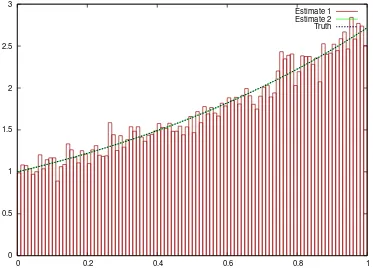
Fig. 1. Histogram of 250,000 samples scaled by the estimated normalising constant (estimate 1), smooth estimate of the same (estimate 2) and the analytic solution for the toy example.
varhW1
X0:(ik)(i)
i
= 1 2Pd
√
πσr
∞ X
k=1
γ2
1−Pd !k
Z 1 µ(x0)
Nmk(x0) ; 0, σ2k+σr2/2
dx0
−
Z
f(x0)dx0
2
. (41)
Assume we consider µ(x0) = N(x0; 0, σ2), then to ensure that the variance
(41) is finite, it requires 1−Pγ2
d <1 and
σ2 > σ
2 1
1−α2 +
σ2
r 2 .
In this case, the optimal importance function π2,n admits a closed-form and the variance of the associated estimate is zero.
For more complex problems, it could be impossible to obtain necessary con-ditions on µto ensure the variance is finite by analytic means.
3.2 Analytically Tractable Example
N = 100 N = 1,000 N = 10,000
x f(x) Mean Variance Mean Variance Mean Var. / 10−4
0 1 1.0516 0.1207 1.0026 0.0006 1.0002 0.4
0.1 1.1052 1.1081 0.0060 1.1047 0.0005 1.1038 0.4
0.2 1.2214 1.2259 0.0103 1.2199 0.0006 1.2214 0.7
0.3 1.3499 1.3864 0.0281 1.3483 0.0008 1.3508 0.9
0.4 1.4918 1.5232 0.0193 1.4893 0.0009 1.4909 1.0
0.5 1.6487 1.6706 0.0430 1.6418 0.0009 1.6488 1.0
0.6 1.8221 1.8277 0.0376 1.8164 0.0019 1.8206 1.2
0.7 2.0138 2.0340 0.0259 2.0178 0.0018 2.0148 2.2
0.8 2.2255 2.2482 0.0471 2.2354 0.0021 2.2245 2.0
0.9 2.4596 2.5316 0.1117 2.4634 0.0034 2.4623 2.7
[image:17.595.95.461.71.349.2]1 2.7183 2.7693 0.0964 2.7232 0.0037 2.7192 3.4
Table 1
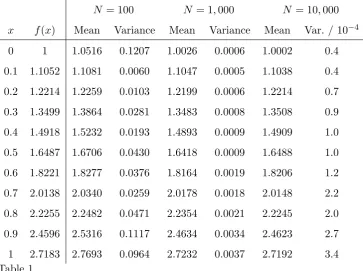
Performance of MCMC point-wise-estimation. Figures are obtained from 100 inde-pendent instances of the algorithm.
solution of:
f(x) =
1
Z
0
1
3exp(x−y)f(y)dy+ 2
3exp(x), (42)
which has the solution f(x) = exp(x).
For simplicity the birth, death and update probabilities were set to 1/3 and a uniform distribution over the unit interval was used for all proposals. Note that previously it has been mentioned that an empirical measure approximates the solution to the Fredholm equation in a weak sense. This approach amounts to using the empirical measure associated with a sample from a related distribu-tion as an approximadistribu-tion of that distribudistribu-tion. In order to recover a continuous representation of the solution it is possible to use standard density estimation techniques. There is much literature in this field: the details of such estimation pose no great technical difficulties and are outside the scope of this paper.
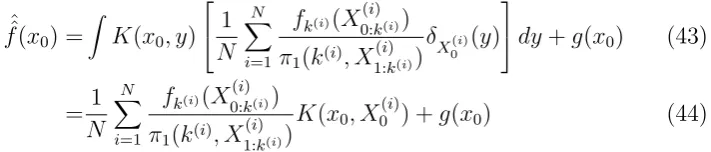
[image:17.595.94.458.73.344.2]The figure also illustrates one particularly appealing approach, and the one which we would recommend. The Fredholm equation itself provides a natu-ral device for obtaining smooth approximations to the solution of Fredholm equations (with smooth kernels and potentials) from a sample approximation: such an estimate can be obtained by approximating the right hand side of (1) using the sample approximation to the integral on the right hand side. That is, rather than using (21) directly, we use it to approximate the right hand side of the Fredholm equation, obtaining the estimator:
ˆ ˆ
f(x0) =
Z
K(x0, y)
1
N N X
i=1
fk(i)(X
(i) 0:k(i)) π1(k(i), X
(i) 1:k(i))
δX(i) 0
(y)
dy+g(x0) (43)
=1
N N X
i=1
fk(i)(X
(i) 0:k(i)) π1(k(i), X
(i) 1:k(i))
K(x0, X (i)
0 ) +g(x0) (44)
which, of course, takes a particularly simple form when the optimal π1 is
[image:18.595.132.488.196.272.2]chosen. It is clear that this produces a smooth curve in good agreement with the analytic solution (indeed, we cannot distinguish this estimate from the truth).
Table 1 shows the performance of the second MCMC estimator when used for estimating f point-wise. Figures obtained are consistent with an estima-tor variance proportional to the square of the value being estimated and the reciprocal of the number of samples used.
3.3 An Asset-Pricing Problem
The rational expectation pricing model (see, for example, [12]) requires that the price of an asset in some state s∈E, V(s) must satisfy
V(s) =π(s) +β Z
E
V(t)p(t|s)dt. (45)
In this equationπ(s) denotes the return on investment (or the perceived utility of that return), β is a suitable discount factor and p(t|s) is a Markov kernel which models the evolution of the asset’s state. E is generally taken to be some compact subset of Rn.
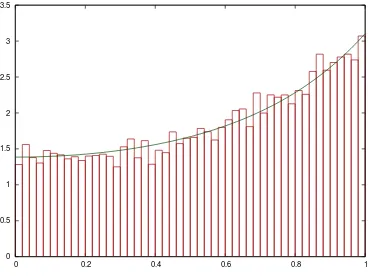
For simplicity, we consider E = [0,1], although there is no difficulty in using the proposed method in the multivariate case, and employ the risk-seeking utility function π(s) = exp(s2)−1. As suggested by [12], we take p(t|s) a truncated normal distribution, which leads to the following Fredholm equation:
V(s) = √β
2πλ
1
Z
0
exp−1
2λ(t−[as+b])
2
Φ1−[√as+b] λ
−Φ−as√+b λ
V(t)dt+ (exp(s
0 0.5 1 1.5 2 2.5 3 3.5
[image:19.595.108.476.76.352.2]0 0.2 0.4 0.6 0.8 1
Fig. 2. Histogram and our smooth estimate ofV obtained with 100,000.
with Φ denoting the standard normal distribution function (which has asso-ciated density φ).Thus the potential is g(s) = exp(s2)−1 and the kernel may
be written in the form
K(s, t) = βφ
t−[as+b] √
λ
Φ1−[√as+b] λ
−Φ−as√+b λ
.
For the purposes of this paper we will use the following parameter values:
a = 0.05, b = 0.9, β = 0.85 and λ = 100. Note that using such a large value for λ has the effect of making the distribution of Xt almost independent of Xt−1. This has been done to demonstrate that even in such a simple scenario,
it can be impossible for the SIS algorithm to use a good approximation of the optimal importance distribution. Details are provided below.
0 0.1 0.2 0.3 0.4 0.5 0.6
0 2 4 6 8 10 12 14 16 18 X00
[image:20.595.105.478.76.357.2]X11
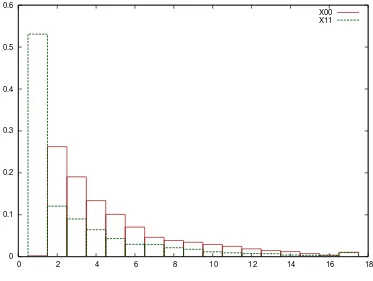
Fig. 3. Distribution of path lengths for two ranges ofX0.
Figure 3 illustrates the distribution of path lengths for samples with values of X0 close to 0 and 1. Notice that even in this situation, the distribution is
very different for the two regimes. As the length of chains has a distribution independent of their starting points in the SIS case, it would not be possible for such an algorithm to approximate both of these regimes well. It is the non-uniform potential, g, which is responsible for this phenomenon: if the initial sample lies somewhere with a large value of g, then there is little advantage in extending the chain; if the initial value has a very small value of g asso-ciated with it then there is a large expected gain. The near-independence of consecutive samples ensures that the distribution of chain length conditional upon the length exceeding 1 is approximately the same for the two regimes, but this would not be true for a more general model.
It would be straightforward to employ the algorithms developed here for more challenging models, although some effort may be required to design good MCMC moves in the case of complex models.
4 Discussion
other methods for sampling from such distributions could also be used. The principal rˆole of this paper has been to introduce a novel approach and to provide a “proof of concept”.
The proposed method is qualitatively different to the Monte Carlo methods which have previously been developed for the solution of integral equations. Existing techniques almost all depend upon SIS techniques or closely-related importance sampling strategies. The approach proposed here operates by ex-plicitly defining a distribution over a trans-dimensional space and obtaining samples from that distribution using MCMC (other sampling strategies could also be adopted within the same framework). The one existing approach which appears to be related to the method developed here is described by [13]. This is a specialised technique used to solve a particular problem which arises in ray tracing. It is not clear how the method developed in this context relates to the solution of more general integral equations.
References
[1] D. P. Bertsekas, Dynamic Programmming and Optimal Control, Athena Scientific, 1990.
[2] R. C. Griffiths, S. Tavar´e, Simulating probability distributions in the coalescent, Theoretical Population Biology 46 (1994) 131–159.
[3] J. Spanier, E. M. Gelbard, Monte Carlo Principles and Neutron Transportation Problems, Addison-Wesley, Reading, Massachusetts, 1969.
[4] R. Rubinstein, Simulation and the Monte Carlo Method, Wiley, New York, 1981.
[5] J. Saberi-Nadjafi, M. Heidari, Solving linear integral equations of the second kind with repeated modified trapezoid quadrature method, Applied Mathematics and Computation 189 (1) (2007) 980–985.
[6] E. Babolian, H. R. Marsban, M. Salmani, Using triangular orthogonal functions for solving Fredholm integral equations of the second kind, Applied Mathematics and Computation 201 (1–2) (2008) 452–464.
[7] D. P. Bertsekas, J. Tsitsiklis, Dynamic Programmming and Optimal Control, Athena Scientific, 1996.
[8] P. Del Moral, L. Miclo, Branching and interacting particle systems and approximations of Feynman-Kac formulæ with applications to non-linear filtering, in: J. Az´ema, M. Emery, M. Ledoux, M. Yor (Eds.), S´eminaire de Probabilit´es XXXIV, Vol. 1729 of Lecture Notes in Mathematics, Springer Verlag, Berlin, 2000, pp. 1–145.
[9] A. Doucet, N. de Freitas, N. Gordon (Eds.), Sequential Monte Carlo Methods in Practice, Statistics for Engineering and Information Science, Springer Verlag, New York, 2001.
[10] P. J. Green, Reversible jump Markov Chain Monte Carlo computation and Bayesian model determination, Biometrika 82 (1995) 711–732.
[11] P. J. Green, Trans-dimensional Markov chain Monte Carlo, in: P. J. Green, N. L. Hjort, S. Richardson (Eds.), Highly Structured Stochastic Systems, Oxford Statistical Science Series, Oxford University Press, 2003, Ch. 6, pp. 179–206.
[12] J. Rust, J. F. Traub, H. W´ozniakowski, Is there a curse of dimensionality for contraction fixed points in the worst case?, Econometrica 70 (1) (2002) 285–329.