Gunnel Källgren Dep of Linguistics GtocKholm University
S-106 91 Stockholm, Sweden
What good is syntactic Information in the Lexicon of a Syntactic Parser?
Imagine a situation where we want to parse texts and get as output information about the traditional grammatical categories of s e n t e n
ces, i. e. subject, direct and indirect object, finite verb, a d
verbials etc. That is an explicit goal of most parsers, and a
necessary prerequisite for many applications of computational
linguistics. How much information, syntactic and/or other, do we
need in order to reach that goal?
In this paper I will look at the kind of syntactic information that
is mostly given in syntactic parsers (sect. 1) and relate it to
different parts of the parsing process (sect. 2). In section 3, I
present an algorithm for assigning syntactic function to c o n stitu
ents without any use of lexical look-up. I discuss its results
(sect. 4) and the type of errors that arise (sect. 5), which leads me to the conclusion that parsing can in most cases very well be done without a lexicon containing syntactic information. In section 6 I point to the nee d for different parsers for different purposes.
1. W’aat kind of information can be given?
Many parsing systems use information that is centered around the
verb. In the dictionary of the parser, each verb has information
about whether it is transitive or intransitive and how- obligatory or optional its complements are. Often some kind of selectional restrictions are also given. The y describe properties of the referents of the noun phrases that enter different syntactical roles in relation to the verb. Such properties are concrete/abst- ract, animate/inanimate, h u m an/non-human etc. The apparatus demands marking of the verbs with their functional frames, and marking of all words that can enter those frames accordingly, and procedures for checking the different kinds of marki n g against each other.
The basic thoughts behind this technique are clear; to get correct
syntactic assignments in la-b and 2a-b one will nee d verbal frames like 3 and 4.
(la) Mary gave the book to John. (b) Mary gave John the book.
(2a) She drank the wine from a chrystal glass. (b) The horse drank (the water) (in the bucket).
(3) give(x,y,2) where x=subj, y=dir o b j , z=indir obj
patterns: x give y PREP z where PREP=to
X give z y
(4) drink(x,y,z) where x=subj, y=dir obj, z=loc advl
pattern; >; drink (y) (PREP z) where PREP=from, in
selectioral restrictions: x=animate, y-liquid, z=some kind
container of
The classificatory system can then be developed and refined to cover more and more of the ways a wor d is used, and more and more of the voc abulary of a language (see Källgren 1986). Some existing systems use a much more finely graded classification, and some also include e g a cl assification of the adverbials that can mod i f y a
verb or a sentence. Fig. 5 shows two entries from a such system,
the Janus system, that seems to be carefully planned and built on a larger scale than most others, see Gumm i n g 1986 for a closer description of its design.
(5)
:name 'LEAD :spelling "lead"
:features '(VERB INFLECTABLE LEXICAL N O T - C ASEPREPOSITIONS OB J ECT PERMITTED N O T -TOCOMP NOT - Q U E S TI O N C O M P NOT-PARTICIPLECOMP NOT-MAKECOMP N O T - BA R E I N F I NI T I V E CO M P N O T - C O P U L A PASSIVE NOT-THATCOMP N OT - ADJECTIVECOMP N O N E - O F - B I T R A N S I T I V E- I N D I R E C T O B JE C T DOVERB DISPOSAL EFFECTIVE OBJECTN OT R E Q U I R E D N O T - O B J EC T N O T P E R M I T TE D SUBJECTCOMP
U NI T ARY S P E L L I N G S-IRR PASTFORM EDPARTICIPLEFORM)
:properties '((PASTFORM "led") (EDPARTICIPLEFORM "led"))
:name 'SIMPLE :spelling "simple"
:features '(ADJECTIVE NOT-CASE PR E P O S I T I ON S R-ST DEGREE
COMPLEMENTPERMIT T E D TOCOMP F O RNPPERMITTED SUBJECTHOLD NOT-SUBJECTCOMP N O N E - O F - A P P R O P R I A T E N E S S- P O S S I B I L IT Y P R O P E R TY -O B V I O U S N E SS NOT-THATCOMP N O T - P R E D I C A T E O N L Y )
:properties '()
The lexicon must mai n l y be built up b y hand and that is a task that
takes good and clear linguistic intuitions to do. Actually, it is
quite hard to imagine all the different kinds of complements that a
verb can take. Sometimes subtle shades of meaning in the verb
accompanies differences in the functional frame ('to read a book' but 'to read a child to sleep'). The verb can then be entered as two homonymous forms, or some other way of entering the information can be designed, but for the pars i n g process as such this does not n e ce ssarily remove all ambiguity. There is always the risk that some p o s sibilit y is forgotten and the functional frame gets too small, or that some allowed pattern makes the frame too loose and
unwanted constructions become allowed. In short, this way of
putt ing conditions on the parse is hard, tedious and time-consuming without ever guar anteeing total correctness.
(6a) She read the book. (b) She read on the train.
(c) She read on the bus that there was a sale on. (Ambiguous.)
(d) She read the street sign to see where she was.
(e) *She read on the street sign to see where she was. (f) She read on the sign that the store was closing at 6. (g) *She read on the street sign that the street was 5th Ave. (h) She read on without being disturbed b y the noise.
(i) She read quickly. (j) The book read quickly. (k) She read the book quickly.
(l) The thermometer read 20 degrees.
(m) She read 20 degrees on the thermometer.
(n) Every morning she read the thermometer to see what to wear. (o) She read the child to sleep.
(p) She read the book to pass the exam. (q) She (read) (up on the mountain). (r) She (read up) (on the mountain). (s) She read German.
(t) She read law.
Some systems use an on-line ordinary d i c tionary instead. This makes large-scale parsing possible to an extent that will p r o b a b l y never be reached with the more handicraft bas e d systems, but it brings with it the problem of extracting the w a n t e d information from d i c
tionary entries that were not w r i t t e n wit h this p a rt i c u l a r a p p l i c a tion in mind. The problem with full coverage of all possibilities also remains, but still this seems to be a more pro m i s i n g way.
(Jensen and Binot 1987.)
2. Category assignment versus functional assignment
Parsing really consists of (at least) two parts, c orresponding to the important difference between category and function. It is one task to identify the constituents of a sentence and assign their category, another task to decide the functional roles that the c o n stituents play and to assign the structure of the whole sentence. Different languages signal categorial and functional information in
different ways and to a different extent, a fact that must influ
ence the mode of parsing chosen for a language. In a language like Finnish, both greimmatical category and syntactic function can often be seen from the morphology of single words (Karlsson 1985), w h e r e as in English, knowledge about overall sentence structure is often needed in order to assign the correct category to ambigous words. In 7, the two parsing levels clearly presuppose each other:
(7a) He judges sentence (7b) to be correct. (b) Judges sentence criminals.
Swedish lies somewhere between Finnish and English in this respect. The morphology gives a good idea of the category of a word, es p e c i ally when its close context is taken into account (Källgren 1984), while it is mainly the word order of the full sentence that gives
information about the syntactic function of its constituents.
If category assignment and functional assignment are kept apart, what kind of information is needed for each of the two tasks? To
part of speech each w o r d is and the allowed internal patterns of
constituents such as noun phrases, prepositional phrases, and
simple and complex verbs. If for the moment we disregard the p r o blem of homonymy, we can generally say that a sequence of article +
adjective + noun constitutes a noun phrase without knowing about the abstractness or animacy of the noun, and a finite verb is a finite verb, no matter what its functional frame may contain.
For the task of category assignment then, no syntactic information except part of speech and internal structure of certain phrasal categories seems to be needed. All the elaborate apparatus describ ed above must thus be introduced in order to handle the assignment of syntactic function. This seems reasonable; the kind of condi tions expressed in verb frames are conditions on sentence struc ture, not on c onstituent-internal structure. The purpose of adding the verb frames and the s y ntactico-semantic properties of the nouns is then to aid in the identification of subject, object, main verb etc. The question will thus be: Precisely wha t kind of information and h ow much information is nee d e d in order to reach a good parse?
T a g gi ng and p a r s i n g systems for English that make precisely this separation of tasks have been cons t r uc t e d for the large-scale analysis of the Brown and LOB corpora. Their systems for w o r d
tagging, i e about the same as what was above called category
assignment, are b a s e d on lexicon and morphology. TAGGIT is the
system u sed for the Brown corpus. Its degree of correctness in
deciding the grammatical class of words in u n r e stricted text is reported to be 77% (Greene and Rubin 1971). For CLAWS, the LOB system w h ich is deve l o p e d on the basis of TAGGIT, the degree of correctness is 96-97% (Garside 1987).
I ndependently of their work, I have built up a m o rp h o logically
b a s ed system for cate g o r y assignment in u n r e s tricted Swedish text. For theoretical reasons, I have tried to limit the lexicon as much as possible, and today the system has a lexicon of less than 300 words that b e l o n g to closed categories or are morphologically highly irregular, which should be comp a r e d to the lexicon of 7 200 words in the CLAWS system. Except for those 300 words, all w o r d
tagging in the Swedish system is b a s e d on morphological and contextual clues. As stated above, Swedish m o r phology contains more information and less ambiguous information than is the case with
English, so the pe r f ormance of the lexicon-less Swedish system is
around 90% on any arbitrary text. The system is described in Källgren 1984a,b, 1985. It is written in BETA (see Brodda 1987) and
runs on DEC-10/20 computers under TOPS-10/20 and is being
implemented on PCs under DOS. Its output can give sentences that
are analyzed like 8 and 9, or that simply look like the c o rr e s p o n d ing structures 10 and 11.
(8) S :( N P :(Mannen) F i n - V : (skrev) NP:(ett b r e v ) )
the man wrote a letter
(9) S : ( N P : (Kvinnan) F i n - V : (v i s s t e ) S :(C o n j :(a t t ) P r o n - s u b j :(h ä n )
the wom a n knew that he
F i n - V : (s k r e v ) NP:(ett brev) A d v l :(i d a g ) ))
wrote a letter today
(10) S:(NP Fin-V NP)
3. An algorithm for functional assignment in Swedish sentences
To reach a full parse, I have c o ns tructed an a l gorithm for func tional assignment in Swedish sentences, which is b a s e d on the output from the morphological system. The algorithm is now being
implemented in BETA and CommonLisp. Its task is to decide, on the
basis of as little information as in 10 and 11, the m ajor syntactic
roles of the constituents. I will here present the algorithm and
its results and discuss the implications of it.
The algorithm has been applied to natural Swedish texts that have already been analyzed into sentences and clauses, and with the following major categories identified: noun phrases, pronouns in
subject and object form, prepositional phrases, finite and non-
finite verbs, auxiliaries, adverbs, prepositions, and conjunctions. As mentioned above, a system that does prec i s el y this category assignment with a high degree of correctness (around 90%) already exists, but to be cible to judge the output from the different parts of the parse separately, we have started from an idealized situation where the category assignment is taken to be 100% correct. Note that the algorithm does not pre s u p p o se correct text,
it presupposes text that does not n eed to be corrected. (Cf. the
discussion in section 6 about the d ifferent p ossible purposes of parsers.) This means that it gives a b e s t - p o s s i b l e parse for every sentence, regardless of whether the sentence adheres to grammatical standards or not. A robustness of this kind is n e c e s s a ry to be able to deal with unr e stricted text.
We regard each occurrence of a verb and its complements as a simplex sentence. The present version of the algorithm only works with clauses that contain a finite verb. N o n -finite clauses pose an
extra set of difficulties to any parser. Subordinate clauses get
their analysis bot h as to the functional role they p lay in the superordinate sentence and as to their internal structure. The basic task is then to identify the subject of each simplex sentence
and its direct and indirect object, in case any object(s) occur.
The algorithm is formulated as a set of rules (around 25 at present), of which some describe clear and unequivocal patterns and
others give heuristic solutions for situations that can be
ambiguous. Some examples:
A noun phrase "inside" a complex verb, i e b e t w e en a finite and an
infite verb, must always be the subject of the verb. Examples like 12a-b thus gives the rule 13.
(12a) Idag har
today has (b) Brevet
the letter
mannen skrivit brevet,
the man wri t t e n the letter
har mannen skrivit idag.
has the man w r i tten today
(13) X Fin-V NP Infin-V Y -> NP := subj
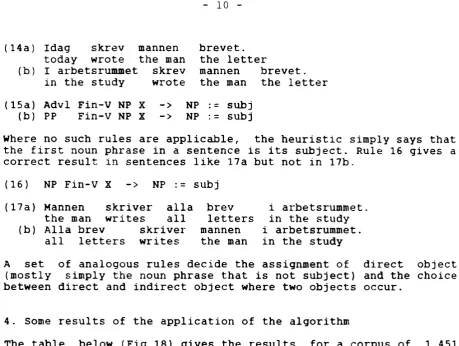
If the position before the finite verb (the .so-called fundament
position) is filled by an adverbial (an adverb or a prepositional
(14a) Idag skrev mannen today wrote the man (b) I arbetsrummet skrev
in the study wrote
(15a) Advl Fin-v NP X -> NP
(b) PP Fin-V NP X -> NP
b r e v e t . the letter
mannen brevet,
the man the letter
:= subj ;= subj
Where no such rules are applicable, the heuristic simply says that the first noun phrase in a sentence is its subject. Rule 16 gives a correct result in sentences like 17a but not in 17b.
(16) NP Fin-v X -> NP := subj
(17a) Mannen skriver alia brev i a r b e t s r u m m e t .
the man writes all letters in the study
(b) Alla brev skriver mannen i arbetsrummet.
all letters writes the man in the study
A set of analogous rules decide the assignment of direct object (mostly simply the noun phrase that is not subject) and the choice betw ee n direct and indirect object where two objects occur.
4. Some results of the application of the algorithm
The table below (Fig 18) gives the results for a corpus of 1,451 simplex sentences, taken from different text types. Of the 1,451
simplex sentences, 160 lack a finite verb, so the figures in the
table are computed on the basis of the 1,291 sentences that the algorithm applies to.
Instances where the algorithm (correctly) predicts zero subject, as
in imperatives, count as a correct identification of subject. For
the identification of objects, two figures are given. The first covers the cases where object(s) occur without a preposition in the sentence, while the second also includes instances with particle verbs ('skriva ner något' write down something) and instances where a prepositional phrase can on semantic grounds be regarded as a direct or indirect object. The last cate g o r y can be difficult to judge, but some clear instances exist ('titta på TV' look at TV,
'ge boken till flickan' give the b o o k to the girl, as compared to
'ge flickan boken' give the girl the book). Generally, a human
linguist in ma n y cases has quite a h a r d time in choosing between
particle + obj ect/prepositional object/prepositional adverbial
phrase. There are often no clear rules-of-thumb and different
people come to different decisions, so the resulting figures in
themselves are not that important. The important thing is that such
instances occur, and that a w e a k point of the algorithm is its
inability to decide the syntactic function of prepositional
phrases. They are at present all regarded as some unspecified kind of adverbials. However, this deficiency is not as destructive as
one might fear, since there are in fact not that many such
[image:6.595.66.526.80.426.2](18) Ratio of correct functional assignments
Correct subject/total number of sentences Correct dir object/''naked" dir objects Correct dir obj/"naked" + prep dir obj Correct indir obj/"naked" indir obj
Correct indir obj/"naked" + prep indir obj
%
99, 98, 83,
100
60
N
1 284/1 291 579/587 579/693
3/3 3/5
The ratios for identification of subject and direct and indirect
object without preposition are remarkably high. Indirect objects
are surprisingly infrequent. In the whole material of almost 1,300 sentences only five indirect objects appear, three without a preposition that are all correctly identified and two instances with a preposition that have been m i s s e d b y the algorithm. The really disturbing figure is the one for direct objects with
preposition. The algorithm has mis s e d 106 such objects, in total
15% of all direct objects, plus 8 direct objects without a
preposition. Most of the latter errors are instances where the
algorithm mixes up subject and direct object (cf 17b a b o v e ) . The number of such errors is however low, considering the fact that Swedish often has OSV order for reasons of textual coherence.
5. Some analysis errors occuring in the material
However, the most interesting results of the a p p lication of the algorithm are perhaps the errors. What type of structures can this simplistic method not manage? Can it be improved and developed? Would more elaborate systems like those m e n t i o n e d in section 1 do better? What kind of information - syntactic, semantic, pragmatic - would be needed in a lexically bas e d parser? I will here give one example of every error type occuring in the material and discuss what kind of extra information would 'rescue' them.
The examples below are all chosen because they are typical for the kind of errors they represent. As can be seen, m any sentences are quite weird and some are even ungrammatical, but that is not an argument for excluding them from the corpus. The aim of my algorithm is to handle unrestricted text; the strange sentences have occured in normal texts and should thus be given an analysis. (Cf section 6.) As a matter of fact, there are also ungrammatical sentences that get correct functional assignment by the algorithm.
Below each example I give the correct analysis and an English translation. As a comparison I then show a str u c t ur a l l y analogous sentence, where the algorithm's analysis w o u ld be the correct one. It is clear that in most cases the latter sentence represents a more common pattern.
Erroneous subject:
(19) Plötsligt, mitt på den sterila slätten, buktar gräsmattor
(Adverbial ) FVl Subj of FVl
och står en byggnad som ser ut som ett rymdskepp.
Conj FV2 (Subj of FV2 )
'Suddenly, on the sterile plain, bend lawns
An a l y z e d in analogy with:
(20) På slätten bukt a r gräsmattor och pryder sin omgivning.
'On the plain b e n d lawns and adorn their surroundings.'
The algorithm says that if a finite verb comes immediately after a sentence conjunction, the subject of the p receding clause is the subject of that verb. (There is no number agreement between subject and verb in Swedish.) The error in 19 w o u ld be solved by the extra information that 'står' (stands) is intransitive, so that 'en
b y g g n a d . ..' cannot be a direct object, and, for semantic reasons
(however they are to be specified), cannot be a temporal or locative adverbial; thus it must be the subject. At the same time I find it hard to believe that the selectional restrictions of a c a refully d e sig n e d lexicon would allow lawns to be the subject of the verb bend.
Mix ing of subject and direct object:
(21) Större bety de l s e än riksdagen har under hösten
(Object? ) FV (Adverbial )
två andra processer.
(Subject )
'Greater importance than the parliament have during autumn two other processes.'
A n a l y z e d in analogy with:
(22) Större universitet än Linköping har under hösten två andra problem.
'Larger universities than L. have during autumn two other p r o b l e m s .'
Sentence 21 has a verb phrase that is as problematic to a human as to a computer. Is the main verb a simply 'har' (has) with a nominal
direct object, or is it 'har ... b e tydelse (än)' (is of ...
importance (than))? Most analyzers w o u l d prob a b l y prefer the second solution, w h ich w o u l d have to be given as an entity in a lexicon, with slot for comparative adjective and all. But the situation is then messed up further by the splitting and fronting of the last
part of the phrase. It is high l y unli k e l y than any lexical look-up
m e chanism wou l d be able to restore this discontinuous constituent.
Erroneus direct object:
(23) Jag glömmer aldrig när Palme var i Frankrike.
Subj FV Advi (Object )
'I never forget whe n Palme was in France.'
Analyzed in analogy with:
(24) Jag glömmer aldrig när jag skriver upp saker i almanackan.
On rare occasions, a temporal clause can appear as a direct object of some verbs. Those verbs can however also take temporal clauses as adverbials. I can see no generalizable way of telling when the when-clause is an adverbial and when it is an object in sentences like 23 and 24. The adverbial reading must have an overwhelming probability in its favour.
Erroneous direct object with complex verb:
(25) ... när den ena fick tag i ett snöre.
(Subj ) (FV ) (Object )
'... when one got hold of a s t r i n g . ’
Analyzed in analogy with:
(26) ... när den ena fick buggar i ett program.
"... when one got bugs in a p r o g r a m . '
The main verb is the whole phrase 'fick tag i' (got h old of) with 'i' as a verbal particle, but it is interpreted w i t h the noun 'tag' as direct object and 'i' as a prep o s i t i o n starting a prepositional phrase incorporating what should really be the direct object. All those complex verbs - and there are m a n y of them - must be listed as idioms, but there remains the pro b l em that some of them can have literal readings as well.
Erroneous indirect object:
No instances in the material.
Missed prepositional direct object:
(27) ... det avvek frän vad p arterna träffat förlikning om, ...
subj FV (Object )
'... it deviated from what the parties had settled, ...'
Analyzed in analogy with:
(28) Han avvek från anstalten.
'He deviated from the prison.' = 'He escaped.'
In its concrete meaning, a verb like 'avvek' is constructed with a locative adverbial, but it can also have a transferred meaning, where the locative reading of the complement seems less natural and an object interpretation is closer at hand. In these cases, there are mostly clear instances at either end and a grey zone in the m i d d l e .
Missed prepositional indirect object:
(29) (Det vet man väl) vad han gör med oss. Obj Subj FV (Indir O b j )
Ana ly zed in analogy with;
(30) Det vet man väl vad han gör m ed kniven.
'One sure knows what he does wit h the knife.'
The particle verb 'gör med' with a sense of doing something against somebody/something has a p article identical to the instrumental preposition. A lexicon might tell us that knives are typical
instruments and persons are not, and thus guide the analyses of 29
and 30; but how w o u l d it handle a sentence like 'One sure knows what he does with them'? A full anaphora resolution is necessary to decide whether the antecedent of 'them' is animate or not and, consequently, whe t h e r 'them' is to be analyzed as indirect object or instrumental adverbial. This does not always help either:
'books' are certainly not instrument in 'What will you do with all your books when you move?'
Many of the errors (21, 25, 27, 29) exemplify a general tendency.
Verbs are often used with a tran s fe r r e d meaning that almost always implies an abstraction in c o m parison to their 'prototypical' meaning, or the mea ni n g of the p r edicate is given by an 'empty' verb (be, do, have, get) plus a complement. In b oth cases, the
patt ern of functional roles of the verb/predicate is often
affected.
Thus, from all this we can conclude that most of the functional
assignment can be done without any recourse to lexicon at all, and for those cases that remain, the information necessary for a correct assignment is of a complex and often rather dubious nature. From the error analysis and from the senteces wit h 'read' in ex. 6, we can see that it is an enormous task to think of all the possible constructions, to find minimal properties that are not too ad hoc and that can all o w the d e s i r e d sentences and exclude the others,
and to b u ild a system that can check all these possibilities and
keep track of what it is doing. To get both readings of 6c for
instance, we w o u l d have to b u i l d into a parser the knowledge of the world that (in this culture) buses, but not trains or airplanes, can be used as m o v i n g signboards for advertising, and that it is thus possible either to sit on a bus and read, or to stand beside it and read on it. We must ask ourselves if this is the kind of information we w o u ld want to have in a syntactic parser and we must be aware of the fact that there will always be examples that we cannot manage. We must also acknowledge the fact that different purposes have different demands on the performance of parsers.
6. Parsers adjusted to different purposes
Parsing is no longer only a research enterprise in itself, but will more and more become a necessary prerequisite for other kinds of theoretical research or practical applications, and that fact must influence the choice of parsing algorithm. The important question of what to do wit h ungrammatical input should also depend on the purpose of the parser.
important and there is a clear distinction between sentences that the parser can and can not handle, a distinction whi c h not always
corresponds to the intuitions of a human language user.
Ungrammatical sentences are rejected, mostly without indication of what caused their ungrammaticality.
A parser that is part of a grammar check or crit i q u in g system of some editor should note all deviant sentences and perhaps even suggest how they should be corrected. It can also note stylistic features and compute frequencies for single words as well as c o n s t r u c t i o n s . Such parsers are supposed to cover large parts of the language and to find and diagnose literally all instances of u n g r a m m a t i c a l i t y . This makes their task considerably more difficult than that of the model testers, and truly there are no fullfledged critiquing systems available at present even if some attempts seem promising.
A parser that is to be used in connection w it h e g a q u e s t i o n answering system must have the ability to decide not onl y what is grammatical but also what makes sense. It will n e e d more semantics than the other parsers, often in the form of knowledge about the database to which it is connected. Questions of gram m a ti c a l i t y can be of less importance as long as the input is interpretable.
The wor k with large-scale corpora that is emer g i n g in today's linguistics demands of a parser that it can analyze sentences, add structural information, and always give a b e s t- p o s s i b l e analysis, with or without at the same time signalling if there is something wrong with the sentence. Its input is more or less u n r estricted text and its output can be use d for man y forms of linguistic research, also of the mod e l -t e s t i n g kind, as well as for b u i l d i n g and updating databases etc. In this connection there are m a n y purposes for which a fast, simple, and robust parser of the kind suggested here is p r ecisely what is needed.
R e f e r e n c e s :
Brodda, Benny, 1987. Tracing Turns in the Lon d o n - L u n d Corpus with BetaText. In: Proceedings from the ALLC conference, Goteborg June
1987. Forthcoming, Språkdata, Got eb o r g university.
Garside, Roger, 1987. The CLAWS wor dt a g g i n g system. In: Garside -
Leech - Sampson, The Computational Analysis of English. London: L o n g m a n .
Green, B.B. - Rubin, G . M . , 1971. Automatic grammatical tagging of
English. Providence, R.I.: Department of Linguistics, Brown
University.
Jensen, Karen - Binot, Jean-Louis, 1986. Disambiguating p r e p o s i
tional phrase attachments by using on-line dictionary definitions. IBM Research Report RC 12148, Yorktown Heights.
Källgren, Gunnel. 1984b. Aut o m a t i s k excerpering av substantiv ur löpande text. Ett möjligt hjälpmedel vid automatisk indexering? IRI-rapport 1984:1. Institutet för Rättsinformatik, Stockholms u n i v e r s i t e t .
Källgren, Gunnel, 1985. A Pattern Mat c hi ng Parser. In: Togeby,
o.
Papers from the Eight Scandinavian Conference of Linguistics. Copenhagen University.
Källgren, Gunnel. 1986. The Role of Lexicon in computerized
Analysis of Natural Language. In Dahl (ed.) Papers from the Ninth Scandinavian Conference of Linguistics. Stockholm University.
Karlsson, Fred, 1985 (ed.). Computational Morphosyntax. Report on