Master Thesis
The Virtual Machine
Delivery Network
University of Twente Computer Science
Netherlands Organisation for Applied Scientific Research (TNO)
Maarten Fonville 2014
Supervisors:
1
Abstract
Distributing virtual machine images over the internet via traditional methods wastes network resources. A proposed solution to this problem is the Virtual Machine Delivery Network (VMDN). A VMDN optimizes the distribution of virtual machine images using concepts from content delivery networks combined with knowledge that exists about the inner structure of virtual machines and their disk images. In this research this virtual machine image’s disk structure has been analyzed which resulted in three different type of data structures. For each of these data structures a different strategy has been
2
Table of Contents
Abstract ... 1
Table of Contents ... 2
1 Introduction ... 4
2 Rationale ... 7
2.1 Problem Statement ... 8
2.2 Research questions ... 11
3 Background ... 12
3.1 Content Delivery Networks ... 12
3.2 Virtual Machines ... 14
3.3 Analysis of background overlap ... 16
4 Scenarios ... 17
4.1 Introduction of the Performance Factors ... 18
4.2 Scenario 1: Academic Research Publication ... 21
4.3 Scenario 2: Specialized Database Server ... 24
4.4 Scenario 3: WebRTC TURN Server ... 26
5 State of the Art ... 28
5.1 Related work to Virtual Machine Image structure ... 28
5.1.1 Clusters ... 28
5.1.2 Files and Functionality ... 29
5.2 Analysis of Virtual Machine Image structure ... 30
5.3 Related Work to Virtual Machine Image distribution ... 32
5.3.1 Copying Virtual Disk Image Files ... 32
5.3.2 Deduplicating Virtual Disk Image Files ... 32
5.3.3 Block deduplication ... 33
5.3.4 Dirty-block tracking and overlays ... 34
5.3.5 Filesystem optimization ... 35
5.3.6 Filesystem deduplication ... 35
5.3.7 File copying and deduplication ... 36
5.3.8 Infrastructure-as-Code ... 36
6 Virtual Machine Delivery Network ... 40
6.1 Virtual Machine Structure ... 40
3
6.3 Strategy 1: Disk clusters ... 42
6.3.1 Technical Background ... 42
6.3.2 Design ... 42
6.3.3 Implementation ... 45
6.3.4 Usage of Prototype ... 47
6.3.5 Limitations ... 47
6.4 Strategy 2: Files ... 49
6.4.1 Technical background ... 49
6.4.2 Design ... 49
6.4.3 Implementation ... 51
6.4.4 Usage of Prototype ... 52
6.4.5 Limitations ... 53
6.5 Strategy 3: Functionality ... 55
6.5.1 Technical background ... 55
6.5.2 Design ... 56
6.5.3 Implementation ... 58
6.5.4 Usage of Prototype ... 58
6.5.5 Limitations ... 60
6.6 Analysis ... 61
6.6.1 Support and scope of VM variations ... 61
6.6.2 Deduplication of the Operating System ... 61
6.6.3 Deduplication of the Applications ... 61
6.6.4 Deduplication of the ‘User Data’ ... 62
6.6.5 Deduplication of Revision Information ... 62
6.6.6 Speed of importing VM image ... 62
6.6.7 Speed of reassembling VM image ... 62
6.6.8 Minimal size for effective cache ... 63
6.6.9 Re-usability of data-objects ... 63
6.7 Results ... 64
7 Future work ... 65
7.1 Improving the prototype ... 65
7.2 Build a real application around the VMDN ... 66
8 Conclusion ... 68
4
Strategy 1: Clusters ... 70
Strategy 2: Files ... 73
Strategy 3: Functionality ... 75
Overview ... 77
Scenario 1: Academic Research Publication ... 78
Scenario 2: Specialized Database Server ... 79
Scenario 3: WebRTC TURN Server ... 80
Glossary ... 81
Bibliography ... 82
1
Introduction
Virtual machines; a term that you might not be acquainted with, but very important in today’s digital world [1], [2]. The virtual machine is an software-abstraction of a real computer and is an ideal unit for computing; we will explain you why. Probably you have a desktop computer at your work, to perform your job’s activities. The computer
hardware is bought, software applications were installed and software licenses for it were obtained. This computer is 24 hours a day at your desk, but you only work 8 hours a day. Meanwhile computer hardware is precious and expensive. So only using the hardware for a third of the time makes introduces unnecessary costs. It could be compared to paying the whole year round for a holiday home that is only used on the weekends. For the holiday home a solution to this problem is possible through the use of time-sharing. The user only pays for the time the holiday home is actually being used. When it is not used and the holiday home would be idle, it is rented out to another user. By using such a scheme, the costs of each user can be greatly reduced by dividing the costs of the home-ownership over multiple users.
For computing time-sharing would also be possible, you could choose to rent out your computer resources to another party at the time your machine would be idle. But a consequence would be, just like with the equipment of the holiday home, that you’d have to share the contents of the computer with the other users. Sharing the contents of your computer with other users could pose security, legal and many other possible problems. Virtual machines are a solution to allow the sharing of computing resources without having to share computer contents with other users. Virtual machines are possible by creating an abstraction layer between the physical computer hardware that provides the computing resources and the computer components that are visible to the software [3]. By introducing this abstraction, the physical computing resources can be shared while the computers and their contents are isolated. It also allows one physical computer to serve multiple virtual machines at the same time, dividing its resources.
5
with the ownership of a fixed amount of computing resources. This payment scheme enables parties to greatly reduce their costs if their demand of computing resources varies greatly over time. Think e.g. about video-on-demand providers like Netflix [4]. During the day there is a low demand for computing power, because people are don’t have any free time to watch a movie. But in the evening a lot of customers switch on their
televisions and want to watch a movie from Netflix. Obviously there are times of the day when there is a peak-demand for computing-infrastructure for the video-provider, while at other moments demand is low. They greatly benefit from a pay-as-you-go scheme for computer resources.
Thus virtual machines are a proper answer to meet the demands for flexible computer resources. Their large advantage is that these virtual machines are able to provide the exact same functionality of real physical computers. But instead of directly executing the software’s hardware instructions on physical components, they are interpreted by a virtual machine monitor (also known as a hypervisor) [5]. The hypervisor then executes its interpreted instructions from the virtual machine on the real physical computer.
One of the great advantages of the virtual machines is that they can be created when there is demand for their existence and be removed when there is not. Also these virtual
machines can be moved from one physical machine to another. By optimally combining multiple virtual machines on physical machines, matching resources to actual computing demand, less physical computing resources are necessary in the end. This makes the virtual machine one of the most practical ‘units’ to work with in the world of computing
where flexibility is key. And we foresee a future where this unit will become more and more important throughout time.
In daily live we are already acquainted with the fact that a physical computer has a location as one of its properties. The computer has to be placed somewhere, it cannot be nowhere. This location can influence the usability and functionality of the computer. E.g. if you want to use your laptop computer to process some text of your USB stick in your text editor, you need the screen, keyboard and USB-port to be accessible.
If your laptop would be inaccessible, for example being in another room, the laptop could not provide you with the means to fulfill your goal of text-editing. You’d have to move the laptop first to your room, before you would be able to use it in a purposeful manner.
The same applies for virtual machines, also for them their location is a property and it can influence their functionality. And just like laptop computers, virtual machines can be moved. But unlike physical computers, where you are moving the physical components from one room toe the other. With virtual machines, you move virtual components. So what do these virtual components embody? The components are, as described before, just software interpretations done by the hypervisor. But the hypervisor needs a list of which components and how they are configured and which data they contain to be able to recreate these virtual components. This list of components is stored per virtual machine as a virtual machine configuration file. Most of the components of the virtual machine barely have any data which (permanently) resides inside them. But one component is the exception: the hard disk. The hard disk contains many bytes of data and to let the
6
the virtual machine is moved. This can be a challenge when a virtual machine with a large disk has to be moved, or if a virtual machine has to be moved over a large distance. Because this will imply a large amount of network resources would have to be used to transfer all these bytes to the target location.
Within this research we will introduce a solution for optimizing the moving of virtual machines over computer networks, using as little resources as possible to get virtual machines from a source to a target location.
In chapter 2 the motivation for this research will be described. The problem with current distribution of virtual machines is explained and the role for the proposed Virtual
Machine Delivery Network (VMDN) is to solve this problem
In chapter 3 the technical details of current virtual machines and Content Delivery Networks (CDNs) are described. This background also shows why regular CDNs are currently not sufficient for solving the VM distribution problem.
In chapter 4 three example situations for a virtual machines to be distributed are
introduced. These three examples will be used as possible scenarios within this research. For each of these scenarios performance factors that could be considered relevant for their distribution and deployment scenario are highlighted and discussed.
In chapter 5 the state of the art is discussed. In the first subchapters the current virtual machine image structure is derived from findings in literature. With this information more related work for each type of data-object that is found in the virtual machine’s image structure is discussed.
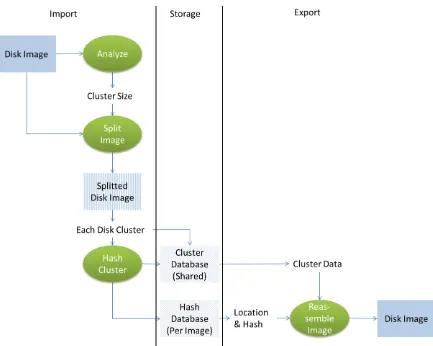
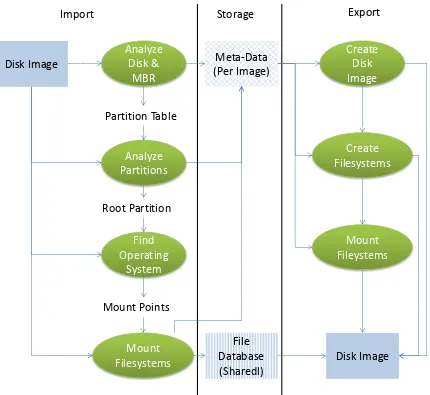
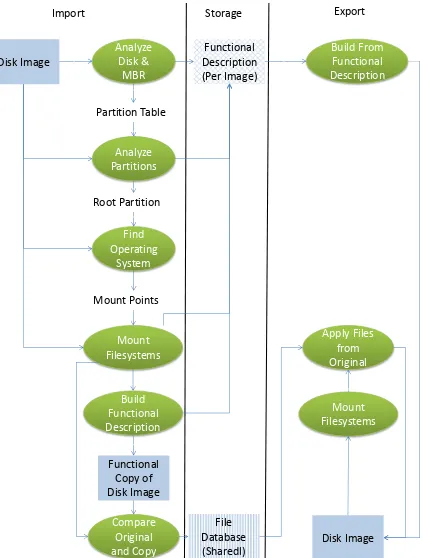
In chapter 6 the proposed VMDN is introduced. The VMDN consists of a prototype using three different strategies. These three strategies all have a different technical background, design and implementation. Per strategy these aspects will be discussed. A short analysis will be performed on the relative performance scores between the strategies.
In chapter 7 the possible future work is discussed. Focus within the future work is improvements on the current prototype and on the so-called “YouVM” example. A parallel for future virtual machine distribution as YouTube did for video distribution. In chapter 8 a short summary of the conclusions of the research can be found.
Also a glossary has been included for the reader, where some of the used tools and non-generic abbreviations are indexed.
7
2
Rationale
As described in the introduction is in the world of information technology (IT) services for certain scenarios, like Netflix, a demand for flexibility of computing resources. A new business model was an important part of the solution of IT resource providers to offer their customers this demanded flexibility: the ‘as-a-Service’ paradigm [6].
This new paradigm is popular and has resulted in an enormous growth of the so-called ‘cloud computing’ industry, which offers their IT services within this as-a-Service paradigm [7].
But these as-a-Service cloud computing applications did also issue new demands on the underlying computing infrastructure. To be able to offer the flexibility that the cloud computing services demand, the computing infrastructure itself also had to become more flexible. A key element for fulfilling this need of flexibility is ‘hardware virtualization’. Hardware virtualization encompasses the possibility to instead of having one computing-environment on one physical computer, that you can have multiple virtualized
computing-environments on a single physical computer. These virtualized computer-environments are also moveable between different physical computers. This allows virtualization to be an ideal method for offering the flexibility necessary for cloud computing, because it eliminates the need for a physical computer to offer a computing environment. Instead, per demand a ‘virtual machine’ can be created that offers the same computer-environment experience as a physical one provides. This makes the virtual machine a practical unit for offering IT services in cloud computing and it is to be expected that its importance will grow even more throughout time.
Since cloud computing providers already use the virtual machines to provide their services, it is also a unit that they can offer to their cloud computing customers. This virtual machine unit is then also the most basic unit that is offered within the typical cloud computing service stack [8]. Offering a cloud computing service to customers using these virtual machine units is called Infrastructure-as-a-Service (IaaS). IaaS enables the cloud computing providers and their customers to use full machine-like computing environments, through the usage of virtual machines. These virtual machines can be created at many different locations in the world and expose their services to clients, like end-users, via networking interfaces, e.g. via the internet. The virtual machines
8 2.1 Problem Statement
In the introduction was described that a computer’s location can influence its
functionality. Also virtual machines have a location: the physical computer (also known as the ‘host’) that executes the hypervisor software that runs the virtual machine (also
known as the ‘guest’). For various purposes there can be a demand for a virtual machine
to be available at a certain target location. The physical host that is this target location then needs access to the virtual machine’s disk image to be able to execute the virtual machine. If this virtual machine disk image is not available at the target location, but only available at a remote source location, access to this disk image should be gained
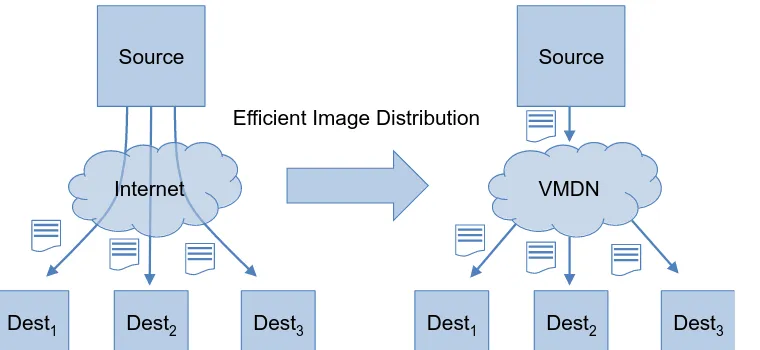
[image:9.612.93.473.347.522.2]somehow. The easiest way to gain this access is by just copying the virtual machine’s disk image from the source location to the target location via a computer network like the internet. But even though virtual machine images can be copied bit by bit between these locations, in practice the distributing of such large files over the internet is inefficient and wastes network resources. Especially if multiple copies of a virtual machine would have to be copied to multiple target locations. The problem addressed in this thesis is how to create a Virtual Machine Delivery Network (VMDN) that facilitates the exchange of virtual machine images between different locations to be substantially more efficient than simply distributing the images via the internet using conventional methods. The problem and proposed VMDN are illustrated in Figure 1.
Figure 1 Distributing virtual machine images via the internet wastes network resources. A Virtual Machine Delivery Network (VMDN) optimizes the distribution of virtual machine images, possibly using concepts from content delivery networks and storage networks. The goals of this thesis are to identify methods for efficient image distribution, to quantify the efficiency of these methods, and to create a proof of concept demonstrating the workings of a virtual machine delivery network.
The presented problem is similar to distributing media content via the internet. For that problem a solution was found with the development of Content Delivery Networks (CDN) [9]. CDNs are networks of caches and media servers that are vastly distributed over different (geographical) locations all over the internet. CDNs enable more efficient delivery and higher performance of multimedia content to consumers. CDNs enable a better quality of experience to the consumers and offload the burden of delivering large quantities of data from the source providers of the media content. By using CDN infrastructure, the total amount of data that in the end has to be transferred over the various networks that make up the internet is reduced through the caching mechanisms.
Source
Dest1 Dest2 Dest3 Internet
Dest1 Dest2 Dest3 VMDN
Source
9
Thus also the overall network itself benefits from the use of CDNs, by improving the available network capacity.
Unfortunately CDNs are not suitable for virtual machine distribution. CDNs rely on the property that content has to be a static and bitwise identical to be identified by the CDN infrastructure as a cacheable object. But unlike many other types of content, virtual machines are not static. With every execution their virtual machine image will change. Also the virtual machine’s binary representation can greatly differ between virtual machine images that actually represent identical virtual machines. And though we know many virtual machines can be very alike, like having the same applications and files on their disk, their disk image’s binary representation are nothing alike. Such overlap between different virtual machine image’s cannot be discovered by current CDNs. This makes virtual machine’s images to be really unsuitable objects to be cached in CDNs, because no cache-hits are to be expected given these circumstances. This while virtual machine images are very large in size and a lot of network resources could be saved if the distribution mechanisms would be improved.
Apparently there is a gap between the caching features of CDN that would be useful for Virtual Machine distribution and the constraints of current CDN implementations. That is why we propose a new concept to fill this gap: the VMDN (Virtual Machine Delivery Network). The VMDN should provide the same distribution-optimization features as a CDN does, but should be able to mitigate the current limitations of CDNs concerning virtual machines as content-type. Thus a VMDN should provide the methods to efficiently distribute virtual machine images from a source location to various target locations. The VMDN should leverage the knowledge that large virtual machine images do have a certain common structure: a structure that in the end represents a virtual machine. In this manner VMDNs should be able to use methods that are more advanced than those from traditional CDNs. This should enable VMDNs to implement effective caching and storage methods, reducing the amount of network resources necessary for distributing virtual machine images to the target locations.
Also it is important for the distribution of virtual machines that the concept of a copy has to be further questioned in the given context. A comparison could be made to other topics to answer the question “what is a copy?” Is a copy of a movie on VHS different from the
original movie? And is the Blu-Ray version? Since all of these copies they are not a pixel-perfect copy of the original production. This is because they all use different
technology and different lossy compression methods that produce small differences in the end-result. But nonetheless all of these copies are considered to be valid functional copies for the purpose of watching the movie.
The same questions could also apply to virtual machines. If copying a virtual machine, which factors are important for it to be perceived as a good, functioning copy? Which properties should it retain? Should it be (when comparing to movies a pixel-)perfect copy of the original? Or is a lossy-copy (that loses some of it details) with same functionality also sufficient?
10
11 2.2 Research questions
The main research question for this research is as follows:
Can an optimized Virtual Machine Delivery Network be substantially more bandwidth efficient for distributing virtual machines than using traditional Content Delivery Networks?
Sub-questions
To answer this question the following sub-questions were formulated:
1. What are the performance aspects concerning bandwidth efficient virtual machine distribution?
2. What is the bandwidth efficiency of the distribution of completely (bitwise) identical copies of virtual machines using traditional content distribution methods?
3. How can completely (bitwise) identical copies of virtual machines be more efficiently distributed by using a VMDN?
12
3
Background
3.1 Content Delivery Networks
As we described earlier, the current method for optimizing distribution of large or popular files is through the usage of CDNs. CDNs are run by companies that are
specialized in delivering content for their customers (which is the party that provides the content) by mirroring it on various servers that are (geographically) spread out over the internet network [9], [10]. The benefits of using a CDN for the original content
distributing party are a reduced load on the content providing party’s servers, off-load of the burden at peak-time loads, increased performance and availability of the content to the end-users and a reduction in the amount of network capacity that is necessary and network-peering costs.
The business model of the companies running the CDNs relies on the fact that they can bundle the deliveries for the content of their customers all together. This allows them to reach an economy of scale that allows them to reduce the costs per ‘unit’. A unit can be considered in this situation a delivery to an end-user for a piece of content that originally originates from one the customers. The economy of scale is also actually necessary to allow the service model of CDNs itself to function. They need many deliveries to reach the implicit geographical spread. Only by a having a great enough demand per
geographical area the companies running the CDNs can afford to have servers available in all of those different regions to fulfill the content deliveries.
CDNs use statistical effects within the content’s consumption, like Zipf’s law and the Pareto principle, in conjunction with caching methods and content consumption
prediction algorithms [11]–[14]. CDNs allows their customers’ content to be replicated into their distribution network. CDNs can then mirror this content at different
geographical locations and on different peering-level, depending on demand.
Each location where content is being mirrored has a limited set of storage available, so a choice has to be made where which content will be mirrored. The idea is to match the content of each cache in such a way that an optimal distribution is achieved. This optimum can be achieved if the amount of bytes that has to be transferred in total to handle all requests can be kept as low as possible for an affordable price.
If we combine this optimum with the fact that CDNs have to pay for each location, servers, storage and peering and have various options for each of these factors they have to make several choices when caching content. So when considering where to cache which content, the CDN has to make smart choices.
For content that is or large or is popular within a (single) distinct (network) region it is often smart to cache it as close as possible to the end-user ( e.g. at the Tier 3 level, like the ISP’s network) [15]. In that manner the highest amount of bytes that has to be transferred on the grand total can be saved.
13
The cache mechanisms used by the CDNs are only having any effect if they can generate a cache-hit when handling an end-user’s request. Such a cache-hit is achieved if the cache already has the requested content object available because of an earlier retrieval.
This is only possible if content is requested multiple times through the same host that operates the cache. It is also important that these multiple requests for the same content come with high enough frequently, so that the content will be still in the cache the next time it is requested, instead being pushed out again already by other (popular) content. When assessing the mechanism on which CDNs rely to optimize the distribution of content it is apparent that they can only improve content delivery to end-users if:
A cacheable content object that is served to end-users is exactly equal for each recurring request
a content object is served multiple times within the same network area,
the requests for the content object are in high enough frequency within a limited time-window to survive in cache,
14 3.2 Virtual Machines
Virtual machines recently revived as a useful and popular concept when Stanford’s former professor M. Rosenblum founded the VMWare company [17]. It is used to disconnect the physical aspects of a computing unit from the functional aspects of the computing unit by creating a new abstractive layer between the real physical computer hardware and the logical hardware that executes the computing instructions [18]. It allows to create a virtualized computing environment on a physical environment. To create this virtual environment a piece of software is necessary that is able to emulate the virtual hardware: the hypervisor, sometimes also called the virtual machine monitor (VMM).
There are different hypervisor implementations available from different vendors and each of those hypervisors has taken several different choices concerning some technical
aspects during implementation [19]–[21]. Each of those differing aspects can make it even harder to find common structures in virtual machines as content; this is something to keep in mind when researching this subject. Because in effect there is no single ‘virtual machine’ content-type. Virtual machines should be considered more to be a concept, that encapsulates many possible implementations and variations, many of which will not even be discussed in this research. That’s why sometimes assumptions are necessary or
relatively arbitrary choices concerning the used technology have to be made when going into more detail.
In abstract terms, the following components on the physical host machine, on which the virtual machine is executed, are necessary:
Hypervisor software
Virtual machine disk image(s) Virtual machine configuration
Using these three components a virtual machine can be executed. The hypervisor reads the configuration file, creates a virtual hardware environment that is described in this file. The configuration file also points to the disk image, and this disk image file is
represented as a hard disk drive (a block device) within the virtual hardware environment [22]. Within this virtual environment the virtual hardware is turned on and the contents on the hard disk are executed as if they would be on a regular (physical) computer.
Of these three components the hypervisor software is ‘static’, meaning that it only has to be installed once on the host machine and can be re-used for the executing of multiple (different) virtual machines. Meanwhile the virtual machine disk images and
configuration are unique for each virtual machine. The configuration is just a few lines text and therefore not so hard to distribute. But the virtual machine disk image has a size, just like real physical disk, in the order of gigabytes. The transfer of such a disk image therefor poses the hardest challenge in the distribution of virtual machines between different locations and is therefore the logical focus of our research.
15
said that they are unique if considered to be per machine at a given moment in time. The cause of this fact is result of the following techniques that are used:
Virtual machines use block devices for data storage
Virtual machines tend to write continuously to their storage when executed Virtual block devices can be mapped in non-contiguous ways into a file
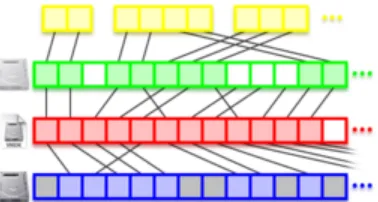
The first aspect, that virtual machines use block devices for data storage, is the first cause for the uniqueness of an individual virtual machine disk image. When a virtual machine stores information, it stores files on a filesystem. The filesystem handles the storage on the block device, but the filesystem is free to select in which blocks it puts which files, and files don’t even have to be contiguously stored over blocks and can be spread out. This is also shown in Figure 2, where the yellow blocks make-up files, and the green blocks are the virtual block device:
The second aspect, that virtual machines tend to write to their storage, also creates the effect that the content of the files do change and therefor the content of the green blocks on the virtual block device. This makes the virtual block-device unique throughout time. Each time the virtual machine is executed, the contents of the virtual block-device change.
The third aspect, that virtual block devices can be mapped in non-contiguous ways into a file is influenced by two factors: time and hypervisor technology. Each hypervisor can choose a different method for mapping their emulated block device to a file or even a set of files [24]. This enables the possibility that different virtual blocks have a different location within the virtual disk image file. This is also influenced by time and the machine’s history, the order of the data blocks can be randomly influenced by whatever location’s blocks are written first to
[image:16.612.92.281.473.574.2]This non-contiguous mapping is also visible in Figure 2 as is supplied by the VMware blog with the relations between the green and red layer, where the green blocks are representing the virtual block device and mapped to different locations on the red disk-image file [25].
Figure 2 is an image from the VMware blog. It shows the mapping of disk clusters from a physical disk (blue), to a virtual disk image file (red), to a virtual disk (green), to a virtual filesystem (yellow). [25]
16 3.3 Analysis of background overlap
From the preceding technical background about virtual machine disk images, it is apparent that there are many possible permutations for data blocks to be spread out over the disk image file. Also throughout time, when using the virtual machine, the disk image file can change.
This makes any virtual machine disk image file a unique object in bitwise perspective. This hinders the usage of current content distribution optimization techniques. Because the virtual disk image is by no means for them a trivially cacheable object. For them all virtual disk images appear to be different, they cannot effectively find similarities between various virtual machines, rendering their current caching and deduplication methods useless.
It also answers partly the first to sub-research questions. If a virtual machine cannot be cached, or deduplicated during distribution, it has to be copied directly from the source to the target location. That would mean the bandwidth consumption would be a
17
4
Scenarios
In this chapter we depict three different scenarios of possible virtual machine usage that would desire distribution from one source to multiple target locations. Each scenario varies in context: what kind of copy is to be desired? Which content(types) are to be expected within the virtual machine? Which distribution factors are considered to be of importance?
The (details of the) scenarios and the list of performance factors per scenario are mostly result of a creative, iterative question-driven process. The first scenario is based on supervisor Strijker’s work on Executable Scientific Publications and from this scenario a first set of performance factors were deducted [27]. Using these performance factors, other various scenarios with more varying results in these factors were sought after. The WebRTC relay server scenario is e.g. based on real world issues found by a TNO
networking research group concerning WebRTC relay capacity. From the resulting set of scenarios other new impacting performance factors were introduced.
18
4.1 Introduction of the Performance Factors
First of all, it is important to notice that even though the performance factors are here introduced before the scenarios, they were not fully established before the scenarios and VMDN prototype implementation were.
The performance factor originate partly from current virtual machine performance measurements in literature and whitepapers. Such as the time it takes from starting the download of a virtual machine to being able to execute it locally at a target location. Other performance factors were found after reviewing possible functionality impacting aspects for the usage of virtual machines in the VMDN’s different strategies and the different scenarios and from the inner virtual machine image disk structure. Of course the set of scenarios and strategies were limited in number, which also implies that the list of performance factors may not be definite.
The performance factor list is (only for a overview) divided into two different categories: Virtual Machine Characteristics and Distribution Factors. The Virtual Machine
Characteristics are performance factors that tend to be influenced depending on which kind of virtual machine and its contents is to be distributed. The Distribution Factors are performance factors that are more judged on given constraints within the applicable scenarios.
The performance factor’s importance will be decided per scenario. The lowest score is ‘Low’ which means the given factor might is not considered essential or applicable to the scenario. ‘Medium’ is given to those factors that are considered nice to have, because of having possible impact, but not deemed to be essential. ‘High’ is given to those factors that will have a serious impact in the given scenario and could greatly influence the results of a successfully functioning solution for the given scenario. ‘Critical’ is given to the performance factors that, if not fulfilled satisfactory, would block the original design function in the given scenario. The importance score given to each factor is by reviewing the context, but as stated before, an endless amount of scenarios could be created with their own set of valued aspects and importance.
Virtual Machine Characteristics
Support and scope of VM variations
19
variations that could be handled by the distribution system. This performance factor describes if such limitations would be likely to impact the given scenario or not. Deduplication of the Operating System
This performance factor describes the impact that deduplication methods would have in the given scenario for content that is part of the operating system of the virtual machine. This content type would be e.g. in Unix-like systems mostly the contents of /bin, /lib and /usr and on Windows systems C:\Windows\.
Deduplication of the Applications
This performance factor describes the impact that deduplication methods would have in the given scenario for content that makes up the applications of a virtual machine. This content type would be e.g. in Unix-like systems in /usr/lib and /usr/bin and on Windows systems c:\Program Files\.
Deduplication of the ‘User Data’
This performance factor describes the impact that deduplication methods would have in the given scenario for content that makes up the configuration and data that is neither part of the operating system neither any of the static or data that is part of any application. In Unix-like systems this would at least include directories like /etc/, /home/, /root/ and /var/lib/. On Windows systems this would be at least c:\Users\. Deduplication of Revisions
This performance factor describes the impact that revision-tracking and -reusing methods would have in the given scenario. E.g. if a virtual machine would have each day a new revision to be distributed, but between every revision only one single file on the virtual machine’s filesystem would be changed could greatly benefit from a tracking and reusing method.
Distribution Factors
Speed of importing VM image
This performance factor describes the time necessary to import a virtual machine disk image file into the distribution network. This encompasses all the steps necessary, such as reading the original disk image, writing data, computational processing and any network activity.
Speed of reassembling VM image
This performance factor describes the time necessary to retrieve a virtual machine disk image file from the distribution network and prepare it to be used by a
hypervisor. This encompasses all the steps necessary, so reading data, any network activity, writing data and any computational processing.
Minimal size for effective cache
This performance factor describes the object-frequency curve to indicate the possible effectiveness of a cache during distribution. The minimal size of cache can only be small only if a small set of objects is retrieved many times and thus can be served by the caching mechanism. If the distribution of object retrieval is more evenly spread out over a large set of objects, the minimal size for an effective cache would have to be much larger to be of any use. Also the size of the individual objects in the cache can (indirectly) influence the minimal size of the cache.
Re-usability of data-objects
This performance factor describes the re-usability of the data-objects when
20
21
4.2 Scenario 1: Academic Research Publication
Our first scenario is about a virtual machine containing the tools and dataset use for academic research and accompanies a scientific paper and is based on the work of supervisor Strijker [27]. The idea behind this scenario is that in the academic world is important to be able to reproduce the research of an author. This to falsify or confirm any findings and to be able to perform any follow-up on the original research. Also it can be practical to be able to access any raw data that was used in a study from the past, for checking new insights.
Currently this reproduction can be hard, because of (details of) the original applications and datasets getting lost. Or because of incompatibility with newer hardware and software. The virtual machine could be a great solution to these problems. If all the necessary elements to reproduce the research are to be stored within a virtual machine, a study can always be retrieved later by just booting this virtual machine. All the
applications and data available and directly ready to be used.
In this scenario the expectation is that virtual machines for academic papers will be in the future widely distributed as currently papers in the Portable Document Format (PDF) are. They will be offered as a download via the academic press to interested parties.
In the distribution scenario of these academic virtual machines there will be three
stakeholders in the distribution process. The author of the research that created the virtual machine, probably a scientist. The publisher, probably an academic press organization that will publish the virtual machine. As last the consumer, probably a fellow scientist. During the distribution process the following context is applicable:
The author has plenty of time available for generation of the virtual machine The publisher has to host many scientific articles and their virtual machines. The retrieval rate of a single virtual machine will probably be relatively low. A peak in retrieval can be expected around the time of publication and
presentation.
The consumer will study for a longer time on the data anyhow and probably has plenty of time for retrieving the virtual machine.
The consumer might have multiple alike virtual machines of related studies.
If we put this in an overview for which performance factors are important on a scale from low, medium, high to critical:
Performance factor Performance Importance
Virtual Machine Characteristics
Support and scope of VM variations Medium Deduplication of the Operating System High Deduplication of the Applications High Deduplication of the ‘User Data’ Low
Deduplication of Revisions High
Distribution Factors
22 Speed of reassembling VM image Low Minimal size for effective cache High Re-usability of data-objects Medium
Support and scope of virtual machine variations
It is to be expected that the virtual machines used for research purposes will reflect common variations as most other virtual machines. The popular hypervisors, operating systems and filesystems will dominate, exceptional choices will be rare.
Deduplication of the Operating System
The publisher hosting the virtual machines will probably have store hundreds of thousands of virtual machines, since 1.5 million new academic papers are published every year [31]. Since all of those virtual machines have an operating system
deduplication for storage is essential to the publisher. We can note that the operating systems’ versions might be diverse throughout all the virtual machines, because old studies will have older versions installed.
Deduplication of the Applications
The same applies to applications. When storing hundreds of thousands of virtual machines deduplicating the applications is important to reduce the amount of storage necessary.
Deduplication of the ‘User Data’
Since the expectation is that between different studies the ‘User Data’ will always vary, deduplication is hard and probably in majority of the cases not possible and thus doesn’t need any priority.
Deduplication of Revision Information
Because a study might be revised or spawn multiple articles for different publications, it might be useful to deduplicate on basis of revision information. Also for follow-up studies this might be useful.
Speed of importing VM image
The process of authoring an academic paper and the reviewing process is a time-intensive task anyhow, publishing the virtual machine for distribution is not time-critical.
Speed of reassembling VM image
Academic work is retrieved for study. Especially if the data is of interest to the consumer of the virtual machine it means they are processing the details. This is time-intensive anyhow and thus fast retrieval is not essential.
Minimal size for effective cache
Many different studies are retrieved each day from the academic press. There is
23
of data compared to the complete set of all virtual machines for academic papers to be hosted. Otherwise the demanded storage for the cache would have to be high.
Re-usability of data-objects
24
4.3 Scenario 2: Specialized Database Server
The second scenario is about a virtual machine that is dedicated for database storage. The context is that this virtual machine is distributed to various parties for a specific set of high performance database operations that it will execute. It contains an optimized installation of an operating system that is heavily stripped of unnecessary parts as possible, to keep as many resources as possible available for the database application. The filesystem is tuned to best performance for the database application. The data within the database is also carefully ordered on the filesystem and disk for best performance. The database application itself is compiled to be as fast as possible in the given environment. The results from the database operations are uploaded to an external database once a while. The virtual machine is replaced during scheduled maintenance windows with a newly distributed copy.
If we put this in an overview for which performance factors are important on a scale from low, medium, high to critical:
Performance factor Performance Importance
Virtual Machine Characteristics
Support and scope of VM variations High Deduplication of the Operating System High Deduplication of the Applications High Deduplication of the ‘User Data’ Low
Deduplication of Revisions Low
Distribution Factors
Speed of importing VM image Low
Speed of reassembling VM image Medium Minimal size for effective cache Low Re-usability of data-objects Low
Support and scope of virtual machine variations
Since the virtual machines will have tailored filesystems and operating system it is important that these customizations won’t block any optimizations for distribution.
Deduplication of the Operating System
Since the virtual machines are distributed on a regular basis with a new distributed copy and these copies mostly consist of the operating system, it is important that deduplication can be applied on this part.
Deduplication of the Applications
The same applies to applications. The application(s) used to run the database will make up the majority of the virtual machine that is distributed.
Deduplication of the ‘User Data’
25
Deduplication of Revision Information
The content of the virtual machine instances to be distributed is heavily optimized for performance. This implies that there can be large (binary) differences between different revisions of files and applications. This makes revision information less useful. Also the virtual machine that is distributed is every time a new instance and doesn’t inherit any data from the previous instance.
Speed of importing VM image
The process of creating the virtual machine image has to fit in the time between the scheduled maintenance intervals, assuming that on the intervals a new revision has to be ready and not an older one can be re-used. This will probably be plenty of time and thus of low importance.
Speed of reassembling VM image
The retrieval of the virtual machine image has to fit within the planned maintenance windows. There is a window, but it will have limited span. Retrieval speed is thus of medium importance.
Minimal size for effective cache
Since many same instances of the virtual machines will be distributed at planned intervals the retrieval rate will have a universal peak. The parties downloading the virtual machine will know about the distribution process and can install local caching mechanisms.
Re-usability of data-objects
26 4.4 Scenario 3: WebRTC TURN Server
The third scenario is about virtual machines that would be used to facilitate WebRTC connections between parties [32]. When parties cannot directly connect with each other because of Network Address Translation (NAT) an intermediate party is necessary to set-up the connection and (in worst case situations) relay data between the parties. Such intermediate relay is at best located on a network location that is close to all parties to avoid latency issues.
Since WebRTC TURN servers need to be configured per website and the parties needing the connection can come from all over the world, with variable demand. A great solution would be to run virtual machines providing the relay functionality at on-demand basis. Creating the virtual machine there where there is demand, and only if there is any demand.
These virtual machines could be created from a regular installed virtual machine, with a popular operating system using a normal precompiled package from the package
management software for the WebRTC TURN server’s relay functionality.
If we put this in an overview for which performance factors are important on a scale from low, medium, high to critical:
Performance factor Performance Importance
Virtual Machine Characteristics
Support and scope of VM variations Low Deduplication of the Operating System High Deduplication of the Applications High Deduplication of the ‘User Data’ Low
Deduplication of Revisions Low
Distribution Factors
Speed of importing VM image Low
Speed of reassembling VM image Critical Minimal size for effective cache High Re-usability of data-objects High
Support and scope of virtual machine variations
Since the virtual machines will use common operating systems this factor is not of importance.
Deduplication of the Operating System
Since the virtual machines are distributed for a single functionality, it is to be expected that the operating system will be a large part of the virtual machine’s content and should preferably be deduplicated.
Deduplication of the Applications
The same applies to applications. The application(s) used to run the WebRTC relay will make up the majority of the virtual machine that is distributed.
27
The ‘user data’ that is distributed will mostly be some configuration files, thus small and negligible.
Deduplication of Revision Information
These virtual machines are created to serve just for a short time (the period of demand) and afterwards be removed again. There is no expectation that any new revision of a virtual machine will be constructed.
Speed of importing VM image
The process of initially creating the virtual machine image only has to be executed when creating the WebRTC functionality on the website. This process is only once and speed is not important.
Speed of reassembling VM image
The retrieval of the virtual machine image has to be fast enough to meet the demand from connecting parties. This is probably the most important factor.
Minimal size for effective cache
Since the virtual machines will probably be retrieved at irregular interval over various places in the world, generating cache hits with a small cache is improbable.
Re-usability of data-objects
28
5
State of the Art
This chapter is divided into three parts: first the related work to the structure of virtual machine images is discussed. On basis of this related work a brief analysis of the found virtual machine image structure is performed. Using this analysis of the structure, several structural layers and corresponding data-type objects are identified. For each of these data-type objects deduplication and efficient distribution methods are discussed in the third part.
5.1 Related work to Virtual Machine Image structure
Virtual machine image structure is apparently not a popular academic topic, since no literature directly describing this topic could be found. Partly this is probably because the most recent developments are more driven by industry than by academia. Another reason is that the image structure is mostly a result of (legacy) implementation of the storage stack. As a result this paragraph also relies on white papers and descriptions of current implementations.
5.1.1 Clusters
As provided earlier in the background chapter 3.2, the VMware company’s blog had provided a nice diagram to showcase how data is stored using their VMDK virtual machine image disk format in Figure 2. Within this figure the storage of content within the virtual machine’s image is displayed using blocks of data and lines for mappings between the layers. The location of the data differs per layer in the diagram. But each block and its (data) contents are always the same, as long as you follow the line of the mapping, no matter in which layer it resides. This is because in all layers this block represents a ‘Cluster’. Clusters are a universal unit of storage. They are offered as a unit by most storage media, and filesystems use these clusters to organize their contents. Emulating the properties legacy storage media was chosen by hypervisors as method of providing virtual disks to virtual machines [26]. As a result, all advantages and
disadvantages are automatically inherited.
The largest advantage is that the whole current legacy storage stack can be used. No special drivers or filesystems are necessary.
But this also introduces disadvantages. Virtual disks are not physical disks. But block device drivers and filesystems were designed with physical disks in mind [33]. This results in the effect that those designs that were optimal for physical disks, can actually be inefficient for virtual disks and negatively impact transfer speeds and access times [34].
But it can also pose issues when handling empty or by the filesystem unused clusters. Because when emulating a disk, also all parts of the disk that may not be actually in use (anymore) still have to be modelled by the virtual disk [35].
29 5.1.2 Files and Functionality
Within the diagram of VMware in Figure 2 the top layer is grouped into several larger sets of blocks. These sets of blocks represent files on a filesystem. It is the filesystem’s responsibility to keep track of the clusters on the (virtual) disk to map, group and represent them as files to the operating system of the (virtual) machine.
The purpose of these files on the guest machine is in the end to perform certain
functionality. Since virtual machines are objects that have to be created, it is fairly safe to say that they have a certain purpose. This functionality can only be performed by
multiple files interacting together. Some files are part of the operating system or
applications, while others are what we call here ‘User Data’; data that is relatively unique per virtual machine e.g. describes its configuration, its state and could contain some files to be hosted by its webserver, or a relational database or anything else.
30
5.2 Analysis of Virtual Machine Image structure
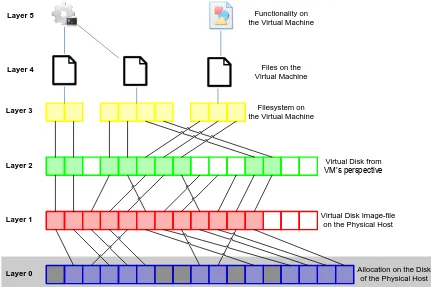
The lowest structure of the virtual machine is made up by several layers that were already identified in the diagram of Figure 2 in chapter 3.2. All these layers were made up by data clusters as unit of storage: a data unit. Using the extra information found about the virtual machine image’s structure this diagram can be expanded, which has been done in Figure 3.
This extension of the diagram is necessary for our research to look for possible
distribution optimization methods. Since the old diagram did only have the data cluster as data unit. Thus optimizations could only be applied on these data clusters. By identifying more new data units, more possible optimizations could arise.
In Figure 3 two new data units are introduced along the data clusters. The files on the virtual machine and the functionality of the virtual machine are built on top of the stack of data clusters. A single cluster or a set of data clusters within the filesystem layer encompass a file. And one or multiple files represent functionality.
Only using this information about the virtual machine image’s structure, the search for related work could be performed. The search focused on the three kind of type of data units that were found: Clusters, Files and Functionality.
31
Figure 3 is a derived and further extended version of Figure 2 that shows the mapping of disk clusters from a physical disk, to a virtual disk image file, to a virtual disk, to a virtual filesystem, to files, to functionality. They layers are numbered from bottom to top. The bottom layer (zero) is grayed-out, since that layer will not be relevant to our further analysis.
Filesystem on the Virtual Machine
Virtual Disk from VM’s perspective
Virtual Disk Image-file on the Physical Host
Allocation on the Disk of the Physical Host Files on the
Virtual Machine Functionality on the Virtual Machine
Layer 5
Layer 4
Layer 3
Layer 2
Layer 1
32
5.3 Related Work to Virtual Machine Image distribution
The related work to our research are studies in a widespread set of research areas.
Because this study touches multiple research fields that all play a role in the structure and distribution of virtual machine images: filesystems, file transfers, disk storage,
deduplication, infrastructure-as-code and content distribution techniques.
The structure of the virtual machine is made up by several layers that were identified. The related work is discussed in order from the bottom to the top layer. For each layer we will try to identify the related work that is relevant to our research. First the related work to a file-based representation and distribution of the virtual disk image will be discussed. Then we will look into the related work to the cluster-based structure of the virtual disk. As third the relevant work for filesystem structure will be researched. As fourth we will look again into the file structure and as fifth into the functional properties.
5.3.1 Copying Virtual Disk Image Files
If considering the ‘outside’ virtual machine disk image no knowledge of the inner working of the image is assumed. The data that is being handled is a file that consists of bits that are in a certain order. To move a virtual machine disk image around in such a situation all bits have to be moved in exact order from a source to a target location. For file transfers from a source to target location there are classical point-to-point transfer methods that copy bit for bit without any optimizations, such as Secure Copy (SCP) or File Transfer Protocol (FTP) [36], [37]. One of the bottlenecks for virtual disk image files transfers via such protocols is that sparse files (empty space within a file) are not
supported and also the empty space has to be copied bit-by-bit making such transfers possibly inefficient [38].
Optimized transfers are possible using rsync, if the target location has an older revision of a virtual machine disk image [39]. Rsync compares with a sliding window the data at the source location with that at the target location. Differences are detected, compressed and transferred. Unfortunately also rsync also doesn’t support sparse files if used with the compare-feature. Thus again all empty space within a file has to be transferred, though the compression filter is efficient with handling the long array zeroes. The largest disadvantage is that storage space will be wasted at the target location.
Virtsync is a fork (a deviation from the original rsync project by a new developer) off rsync [40]. This fork allows to combine the normally incompatible rsync command-line parameter “--inplace" for comparing both the source and target location with the
“--sparse" parameter. Virtsync is therefore the currently most efficient method for copying a complete identical virtual machine disk image from a source to a target location.
5.3.2 Deduplicating Virtual Disk Image Files
33
searching duplicates in the storage. This is a simple and straightforward approach that is suitable for deduplication of static content. But more dynamic content, like webpages with randomized advertising, would have different hashes. To handle those cases specific cases for webpages Edge Side Includes (ESI) were developed [42]. But also more generic approaches like Fixed-sized partition (FSP) detection technology, content-defined
chunking (CDC) detection technology and sliding block technology are available to deduplicate overlapping content over multiple files [43], [44]. But a problem with all of these technologies for deduplication is that it is necessary to download and store these content files completely before the deduplication mechanisms can actually be applied [41].
These traditional file-deduplication techniques can be applied on virtual disk image files, but as described in the problem statement and background, such deduplication is
normally not effective on virtual machine disk image files.
Deduplication of is also used in shared-storage scenarios. Examples of such scenarios are the usage of Networked Attach Storage (NAS) solutions and distributed filesystems [45]. When using those technologies the filesystem on the storage device is shared via
protocols at a file-level access manner. The client nodes can access these files as if they were on a local filesystem but don’t see the underlying block-device storage [46]. The factual block-device handling is actually done within the storage node. This storage node can apply under-water deduplication techniques on a file-level or chunk-level basis. These storage methods are popular for two scenarios: a first scenario is with many different client nodes that rely on a common pool of files, to be accessed read-only. Examples are shared online disks with application executables or pre-populated data for users.
The second scenario is with multiple client nodes, which have to be able to read and write to a common dataset where each of the nodes has to be able to read what the other ones have committed.
Another approach to deduplicating content during distribution is to match hashes of chunks with local caches which can save up to 7% in overall transferred volume [47]. Data that is transferred between different hosts contains often redundant parts. When the data is transferred it is split up in different chunks, before sending the chunk from the source to the target, it first sends a hash of the chunk. If the target already has a chunk corresponding with the hash in its local cache, the chunk is retrieved from the local cache and not send by the source. Only if the target doesn’t have the chunk yet, it is send. 5.3.3 Block deduplication
34
deduplication can be applied. The advantage is that this approach works agnostic of the filesystem(s) used, but the disadvantage is that a lot of metadata has to be stored and discarded blocks have to be garbage collected. But especially for the storage of (many alike) virtual machines that use the same storage cluster this can have positive impact in terms of performance (since identical blocks can be more easily buffered in memory) and in reducing the amount of storage needed [49], [50].
There is also an application from a research paper called Parallax that takes such clustered storage to a virtualized level [51]. It virtualizes the SAN nodes and puts the clustered storage within virtual machines. This allows the researchers to spawn storage clusters at the same physical hosts as where the virtual machines are run, which are the clients of the cluster. Also Parallax is able to deduplicate the stored blocks and stores the data in a so called shared blockstore. By using the state information available from the virtual machines, that are clients to the Parallax application, this information is already known to the host machine, thus it is able to housekeep the data more efficient than regular SANs.
The second deduplication scenario is by applying deduplication on virtual machine disk image files. With such an approach the disk blocks are not mapped directly from a physical disk to a virtual machine as in the storage cluster scenario, but the blocks are mapped to locations within a virtual disk image file. For such a scenario using classic virtual disk image drivers in the hypervisor have to be changed, or deduplication can only be performed in an offline manner. Research indicates that block deduplication for virtual machines sharing the same version and revision of the operating system and applications can allow 80% of deduplication of identical blocks [50].
5.3.4 Dirty-block tracking and overlays
Another method for deduplication is the use of dirty or changed block tracking (DBT or CBT) in combination with the usage of snapshots [26], [52], [53]. The basic idea is to only store the disk-blocks of any virtual machine copy, which have changed since it started to deviate from the original virtual machine.
Of course this method can only be applied on data that has a common ‘ancestry’. Which means that the started out with a single original version, which over time forked into multiple different revisions. This allows for an (relatively efficient) differences-only description of the virtual machine’s disk image.
The method is already widely used for virtual machine disk images, mostly because in practice there are two typical scenarios. The first scenario encompasses a data center where many virtual machines are created with a typical common set of functionality. The second scenario is with a single virtual machine that is mobile between different locations and is copied on a regular basis from one location to the other.
The first scenario is popular if the virtual machines that are deployed in a data center are pre-installed by a single party (like the hosting provider). In this manner they can
35
snapshot, all content on the snapshot can easily be deduplicated, as many disk-blocks are completely equal and can be shared by multiple virtual machines [54], [55].
Only the disk blocks that have changed on a virtual machine since the use of the snapshot that it originated from, have to be stored on a per virtual machine individual basis. This process is called dirty-block tracking. The blocks that have changed are stored in an overlay.
The second scenario often uses these overlays as a synchronization method. When copying a virtual machine from one location to the other, a snapshot is created. This snapshot is kept (in a static form) at the location where the virtual machine is being executed, but also at the other location(s). All changes to the virtual machines during its execution are stored in an overlay. When at a later moment the virtual machine has to be copied to another location, only the overlay has to be transferred, since the snapshot (which is already there) and the overlay provide all that is necessary to reconstruct the virtual machine’s image.
This method is also used for the so-called “live migration” of virtual machines [53].
During the live-migration an initial snapshot is made of the virtual machine, all changes at the source location from then on are stored in an overlay. The snapshot is copied from the source to the target location. Once the copying was successful, a new (second) overlay-instance is created at the source and the first overlay is copied from the source to the target. Once this overlay has been copied, another overlay is made and the process is repeated. At some point, if there is enough bandwidth and the changes to the virtual machine are limited, the overlay becomes so small that it can be copied almost instantly. At that point, the virtual machine at the source location is ‘stopped’ and the instance at the target location is ‘resumed’, generating the effect that the virtual machine has moved from one location to the other in a short instance.
5.3.5 Filesystem optimization
Virt-sparsify is a tool developed by Red Hat’s libguestfs-project [56]. This tool is able to read the partition information on a virtual disk and detect the installed filesystem on each filesystem. Virt-sparsify supports many filesystems and if it understands a filesystem it can scan which disk blocks are currently in use by the filesystem. Using this information it can also detect which blocks have been discarded e.g. when a file in the filesystem was deleted. The discarded blocks can then be zeroed or trimmed from the virtual disk image file by virt-sparsify. Also virt-sparsify can detected swap partitions and remove the disk blocks used by the swap partition from the virtual disk image.
5.3.6 Filesystem deduplication
In IBM’s Mirage project a convertor was implemented that could import existing virtual machines disk images into Mirage’s storage library for later export [57], [58]. The library imports block-based storage, thus virtual disks. But instead of only storing the blocks, an analysis of the disk is performed. Mirage detects the inner structure of the disk and analyzes the contents. Using this analyzing mechanism, the actual contents of the virtual machines’ disks can be cataloged. The catalog keeps track of the partitions, the
36
what file, keep track of file-modifications between different revisions, and allows offline manipulation of these files. The disks can be exported from Mirage’s storage library as block-based images, reconstructed from the library content.
Microsoft also performed a great analysis on file deduplication on many desktop
computers [59]. The results were that storage consumption could be lowered with 32% by using chunk-based deduplication, where chunks varying in size from 8 to 64 Kibibytes. Around 25% storage consumption reduction could be achieved if only WFD-based (Whole File Detection) deduplication was applied, which only works for completely identical files. While chunk-based deduplication also allows for deduplicating files that share part of their content (of at least the chunk size).
5.3.7 File copying and deduplication
Using virt-mount from the Red Hat’s libguestfs-project it is also possible to inspect a virtual machine image disk, find the partitions and detect the filesystems and mount these filesystems on a host machine [60]. After mounting these filesystems the files within the virtual machine are accessible like any other file, thus allowing using any of the file copying and deduplication strategies that were discussed before with the virtual disk images.
5.3.8 Infrastructure-as-Code
Infrastructure-as-Code is are relative new paradigm, it was coined around 2011 and has gained a lot of traction with popular projects as Chef, Puppet and CF Engine [61]–[64]. With the announcement of Amazon’s EC2 in 2006 and the release of Ruby on Rails Luke Kanies announced the release of his research’s project result “Puppet” [65]. The
development of Puppet inspired developers to release Chef in 2009 really brought infrastructure to code. The philosophy behind this development was that infrastructure can and should be treated as code and that same professionalism and principles as used in software development could and should be applied to infrastructure development.
Therefore, the many years of software development methodologies should be reapplied to the development of infrastructure as code.
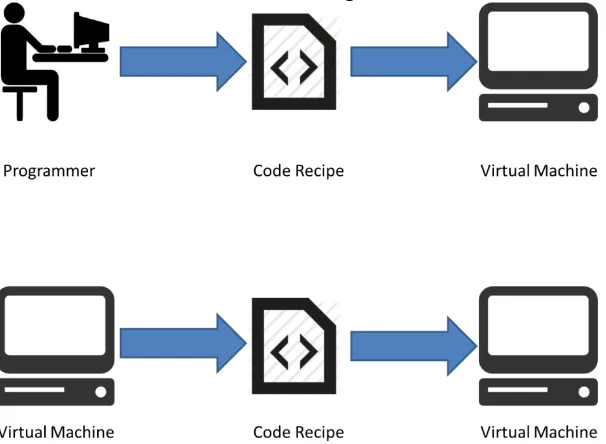
Two important high-level steps are identified for developing infrastructure as code identified by Adam Jacob, creator of Chef:
1. Break the infrastructure down into independent, reusable, network-accessible services.
2. Integrate these services in such a way as to produce the functionality our infra‐ structure requires
These principles and new paradigm are now becoming key to virtual machine
![Figure 5 Copy of the diagrams from the Docker website, explaining “What is Docker” [73]](https://thumb-us.123doks.com/thumbv2/123dok_us/9819786.483241/39.612.93.344.132.265/figure-copy-diagrams-docker-website-explaining-docker.webp)