A Thesis Submitted for the Degree of PhD at the University of Warwick
http://go.warwick.ac.uk/wrap/3773
This thesis is made available online and is protected by original copyright.
Please scroll down to view the document itself.
Pipelined Wavefront Applications Using
Reusable Analytic Models
by
Gihan Ravideva Mudalige
A thesis submitted to the University of Warwick
in partial fulfilment of the requirements
for admission to the degree of
Doctor of Philosophy
Department of Computer Science
University of Warwick
Pipelined wavefront computations are an ubiquitous class of high performance parallel algo-rithms used for the solution of many scientific and engineering applications. In order to aid the design and optimisation of these applications, and to ensure that during procurement plat-forms are chosen best suited to these codes, there has been considerable research in analysing and evaluating their operational performance.
Wavefront codes exhibit complex computation, communication, synchronisation pat-terns, and as a result there exist a large variety of such codes and possible optimisations. The problem is compounded by each new generation of high performance computing system, which has often introduced a previously unexplored architectural trait, requiring previous performance models to be rewritten and reevaluated.
In this thesis, we address the performance modelling and optimisation of this class of application, as a whole. This differs from previous studies in which bespoke models are ap-plied to specific applications. The analytic performance models are generalised and reusable, and we demonstrate their application to the predictive analysis and optimisation of pipelined wavefront computations running on modern high performance computing systems.
The performance model is based on the LogGP parameterisation, and uses a small number of input parameters to specify the particular behaviour of most wavefront codes. The new parameters and model equations capture the key structural and behavioural differences among different wavefront application codes, providing a succinct summary of the operations for each application and insights into alternative wavefront application design.
The models are applied to three industry-strength wavefront codes and are validated on several systems including a Cray XT3/XT4 and an InfiniBand commodity cluster. Model predictions show high quantitative accuracy (less than 20% error) for all high performance configurations and excellent qualitative accuracy.
I am indebted to many people for the help, advice, guidance, support and friendship they have provided me during the course of this work. Several have made special contributions, influencing not only my thesis work but also my technical and professional development in research and computer science. It is a privilege to acknowledge them here.
My supervisor, Dr. Stephen Jarvis, first guided me to conduct research in this area, giving me the opportunity to work in the High Performance Systems Group at Warwick and provided a never-ending source of optimism, good-will and guidance. I am truly grateful for his support, advice and encouragement.
Prof. Mary Vernon, my advisor, during the research fellowship year at the University of Wisconsin-Madison has been an inspiration for developing analytic models. I am sincerely indebted to her for giving me the opportunity to work at Madison and for the many long hours of discussions, advice and motivation.
I am grateful to Dr. Daniel Spooner for acting as my second supervisor, particularly for his advice during the early years of my degree.
A special vote of thanks should go to my colleague and fellow labmate, Simon Ham-mond for his relentless hard work, support and the many hours of discussions during our research collaborations.
I would like to acknowledge and thank Jon Holt, Andy Herdman, Ash Vadgama and Ben Ralston of the Parallel Technology Support team at AWE for providing us with access to the Chimaera benchmark code as well as supporting our research with valuable com-ments. Additionally I am thankful to Patrick H. Worley for giving us access to the ORNL Cray XT3/XT4 under the PEAC project, Howard Pritchard for his comments on the Cray XT3/XT4 and David Sundram-Stukel for his comments during the development of the reusable analytic model.
It is a pleasure to acknowledge the many members and colleagues of the High Perfor-mance Systems Group both past and present including, Dr. Ligang He, Dr. Guang Tan, Dr. David Bacigalupo, Dr. Graham Nudd, Dr Nathan Griffiths, Dr Arshad Jhumka, Dr. Elizabeth Ogston, Dr. Tongcheng Guo, Jonathan Smith, Justin Dyson, Xenu Chen, Peter Wong, Jonathan Byrd, Brian Foley, Paul Isitt, Lei Zhao, James Wen Jun Xue, Adam Chester, Matthew Leeke, Alistair Mills and Mohammed Al Ghamdi.
I would also like to acknowledge the support of my many friends, particularly Dr. Dhammika Widanage and Matthew Higgins for the supportive discussions and guidance dur-ing my PhD years.
This thesis is presented in accordance with the regulations for the degree of Doctor of Philosophy. It has been composed by myself and has not been submitted in any previous application for any degree. The work described in this thesis has been undertaken by myself except where otherwise stated.
Portions of this work have been published in the following publications:
Parts of Chapter 2 in [1] :
S.A. Jarvis, D.P. Spooner, G.R. Mudalige, B.P. Foley, J. Cao, and G.R. Nudd. Performance Evaluation of Parallel and Distributed Systems, chapterPerformance Prediction Techniques for Large-scale Distributed Environments. Mohamed Ould-Khaoua and Geyong Min Eds. Nova Science, 2005.
Chapters 3, 4 and 5 in [2]:
G.R. Mudalige, M.K. Vernon, and S.A. Jarvis. A Plug-and-Play Model for Evaluating Wave-front Computations on Parallel Architectures. In IEEE International Parallel and Distributed Processing Symposium (IPDPS 2008). April, 2008. IEEE Computer Society.
Chapter 6 in [3]:
G.R. Mudalige, S.A. Jarvis, D.P. Spooner, and G.R. Nudd. Predictive Performance Analysis of a Parallel Pipelined Synchronous Wavefront Application for Commodity Processor Cluster Systems. InProc. IEEE International Conference on Cluster Computing - Cluster2006, Barcelona, September 2006. IEEE Computer Society.
Parts of Chapter 7 in [4]:
S.D. Hammond, G.R. Mudalige, J.A. Smith, and S.A. Jarvis. Performance prediction and procurement in practise: Assessing the suitability of commodity cluster components for wavefront codes. InProc. Performance Engineering Workshop 08 (UKPEW), Imperial College, London, July 2008. Also accepted for publication inIET Software2009.
and in [5]:
Other work that has been conducted as part of this research has been published in:
[6] S.D. Hammond, G.R. Mudalige, J.A. Smith, and S.A. Jarvis. WARPP - A Tool Kit for Simulating High-Performance Parallel Scientific Codes.In Proc. 2nd International Conference on Simulation Tools and Techniques (SIMUTools 2009), Rome, Italy, March 2009. ACM Press.
The research in this thesis was part-sponsored by research grants from:
The University of Warwick Department of Computer Science Fellowship (2004-2005), The Warwick Postgraduate Research Fellowship (WPRF) (2005-2006 and 2007-2008), The Overseas Research Student Fellowship (ORS) by the Government of the U.K. (2004-2006 and 2007-2008), The Warwick, Wisconsin-Madison Research Fellowship (2006-2007) and The National Science Foundation (NSF), U.S. under grant CNS-0435437.
Access to the Chimaera benchmark was provided by the Atomic Weapons Establishment (AWE) U.K. under grants CDK0660 (The Production of Predictive Models for Future Computing Requirements) and CDK0724 (AWE Technical Outreach Program).
This research work used resources at the National Centre for Computational Sciences (NCCS) at the Oak Ridge National Laboratory (ORNL), which is supported by the Office of Science of the U.S. Department of Energy (DOE) contract DE-ASC05-00OR22725 under the Performance Evaluation and Analysis Consortium (PEAC).
API - Application Programming Interface
ASC - Advanced Simulation and Computing Program AWE - Atomic Weapons Establishment (U.K)
BLAS - Basic Linear Algebra Subprograms BSP - Bulk Synchronous Parallel (model) CFDs - Computational Fluid Dynamics
CHIP3S - Characterisation Instrumentation for Performance Prediction of Parallel Systems
CMP - Chip Multi-Processor CNL - Compute Node Linux
CRCW - Concurrent Read Concurrent Write CREW - Concurrent Read Exclusive Write DMA - Direct Memory Access
EPCC - Edinburgh Parallel Computing Centre EREW - Exclusive Read Exclusive Write FFT - Fast Fourier Transforms
FLOPS - Floatingpoint Operations per Second
HMCL - Hardware Model Characterisation Language HPC - High Performance Computing
HPF - High Performance FORTRAN IMB - Intel MPI Benchmark
ILP - Instruction level parallelism LAN - Local Area Network
LANL - Los Alamos National Laboratory (U.S) LAPACK - Linear Algebra Package
LU - Lower and Upper triangular system solution application benchmark in NPB MFLOPS - Millions of Floating-Point Operations per Second
MIMD - Multiple Instruction (stream) Multiple Data (stream) MIPS - Millions of Instructions per Second
MISD - Multiple Instruction (stream) Single Data (stream) MTU - Maximum Transmission Unit
MPI - Message Passing Interface MPMD - Multiple Program Single Data MPP - Massively Parallel Processor MTU - Maximum Transmission Unit MVA - Mean Value Analysis
NPB - NASA’s Aerodynamic Simulation Parallel Benchmarks NIC - Network Interface Card
NUMA - Non Uniform Memory Access ORNL - Oak Ridge National Laboratory (U.S)
PACE - Performance Analysis and Characterisation Environment PAPI - Performance Application Programming Interface
PBB - Purpose Bases Benchmarks
PGAS - Partitioned Global Address Space PRAM - Parallel Random Access Machine PSL - Performance Specification Language PVM - Parallel Virtual Machine
QoS - Quality of Service SDR - Single Data Rate
SIMD - Single Instruction (stream) Multiple Data (stream) SISD - Single Instruction (stream) Single Data (stream) SMP - Symmetric Multi Processor
SPEC - Standard Performance Evaluation Corporation SPMD - Single Program Multiple Data
SSOR - Successive Over-Relaxation UMA - Uniform Memory Access WAN - Wide Area Network
C Number of cores on a CMP(section4.3.3)
Cx Number of cores in thexdimension on a CMP (section4.6)
Cy Number of cores in theydimension on a CMP (section4.6)
G LogGP parameter: Gap per bytedefined as the time taken to transmit a byte on to the network (section2.3.4)
Gcopy Gap per byte for a memory copy on-chip (section4.3.2)
Gdma Gap per byte for a DMA transfer on-chip(section4.3.2)
Htile(cells) Height of the tile in thezdimension (section4.2)
it, jt, kt Number of grid cells inx, yandzdimension for Sweep3D (section3.1.2)
I NIC contention (interference) time (section4.6)
L LogGP parameter: the upper bound on thelatencyof the network the flight time for a message from one point of the network to another (section2.3.4)
m Number of processors along theydimension of the 2D processor array (section3.1.2)
mmi Number of angles solved per sweep step in Sweep3D (section3.2.2)
mk Height of the tile in thezdimension for Sweep3D (section3.2.2)
M essageSizeEW Message size (East-West or West-East) (section4.2)
M essageSizeN S Message size (North-South or South-North) (section4.2)
n Number of processors along thexdimension of the 2D processor array (section3.1.2)
ndiag Number of sweeps that completes from corner up to and including the
main diagonal (section4.2)
nf ull Number of sweeps that completes fully (from corner to opposite corner)
(section4.2)
nsweeps Total number of sweeps (section4.2)
Nx, Ny, Nz Number of grid cells inx, yandzdimension (section3.1.2)
o LogGP parameter: the overhead time taken by a processor to trans-mit/receive a message. (section2.3.4)
oc2N IC Time to setup a, DMA or other, copy of the message data between
kernel memory and the NIC and to prepare or process the message header (section4.3.1)
ocopy Processing time before and after the message copies on the sender and
the receiver on-chip (section4.3.2)
odma Overhead of setting up a DMA or other, copy of the message data
be-tween kernel memory and the NIC on-chip (section4.3.2)
oh The processing time for a handshake request or reply, including the
time to prepare a new message header (section4.3.1)
oinit Overhead for a message copy between application and kernel
(sec-tion4.3.1)
P LogGP parameter: number of processors (section2.3.4)
Pr Probability that a processor takesWrtime to complete a block of cells
of heightHtile(section7.4.1)
R Execution time for a single simulation (section5.2)
Receive Time to obtain a message from the network (section4.2)
Send Time to release a message to the network (section4.2)
StartPi,j Time to begin the main computation on processor(i, j)(section4.2)
Tallreduce Time to complete an MPI allreduce operation (section4.3.3)
Tdiagf ill Time gap between starting a sweep at a corner processor and the first
wavefront of that sweep reaching up to the main diagonal processors (section4.2)
Tf ill Time for a wavefront operating on a 1D processor array to arrive from
one end processor to the opposite side processor (section4.5)
Tf ullf ill time gap between starting a sweep at a corner processor and the
first wavefront of that sweep reaching the opposite corner processor (section4.2)
Tnonwavef ront Time to complete non-wavefront portions (section4.2)
Tstack Time taken by a processor to solve its stack of tiles (section4.2)
Wg A grid cell computation time (main computation block) (section4.2)
Wg,pre A grid cell computation time (pre-computation block) (section4.2)
Wg,rhs A grid cell computation time (LU RHS computation block) (section
4.7.1)
X Total number of simulations that complete per unit time (throughput) (section5.2)
Abstract ii
Acknowledgements iv
Declarations v
Sponsorship and Grants vii
Abbreviations viii
Notations x
Contents xv
List of Figures xvi
List of Listings xviii
List of Tables xix
Chapter 1 Introduction 1
1.1 Motivation and Problem Statement . . . 2
1.1.1 Analytic Modelling. . . 4
1.1.2 Reusable Performance Models . . . 6
1.2 Thesis Contributions . . . 7
1.3 Thesis Limitations. . . 9
1.4 Thesis Overview . . . 9
Chapter 2 Performance Analysis and Prediction 11 2.1 Introduction . . . 11
2.2 Parallel Computing and Parallel Programs . . . 11
2.2.1 Parallel Computing Architectures . . . 12
2.2.2 Parallel Programming Models and Languages . . . 13
2.2.3 Parallel Decompositions . . . 14
2.3 Performance Engineering Methodologies . . . 15
2.3.1 Amdahl’s Law and Gustafson’s Law. . . 16
2.3.2 Parallel Random Access Machine (PRAM) Model . . . 18
2.3.3 Bulk Synchronous Parallel (BSP) Model . . . 19
2.3.4 LogP and LogGP Models . . . 21
2.4 Performance Engineering and the HPC Lifecycle . . . 22
2.4.1 Benchmarking and Profiling . . . 24
2.4.1.1 Low-level Benchmarks, Kernels and Microbenchmaks . . . 24
2.4.1.2 Synthetic Benchmarks, Application Benchmarks and Bench-mark Suites . . . 25
2.4.1.3 Profiling. . . 26
2.4.2 Statistical Analysis . . . 28
2.4.3 Simulation . . . 28
2.4.4 Analytic Modelling. . . 30
2.5 Discussion . . . 32
Chapter 3 Pipelined Wavefront Computations 35 3.1 Pipelined Wavefront Sweeps. . . 35
3.1.1 Wavefront Sweeps on 2D Data Grids. . . 35
3.1.2 Wavefront Sweeps on 3D Data Grids. . . 37
3.2 Pipelined Wavefront Applications . . . 41
3.2.1 NPB - LU . . . 41
3.2.2 Sweep3D and Chimaera . . . 44
3.3 Related Work . . . 47
Chapter 4 A Plug-and-Play Reusable Analytic Model 51 4.1 Application Parameters . . . 51
4.2 Reusable Model : Single Core . . . 54
4.3 The Cray XT3/XT4 and MPI Communications Performance . . . 59
4.3.1 MPI Send/Receive: Off-node . . . 62
4.3.2 MPI Send/Receive: On-chip . . . 64
4.3.3 MPI Allreduce. . . 65
4.4 Measuring Computation Performance . . . 68
4.5 Deriving a Model for 2D Regular Orthogonal Grids . . . 70
4.6 Extending the Reusable Model to CMP Nodes on the XT4. . . 71
4.7 Model Validations. . . 74
4.7.1 NPB - LU . . . 74
4.7.2 Sweep3D. . . 75
4.7.3 Chimaera . . . 76
4.7.4 Discussion on Validation Results . . . 78
4.8 Summary. . . 79
Chapter 5 Wavefront Application and Platform Design 80 5.1 Application Design:Htile . . . 80
5.2 Platform Sizing and Configuration . . . 83
5.3 Platform Design: Multi-core Nodes. . . 87
5.4 Application Bottlenecks . . . 88
5.5 Sweep Structure Re-design. . . 91
5.6 Summary. . . 93
Chapter 6 Wavefront Simulation Models 94 6.1 The PACE Discrete Event Simulation System . . . 94
6.2 A PACE Model for Sweep3D . . . 97
6.3 Enhancing the Predictive Accuracy of PACE for Modern HPC Systems . . . 103
6.4 The WarPP Simulation Toolkit. . . 107
6.5 Summary. . . 109
Chapter 7 Optimisations and System Procurement 111 7.1 Introduction . . . 111
7.2 Shifting Computation Costs . . . 111
7.3 Multiple Simultaneous Sweeps . . . 113
7.3.1 Multiple Simultaneous Sweeps on Separate Cores . . . 114
7.3.2 Multiple Simultaneous Sweeps on All Cores . . . 115
7.4 Model Extensions for Heterogeneous Resources and Irregular/Unstructured Grids . . . 118
7.4.1 Homogeneous Cells, Structured Grid and Heterogeneous Resources . . 119
7.4.2 Heterogeneous Cells, Structured Grid and Homogeneous Resources . . 121
7.4.3 Homogeneous Cells, Unstructured Grid and Homogeneous Resources . 122 7.5 System Procurement and Bottleneck Analysis . . . 122
7.5.2 Computation, Latency and Bandwidth . . . 123
7.6 Summary. . . 125
Chapter 8 Conclusions and Future Work 126 8.1 Contributions and Conclusions . . . 126
8.2 Future Work . . . 128
8.2.1 Further Validations and Model Extensions . . . 128
8.2.2 Future Work on Wavefront Computations. . . 129
Bibliography 141 Appendix A Modelling Contention on CMPs 142 A.1 Dual Core CMP . . . 142
A.2 Quad Core CMP. . . 143
A.3 8 Core CMP . . . 144
A.4 16 Core CMP. . . 144
Appendix B Model Validations 147 B.1 Chimaera Validations. . . 147
B.2 Sweep3D Validations . . . 148
Appendix C cflowworkfromsweep.x 150 Appendix D Wavefront Model and Extensions 153 D.1 Model Parameters. . . 153
D.2 Single Core Model . . . 153
D.3 2D Model. . . 153
D.4 Extensions for Cray XT3/XT4 CMP Nodes . . . 154
D.5 Model Extensions for Simultaneous Multiple Wavefronts . . . 154
D.6 Model Extensions for Heterogeneous Resources . . . 155
D.7 Model Extensions for Irregular/Unstructured Grids . . . 155
Appendix E Model Parameter Error Propagation 156 E.1 General Case. . . 156
1.1 Operation of a Wavefront computation. . . 3
2.1 Speedups projected by Amdahl’s law . . . 16
2.2 A superstep in the BSP model . . . 20
2.3 LogGP parameters . . . 22
2.4 Stages in the HPC lifecycle. . . 23
2.5 Performance Engineering Methodologies . . . 33
3.1 A 2D pipelined wavefront operation on a 1D processor array. . . 36
3.2 Hyperplanes on a 3D grid of data . . . 37
3.3 3D data grid mapping on to a 2D processor array. . . 38
3.4 Pipelined wavefronts on the 2D processor array . . . 39
3.5 Fine-grained messaging and agglomerated messaging. . . 40
3.6 LU pipelined wavefront operation on the 2D processor array . . . 43
3.7 Sweep3D and Chimaera pipelined wavefront operation on the 2D processor array 45 4.1 Pipelined wavefront operation on a 2D processor array . . . 56
4.2 Measured and modelled Cray XT4 off-node MPI end-to-end communication times 61 4.3 Measured and modelled Cray XT3 off-node MPI end-to-end communication times 61 4.4 Measured and modelled Cray XT4 on-chip MPI end-to-end communication times 64 4.5 MPI allreduce operation on dual-core nodes. . . 67
4.6 MPI allreduce operation on quad-core nodes . . . 67
4.7 Wavefront operation on a 2D data grid . . . 70
4.8 Wavefront application mapped to multi-core nodes . . . 72
4.9 Wavefront operation and collisions on dual core nodes . . . 72
4.10 Wavefront operation and collisions on quad core nodes . . . 73
5.1 Execution time vs.Htile: Sweep3D 20 Million cell problem . . . 81
5.2 Execution time vs.Htile: Chimaera240×240×240cell problem. . . 81
5.3 Execution time vs.Htile: Sweep3D 1 Billion cell problem . . . 82
5.4 Execution time vs.Htile: Chimaera240×240×960cell problem. . . 82
5.5 Execution time vs. System size: Sweep3D Billion cell problem,104time steps, 30 energy groups, 120 iterations,Htile= 2 . . . 83
5.6 Execution time vs. System size: Chimaera2403cell problem,104time steps, 16 energy groups, 419 iterations,Htile= 2 . . . 84
5.7 Throughput vs. Partition Size (Sweep3D109 Cells,104 time steps, 30 energy groups 120 iterations,Htile= 2) . . . 84
5.8 Throughput vs. Partition Size (Chimaera2403 Cells,104time steps, 16 energy groups 419 iterations,Htile= 2) . . . 85
5.9 Optimising Partition Size (Sweep3D 1 Billion Cells, Total number of available processors = 128K) . . . 86
5.10 Optimising Partition Size (Chimaera2403Cells, Total number of available pro-cessors = 32K) . . . 86
5.11 Execution time on multi-core nodes (Sweep3D 1 Billion Cells,104time steps, 30 energy groups, 120 iterations,Htile= 2) . . . 87
5.13 Computation and communications cost breakdown (Sweep3D 1 Billion Cells,
104time steps, 30 energy groups, 120 iterations,Htile= 2) . . . 88
5.14 Computation and communications cost breakdown (Chimaera2403Cells,104 time steps, 16 energy groups 419 iterations,Htile= 2) . . . 89
5.15 Communications cost breakdown (Sweep3D 1 Billion Cells,104 time steps, 30 energy groups, 120 iterations,Htile= 2) . . . 90
5.16 Communications cost breakdown (Chimaera2403 Cells,104 time steps, 16 en-ergy groups 419 iterations,Htile= 2) . . . 90
5.17 Pipeline fill and steady state cost breakdown (Sweep3D 1 Billion Cells,104time steps, 30 energy groups, 120 iterations,Htile= 2) . . . 91
5.18 Pipeline fill and steady state cost breakdown (Chimaera 2403 Cells,104 time steps, 16 energy groups 419 iterations,Htile= 2) . . . 91
5.19 Pipeline fill and steady state cost breakdown (Sweep3D4×4×1000Cells per processor,104time steps, 30 energy groups, 120 iterations,Htile= 2). . . 92
5.20 Sweep structure redesign - pipelining 30 energy groups (Sweep3D4×4×1000 Cells per processor,104time steps, 30 energy groups, 120 iterations,Htile= 2) . 92 6.1 Overview of the PACE simulator and toolset . . . 95
6.2 Layers in a PACE model . . . 96
6.3 Layered objects for PACE Sweep3D model . . . 101
7.1 Optimisation by shifting computation costs to pre-computation - strong scal-ing (Speculative Chimaera type application, 240x240x240 Cells, 1 time step, 16 energy groups 419 iterations,Htile= 1) . . . 112
7.2 Optimisation by shifting 100% of computation costs to pre-computation - weak scaling (Speculative Chimaera type application, 8x8x1000 Cells/PE, 1 time step, 16 energy groups 419 iterations,Htile= 1) . . . 113
7.3 Chimaera Model Validation on a Intel Xeon-InfiniBand cluster -2403total prob-lem size,Htile= 1). . . 114
7.4 Multiple simultaneous sweeps on separate cores . . . 115
7.5 Simultaneous Sweeps on Separate cores (Speculative Chimaera type applica-tion, 240x240x240 Cells, 1 time step, 16 energy groups 419 iterations, Htile = 1) . . . 115
7.6 Simultaneous multiple wavefronts overlapping steps . . . 116
7.7 Simultaneous sweeps on all cores (Speculative Chimaera type application, 240x240x240 Cells, 1 time step, 16 energy groups 419 iterations,Htile= 1) . . . . 118
7.8 Parallel efficiency of larger problem sizes (Chimaera, 1 time step, 16 energy groups 419 iterations) . . . 123
7.9 Change in runtime due to improved computation performance (Chimaera 240x240x240, 1 time step, 16 energy groups 419 iterations) . . . 124
7.10 Change in runtime due to reduced network latency (Chimaera 240x240x240, 1 time step, 16 energy groups 419 iterations). . . 124
7.11 Change in runtime due to increased network bandwidth (Chimaera 240x240x240, 1 time step, 16 energy groups 419 iterations) . . . 125
A.1 Wavefront operation and collisions on dual core nodes . . . 142
A.2 Wavefront operation and collisions on quad core nodes . . . 143
A.3 Wavefront operation and collisions on 8 core nodes . . . 144
A.4 Wavefront operation and collisions on 16 core nodes. . . 145
3.1 A simple sequential loop operating on a 2D data array . . . 35
3.2 Parallelised loop for a 2D data array using pipelined wavefronts. . . 36
3.3 A simple sequential loop operating on a 3D data array . . . 37
3.4 Parallelised loop for a 3D data array using pipelined wavefronts. . . 38
3.5 General pipelined wavefront algorithm . . . 40
3.6 LU sequential algorithm . . . 43
3.7 LU parallel algorithm. . . 43
3.8 The pipelined wavefront algorithm in LU . . . 44
3.9 The pipelined wavefront algorithm in Sweep3D . . . 46
3.10 The pipelined wavefront algorithm in Chimaera . . . 46
4.1 Timer instrumentation of a wavefront code . . . 68
6.1 Application object:sweep3d . . . 97
6.2 Subtask object:sweep . . . 99
6.3 Parallel template object:pipeline. . . 99
6.4 Hardware model for a Pentium 3 2-way SMP Myrinet2000 cluster . . . 102
6.5 Modified clc for the serial computationworkfrom subtask objectsweep . . . . 104
2.1 Pros and cons of performance prediction methodologies . . . 33
4.1 Plug-and-Play Reusable Model Application Parameters . . . 52
4.2 Plug-and-play LogGP Model: One Core Per Node, on 3D Data Grids . . . 59
4.3 The ORNL Jaguar : System Details . . . 60
4.4 XT4 Communication Parameters . . . 65
4.5 LogGP Model of XT4 MPI Communication . . . 65
4.6 Validations for the LogGP MPI allreduce model on a Cray XT4 . . . 66
4.7 Plug-and-play LogGP Model for Wavefront Codes on 2D Data Grids . . . 70
4.8 Re-usable Model Extensions for CMP Nodes . . . 73
4.9 LU Model Validation on Jaguar (Cray XT3) -643cells per processor . . . 75
4.10 LU Model Validation on Jaguar (Cray XT3) -1023cells per processor . . . 75
4.11 Sweep3D Model Validation on Jaguar (Cray XT4) -10003 total problem size, Htile = 2,mmi= 6 . . . 76
4.12 Sweep3D Model Validation on Jaguar (Cray XT4) -20×106total problem size, Htile = 2,mmi= 6 . . . 76
4.13 Chimaera Model Validation on Jaguar (Cray XT4) -2403total problem size. . . 77
6.1 Model Validation Systems . . . 105
6.2 Sweep3D simulation model validations on an Intel Pentium-3 2-way SMP clus-ter with a Myrinet 2000 inclus-terconnect . . . 105
6.3 Sweep3D simulation model validations on an AMD Opteron 2-way SMP cluster interconnected by a Gigabit Ethernet . . . 106
6.4 Sweep3D simulation model validations on an SGI Altix Intel Itanium-2 56-way SMP . . . 106
6.5 Intel InfiniBand (CSC-Francesca) Cluster - Key Specifications. . . 108
6.6 Chimaera Model Validation on a Intel Xeon-InfiniBand cluster -1203total prob-lem size. . . 108
6.7 Chimaera Model Validation on a Intel Xeon-InfiniBand luster -2403total prob-lem size. . . 108
6.8 InfiniBand network model parameters . . . 109
7.1 Predictions for a system with heterogeneous processors (Chimaera 240x240x240 Cells, 1 time step, 16 energy groups 419 iterations,Htile= 1) . . . 120
B.1 Chimaera Model Validation on Jaguar (Cray XT4) -603problem size,H tile= 1 147 B.2 Chimaera Model Validation on Jaguar (Cray XT4) -1203problem size,H tile= 1 147 B.3 Chimaera Model Validation on Jaguar (Cray XT4) -2403problem size,H tile= 1 147 B.4 Chimaera Model Validation on a Intel Xeon-InfiniBand cluster -1203problem size147 B.5 Chimaera Model Validation on a Intel Xeon-InfiniBand luster -2403problem size147 B.6 Sweep3D Model Validation on Jaguar (Cray XT4) -10003 total problem size, Htile = 2,mmi= 6 . . . 148
B.7 Sweep3D Model Validation on Jaguar (Cray XT4) -20×106total problem size, Htile = 2,mmi= 6 . . . 148
B.8 Sweep3D Model Validation on Jaguar (Cray XT4) -5×5×400per processor problem size,Htile= 5,mmi= 6 . . . 148
B.10 Sweep3D Model Validation on Jaguar (Cray XT4) -20×20×1000per processor problem size,Htile= 5,mmi= 6 . . . 149 B.11 Sweep3D Model Validation on Jaguar (Cray XT4) -45×45×1000per processor
1
Introduction
The use of computational methods is now an essential research methodology that propels modern science, medicine and engineering. The scientific methods of computational mod-elling and simulation are now as ubiquitous as the traditional theoretical and experimentation approaches to scientific research. Particularly through computational modelling and simula-tion, domain scientists and researchers in these fields have been able to conceptualise, discover, design and produce more innovative solutions and solve highly complex problems than was ever possible with traditionalpaper and pencilmethods. Thus, such computational methods have established themselves as a third pillar of scientific investigation, comparable to experi-mental and theoretical approaches. In the last decade, the use of these techniques has grown rapidly, due to the increasing availability of efficient and large-scale computational resources. High Performance Computing (HPC) or its more popularly known designation - super-computing- is concerned with the research, design, development, manufacturing, deployment and usage of such high-end computer systems. It is more specifically characterised by the use of parallel processing for running advanced application programs quickly, efficiently and reliably. HPC systems can be of the form of a high-end server, or a massively parallel super-computerwith thousands of processors interconnected by high speed networks or a large dis-tributed system that is spread across a building, city, country or even continents.
applica-tion scientists to design near optimal applicaapplica-tion code by exposing software bottlenecks [14] and hardware facilities that should be exploited to obtain maximum efficiency and resource utility [15].
Due to these significant benefits, performance engineering has been and continues to be an important research area in the field of HPC. But understanding the performance as-pect of an HPC application when running on various parallel high performance systems and architectures still remains to be a significantly difficult task. The complexity of the HPC ap-plications and systems, the rapid pace of technology development and the lack of expertise in performance engineering make it highly non-trivial and labour intensive.
The underlying objective of this work is to assist the complex and demanding task of performance engineering for HPC. To this end, the dissertation investigates the performance of a significantly important, non-trivial and ubiquitous class of HPC computations - Pipelined Wavefront Computations - on modern HPC systems. We conduct a performance engineering study of these codes by developing a reusable analytic model, attesting it as a technique that simplifies the task of performance engineering, and then utilise the model for comprehensively assessing the quantitative and qualitative performance of pipelined wavefront computations on modern HPC systems.
1.1
Motivation and Problem Statement
Pipelined Wavefront Computations, originally described as hyperplane methods [16] by Lam-port form a major Lam-portion (up to 80 % [17]) of the high performance scientific computing work-load at institutes such as the Los Alamos National Laboratories (LANL) in the U.S [18] and the Atomic Weapons Establishment (AWE) [19] in the U.K. The communication primitives used in these parallel benchmark codes are the blocking send, receive, and group communication primitives in the Message Passing Interface (MPI) [20]. To aid the design, procurement and optimization decisions of these applications on high-end computers, there has been and con-tinues to be considerable research interest in performance engineering of these codes.
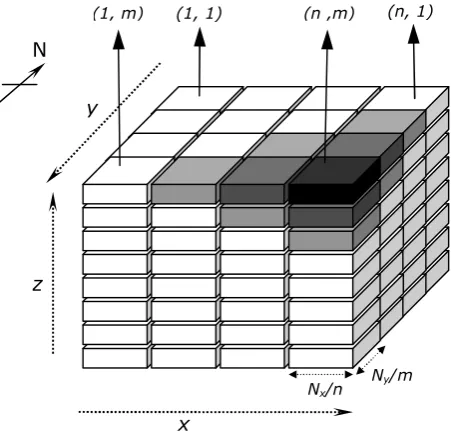
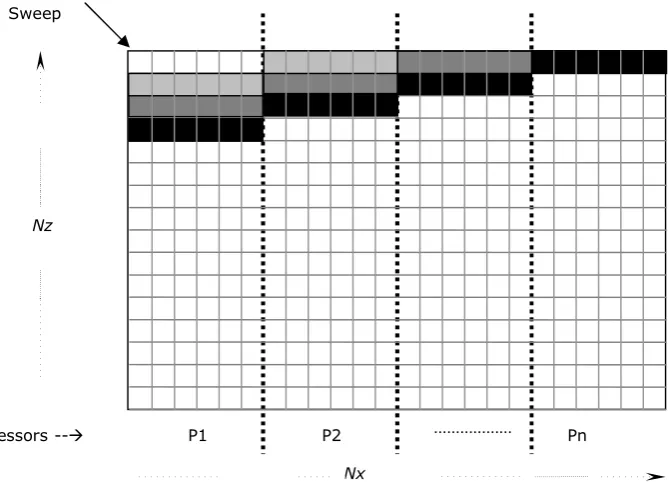
Pipelined Wavefront Computations, generally operates on a 3D grid of data cells (al-though the algorithm extends equally well on to 1D and 2D grids), where the parallel process-ing of the computation can be viewed as a wavefront originatprocess-ing from a corner of the data grid propagating to the oppisite corner of the data grid. Figure1.1illustrates this operation. Here, a 3D data grid of sizeNx×Ny×Nzis decomposed onto a 2D array ofm×nprocessors. Each
partition of data cells assigned to a processor can be viewed as a stack of tiles, each of 1 cell high. The data dependency of the cells held in processors results in a sequence of wavefronts (or a sweep) that starts at one of the corner processors, computing over the cells of its topmost or bottommost tile and propagating to the opposite processor’s bottommost or topmost tile. The shaded tiles in Figure1.1depict three basic steps of the general wavefront operation. It illustrates the tiles that are processed during the nal three wavefronts (or final three sweep steps) - light Gray, then medium Gray, then dark Gray - belonging to a sweep that originated at the bottommost tile on processor (1, 1), ending at the topmost tile on (n, m).
z y
x N
(1, m) (1, 1) (n ,m) (n, 1)
Nx/n
[image:24.595.178.404.85.301.2]Ny/m
Figure 1.1:Operation of a Wavefront computation
solve a compressible Navier-Stokes equation used in computational fluid dynamics (CFDs). The model elucidates the differences in communications structure and predicts performance with a maximum of 30% error compared with measured LU execution time on an IBM SP sys-tem. Sundaram-Stukel and Vernon [8] develop an analytic model based on LogGP [22] for the pipelined wavefront application Sweep3D [23] on an IBM SP/2 system. This model has high accuracy with less than 10% error for up to 128 processors. Mathiset al.[24] develop a general analytic performance model for Sweep3D and apply the model to explore two possible alter-native domain decompositions. Hoisieet al.[17] develop analytic models for a singlesweepof the wavefront code based on Sweep3D, while Kerbysonet al. [25] use the single sweep equa-tion to model the total Sweep3D runtime. In [26], Hoisieet al. detail the contention arising in wavefront computations when executed on clusters of SMPs where processors in a node share router links to communicate with processors in other nodes.
Non-analytic performance engineering work on wavefront codes include the Sweep3D simulation model developed and evaluated using PACE [27,28] and MPI-SIM [29,30] which was part of the POEMS [31] system. PACE uses a layered performance characterisation method and provides tools that model and evaluate (using discrete-event simulation) the com-putation and communication activities in an application by linking serial code graphs with a template that models the message passing and concurrency behaviour. MPI-SIM simulates an application by direct execution of computation and parallel discrete even simulation for com-munication and I/O operations. Other tools of note that have been used to evaluate Sweep3D include Kojak [32] and PTI [33].
In spite of all the above work, we believe that three key issues continue to make per-formance engineering of wavefront applications important:
Firstly, the complex synchronisation pattern of computation and communications in wavefront codes brings with it a considerable amount of structural variations and optimisa-tion possibilities. Each of the previous performance engineering studies are specific to LU or Sweep3D and require significant and unspecified restructuring to apply them to other wave-front codes of interest. As will be seen in the applications that are analysed in this dissertation, each have considerable differences in domain decompositions, operational characteristics, par-allel overlappings and optimisations. Therefore one of the key difficulties has been that each new wavefront application has had to be performance engineered from scratch.
Secondly, the above problem was confounded by each generation of HPC systems, introducing a previously unexplored aspect that made previous studies of wavefront com-putations require a considerable (sometimes almost entire) re-evaluation. For instance, the typical approach to performance engineering of new wavefront applications or evaluating a new HPC system was to modify existing performance studies to reflect the behaviour of the new code or the new systems. However, the modification process is error-prone and thus each new model must be extensively validated. One of the underlying goals of this dissertation is to develop methods that reduce this effort, alleviating the above problems and assisting in future performance engineering work of wavefront applications.
Finally and more importantly, all the previous performance studies on wavefront ap-plications have only addressed (in most cases through customised models) the performance and thus the optimisation of a specific application has not explored or investigated the class of applications as a whole. A considerable motivation for us, therefore, is the open question of what optimisations are possible given this important class of parallel applications. Particu-larly, one of the interesting questions, is that if the underlying scientific or numerical solution permits, what the optimal software design for this class of application is and how best it can be run on a particular HPC system. Moreover, we want to develop tools that address per-formance questions posed by application domain scientists who are required to develop their own wavefront codes and need to understand the optimal design possibilities, given their sci-entific and numerical boundaries. The aim is to develop techniques that not only answer the above questions, but also motivate and expose new questions and at the same time enable us to obtain solutions in a speedy, efficient and low cost manner.
Thus, motivated by the above key open issues, this dissertation develops analytic per-formance models that are generalised orreusable and demonstrate, their use for predictive analysis and optimisation of pipelined wavefront computations running on modern HPC sys-tems. In the remainder of this section, we discuss the incentives for using analytic methods and motivate the idea of reusable performance model development.
1.1.1
Analytic Modelling
of the four broad performance engineering methodologies. The others being Benchmarking (or direct measuring/monitoring), Statistical Analysis, and Simulation.
Performance measurement or monitoring is the most direct and straightforward form of performance analysis. In the simplest case, a program of interest (a collection of programs or a workload) is executed on the system of interest and quantitative values such as execution time and floating point operation rates are monitored. The workload plays an important part here. In order to compare systems the workloads executed on them should be compatible for comparison. A benchmark is such a workload that is developed to assess systems. Also related to benchmarking is the use of profiling tools that enables one to instrument a code and extract measures and behaviours of the code as it runs dynamically.
Based on measurements taken on a working system, statistical methods can be used to understand expected behaviour of systems. Statistical methods such as regression and curve fitting are used to make speculations for possible future systems. For example data from a relatively small cluster running an HPC application may provide an initial idea of how the ap-plication will scale to a larger cluster made up of similar nodes and communication channels. In contrast, simulation techniques seek to capture application behaviour by executing a representation of the application’s control flow, communication structure and synchronisation behaviour. In effect they model the application running on a real-world system as a computer program, also called a simulator. The events that occur during execution, such as computation, memory access and communications, are represented as events in the simulator. Simulation allows one to model the events of the system at any level of detail from low-level instruction simulations to high-level transactions.
The previous performance engineering work for wavefront applications consists of research, based on all of the above methodologies, where in most cases they employ multiple or a hybrid of these techniques. Especially for analytic and simulation based methods, there is a need to benchmark a system to obtain initial performance behaviour, system parameter values etc. Additionally, the initial insights gained from some basic statistical technique can be an integral part of model/simulator development, testing and validation.
In [35], three requirements that a performance evaluation technique for parallel com-puting must accomplish are detailed. (1) Provide an understanding of the fundamental prin-ciples of parallel program behaviour and their impact on program performance, (2) enable the evaluation of the performance of a particular program on a particular system and thus obtain insights that can suggest potential improvements and (3), predict the impact (on program per-formance) of design changes in the program or changes to the underlying system or system configuration.
pa-rameters for the best possible combination but usually the trade-off between the papa-rameters is not clear [39].
Further motivation for using analytic modelling extensively in this research is its low cost when compared to direct measuring and benchmarking, the speed in which models can be evaluated when compared to simulation, the flexibility when compared to pure statistical methods and the high levels of accuracy that can be attained. During the course of this thesis, the results will show further evidence for the advantages of utilising this methodology. This is particularly true in facilitating the development of reusable performance engineering charac-terisations for wavefront computations by, (1) enabling one to gain an understanding of which performance optimisations are possible, (2) determining quantitatively how much benefit each possible optimisation is likely to attain, and (3) allowing one to evaluate qualitatively which combination of optimisations are worthwhile.
Although the majority of this work uses analytic models, it should be noted that we supplement and reinforce our findings using both application benchmarking, in the form of actual validations, as well as results obtained by extensive simulations of these codes. Multi-ple evaluation techniques, including simulation studies, are invaluable when an actual system is unavailable or infeasible for validating the analytic predictions. When making critical deci-sions such as in the procurement of highly expensive HPC systems, assessment of the suitable system requires guarantees of predicted performance through multiple methodologies.
1.1.2
Reusable Performance Models
Performance Engineering - the understanding, analysing, evaluating and predicting of per-formance - on HPC systems is a highly complex task. An HPC application’s perper-formance on a high-end computer system is determined by many variables including, but not limited to, application algorithm, compiler, compiler optimisations, operating system, memory hierarchy and network. Thus it is difficult to find the optimal convergence point of all these variables. Furthermore, when the requirement to be cost effective and economical in managing the above resources to obtain the best performance per unit cost is included into the evaluation, the un-dertaking becomes significantly complex. Three additional concerns make this task even more laborious and demanding:
Firstly, the formidable size of HPC application codes demands analysis of many hun-dreds, thousands and hundreds of thousands of lines of source code, in many cases written using a number of different programming languages and development tools, incorporating many third party libraries and legacy codes. This imposes considerable demand on the per-formance engineer in terms of time, effort and resources.
Secondly, the pace at which the computing industry changes, not only the hardware and software technologies, but also the practices and sometimes the semantics is difficult to follow and elucidate in terms of their affect on overall performance for a given application. In-corporating new technological developments into previously understood performance char-acteristics for an application is highly non-trivial as now the performance engineer needs to re-evaluate the new characteristics and examine methods of extrapolating performance profiles. The next generation of development will demand a repeat of this cycle. Thus the performance engineer is forced to pursue a moving target.
and expertise. This is compounded very much as a result of the previous concerns. Moreover, the knowledge of performance engineering has not usually been the fort´e of domain scientists who are most often concerned firstly with solving the scientific or engineering problem and then second in improving the performance of the application.
Therefore, there is a significant need for developing efficient performance engineering methodologies and expertise.
In a recent white paperThe Landscape of Parallel Computing Research: A View From Berke-ley [40] the idea of using a number of computation-communication patterns (called dwarfs) that commonly occur in HPC codes as an abstract set of behavioural patterns was presented. The concept is to not be overly specific to individual applications, implementations, optimi-sations or hardware platforms, but to use the computation-communication patterns to draw an abstract view of their performance and underlying hardware and system requirements. The white paper [40] argues that these computation-communication “dwarfs” have consis-tently appeared in parallel applications persisting the significant technological changes that have occurred since the inception of this field. As an example of the existence of ubiquitous computation-communication patterns, the authors of [40] present the existence of numerical libraries such as BLAS [41] and LAPACK [42] which encompass commonly occurring code as reusable software.
Inspired by this idea, we believe that commonly occurring computation-communication patterns provide an excellent basis to develop reusable performance charac-terisations. During the course of this thesis we show the significant benefits and flexibility of developing such characterisations, particularly as an ideal tool that aids exploration of the key open issues that has motivated this research.
1.2
Thesis Contributions
More specifically, the principal contributions of this thesis are as follows.
• We develop a reusable (plug-and-play type) analytic model that reflects the functional behaviour of existing and imaginable wavefront computations that use MPI on a regu-lar orthogonal 3D grid of data. The model, based on LogGP [22], uses a small number of input parameters to specify the particular behaviour of most (if not all) wavefront codes. A key advantage of these parameters is that they are neither complex nor diffi-cult to obtain. The new parameters and model equations capture the key structural and behavioural differences among different wavefront application codes, providing a suc-cinct summary of operation for each application and insights into alternative wavefront application design. To our knowledge, this is the firstplug-and-playreusable model for wavefront computations and perhaps the first such model for a class of HPC applications with a highly complex computation, communication and synchronisation pattern.
possible solutions to alleviate them. Additionally, we develop simple extensions to the reusable model so that it can be applied to model wavefront codes based on irregular grids of data, HPC systems with heterogeneous resources, as well as 2D grids of data.
• We apply the reusable plug-and-play model to three different 3D wavefront codes of in-terest - NPB-LU, ASC Sweep3D and AWE’s Chimaera. The resulting model for Chimaera is the first analytic model for this application. Then the models are validated on several systems including a large Cray XT3/XT4 and an InfiniBand commodity cluster. Model Predictions show high quantitative accuracy (less than 20% error) for all high perfor-mance configurations of LU, Sweep3D and Chimaera and excellent qualitative accuracy.
• As part of the modelling process and for validation, we develop highly accurate MPI communication models for on-chip and off-chip Send, Receive and All-reduce opera-tions for the Cray XT3/XT4, and an InfiniBand based Cluster. These models provide insights into the MPI protocol operation on the respective networks and contribute to elucidating the contention arising on CMPs particularly on the Cray XT3/XT4. The communications models can be re-used in other analytic models that model applications running on these machines and use the same communication operations.
• Using the model, we present applications, projections and insights for optimisations that shows the utility of reusable analytic models for performance engineering HPC codes. Particularly, we demonstrate its ability to assist in evaluating (1) software configura-tion performance, (2) hardware platform quesconfigura-tions including platform sizing, configu-ration and a case study that uses the performance engineering insights to assess system procurement decisions, (3) hardware platform design alternatives such as the optimal number of processor cores per node, and (4) optimisations and performance bottlenecks for wavefront computations demonstrating quantitatively and qualitatively the perfor-mance improvements from the optimisations. We validate these with the use of a discrete event simulator. The bottleneck analysis shows the most important contributors (hard-ware and soft(hard-ware) to a wavefront code’s runtime. To our knowledge, this is the first such extensive optimisation study conducted for wavefront applications.
1.3
Thesis Limitations
Computer performance is measured in various forms. In many scientific and engineering problems, it is concerned with the wall clock time taken for an application to run on a com-puter system or more specifically the time to solution. This could also be interpreted as throughput or the number of solutions per time unit. Other important measures involve, speedup of an application (which is the ratio of the time to solution on a single processor to the time to solution of a parallelised - or enhanced version of the same program), resource usage (such as the amount of memory, disk space used or the rate at which power is con-sumed) and the rate at which operations are performed (such as transactions, mathematical operations, etc). Additional performance measures include measures related to fault tolerance, reliability and dependability. Finally, all of these criterion are usually viewed in the context of cost and economic viability or more specifically as the performance per unit cost.
This thesis is solely concerned with the performance measures of (1) time to solution as well as throughput, (2) scalability including speedup and efficiency. Performance related to power consumption, system reliability or dependability are not addressed. Additionally, we only discuss performance per unit cost in a qualitative context. However, recent applications of this work and feedback from the sponsors of this research have shown that the techniques developed in this research can be readily used to obtain specific evaluations of cost, for exam-ple during the procurement process for an HPC system.
1.4
Thesis Overview
This chapter detailed the underlying goals, open questions and motivations for the research presented in this dissertation. The remainder of this thesis is organised as follows:
Chapter2presents a detailed account of (1) the basic concepts, components, terminol-ogy and implementations of high performance computing, (2) the basic laws and principles related to performance engineering and (3) the state of the art in performance engineering methodologies for HPC. In general this chapter provides a survey of the literature related to HPC performance engineering and provides a critique of the existing methodologies.
Chapter3details the operational behaviour of pipelined wavefront computations as a mandatory preliminary to develop a generalreusableanalytic performance model. We investi-gate three 3D wavefront codes of interest - NPB-LU, ASC Sweep3D and AWE’s Chimaera. We describe in detail the research carried out in support of understanding of the complexities of these computations in terms of both the algorithm and the application execution on a target platform.
model applied to NPB-LU, Sweep3D and Chimaera on this system.
Chapter5uses the analytic model to investigate speculative performance of wavefront codes on the Cray XT4 system including (1) software configuration performance, (2) hardware platform questions including platform sizing and configuration (3) hardware platform design alternatives such as the optimal number of processor cores per node (4) application bottleneck analysis and (5) application redesigns to alleviate bottlenecks.
Chapter6details an alternative investigation of the performance of pipelined wave-front computations through the use of a discrete event simulator. As part of this work, the application of the insights gained through analytic model development for enhancing the predictive accuracy of a discrete event simulator system is presented.
Chapter7 further demonstrates the utility of the models developed in this research by analysing the performance of several key optimisation possibilities which include model extensions and a comprehensive bottlenecks analysis in the context of answering performance engineering questions to assist system procurement decisions. The accuracy of the results of this chapter is reinforced by detailed predictive simulation.
2
Performance Analysis and Prediction
2.1
Introduction
In order to provide a clear context and a consistent perspective for this work, in this chapter we present a detailed account of (1) the basic concepts, components, terminology and imple-mentations of high performance computing that are inherently based on parallel computing and parallel programs, (2) the basic laws and principles related to performance engineering and (3) the state of the art in performance engineering methodologies for HPC at the time of this research.
2.2
Parallel Computing and Parallel Programs
Any computing system that makes use of simultaneous execution of some set of instructions on data can be classified as a parallel computer system. Since the inception of the modern dig-ital computer, computer architects have been exploring parallelism and concurrency at many levels as a form of improving efficiency and increasing the throughput of systems. The idea is that large problems can be separated into smaller parts and these smaller parts can be solved simultaneously, or in parallel, usually using multiple processing units or entities. In mod-ern HPC systems, high performance is almost always achieved by some parallel computing methodology. Therefore in this dissertation, all systems or applications termed to be in the do-main of high performance computing are implicitly taken to be a subset of parallel computing unless stated otherwise.
There are several forms of parallelism. Bit level parallelism - is concerned with in-creasing the processor word size, which then, for instance, reduces the number of processor clock cycles needed to carry out instruction movements between processor and memory [44], pp15. The shift to 64 bit words from 32 bit computing is an example of increasing bit level parallelism.
Instruction level parallelism (ILP) - re-orders computer instructions such that they can be combined to execute in parallel without changing the result of the program. A well known form of ILP is the use of pipelining where the basic fetch-decode-execute cycle of successive instructions are overlapped by delegating each stage to a separate hardware unit. Other ex-amples for ILP methods are superscalar execution, where multiple execution units are used to process instructions in parallel, out-of-order execution of instructions, speculative execution, in which instructions are executed before being certain of its occurrence and branch prediction which involves for instance, taking a conditional branch to avoid blocking control flow.
- distributes different tasks or functions across processors to be executed in parallel. When parallelising an application or when writing parallel code, it is data and task parallelism that are dominantly exploited either by a parallelising compiler or a programmer, while bit level and ILP are well exploited by modern compiler technology on single processor architectures.
2.2.1
Parallel Computing Architectures
Considering the systems that are used for parallel computing, a broader and abstract clas-sification was provided in Flynn’s taxonomy [45]. Flynn categorises computer architectures based on whether it operates on multiple instructions and/or multiple data. The simplest sequential computer is observed to be a Single Instruction stream, Single Data stream (SISD) system where one instruction stream operates on one data stream at any instance. The second category - Multiple Instruction stream, Single Data stream (MISD) can be viewed as ILP based on the pipelining method. But it can be argued that pipelining changes the data stream at each stage and therefore is not a single data stream. The pure form of MISD has not been explored significantly and as such is not implemented in modern systems. Data Parallelism is classified into the Single Instruction stream, Multiple Data stream (SIMD) where an operation of a single instruction is applied on many data elements, similar to a vector operation. Finally Multiple Instruction stream, Multiple Data stream (MIMD) covers the case where different instruction sets are operated on different (independent) data sets.
While SISD categorises non-parallel systems and MISD represent only a limited level of parallelism or represents a class of architecture that has not been explored or have proved to be note-worthy to solve modern problems, it is SIMD and MIMD architectures that have be-come the prevalent parallel architectures in modern HPC systems. Even then MIMD machines are by far the most dominant as the SIMD operational model could be easily implemented on MIMD machines. However, specialised SIMD systems do exist for instance in the form of vector machines that are developed solely to solve inherently data parallel problems. The MIMD architecture, on the other hand has been the most popular parallel architecture due to its sufficiency to support all forms of parallel programming models.
MIMD architectures can be further classified based on the distribution of memory hi-erarchy. Shared memory MIMD machines are the earliest form, where one block of memory is shared between many processing elements. All processors share a global address space and shared data variables are operated on by many processors using consistency mechanisms and synchronisation to arrive at the desired solution. When implementing shared memory systems, the simplest have been the Symmetric Multi Processor (SMP), also called Uniform Memory Access (UMA) where each memory location takes the same amount of time to be ac-cessed by any processor. With the advent of multi-core processor chips (Chip Multi-Processors, CMPs), SMP style memory accessing is used when the processing cores access a shared main memory. But CMPs are mostly used as clusters to implement distributed memory MIMD sys-tems. Alternatively the Non-Uniform Memory Access (NUMA) systems take different times to access different areas of memory. Due to the consistent memory access requirement, SMPs cannot be too large and range from about 2 to 64 processors. NUMA machines, on the other hand can be scaled to larger numbers of processors in the order of 1024.
each other through a network passing explicit variables during execution. Distributed mem-ory machines scales to larger numbers of processors while at the same time remain relatively cheap. The disadvantage is that the latency to communicate variables is higher than on a shared memory architecture. This latency is dictated by the interconnection network. Based on the level of coupling or distribution of processors, distributed memory MIMD systems, range from the Massively Parallel Processor (MPP) Systems, computer clusters to computer Grids. MPPs are closely coupled systems where a large number of processors, typically from 1K to more than 100K are interconnected by a very high speed network. Each processor works in tight synchrony with each other and the interconnection is highly reliable. Clusters on the other hand share similar characteristics to MPPs but the interconnect is generally slower and there are fewer processors than an MPP machine. A typical example of a low-end cluster is a Network of Workstation (NoW) where several workstations are grouped as a MIMD system, to perform parallel processing utilising a LAN. A popular system architecture that’s commonly used in modern HPC is clusters of SMPs, or the more recent version - a cluster of CMPs. Each node in these systems is made up of a SMP or CMP while the nodes are interconnected by a very high speed network. Both MPPs and clusters are usually located in one location such as a single room or building. In contrast Grid computing interconnects systems spread across many buildings or are in different cities, countries or even continents. Processors in such a widely distributed system are much more independent than in MPPs or a cluster. Commu-nication between them is kept to a minimum as the interconnection latency and bandwidth between two different locations on a computer Grid are relatively poor.
2.2.2
Parallel Programming Models and Languages
In addition to the parallel architectures classification, the programs written for these systems can have several parallel programming models [44],pp26-47. These models exist as an ab-straction of the above hardware and memory architecture and are not specific to any parallel architecture. Theoretically they can be implemented on any underlying hardware.
The earliest form of parallel programming was achieved through the Shared Memory programming model. Tasks share a common memory space which facilitates communication between tasks. Data consistency and synchronisation is managed by well understood mech-anisms such as semaphores, critical sections and locks [46,47,48] avoiding, for instance, race conditions, deadlocks and starvation. Parallelism is achieved by a parallelising compiler that usescluesprovided by the programmer as compiler directives, and automatically generates parallel tasks that can be assigned to multiple processors. The OpenMP consortium [49] has developed the most popular programming specification for the shared memory programming model. Compilers implementing this specification allocate parallel areas of the code such as in-dependent loop iteraterations to separatethreadsof execution. The multiple threads or groups of threads are executed simultaneously, where each thread or group is normally assigned to a single processor. The communication between threads is achieved through shared memory. As such, the parallelism is said to befine grainedand has low overhead.
there is no shared memory location that is accessible to all processors. Particularly each task or process operates on a separate block of memory. Message passing models have been usually implemented as a set of routines packaged into a library that can be called by sequential pro-gramming languages. The programmer is responsible for specifying parallelism. In this sense, message passing parallelism is coarser grained than shared memory parallelism. The most common message passing specification is the Message Passing Interface (MPI) [20] which can be considered the de facto industrial standard for production work. The commonly used MPI bindings are for the Fortran, C and C++ languages while bindings for Java, Perl, Python as well as .NET and MATLAB [50] have been implemented but have not yet been used significantly for production work. The pipelined synchronous wavefront applications investigated in this dissertation are all based on message passing and use MPI. Therefore significant consideration needs to be taken regarding the performance aspects of MPI operation on HPC systems, when developing these models.
Finally, the Data Parallel programming model uses a more strictly regulated form of concurrency where multiple processing units perform an operation on separate elements of data simultaneously. At the end of each parallel execution block an information exchange might occur to re-organise the data. Such a re-organisation is implemented on shared mem-ory or by message passing. Therefore the data parallel model could be considered a more abstract model than shared memory or message passing. Such a programming model is said to implement a Single Program Multiple Data (SPMD) programming model. The data parallel programming model is implemented by languages such as High Performance Fortran (HPF) [51] and the OpenMP shared memory directives. Additionally, message passing programs can be written implementing the strict step-wise data parallel execution model.
2.2.3
Parallel Decompositions
Another related parallel programming concept is the parallel decomposition implemented in a program. The simplest of these is the trivial or embarrassingly parallel decomposition where it involves running the same sequential program on many processors without need for any dependency or communication between the tasks.
The data parallel decomposition takes a large data set and splits it into smaller parts and then distributes them across a set of processors. Each processor may then apply a set of instructions on its local data and communicate with other processors to exchange data that has dependencies in order to arrive at the desired solution. The set of instructions that is executed by all processors can be the same (Single Program Multiple Data - SPMD) or different (Multiple Program Multiple Data - MPMD). When a large data grid is split into regular sub-grids of data the decomposition is termed to be a regular domain decomposition. That is, each processor will work on an equal (or almost equal) number of data elements. If each data point in the global grid requires a similar amount of processing then we say that the grid is regular. If the number of grid points cannot be distributed equally (or almost equally) then we say that the grid is unstructured. In both unstructured and irregular grids, the amount of work done per processor will in most cases have large variations.
processed by an independent processing unit and the data flows through the stages to finally produce the desired solution. Other notable parallel decompositions include task farming, divide and conquer and speculative parallelism [52].
2.3
Performance Engineering Methodologies
From a performance analysis point of view, the type of application, programming model or parallel decomposition, which is best suited to be run on the various physical hardware sys-tems varies considerably. For example, message passing programs can be run on both shared memory systems as well as distributed memory systems. On shared memory systems the messages are “passed” as memory copies. On the other hand, shared memory programming models can be implemented on distributed memory systems where each processor will access a virtual shared memory space. But in this case the shared memory program will perform significantly worse on the virtual shared memory than on an actual shared memory system as now communication between tasks/threads/processors are done via a network. Similarly for instance, the performance to cost ratio may dictate that a given data parallel program is best implemented on a MIMD architecture as opposes to a SIMD machine. A trade-off between runtime and scalability may dictate that for a small number of parallel tasks, a shared memory MIMD machine will give better performance for this application. While for larger numbers of tasks, a distributed memory system could appear to be far more cost efficient.
It is these types of trade-offs that a performance engineer must consider. Ultimately, the objective is to identify the architecture that gives the best performance-cost trade-off for a given HPC application. In addition, the insight obtained will enable one to answer more significant design questions such as the programming model and/or the data decomposition best suited for the underlying scientific and numerical algorithm. In this section we give a detailed account of the state of the art and discuss key established laws, methodologies, tools and techniques that aid the performance engineer in addressing these issues.
As noted in Section1.1.1, performance engineering techniques fall in to four broad cat-egories - benchmarking (or direct measuring/monitoring), statistical analysis, simulation and analytic modelling. Since the inception of parallel computing and then high performance com-puting in the 1960s and 1970s, there has been a wealth of performance engineering research and studies conducted using techniques based on the above categories.
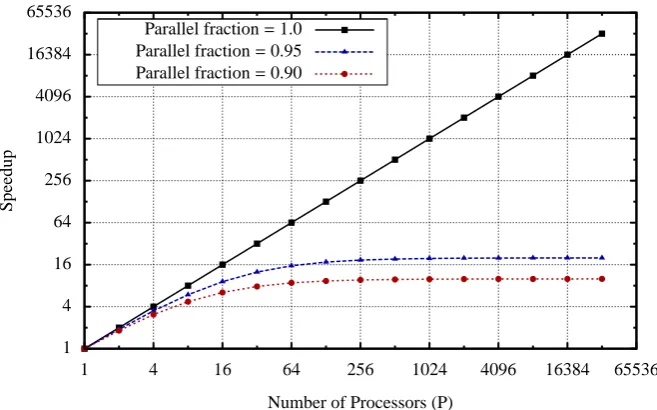
1 4 16 64 256 1024 4096 16384 65536
1 4 16 64 256 1024 4096 16384 65536
Speedup
Number of Processors (P) Parallel fraction=1.0
[image:37.595.133.462.78.283.2]Parallel fraction=0.95 Parallel fraction=0.90
Figure 2.1:Speedups projected by Amdahl’s law
2.3.1
Amdahl’s Law and Gustafson’s Law
In 1967, Amdahl presented a paper [53] that states the maximum limit of the speed improve-ment that can be achieved in a parallel program. The parallel speed improveimprove-ment, is usually given as a ratio based on the runtime of the parallel version and the run time of the serial version of the program. This is called the speedup, and is given in (2.3.1).
Speedup(n) =
Execution time of the serial version of the program
Execution time of the parallel version of the program on n processors
(2.3.1)
A related measure to speedup is parallel efficiency, which is obtained by dividing the speedup by the number of processors.
P arallel Ef f iciency(n) = Speedup(n)
n (2.3.2)
Any parallel program can be viewed as having two parts: a potentially parallel part and an inherently sequential part. Amdahl’s law states that the maximum speedup that can be achieved in a parallel program is limited by the runtime of the sequential portion of the program as given in (2.3.3).
Speedup(P)≤
1
fs−
fp
P
(2.3.3)