Integration of Large-Scale Simulations and Numerical Modelling
Tools in Close Link with the LHD Experiment
∗
)
Masayuki YOKOYAMA, Ryosuke SEKI, Chihiro SUZUKI, Masahiko EMOTO, Katsumi IDA,
Masaki OSAKABE, Sadayoshi MURAKAMI
1), Yasuhiro SUZUKI, Shinsuke SATAKE,
Masanori NUNAMI, Atsushi FUKUYAMA
1), Hiroshi YAMADA,
Numerical Simulation Research Project and LHD Experiment Group
National Institute for Fusion Science, Toki 509-5292, Japan
1)Department of Nuclear Engineering, Graduate School of Engineering, Kyoto University, Kyoto 615-8540, Japan
(Received 10 December 2013/Accepted 20 January 2014)
An integrated transport analysis suite, TASK3D-a, has been developed with the emphasis on establishing close-link with the LHD experiment database. The suite makes possible energy transport analyses for huge cases, from which the systematic understandings can be elucidated. A statistical approach for implementing large-scale simulation results into the integrated modelling has been tested. The importance of strengthening trilateral links among experiments, large-scale simulations, and integrated numerical modelling tools such as TASK3D, is crucial for promoting systematic understandings, performing validations, and then increasing the predictive capabilities.
c
2014 The Japan Society of Plasma Science and Nuclear Fusion Research
Keywords: TASK3D-a, LHD, energy confinement, Kaiseki Data Server, large-scale simulation DOI: 10.1585/pfr.9.3402017
1. Introduction
The Large Helical Device (LHD) has steadily ex-tended its parameter regime [1]. More importantly, not only the parameter extension, but also the increased diag-nostic capability has provided a wide-range database to be exploited for the accurate physics discussion. Simultane-ously, cutting-edge large-scale simulations of LHD plas-mas have been conducted for their validation by direct comparisons with experimental observations [2, 3].
However, cases for such comparisons have been lim-ited to a relatively small number because of the large size of cutting-edge simulations. To acquire comprehen-sive physics understandings and then increase the predic-tive capabilities, systematic and comprehensive compar-isons should be performed between experiments and the-ory/simulations. Therefore, simplified numerical mod-elling tools developments are complimentary essential so that the experiment database can be widely and effectively exploited.
One such tool is the integrated transport analysis suite, TASK3D-a (analysis version) [4], which has been developed as a first attempt for conducting automated energy confinement analyses for NBI plasmas in LHD. The capability of TASK3D-a has been gradually increas-ing from its first version TASK3D-a01 (released in Sep. 2012) through implementations of modules for
neoclassi-author’s e-mail: [email protected]
∗)This article is based on the invited presentation at the 23rd International
Toki Conference (ITC23).
cal transport (GSRAKE [5]), ECH deposition, and neu-tral penetration from the plasma periphery, etc., although describing these extensions is not the main topic of this paper. In this paper, the significance and usefulness of TASK3D-a are described in terms of its close link with LHD experiment data, thereby making systematic analy-ses possible. An on-going trial is introduced for integrating cutting-edge large-scale gyrokinetic simulation results into TASK3D before presenting a summary and outlook in Sec-tion 5. Such integraSec-tions should significantly enhance sys-tematic validations of large-scale simulation results against the wide-range experiment database.
2. TASK3D-a in the LHD Experiment
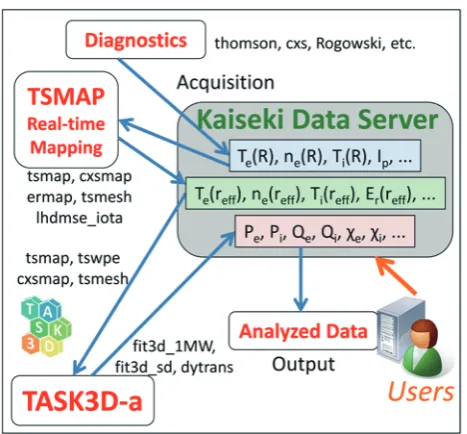
The computational flow in TASK3D-a01 has been al-ready introduced in Ref. [4, 6] and it is not repeated here. In brief, the equilibrium specification, NBI deposition, and energy balance calculations are packaged so that they are sequentially executed in an automated manner. The pack-age contains an LHD experiment data interface that has a direct link to the so-called LHD Kaiseki (analysis in Japanese) Data Server [7] and TSMAP (real-time coordi-nate mapping system) [8]. Processed diagnostics data are registered onto the Kaiseki Data Server in a common for-mat (ASCII file, the so-called eg-format), and then pro-file data, such as temperature and density propro-files (which are required for transport analyses), are mapped from the real geometry to the effective minor radius,reff, defined byTSMAP. These mapped profile data are then transferred as
c
2014 The Japan Society of Plasma
Fig. 1 Schematic illustrating the close link between TASK3D-a and LHD experiment data (centralized to LHD Kaiseki Data Server).
input to TASK3D-a. Some TASK3D-a results (NBI depo-sition profiles, ion and electron heat diffusivities, etc.) are then registered onto the Kaiseki Data Server for common use. To utilize these results, users just need to login to the Kaiseki Data Server. The dataflow described above is con-ceptually illustrated in Fig. 1. The words written in small characters are the names of registered data (so-calledeg
data).
3. Transport Analyses Database
Cre-ated by TASK3D-a
The process described in Section 2 shows how TASK3D-a has been fully integrated into the LHD ment database, allowing smooth utilization of LHD experi-ment data and then increasing numbers of analyses. So far, extensive analyses have been performed on high ion tem-perature (Ti) plasmas [9] (Ti∼5 - 7 keV,Ti>Teat the core with the density of 1∼2×10¹⁹m−3), and on medium-to-high density plasmas [10] (Ti≤Te∼3 - 4 keV at the core with the density of 3∼5×10¹⁹m−3) have been extensively analyzed. High-Te plasmas will also be analyzed once ECH modules are fully integrated into TASK3D-a. For su-per high-density core plasmas [11] and high-beta [12] plas-mas, MHD equilibrium should be more carefully treated by HINT2 [13], including such as stochastization; these are tasks beyond the presently implemented VMEC [14] in which the existence of nested magnetic surfaces is as-sumed a priori. Note that high-Ti and medium-to-high density plasmas have volume-averaged beta values typi-cally of at the most 1%, where VMEC equilibria should be considered to be reasonable. Fast computation of VMEC is also an advantage for integrated analyses.
Fig. 2 Example of NBI injection pattern.
Figure 2 shows an example NBI injection pattern (port-through power) of an LHD shot. In this shot, all five NBIs were injected (#1, #2, #4 and #5 from 3.3 s, and then #3 from 3.8 s). One beam line (#4) was intentionally mod-ulated on purpose for the charge exchange spectroscopic (CXS) measurement (for subtracting background signal), from which theTi profile can be obtained. In this shot,
Tiprofiles can be measured at 100 ms intervals. Thus, for this particular shot, 20 timings can be analyzed with full sets of temperature and density profiles. In this manner, the numbers of TASK3D-a analyses have been increased. So far, on the order of 104cases have been analyzed from
multiple shots, including cases withoutTiprofile measure-ments (onlyTeandneare available). The important fea-ture of such a huge TASK3D-a analysis database is that it stores plasma parameters, experimental power balance, neoclassical diffusion, and dimensionless parameters,etc., “ALL IN PROFILES.” Thus, it is anticipated that one is able to deduce heat diffusivity scaling with radial depen-dence, with distinguishing ion and electron channels using a statistical approach. This is one of research targets for the near future and will be reported in a separate paper. It should go far beyond the global energy confinement scal-ing [15, 16], and thus the significant increase in the predic-tive capabilities is expected. Such a deduced scaling will be implemented into TASK3D-p, the predictive version of TASK3D in which transport models (e.g., χi andχe)
be-come “the inputs” rather than the outputs as in the case of TASK3D-a.
In the following text, some examples of systematic plots on energy transport analyses are introduced as the significance of the TASK3D-a analyses database. For sim-plicity, the plotted data are only a small part (∼1%) of the entire database.
Based on dynamic transport analyses, Fig. 3 (a) shows the ion and electron heat diffusivities as a functions of the temperature ratio, Te/Ti, for reff/a99∼0.4 Here a99 is the plasma minor radius in which 99% of the total stored energy is confined. In general, data for Te/Ti<1
Fig. 3 Example figures describing systematic dependence based on TASK3D-a analysis database (multiple shot-timings). (a) Ion and electron heat diffusivity evaluated with the dy-namic transport as a function of temperature ratio,Te/Ti at a specific radius (reff/a99∼0.4). (b) Ion and electron neoclassical heat diffusivities as a function of normalized ion collision frequency. The larger symbols correspond to high-Tiplasmas, and smaller to medium-to-high den-sity plasmas.
(smaller symbols). The diffusivity is normalized by Gyro-Bohm temperature scaling,T1.5. The tendency is recog-nized that the normalized ion (electron) heat diffusivity de-creases (inde-creases) asTe/Ti is decreased. Thus, it can be considered that present high-Tiplasmas in LHD are situ-ated in aTe/Tiregime with smaller ion diffusivity but with larger electron diffusivity. This systematic plot implies that plasmas withTe∼Tiare favorable in terms of simultane-ously small ion and electron heat diffusivity. This impli-cation is consistent with recent trials for increasingTe in high-Tiplasmas (fromTi>TetowardsTi∼Te) through the increase of available ECH power.
In addition to the experimental energy balance, TASK3D-a also evaluates neoclassical heat diffusivity
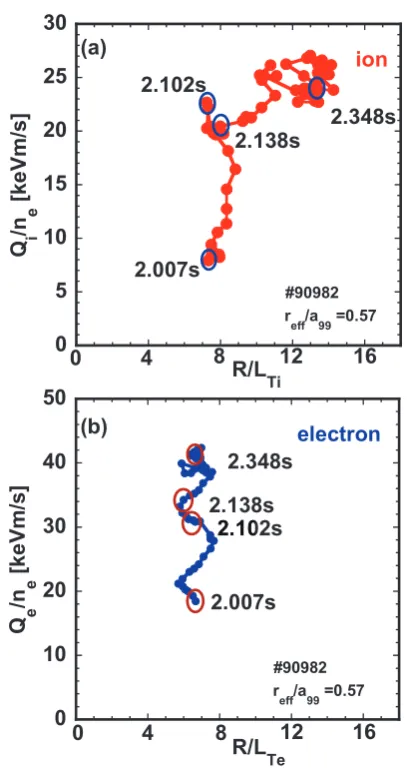
(in-Fig. 4 (a) Ion and (b) electron heat flux divided by the elec-tron density as a function of the normalized scale length of inverse of each temperature gradient atreff/a99=0.57 (inside the ion ITB of high-Tiplasma) [reproduced from Fig. 3 in Ref. [17]].
cluding the effects of neoclassical ambipolar radial elec-tric field) in addition to experimental power balance. Fig-ure 3 (b) shows the ion and electron neoclassical heat diff u-sivities as a function of ion collisionality, which is normal-ized by the ion collision frequency at the banana-plateau boundary. This plot shows clear separation between
high-Tiplasmas (lowerν∗i,b) and medium-to-high density plas-mas (higherν∗i,b) in terms of the normalized collision fre-quency. For electrons, the variation of heat diffusivity with collisionality is larger than that for ions. These plots are merely examples of systematic plots that can be extracted from the TASK3D-a analyses database. As mentioned above, statistical analysis would be one of approaches for exploiting the database to elucidate systematic and com-prehensive understandings of energy transport properties in LHD.
tem-poral behavior of (a) ion and (b) electron heat diffusivities (divided by the electron density) as a function of normal-ized scale length of the ion and electron temperature gra-dient [17]. These plots are for a radius inside the ion inter-nal transport barrier of LHD high-Ti plasma (#90982) in the phase (duration of about 300 ms) of increasingTi. The plots consist of data for 58 timings, all of which were eval-uated with TASK3D-a; profile fittings, equilibrium spec-ifications, NBI deposition calculations (including slowing down effect), dynamic transport analyses taking into ac-count theTiprofile measured by CXS with a higher time resolution (∼20 ms), and temporally interpolated values from those. Figure 4 (a) clearly identifies the time of ion energy confinement improvement, which occurs at about 2.14 s. Before this time,R/LTi is almost unchanged even with a large increase in Qi/ne. In contrast, after 2.14 s, R/LTi becomes nearly doubles (the temperature gradient
becomes about twice as steep) with almost no change in
Qi/ne. However, there is no such confinement
improve-ment observed in the electron channel (see Fig. 4 (b)). In such a way, TASK3D-a can also provide sequential infor-mation on energy confinement properties through dynamic transport, which also extends the analyses database.
4. Approach for Implementing
Large-Scale
Simulation
Results
into
TASK3D-p
Sections 2 and 3 describe how TASK3D-a has been useful for experimental analyses. On the other hand, the predictive version, TASK3D-p, has been developed to pre-dict, e.g., the achievable temperature (and those profiles) based on assumed heating scenario and transport model.
Recently, ITG-turbulence-induced ion heat diff usiv-ity in an LHD high-Ti plasma has been estimated [18]
through the gyrokinetic simulation code, GKV-X, in which experimentally observed profiles and corresponding three-dimensional VMEC equilibrium are employed. In such a way, direct application of a cutting-edge large-scale sim-ulation to experiment has been progressed. However, in terms of wide-range experiment database in LHD as men-tioned above, this application can be recognized as merely “one timing of one shot”.
Because it is extremely time-consuming to run nonlin-ear gyrokinetic simulations over a wide-range of plasma parameters, a novel reduced-model has been deduced in Ref. [19], in which nonlinear gyrokinetic simulation re-sults can be predicted from “less-expensive” linear simu-lations. The deduced model for ITG-turbulence-induced ion heat diffusivity is represented through the linear ITG growth rates and zonal flow decay times, both of which are available from linear gyrokinetic simulations. In this way, the implementation of ITG-turbulence-induced ion heat diffusivity into numerical modelling, such as TASK3D-a, can be considered as pointed out in Ref. [19].
However, even in this reduced model, it still requires
linear gyrokinetic simulations. In terms of TASK3D-p velopment, an on-going trial for further reduction is de-scribed below. In Ref. [19], 21 nonlinear gyrokinetic sim-ulation results were treated taking the following as parame-ters: radial position, safety factor, magnetic shear, normal-ized scale lengths of ion-temperature, and density gradient (cf., Table 1 in Ref. [19]). A multivariate nonlinear regres-sion analysis was applied to this dataset by taking the lat-ter four paramelat-ters as predictor variables. The remaining parameter, radial position, would be replaced by the ef-fective helicity [20], because it is one of the quantities for describing the three-dimensionality of magnetic configu-rations. Including this parameter will be performed with further implementation of other possibly important param-eters, such as dimensionless collisionality, Larmor radius, etc. Thus, the current result shown below should be con-sidered as a first example for reduced modelling through a statistical approach.
A multivariate nonlinear regression analysis per-formed on the 21 GKV-X data has provided the following functional form for the Gyro-Bohm normalized nonlinear gyrokinetic simulations results:
χi,Fit/χi,GB=0.03856
R0 LTi
1.758
R0Ln0.0506
× |sˆ|−0.285
ι
2π
−1.567
, (1)
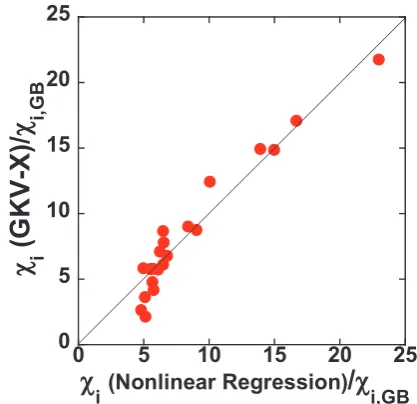
whereι/2π is the rotational transform (the inverse of the safety factor). Figure 5 compares the ion heat diffusivity from the GKV-X nonlinear simulations (vertical axis) and the fitted values obtained from eq. (1). The GKV-X results are reasonably well reproduced, although some scatter ap-pears, especially in small values of the ion heat diff usiv-ity (cf., to be compared to Fig. 9 in Ref. [19]). Nonethe-less, the important point about eq. (1) is that all the predic-tor variables can be estimated from only equilibrium and density/temperature profiles. Note that this is based on a purely statistical approach, and a physical interpretation of eq. (1) is yet to be pursued. Nevertheless, a relation such as eq. (1) makes it much easier to implement a model for ITG-turbulence-driven ion heat diffusivity into TASK3D-p through such a fitting formula.
5. Summary and Outlook
Fig. 5 Comparison of the ion heat diffusivities from GKV-X nonlinear simulations (vertical axis) and the nonlinear re-gression results (estimated by eq. (1), horizontal axis).
for LHD plasmas. This tool can be extended to other ex-periments.
The close link between TASK3D-a and the experi-ment database (LHD Kaiseki Data Server) has enabled extensive energy transport analyses in NBI-heated LHD plasmas possible. So far, on the order of 104 analyses
cases have been accumulated. General tendencies of en-ergy confinement properties in LHD have been elucidated from only a part of that database. In the near future, this TASK3D-a analyses database will be utilized in statistical analyses to deduce such as ion and electron heat diffusivity scaling with radius dependence; the results will be reported in a separate paper.
Efforts have also been made for implementing large-scale simulation results into numerical modelling tools. A reduced model for the ITG-turbulence-induced ion heat diffusivity has been obtained in Ref. [19] in this regard. In this paper, another trial is introduced; a trial based on the multivariable nonlinear regression analysis, with predictor variables available from the temperature and density pro-files and equilibrium. Of course, the eq. (1) obtained from this approach should be further upgraded and improved by adding other predictor variables that possibly affect ITG modes. Nevertheless, these efforts should strengthen links between experiment and large-scale simulation through in-tegrated modeling, such as TASK3D.
On the basis of this enhanced trilateral integration among experiment, large-scale simulations, and integrated numerical modelling tools, systematic physical under-standings and validations can be significantly enhanced, and then the predictive capabilities can also be increased.
Acknowledgments
The authors are grateful to LHD experiment group for making the experimental data available. Encouragements and advices from Prof. H. Sugama (National Institute for Fusion Science) have been highly appreciated. This work has been supported by the NIFS Collaborative Research Programs, NIFS11KNTT008 and NIFS11UNTT006. One of authors (M.Y.) appreciates a grant-in-aid from the Future Energy Research Association. Strong support from Dr. Andreas Kus (Max-Planck institute for Plasma Physics, Greifswald, Germany) on the statistical analysis of GKV-X data is highly appreciated.
[1] O. Kaneko, H. Yamadaet al., Nucl. Fusion53, 104015 (2013).
[2] H. Yamada for LHD Experiment Group., O4-1, presented at 22nd International Toki Conference (Nov. 2012). [3] For example: NIFS Peer Review Report in FY2012,
http://www.nifs.ac.jp/hyokarep/gaibuhyouka_24.pdf (in Japanese).
[4] M. Yokoyama et al., Plasma Fusion Res. 8, 2403016 (2013).
[5] C.D. Beidler and W.D. D’haeseleer, Plasma Phys. Control. Fusion37, 463 (1995).
[6] M. Yokoyama for TASK3D Users and Developers, NIFS-MEMO-61, National Institute for Fusion Science, Nov. 2012.
[7] M. Emotoet al., Fusion Eng. Des.81, 2019 (2006). [8] C. Suzukiet al., Plasma Phys. Control. Fusion55, 014016
(2013).
[9] K. Nagaokaet al., Nucl. Fusion51, 083022 (2011). [10] A. Dinklage, M. Yokoyamaet al., Nucl. Fusion53, 063022
(2013).
[11] R. Sakamotoet al., Fusion Sci. Technol.58, 53 (2010). [12] Y. Suzukiet al., Nucl. Fusion53, 073045 (2013). [13] Y. Suzukiet al., Nucl. Fusion46, L19 (2006).
[14] S.P. Hirshman and J.C. Whitson, Phys. Fluids 26, 3553 (1983).
[15] For example, ITER Physics Basis, Nucl. Fusion39, 2175 (1999).
[16] H. Yamadaet al., Nucl. Fusion45, 1684 (2005). [17] K. Idaet al., Phys. Rev. Lett.111, 055001 (2013). [18] M. Nunamiet al., Phys. Plasmas19, 042504 (2012). [19] M. Nunamiet al., Phys. Plasmas20, 092307 (2013). [20] M. Yokoyama and K.Y. Watanabe, Nucl. Fusion45, 1600