2825 Int. J. Adv. Biol. Biom. Res, 2014; 2 (11), 2825-2829
*Corresponding Author: Monireh Movahedi, Department of Entomology, College of Agriculture and Natural Resources, Science and
Research Branch, Islamic Azad University, Tehran,Iran ([email protected])
A R T I C L E I N F O A B S T R A C T
Article history: Received: 06 August, 2014 Revised: 29 September, 2014 Accepted:16 October, 2014 ePublished: 30 November, 2014
Key words:
Integrated pest management Ostrinia nubilalis Bacillus thuringiensis Trichogramma pintoii
1.INTRODUCTION
European corn borer Ostrinia nubilalais is a major pest of corn in Moghan region of Iran and many countries. This pest cause significant decline in corn yield annually
(Wang, 2005). In Moghan plain in the north- west of Iran, this pest has three generations that first generation occurs on wheat but does not make significant decline in wheat yield. Adults of this generation lay their eggs on corn leaves. Neonate larvae of O. nubilalais feed on leaves IJABBR- 2014- eISSN: 2322-4827
International Journal of Advanced Biological and Biomedical Research
Journal homepage: www.ijabbr.com
Original Article
Evaluating the Efficiency of Trichogramma Pintoii and Bacillus Thuringiensis Var. Kurstaki
on Corn Stem Borer, Ostrinia Nubilalis (Lepidoptera:Pyralidae) in Corn Fields of Moghan
Plain
Monireh Movahedi1*, Ghadir Nouri Ghanbalani2, Hosein Ranjbar Aghdam3, Sohrab Imani4
1Department of Entomology, College of Agriculture and Natural Resources, Science and Research Branch, Islamic Azad
University, Tehran,Iran
2Mohaghegh Ardebili University, Ardebil, Iran
3Biological Control Research Department, Iranian Research Institute of Plant protection, Iran
4Department of Entomology, College of Agriculture and Natural Resources, Science and Research Branch, Islamic Azad
University, Tehran, Iran
at first and then penetrate and feed throw stems of plant. This pest makes holes in the stem cause reduction in handling of materials to the aerial part of the plant and decrease the yield. Chemical control is the most common way to control these pests in many countries but due to destructive environmental effect of chemical pesticides in last decade researches have tried to find alternative for synthetic pesticides. Between alternative options biological control agents as like as parasitoid wasps and microbial agents has proved as admissible alternative for chemical pesticides (Nagarkatti & Nagaraja, 1997; Li, 1994; Charles et al., 2000; Haffmann, 2006; Ahmad et al., 2012). Adults of this parasitoid lay their eggs inside pest eggs and the Larvae of parasitoid feed inner material of pest eggs and decrease the larvae population.(Godfray, 1994). Genus Trichogramma wasps are host to hundreds of species of lepidopteran eggs (Nagarkatti & Nagaraja, 1997). In 1970 Trichogramma wasps for the first time used as biological control agent in China to control pests of corn and sugarcane (Li, 1994; Wang, 2005). In south Germany release of Trichogramma evanecense to control European corn borer Ostrinia nubilalis Hub indicated 80/5% to 96/8% reduction in plant damage (Neuffer, 1982). Kuhar (2004) used Trichogramma ostriniae for biological control of Eropean Corn Bore Ostrinia nubilalis Hub on potato plant and results showed that release of Trichogramma significantly reduce the number of larvae and damage on plant. Ahmad and Ashfaq (2012) in pakistan used Trichogramma chilonis (Ishii) successfully for the control of sugarcane stem borer (Chilo infuscatellus) under natural field conditions.
Bacillus thuringiensis is a biological control agent and is used extensively in integrated pest management programs specially for the control of Lepidoptera, Coleoptera and human disease insect vectors (Wei et al., 2003). Tghizadeh (2006) evaluated the effect of Bt on cotton bollworm Helicoverpa armigera Hubner and results showed that Bt can control pests as a biological agent and can be accepted as an alternative compound for synthetic insecticides like Endosulfan. In this study the efficacy of two agent of this biological control agent of corn stem borer in corn fields compared with common synthetic insecticides Endosolfan to find a suitable alternative for chemical control of pests in corn fields.
2. MATERIALS AND METHODS
Trichogramma wasps had produced in the insectarium in north of Iran. The native genus of Trichogramma wasps were used to mass reared on Ephestia kuhniella eggs and they used in carts (Trichocart).Experiment conducted in
corn field with 1/5 acre in northwest of Parsabad of Moghan. Five treatments were release of trichogramma, release of trichogramma plus Bt spray, Bt spray, Chemical insecticide and control respectively. For each
treatment 4 replications observed.
In order to determine the limits of each plot, plants around plots marked by color spray. In addition on the corners of plots, wooden labels with treatment code was installed. Around every traestment 5 meters observed as
border. In order to determine the time of adult emergence in the field, 10 pheromone traps were installed in different parts of the field. When traps showed the time of flying pick, the trichogramma wasps released in treatments with parasitoid release
(parasitoid release, Bt plus parasitoid release). In each 10 m2 one Trichocart. Because of the delay in emergence of adults in Moghan, 14 days later the second release of parasitoid carried out. In treatments with Bt ( Bt and Bt
plus parasitoid release treatments) at the emergence of 50% of first instars larvae the plots sprayed by formulated Bt suspension. In chemical control treatment Indoxacarb (Avant®) sprayed on plants as common
pesticide for O. nubilalis on corn, in Moghan. Two weeks fter releasing the parasitoides in treatments with release of Trichogramma the egg masses of pest was counted and the number of parasited masses recorded. One month later in each plot 20 plants selected randomly and the
number of larvael holes on the stems counted and recorded. At harvest time in each plot 20 plants selected randomly and the number of infected plants counted and recorded. Excel and MINITAB software used for data
analysis.
3. RESULTS AND DISCUSSION
3.1. Parasitism of egg masses:
Results showed that parasitism of European corn borer egg masses in release treatments ranged from 10% to 28%. In control treatment there were no parasited egg messes.
3.2. Larvael holes on plants
Table 1.
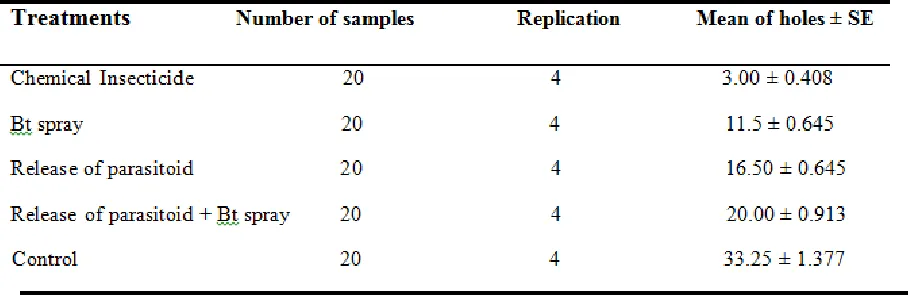
Number of European corn borer tunnels in corn stalk
Table 2.
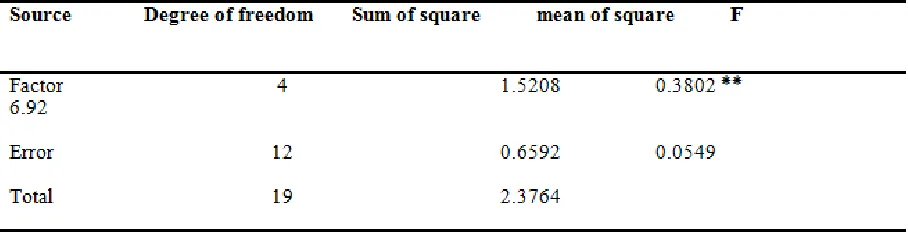
Analysis of Variance for number of larvael tunnels in corn stalk
3.3. Larvael infection at harvest
Table 3.
Number of infected plants at harvest
Table 4.
Analysis of Variance for number of infected plants at harvest
DISCUSSION
As results showed the parasitism of egg masses in release treatments was lower than expected and this results are similar to finding of Haffmann (2006) in which egg parasitism was about 50% in many of their releasing fields and this results show that releasing of trichogramm alon can not reduce O. nubilalis population and its damage in corn filed (Wright et al., 2002; Haffmann et al., 2006). To find the reason of low parasitism of egg masses farther studiescarried out on Trichocarts and results showed that in 40% of carts the number of parasitoid pupa was less than 300 (the best number is 500 in each cart) and it can be very important factor to decrease the number of released wasps in the field.
two factors did not increase the efficiency of each other. Despite the low efficiency of parasitoid wasps in pest control programs in this study, using the biological agent for pest control in fields for years can help other natural enemies to establish in the field and decrease the pest population under damage treshhold.
REFERENCES
Ahmad, S., Ashfaq, M., Hassan, M. U. and Sahi, S. T. 2012. Potential of parasitoid Trichogramma chilonis (Ishii) (Hymenoptera: Trichogrammatidae) against the sugarcane stem borer, Chilo infuscatellus (Lepidoptera; Pyralidae) under field conditions. International Journal of Biodiversity and Conservation 4 (1) 36-38.
Charles, P.-C., ORR , D. B. and Van Duyn. J. W. 2000. Trichogramma Releases in North Carolina Cotton: Why Releases Fail to Suppress Heliothine Pests. Economic Entomology 93(4): 1137-1145.
Godfray, H.C.J. 1994. Parasitoids behavioral and evalutionary ecology. Princeton Univ. Press.
Haffmann, M. P., Walker, D. L. and Shelton, A. M. 1995. Biology of Trichogramma ostriniae (Hymenoptera: Trichogrammatidae) reared on Ostrinia nubilalis (Lepidoptera: Pyralidae) and survey for additional hosts. Entomophaga 40: 387-402.
Haffmann, M. P., Pitcher, S. A., Cheever, S. A., and Gardner, J. 2006. Efficiency of inoculative releases of Thrichogramma ostriniae ( Hymenoptera: Trichogrammatidae) against European corn borer , Ostrinia nubilalis (Lepidoptera: Crambidae). Biological Control 36:345-349.
Kuhar, T. P, Barlow, V. M., Haffmann, M. P., Fleischer, S. J., Groden, E., Gardner, J., Hazzard, R., Wright, M. G., Ptcher, S. A., Speese, J and Westgate, P. 2004. Potential of Trichogramma ostriniae (Hymenoptera: Trichogrammatidae) for Biological Control of European Corn Borer (Lepidoptera: Crambidae) in Solanaceous Crops. Economic Entomology 97940: 1209-1216.
Li, Y. L. 1994.World wide use of Trichogramma for biological control on different crops. In: Wajnberg, E. and Hassan, S. A. ,eds. Biological control with egg parasitoid, CAB International, UK. 37-51.
Nagarkatti, S. and Nagaraja, H. 1997. Biosystematics of Trichogramma spp. and Trichogrammatoidea species. Annu. Rev. Entomol. 22: 157-176.
Neuffer, G. 1982. The use of Trichogramma evanescens Westw. In sweet corn fields. A contribution to the biological control of the European corn borer Ostrinia nubilalis Hbn. in south west Germany. Les Trichogramma, Antibes (France). April 20-23. 232-235.
Taghizadeh, M., Basiri, G and Sarifi, P. 2006. Biology of Corn Stem Borer, Ostrinia nubilalis, in Moghan Region.17th Iranian Plant Protection Congress, 2-5 Sep 2006.
Wang, Z., He, K and Yan, S. 2005. Large- scale augmentative biological control Asian corn borer using Trichogramma in China. Second international Symposium on biological control of arthropods. (China). 487-494.
Wei, J-Z., Hale, K., Carta, L., Platzer, E., Wong, C., Fang, Su-C and Aroian, R. V. 2003. Bacillus thuringiensis crystal proteins that target nematodes. PNAS. 100 (5): 2760-2765. Available on: