Research
Article
Separated
Control
and
Data
Stacks
to
Mitigate
Buffer
Overflow
Exploits
Christopher
Kugler
1and
Tilo
Müller
1,*1DepartmentofComputerScience,Friedrich-Alexander-UniversityofErlangen-Nuremberg,Germany
Abstract
Despite the fact that protection mechanisms likeStackGuard,ASLRandNX are widespread, the development on new defense strategies against stack-based buffer overflows has not yet come to an end. In this article, we present a novel compiler-level protection calledSCADS: Separated Control and Data Stacksthat protects return addresses and saved frame pointers on a separate stack, called thecontrol stack. In common computer programs, a single user mode stack is used to store control information next to data buffers. By separating control information from thedata stack, we can protect sensitive pointers of a program’s control flow from being overwritten by buffer overflows. To substantiate the practicability of our approach, we provide SCADS as an open source patch for the LLVM compiler infrastructure. Focusing on Linux and FreeBSD running on the AMD64 architecture, we show compatibility, security and performance results. As we make control flow information simply unreachable for buffer overflows, many exploits are stopped at an early stage of progression with only negligible performance overhead.
Keywords: Stack-basedBufferOverflows,LLVM,SeparateControlStack
Received on 02 September 2014; accepted on 05 January 2015; published on 05 October 2015
Copyright © 2015 T. Müller and C. Kugler, licensed to EAI. This is an open access article distributed under the terms of the Creative Commons Attribution license (http://creativecommons.org/licenses/by/3.0/), which permits unlimited use, distribution and reproduction in any medium so long as the original work is properly cited.
doi:10.4108/eai.5-10-2015.150477
1. Introduction
Security in software has a long history. After one of the mostprominentexamplesofmalware,theMorrisWorm[16, chapter:“TheInternetWorm”],gainedalotofmediaattention, steadilymoreandmoreexploitshavebeendevelopedtoabuse severalvulnerabilities,presentinfrequentlyusedprograms. Asacountermeasure,scientistsbegantodeveloppatchesand protectionmechanisms,tobeintegratedintoprograms,tofix vulnerabilities or at least make it as unfeasibleas possible for attackers, to abuse them any further. This triggered a long-lasting race, with the task for both of the two sides (attackersanddefenders)tobethefirsttoexploreanewor oldvulnerabilityandattackorfixitbeforetheopponentgains knowledgeaboutit.Thisraceisstillongoingtoday,nowthat security in the IT sector is even more important than ever before.And untiltoday,one ofthemost frequentlyabused vulnerabilities,alreadypartoftheattackstrategyoftheMorris Worm,is still not fixed satisfactorily. Thetalk is of buffer overflows.Bufferoverflowsareavulnerability inprograms thatiscausedbymissingrangechecksonbuffers,whichmakes themaninherentproblemoftheusedprogramminglanguage.
Cisoneofthelanguagesthatdoesnotperformanyrange checksonbuffersbyspecification,thusitisnotsupporting the preventionofbufferoverflowsa llb yi tself.According totheTIOBE-index[28],Cisstillthemostcommonlyused programminglanguageasof2014,whichmaybethemain
reason why buffer overflows are so dangerous and well-known, even in modern software. Of course, in the history of IT security, many attempts have been made to eliminate the vulnerability of buffer overflows. Though the developed defensive schemes either were not able to protect against all consequences of a buffer overrun, or they had other disadvantages, like a non-negligible performance overhead.
Protection schemes that focus on incorporating a posteriori boundary check for buffers (against the language’s specification), lower the performance of programs written in C severely, and are therefore not the favored protection mechanism of choice, because C as a programming language is mostly used because of its well-known high performance features. Some supporting protection concepts like Data Execution Prevention (DEP)[18] andAddress Space Layout Randomization (ASLR)[26] share the idea of not protecting the overrunning buffers at all, but instead target to enfeeble any exploits that abuse buffer overflows, by reducing the amount of options an exploit has, as soon as the redirection of the program’s control flow has occurred. But history once again has proven, that this strategy also is not the answer to everything. The invention of DEP, although it was a very important progress to be made in the field of IT security, has spawned attack schemes such asReturn Oriented Programming (ROP) [23, 25], which is able to bypass the protection offered by ASLR and DEP to successfully exploit a program.
The main reason why ROP can be successful is the fact that neither DEP nor ASLR protect theReturn Instruction Pointer (RIP)from modification, which is the most popular target of exploits for control flow manipulation. A rather obvious conclusion to this situation is that a better strategy may be to protect the RIP and equals, hence to use a security mechanism which sets in at a temporal stage of protection between DEP/ASLR and boundary checking of buffers. The approach we present within this article is based on just this idea. The protection ofcontrol flow datalike the RIP can be maintained in many different ways, and our concept is not the first to take up this strategy. Nevertheless, our approach is defined by the way it addresses this task, by introducing a second stack to the generally single stack of a runtime environment. The two stacks, namely thecontrol stackand thedata stack, are supposed to manage different types of data without mixing them, to fulfill the protection of control flow data, especially the RIP. For this reason the defensive concept we introduce is given the nameSeparated Control and Data Stacks (SCADS).
2. Design and Implementation
Control-Stack
Data-Stack
Heap
BSS-Segment
Data-Segment
Text-Segment
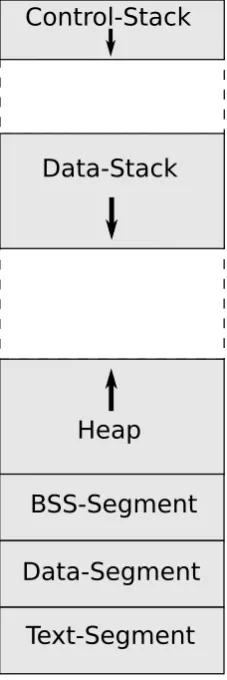
Figure 1. Userland memory layout of a program compiled with SCADS.
SCADS is based on the idea ofseparatingthe data which is stored on the stack of a process. It shall not be possible for an attacker to manipulate and redirect a program’s control flow after a buffer overflow occurred. To achieve this separation, we introduce a second stack, the so calleddata stack). While the remaining, native stack of the unified model now shrinks in size and becomes the so calledcontrol stack. For the purpose of preventing misunderstandings, we denote the original stack of the non-SCADS runtime environments asunified stack.
In consequence to the twofold stack usage, the process memory layout experiences a few changes. Figure 1 roughly indicates the new memory layout that is accompanied with the usage of SCADS. The memory segment of the unified stack is now occupied by the control stack, and in contrast to the original memory layout there now exists an additional memory segment between the heap and the control stack: the data stack. We further describe the exact location of the data stack in the forthcoming sections, but for now we want to mention that the control stack cannot collide with the data stack when it grows downwards, as both the control and the data stack are fully able to grow automatically.
Both of the newly introduced stacks manage mutually exclusive types of data. To clarify what kind of data is stored on each of the stacks, we classify two types of data that can be identified on the unified stack:
Control Flow Data This type of data is responsible or at least capable of managing the control flow of the program. The most important example of control flow data is the return instruction pointer, which is stored on the stack every time a function is called. Common exploits often modify the RIP, to redirect the control flow to pre-delivered shellcode or other source of malicious code.
Regular Data This data type is everything but control flow data. It includes all data which is necessary for computations but does not influence the control flow, e.g. buffers. Moreover local variables and saved data registers are considered to be of the type of regular data. Regular data, especially buffers, are often used by common exploits to gain the ability to modify nearby control flow data.
both of the two stacks to be referenced by a register, which allows access to the stack pointers (and frame pointers if used) as known from the unified stack.
Listing 1: Exemplary assembly code that indicates which of the two stacks is influenced by a corresponding machine instruction (green: control stack; yellow: data stack).
push %r14
sub 8, %rsp
mov %rbp, %r14
sub 8, %rbp
mov %rbx, (%rbp)
sub 8, %rbp
mov %rcx, (%rbp)
call function
mov (%rbp), %rcx
add 8, %rbp
mov (%rbp), %rbx
add 8, %rbp
add 8, %rsp
pop %r14
ret
In consequence to the data separation, the machine instructions of the x86 ISA can now also be classified into different categories. Some of them influence the state of the control stack, others the state of the data stack, and still others do not have an influence on any of the two stacks. Listing 1 illustrates the responsibility of the two stacks for different machine instructions, by the help of an exemplary assembly program. The code highlighted in green influences the control stack, the code in yellow influences the data stack and the code in gray does not have an influence on any of the stacks, mainly because it does not perform a memory access.
2.1. Initialization of Data Structures
The initialization phase is an essential process of the SCADS concept. All necessary data structures, that are needed to guarantee the protection of the control flow data, are created and initialized. The summarized task of the initialization phase is to set up a runtime environment that is conform with the SCADS concept. A program is supposed to be compatible with the SCADS environment as soon as themain-function is entered, such that initialization operations must be completed before.
2.1.1. Linking the Initialization Module. As we do intend to separate the initialization phase from the actual program code, we perform the initialization before the body ofmainis executed. One way to achieve this would be to hard-code the initialization mechanism into the compiler, and
let it place the machine instructions at the very beginning of main. But this is not be the method of preference because anything that is to be executed before the main function should not be the task of the compiler, but the task of the linker. So the initialization phase is encapsulated within a separate module, which is linked to the binary and builds a wrapper around the mainfunction.
Listing 2: Command-Line to link a SCADS-binary with the init module.
clang -Xlinker --wrap=main -o scads_bin
scads_module.o init_module.o
An exemplary command-line, which is used to link a binary with the initialization module, is illustrated in listing 2. The here defined object fileinit_module.o contains a function called__wrap_main. By passing the-Xlinker -wrap=main flags to the linker, it is advised to replace every call to the function main with an invocation of the function __wrap_main. To ensure the invocation of the original mainfunction, the__wrap_mainfunction must make a call to it after the initialization is finished. Everything that is contained in, and performed by the initialization module is now be described in section 2.1.2.
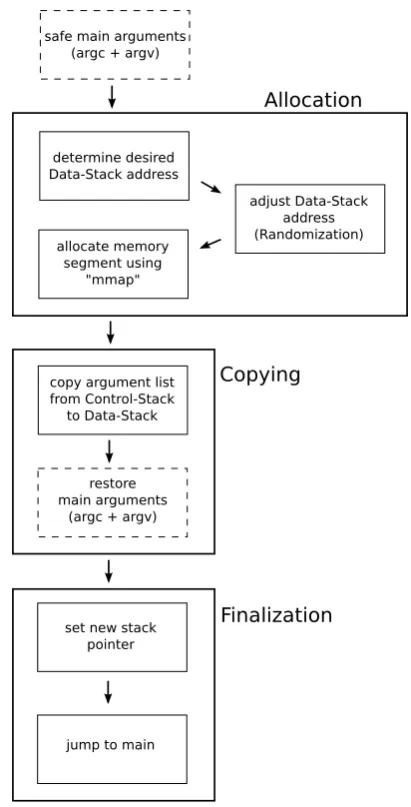
2.1.2. The Initialization Process. The initialization itself consists of a couple of steps to be performed. Figure 2 shows the single steps of the initialization phase by the help of a control flow diagram. As mentioned in section 2.1.1, the initialization is implemented within the__wrap_main function, which is called by the_startfunction. When the __wrap_mainfunction is entered, the runtime environment still consists only of one single stack, the unified stack. This stack is used during the whole initialization to allocate and set up the second stack, the data stack. By the end of the initialization, we no longer reference the unified stack by its original name but call it control stack. Because after the initialization steps, the behavior of the unified stack equals the behavior of the control stack, as explained in section 2.3.
For the whole initialization process, no lib-functions are used but only raw system calls without wrapper functions around them. The reason for this approach is a compatibility issue which occurs when functions of a custom library compiled with SCADS are used before the initialization of the data stack has finished. In such case, the program aborts due to a segmentation fault. This topic is further explained in section 7.4.
Allocation
Copying
Finalization safe main arguments
(argc + argv)
restore main arguments
(argc + argv) determine desired Data-Stack address
adjust Data-Stack address (Randomization) allocate memory
segment using "mmap"
copy argument list from Control-Stack
to Data-Stack
set new stack pointer
jump to main
Figure 2. Control-Flow diagram of the initialization phase step-by-step.
command-line arguments, which needs to be known for later copying of the arguments, as explained in section 2.1.2.
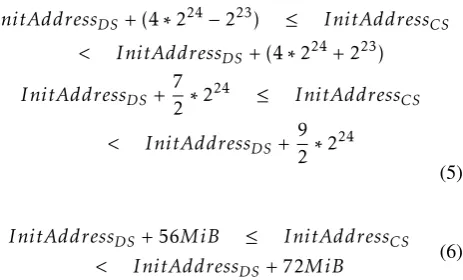
Afterwards a desired, raw starting address for the data stack segment is computed. This is achieved by retrieval of the unified stack address (i.e. the current value of%rsp), which is the control stack address later on. As shown in figure 1, the data stack is determined to lie below the control stack, within the unallocated memory gap between the unified stack and the heap. To prevent the data stack from being placed inside the control stack, we first obtain the maximal extension of the control stack, which can be retrieved via thegetrlimitsyscall by passing theRMLIMITconstant as resource parameter. By default the maximal extension size of the stack is defined to be8MiB.
addressData,static =addressCtrl+ 8∗maxExtensionCtrl
addressData,f inal =addressData,static+randomEntropy
with randomEntropy∈[−223,223−1]
(2) We use the value returned by this syscall to identify the maximal starting address (control and data stack grow both from high to low addresses) for the data stack, satisfying the condition that the data stack does lie below and not inside the extensible area of the control stack. Within a64-bit address space, there is no lack of leeway, so we can define the raw static starting address of the data stack, as shown by formula 1, without introducing any complications. With a default value of8MiB for themaxExtensionControl variable, this leads
to a starting address of the data stack, 64 MiB below the control stack extension during the execution of the data stack allocation.
Nevertheless, as already indicated, the so computed address is just a static one. Meaning that apart from the
maxExtensionControl variable, there is no other variable
factor to influence the resulting address. For processes with equal maximal stack extension, the gap between data and control stack would remain always the same. If an attacker could obtain this information, pointers could be misused similar to the attack scheme by Bulba [17]. Knowing that the maximal stack extension is a parameter to rarely change, this static sized gap would be the regular case and therefore not sufficient to guarantee an anonymous location of the control stack relative to the data stack.
Listing 3: Allocation of the data stack via mmap. // this variable is placed on the control stack
int control_stack_address = 0;
void *segment_addr_final = (void*)(((long long)&control_stack_address) - ((long long)DATA_STACK_OFFSET));
const int MMAP_SYSCALL_PROT = PROT_READ | PROT_WRITE; const int MMAP_SYSCALL_FLAGS = MAP_PRIVATE |
MAP_ANONYMOUS | MAP_GROWSDOWN; const int INITIAL_STACK_SIZE = PAGE_SIZE; const int FD = -1;
const int OFFSET = 0;
// invoke mmap
void *data_stack_ptr =
invoke_mmap_syscall(segment_addr_raw, INITIAL_STACK_SIZE, MMAP_SYSCALL_PROT, MMAP_SYSCALL_FLAGS, fd, offset);
randomEntropy which lies in the interval[−223,223−1]. This means the data stack can be adjusted in both directions, to high and low addresses, depending on the sign of the pseudo-random value.
With the final data stack address, we can now allocate the memory segment using the system callmmap. The entire code that is executed for the allocation is illustrated in Listing 3. As result of the allocation, we receive an anonymous, non-executable memory segment of initial size of one page, including read- and write-privileges. TheMAP_GROWSDOWN flag, which is passed to mmap, allows the data stack to grow in size, just like the control stack does. The growth of the stack is an essential property, because it allows the allocation of the stack with the minimal size of one memory page, so that no unused memory is wasted. However the growth of the data stack, with theMAP_GROWSDOWNflag activated, is a bit more complicated than one would expect. A short explanation of the addressed complexity is given in section 2.2.3. Also note that MAP_GROWSDOWNis a Linux specific flag. The equivalent on FreeBSD is theMAP_STACKflag, and the call to mmap is accordingly adjusted, depending on the operating system, the binary is compiled and linked on.
Copying of Command-Line Arguments In general, no data migration needs to be performed that transfers data from the control stack on to the data stack, with one exception. We implemented SCADS in such a way that all data gets automatically separated and stored at its destination, from the moment of the invocation of the main function. But there is one important block of data, that gets stored on the control stack even beforemainis executed. The talk is of thecommand-line arguments, which shall not remain on the control stack, and therefore do get migrated onto the data stack within the initialization process.
According to the control flow chart of figure 2, the next step after the allocation of the data stack is the copying of the command-line arguments from the control stack onto the bottom of the data stack, we just mentioned. It is vital for the SCADS concept that the arguments are no longer addressed on the control stack. By copying them onto the data stack we once again enforce the important condition of separating control flow data from regular data, as all command-line arguments are classified as regular data and so shall not remain on the control stack.
The goal is to prevent exploits from abusing the argv pointer to reach control flow data and modify it. Thus, to successfully prohibit such actions, theargvpointer must not contain an address, that points to the control stack. Hence we copy all arguments onto the data stack as mentioned before. To perform this task, the argument list is parsed from the control stack, to identify the overall space that is needed to store the arguments on the data stack. After the whole block of command-line arguments has been copied, the addresses of theargvarray pointing at the arguments, are no longer consistent. Therefore, the wholeargvarray is translated to
stack, where themainfunction can reach it. Last but not least, theargcvariable, indicating the number of arguments, and theargvpointer, pointing at the start of the arguments array, are restored into the registers%ediand%rdito fulfill the parameter interface of themainfunction.
Finalization Two more small steps need to be accomplished to finalize the initialization phase. We already computed the starting address of the data stack and know the offset to the end of the argument list, which is now also located on the data stack. But we must place this address where the program expects it. The SCADS environment is configured to have%rbpmanage the stack pointer of the data stack (see section 2.2.1). Hence, the starting address of the data stack, below the argument section, is placed into%rbpusing inline assembler. Finally, a call to themainfunction is made to initiate the program’s true control flow, which from then on uses the SCADS runtime environment, including the control and the data stack.
2.2. The Data Stack
As explained in the previous section 2.1, the data stack is a completely new memory segment. This segment was and is not present in a runtime environment with the unified stack. Its allocation is done during the initialization phase (see 2.1.2). Nevertheless, the newly created data stack stores most of the data that is stored on the unified stack, and therefore its size does only differ very slightly from the size of the unified stack. Its location is designed to be below the control stack, within the unallocated memory space between the heap and the control stack. However its position is not completely static, as it is partially randomized to improve the protection against several exploits.
2.2.1. Register Occupation. The data stack occupies at most two registers for which we have chosen%rbpas stack pointer and%r14as optional frame pointer. The reason we not chose%rspto be the data stack’s stack pointer is based on an architectural matter, which forces the use of%rspfor the control stack. A more detailed explanation of this can be found in the forthcoming section 2.3, which focuses on the control stack.
Knowing that%rspis reserved by the control stack, it is obvious to use%rbpas stack pointer of the data stack, because it is not occupied by the control stack which does not need a frame pointer for its memory management. The%rbpregister is most of the time used as a specific purpose register anyway, but we reserve it permanently for the usage as stack pointer. In contrast, the reservation of register%r14as frame pointer is not permanent.
Stackframe #1
Stackframe #2
(saved data registers)
Local Area
...
parameter #7 parameter #8
(saved data registers)
Local Area
...
+16
- localOffset
High
Low
saved frame pointer RIP
saved frame pointer RIP
+24 +32
+0 +8
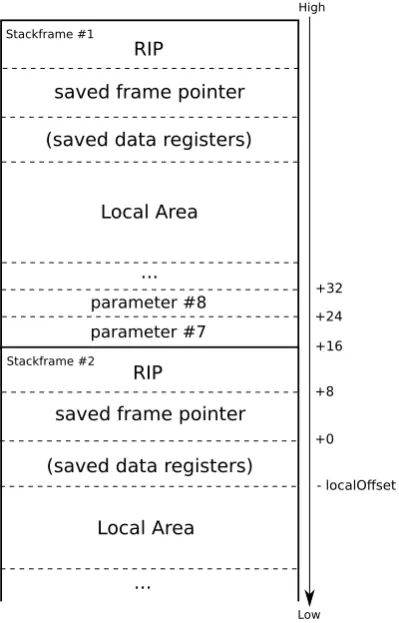
(a)Several stack frames of theunified stackwith frame pointer offsets for data structures
Stackframe #1
Stackframe #2
(saved data registers)
Local Area
...
parameter #7 parameter #8
(saved data registers)
Local Area
...
+0 +8 +16
- localOffset
High
Low
(b) Several stack frames of the data stack with frame pointer offsets for data structures
Figure 3. Detailed representation of the unified stack in comparison to the data stack (using the AMD64 calling convention).
the register defined as operand. Because of this fact, by using %rbpas stack pointer of the data stack we do not end up with problems of storing control flow data like the RIP on the data stack by mistake.
Figure 3(b) shows a compilation of stack frames on the data stack. It is clearly shown that due to the missing frame pointer and RIP on the stack, the parameters stored on the stack are starting at frame pointer offset +0bytes on a64-bit architecture. The figure 3 fulfills the concept of the AMD64 calling convention, thus parameter1to6are not stored on the stack but passed via registers. In contrast to the data stack, the parameters on the unified stack (figure 3(a)) are starting at frame pointer offset +16bytes. Hence, for the implementation of the parameter access on the data stack, all offsets must be subtracted by16.
The data stack is also responsible for the storage and retrieval of any callee-saved data registers (not including the frame pointer register, which is classified as control flow data) at the beginning and the end of a function. In this context, a second difference towards the unified model exists, which concerns the topmost access to the data stack. We cannot use pushandpop instructions on the data stack, because these instructions implicitly use the register%rspfor storage of the corresponding data, but we define%rbpas stack pointer of the data stack. The solution is to simulate thepushandpop instructions on the data stack with a chain of usable, alternative machine instructions, which do not create any side effects on memory regions we want to keep clean from regular data. Listing 4: Usage of push/pop instructions on theunified stack.
# push instruction push %rbx
# pop instruction
pop %rbx
Listing 5: Simulation of push/pop instructions on thedata stack.
# push simulation
sub 8, %rbp mov %rbx, (%rbp)
# pop simulation mov (%rbp), %rbx
add 8, %rbp
Listing 5 demonstrates how the regular push and pop instructions from listing 4 are translated to operate on the data stack. Everypushandpopis simulated by two instructions, consisting of eithersub/movormov/sub. As we now use two instructions, instead of one, this simulation scheme may have a negative effect on the performance of the program.
by the kernel. The flagMAP_GROWSDOWN, which is passed to the mmapsystem call, enables the feature of the newly allocated memory segment, to grow downwards. But there may be some complications with large stack frames (by large we mean frames with a size larger than one page). It may be necessary to treat such stack frames in a special way to allow the stack to grow correctly. Though, this is a complication dependent on the operating system. On FreeBSD the stack extension can be performed the same way on small as well as large stack frames (as shown by listing 6), without introducing any performance overhead. But on Linux, a large stack frame must be extended page-wise (as shown by listing 7), as otherwise the program’s execution is likely to abort. Listing 6: Stack extension for a large stack frame on the
unified stack.
# stack extension
sub 10000, %rsp
Listing 7: Translated stack extension for a large stack frame on thedata stack.
# stack extension
sub 4096, %rbp
mov %rax, (%rbp)
sub 4096, %rbp
mov %rax, (%rbp)
sub 1808, %rbp
During our analysis on Linux, we have made the observation that it is impossible to extend the size of the data stack in one step for large stack frames, by modifying the stack pointer %rbponly once. Instead it is necessary to extend the stack in steps of single pages (generally4KiB large), to ensure that the operating system can allocate guard pages at the top of the growing stack correctly. This circumstance makes need of a chain of instructions to be generated for the extension of the data stack for large stack frames. The chain consists of instructions to modify the stack pointer in direction of growth andtouch(make a write access) the stack at its current extension. This ensures that the exception handler of the guard page, at the top of the stack, gets invoked, to let the operating system extend the stack by one page. Listing 7 shows the translation of anormalstack extension for a large stack frame (shown by listing 6) to the extension mechanism needed for the data stack.
If the data stack’s extension is not specially treated, as shown in listing 7, and instead extended normally, as illustrated in listing 6, the program aborts with a segmentation fault due to a memory access to not allocated memory. By extending the stack pointer by more than about one page’s size (depending on the position of the stack pointer in the current stack frame), the guard page at the top of the stack is skipped and the next memory access takes place at the unallocated memory region between the data stack and the heap.
2.3. The Control Stack
The control stack stays at the place of the unified stack. This means that it is allocated by the kernel of the operating system at load time of each program. Due to the fact that it now stores much less data compared to the unified stack, the control stack is of rather small size and generally not exceeds the size of one page with the exception of heavy recursion. It keeps the direction of growth from high addresses to low ones and expands towards the data stack.
RIP #1
saved FP #1
Stackframe #1RIP #2
saved FP #2
Stackframe #2Stackframe #3
...
...
16 Byte
8 Byte
8 Byte
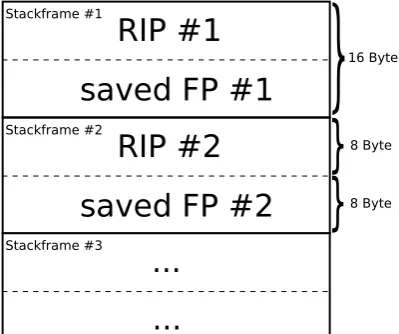
(a)Several stack frames of the control stack with frame pointer in use
RIP #1
Stackframe #1RIP #2
Stackframe #2Stackframe #3
...
...
16 Byte
8 Byte
8 Byte
Alignment
Alignment
--(b)Several stack frames of the control stack without usage of frame pointer (including optional 16 byte alignment)
Figure 4. Detailed representation of the control stack.
generated return addresses would not be stored on the control stack in the first place, thus becoming necessary to copy or move them to the control stack, right after a function has been called. Not only would this lead to a significant performance loss, because a couple of instructions would be needed for copying the addresses. Moreover it would construct a severe vulnerability that would eliminate the necessary condition of separation for a secure environment, defined by the concept of SCADS. The only other reasonable choice for the use of %rspwould be as stack pointer for the data stack. Therefore we would store the most vulnerable control flow data, namely the RIP, on the data stack. Hence, it is actually mandatory to use%rspas stack pointer for the control stack.
2.3.2. Managed Data Types. The control stack is responsible for the maintenance of control flow data. To be exact, the control stack storesreturn instruction pointersand saved frame pointersonly. This means, that it handles existing control flow data except of function pointers. Our SCADS implementation is yet only prototypical and the usage of the control stack is intended to be extended in the future. But the handling of function pointers is a rather complex task, as the C specification on the usage of pointers of any type, as function pointers, is far from strict.
“A pointer to an object or to void may be cast to a pointer to a function, allowing data to be invoked as a function (6.5.4). A pointer to a function may be cast to a pointer to an object or to void, allowing a function to be inspected or modified (for example, by a debugger) (6.5.4).”[5, J.5.7 Function pointer casts]
The loose specification of function pointers, produces the need to treat any arbitrary type of pointers as function pointers, because such transferring casts are not prohibited. Nevertheless, the storage of regular pointers (classified as regular data) on the control stack in general enforces the mixing of regular data and control flow data on the control stack, which threatens the security of the primary control flow data such as the return addresses. Accordingly, as long as function pointers remain ambiguous, as defined by the C specification, there is no proper solution to find the right place for their storage. So far, function pointers could be cast into pointers of any other type and vice versa, without offending the terms of their specification. This is the main reason why we do not configure the control stack to handle function pointers in SCADS.
Because%rspis used to store the stack pointer of the control stack, it is further possible to usepushandpopinstructions for storage and retrieval of data on the control stack. This makes the implementation of the control stack extremely simple, as we do not need to change any machine code generation in the compiler, which concerns the storage and removal of RIPs and the frame pointer of the data stack. They are implicitly stored and retrieved from the control stack by usage of thecall,ret, pushandpopinstructions.
2.3.3. Alignment. Alignment is an optional feature in SCADS which enables compatibility to legacy code, e.g.
legacy libraries; it can be enabled by a flag at compile time. When code compiled with SCADS is not confronted with legacy code, this feature is not necessary for a program. The purpose of stack alignment has various reasons. In case of a64-bit architecture like x86-64, every memory address is represented by an8byte value. Since we only store at most two addresses per function call on the control stack, it is always implicitly8byte aligned. The planned usage of the control stack would not require any coarser alignment. But to be compatible to legacy code, which uses the control stack for storage of control flow data, as well as regular data, an 8byte alignment would not be sufficient in some cases. To fulfill a maximum of 16 byte alignment, in case no frame pointer is in use, we extend the control stack by another 8 byte using thesubandaddinstruction. On the other hand, if a frame pointer is enabled for a stack frame, the stack is already 16byte aligned and thus no further operations are performed. Figure 4 shows the two cases which do either not need a forced stack alignment, because the frame pointer is in use, or a stack alignment needs to be enforced by adding gaps of8byte of memory to each stack frame.
2.4. Implementation in the LLVM Back-End
We briefly want to describe, what was done to implement SCADS in the LLVM back-end in practice. As our implementation’s target architecture is the x86-64 architecture, most of the modifications have been made to the files belonging to the x86 back-end. A complete list of files (with full project path), which have been modified is:
• include/llvm/CodeGen/CommandFlags.h • include/llvm/Target/TargetOptions.h • include/llvm/Target/TargetFrameLowering.h • lib/CodeGen/PrologEpilogInserter.cpp • lib/CodeGen/PrologEpilogInserter.h
• lib/CodeGen/TargetFrameLoweringImpl.cpp • lib/Target/X86/X86RegisterInfo.h
Note that the code for the initialization module is completely independent from the Clang/LLVM compiler and has therefore been excluded into a separate file we named main_wrap.c. The name arises from the fact that the initialization module is linked to the program in such a way, that it wraps around the mainfunction and calls it as soon as the initialization is done. While the filesllc.cpp, CommandFlags.handTargetOptions.h have only been adjusted to implement the various flags we integrated to let the user decide about the features to use, the rest of the listed files contribute to the actual functionality of SCADS. The set of flags now contains the following four:
• -num-stacks [number of stacks] • -enable-xor-encryption
• -enable-legacy-callback-compat • -enable-legacy-stack-alignment
As most of the features of SCADS do not interfere with any function’s body, but just need to make changes to the prolog and epilog of functions, the file that was most important for SCADS’ implementation is the fileX86FrameLowering.cpp. In this file, the whole prolog and epilog mechanism for every source code function is implemented within the two functions emitPrologue(. . . )andemitEpilogue(. . . ). It is implemented how the stack extension is managed (regarding normal and large stack frames), which way registers are to be pushed and retrieved from the data stack (aspush/popare not usable on the data stack), and the functionality of the compatibility flags, as well as the XOR encryption (see section 2.5).
The LLVM back-end is structured in such a way, that every hardware architecture has its own back-end, separated from any other back-end, to implement the generation of code for just one specific architecture. This also applies for the x86-architecture. For that reason, one of our goals during the implementation of SCADS was to interfere as few as possible with other hardware architectures. Largely, we have accomplished this task, but there is one upper class every single back-end inherits from, which we had to modify, hence also taking influence on the implementation of other back-ends. In the class TargetFrameLowering of the file TargetFrameLowering.h, we included a couple of data structures and added a second constructor to handle the management of more than one stack. In fact, the class’ structure has been modified in such a way that it would be easy to let its inheriting classes handle an arbitrary number of stacks in future. The newly added constructor is only used by the x86 back-end. Some data structures like theStackDirection, that were originally single values, have been transformed into arrays to manage multiple values of the same type (i.e. multiple stacks instead of just one). Nevertheless, the access on these arrays is fully managed through read-only functions of that class, which we adjusted in such a way that they hide the information from the caller of the read data structure being an array. So the behavior of the non-modified back-ends remains the same.
Although we had to make a few major changes to the architectural design of the compiler’s class structure, we have implemented SCADS in such a way that the compiler is fully downward compatible. If the-num-stacksflag is set to “1”, the compiler generates code the way it did before we modified it. The rest of the yet not mentioned files, listed above, have experienced minor modifications to maintain the new register occupation for the data and the control stack, and to adjust the offsets to the data structures on the data stack.
2.5. Extension: XOR-Encryption
The SCADS approach alone is designed to protect control flow data, especially the return address, from abuse by malicious code injection. Nevertheless, in this section we want to introduce an extension to the SCADS approach, which also targets the protection of the RIP. This approach is similar to the one presented in [14, section 3.1(c)]: By encrypting the RIP with XOR, we can enforce an enhanced security level regarding the integrity of any stored RIP on the control stack. Every time a function is entered, at the very beginning of the function, the RIP is encrypted. The decryption of the previously encrypted function takes place at the very end of each function. Thus the return address remains encrypted for the whole runtime of the function (including its sub-calls), until the decrypted state of the return address is needed again, to jump back to its caller. So the implementation of the scheme only requires us to extend the prolog and epilog of every function, generated by the compiler.
To preserve the performance as much as possible, the encryption algorithm is reduced to a simple XOR with the current value of the stack pointer. As performing the XOR operation twice on a single value obviously results in its identity, it can be used for encryption as well as for decryption of the return address equally. Listing 8 shows the implementation of the XOR-encryption within a function’s prolog and epilog.
Listing 8: Implementation of the XOR en-/decryption. # prolog: encryption of RIP
xorq %rsp, (%rsp)
...
# epilog: decryption of RIP
xorq %rsp, (%rsp)
the data stack’s frame pointer would be used for encryption. Therefore it is wise to choose the%rspregister (i.e. the stack pointer of the control stack) for the encryption process.
We want to mention that we define the approach of XOR-encryption of the RIP within our SCADS environment as more effective, because of the fully dynamic randomized positioning of the data stack towards the control stack. In contrast the randomization (or “float” as they call it) of Fu’s and Wang’s approach [14, section 3.1(b)], takes place during compile time, which lowers the effect of the XOR-Encryption, due to the fact, that the stack address may be known more likely.
3. Related Work
In history, many different approaches have been invented to pit themselves against the menace of exploits of all kind, from which some are similar to our approach. We want to have a discussion on these related schemes and point out the differences between them and SCADS.
3.1. StackGuard
StackGuard[10] is a compiler-based security measure that focuses on the protection of return addresses and saved frame pointers, just like SCADS does. To achieve this task, binaries must be recompiled into code which places so calledcanaries (orcanary word[s][10, chap. 3]) on the stack, right below a return address or saved frame pointer. These canaries are in general8byte sized values, which can be of different, common types:random canary,terminal canary, andXOR canary[22, sec. 2.2]. Random canaries consist of randomly generated values, terminal canaries include characters that cannot be used within an attack vector of an exploit, and XOR canaries are random canaries which are additionally encrypted with the return address of the corresponding stack frame. While these three types do possess their own specific properties, the security of the whole concept strongly depends on the anonymity of any created canaries. On every removal of a stack frame, with a subsequent jump to the previous control flow, the previously stored canary is checked for integrity and this way allows to detect buffer overflows that may have modified the protected data. When a buffer overflow occurs, the attack vector is placed in the buffer and further, potentially overwriting the return address. But to reach the return, the attacker must overwrite the canary linearly. Thus it is vital for the delivered security level that an attacker must not be able to reproduce the correct value of the canary.
There exists an extension of StackGuard, called Mem-Guard [10, sec. 3.2], which offers a higher security level than StackGuard itself. But with the higher security level, this concept “suffers substantial performance penalties compared to”[10, sec. 4.2.2] StackGuard. For that reason, we are not discussing MemGuard in this article, because performance preservation is one of the main goals of SCADS. A detailed analysis of SCADS’ and StackGuard’s security quality in
With StackGuard, a slight performance overhead may be attached, because the placement of the canaries on the stack requires the execution of “7 [more machine] instructions”[10, sec. 4.2.1] per function call, than without the usage of StackGuard. This performance overhead is generally very small, but may sum up to a noticeable amount when the number of performed function calls is rather high. In contrast, SCADS does not introduce additional machine instructions for each stack frame, hence there is no significant performance overhead in general. The memory overhead of StackGuard is negligible, as the only additional memory that is used, arises from the canaries placed on the stack. With canaries of 8 byte size on a 64-bit system, the average call-depth of the program must be high to create a significant memory overhead. SCADS produces a small initial memory overhead at program start, that is likely to be compensated at runtime.
3.2. StackShield
StackShield[2] is a defensive concept similar to SCADS in specific ways. In 2008, the idea of StackShield was revisited for the binary rewriting tool TRUSS (Transparent Runtime Shadow Stack)[27], with the difference that a return address is compared to its shadow copy rather than enforcing its integrity by restoring a backup value.
By managing a redundant storage area, that contains return addresses of the regular control flow, StackShield reminds of the control stack of SCADS which being separated from the main stack. The storage area of StackShield though, is located in the data segment of a process’ memory space. Within this memory space, StackShield manages redundant copies of any return address, created during runtime. The original return addresses from the stack, however, remain at their original memory location and are not modified. The objective of StackShield is to prevent the permanent modification of a return address by comparing its value with its copy in the redundant storage area, before theretmachine instruction is executed. In case a buffer overflow occurred and modified the return address maliciously, StackShield does notice the modification and perform a counter action. It is up to the programmer to define the behavior in such a case. StackShield may either abort, due to a detected exploitation attempt, or overwrite the modified return address with its original value from its copy and keep the program running, even though some local data may have been altered and causes undefined behavior. Just like StackGuard and SCADS, StackShield is a security mechanism that is compiler-based. This means that it the activation of StackShield within a binary does require to recompile the program, but not to modify the source code.
therefore decreases the performance noticeably. The overall performance overhead of a binary with StackShield activated may not be underestimated, because the overall management of the redundant storage area, incorporated into every prolog and epilog of a compiled function, is again quite expensive. Like StackGuard, StackShield’s performance overhead is thus bound to the number of calls that are made within a program, while SCADS’ performance overhead is onlystatic.
The memory overhead of StackShield is also similar to the one of StackGuard. Every new stack frame requires a few additional bytes to store the redundant return address as well as minor collateral data used to maintain the data structures of the redundant area in the data segment. Unless a program does not have a very high average call-depth, the memory overhead is not large at all.
3.3. Multi-Stack Approaches
During our research, we found two existing concepts which are especially similar to our approach as they make use of multiple stacks, just like SCADS does. These two concepts areMSC (“Multiple Stacks Countermeasure”) [29, p. 63ff.] andSCISM (“Stack Control Information Separating Mechanism”) [14]. While these approaches are closely related to ours, there exist some essential differences having an influence on the security and other properties. We explain these differences and point out what sets SCADS apart from MSC and SCISM in the following.
3.3.1. MSC. MSC is a security measure based on the idea of separating data on the stack to different memory locations. However, MSC follows a much more excessive strategy of data separation by using not only two different stacks but up to five stacks. The five stacks and data they manage are classified upon risk levels that indicate how likely data is to be used for exploitation, as indicated by [29, p. 64, table 3.1]. Thus MSC separates all data, stored on the stack, in a fine-grained way, to prevent correlation between data types, that shall be strictly isolated from each other. As all other previously presented concepts, MSC is a compiler-based approach as well. For the maintenance of the five newly introduced stacks, the compiler that implements MSC uses the frame pointer of a stack frame and modifies the offsets to any local data to redirect the access onto the stack of desire. So in contrast to SCADS, MSC does not reserve a register (or pair of registers) for every single stack that is added to the original one. This method forces the location of every single stack to be static, thus defined at compile time. In our view the static location of every stack and also the static offset between all stacks can introduce a security vulnerability for exploits making use of random write access. Such exploits can easier find the data on corresponding stacks that they need to modify, because the relative position is known before execution.
MSC tries to address this problem by placing all character buffers on a stack where nothing but buffers are stored. However, as explained in [29, p. 63, sec. 3.3.1], it is also
of structs does not get separated across stacks (see [29, p. 68, fig. 3.2]). This proves the approach is kind of “over-engineered” because it is possible to gain random write access during an attack, when a struct containing a buffer inhabits an arbitrary pointer. An example for such an exploit is shown in section 4. We classify the security level of SCADS in such a scenario as more safe, because it is capable of protecting against these exploits.
According to the performance analysis that has been performed in [29, p. 70, sec. 3.4.1], MSC does introduce only minor performance impacts. SCADS is also designed to cause as few performance overheads as possible. Nevertheless, the fact that MSC does not occupy an additional register for the maintenance of the stacks may result in more optimal code. The memory overhead that comes with MSC is rather high: “The drawback of this countermeasure is that it results in gaps on the remaining stacks, resulting in wasted memory” [29, p. 69]. All five stacks are allocated with the same size, which is the maximum size of the unified stack, that needs to be known at compile time. For the storage of the specific data types, that are placed on each of the five stacks, no reordering is fulfilled, to prevent an internal fragmentation as shown by [29, p. 69, fig. 3.3]. This leads to the problem that MSC causes a memory overhead of5∗sizeof stackwhen all five memory segments are mapped to physical memory, which happens as soon as all of the stacks have been used once with an arbitrary operation. So in contrast to a binary that is not been protected with MSC, the memory overhead is increased fivefold and the overall overhead is dependent on the size of the stack, leading to an even worse decline in memory usage, the higher the original stack memory consumption of a program is.
With SCADS we do have an initial memory overhead that cannot be weed out, but in comparison to MSC, SCADS tends to compensate the initial memory overhead the more memory is used by an application at runtime, instead of even increasing the overhead. Furthermore, the initial memory overhead with SCADS is of static size and is explicitly one page (needed to be allocated for the initialization of the data stack) while the memory overhead of MSC is dynamically increasing with the maximum size of the stack. Regarding memory analysis, Younan states [29, p. 72, sec. 3.4.2] that it may be possible to reduce the memory consumption for future work, but it is not an available feature yet.
With SCADS we have the full ability to eliminate the frame pointer in stack frames, which do not need a frame pointer for their data management, whereas MSC is designed to be dependent on the use of a frame pointer in every stack frame. “[The] frame pointer is used as a fixed location access [. . . ] because the value of the register containing the stack pointer changes whenever a variable is pushed or popped from the stack” [29, p. 68, sec. 3.3.2]. Hereby MSC unfortunately loses a simple performance optimization technique.
SCADS. It allocates the second stack, that is responsible for the storage of the control flow data, within the data segment. One difference to SCADS is the size of the stack, managing the control flow information. In SCISM the stack is allocated with fixed size, defined at compile time. In case the size of the stack is not sufficient, the additionally created control-flow data is migrated to an isolated area within the heap. This forces a permanent, performance-decreasing check for data to be stored on the “local stack” [14, sec. 3.2], whether it already exceeds the maximum size. SCADS allows an automatic growth of the control stack, therefore making any boundary checks unnecessary and allowing a more dynamic way of using the stack. SCISM’s behavior in this case is not only decreasing the performance, especially when the size if the stack gets exceeded, but it also causes an initial memory overhead due to the local stack initialization with a static size.
Another performance-limiting difference between SCADS and SCISM is the task specification for the two stacks. SCISM uses the original unified stack for the storage of regular data, while the stack in the data segment is responsible for the storage of control-flow information like return addresses and saved frame pointers. SCADS twists the management vice versa, by using the unified stack (managed by%rsp) as control stack, and the data stack is the memory segment to be newly allocated. This may sound like an unimportant difference, but in fact it has an influence on the performance of the security measure. Thecallandretinstructions of the x86-architecture are defined to use the the register%rsp for their memory access (either storage or retrieval of return addresses) and there is no option to alter this behavior. The consequence for SCISM is, it has to perform copy operations to move the return address between the stacks, because it is not implicitly placed on the right stack. This results in a performance overhead for SCISM which is not present in SCADS, because the control stack is managed via %rsp, causing all return addresses to be immediately stored in the right place, thus making any copy operations unnecessary. However, in consequence to the different usage of the two stacks, SCISM does not incorporate incompatibilities to legacy code, as the calling convention is not altered and parameters are accessed via%rsp.
Just like MSC, SCISM does not make use of reserved registers for the maintenance of its stacks. This again causes the problem, that the location of the local stack is not randomized at runtime. “The offset of the first address for SFM data area from the begin of the static data block is float and decided randomly within a certain constant c [. . . ] The offset is fixed in once compile[d] and varied in different compilers.” [14, sec. 3.1] Furthermore the fact that the data segment’s start address is also not randomized by ASLR on Linux, makes it especially easy for an attacker to reach the local stack and its managed data when random access write is gained. Once more we want to emphasize that we consider a known location of the second stack as a severe vulnerability towards various exploits (as shown in section 4)
3.4. Hardware-Assisted Approaches
In 2009, Francillon et al. [13] presented a multi-stack approach similar to SCADS in the sense that data and control information are stored separately on two distinct stacks. In their work, however, the authors propose a hardware-assisted modification for embedded systems like the AVR micro controller and prove the effectiveness of their approach based on FPGA simulations. A hardware-assisted solution has the advantage that insructions likecallandretcan be modified in a way that return addresses are placed directly on a secure stack without being accessible for user instructions like mov. On the downside, hardware-assisted solutions cannot be deployed to end-users easily and cannot be elevated to the x86 architecture easily.
Only established companies like Intel and AMD are in the position to deploy security-related hardware changes with a practical impact for x86. In a U.S. patent from July 2014 [11], AMD proposes the encryption of return instruction pointers. In this approach, data and control information are not separated on two distinct stacks – and hence, control information can still be overwritten. But as instruction pointers are encrypted, they cannot be modified in a predictable manner. This solution is not available on the market during the time of this writing, but the patent states a minimized performance overhead similar to SCADS because the encryption takes place in hardware. As an advantage over SCADS, recompilation of existing code will not be required.
With the Memory Protection Extensions (MPX) [7, 21], first proposed in June 2013 as an extension for Intel x86 architectures, Intel presented a concept built upon the idea of integrating boundary checks for buffers. This way, buffer overflows shall be prevented and with it any exploits that make use of buffer overflows. The mechanism of MPX addresses exploitation prevention at an even earlier stage than SCADS. A compiler, which implements the mechanism of MPX is used to integrate the boundary checking into any program code to be compiled. Boundary checking, however, is not present in the specification of the programming language C.
operated, this introduces another vulnerability as soons as an attacker finds a way to modify the value of the bounds register on the stack. Unfortunately, we were not able to solve these questions at the time of this writing, because MPX was not yet available yet.
4. Security Evaluation
We now inspect the security that can be achieved by using SCADS as defensive approach against known stack smashing techniques. The task to visualize and explain the security level of a defensive method can be highly complex. The achievement of a formal verification is impossible when it comes to a randomized memory layout, which is an essential requirement of SCADS to guarantee the protection against advanced types of exploits. Therefore we do not seek to verify the security of SCADS formally, but instead focus on giving as many relevant examples of common stack smashing exploits as possible. We apply these exploits to programs compiled with SCADS to analyze their effectiveness.
At the same time, we want to discuss the effectiveness of SCADS in contrast to other security measures to point out the uniqueness of our defensive technique. To perform this task, we stick with the most commonly used and widespread alternative approaches known, which we decided to be StackGuard[10] andStackShield[2]. Both of these methods share the high priority target with SCADS to protect the return instruction pointer from illegal misuse and modifications. Thus they are suitable for an appropriate comparison with SCADS, regarding the level of protection that can be achieved in each case.
In case the return address can be modified permanently without notification, any of the three concepts can be seen as vulnerable against an attack. Thus we simplify our security analysis to exemplary exploits which try to modify the return address permanently. Any tasks beyond the modification of the return address, which are normally performed by real world exploits to invoke the execution of malicious code are ignored in this analysis. Any attack vector we construct for an exploit does therefore only include the data to overflow a supplied buffer and to reach a return address by whatever means. For the details that follow on the successful modification of return instruction pointers, the reader may have a look at the known literature [17, 19, 20], where several stack smashing techniques are explained and referenced entirely.
As shown in listing 9, each of our test binaries is compiled to incorporate the StackGuard, StackShield or SCADS defensive mechanism. The compilation of the SCADS binary is slightly more complex, because the flag which enables SCADS (-num-stacks) has been implemented in the compiler’s back-end (LLVM). Hence, the LLVM build process needs to be split up into three parts (intermediate code generation, machine code generationandlinking), as long as SCADS is not enabled by default. We usedStackShield v0.7andGCC v4.6.3 for generating the binaries with StackShield and StackGuard
Listing 9: Build commands for binaries compiled with SCADS, StackGuard and StackShield.
# StackGuard build process
gcc -O0 -fstack-protector -std=c99 -o binary_name source_name
# StackShield build process
shieldgcc -O0 -std=c99 -o binary_name source_name
# SCADS build process
clang -O0 -emit-llvm -S -o intermediate_name source_name llc -O0 -march=x86-64 -num-stacks=2 -o asm_name
intermediate_name
clang -Xlinker --wrap=main -o binary_name asm_name main_wrap.o
4.1. Simple Buffer Overflow
As first example we want to present a simple exploit abusing buffer overflows. It is only successful on older systems and binaries without further security measures in use, like ASLR and DEP. Although the presented exploit may be rather harmless today, we want to prove that SCADS alone protects against such an attack, and compare the effectiveness with StackGuard and StackShield. For this purpose we use an abbreviation of an example presented in Aleph One’s summary of various stack smashing techniques from 1996 [20].
The source code of the frame work, that is used to establish a vulnerable environment for the exploit can be seen in listing 11. Within this example, the vulnerability is caused by the function strcpy. The function does not check the size of the output buffer according to the size of the input data. Thus, it is easy to cause a buffer overflow when a string as parameter is used whose size is larger than the output buffer.
Listing 10: Attack vector to exploit framework I.
char attack_vector[120];
// fill attack_vector with 120 bytes of value 0xff
void set_attack_vector(){
for(int i = 0; i < 120; i++){
attack_vector[i] = ’\xff’;
} }
Listing 11: Exploit framework I (inspired by [20]).
#include <string.h>
void overflow_function(char *str) {
char overflow_buffer[8];
// buffer overflow occurs here
strcpy(overflow_buffer,str);
}
int main(int argc, char **argv) {
set_attack_vector();
overflow_function(attack_vector);
return 0;
}
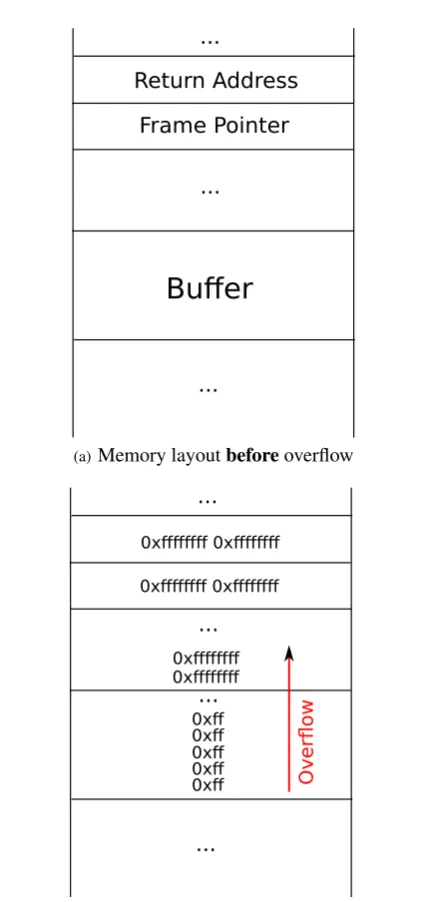
overwrite the return address which is expected to be above the overflowed buffer.
The resulting attack vector, to perform the stack smashing attack, is described by listing 10. We fill the attack vector simply with 120 bytes of the value 0xff. The size of the buffer is not necessary to be 120 bytes large, but we just chose a size that is large enough to generate an appropriate reaction on all three compiled binaries.
The attack strategy for this exploit is rather simple and is outlined by figure 5. It uses thestrcpyfunction to cause a buffer overflow on the entitledoverflow_buffer(see listing 11). To reach the control flow information (i.e. the return instruction pointer) on the stack, the exploit just fills the buffer with the attack vector declared in listing 10 to linearly overwrite all the space between the start of the buffer and the return instruction pointer, until it eventually reaches the return address itself.
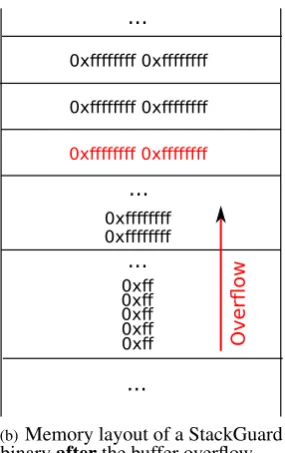
4.1.1. StackGuard. We first take a look at the behavior of StackGuard towards the exploit. We already know from section 3 how the memory layout is theoretically organized for binaries compiled with StackGuard activated. In fact the memory layout does not differ much from the one of an arbitrary ELF binary at runtime, without any further security mechanisms. The essential difference is the canary that is placed right under the saved frame pointer (or right below the return address if no frame pointer is in use). This canary is also the hurdle the exploit needs to surpass to be effective and perform the action it is intended for.
In figure 6 we see what happens when the exploit overwrites the memory of the process invoked with the StackGuard binary. As the memory layout of StackGuard does not differ immensely from any general layout, figure 6 does only differ slightly from the fictive memory layout shown on figure 5. The only difference is the section that is highlighted in red, which is obviously the stack slot that is occupied by the canary, generated by the StackGuard compiler. By
Return Address
Frame Pointer
...
Buffer
...
...
(a)Memory layoutbeforeoverflow
...
...
...
0xff 0xff 0xff 0xff 0xff
...
0xffffffff 0xffffffff 0xffffffff 0xffffffff 0xffffffff 0xffffffff
Over
fl
o
w
(b)Memory layoutafteroverflow
Figure 5. Memory layout of the exploit framework described by listing 11 (without the usage of any security mechanism) before and after initiation of a simple exploit.
Return Address
Frame Pointer
...
Buffer
...
...
Canary (random)
(a)Memory layout of a StackGuard binarybeforethe buffer overflow
...
...
...
0xff 0xff 0xff 0xff 0xff
...
0xffffffff 0xffffffff
0xffffffff 0xffffffff
0xffffffff 0xffffffff 0xffffffff 0xffffffff
Over
fl
o
w
(b)Memory layout of a StackGuard binaryafterthe buffer overflow
Figure 6. Memory layout of the exploit framework described by listing 11 compiled with StackGuard.
4.1.2. SCADS. Next up, we find out whether the SCADS approach is also able to deal with the exploit, to not allow further malicious actions to be performed. In contrast to StackGuard, with SCADS we do have greater change in a process’ memory layout. We want to remind the reader that SCADS uses two stacks instead of one.
Figure 7 represents the memory layout of a process executing the SCADS binary. Neither return addresses nor saved frame pointers are stored on the data stack where the overflow_buffer from our example resides. The control flow data is here located on the control stack, which is separated from the data stack by a large block of unallocated
...
Buffer
... ...
Frame: overflow_function parameter
Frame: main
command-line arguments
Frame: main
Frame: overflow_function
not allocated
Return-Instruction-Pointer
Return-Instruction-Pointer saved frame pointer
saved frame pointer
Control-Stack
Data-Stack
(a) Memory layout of a SCADS binary before
the buffer overflow
...
... ...
Frame: overflow_function
Frame: main
Frame: main
Frame: overflow_function
not allocated Return-Instruction-Pointer
Return-Instruction-Pointer saved frame pointer
saved frame pointer
Control-Stack
Data-Stack
0xff 0xff 0xff 0xff0xff ... 0xffffffff 0xffffffff 0xffffffff
0xffffffff 0xffffffff 0xffffffff 0xffffffff 0xffffffff ...
Over
fl
o
w
(b) Memory layout of a SCADS binaryafterthe buffer overflow
Figure 7. Memory layout of the exploit framework described by listing 11 compiled with SCADS.
memory. To reach the control flow data, subsequent to a previously enforced buffer overflow on the data stack, the attacker’s exploit needs to somehow bypass the unallocated memory space and continue overwriting the necessary data on the control stack.
Though, the exploit we presented is yet only simple and does not perform any complicated actions to skip the unallocated memory block. As explained earlier, it just overwrites the memory above the buffer linearly. Hereby it reaches the border of the data stack (highlighted in red within figure 7(b)) and tries to write to non-allocated memory. This causes the process to terminate with a segmentation fault, leaving the control flow data on the control stack completely untouched. Consequently, the exploit is not able to harm the control flow data within the SCADS environment, leaving SCADS immune to such an exploit.
the stack. This area inhabits the copies of all redundantly duplicated return addresses. But the fact that the data segment lies below the stack, while the buffer overflow occurs towards the top of the stack makes it impossible in this case to reach any return address within the data segment, and to modify it permanently. Instead the exploit just overwrites the temporary return address on the stack, which is afterwards detected by StackShield, due to a comparison of the temporary return instruction pointer on the stack, with the redundant copy from the data segment. Further on, this leads to the same reaction as we have seen from StackGuard. The buffer overflow is indicated to the user and the StackShield mechanism causes the process to abort its execution (if not configured differently). Therefore, also StackShield is capable to defend against the presented exploit successfully. Summarized, we can confirm, that all of the three defense concepts were either able to detect and prevent the exploit from taking control over the program’s control flow, or were completely immune to the attack scheme by leaving no chance to reach the control flow information for a malicious modification. So SCADS is fully capable to prevent a successful exploitation when it comes to a simple stack smashing technique. While this alone may not be fascinating, the effectiveness of SCADS can only be stated step by step and we now continue to investigate more complex attack schemes.
4.2. Frame Pointer Overwrite
In [22], Richarte Gerardo lists a few examples how to exploit StackGuard and StackShield successfully. One of the examples describes the modification of the saved frame pointer to alter the control flow consequently. Though this scheme is not usable anymore to attack StackGuard, because since the paper [22] has been released, modifications have been made to the implementation of StackGuard. Most notably the saved frame pointer is now also protected by canaries placed on the stack. The idea of altering the frame pointer to be indirectly able to alter a process’ control flow originates from the way, how a stack frame is cleared. Listing 12 shows the essential machine instruction (highlighted in red) that is needed to make such an attack possible. This instruction moves the value of the frame pointer register into the stack pointer register. By overwriting the saved frame pointer of a stack frame, one can get control over the stack pointer in the next upper frame and abuse this circumstance by setting it to a location within the memory where a self-prepared return address lies. On return, the instruction pointer is then set to this address, thus the control flow is redirected to wherever the attacker wants it. Listing 12: Machine code showing stack frame initialization.
# prolog
push %rbp
sub 0xff, %rsp
...
# epilog mov %rbp, %rsp
pop %rbp
Note that the necessary instruction, which causes the vulnerability, may not be present for every single function. The swapping of the frame and the stack pointer can also be replaced by increasing the stack pointer with an appropriate value, using theaddinstruction (due to the stack’s direction of growth). This leads to the same result, of the stack pointer being set to the address right below the saved frame pointer of the last stack frame. TheClang/LLVM-compiler uses the sub/addinstruction for most of its stack frame management. But it may be possible that it switches to the register swapping in some cases, when optimizations are in use.
We do not introduce an additional exploit for this attack strategy, because the one from the previous example (see section 4.1) can be used the same way. Nothing changes except of the data structure, which is now the target of the exploit and is intended to be modified. SCADS is invulnerable against this attack mechanism, because the frame pointer is defined as control flow data. Therefore the saved frame pointers lie on the control stack, separated from any buffers, which may overflow. If no more complex actions are performed by an exploit to reach the control stack, without causing the program to abort, then it is not possible to modify the frame pointer by overflowing a buffer on the data stack. The scenario can be well compared to the first example we presented within the security analysis, where we already explained why the exploit fails to reach the control flow information on the control stack.
4.3. Indirect Pointer Overwrite
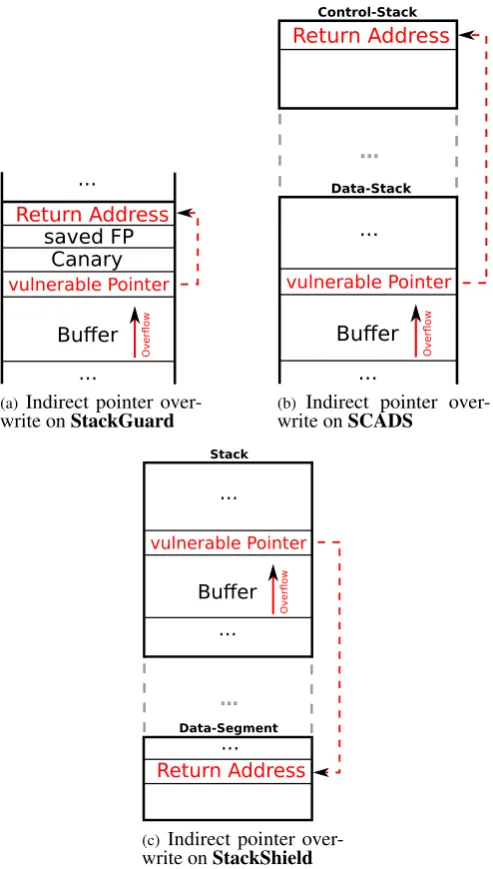
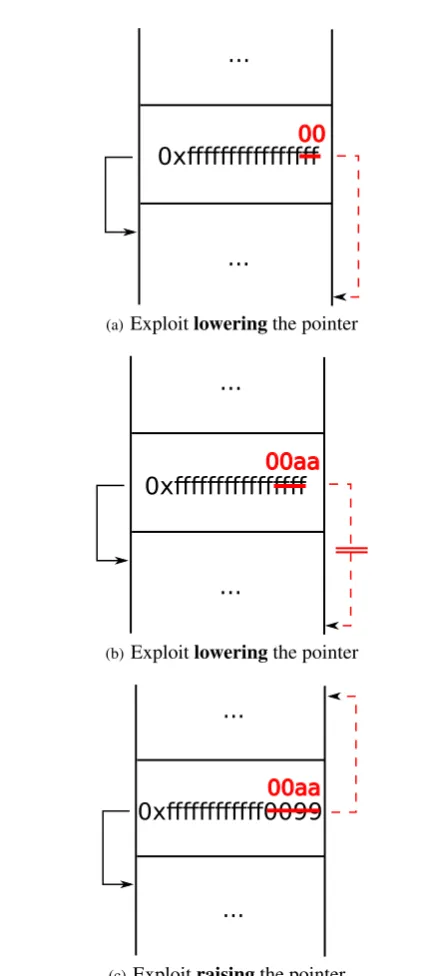
In 2000, Bulba and Kil3r presented an article [17] that addresses the exploitation of StackGuard and StackShield. As we want to compare SCADS with both of them, the content of this article is useful regarding the evaluation of SCADS’ security. Especially one attack mechanism that was introduced by this article is of interest. It uses regular pointers within a function, under certain circumstances, to gain the ability of random write access to any address of the process’ memory. This makes it possible, to bypass canaries without overwriting them. There was no precise name given for this kind of attack scheme, but we label it “indirect pointer overwrite”.
Listing 13: Attack vector to exploit framework II.
char attack_vector_1[64];
// text segment address of "secret()"
char attack_vector_2[9] =
"\x70\x06\x40\x00\x00\x00\x00\x00";
void set_attack_vector(){
for(int i = 0; i < 32; i++)
attack_vector_1[i] = 0x42;
// overwrites the least-significant byte of the pointer "v_pointer"
attack_vector_1[32] = 0x48;