1
Dynamic Difficulty Adjustment through a Learning
Analytics Model in a Casual Serious Game for Computer
Programming Learning
Adilson Vahldick
1,2,*, António José Mendes
1and Maria José Marcelino
11CISUC, Department of Informatics Engineering, University of Coimbra, Portugal 2Universidade do Estado de Santa Catarina, Ibirama, Brasil
Abstract
Teachers have used games as a support tool to engage students in learning tasks. As they often record student’s performance as learning progresses, it is interesting and useful to discuss how that information can be used to assess learning and to improve the learning experience. For instance, teachers can use that information to give personalized attention in classes and the game can use it to provide challenges of the “right” difficulty. In computer programming learning, games can provide an alternative way to introduce concepts and, mainly, to practice them. This paper proposes a model to identify the students’ progress considering their performance in programming tasks. The model is demonstrated by an implementation in a casual computer programming serious game. We illustrate how this game could use this model to personalize its challenges.
Keywords: Novice programmers, learning analytics, dynamic difficulty adjustment, fuzzy systems.
Received on 1 November 2016, accepted on 13 December 2017, published on 27 December 2017
Copyright © 2017Adilson Vahldicket al., licensed to EAI. This is an open access article distributed under the terms of the Creative Commons Attribution licence (http://creativecommons.org/licenses/by/3.0/), which permits unlimited use, distribution and reproduction in any medium so long as the original work is properly cited.
doi: 10.4108/eai.27-12-2017.153509
1. Introduction
Initial programming learning is known to be complex for many students. Games have been proposed to help students in their initial learning stages, namely to increase their motivation and engagement with the learning process [1]. Two approaches have been used: creating and playing games. In the first approach students are asked to develop small games in order to apply the programming concepts [2]. In the second approach the students play games to reinforce and practice concepts and programming skills [3]. The main idea is to motivate students to the learning activities, shortening the time between theory and practice, and bringing together abstract concepts and concrete activities.
Digital educational environments generate vast amounts of track data that could be used for the development of learning theories and applications [4]. Learning Analytics (LA) rely
*Corresponding author. Email:[email protected]
on data generated by the user’s interaction with these environments. LA approach applied in educational games is an alternative to more traditional forms to evaluate learning [5] and it avoids to brake the game-flow experience risking to lose student’s interest [6]. We only found in literature one study with LA applied in programming learning games [7]. It proposed a framework with six axes. A mathematical model, relating each axis to a variable, was created to implement this framework. The game rates the student considering each variable and normalizes the data based on a teacher defined ideal behaviour.
One way to adjust the game experience based on student achievements is through Dynamic Difficulty Adjustment (DDA) techniques [8]. Considering the data collected, the game changes the behaviour of game elements (enemies, items, bonus, environment, sound, …) [9, 10]. Also it is possible to define difficulty levels associating each of them to a game configuration set [11, 12]. For instance, in the easiest
EAI Endorsed Transactions on
Serious Games 12 2016 - 12 2017 |Volume4|Issue 13| e1
2 level, the opponent seldom shoots, its velocity is very slow, and the items are easy to find. However, in the hardest level, there are two very fast enemies and the items are hard to find. This kind of adaptation can keep the player engaged longer, avoid boring or frustrating situations.
In this paper, we propose a LA model applied in computer programming games focused in the student’s performance, rating them automatically based on the performance of their classmates. This output can be used to identify if the game should give more feedback and/or define a different mission sequence. The model was designed as a Fuzzy Logic Controller (FLC). Fuzzy Logic is closer to human thinking and natural language than other artificial intelligence approaches [13]. The system is modelled using linguistic terms and thus it is easy to represent human knowledge [14].
Casual games usually have smooth learning curves and their assignments are often short [15]. These aspects should also be considered in the design of serious games reducing the time needed to learn the game features and mechanics, and freeing more time to learn [16]. We developed a casual serious game for initial computer programming learning, called NoBug’s Snack Bar, using a Blocks-Based Programming (BBP) approach. In BBP the program is constructed through assembling functional blocks [17]. The LA model was tested in this game.
Section 2 presents the design principles followed and the architecture of the FLC to design and implement the LA model. Section 3 describes briefly the developed game and section 4 explains the proposed model. Section 5 demonstrates its implementation and the data gathered by this model. The final section concludes the paper.
2. Fuzzy Logic Controller & Design
The essential part of a FLC is a set of linguistic control strategies based on expert knowledge mapped into an automatic control strategy [14]. A basic configuration of a FLC is depicted by a block diagram such as that shown in Figure 1.
Figure 1. Configuration of a FLC [14].
The controlled system represents a process that is regulated through a control action. The fuzzification interface is responsible for converting the input data (current state of
the controlled system) into suitable linguistic values (fuzzy sets). The knowledge base module contains knowledge about all the input and output fuzzy partitions. The inference module simulates the human decision-making procedure based on fuzzy concepts, inferring fuzzy control actions to employ fuzzy implications and linguistic rules. The defuzzification interface converts the range of output values into the corresponding universe of discourse.
The design procedure of a FCL is divided in several steps as follows [13, 14]: 1-identification of the variables (states and controls); 2-normalization and partition of the variables space; 3-determination of the shapes of the fuzzy sets and their membership functions; 4-construction of the fuzzy rule base; 5-definition of the inference method; 6-determination of the defuzzification strategy.
There are many Fuzzy Logic software packages, as the MATLAB Fuzzy Toolbox and jFuzzyLogic [18]. jFuzzyLogic is an open source library written in Java that supports a Fuzzy Control Language (FCL) defined in the IEC-1131 specification. This specification defines the syntax and semantic of the FCL’s components. jFuzzyLogic provides an API that interprets and executes a FCL program. It is also possible to define some or all members of a FLC through Java programming.
3.
NoBug’s SnackBar
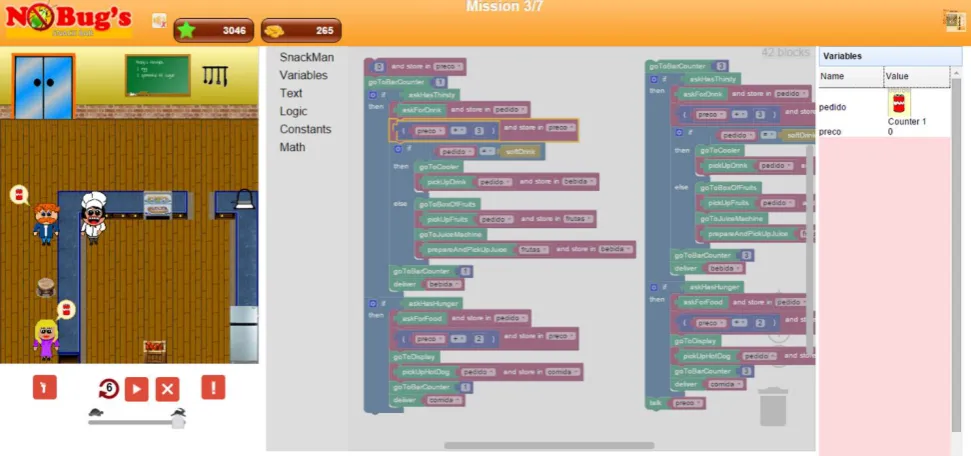
NoBug’s Snack Bar game mechanics are inspired in time management games. The player controls an attendant of a snack bar. Customers require some combination of foods and drinks, and the attendant must go to places where they are prepared, fetch them and serve them. The mission ends when the player meets all requests.
Figure 2 shows the game’s interface. The animation area (on the left) shows the mission situation and shows the attendant behaviour controlled by the player solution. The central area allows the construction of the mission solution. The player can run or debug her/his code. If she/he debugs, then the game shows the list of variables (at the right side of the figure) and runs one block at a time after each click of the debug button.
The game covers the initial topics usually included in introductory computer programming courses. It is divided in five levels with 55 missions: 1-Sequence actions (10 missions); 2-Variable manipulation (8 missions); 3-Conditionals (13 missions); 4-Loops (14 missions) and 5-Functions and arrays (10 missions). The first four missions in level one serve only to familiarize the student with basic interface of the game.
EAI Endorsed Transactions on
3
Figure 2. Game interface.
4. LA Model in Computer Programming
Learning Games
Following the FLC design procedure described in section 2, our initial concerns were the definition of state and control variables, their partition in fuzzy subsets and the assignment of a membership function for each of them. The input variables of the proposed model are the missions’ level and the time spent to solve them:
Mission: classify the mission as introductory,
development or mastery level.
Time Spent (TS): is the accumulated time spent
by the student to solve the last three missions. In our first experiments, we used the total time spent in the missions. However, after some tests, we verified that once a student had a bad performance in any previous mission, this was propagated for a very long time. Then we constrained it to the last three missions. This variable is partitioned into five subsets: very fast, fast, normal, slow and very slow. The subsets very fast and very slow are trapezoidal asymmetrical membership functions and the other three are trapezoidal symmetrical. The universe of discourse range varies according to students’ experience. The students’ performance in the game depends on several factors, such as the teaching methodology (learning content, assignments, etc.) and the previous programming knowledge or literacy (according to the region or country where the game is being used). To have a general model it is necessary to consider these divergences. We created a Time Normalization module to deal with these issues. This module assigns the membership function parameters dynamically, before it fuzzifies the input variables, performing 5 steps (Figure 3). In the first step, the module
retrieves from the game database the time spent in the previous three missions of each student using the Equation 1:
𝑇𝑆(𝑖,𝑚)=
𝑇(𝑖,𝑚−1)+𝑇(𝑖,𝑚−2)+ 𝑇(𝑖,𝑚−3) 3 . (1)
where i denotes the student identification, i=1 denotes the current player which the system is computing for, m denotes the current mission, T(x, y) denotes the time spent on
mission y by student x, and TS(i, m) denotes the average time
spent on the three missions before the mth mission of
student i. Thus, TS(i, m) is the crisp value of the input variable TS. The second step identifies and removes students (i >= 2) with average time spent that are at least moderate outliers. The third step aims to create five clusters, one for each subset, of average times using the process of hierarchical cluster analysis (HCA) with the complete-linkage method [19]. The fourth step identifies the lowest (l) and the highest (g) values on each cluster (c1, c2, c3, c4, c5) where c1 has the lowest average time values and c5 the highest values. The final step defines each membership function parameters (veryfast, fast, normal, slow and veryslow) as described in Equations 2, 3, 4, 5 and 6:
𝑢𝑣𝑒𝑟𝑦𝑓𝑎𝑠𝑡(𝑥) = 𝑡𝑟𝑎𝑝𝑒 (𝑥, 0, 0, 𝑐1(𝑔), 𝑐2(𝑙) +
𝑐2(𝑔)−𝑐2(𝑙) 2 ). (2)
𝑢𝑓𝑎𝑠𝑡(𝑥) = 𝑡𝑟𝑎𝑝𝑒(𝑥, 𝑐1(𝑔), 𝑐2(𝑙), 𝑐2(𝑔), 𝑐3(𝑙)). (3)
𝑢𝑛𝑜𝑟𝑚𝑎𝑙(𝑥) = 𝑡𝑟𝑎𝑝𝑒(𝑥, 𝑐2(𝑔), 𝑐3(𝑙), 𝑐3(𝑔), 𝑐4(𝑙)). (4)
𝑢𝑠𝑙𝑜𝑤(𝑥) = 𝑡𝑟𝑎𝑝𝑒(𝑥, 𝑐3(𝑔), 𝑐4(𝑙), 𝑐4(𝑔), 𝑐5(𝑙)). (5)
𝑢𝑣𝑒𝑟𝑦𝑠𝑙𝑜𝑤(𝑥) = 𝑡𝑟𝑎𝑝𝑒 (𝑥, 𝑐4(𝑙) + 𝑐4(𝑔)−𝑐4(𝑙)
2 , 𝑐5(𝑙), 𝑐5(𝑔), 𝑐5 (𝑔)) .(6)
EAI Endorsed Transactions on
4 where cn(g) denotes the greatest value of cluster n, cn(l)
denotes the lowest value of cluster n, and x denotes the parameter that is converted to a membership degree (umembership(x)).
Figure 3. Time Normalization module.
Figure 4 exemplifies the membership functions when c1(l)=50, c1(g)=100, c2(l)=130, c2(g)=170, c3(l)=210 and c3(g)=300.
Figure 4. Examples of membership function of variable time spent.
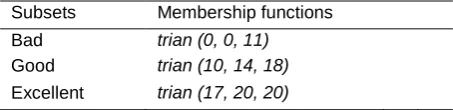
The output variable is the knowledge level of the student. This variable is partitioned into three subsets (bad, good and excellent) and their membership function are triangles as defined in Table 1.
Table 1. Membership functions of the output variable knowledge level.
Subsets Membership functions Bad trian (0, 0, 11)
Good trian (10, 14, 18)
Excellent trian (17, 20, 20)
The next step of the FLC design is to define the inference method and form the rule base. The Mamdami inference method was adopted because it does not have nonlinear dynamic equations. The system rates a student according to the time she/he spends to solve the missions. Table 2 summarizes the rule-base, the relation between the two input variables and the output variable. When the player takes a long time to finish a mission, the model assumes that she/he has bad knowledge. On the other hand, the model rates the player as excellent when she/he finishes
the mission very fast. In the other rules, the student classification varies according to the mission level. As the introductory missions presents new concepts and do not present challenges, it is expected that the player finishes them quickly. Yet the mastering missions are harder and full of constraints, really challenging the player.
Table 2. Fuzzy rule-base.
Mission
Time spent
Very slow
Slow Normal Fast Very fast
Introductory Bad Bad Bad Good Excellent
Development Bad Bad Good Good Excellent
Mastering Bad Good Good Good Excellent Centre of Gravity is defined as the defuzzification method. Figure 5 shows the components relation of the proposed LA model. The ellipses are the input variables. The Time Normalization module accesses the database of the game and the current mission to define which is the time spent by the student and updates the knowledge base. The diamond designates the output variable.
Figure 5. LA Architecture.
5. Implementation & discussion
The proposed model was instantiated as a FLC in Java with jFuzzyLogic. The code below exemplifies the fuzzy rule-base by FCL. Nine rules were created to cover all the cells in Table 2. The variables definition was suppressed in the code because they were explained in the previous section.
LA model defined by IEC-FCL
FUNCTION_BLOCK nobugs_usecode ...
RULEBLOCK OnlyThis
AND : MIN; OR : MAX; ACT : MIN; ACCU : MAX;
RULE 1 : IF TimeSpent IS verySlow THEN KnowledgeLevel IS bad; RULE 2 : IF TimeSpent IS fast THEN
KnowledgeLevel IS good; RULE 3 : IF TimeSpent IS veryFast THEN
KnowledgeLevel IS excellent;
RULE 4 : IF Mission IS introductory AND TimeSpent IS slow THEN
KnowledgeLevel IS bad; RULE 5 : IF Mission IS introductory AND
TimeSpent IS normal THEN KnowledgeLevel IS bad; RULE 6 : IF Mission IS development AND
EAI Endorsed Transactions on
5
TimeSpent IS slow THEN KnowledgeLevel IS bad; RULE 7 : IF Mission IS development AND
TimeSpent IS normal THEN
KnowledgeLevel IS good; RULE 8 : IF Mission IS mastering AND
TimeSpent IS slow THEN
KnowledgeLevel IS good; RULE 9 : IF Mission IS mastering AND
TimeSpent IS normal THEN
KnowledgeLevel IS normal;
END_RULEBLOCK
END_FUNCTION_BLOCK
We tested our game with 52 students. Figure 6 shows how many students completed the first 19 missions. Only two students progressed beyond mission 19.
Figure 6. Distribution of the missions finished by students.
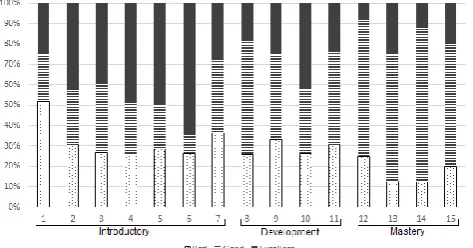
Figure 7 shows the results obtained in the first 15 missions, divided in introductory (1-7), development (8-11) and mastery (12-15).
Figure 7. Distribution of the students’ knowledge classification.
The above two figures confirm that students have their own learning and studying pace. Also, when they fail they often give up playing.
About 30% of students struggled in introductory missions. Using this information without considering a DDA component, this number could alert the teacher or the game designers to review the missions. As the quantity of bad performing students is stable in introductory missions,
maybe the teacher should address individually those students. As the students advance in the game, less of them are classified as excellent. This also happens frequently in the classroom: the very well performing students are a small part of the class. Therefore, these seldom students keep playing.
For adding a DDA component in the game, the students classified as bad need to repeat more times the same kind of challenges, offer them more support in the content and show them hints to achieve the mission. To good students, the challenges also can repeat with little variations, and continue to support them by content. However, for the excellent students (because in our experiment we only had two of them), it is not necessary change something in the game: we can keep how it is developed.
6. Conclusions
Serious games are played in computer programming classes to motivate students overcome the initial natural barriers. However, to maximize the adoption of games in educational settings, it is important that teachers could track the overall progress of the students.
In this paper, we presented a LA model based essentially on the time spent by the student to finish each mission. The model classifies the student (as bad, good or excellent) taking into consideration each mission level. This classification can be used to adjust the difficulty of the next missions, and to adjust the support given to a particular student.
The model uses a fuzzy system’s approach. It was easier to represent the teacher knowledge as linguistic variables: humans can read and interpret the fuzzy rules, and this facilitates the system maintenance. It may ease the rules adaption by teachers want to personalize them to their instructional requirements and preferences. The Time Normalization module identifies the student’s performance in relation to their classmates. We cannot previously determine the range of time to classify each set of students. Therefore, that module computes dynamically the student’s knowledge in relation of their classmates. Students are classified according to their performance in the last three missions. It is expected that this measure gives a good indicator of the student level.
We tested the model during a first experiment. We found out that initially most students were classified as bad or excellent. However, as students advanced in the game, they had a more similar performance and more students were classified as good. Although more experiments are necessary to evolve and validate the model, we believe teachers and the game can use this information to adapt their lessons or missions giving special attention to less performing students. In addition, game designers should analyse this data to review the challenges and learning tasks.
During this experiment it was possible to conclude that it was not necessary to increase the challenges difficulty level. However, we needed to enhance the game to adjust
EAI Endorsed Transactions on
6 it to the poor performance students, this can be achieved through a DDA component.
Acknowledgements.
AV acknowledges the doctoral scholarship supported by CNPq/CAPES – Programa Ciência sem Fronteiras – CsF (6392-13-0) and authorized retirement by UDESC (688/13). We also want to thank the students that played the game and their teachers that allowed us to try it with them.
References
[1] VAHLDICK,A.; MENDES,A.J.; and MARCELINO,M.J. (2014) A review of games designed to improve introductory computer programming competencies. In:
Proceedings of 44th Annu. Front. Educ. Conf. Madrid, Spain, 781–787
[2] BAYLISS,J.D.; and STROUT,S. (2006) Games as a “flavor” of CS1. In: Proceedings of 37th SIGCSE Tech. Symp. Comput. Sci. Educ. Houston, Texas, 500–504
[3] BARNES,T.; POWELL,E.; CHAFFIN,A.; GODWIN,A.; and RICHTER,H. (2007) Game2Learn: Building CS1 learning games for retention. In: Proceedings of 12th SIGCSE Conf. Innov. Technol. Comput. Sci. Educ. Dundee, Scotland, 121–125
[4] GRELLER,W.; and DRACHSLER,H. (2012) Translating Learning into Numbers: A Generic Framework for Learning Analytics. Educ Technol Soc15 (3): 42–57. [5] SHUTE,V.J.; and KE,F. (2012) Assessment in
Game-Based Learning. Assess game-based Learn Found Innov Perspect 43–58.
[6] CHEN,J. (2007) Flow in games (and everything else).
Commun ACM50 (4): 31.
[7] MALLIARAKIS,C.; SATRATZEMI,M.; and XINOGALOS,S. (2014) Integrating learning analytics in an educational MMORPG for computer programming. In: Proceedings of 14th Int. Conf. Adv. Learn. Technol. ICALT 2014. 233– 237
[8] MISSURA,O.; and GÄRTNER,T. (2009) Player Modeling for Intelligent Difficulty Adjustment. In: Proceedings of 12th Int. Conf. Discov. Sci. Bled, Slovenia, 108–122 [9] SHA,L.; HE,S.; WANG,J.; YANG,J.; GAO,Y.; ZHANG,Y.;
and YU,X. (2010) Creating appropriate challenge level game opponent by the use of dynamic difficulty
adjustment. In: Proceedings of 6th Int. Conf. Nat. Comput. ICNC 2010. Valencia, Spain, 3897–3901
[10] OSMAN,Z.M.; DUPIRE,J.; MADER,S.; CUBAUD,P.; and NATKIN,S. (2016) Monitoring player attention : A non-invasive measurement method applied to serious games (In press). Entertain Comput14 33–43.
[11] JENNINGS-TEATS,M.; SMITH,G.; and WARDRIP-FRUIN,N. (2010) Polymorph : Dynamic Difficulty Adjustment Through Level Generation. In: Proceedings of Work. Proced. Content Gener. Games PCGames. Monterey, California,
[12] NAGLE,A.; NOVAK,D.; WOLF,P.; and RIENER,R. (2014) The effect of different difficulty adaptation strategies on enjoyment and performance in a serious game for memory training. In: Proceedings of IEEE 3rd Int. Conf. Serious Games Appl. Heal. Rio de Janeiro, Brasil, 120–128 [13] JANTZEN,J. (2007) Foundations of Fuzzy Control. John
Wiley & Sons, Chichester.
[14] LEE,K.H. (2005) First Course on Fuzzy Theory and
Applications. Springer Berlin Heidelberg, Berlin. [15] JUUL,J. (2010) A casual revolution: Reinventing video
games and their players. MIT Press, Cambridge, MA. [16] LANDERS,R.N.; and CALLAN,R.C. (2011) Casual social
games as serious games: The psychology of gamification in undergraduate education and employee training. Serious Games Edutainment Appl 399–423.
[17] NOR,S.; MOHAMAD,H.; PATEL,A.; LATIH,R.; QASSIM,Q.; NA,L.; and TEW,Y. (2011) Block-based programming approach : Challenges and benefits. In: Proceedings of Int. Conf. Electr. Eng. Informatics. Bandung, Indonesia, 4–8 [18] CINGOLANI,P.; and ALCALÁ-FDEZ,J. (2012) jFuzzyLogic :
A Robust and Flexible Fuzzy-Logic Inference System Language Implementation. In: Proceedings of IEEE World Congr. Comput. Intell. Brisbane, 1090–1097
[19] JOHNSON,S.C. (1967) Hierarchical clustering schemes.
Psychometrika32 (3): 241–254.
EAI Endorsed Transactions on
![Figure 1. Configuration of a FLC [14].](https://thumb-us.123doks.com/thumbv2/123dok_us/8430850.1697721/2.595.48.284.543.703/figure-configuration-of-a-flc.webp)