Proceedings of the 9th International CDIO Conference, Massachusetts Institute of Technology and Harvard University School of Engineering and Applied Sciences, Cambridge, Massachusetts, June 9 – 13, 2013.
TRAINING ELITE SPECIALISTS IN ENGINEERING AND
TECHNOLOGIES
Petr S. Chubik
Rector of Tomsk Polytechnic University
Oxana M. Zamyatina
Head of Elite Engineering Education Department
ABSTRACT
In 2004 Elite Engineering Education Program (EEEP) was implemented at Tomsk Polytechnic University (TPU), on an urgent demand of industry and society. In 2012 the Program was modernized based on CDIO approach. The EEEP is a multi-level competitive environment which motivates students to acquire deep fundamental and professional knowledge and strive for Engineering Leadership, Entrepreneurship, and Innovation.
About 10% of the best first-year students are enrolled in EEEP in parallel with major learning pathway according to the results of entry test. At the end of the 2ndsemester 30% of EEEP students are expelled from the program in accordance with their academic rating.
EEEP graduates attain the following learning outcomes: profound fundamental knowledge (Physics, Mathematics, and Economics); professional and foreign language communicative competencies; creative and systems thinking; leadership and team-building qualities; participation in project-oriented activities. The EEEP curriculum has undergone sustainable changes to be in line with innovative and competitive strategies of the industry and society, which are presented in the paper.
The experience of elite engineer training in Russia and abroad is analyzed.
KEYWORDS
Engineering, education, innovation, leadership, entrepreneurship, project.
EEEP HISTORY IN TPU
In 2004 the program of Elite Engineering Education (EEEP) for talented and motivated students was introduced at Tomsk Polytechnic University (TPU) [1]. The EEEP system was developed to train professionals of a new level who are capable of making a complex combination of research, project, and entrepreneurial activities, possess deep fundamental knowledge, have a good grip of engineering creativity, and are able to work in a team [2]. The EEEP at TPU is implemented in parallel with training in a major learning pathway for the students who have passed the special selection procedure.
Proceedings of the 9th International CDIO Conference, Massachusetts Institute of Technology and Harvard University School of Engineering and Applied Sciences, Cambridge, Massachusetts, June 9 – 13, 2013.
About 1600 students have been enrolled in the EEEP since 2004 at Tomsk Polytechnic University, 253 students have graduated, and 456 are currently studying in their 1st-6th years. The Elite Engineering Educational Program is constantly under development. In 2007–2008 the program got a powerful development spur in the course of implementing the innovative educational program “Preemptive training of elite specialists and world-class specialist teams in priority areas of engineering and technologies development”. In 2009 TPU was awarded the “National Research University” status and a development program until 2018 was approved focusing on research, developing new technologies, as well as training staff to support these activities.
In 2010 “Standards and instructions for quality assurance of the general educational programs of Bachelors’, Masters’, and Specialists’ training in priority development areas of National Research Tomsk Polytechnic University” (GEP TPU Standard) were developed and implemented. A new version of GEP TPU Standard was developed in 2012, where the EEEP was identified as one of the learning pathways in student-centered learning environment [3, 4]. Presently the EEEP TPU is constantly under development and improvement to increase the competitiveness of TPU and its graduates on international level by using experience and best practices of training elite specialists in Russia and abroad.
TRAINING ELITE SPECIALISTS IN RUSSIA AND ABROAD
Elite engineering education is developing with consideration given to the peculiarities of engineering in post-industrial society based on knowledge. Engineering in modern society is becoming more integrated and innovative.
Integrated engineering activities, being complex and multi-component, analyze a wide range of solutions of different problems during planning, design, manufacturing, and application of technical objects, systems, and technological processes. The CDIO (Conceive, Design, Implement, Operate) concept, developed in Massachusetts Institute of Technology (USA) with the participation of leading IHEs from Sweden (KTH, Chalmers) [5] is used by the world’s leading universities for training specialists in integrated engineering activities.
Innovative engineering, while basing upon profound fundamental and practical interdisciplinary knowledge, is aimed at design and development of engineering and technologies that ensure new social and economic effect, and thus are highly demanded and competitive. In order to design and implement innovations in the sphere of engineering and technologies that would change our life dramatically and ensure human progress, we need professionals possessing special competencies in leadership and entrepreneurship.
Approaches to training engineering elite are rather similar in Russia and abroad, but there are some differences in the priorities of graduates’ expected professional and personal competencies. We have divided the IHEs into 2 groups, depending on their organization: the 1st one implements a program of additional training of “elite” specialists, broadening their fundamental knowledge and developing their competencies in the sphere of project activities and teamwork, their leadership qualities, communication skills, etc. The IHEs that were classified as the 2nd group train elite specialists within a basic academic program, specially designed to develop professional and personal competencies of the graduates.
The IHEs of the 1st category are: Siberian Federal University, Omsk State Technical University, Ural State University of Railway Transport, Volga State University of Technology, Tomsk Polytechnic University, and some other engineering schools in Russia. The universities that belong to the 1st group abroad are: Massachusetts Institute of Technology
Proceedings of the 9th International CDIO Conference, Massachusetts Institute of Technology and Harvard University School of Engineering and Applied Sciences, Cambridge, Massachusetts, June 9 – 13, 2013.
(USA), University of Toronto (Canada), University of New South Wales (Australia), Nanyang Technological University (Singapore), and others.
The IHEs of the 2nd type are Bauman Moscow State Technical University – the flagship of Russia’s engineering education, Moscow Institute of Physics and Technology, National Research University of Electronic Technology, National Research Nuclear University “MEPhI”, Moscow Aviation Institute, and others. The engineering schools abroad belonging to the 2nd group are: Franklin W. Olin College of Engineering, Singularity University (USA), Churchill College (Great Britain), Technische Universität München (Germany), École Polytechnique Paris (France), and others.
The analysis of elite engineering programs functioning in Russian universities is given below in order to identify the peculiarities and priorities while teaching special competencies in future specialists.
Moscow Institute of Physics and Technology (MIPT)
There is a special program of elite specialist training at MIPT which was introduced in 1946 and became popular under the name of “Phystech system” [6].
The peculiarity of academic process organization in MIPT is that for the first 2 years at the university students get profound fundamental knowledge in science and mathematics; senior students undergo special practice-oriented preparation at basic departments and institutes. “Bases” are the foundation of the “Phystech system”. They are established in leading academic and research organizations as well as in large companies specializing in particular areas of engineering.
National Research University of Electronic Technology (MIET)
Special educational program at MIET was implemented at the Department of Electronics and Computer Technologies (ECT) in 1997. [7]. The Department relied upon strategic partnership with the world’s leading software developers and IT enterprises (Cadence, Synopsys, Motorola, Microsoft, Oracle, EMC) operating in Russia. In order to promote their state-of-the-art products it was necessary to train local specialists that have already been trained in their use. Thus, elite specialist training program in MIET is a grant program: students are taught on demand of the enterprises to satisfy their staffing needs.
Omsk State Technical University
The program of elite engineering education at Omsk State Technical University (OmSTU) had been implemented at the Faculty of Elite Education and Graduate Studies in 2009 [8]. The objective of the program is to train a new generation of specialists and bachelors in the sphere of engineering and technologies, who will become the foundation of the country’s engineering elite.
Selection for study within the OmSTU’s system of elite engineering education is carried out on the basis of the score point total for the Unified National Exam (UNE) in physics and mathematics among the enrolled 1st year students. The program consists of fundamental (1st and 2nd year) and professional training (3rd – 5th year).
The fundamental program consists of profound learning of physics and mathematics, and programming languages. The professional program of OmSTU’s elite engineering education system is individual and provides for students’ participation in research activities taking place
Proceedings of the 9th International CDIO Conference, Massachusetts Institute of Technology and Harvard University School of Engineering and Applied Sciences, Cambridge, Massachusetts, June 9 – 13, 2013.
at the university, presentation of results in scientific articles and patents, solving actual engineering problems, undergoing internships abroad. Successful graduates of elite engineering education program are awarded certificates of completion.
Siberian Federal University
The system of elite engineering education in Siberian Federal University (SFU) has been introduced as a pilot project in 2012 [9]. The project is planned for 2 years and includes 3 Master’s programs.
The declared advantages of elite engineering education at SFU are as follows: joint professional Masters’ program with foreign partner IHEs, participation of visiting professors from leading European universities in the academic process, intensive foreign language training with an opportunity to take an international level exam, semester-long internships in renowned foreign research and engineering centers.
The analysis of elite specialist training in domestic IHEs shows that the priority is placed upon profound scientific and mathematical knowledge, as well as practical goal-oriented training. At the same time focus is given to development of professional competencies such as carrying out research and learning modern technologies. Recently a lot of attention has been given to studying foreign languages, internships abroad, design and implementation of joint educational programs with world’s leading universities.
In order to analyze the priorities of engineering elite training abroad some examples of elite engineering education in the leading universities of the USA and Canada were examined. Franklin W. Olin College of Engineering
Franklin W. Olin College of Engineering was established in 1997. Olin College prepares its students to become exemplary engineering innovators who recognize needs, design solutions, and engage in creative enterprises for the good of the world [10]. The curriculum is based on the "Olin Triangle", a combination of rigorous science and engineering fundamentals, entrepreneurship, and liberal arts [11].
Singularity University
The mission of the University is to assemble, educate and inspire a new generation of leaders who strive to understand and utilize exponentially advancing technologies to address humanity’s grand challenges [12]. Founded in 2007, SU offers programs belonging to different areas of human activity: futures studies and forecasting, networks and computer systems, biotechnologies, nanotechnologies, neuroscience, etc. Singularity University’s program participants choose one of the key problems in the areas mentioned and design a project that can solve it. These programs train innovative leaders possessing exclusive competencies and advanced conceptual knowledge of the basics of developing engineering and technologies.
University of Toronto
There is a program for training elite engineering specialists called “Entrepreneurship, Leadership, Innovation and Technology in Engineering (ELITE) Certificate” in the University of Toronto in Canada [13]. ELITE program is an elective one and can be taken in parallel with basic programs (MEng) or after obtaining a Master’s degree. ELITE program includes a
Proceedings of the 9th International CDIO Conference, Massachusetts Institute of Technology and Harvard University School of Engineering and Applied Sciences, Cambridge, Massachusetts, June 9 – 13, 2013.
range of courses in engineering entrepreneurship, leadership, innovations, and technologies. Successful students are awarded an ELITE certificate.
Massachusetts Institute of Technology
The Bernard M. Gordon-MIT Engineering Leadership Program committed to developing a next generation of engineering leaders who are capable of understanding and addressing significant engineering problems in a real-world situation was launched in 2006 at Massachusetts Institute of Technology (MIT), a leading engineering IHE in the US and a world leader in engineering education [14].
At the foundation of the Program lies the postulate that large engineering projects should be managed by leaders with engineering education. That is why the program is aimed at engineering students acquiring such multipurpose professional competencies as creativity, sensitivity to innovations, ability to work efficiently in a team, as well as forming leadership qualities.
The Gordon Engineering Leadership program features two years of study: MIT undergraduate students enter the program through the Undergraduate Practice Opportunities Program (UPOP). It takes place during the 2nd year. Coached practice in networking, principled negotiation, and reputation building helps students take active control of their careers two years before graduation with guidance from UPOP faculty, staff, and seasoned industry professionals (Boeing, NASA, Chevron, Ford, GM, Microsoft, Intel etc.) [15].
After successful summer internship students can enter Bernard M. Gordon-MIT Engineering Leadership Program, which they would undergo during their 3rd and 4th years. Starting from the 3rd year they design actual projects, work in teams.
Personal leadership development plan is formed and implemented annually. MIT staff and graduates work with students for the whole period of study. Not all students succeed in Bernard M. Gordon-MIT Engineering Leadership Program, two thirds drop out. Those who manage to graduate acquire such competencies as foresight, making sense of context, delivering on the vision, technical knowledge and reasoning, attitudes of leadership, relating [15].
The system of Engineering Leadership Program in Massachusetts Institute of Technology, as well as its counterparts in other foreign universities, demonstrates that the main priority is the graduates’ profound fundamental technical knowledge. But the paramount issue is developing special competencies such as the ability to assess technological development of the society and manage innovative projects, entrepreneurial and teamwork skills, aptitude to inter-personal communication, as well as leadership qualities and responsibility.
Comparative analysis of the priorities in training future engineering leaders in Russian and foreign IHEs shows both their differences and peculiarities. Russia’s higher engineering school generally highlights the fundamentals: scientific, mathematical, and engineering education, i.e. development of the graduates’ professional competencies. Soft skills are rather weakly represented. While the leading foreign universities, primarily American ones, along with engineering training emphasize the importance of education in liberal arts for the future engineers and multipurpose (soft) skills development of the graduates, focused on satisfying prospective needs of the society, innovation, entrepreneurship, and leadership.
Proceedings of the 9th International CDIO Conference, Massachusetts Institute of Technology and Harvard University School of Engineering and Applied Sciences, Cambridge, Massachusetts, June 9 – 13, 2013.
DEVELOPMENT OF THE EEEP SYSTEM AT TPU
The requirements to Bachelor, Master, and Specialist graduates on the basis of general educational programs in Tomsk Polytechnic University are listed in the GEP TPU Standard [4].
The requirement to graduates of the EEEP as one of the pathways of implementation of the GEP TPU Standard 2012, are enlarged with CDIO Syllabus v2 [18] requirements and improved in what concerns its fundamental nature, professionalism, innovativeness, entrepreneurship, and leadership. The attributes of future engineering leaders that the EEEP TPU focuses on are given below.
1. Fundamentality is assured by profound knowledge of science, mathematics, economics, and foreign language.
2. High level of professionalism is achieved by active research, inventive, and project activities of the students.
3. Innovativeness is acquired through developing of critical thinking and students’ initiative, analyzing modern problems and values.
4. Entrepreneurship is formed by students’ practical activities in organizing simulated and actual process of manufacturing innovative products.
5. Leadership is taught through gaining management experience while leading a team designing new engineering and technological solutions.
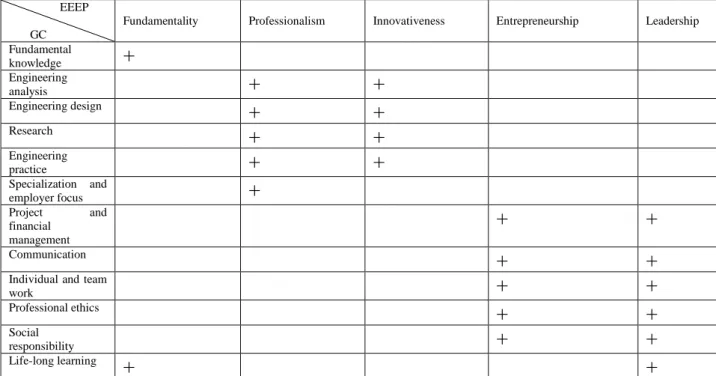
Table 1. Interconnection of Professional and Multipurpose Competencies of General Curricula (GC) and EEEP Graduates
EEEP GC
Fundamentality Professionalism Innovativeness Entrepreneurship Leadership
Fundamental knowledge
+
Engineering analysis+
+
Engineering design+
+
Research+
+
Engineering practice+
+
Specialization and employer focus+
Project and financial management+
+
Communication+
+
Individual and team
work
+
+
Professional ethics
+
+
Social
responsibility
+
+
Proceedings of the 9th International CDIO Conference, Massachusetts Institute of Technology and Harvard University School of Engineering and Applied Sciences, Cambridge, Massachusetts, June 9 – 13, 2013.
On the basis of Table 1 the conclusion can be made that the EEEP develops all basic professional and multipurpose competencies of the students undergoing general educational programs in the sphere of engineering and technologies.
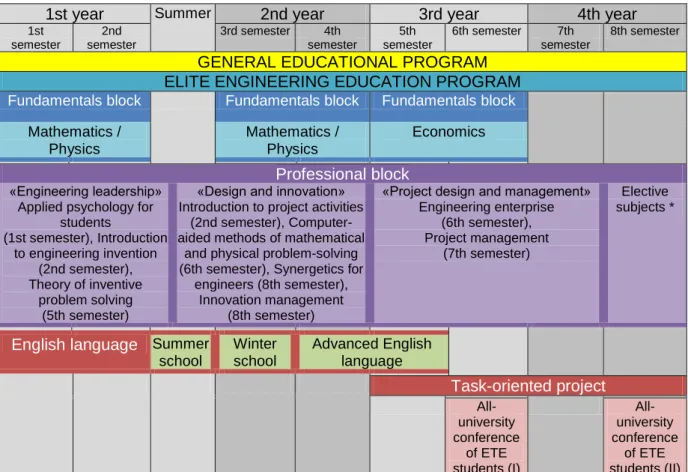
At the stage I students acquire fundamental knowledge (1st and 2nd years) through in-depth training in the disciplines of “Advanced mathematics”, “Physics”, and “English for Mobility” for separate inter-institute joint groups. The academic plan is extended with a number of modules (see below). In addition, there are language and professional winter and summer schools for students, as well as training seminars for their personal qualities development. At the stage II of the EEEP training 3rd and 4th year students get in-depth training by taking specially designed disciplines. There are modules preparing students to innovative and entrepreneurial activities as well as elective subjects. The stage includes carrying out group-based task-oriented projects, practical experience in the business incubator and active participation in international mobility programs.
The stage III of the EEEP is, as a rule, Master’s program. Students have their individual learning pathways, developed in cooperation with major departments. The peculiarity of this stage is that students get practical experience in innovative and entrepreneurial activities together with researchers, teachers, and post-graduate students of the university while working on the actual research engineering projects.
Table 2. Bachelor’s Degree Academic Program within the EEEP TPU System
1st year Summer 2nd year 3rd year 4th year
1st semester 2nd semester 3rd semester 4th semester 5th semester 6th semester 7th semester 8th semester
GENERAL EDUCATIONAL PROGRAM ELITE ENGINEERING EDUCATION PROGRAM
Fundamentals block Fundamentals block Fundamentals block
Mathematics / Physics Mathematics / Physics Economics Professional block «Engineeringleadership»
Applied psychology for students (1st semester), Introduction to engineering invention (2nd semester), Theory of inventive problem solving (5th semester)
«Design and innovation» Introduction to project activities
(2nd semester), Computer-aided methods of mathematical
and physical problem-solving (6th semester), Synergetics for
engineers (8th semester), Innovation management
(8th semester)
«Project design and management» Engineering enterprise (6th semester), Project management (7th semester) Elective subjects *
English language Summer school Winter school Advanced English language Task-oriented project All-university conference of ETE students (I) All-university conference of ETE students (II)
Proceedings of the 9th International CDIO Conference, Massachusetts Institute of Technology and Harvard University School of Engineering and Applied Sciences, Cambridge, Massachusetts, June 9 – 13, 2013.
* Elective subjects: 1) Fundraising; 2) Technologies; 3) Instrumental block; 4) World view block; 5) Subjects included in the individual study plan for the purposes of work on the individual task-oriented project
Tomsk Polytechnic University is the leader among the IHEs in Russia in the quantity of scientific research and developing new equipment and technologies by local and international companies' orders. There are more than 50 small enterprises functioning in the field of engineering and technologies cooperating with TPU in the field of innovation. Furthermore, a proprietary innovation infrastructure is under development at the university. The resources mentioned above are actively used within the Master’s degree program at EEEP TPU. There are additional opportunities to improve quality of education and get international experience by implementing Double Degree Master’s programs with foreign partner universities. TPU Master’s degree students take a Double-degree program at a partner university for a year, write and defend their thesis in 2 languages and get Master’s degrees of 2 universities.
As it has already been mentioned in order to study within the EEEP system students should comply with relatively high requirements concerning their intellectual potential, motivation, industriousness, ambition, and persistence. There is a system of student selection designed and used in TPU within the program of training future engineering leaders.
The first stage involves preliminary selection of candidates among all 1st year students willing to be enrolled into the system, based on their UNE results where score point total for physics and mathematics should be at least 140. There were more than 1200 participants on the 1st stage of selection process in 2012, 700 of them were invited to the second stage. The second stage of the competition is carried out in the form of a test that includes elements identifying the contestants' creative potential, their logical reasoning, and the ability to apply their knowledge in practice. Students that fulfill more than a half of the tasks are shortlisted. In 2012, 228 students were selected at the second stage of the process.
At the third stage students write a motivation letter explaining their will to study within the Elite Engineering Education Program at TPU and have an interview. About 10% of students are dropped out on this level of selection process. Lots of students give up shortly after starting the EEEP program.
During the academic process students are annually selected to continue their education within the program, and only the most active and challenge-ready remain in the system. Expected annual dropout during the 1st and 2nd year is about 25%. As a result, only every fourth student participates in the 3rd stage – the Master’s degree program within the Elite Engineering Education system and continues his/her training as a future leader in engineering. Thus, statistically no more than 2.5% of students annually enrolled in TPU in one of the engineering majors graduate from the EEEP TPU system.
CONCLUSION
The system of Elite Engineering Education at Tomsk Polytechnic University is constantly improving, taking into account the experience accumulated since 2004 when it was founded, and the best practices taken from its counterparts functioning at the universities of Russia and abroad. In accordance with the TPU development program until 2018 designed in 2009, the EEEP system is focused on training engineering leaders in the priority areas of modern
Proceedings of the 9th International CDIO Conference, Massachusetts Institute of Technology and Harvard University School of Engineering and Applied Sciences, Cambridge, Massachusetts, June 9 – 13, 2013. engineering and technologies. The EEEP is aimed at developing professional and multi-functional competencies in its graduates with the attributes of fundamentality, professionalism, innovativeness, entrepreneurship, and leadership. To increase global competitiveness of the EEEP system’s graduates, a great deal of attention is given to international activities such as academic mobility and exchange programs, joint Double Degree programs – academic programs with leading foreign universities. Further development of Elite Engineering Educational Program at Tomsk Polytechnic University is aimed at increasing its quality and intensifying international cooperation with the world’s leading universities. In particular, there are plans to develop some joint projects in cooperation Bernard M. Gordon-MIT Engineering Leadership Program.
REFERENCES
1. Chubik P.S., Kryuchkov Yu.Yu., Solovyov М.А., “Elite engineering educational system as an element of innovative engineer training”, Tomsk Polytech, 2005, № 11, 16 – 22.
2. Chubik P.S.., Mogilnitskiy S.B., “System of elite preparation for engineers in TPU”, Quality of Education, 2012, № 10, 22 - 28.
3. Chubik P.S., Chuchalin А.I., “Educational policy of National research Tomsk polytechnic university”, High School Bulletin «Alma Mater», 2012, № 11, p. 7 – 14.
4. Standards and guidance in quality assurance of basic academic Bachelor’s, Master’s and Specialist’s programs in prior direction for development of National research Tomsk polytechnic university (Standard BAP TPU), Digest of normative inventory materials, edited by А.I. Chuchalin, Tomsk: Tomsk polytechnic university pub., 2012, 197
5. http://www.cdio.org
6. http://www.mipt.ru
7. http://www.miet.ru
8. http://www.omgtu.ru
9. http://www.sfu-kras.ru
10. Richard K. Miller, “ From the Ground Up: Rethinking Engineering Education for the 21st Century”, Symposium on Engineering and Liberal Education, Union College, Schenectady, NY, June 4-5, 2010 11. http://www.olin.edu 12. http://www.singularityu.org 13. http://www.utoronto.ca 14. http://web.mit.edu/gordonelp 15. http://upop.mit.edu/about/
16. Etzkowitz H, MIT and Rise of Entrepreneurial Science, London: Routledge, 2002.
17. www.washingtonaccord.org
18. Chuchalin А.I., Gerasimov S.I., “Competences of engineering programs graduates: national and international standards”, Higher education in Russia, 2012, № 10, 3 – 14.
19. Crawley E.F., Malmgvist J., Lucas W.A., Rodeur D.R, The CDIO Syllabus v 2.0. An Updated Statement of Goals for Engineering Education, Proc. of the 7th International CDIO Conference, Technical University of Denmark, Copenhagen, June 20 - 23, 2011.
BIOGRAPHICAL INFORMATION
Petr S. Chubik, DSc, is Rector of Tomsk Polytechnic University. Presently he is a Full Member of the International Higher Education Academy of Science and Russian Academy of Natural Sciences (RANS), a Correspondent Member of Russian Academy of Natural Sciences as well as Russian Engineering Academy. Areas of his research activity are development of scientific and methodological bases of qualimetry, ecologization and optimization of drilling fluids quality.
Proceedings of the 9th International CDIO Conference, Massachusetts Institute of Technology and Harvard University School of Engineering and Applied Sciences, Cambridge, Massachusetts, June 9 – 13, 2013.
Oxana M. Zamyatina, PhD, is Head of Elite Engineering Education Department. Areas of her research activity are systems analysis, management and information processing, educational system development, educational management, curricula design, innovative pedagogical methods, competences oriented approach.
Corresponding author Dr. Oxana M. Zamyatina
National Research Tomsk Polytechnic University
Usova St. 4a -104 Tomsk, Russia, 634034 7-3822-563-627
This work is licensed under a Creative Commons