*Corresponding author’s e-mail: [email protected] https://doi.org/10.32802/asmscj.2019.319
A Data Integration Model for Multi-Agency
Assets in Disaster Logistic Management
Noor Haryantie Noor Sidin, Khalina Abdan and Hazreen Haizi Harith*
Department of Biological and Agricultural Engineering, Universiti Putra Malaysia,Serdang,
43400 Seri Kembangan, Selangor, Malaysia
The complexity of disasters occurred in recent years demands for a sound and effective disaster management. Since logistics accounts for 80% of the overall cost for disaster management, it requires specific management of its own embedded within the existing disaster managem ent mechanism. This study focuses on the existing disaster logistics management mechanism in Malaysia and how the assets component can be integrated to optimise the utilisation of available resources. This study revealed that there is no linkage between government’s disaster responding agencies on their disaster logistics management systems; hence there is no quantifiable way to ascertain how much resources are allocated for the purpose. The objectives of this study are two -fold; understanding the current disaster logistics mechanism and proposing a data integration model for existing multi-agency disaster logistics management system. This study employed a systematic approach for empirical studies until data analysis. The methodology used to develop the proposed data integration model is based on the System Development Life Cycle principles, whereby a common data storage approach for data integration was adopted; followed by the Extract, Transform, Load architectural pattern for the model. Subsequently, a conceptual data integration model and logical data integration model were developed. The logical data model comprises of four modules; logical extract, logical data quality, logical transform and logical load module. Further expansion of this study could incorporate location intelligence into the system, and also include resources available from other entities, such as non-governmental agencies and private companies. It is hoped that this study will pave the way towards a comprehensive disaster logistics management in the country.
Keywords: disaster logistic management; data integration model; multi-agency asset; System Development Life Cycle
I. DISASTER AND LOGISTICS
MANAGEMENT
Annual economic loss due to disaster has significantly increased over the years with a total of USD1.5 trillion in damage worldwide between 2003 until 2013, according to a study by the United Nations Food and Agriculture Organization. Although the losses are understandably increases due to the magnitude and severity of disasters, it can also be considerably reduced through effective disaster management practices. Disaster management practices generally refer to activities associated with handling or
coping with disaster; prior, during and after its occurrence. This is apparent in the dominant concept of disaster management cycle, which typically consists of four phases; prevention and mitigation, preparedness, response and recovery. This concept has been widely accepted due to its thorough approach in managing disasters as well its ability to correlate the relationship between disaster and development (Guzman, 2001).
2 funding in overall disaster response operation (Wassenhove, 2006; Jahre, 2016). Therefore, efficient logistics management can be considered as one of the critical success factors in disaster management. A well-organised disaster logistics management can deter the negative impact of disaster and subsequently reduce the loss due to disaster.
Disaster logistics management consists of delivering appropriate supplies in good condition, in the quantities required, at the places and time they are needed (UNDP, 1993). At the same time, it also encompasses the relocation of disaster victims, and the movement of the relief supplies and workforce. Therefore, disaster logistics management is inherently present in all the four phases of a typical disaster management cycle but is most prevalent in the response phase. Each element of disaster logistics management is expected to integrate seamlessly to serve as the backbone of the entire disaster operation.
In recent years, Malaysia has been hit by back-to-back incidents; ranging from natural disasters to human-made disasters. As a result, disaster management has become more complex due to the intertwining nature of both natural and human-made disasters, the frequent occurrence and the increasing severity and complicated response effort which affects the community as well as the government.
During the 2014 flood, victims were trapped at Sekolah Kebangsaan Manek Urai Lama for almost a week with minimal logistics supplies. The situation worsened when the existing supplies were rapidly depleting, but additional resources could not be delivered as the area was completely inundated. Additionally, almost 8,000 Orang Asli from 67 villages were trapped in their areas and had to endure two weeks of inadequate food supplies. Though seemingly a supply shortage problem, these two instances are manifestations of poor logistics management. Supplies were abundant in surrounding the inundated area and kept arriving from various locations all over the country, but the distribution of the said supplies was hampered by ineffective logistics planning and preparation.
It is hypothesised that the crux of the above problem lies within our local disaster logistics management, which is currently being handled by multiple government organisations with different objectives and stakeholders. While each agency has a working logistics management system, there is no one integrated system. General
information such as the number of assets allocated to a state and district can only be acquired through conventional means of communication such as in a meeting, phone calls, emails or fax, but the data could not be obtained in real-time, and may be inaccurate. Furthermore, this traditional method of information sharing consumes valuable time and subsequently hampers the overall response to a disaster. This will subsequently delay the requirement of additional resources, as there is no system with integrated data on the availability and current location of allocated resources and assets.
Therefore, this study aims to develop an integration model for multi-agency disaster logistics management, focusing on the assets. To chronological objectives were established as follows:
1. To review the existing government’s mechanism on disaster logistics management.
2. To develop a data integration model for assets from responder agencies for disaster logistics management.
Since disaster logistics management is present in all three phases: pre-disaster, during disaster and post-disaster, the scope of this study includes the activities within all three phases but limited to the asset component in disaster logistics management. The scope of this study is as follows:
1. Pre-disaster activities include strategic planning in terms of pre-positioning of assets and evacuation plan. Activities during disaster consisting of carrying out evacuation and mobilisation of assets to support delivery of supplies. Post-disaster activities include the earlier part of recovery such as delivering relief aids to evacuation centres and areas which are not accessible through normal means of transportation. 2. Since this study was specifically done on Malaysia as
3 Moreover, this study focused on the asset component of disaster logistics management; namely transportation (ground, water and air), and equipment (search and rescue equipment and generator sets).
II. IMPORTANCE OF
DISASTER LOGISTIC MANAGEMENT (DLM)
Disaster or emergency logistics management can also be
characterised by the following main features: the urgency
and unpredictability of its requirement, the uncertainty of
demands, the shift in focus towards efficiency of operations
instead of cost involved, and the complexity due to the
number of entities involved in the process (Yang and Yan,
2010). In this regard, it is important to remember that
disaster logistics activities are typically carried out by
various entities, the most prominent being government
organisations and relevant NGOs. To achieve the objective
of disaster logistics management, the relationship between
the various entities is highly dependent on coordination
(Yang and Yan, 2010). This not only holds for disaster
management as a whole, but it is particularly prevalent in
disaster logistics management.
In disaster logistics management context, coordination
together with elements of control can be defined as the
process that directs and coordinates all activities
encumbered in the responses to a disaster and in
preparedness for a disaster which needs to be established by
the government before the occurrence of an event. Proper
coordination and control will provide the structure for all
disaster management functions, and its main role is to
assure that the responses meet the identified needs of the
affected society (6. Coordination and control, 2014).
Effective coordination within the government is apparent in the way resources, and logistics are managed. A proper
plan and well-coordinated implementation of logistics
management contribute towards efficient disaster
management to ensure that mobilisation of resources is
done cost-effectively with timely response (Abulnour, 2014;
Thompson, 2015). Even in the face of unpredictable and uncontrollable conditions, logistics should continue to
operate, and initial logistic evaluation of a disaster-stricken
area is highly necessary. Evaluating the logistical capacity of
the affected area and surroundings and seeking all necessary
and relevant information such as access routes and locations
will enable the relevant agencies to understand the
specification of the urgent needs and the consequent
efficient management of those needs (Jensen and Jahre,
2010).
Since 1996, international humanitarian organisations have
begun to recognise that logistics is the most expensive part
in an operation, and is crucial to the effectiveness and speed
of operations (Wassenhove, 2006). Logistics also serves as a
bridge between disaster preparedness and response,
between procurement and distribution and between headquarters and field (Thomas and Mizushima, 2005).
III. CRITERIA FOR
EFFECTIVE DLM
Disaster logistics have different characteristics than
traditional business logistics in terms of its high volatility
and overall purpose. While business logistics strive to
deliver goods at the most economical approach, disaster
logistics endeavour to save lives by ensuring aids are
distributed to affected areas. Efficient disaster logistics
management centres around anticipating and recognising
problem, and providing specific supplies at the right time
where they are most needed (Beamon and Balcik, 2008).
The criteria for efficient disaster logistics management can
be characterised into the following categories;
A. Proper Assessment of Requirement
Assessment of requirement gives insights into the actual
necessities from the ground. The initial assessment will
provide a strong basis for the establishment of the supplies
and assets components in disaster logistics management.
The establishment of a proper and effective supplies
component is necessary to cater for uncertainties and
irregularities in demands and may involve high volume of
items (Cheng and Lu, 2008). The process begins with the
acquisition and procurement process which has to address
the suitability and durability of the items, as well as the
4 supported by appropriate relief facilities and inventory
management.
On the other hand, a similar establishment of
transportation and distribution mechanism needs to be set
up as it is a core part of an emergency logistics system
(Cheng and Lu, 2008). The setup should consider the
movement of supplies including suitable transportation
method (by air, water or ground), selection of route and
distribution mechanism.
B. Agility and Leanness
Agility and leanness are commonly associated with supply
chain management. The agile principle is used when there is
unpredictable demand that has to be fulfilled in a short
duration of time, while the lean principle is used for
predictable demand, through continuous replenishment
when time is short, and planning and optimisation when
time is ample (Cozzolino, Rossi, and Conforti, 2012). In
other words, agility correlates with speed, while leanness
correlates with cost, in which both speed and cost would
ultimately result in more lives being saved and helped
(Wassenhove, 2012). Both principles bring efficiency to
disaster logistics management; with agility being more
prevalent in the response phase and leanness dominates the
recovery phase (Wassenhove, 2012).
C. Robust Governmental Structure and Multi-agency
Collaboration
The government’s role in disaster logistics management is
vital to provide an organised mechanism from the various
actors that emerge during a disaster operation (Cheng and
Lu, 2008). The overall structure should be robust but still
provide ways to elicit cooperation from various agencies.
This is where establishing command and control is
necessary, and coordination between agencies is essential
despite the different capabilities. Research on disaster aid
models and systems for logistics revealed that the presence
of multiple decision-makers which can be classified into
local, national and international levels might provide
difficulty in logistics management (Ortuño et al., 2013).
Therefore, the establishment of governmental multi-agency
structure must come with strong coordination.
C. The Utilisation of Information Technology
The utilisation of information technology has significantly
increased communication through exchange of information
during disaster logistics operation (Cheng and Lu, 2008).
However, communication issues are seldom addressed
which has resulted in an overall poor disaster management
system. In the event of a large scale disaster, the local
telephone network including mobile phones is typically
affected. Therefore, there is a need to identify a suitable
form of communication such as through radio networks
(Timoleon, 2012).
In addition, response operations hinge on the availability
of data, particularly spatial data, which can significantly
help in decision making (Alamdar, Kalantari, and Rajabifard,
2016). The importance of real-time disaster monitoring and
response systems have increased in recent years because of
the high number of casualties, victims and the devastating
impact of large scale disasters on economy and environment
(Bayrak, 2010). Therefore, proper utilisation of information
technology will allow rapid response which demonstrates
the need for a well-structured and functional information
technology system to support initial assessment,
information flow, decision-making process, monitoring tool
and archive all relevant records.
D. Strong Continuity of the Process
Disaster management is often treated as a one-time process,
on the basis that each disaster is unique, thus requiring
different responses. Nevertheless, it is important to
remember that the structure, mechanism and planning of
response generally remain the same. Therefore, it is crucial
to treat disaster logistics management as a continual process
(FEMA, 2000). Recognising logistics management as a
continual process would allow disaster logistics planner to
identify and respond towards hazard vulnerability and
changing capabilities in both workforce and equipment.
Although proper planning may be demonstrated in written
5 continuity part of the plan is demonstrated by the
implementation of the plan, which should also include
capacity building of the relevant entities, as well as
coordination between the said entities. Lastly, it is of equal
importance to evaluate and learn from past disasters for
future improvements.
E. Competent and Knowledgeable Personnel
A study by the Fritz Institute highlighted a significant lack of
logistics professionals in disaster management
internationally (Thomas and Mizushima, 2005). This is
supported by another study which highlighted an increasing
demand in professional logisticians in disaster management,
but the lack of properly developed training and education
are the main causes of the shortage. The study then
proposed that the training and curriculum for logistics
management be customised according to the condition and
existing framework in certain countries (Bolsche, Klumpp,
and Abidi, 2013).
IV. MAIN APPROACHES IN
DLM
There are multiple ways to approach disaster logistics
management. The most prominent are approaches that are
useful in understanding the concept relevant to coordination
and command and control. In this regard, even though
many literatures focus on coordination during disaster
response, its importance in other phases should not be
overlooked. Understanding the level of coordination and
cooperation in disaster logistics management requires one
to comprehend the prominent approaches in the field,
summarised as follows:
A. A Centralised and Decentralised Approach
In a centralised approach, a single agency has the authority
to direct the overall disaster logistic process through a
command system, whereby it will have control over the
resources, flow of information and instructions to the
collaborating agencies. This will facilitate effective
coordination and control, which are important attributes in
disaster logistics. Centralising elements also facilitate pooled
decision-making, eliminating duplication of efforts and
financing efficiency (Dolinskaya, Shi, and Smilowitz, 2011).
On the other hand, the decentralisation approach is based
on consensus whereby agencies involved are empowered to
make own decisions. This allows for capacity building at the
sub-regional level, which adds diversity to the overall
logistics system and improves response time (Dolinskaya et
al., 2011). Decentralisation allows more flexible and
potentially more resilient operations, but it may result in
loss of capacity for strategic action. A disaster response plan
should not be rigid in its approach, as it needs to be as
dynamic as the disaster situation surrounding it. Therefore,
an effective disaster response plan should outline roles and
responsibilities and prescribes a command structure that is
as decentralised as necessary and as centralised as possible.
B. A Vertical and Horizontal Approach
According to the Cambridge Dictionary, horizontal
integration is a situation in which an entity procures another
entity that has similar activities while vertical integration is
a process where one entity procures another entity that
supplies it with goods or buys goods from it to control all the
processes in production. In the context of disaster logistics
management, a horizontal integration approach is an act of
integrating similar infrastructures, assets or supplies which
usually results in an expansion of its operation. Vertical
integration in disaster logistics is the act of expanding into
new operations in order to reduce its dependency on
existing logistical components. This is supported by a study
by Jahre and Jensen in 2009 which describes the vertical
approach as the overall process of logistics management consisting of sending items from the originating location to
its intended delivery location, whereas the horizontal
approach can be described as having two different entities
delivering similar service in the same area (Jahre, Tore,
Jahre, and Jensen, 2010).
A study on both vertical and horizontal approaches revealed that the vertical organisational structures in most
6 especially when collaboration, information sharing, and
coordination are required. However, horizontal
organisations have assisted traditionally vertical civilian and
military agencies by enhancing their capacity to operate
successfully in complex humanitarian emergencies and
large-scale natural disasters (Burkle and Hayden, 2001).
Fundamentally, the vertical approach is dependent on
existing structures, particularly structures that are well
established and permanent infrastructures, whereas the
horizontal approach allows for emerging solutions to be
considered and implemented. A combination of both
approaches would work well to fill existing gaps and
complement its shortcomings.
C. Cluster Approach
The cluster concept is defined functionally in terms of areas
of activity whereby in large disasters, responding
organisations often coordinate in clusters based on major
sectoral activities, such as logistics, health and shelter. This
approach pays particular emphasis on information
management whereby the information collection,
management and sharing are often targeted to the specific
cluster’s activities (Sokat et al., 2014; Jensen and Jahre,
2010). This is because the cluster system enables the sharing
of information at all level, notwithstanding the location or
the hierarchical position. However, the disadvantages of this
approach are apparent when valuable information needed
by a specific cluster is held by another cluster. The approach
would work well if the coordination between clusters is strong, and sharing of information is done freely between
clusters.
V. METHODOLOGY
This study was performed based on a systematic approach
for empirical research, which utilises knowledge based on
real-world data and observation. It aims to include multiple
case studies from past disaster incidents occurring within
the country. Detailed information on each incident
regarding the disaster logistics management was used to
verify the earlier established hypotheses. For information
gathering, survey which relies on self-reports of factual data
and opinion was implemented. The aims for the data
collection method and data analysis are (1) to study the
current mechanism on disaster logistics management, which
was also used to wither support or nullify the hypotheses
made in establishing the theoretical foundation, and (2) to
gather data from the multi-agencies database to serve as the
dataset for the development of a data integration model for
multi-agency assets.
For primary data collection, the methods employed were
structured interviews with the subject matter expert, i.e. the
person-in-charge for disaster logistics in each agency.
Additionally, ethnographic interviews were conducted at
Pahang and Kelantan with the personnel involved with
logistics operations during the flood. The secondary data
collection was derived from two main sources: information
from a multi-agency database and relevant literature, in
order to establish a baseline of the state of knowledge on
disaster logistics, both substantive and methodological
(Majewski and Heigh, 2010). The literature review focused
on analysing the documentation for disaster logistics
management, namely the National Security Council
Directive No. 20 and also various journals articles on
disaster logistics management. The literature review also
focused on analysing existing models in disaster logistics
management to support the earlier hypothesis. In summary,
the need to optimise existing resources through integration
of multi-agency assets was emphasised.
The second objective of this paper is to develop a data
integration model for multi-agency assets. Data integration
is a process whereby information from multiple databases is
consolidated for a single application. Users of a data
integration model would be provided with a homogeneous
logical view of the data that is physically located over
multiple data sources. Any data integration project typically
consists of assessing the data, integrating the data and
delivering or displaying the integrated data. Therefore,
based on the dataset procured from all four agencies, a data
integration model was developed. Based on the findings
from the case studies, the most suitable approach is
Common Data Storage. This is due to the different datasets,
as each agency has a unique method to store and maintain
data. Common Data Storage permits combination from
7 Furthermore, this approach allows simpler implementation
for future upgrades and future changes to the source system
will not affect the data integration process.
Based on the data acquired from the agencies, the most
suitable architectural pattern was Extract-Transform-Load
(ETL) implemented with the Common Data Storage
approach. Similar to the approach selection, this
architectural pattern was chosen due to the way the existing
data are maintained by each agency. The data accumulated
from these agencies have different frequencies of the update,
file formats, and attributes, hence needs to be aggregated
into a common file format before they can be used. The data
integration modelling was then carried out based on the
Systems Development Life Cycle (SDLC), which describes
the stages involved in a data integration development
project. For this project, data integration modelling was
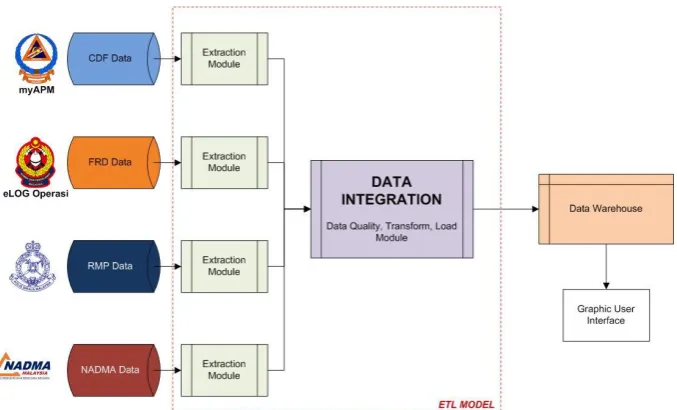
divided into conceptual data integration modelling (Figure 1)
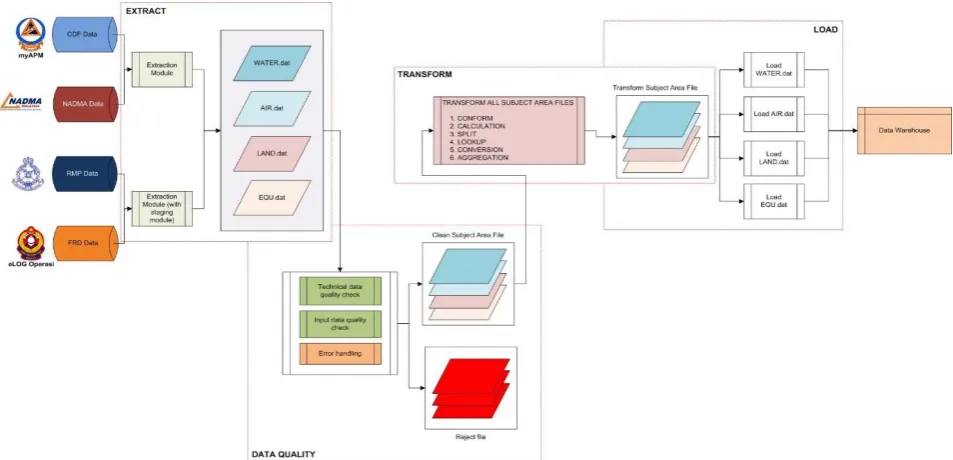
and logical data integration modelling (Figure 2). For the
latter, a high-level logical model was developed, which
consists of four sub-modules, namely the logical extract
model, logical data quality model, logical transform model
and logical load model.
VI. FINDINGS
A. Existing Mechanism for DLM
In Malaysia, the preparation for disaster logistics
management is done in accordance with NSC Directive No.
20. The nature of the directive is such that it is highly
compartmentalised in terms of roles and functions of each
agency. Therefore, the approach for disaster logistics
management in Malaysia can be categorised into two, the
cluster approach and the centralised-decentralised approach.
The cluster approach can be seen in the government
disaster management meetings whereby the Central
Disaster Management Committee (CDMC) members would
present and discuss the available assets to be used during
the disaster, before flooding season. The meeting occurs at
the federal and also state levels, chaired by the Minister in
the Prime Minister’s Department and the State Secretary,
respectively. Meanwhile, the cluster approach is visible in
government disaster logistics in the way the assets are
categorised. The assets are categorised into land
transportation, water transportation, air transportation and
equipment such as mobile kitchen, generator set, mobile
toilet, water purification system, life jackets and others.
These assets are usually deployed as the monsoon season is
nearing, especially for states expected to be hit with the
disaster (usual flooding). Disaster logistics assets in the
country are common assets, and they are not specifically
designated for disaster purposes only. Although this is an
efficient way to manage resources, it has some weaknesses
in terms of their suitability for more complex disasters.
The centralised and decentralised approach in disaster
logistics management can be seen in the way each state
manages disaster. Generally, each state manages disaster
differently. Although disaster management of the country is
centralised at the federal level through CDMC, it is
decentralised at the state level as it includes the involvement
of State Department as well as different entities that are
present in different states. This approach works best due to
the different stakeholders in the state as well as the different
development growths and financial capabilities.
B. Proposed Data Integration Model
In order to develop a data integration model, an
understanding of how the data is being stored within the
respective agencies is required. As stated earlier, each
federal agency has a unique way of managing data. The
logistics assets data of CDF for disaster management
purposes are handled by the Disaster Management and
Operations Division through the “myAPM” web portal. The
logistics assets for FRDM are managed through an online
system “e-LOG Operasi”. The system is accessible by all
FRDM personnel with a limited view of the data based on the administrator’s setting. The logistics assets for both
RMP and NADMA are managed through an online
government asset management system, “mySPPA”. The
system consists of ten (10) modules including the asset
registration module and the asset location module.
As stated in the methodology, it is important to determine the data integration approach and architectural pattern
8 data integration architectural pattern chosen for this study
was the Extract, Transform, Load (ETL) using the Common
Data Storage approach. The selection of the approach and
architectural pattern was based on the nature of the existing
data from the agencies. In general, the data have different
update frequencies and attributes, requiring some form of
standardisation before they can be utilised efficiently by the
user. Based on this architecture, three layers were required,
namely extract layer, transform layer and load layer.
However, between the extract layer and transform layer,
there needs to be a data quality layer to ensure that the data
can be used for its intended purpose.
The conceptual model (Figure 1) identifies the main
subject areas of a data warehouse, which in this case comes
from the entities that hold the original data; namely all the
responder agencies (CDF, FRDM, RMP and NADMA). Since
the data have different formats and structure, they must go
through a module before being stored in the data warehouse.
Therefore, an ETL module was developed to ensure data
availability and reliability in the data warehouse. This
process is necessary to provide a guideline for the next layer
in the data integration model, which is the logical data
integration model. The data source comes from the four
aforementioned agencies, while the target for the envisioned
data integration model system is the overall data for disaster
logistics assets.
Figure 1. The conceptual data integration model provides an overview of the complete data integration process. The model
demonstrates the relationship between each entity that all responder agencies play a prominent role in disaster logistics
management. Although the logistic capabilities vary, the significance of each agency remains the same in this conceptual
model.
Taking the above context, a conceptual high-level data
integration model was developed, as shown in Figure 2. In
the high-level logical data extract model, all NADMA and
CDF assets are used in disaster logistics management, but
not for FRDM and RMP due to the nature of the assets. Data
analysis for the extracted model also validates the findings from the case study, whereby disaster logistics assets
comprise of common assets, which are also used for other
purposes. The outcome of this model is to identify the type
of assets to be extracted into the subject area files. All
extracted data are formatted into pre-determined subject
area files.
The aim of the data quality module is to produce reliable
and effective data for the next module, the transform
module. While there are many ways to measure data quality,
this study focused on the quality of the extracted data, mainly because the expected number of data in the data
warehouse is less than 100,000 and through incremental
extraction, issues on latency would be reduced significantly.
8 distinguish data types and ensure that correct data resides
in the intended type. Technical Data Quality Check is used
to identify invalid data and missing data, while Input Data
Quality Check checks for inaccurate data and inconsistent
definition.
Figure 2. Details of the four logical models, namely logical extract, logical data quality, logical transform and logical load
models required for the high-level data integration model.
The logical transform model identifies the transformation
required by the extracted data in order to meet the end
user’s requirement. In this model, the type of data
transformations involved are conversion, split, aggregation,
calculations, lookup and conforming. The logical load model
is fairly straightforward and simple as it concerns loading
the predetermined subject area files into the data warehouse.
The design of this model is aimed at reducing future
maintenance, whereby the load processes are designed by
the target and the subject area within the target allows any
future changes to be encapsulated in the source data.
VII. CONCLUSION
Disaster management in Malaysia, similar to other countries,
is managed through the coordination between government
agencies, namely National Disaster Management Agency
(NADMA), Fire Rescue Department (FRDM), Royal Malaysian Police (RMP) and Malaysia Civil Defence Force
(CDF). Therefore, the success of managing disaster depends
highly on the coordination between these agencies,
particularly in information sharing on available disaster
logistics. Disaster logistics has and always been an integral
part of disaster management, as logistics are involved in
every phase of the disaster management cycle. During
preparedness, logistics assets are prepositioned according to
disaster forecasted area to ensure swift mobilisation during
response. During recovery, logistics provides support to the
recovery works during the initial stage such as when victims
are allowed to return to their disaster-stricken homes.
Prevention and mitigation phases involve re-evaluation of
disaster logistics requirement and procurement of
additional assets if necessary. Therefore, it can be concluded
that disaster logistics management should not be separated
from the disaster management cycle as it is integrated into
the cycle.
Currently, the country still relies on the NSC Directive No.
20 as a guideline in disaster management. However, the
directive does not specifically mention about joint
management of disaster logistics. This has resulted in
redundancy in response and recovery effort, and in worst
cases, absence of logistics in an area due to
9 studies reports by four main agencies and three different
states represented by the northern zone (Perlis), east coast
(Terengganu) and Central and Southern Zone (Melaka), it
appears that each case study has different ways of
interpreting disaster logistics management. State disaster
logistics management differs between states, accompanied
by specific issues and challenges.
Taking all of these into account, it is essential to develop a
cohesive data integration system regarding disaster logistics
information to enable better coordination between
government agencies. Data integration would enable the
user to find out the location and specification of asset to
determine its suitability for the intended purposes. Having a
complete data warehouse on the available asset and
resources at district, state and federal levels will improve
current disaster logistics management. However, data
integration from various sources has their challenges in
terms of managing the different data format. Therefore, the
top-to-bottom development approach in this study has
detailed out each phase of the data integration model;
beginning with the conceptual data integration model up to
the logical model. The outcome of the conceptual model
revealed that all responder plays an equal role in the
proposed data integration system, irrespective of their asset
capability.
The high-level logical model aims to identify the attribute
of each entity that will describe the requirement for the data
integration process. Subsequently, the four logical data
integration model that has been developed addresses the
heterogeneous challenge of the data source by providing
subject area files from the beginning of the extract module.
The logical extract model aims to identify the relevant type
of assets to be included in the data warehouse; whereas the
logical data quality model manages data reliability and
effectiveness. The outcome of the logical transform and
logical load is to identify the transformation required by the
extracted data such that they can be utilised to meet the
end-user requirement and can load the predetermined
subject area files into the data warehouse respectively.
The current mechanism on disaster logistics management
at the federal level is carried out through NADMA as the
main disaster management agencies. However, due to its
role as a coordinating body, it does not possess strong
logistics capability and is dependent on other sources.
Hence it will have to communicate continuously with other
responder agencies for an updated status of assets. With a
data integrated model database or system, effectiveness in
communication can be increased as the complexity of the
overall process is reduced. This will, in turn, improve
response time. A study by Hristidis, Chen, Li, Luis, and
Deng in 2010 discusses data management and analysis in
disaster situation, which focuses on Information Extraction
(IE), Information Retrieval (IR), Information Filtering (IF),
Data Mining (DM) and Decision Support (DS). Their data
flow model acknowledges the need for data integration and
addresses pertinent issues in data integration, which is the
heterogeneity of the overall disaster data, which was also
one of the considerations in developing the proposed data
integration model.
Since disaster management in the country is a joint effort,
the assets involved are the common asset that is also used by
the respective agencies for their daily tasks. Nevertheless,
using the proposed data integration model, automatic data
extraction can occur at each of the agency-specific logistic
systems as each agency maintains and updates their original
system, without having to inform the main stakeholder of
10
VIII. REFERENCES
[1] ‘6. Coordination and control’ 2014, Scandinavian
Journal of Public Health, vol. 42(14_suppl), pp.
56–75.
https://doi.org/10.1177/1403494813515102.
[2]Abulnour, AH 2014, ‘Towards efficient disaster
management in Egypt’, HBRC Journal, vol. 10, no.
2, pp. 117–126.
doi:10.1016/j.hbrcj.2013.07.004.
[3]Alamdar, F, Kalantari, M, & Rajabifard, A 2016,
‘Computers, Environment and Urban Systems
Towards multi-agency sensor information
integration for disaster management’, CEUS, vol.
56, pp. 68–85.
doi:10.1016/j.compenvurbsys.2015.11.005.
[4]Bayrak, T 2009, ‘Identifying requirements for a
disaster‐monitoring system’, Disaster Prevention
and Management, vol. 18, no. 2, pp. 86-99.
https://doi.org/10.1108/09653560910953171.
[5]Beamon, BM, & Balcik, B 2008, ‘Performance
measurement in humanitarian relief chains’,
International Journal of Public Sector
Management, vol. 21, no. 1, pp. 4–25.
doi:10.1108/09513550810846087.
[6]Bolsche, D, Klumpp, M, & Abidi, H 2013, ‘Specific
competencies in humanitarian logistics education
Specific competencies in humanitarian logistics
education’, Journal of Humanitarian Logistics
and Supply Chain Management, vol. 3, no. 2, pp.
99–128.
doi:10.1108/JHLSCM-08-2012-0019.
[7]Burkle, FM & Hayden, R 2001, ‘The Concept of
Assisted Management of Large-Scale Disasters by
Horizontal Organizations’, Prehospital and
Disaster Medicine, vol. 16, no. 3, pp. 128–137.
doi: 10.1017/S1049023X00025875.
[8]Cheng, W, & Lu, J 2008, ‘Operational Analysis on
Emergency Logistics System and Emergency
Response Model’, in IEEE International
Conference on Service Operations and Logistics,
and Informatics, Beijing, pp. 1323–1328.
doi:10.1109/SOLI.2008.4686605.
[9]Cozzolino, A 2012, ‘Humanitarian Logistics and
Supply Chain Management’, in Humanitarian
Logistics, SpringerBriefs in Business, Springer,
Berlin, Heidelberg, pp. 5-16.
doi:10.1007/978-3-642-30186-5.
[10] Cozzolino, A, Rossi, S, & Conforti, A 2012, ‘Agile
and lean principles in the humanitarian supply
chain The case of the United Nations World Food
Programme’, Journal of Humanitarian Logistics
and Supply Chain Management, vol. 2, no. 1, pp.
16–33.
doi:10.1108/20426741211225984.
[11] Dolinskaya, IS, Shi, ZE, & Smilowitz, KR 2011,
‘Decentralized Approaches to Logistics
Coordination in Humanitarian Relief’, in
Proceedings of Industrial Engineering Research
Conference.
[12] FEMA 2000, Chapter 9 : Preparedness For
Emergency Response.
[13] Guzman, EMDe 2001, Towards Total Disaster
Risk Management Approach United Nations Office
for the Coordination of Humanitarian Affairs-, pp.
11 [14] Hristidis, V, Chen, S, Li, T, Luis, S, & Deng, Y
2010, Survey of data management and analysis in
disaster situations’, The Journal of Systems &
Software, vol. 83, no. 10, pp. 1701–1714.
doi:10.1016/j.jss.2010.04.065.
[15] Jahre, M, Pazirandeh, A, & Wassenhove, L Van.
2016, ‘Defining logistics preparedness : a
framework and research agenda’, Journal of
Humanitarian Logistics and Supply Chain
Management, vol. 6, no.3.
[16] Jahre, M, Jensen, L-M & Listou, T 2009, 'Theory
development in humanitarian logistics: a
framework and three cases', Management
Research News, vol. 32, no. 11, pp. 1008-1023.
doi:10.1108/01409170910998255
[17] Jahre, M & Jensen, L-M 2010, 'Coordination in
humanitarian logistics through clusters',
International Journal of Physical Distribution &
Logistics Management, vol. 40, no. 8/9, pp.
657-674.
doi:10.1108/09600031011079319.
[18] Majewski, B, & Heigh, I 2010, ‘A Peek into the
Future of Humanitarian Logistics : Forewarned Is
Forearmed’, International Journal on Supply
Chain Forum, vol. 11, pp. 4–19.
[19] Ortuño, MT, Cristóbal, P, Ferrer, JM, Muñoz, S, &
Tirado, G 2013, Decision Aid Models and Systems
for Humanitarian Logistics: A Survey, in Atlantis
Computational Intelligence Systems, Atlantis
Press, pp. 17–45.
doi:10.2991/978-94-91216-74-9
[20] Sokat, KY, Zhou, R, Dolinskaya, IS, Smilowitz, K,
Chan, J, Sokat, KY, … Chan, J 2014, Capturing
Real-Time Data in Disaster Response Logistics.
[21] Thomas, A, & Mizushima, M 2005, ‘Logistics
training : necessity or luxury’, Forced Migration
Review, vol. 22, no. 22, pp. 60–61.
[22] Thompson, DDP 2015, Disaster logistics in small
island developing states: Caribbean perspective.
doi:10.1108/DPM-09-2014-0187.
[23] Timoleon, C 2012, The Logistics Chain of
Emergency Supplies in Disasters, Athens
University.
[24] UNDP 1993, Disaster Management Training
Programme - Logistics (1st Edition).
[25] Wassenhove, V 2006, ‘Humanitarian aid logistics:
supply chain management in high gear’, Journal of
the Operational Research Society, vol. 57, no. 5,
pp. 475-489.
doi:10.1057/palgrave.jors.2602125.
[26] Yang, C, & Yan, X 2010, ‘Emergency Logistics
Management and Its Operations Reference Model’,
in International Conference on Management
Science & Engineering, pp. 570–575.
[27] Official Statement By: H.E. Tan Sri Muhyiddin
Mohd Yassin, Deputy Prime Minister, Third United
Nations World Conference On Disaster Risk
Reduction 2015, viewed 5 April 2016,
<http://www.preventionweb.net/files/globalplatfo
rm/ministerialstatementmalaysiafinalre.pdf>
[28] Utusan Online 2014, 400 terperangkap di SK
Manek Urai Lama selamat, viewed on 9 September
2016,
<http://www.utusan.com.my/berita/nasional/400