© Universiti Tun Hussein Onn Malaysia Publisher’s Office
IJIE
Journal homepage: http://penerbit.uthm.edu.my/ojs/index.php/ijie
The International
Journal of
Integrated
Engineering
ISSN : 2229-838X e-ISSN : 2600-7916
Effect of Wood Waste as A Partial Replacement of Cement,
Fine and Coarse Aggregate on Physical and Mechanical
Properties of Concrete Blocks Units
Jasim Mohammed Abed
1*, Ban Ahmed Khaleel
11Department of Building and Construction Technology Engineering, Engineering Technical College,
Northern Technical University, 41002 Mosul, IRAQ
*Corresponding Author
DOI: https://doi.org/10.30880/ijie.2019.11.08.023
Received 27 April 2019; Accepted 15 July 2019; Available online 15 December 2019
1. Introduction
The world produces thousands of tons of sawdust annually from wood products and furniture. Where these wastes accumulate and generate a serious environmental problem. To overcome this problem, researchers have found the Possibility to use it in concrete. Concrete is one of the most widely used construction materials with Portland cement as a main component. Currently, 4.5 billion tons of cement are produced annually in the world, this number is expected to rise to 5.5billion by 2050 and with rapidly urbanizing of poor countries. Unfortunately, this huge amount of cement is responsible for the emissions of approximately 8% of CO2 gas into the atmosphere [1]. CO2 gas emitted by the cement industry is responsible for more than 65% of the global warming problem [2]. Every ton of cement produced is responsible for the emission of the equivalent of 640 kg of CO2 in the atmosphere [3]. Therefore, the incorporation of sawdust waste and use it as a partial replacement of cement is beneficial in reducing global demand for cement to reduce the environmental and economic burden. In addition, the use of sawdust as a partial replacement of sand have great importance in the manufacture of light-weight masonry units [4]. In many parts of the world, the use of sawdust,
Abstract: Wood waste has been used in concrete in 19th century. Its light-weight and cost effectiveness are main recognized characteristics. To reduce the environmental burden, nowadays developed countries have opportunities to use wood waste in concrete construction. This research presents experimental program results on mechanical and physical properties of ninety-six specimens of concrete blocks units. The experimental program concluded three groups of mixes plus the control mix. In Group 1 and Group 2, sawdust waste has been used as a partial replacement of 10%, 15%, 20%, 25% and 30% by volume of cement and sand respectively. In Group 3, wood waste aggregate has been used as a partial replacement of 10%, 15%, 20%, 25% and 30% by volume of coarse aggregate. The specimens were conditioned for 28-days at 80±5% Relative humidity and 24±2°C and tested. Slump, compressive strength, water absorption, dry density, porosity and thermal conductivity tests have been conducted. The compressive strength of concrete blocks units decreased due to the effect of sawdust waste and wood waste aggregate by increasing the replacement ratio instead of cement, sand and coarse aggregate. The results showed the mixes of group1 and group2 produced structural concrete blocks units at 20% replacement ratio of sawdust waste instead of cement and sand respectively. Also, the results showed that light-weight concrete blocks units can be obtained at a 25% and 30% replacement ratio in all groups with satisfactory compressive strength. The optimum replacement ratio was about 20% in the three groups so that physical and mechanical properties were satisfactory. This may be considered a solution not only to the problem of the environment but also to the problem of economics in the design of buildings.
cement, and sand in the manufacturing floor and walls panels have become common. Abdul Awal et al. [5] investigated the possibility of incorporating sawdust waste in concrete with various cement to sawdust ratio 1:1, 1:2 and 1:3 by volume, mechanical and physical properties were tested at different curing periods of 7, 14 and 28 days, and they concluded that the sawdust concrete could be used as a light-weight concrete with a satisfactory compressive strength. Torkaman et al. [6] studied the effect of partial replacement of Portland cement with wood fiber waste and rice husk ash (RHA) on the physical and mechanical properties of lightweight concrete blocks, they concluded that the optimum partial replacement of wood fiber waste and rice ash was 25% by weight of cement. Also, they concluded that recycling of wood fiber waste and rice husk ash (RHA) may be an appropriate and viable solution to solve the problem of economic design as well as the environment.
Sales et al. [7] investigated the possibility of incorporating a water treatment sludge and sawdust to produce a lightweight concrete, they found that lightweight concrete with a suitable physical and mechanical properties for non-structural applications can be produced. Gil et al. [8] studied the mechanical properties of mortar reinforced with sawdust wastes for 7, 30 and 90 days age of curing. They found that compressive strength increased by adding 0.5% of sawdust waste, after that the compressive strength started to decrease gradually with the increase of the sawdust waste content, a light-weight mortar was obtained with adding 3% of sawdust waste. Liu et al. [9] investigated the effect of using local materials such as clay, sand and untreated wood-sawdust waste with cement and water, they concluded that light-weight masonry units can be produced but only suitable for non-loaded walls. Olutoge [10] studied the use of palm kernel shells (PKS) and sawdust as a replacement for coarse and fine aggregates in reinforced concrete slabs, At replacement from 0 to 100% in steps of 25%, specimens were tested at 7, 14 and 28 days. He found that it is possible to produce light-weight concrete with a weight reduction of more than 18% when using sawdust waste and palm kernel shells, also the economic cost is reduced by 7% per cubic meter for concrete produced from sawdust waste and palm kernel shells. Thandavamoorthy [11] made an experimental attempt to recycle wood waste by incorporating it in concrete as a partial replacement of coarse aggregate in percentages of 0, 15, 20 and 25% by volume with mix proportion of 1:1.26:2.76.:0.45. He concluded that concrete with 31.4 MPa compressive strength can be produced with 15% replacement level.
Light-weight concrete blocks units are concrete masonry units (CMU) made of light-weight aggregate to reduce the density and weight compared to standard concrete blocks. The difference between light-weight and normal-weight concrete blocks units is the density of the used aggregate. Lightweight concrete blocks units are made using aggregate whose densities are less than 2745kg/m3. Due to the increasing need to recycle industrial waste from the wood and
furniture industry, this research aims to using sawdust waste as a partial replacement of cement and sand in the manufacture of light-weight concrete blocks units with satisfactory physical and mechanical properties, and to using wood waste aggregate as a partial replacement of coarse aggregates in production of light-weight concrete blocks units with appropriate strength. The investigation on the mechanical and physical properties of sawdust waste concrete and the possibility of using the produced units in loading or non-loading concrete masonry walls are also part of interest.
2. Experimental program
2.1 Cement
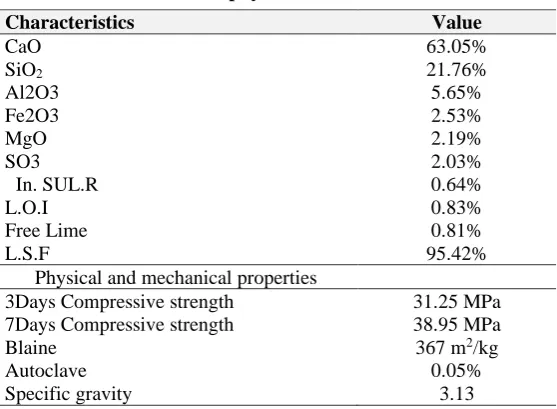
Grade (43) Ordinary Portland cement conforming to the ASTM C150 [12] specifications was used. Table 1 shows the chemical and physical characteristics of cement.
Table 1- Chemical and physical characteristics of cement.
Characteristics Value
CaO 63.05%
SiO2 21.76%
Al2O3 5.65%
Fe2O3 2.53%
MgO 2.19%
SO3 2.03%
In. SUL.R 0.64%
L.O.I 0.83%
Free Lime 0.81%
L.S.F 95.42%
Physical and mechanical properties
3Days Compressive strength 31.25 MPa
7Days Compressive strength 38.95 MPa
Blaine 367 m2/kg
Autoclave 0.05%
2.2 Fine and Coarse Aggregate
A clean local river sand conforming to the BS 882:1992 [13] specifications was used. Meanwhile, a clean local river gravel with maximum aggregate size 20 mm, conforming to the BS 882:1992 [13] specifications was used. Table 2 shows properties of used sand and gravel.
Table 2 - Properties of fine and coarse aggregate.
Property Fine aggregate Coarse aggregate
Fineness modulus 2.5 6.67
Water absorption% 1.1 0.62
Specific gravity 2.62 2.73
2.3 Wood Waste
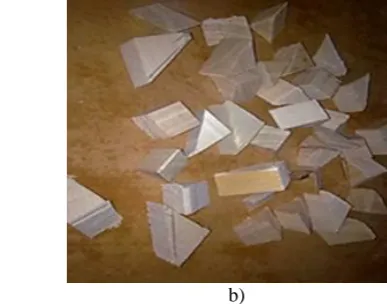
A sawdust collected from local factories used in this work its specific gravity was 1.32, Fig. 1(a), shows the used sawdust waste. On the other hand, a wood waste aggregate with a maximum aggregate size 20 mm was used, its specific gravity was 1.32. Fig. 1(b) shows used wood waste aggregate.
a) b)
Fig. 1 - Wood wast: a) sawdust waste, and b) wood waste aggregate.
3. Methodology and Mix Proportions
In order to standardize and compare the results clearly, three main parts of the work were prepared as shown in Fig. 2. First: control mix without additions. Second: Concrete of 10, 15, 20, 25 and 30% sawdust waste. Third: Concrete with a wood waste aggregate of 10, 15, 20, 25 and 30%. In each part, gravel, sand and cement were mixed in a dry state, sawdust or wood waste aggregate was added and mixed again well. Then water added, and re-mix again to ensure that the additives well distributed. The cast moulds were vibrated for 2 minutes to achieve adequate strength. The specimens were de-clamped after 24 hours and conditioned for 28-days at 80±5% R.H and 24±2°C to allow concrete to cure and gain strength.
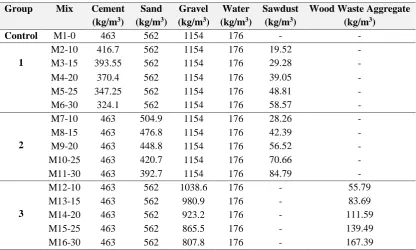
Sawdust waste and wood waste aggregate were immersed in water for 24 hours before casting to ensure that were not absorb mixing water. Slump test was conducted for all concrete mixes. Table 3 shows mix proportions of sawdust and wood waste aggregate concrete blocks units, Group 1 represents Concrete of 10, 15, 20, 25 and 30% of sawdust waste as a partial replacement of cement, Group 2 represents Concrete of 10, 15, 20, 25 and 30% of sawdust waste as a partial replacement of sand and Group 3 represents Concrete of 10, 15, 20, 25 and 30% of wood waste as a partial replacement of coarse aggregate. The control mix designed according to ACI design method, with maximum aggregate size of 20 mm, the target 28-day compressive strength was 25 MPa.
Table 3 - Mix proportion of sawdust and wood waste aggregate concrete blocks units.
Group Mix Cement (kg/m3)
Sand (kg/m3)
Gravel (kg/m3)
Water (kg/m3)
Sawdust (kg/m3)
Wood Waste Aggregate (kg/m3)
Control M1-0 463 562 1154 176 - -
1
M2-10 416.7 562 1154 176 19.52 -
M3-15 393.55 562 1154 176 29.28 -
M4-20 370.4 562 1154 176 39.05 -
M5-25 347.25 562 1154 176 48.81 -
M6-30 324.1 562 1154 176 58.57 -
2
M7-10 463 504.9 1154 176 28.26 -
M8-15 463 476.8 1154 176 42.39 -
M9-20 463 448.8 1154 176 56.52 -
M10-25 463 420.7 1154 176 70.66 -
M11-30 463 392.7 1154 176 84.79 -
3
M12-10 463 562 1038.6 176 - 55.79
M13-15 463 562 980.9 176 - 83.69
M14-20 463 562 923.2 176 - 111.59
M15-25 463 562 865.5 176 - 139.49
M16-30 463 562 807.8 176 - 167.39
4. Test Procedure
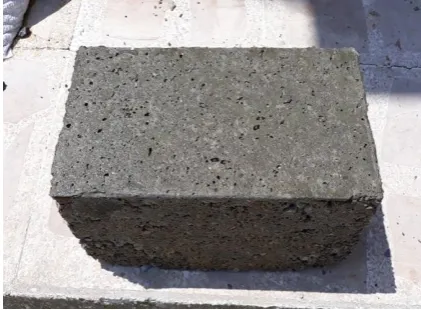
A total of 96 concrete blocks units have been casted and tested for various physical and mechanical properties as enumerated in Fig. 3. Meanwhile, Fig. 4 shows the concrete block unit specimen.
4.1 Compressive Strength
All concrete blocks units were dimensions 200 mm x 200 mm x 400 mm, the loaded-face was capped according to ASTM C1552 [14] with a gypsum layer not exceeding 3 mm to ensure distribution of load on the entire surface of the loading face. Top and bottom steel plates with a thickness of 12 mm and, length and width of the steel plate were 7 mm greater than the length and width of the tested concrete blocks units. A 2000 kN Universal Testing Machine was used to determine compressive strength. Average of three concrete blocks units of compressive strength for each group was reported.
4.2 Water Absorption
According to ASTM C140 [15] standard, water absorption was carried out, concrete blocks units were completely immersed in water at 25°C for 24 hours. The samples were drained on paper towels for 10 min to remove excess water. The samples were dried in oven up to 110°C for 24 hours until reaching constant weights. The increase in weight of the specimen during submersion represent the water absorption. However, water absorption was calculated from the following equation: 100 − = sat d ab d W W W W (1)
where Wab is water absorption (%), Wsat is saturated weight of specimen (kg) and Wd is oven-dry eright of specimen
Fig. 3 - Schematic diagram of the test.
Fig. 4 - Concrete block unit specimen.
4.3 Dry density
Following ASTM C140 standard, samples were tested for dry density. The mass and volume of each sample were measured. The samples were dried in oven up to 110 ° C for 24 hours until reaching constant weights. Then samples were cooled and the dry weight was recorded by a balance with ±0.01 g sensitivity, dimensions of samples were measured using a calliper. Dry density was calculated using the following equation:
=
dry dry
dry
M p
V (2)
where, pdry is the dry density, Mdry is the oven dry weight (kg) and Vdry is the dry volume (m3) of the sample. Average of
three concrete blocks units of oven-dry density for each group was reported.
4.4 Porosity
Following ASTM C140 standard, porosity test was carried out for concrete blocks units were completely immersed in water at 25°C for 24 hours, the samples were drained on paper towels for 10 minutes to remove excess water. The suspended weights in water of the samples were recorded by a sensitive electronic balance. The samples were dried in oven up to 110°C for 24 hours until reaching constant weights. However, porosity was calculated from the following equation:
100 −
=
−
w dry ro
w s
W W
P
W W (3)
where Pro is the porosity (%), Ww is the saturated dry weight of specimen (kg), Wdry is the oven-dry weight of specimen
(kg) and Ws is the suspended weight of specimen (kg). Average of three concrete blocks units of porosity test for each
4.5 Workability
Enabling high structural efficiency and ease of construction, in addition to providing the freedom of shape advantage is made available by appropriate workability. In this study, ASTM C143/C143M [16] was followed in workability test.
4.6. Thermal conductivity
According to the basic testing program conducted by National Institute of Standards and Technology, the U.S. Bureau of Reclamation and the University of Minnesota demonstrate that the thermal conductivity coefficient for concrete depends mainly on the type of used aggregates in the mixture. For simplicity, Valore (1980) plotted over 400 published test results of density against the logarithm of conductivity and suggested an equation depending on oven-dry density of concrete as a logarithmic function of kc, improving a straight line that can be calculated by the equation below which has been adopted by ACI 122R -02[17]:
0.00125 0.072
= d
c
k e (4)
where kc is the thermal conductivity (W/mk) and d is the oven-dry density (kg/m3).
5. Results and Discussion
5.1 Compressive Strength
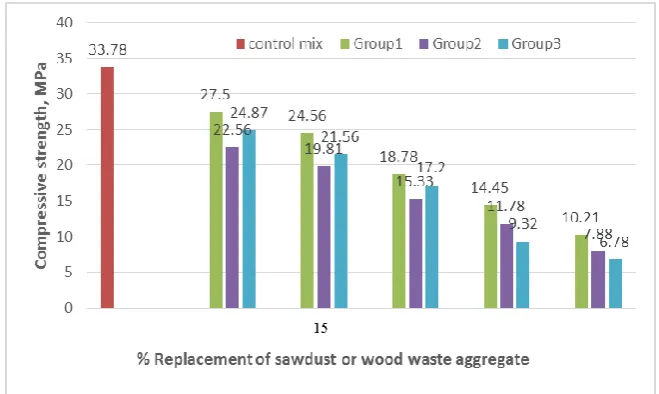
In fact, relatively few previous studies have been conducted on the effect of the addition of sawdust waste and wood waste aggregate on the compressive strength of light-weight concrete blocks units. So, it was a little bit hard to compare the current study with previous studies on compressive strength. Fig. 5 shows that compressive strength was significantly and directly affected when cement, sand and coarse aggregate replaced by sawdust or wood waste aggregate. For Group 1: comparing with the control mix a significant decrease of about 19% was observed when 10% by volume of cement replaced with sawdust waste. After that, the loss of compressive strength increased to 69% when 30% of cement replaced by sawdust waste. This behaviour is highly agreed with Torkaman et al. [6] and Nurul Huda et al. [18]. ACI 213R-14 [19] has identified structural lightweight concrete at 28days as its compressive strength shall not be less than 17.2 MPa, so it was clear in Fig.5 that the replacing of 20% of cement and coarse aggregate was within the scope of the structural concrete strength, which can be used in the load-bearing walls. For Group 2: there was a significant and unexpected reduction in compressive strength of concrete blocks units due to the replacement of 10% sawdust waste as a partial replacement of sand in the mixture. The strength decreased by 33% compared to the control mix, after that the drop rate reached more than 77% compared to the control mix. Group 3 was slightly better than Group 2 when replacing 10, 15 and 20% of coarse aggregate by wood waste aggregate, but it got a significant drop after that. The loss of compressive strength was about 80% compared to the control mix. This behaviour of compressive strength was justified due to the reason that the sawdust waste acts more as a filler material within the cement paste matrix than in the binder material. As the sawdust waste replacement percentage was increased, the surface area of filler material to be bonded by cement increases, thereby reducing strength.
5.2. Water Absorption
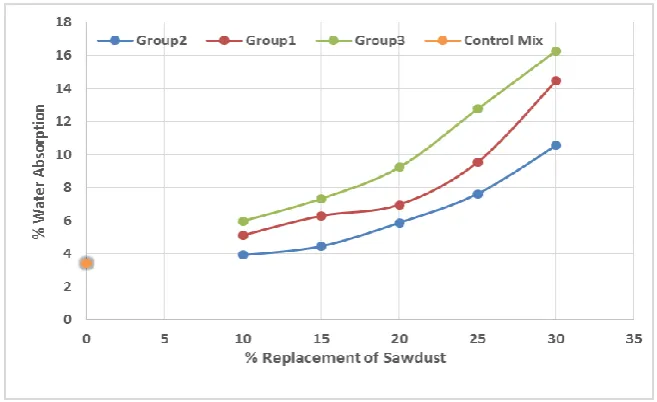
Fig. 6 presents the water absorption tests results of the control mix and the mixes containing sawdust waste and wood waste aggregate for various replacement ratios. The general behaviour of all three groups was that the higher replacement ratio of sawdust waste or wood waste aggregate, the greater the water absorption rate. Generally, Group 2 showed better performance for water absorption, which means less voids in the structure of concrete blocks units. This was due to the needs of cement more water to complete the process of hydration, as well as its high fineness affect the absorption of water. The wood waste aggregate in Group 3 seems to have been absorbed more water than sand and cement. This was due to the fact that the shape of wood waste aggregate was similar to the pyramid, perhaps left some voids under it, which increased the water absorption ratio. This behaviour was agreed with Usman et al. [20].
Fig. 6 - Relationship between water absorption and % sawdust and wood waste aggregate.
5.3 Dry Density
The dry densities variation in concrete blocks units at 28 days can be seen in Table 4 and Fig. 7. The results showed a gradual decrease in densities of the concrete block units with increasing replacement ratios of sawdust waste and wood waste aggregate in the three groups. For example, in group 1, the density decreased from 2432 kg/m3 in the
control mix to 2300, 2133, 2024, 1837 and 1733 kg/m3 when replacing 10, 15, 20, 25 and 30% respectively of sawdust
waste as a partial replacement of cement. And so, in the two other groups, the reason was that the specific gravity of sawdust waste or wood waste aggregate was much less than the specific gravity of cement, sand and coarse aggregate. Some densities in the three groups decreased less than 1850 kg/m3 which is the maximum density required for
structural lightweight concrete [19] (section 4.5). In fact, this behaviour was expected and agreeing with Stasiak et al. [21] and Memon et al. [22].
Table 4 - Oven-dry density of concrete blocks units.
% Replacement
Oven-dry density (kg/m3)
Group 1 Group 2 Group 3
0 2432 2432 2432
10 2300 2320 2300
15 2133 2176 2157
20 2024 2101 2047
25 1837 1922 1887
30 1733 1778 1758
5.4 Porosity
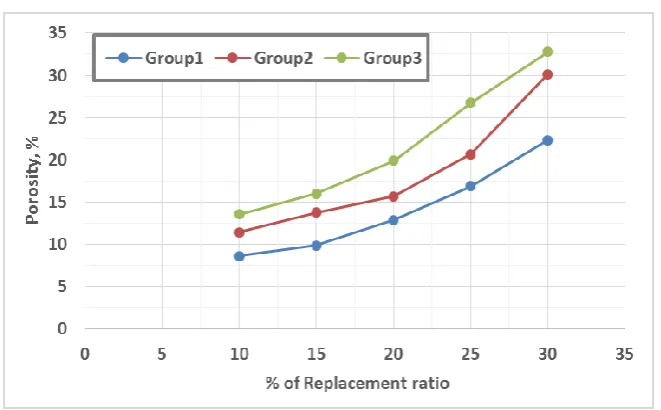
may be due to the fact that the sawdust waste was fine particles (passing sieve No.4) and filled the space in the structure of concrete better than the wood waste aggregate in Group3.
Fig. 7 - Reduction of dry density versus % sawdust and wood waste aggregate.
Fig. 8 - Relationship between porosity and replacement ratio.
5.5 Workability
Table 5 shows the slump test values for fresh concrete. It was clear that there were significant losses of slump values as sawdust waste or wood waste aggregate increased compared with the control mix (slump test value for control mix was 70mm), this behavior agrees with Narayanan et al. [23]. As shown in Fig. 9, Group 1 and Group 2 had a significant loss in slump compared to Group 3.This may be due to the fact that the greater the replacement ratio of sawdust waste or wood waste aggregate, the mixture would need more water, the sawdust waste may absorb the mixture water, this agreeing with the published experimental research byAdebakin et. al. [24].
Table 5 - Slump of concrete blocks mixes.
% Replacement
Slump (mm)
Group 1 Group 2 Group 3
10 55 60 70
15 40 45 61
20 33 39 52
25 23 23 33
Fig. 9 - Slump versus % sawdust waste and wood waste aggregate.
5.6
Thermal Conductivity
Thermal conductivity coefficient was calculated from Eq. (4), which was adopted by ACI 122R -02[17], it was based on dry density as a logarithmic relationship. Table 6 shows thermal conductivity coefficient values. It was observed from Fig.10, that the values of the thermal conductivity coefficient of the three groups were very close at the same replacement ratio. This may be due to the fact that dry density values for concrete block units were very close. It was also observed that the higher the replacement ratio the lower the coefficient of thermal conductivity. The lower the dry density of the concrete block units due to increasing wood waste replacement ratios (ie, the greater the percentage of voids in the structure of the concrete blocks units) the less thermal conductivity. This behaviour was fully consistent with ACI 213[19] and [25].
Table 6 - Coefficient of thermal conductivity of concrete blocks units.
% Replacement
Coefficient of Thermal Conductivity (W/mK)
Group 1 Group 2 Group 3
10 1.276 1.287 1.255
15 1.067 1.120 1.081
20 0.984 1.016 0.954
25 0.766 0.805 0.761
30 0.646 0.673 0.656
However, Real [25] Suggested an equation to predict the thermal conductivity coefficient depending on dry density of the concrete in a logarithmic formula with R2 = 0.93 as below:
0.0012 0.1402
= d
e (5)
where λ is the dry thermal conductivity (W/mK) and d is the dry density (kg/m3). The values of the thermal
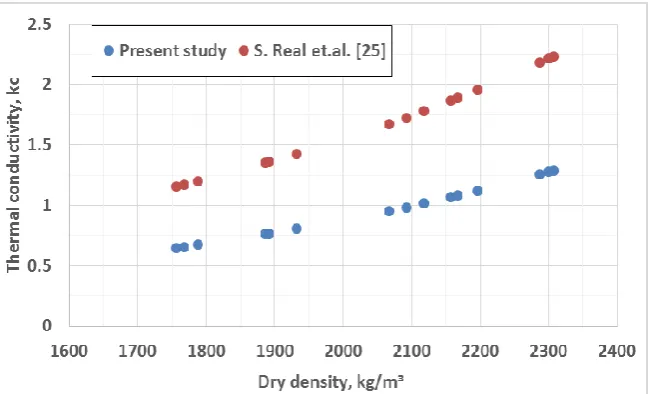
conductivity coefficient in this study were compared with the Eq. (5) and illustrated in Fig. 11. The equation proposed by Real [25] gives higher values of thermal conductivity. This may be due to the fact that they used four types of coarse aggregate: sintered FA aggregate, expanded slate aggregate and two crushed limestone aggregates of different grain sizes. However, despite the different types of aggregates used in this study comparing with Real [25]. As they were all apply to lightweight aggregate, the comparison was made with Eq. (5). Where it only requires determination of the dry density of the concrete, and it was also used for lightweight concrete.
Fig. 11 - Coefficient of thermal conductivity, kc in present study as compared to Real et al. [25].
6. Conclusions
The concrete blocks units were designed following the normal-weight concrete blocks unit procedure. lightweight concrete blocks units were obtained with satisfactory compressive strength and physical properties by replacing sawdust waste and wood waste aggregate as a partial replacement of cement, sand and coarse aggregates in replacement ratios ranged from 10% to 30%. The main conclusions of this research can be summarized below:
• Taking into account the significant reduction in compressive strength and physical properties of concrete blocks units as a sequence of replacement sawdust waste as a partial replacement of cement. Compressive strength of about 18 MPa can be obtained by replacing 20% of cement by sawdust waste.
• A significant increase in water absorption capacity for all concrete blocks units as soon as sawdust waste or wood waste aggregate was replaced. Group 3 was the most affected, with water absorption increasing from 6% to 16.25% when replacing 10% to 30% of wood waste aggregate.
• The effect of sawdust waste and the wood waste aggregate replacement was clear on the dry densities of concrete blocks units. The dry density of concrete blocks decreased when the ratio of replacement in all mixes was increased. • Light-weight concrete blocks units with satisfactory mechanical and physical properties can be produced at 25%
and 30% replacement ratio of sawdust or wood waste aggregate.
• The porosity of all concrete blocks units increased as soon as wood waste was incorporated. The Porosity was increased by more than 60% when the replacement ratio of sawdust or wood waste aggregate increased from 10% to 30% for all mixes.
• The effect of sawdust waste and wood waste aggregate on thermal conductivity was essentially caused by variations in dry densities of concrete blocks units with variability of replacement ratios.
• Thermal conductivity tends to decrease as the replacement ratios of sawdust waste or wood waste aggregate increased due to the decrease in dry density of concrete blocks units.
Acknowledgement
References
[1] Lehne, J. & Preston, F. (2018). Making Concrete Change: Innovation in Low-carbon Cement and Concrete. Chatham House Technical Report, The Royal institute of International Affairs London: Energy, Environment and Resources Department, pp. 3-6.
[2] Kalwane, U.B., Autade, P.B., & Patare, D.S. (2016). Effect of varying ratio of silicon dioxide to sodium oxide on geopolymer concrete. International Journal of New Innovations in Engineering and Technology, 5(4), 1-10. [3] Zhang, H. (2010). Building materials in civil engineering (1st Ed). Woodhead Publishing, Cambridge, UK. [4] Carlson, C. (1995). Lightweight Aggregates for Concrete Masonry Units. Portland Cement Association, Illinois,
USA.
[5] Awal, A. S. M., Mariyana, A. A. K. & Hossain, M. Z. (2016). Some aspects of physical and mechanical properties of sawdust concrete. International Journal of GEOMATE, 10(21) 1918–1923.
[6] Torkaman, J., Ashori, A. & Momtazi, A. S. (2014). Using wood fiber waste, rice husk ash, and limestone powder waste as cement replacement materials for lightweight concrete blocks. Construction and Building Materials, 50(1), 432–436.
[7] Sales, A., Souza, R. A. & Almeida, F.C. (2011). Mechanical properties of concrete produced with a composite of water treatment sludge and sawdust. Construction and Building Materials, 25(1), 2793–2798.
[8] Gil, H., Ortega, A. & Pérez. P. (2017). Mechanical behavior of mortar reinforced with sawdust waste. ICNF Conference Series: Advanced Materials for a Greener World, 325-332.
[9] Liu, Y., Dawe, J., & Christie, G. (2005). Evaluation of lightweight sawdust concrete units. The 10th Canadian Masonry Symposium, 1-8.
[10] Olutoge, F. A. (2010). Investigations on sawdust and palm kernel shells as aggregate replacement. Journal of Engineering and Applied Sciences, 5(4), 7-13.
[11] Thandavamoorthy, T. S. (2015). Wood waste as coarse aggregate in the production of concrete. European Journal of Environmental and Civil Engineering, 20(2), 125-141.
[12] ASTM C150/C150M-17 (2017). Standard Specification for Portland Cement. ASTM International, West Conshohocken.
[13] BS 882 (1992). Specifications for Aggregate from Natural Sources for Concrete. British Standards.
[14] ASTM C1552-12 (2012). Standard Practice for Capping Concrete Masonry Units, Related Units and Masonry Prisms for Compression Testing. ASTM International, West Conshohocken.
[15] ASTM C140/C140M-17 (2017). Standard Test Methods for Sampling and Testing Concrete Masonry Units and Related Units. ASTM International, West Conshohocken.
[16] ASTM C143/C143M-15 (2015). Standard Test Method for Slump of Hydraulic-Cement Concrete. ASTM International, West Conshohocken.
[17] ACI 122R (2002). Guide to Thermal Properties of Concrete and Masonry Systems. American Concrete Institute. [18] Huda N. S., Amir, A., Hazrina, M., Anizahyati, A. & Norliyati, A. (2019). Concrete using sawdust as partial
replacement of sand. MATEC Web of Conferences, 258, 1-5.
[19] ACI 213R-14 (2014). Guide for Structural Lightweight Aggregate Concrete. ACI Standard, American Concrete Institute, Farmington Hills.
[20] Usman, N. D., Idusuyi, F. I., Ojo, E. B. & Simon, B. (2012). The use of sawdust and palm kernel shell as substitute for fine and coarse aggregates in concrete construction in developing countries. Journal of Chemical, Mechanical and Engineering Practice, 2(3), 51-62.
[21] Stasiak, M., Molenda, M., Bańda, M., Wiącek, J., Parafiniuk, P. & Gondek, E. (2016). Mechanical and combustion properties of sawdust-straw pellets blended in different proportions. Fuel Processing Technology, 156(1), 366-375.
[22] Memon, R. P., Mohd, A., Sam, A. S. M., Awal, A. & Achekzai, L. (2017). Mechanical and thermal properties of sawdust concrete. UTM Jurnal Teknologi, 79(6), 23–27.
[23] Narayanan, A., Hemnath, G., Sampaul, K., & Mary, A. (2017). Replacement of Fine Aggregate with Sawdust. International Journal of Advanced Research in Basic Engineering Sciences and Technology, 3(35), 206-210. [24] Adebakin, I. H., Adeyemi, A. A., Adu J. T., Ajayi, F.A., Lawal, A. A. & Ogunrinola, O. B. (2012). Uses of
sawdust as admixture in production of low cost and light-weight hollow sandcrete blocks. American Journal of Scientific and Industrial Research, 3(6), 458-463.