Reliability Analysis and Power Dissipation of Quantum Dot Cellular
Automata Circuits for Next Generation Computing
R. Jayalakshmi1* and M. Senthil Kumaran2
1Department of ECE, Sri Chandrasekharendra Saraswathi Viswa Maha Vidyalaya, Enathur- 631561, Kanchipuram, Tamilnadu, India.
2Department of CSE, Sri Chandrasekharendra Saraswathi Viswa Maha Vidyalaya, Enathur- 631561, Kanchipuram, Tamilnadu, India.
Received 9 May 2019, Revised 27 May 2019, Accepted 9 July 2019
ABSTRACT
Quantum Dot Cellular Automata (QCA), an emerging Field Coupled Nano computing which is the new paradigm of computation has to be analyzed for reliability and thermal stability and power dissipation. The main focus of this study is to analyze a high input majority voter based on 3 to 8 decoder for reliability using Bayesian network at a circuit level. The charge configuration flow indicated the reliability of the data transmitted and hence the behavior of the QCA Circuits was analyzed. The Casual Direct Acrylic graph was used to analyze the behavior of QCA circuits. The power dissipation of the QCA circuits was also analyzed using QCADesigner-E tool. Bayesian networks were generated using dagitty tool.
Keywords: Quantum Dot Cellular Automata, QCA Designer, Dagitty, QCA Designer E.
1. INTRODUCTION
As the Field Coupled Nano Computing technologies such as Quantum Dot Cellular Automata is evolving [1-4], the circuits which are designed using the technology need to be tested for reliability. Bayesian networks are used to check the reliability of QCA Architecture by defining the conditional dependencies between the variables involved in the system. Bayesian networks are probabilistic directed acyclic graphical model that gives the joint and conditional probability occurrences between the variables and the nodes.
In this paper, the main focus is on the probability that the exact output signal will occur by checking the connectivity between the variables and nodes. The pre proposed work of 3 to 8 Decoder using high input majority voter in QCA technology was utilized to study the reliability and power dissipation. The novelty of the work is the designed QCA circuits are tested for reliability using Direct Acrylic Graphical methods, This work studies the casual dependency between the different Quantum Cells. tThe tool used for reliability analysis was GATIT and for power dissipation was QCADesignerE [10] [11].
486
2. QCA STRUCTURES
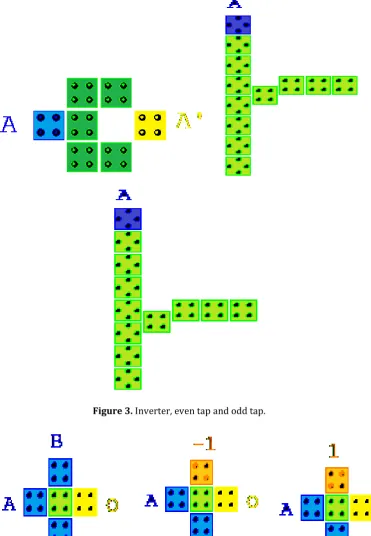
The QCA cells have quantum wells, in which the electrons can be deposited and can occupy the antipodal sites and represents the binary logic ‘0’ and ‘1’. The cells be connected together to carry the signal from one circuit to another using different configurations such as wire, inverter and majority voter. The majority voter is similar to the gate structures used in the conventional complementary metal oxide semiconductor field effect transistor. The primary majority voter is a three-input majority gate. Researchers had figured out using high input majority voters which can simplify the circuit at the layout level [1-4]. Figure 1 represents the QCA cells with the polarization of -1 and +1 to represent binary values of ‘0’ and ‘1’. The Figure 2 represents wire which is used as line between the input and output and as interconnects in high configuration architectures.
Figure 1. QCA Cell.
Figure 2. Wire.
487
Figure 3. Inverter, even tap and odd tap.
Figure 4. Three input majority voter with AND gate and or gate.
488
the probability of occurrence of the correct signal was considered and the probability of occurrence of clock pulses was not considered in this work.
Figure 5. Five Input Majority Voter with and gate and OR gate.
3. PROBABILISTIC MODELING OF QCA CIRCUITS
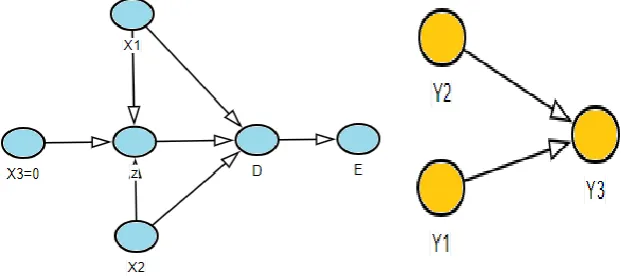
The uncertainty that exists in the computing of QCA circuits can be studied by hierarchical modeling using the Bayesian network. The reliability of a QCA circuit has to be studied by using the Boolean logic of the circuit and also by the probabilistic nature of the functions involved [9]. The probabilistic modeling of QCA circuits has been widely studied by Saket et al., and the authors has utilized a full adder to study the stability using the Bayesian Network. The Bayesian model and macromodel of three input majority gate presented in [9] is presented in Figure 6.
Figure 6. A three Input majority gate (a) Bayesian model of QCA layout (b) Bayesian network of macromodel block diagram
The output of a majority voter is determined by the polarization of the output variable, which is probabilistic nature, such as P(X=0) or P(X=1). Again, the output polarization or probability of exact occurrence depends on the temperature and the ground state configuration, which is maintained by the adiabatic clocking Phases of QCA [9]. The nodes represent the variables. The link between the different nodes gives the direct dependencies between the variables. The proposed work concentrates on hierarchical modeling of QCA circuits since the vector engines such as bistable and coherence vector simulation engines focusses mostly on the state of the vectors. The QCA circuits are unidirectional since the signal flows from input to the output. hHence, casual DAG can be used to study the modeling [10].
489
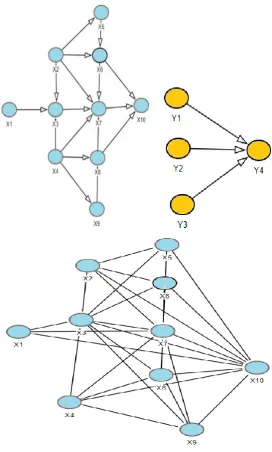
nodes of a five input majority voter with the variables in unidirection. In a five input majority voter, there are five input nodes such as A, B, C, D and E and one output node which is driven by the majority logic function as shown in Equation 1.
F= M (A, B, C, D, E) = ABC+ABD+ABE+ACD+ ACE+ADE+BCD+BCE+BDE+CDE (1)
The Bayesian modeling of the five input majority gate as represented in Figure 7 can be expressed in terms of the joint probability distribution as in Table 1.
490
Table 1 Joint probability distribution
Probability dependency between the nodes The probability of correct/erroneous output
P (x10|x9, x8, x7, x6, x5, x4, x3, x2, x1) P (x9| x8, x7, x6, x5, x4, x3, x2, x1)
P (x8| x7, x6, x5, x4, x3, x2, x1) P (x7|x6, x5, x4, x3, x2, x1) P (x6| x5, x4, x3, x2, x1) P (x5| x4, x3, x2, x1) P (x4| x3, x2, x1) P (x3| x2, x1) P (x3| x2, x1) P (x2| x1) P (x1)
P (x10, x9, x8, x7, x6, x5, x4, x3, x2, x1)
Similarly, the conditional joint probability between the child and the parent nodes can be given by considering the random variable X10, whose parent node is X6, X7 and X8. It is independent of the nodes X5 and X9, which is represented by the correlation graph as in Figure 7(c). The probability of correct output also depends on the radius of the neighboring cells. The minimal factored representation for the Bayesian Network [8] is given by equation 2.,
P(X) = P (xk |pa(xk)) (2)
The pre-proposed work in [6] was a 3 to 8 decoder with enabled input using Five Input Majority Voter with inputs A, B and C. The outputs were from OUT 0 to OUT 7 as given in Figure 8 with both schematic and QCA layout, drawn using QCADesigner [5].
491
Figure 9. Circuit level QCA layout and macromodel Bayesian network.
492
layout and macromodel using Bayesian Network has been created using information from a previous work [10]. The polarization of each QCA cell was computed and the probability of the layout and macromodel were more or less the same at different temperatures [9]. The macromodel of Bayesian network has the parent nodes represented by An, Bn, Cn, the child nodes in terms of Gpq, output nodes as Om, where n, m, p, and q are the arbitrary constants which defines the number of times the variables can exist. By the macromodel modeling using Bayesian Network, the nodes which are responsible for the maximum likelihood can be identified. The maximum likelihood node represents the probability of exact or erroneous output.
4. POWER DISSIPATION OF QCA STRUCTURES
The power dissipation in QCA circuits has been studied extensively in literature [7]. The power in QCA circuits are maintained by the kink energy and adiabatic clocking phases [4]. There is an electrostatic interaction between the neighboring cells in QCA for cells-i and cells-j, which can be determined by Equation 3.
1
4
i j ij
o r i j
q q E
R R
(3)
The kink energy is given by the difference between the same and opposite polarization of the neighboring cells in QCA, which is given by Equation 4.
( ) ( )
k
ij ij OppositePolarization ij SamePolarization
E
E
E
(4)The kink energy (EK), tunneling energy of an electrons () and the Polarization (P) are related by the Hamiltonian equation of a QCA cell-i, which is given by Equation 5.
1
2
1
2
j ij i i
j
i j ij
P E H P E
(5)Hence the total polarization of cell-i depends on the stationary states of overall cells given by Equation 6.
i i
H (6)
493
Figure 10.Temperature vs energy dissipation of a five input majority voter.
Figure 11. Temperature vs energy dissipation of a 3 to 8 decoder [6].
From Figure 10 and Figure 11, it is observed that the energy dissipation varies as when the temperature increases. Hence, the probability of occurrence of exact output is dependent on the power in the circuit, which is altered by the temperature on which the QCA circuits is operated.
5. CONCLUSION
This study focuses on the reliability of obtaining a correct output of a 3 to 8 decoder by using Bayesian network with circuit level analysis using a macromodel. The circuits were checked for the reliability through the outcomes which occurred in each state of directed acrylic graph. The temperature stability and the power dissipation were studied. The maximum likelihood occurrence of the output was analyzed for the high input 3 to 8 decoder using power dissipation analysis. The work can be further extended for high input majority voter QCA architectures in terms of thermal stability, reliability and energy dissipation.
0 2 4 6 8 10 12
1 2 3 4 5 6 7 10
T em p era tu re in K
Energy Dissipation in eV
Total energy dissipation(e-003 eV) Average energy dissipation per cycle (e-004 eV)
0 0.5 1 1.5 2 2.5 3 3.5 4 4.5
1 5 10 20
T em p er atu re in K
Total Energy Dissipation in e-001 eV
494
REFERENCES
[1] Lent, C. S., Tougaw, P. D., Porod, W., Bernstein, G. H.: Quantum cellular automata.
Nanotechnology 4 (1993) 49–57.
[2] Zhang, R., Walnut, K., Wang, W., Jullien, G.:” A method of majority logic reduction for
quantum cellular automata”, IEEE Transactions of Nanotechnology. 3 (2004) 443–450.
[3] Amlani, A. O. Orlov, G. Toth, G. H. Bernstein, C. S. Lent & G. L. Snider, “Digital logic gate
using quantum-dot cellular automata,” Science 284 (1999) 289–291.
[4] P. D. Tougaw & C. S. Lent, “Logical devices implemented using quantum cellular automata,”
Journal of Applied Physics 75 (1994) 1818–1825.
[5] K. Walus, T. J. Dysart, G. A. Jullien, A. R. Budiman,” Qcadesigner: A Rapid Design and
Simulation Tool for Quantum-Dot Cellular Automata”, IEEE Trans. Nanotechnology 3
(2004) 26-31.
[6] R. Jayalakshmi, R. Amutha, “An approach towards optimisation of 3 to 8 decoder using 5
input majority gate with coplanar crossing in Quantum dot Cellular Automata”, AIP Conference Proceedings, 1966 (2018)020039.
[7] S. Srivastava, A. Asthana, S. Bhanja & S. Sarkar, "QCAPro - An error-power estimation tool
for QCA circuit design," 2011 IEEE International Symposium of Circuits and Systems
(ISCAS), Rio de Janeiro, (2011) 2377-2380.
[8] S. Srivastava & S. Bhanja, "Bayesian Macromodeling for Circuit Level QCA Design," 2006
Sixth IEEE Conference on Nanotechnology, Cincinnati, OH, USA, (2006) 31-34.
[9] S. Srivastava & S. Bhanja, "Hierarchical Probabilistic Macromodeling for QCA Circuits," in
IEEETransactions on Computers 56, 2 (2007) 174-190.
[10] Johannes Textor, Benito van der Zander, Mark K. Gilthorpe, Maciej Liskiewicz, George T. H.
Ellison. Robust causal inference using directed acyclic graphs: the R package 'dagitty'. International Journal of Epidemiology 45, 6 (2016) 1887-1894.
[11] F. Sill Torres, R. Wille, P. Niemann & R. Drechsler, “An energy-aware model for the logic
synthesis of quantum-dot cellular automata,” IEEE Transactions on Computer-Aided Design of Integrated Circuits and Systems 37, 12 (2018) 3031-3041.