Freundlich Isotherm Equilibrium Equastions in Determining Effectiveness a Low Cost Absorbent to Heavy Metal Removal In Wastewater (Leachate) At Teluk Kitang Landfill,
Pengkalan Chepa, Kelantan, Malaysia
Mohammad Ghazi Bin Hj Ismail
Section Geography, School of Humanities Universiti Sains Malaysia
11300 Minden, Pulau Pinang Malaysia
Chan Ngai Weng
Section Geography, School of Humanities Universiti Sains Malaysia
11300 Minden, Pulau Pinang Malaysia
Haliza Abdul Rahman
Department of Environmental & Occupational Health Faculty of Medicine and Health Sciences
Universiti Putra Malaysia 43400 Serdang, Selangor, Malaysia.
Nor Azazi Zakaria
River Engineering and Drainage Research Centre (REDAC), Universiti Sains Malaysia, Engineering Campus
Seri Ampangan, 14300 Nibong Tebal Seberang Prai Selatan, Penang
Malaysia
Abstract
Problem Statement: Landfill site at Kg. Teluk Kitang were fully utilized in around 14 years ago. The
method adopted was not fit a right landfills which do not have the bottom of the landfill liner. In the absence of this liner layer leachate seepage occurs causing so bad. The presence of leachate into the soil can interfere with clean groundwater can cause heavy metal content increased and could endanger the human health of a long period of time. Removal of heavy metals such as Iron (Fe2+), Copper (Cu2+) and Zinc (Zn2+) from leachate was studied using granular activated carbon, fly ash, limestone and granular activated carbon mixture.
Methods: The adsorption isotherm is an equilibrium test group will provide data for the substance
Kf value and 1 / n is obtained from the equation of linear plotted by comparing the equation obtained by the equation given. Value of 1 / n can be obtained from the slope and Kf values obtained with the antilog value of log Ce.
Results: Of the isotherm plots, note the value of Kf, R2 and 1 / n for Iron metals are 0.53371, 0.9842 and 0,988, for zinc 3.0123, 0.8974 and 1.7461 and copper are 0.7227, 0.3867 and 0.0791.
Conclusion: These values indicate the removal of the best metal to use GAC is for iron and zinc metal to
have a better adsorption capacity (Kf value is greater).
Keywords: Leachate, Adsorption isotherm, Iron, Zinc, Copper, Fly Ash
Introduction
Landfill through the surface earth has long conducted since centuries ago. There is so much open space away from the environment in the past that can bear the burden of handling the issue of garbage cause garbage disposal system is no emphasis (Evanko and Dzombak, 1997). However, awareness of the importance of the environment is growing, and the rapid development of our country's cause land disposal is becoming increasingly limited. This situation gave rise to questions about the efficiency and effectiveness of the disposal system as the increase in per capita solid waste generation and the potential for environmental pollution by solid waste disposal without prior treatment in a landfill disposal site. As a result, the process of treating waste or solid waste is no longer an easy task and requires deep study and cooperation from various parties.
The definition of solid waste
Solid waste can be defined as waste includes all solid material that has been removed or regarded as worthless by the owner arising from agricultural operations, commercial and industrial and community activities, but does not include solid or dissolved materials in domestic sewage or other significant pollutants agent in water resources such as silt, dissolved solids, or suspended in industrial wastewater effluent, dissolved materials in irrigation return flows or other water pollutants (Masters, 1998). In general, solid waste consists of any solid material that is not used anymore, no economic value and cannot be reworked or discard the cost is cheaper than the cost of reprocessing.
The problem of heavy metal contamination and its effect on health
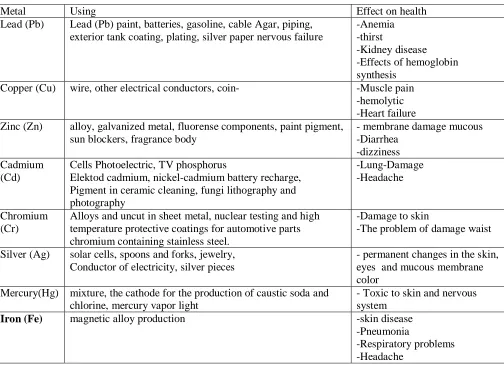
Table 1: The use of heavy metals and its effect on health
Metal Using Effect on health
Lead (Pb) Lead (Pb) paint, batteries, gasoline, cable Agar, piping, exterior tank coating, plating, silver paper nervous failure
-Anemia -thirst
-Kidney disease -Effects of hemoglobin synthesis
Copper (Cu) wire, other electrical conductors, coin- -Muscle pain -hemolytic -Heart failure Zinc (Zn) alloy, galvanized metal, fluorense components, paint pigment,
sun blockers, fragrance body
- membrane damage mucous -Diarrhea
-dizziness Cadmium
(Cd)
Cells Photoelectric, TV phosphorus
Elektod cadmium, nickel-cadmium battery recharge, Pigment in ceramic cleaning, fungi lithography and photography
-Lung-Damage -Headache
Chromium (Cr)
Alloys and uncut in sheet metal, nuclear testing and high temperature protective coatings for automotive parts chromium containing stainless steel.
-Damage to skin
-The problem of damage waist
Silver (Ag) solar cells, spoons and forks, jewelry, Conductor of electricity, silver pieces
- permanent changes in the skin, eyes and mucous membrane color
Mercury(Hg) mixture, the cathode for the production of caustic soda and chlorine, mercury vapor light
- Toxic to skin and nervous system
Iron (Fe) magnetic alloy production -skin disease
-Pneumonia
-Respiratory problems -Headache
Adsorption Isotherms
Adsorption isotherm is a mathematical model equations used to describe the relationship between the adsorbed materials with absorbent material. Isotherm is also used to determine the required amount of absorbent material. Langmuir and Freundlich isotherm is two standard models in adsorption experiments.
According to (Yu et.al, 2000), the Langmuir model considers taking place on the surface of metal ions by adsorption monolayer homogenous.
The model described by equation (3) below:
Cm = 1 + Ce ... . ... (1) x / m KVm Vm
Where Ce is the equilibrium concentration of the solution, x / m is the amount of substance absorbed per unit mass of absorbent material, Vm is monolapisan capacity and K is the equilibrium constant.
Freundlich isotherm is shown by equation (2) the following:
x = KfCe1 / n ... (2) m
Equation (2) above can be simplified and rewritten as equation (3) as follows:
Log x = log Kf + 1logCe ... ... (3) m
Where Kf is the measured adsorption capacity, 1/n is the adsorption intensity. (Allen et al., 2003)
Materials and Methodology
Adsorption isotherm experiments conducted to determine the feasibility of an adsorption treatment. It is a balance test group will provide data on substance adsorbed per unit weight of adsorbent to adsorbent amount remaining in the sample solution. From previous studies have proposed four mechanisms which control the removal of the solvent environment. This includes complex responses the oxidation and reduction, adsorption and precipitation. Charge on the surface of activated carbon pieces also is a determining factor of heavy metal removal efficiency. Divalent metals (Fe2+) which has a positive charge will attract negative charge on the surface at higher pH
Freundlich adsorption Isotherm for Heavy Metals
Instruments and apparatus: -250ml volumetric flask, -Samples of leachate -Orbital-shaker -pH meter -electronic scale
Methods:
1. Activated carbon with different weight weighed
2. Activated carbon heavy pieces weighed (m), respectively, 1g, 2g, 3g, 4g and 5g finally.
3. The aim is to see the adsorption isotherm for the studied metals with activated carbon weight different pieces.
4. A total of 50 ml of leachate samples and activated carbon weight different pieces put into 5 flasks. 5. The five last left shaking flasks on Orbital shaker for 24 hours.
6. After 24 hours, a total of 20 ml of sample was diluted into 100 ml volumetric flask (dilution factor = 5) to determine the content of heavy metals using AAS.
7. The remaining metal concentration (c) and eliminated (x) recorded 8. The value of x / m determined.
Results and Discussion
Freundlich's Adsorption Isotherms
Adsorption isotherm experiments conducted to determine the feasibility of an adsorption treatment. It is a balance test group will provide data on substance adsorbed per unit weight of adsorbent to adsorbent amount remaining in the sample solution. From previous studies have proposed four mechanisms which control the removal of the solvent environment. This includes complex responses the oxidation and reduction, adsorption and precipitation. Charge on the surface of activated carbon pieces also is a determining factor of heavy metal removal efficiency. Divalent metals (Fe2+) which has a positive charge will attract negative charge on the surface at higher pH.
Adsorption Isotherms for Iron metal
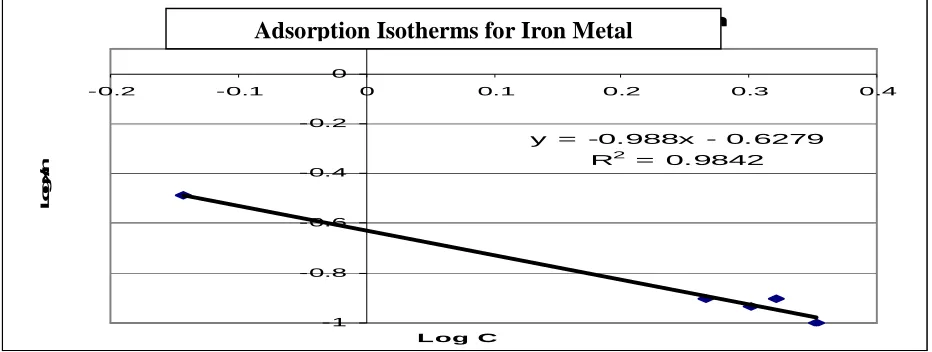
Figure 1 shows the results of the adsorption isotherm for metal Iron. From the figure, the straight lines
plotted indicate the occurrence of Iron metal adsorption from the treated samples. The graph shows the adsorption isotherms of good copper metal removal. This can be proved by looking at the coefficient of determination, R2 where R2 is 0.9842. The slope of the linear plot line is also a good and suitable for testing by. Kf and 1 / n value is obtained from the equation of linear plotted by comparing the equation obtained by the given equation. Value 1/n can be obtained from the slope and Kf values obtained with the antilog value of log Ce
Figure 1: Adsorption Isotherms for Iron Metal
The value of Kf and 1/n obtained is 0.53371 and 0988. Increasingly large Kf value indicates greater adsorption capacity. 1/n is a function of the strength of the used absorbent material. Value of 1/n high adsorption bond is weak show. When 1/n> 1, the absorption coefficient increases with increasing concentration of the solution led to an increase in hydrophobic surface characteristics after monolapisan. When the value of 1 / n <1, Kf decreases with concentration. (Hamidi A.Aziz, et.al, 2003). It can be concluded here that Iron metal can be reduced by using the proposed adsorbent. Freundlich's isotherm equation for Iron metal is:
X/m = 0.53371Ce0.988
Isoterma penjerapan Ferum
y = -0.988x - 0.6279
R2 = 0.9842
-1 -0.8 -0.6 -0.4 -0.2 0
-0.2 -0.1 0 0.1 0.2 0.3 0.4
Log C
L
o
g
x
/m
Adsorption Isotherms for Zinc Metals
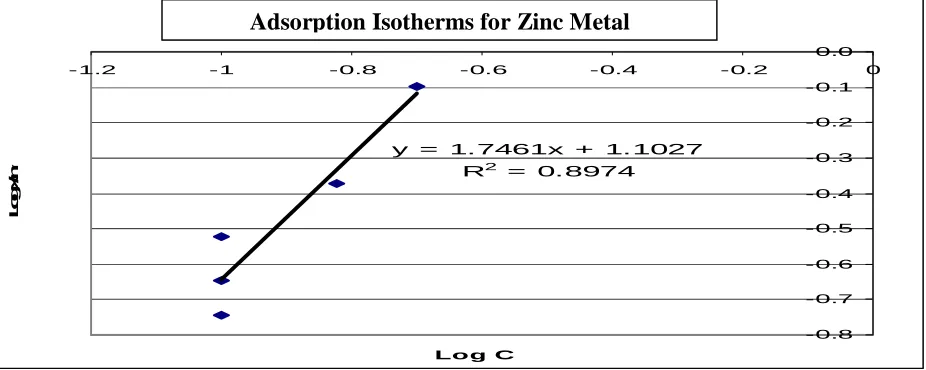
Figure 2 shows a graph of adsorption isotherms for Zinc metal where the graph is showing the removal
of zinc metal is quite good but less efficient than with Iron metal removal. This can be proved by looking at the coefficient of determination, R2 linear plot line. R2 value of this line is 0.8974. The slope of this line is good and suitable for batch testing. Increasingly large Kf value indicates greater adsorption capacity. 1/n is a function of the strength of the used absorbent material.
Figure 2: Adsorption Isotherms for Zinc Metal
Value of 1/n of the adsorption is high and bond is show weak. When 1/n> 1, the absorption coefficient increases with increase in concentration resulted as effect of increase in hydrophobic surface characteristics after monolayer. When the value of 1/n <1, Kf decreases with concentration. The value of Kf and 1/n is obtained from the equation of linear plotted by comparing the equation obtained by the equation given. Value of Kf and 1/ n obtained are 3.0123 and 1.7461. It can be concluded here that the metal zinc studied can be reduced using the proposed adsorbent for high Kf value which has a large adsorption of capacity Freundlich's isotherm equation for Zinc metal is:
X/m = 3.0123Ce1.7461
Figure 3: Adsorption Isotherms for Copper Metal
Isoterma penjerapan Zink
y = 1.7461x + 1.1027
R2 = 0.8974
-0.8 -0.7 -0.6 -0.5 -0.4 -0.3 -0.2 -0.1 0.0
-1.2 -1 -0.8 -0.6 -0.4 -0.2 0
Log C
L
o
g
x
/m
Isoterma penjerapan Kuprum
y = -0.0791x - 0.3247
R2 = 0.3867
-0.5 -0.4 -0.4 -0.3 -0.3 -0.2 -0.2 -0.1 -0.1 0.0
-0.6 -0.4 - 0.2 0 0.2 0.4 0.6
Log C
L
o
g
x
/m
Adsorption Isotherms for Zinc Metal
Adsorption Isotherms for Copper metal
Figure 3 shows a graph of copper metal adsorption isotherms where the graph is showing the removal
of copper metal is relatively weak and less efficient compared with metal removal Iron and Zinc. This can be proved by looking at the coefficient of determination, R2 linear plot line. R2 value of this line is 0.3867. The slope of this line is good and suitable for batch testing.The value of Kf and 1/n is obtained from the equation of the linear plot by comparing with the given equation. The value of Kf and 1/n obtained are 0.7227 and 0.0791 respectively. Increasingly large Kf value indicates greater adsorption capacity. 1/n is a function of the strength of the used absorbent material.
Value of 1/n high adsorption show a bond is weak. When 1/n>1, the absorption coefficient increases with increasing concentration of the solution led to an increase in hydrophobic surface characteristics after monolayer. When the value of 1/n<1, Kf decreases with concentration. From the above results, it was found that the Copper metal removal capability using the proposed adsorbent (GAC) is not satisfactory, but it can increase its efficiency by combining GAC with the other absorbent like Fly ash and limestone.
Freundlich's isotherm equation for Copper metal is:
X/m = 0.7227Ce0.0791
Conclusion
Increasingly large Kf value indicates greater adsorption capacity. 1/n is a function of the strength of the used absorbent material. Value of 1/n high, showed adsorption bond is weak. When 1/n> 1, the absorption coefficient increases with increasing concentration of the solution led to an increase in hydrophobic surface characteristics after monolayer. When the value of 1/n <1, Kf decreases with concentration (Hamidi A. Aziz, et.al, 2003). It can be concluded here that the metal Iron (Fe2+), Zinc (Zn2+) and Copper (Cu2+) can be reduced by using the proposed adsorbent. Table 1 Showed the result of adsorption isotherm for Iron, Zinc and Copper using a low cost absorbent.
Table 1: Adsorption Isotherm Parameters with Granular Activated Carbon (GAC)
Figure Parameter R2 Kf 1/n Isotherm Freundlich’s 1 Iron 0.9842 0.53371 0.988. x/m = 0.53371Ce0.988
2 Zinc 0.8974 3.0123 1.7461 x/m = 3.0123Ce1.746 3 Copper 0.3867 0.7227 0.0791 x/m = 0.7227Ce0.0791
Acknowledgements
References
Evanko CR, Dzombak DA (1997). Remediation of Metals-contaminated Soils and Groundwater, Technology Evaluation Report, TE-97e01. Ground-Water Remediation Technologies Analysis Center, Pittsburg, PA.
Hamidi Abdul Aziz Mohd Suffian Yusoff, Mohd Nordin Adlan, Nurul Hidayah Adnan and Salina Alias,Physico-chemical removal of iron from semi-aerobic landfill leachate by limestone filter.Pages 53-64.
Masters GM (1998). Introduction to Environmental Engineering. 2nd ed.Upper Saddle River, Prentice Hall, NJ.
Nery JRC, Bonotto DM (2011). 210Pb and composition data of nearsurface sediments and interstitial watersevidencing anthropogenic inputs in Amazon River mouth, Macapá, Brazil. J. Environ.Radioactivity, 102: 348-362.