R E S E A R C H
Open Access
Glaucoma-causing
ADAMTS17
mutations
are also reproducibly associated with
height in two domestic dog breeds:
selection for short stature may have
contributed to increased prevalence of
glaucoma
Emily C. Jeanes
1*, James A. C. Oliver
2, Sally L. Ricketts
2, David J. Gould
3and Cathryn S. Mellersh
2Abstract
Background:In humans,ADAMTS17mutations are known to cause Weill-Marchesani-like syndrome, which is characterised by lenticular myopia, ectopia lentis, glaucoma, spherophakia, and short stature. Breed-specific homozygous mutations in ADAMTS17 are associated with primary open angle glaucoma (POAG) in several dog breeds, including the Petit Basset Griffon Vendeen (PBGV) and Shar Pei (SP). We hypothesised that these mutations are associated with short stature in these breeds.
Methods:Two hundred thirty-three PBGV and 66 SP were genotyped for their breed-specificADAMTS17mutations. The height of each dog was measured at the withers. We used linear (per allele) regression to assess the association betweenADAMTS17mutations and height as a continuous variable, and linear regression and likelihood ratio tests to assess the shape of the association by comparing a general model with a linear (per allele) model. Results:The adjusted mean heights of affected, carrier, and clear PBGV were 33.49 cm (n= 21, 95% CI 32.78–34.19 cm), 34.88 cm (n = 85, 95% CI 34.53–35.25 cm), and 34.92 cm (n = 121, 95% CI 34.62–35.21 cm), respectively. The mean heights of affected, carrier, and clear SP were 43.96 cm (n= 9, 95% CI 41.88–46.03 cm), 47.56 cm (n= 28, 95% CI 45.50–48.63 cm), and 48.95 cm (n = 23, 95% CI 47.80–50.11 cm), respectively. There was a significant difference between the height of affected and clear animals in the PBGV (P= 0.001) and the SP (P= < 0.0001).
Conclusions:ADAMTS17POAG mutations are significantly associated with height in these breeds.
Keywords:ADAMTS17, Height, Primary open angle Glaucoma, Primary Lens luxation, Weill-Marchesani-like syndrome
Plain English summary
Mutations in the ADAMTS17 gene in humans cause
Weill-Marchesani-like syndrome, which is a connective tis-sue disorder. Individuals that carry two mutated copies of the gene are affected; if an individual is heterozygous for a specific mutation they are not clinically affected, but can pass the mutation on to their offspring. Their offspring
could also be affected, if they inherit the mutation from both parents. Affected individuals are short in stature, with under-sized fingers and toes, and also suffer from eye problems in-cluding abnormal and unstable lenses, short-sightedness and secondary glaucoma. These changes are caused because the ADAMTS17 gene is involved in the development of con-nective tissues of the limbs and eyes.
Mutations in ADAMTS17 have also been identified in
several dog breeds and are associated with inherited glau-coma and unstable lenses. Association of these mutations with height in dogs has not previously been investigated.
© The Author(s). 2019Open AccessThis article is distributed under the terms of the Creative Commons Attribution 4.0 International License (http://creativecommons.org/licenses/by/4.0/), which permits unrestricted use, distribution, and reproduction in any medium, provided you give appropriate credit to the original author(s) and the source, provide a link to the Creative Commons license, and indicate if changes were made. The Creative Commons Public Domain Dedication waiver (http://creativecommons.org/publicdomain/zero/1.0/) applies to the data made available in this article, unless otherwise stated. * Correspondence:[email protected]
1Centre for Small Animal Studies, Animal Health Trust, Lanwades Park, Kentford, Newmarket CB8 7UU, UK
We hypothesised that dogs carrying ADAMTS17 muta-tions would be shorter than dogs that are homozygous for the corresponding wildtype alleles, as it is likely that ADAMTS17 is important for correct development of the limbs in dogs as well.
The DNA of PBGV and SP was tested to assess whether they were genetically affected (i.e. were homozygous for their breed-specific mutation), were carriers (i.e. were het-erozygous for their breed-specific mutation), or were clear of the mutation (i.e. were homozygous for the wildtype al-lele). The height of these dogs was measured at the with-ers (shoulder blades), and the heights of affected, carrier and clear dogs were compared in both breeds.
An association between ADAMTS17 mutations and
height was found, with affected individuals being signifi-cantly shorter on average than both carriers of the mutation and clear dogs. Our interpretation of these data is that selecting dogs to be of a specific short height may have in-creased the frequency of the mutations within these breeds.
Background
Glaucoma is the term used to describe a group of diseases which result in the progressive death of retinal ganglion cells (RGCs) and their axons [1]. Several forms of this dis-ease exist in the dog, but a common feature is an elevated intraocular pressure (IOP) which results in compression and insult to the RGCs [2]. Canine glaucomas are all con-sidered to be due to an abnormality in aqueous humour flow or drainage, rather than due to abnormalities in aqueous humour production [1]. Glaucoma which de-velops without an antecedent ocular disease (such as uve-itis or trauma) is classified as primary glaucoma [1]. Different subclasses of primary glaucoma exist, but they are all known or suspected to be hereditary [1]. Causal genetic mutations have been identified for hereditary
pri-mary glaucoma in many canine breeds [3–8].
POAG is a common condition in the Petit Basset Griffon Vendeen (PBGV), with an incidence of 10.4% within the breed [9]. Affected individuals may also present with lens luxation as part of the condition [9]. The causal mutation is a 4.96 Mb inversion with a break
point disrupting the ADAMTS17 gene on canine
chromosome 3 at 45,768,123 base pairs (CanFam 3.1); with the other breakpoint being in a downstream inter-genic region, and it is inherited in an autosomal
reces-sive manner [3]. ADAMTS17 is part of the ADAMTS
family of genes which are involved in the maintenance and turnover of the extracellular matrix (ECM) [10].
A different mutation inADAMTS17 (a deletion of six
base pairs on canine chromosome 3 at co-ordinates
40,935,387–40,935,393 (CanFam 3.1) has more recently
been identified in the Shar Pei (SP) [5]. As in the PBGV, this mutation causes an autosomal recessive form of POAG, and primary lens luxation (PLL) is also
associated with this mutation [5, 11]. An independent
ADAMTS17 mutation has been shown to cause PLL in
several breeds [12,13]. Gould et al. [13] showed that the
frequency of this c.1473 + 1 G > AADAMTS17mutation,
that segregates in multiple breeds, ranged from 0.02 to 0.39, leading to speculation that positive selection for
this mutation could exist. Mutations in otherADAMTS
genes have also been shown to cause POAG in other breeds [4,6–8].
TheADAMTSfamily of genes is known to be essential for correct development of the ECM elsewhere in the
body. Mutations in ADAMTS17 in humans cause
Weill-Marchesani-like syndrome (WMLS) [14]. Consist-ent with POAG in the PBGV and SP, this is an auto-somal recessive condition. WMLS is a rare connective tissue disorder characterised by lens luxation, micro-spherophakia, myopia, and glaucoma, and also short
stature [14]. ADAMTS17 may regulate the composition
of fibrillin isoforms [15]. It is expressed during mouse embryonic development in the lens zonules and trabecular meshwork of the eye and in the perichondrium of devel-oping long bones, as well as in other organs, influencing development of the ECM in these areas [15]. It is likely thatADAMTS17plays a similar role in the dog.
The majority of the breeds in which ADAMTS
muta-tions have been described are short in height. We
hypothesised that dogs homozygous for ADAMTS17
mutations would be shorter than heterozygous and wild type dogs. An association between height and POAG genotype would be consistent with our hypothesis that
selection for short height has resulted in ADAMTS17
mutations reaching high frequencies within some pure-bred dog populations.
Results
PBGV results
Population data
Height data from 233 PBGV were collected. Of these, 21 (9%) were affected, 87 (37%) were carriers and 125 (54%) were clear.
Data on biological sex were available for all of the 233 PBGV in the study, of which 93 (40%) were male and 140 (60%) were female. Significantly more female than male
dogs were presented for examination (P= < 0.01). The sex
distribution was not significantly different between
geno-type groups (P= > 0.05) (Table1). Height was significantly
different between males and females (P = < 0.0001). The
mean height of females was 34.19 cm (SD 1.88) and the mean height of males was 35.63 cm (SD 1.63).
Data on date of birth were available for 227 of the 233
PBGV in the study (Table2). The Kruskal-Wallis one-way
ANOVA revealed that there was a significant difference in
the median ages between genotypes (P = 0.002).
revealed that there was a statistically significant difference
in the age between affected and clear PBGV (P = 0.006),
but not between carrier and clear PBGV (P= 0.04), and
af-fected and carrier PBGV (P= 0.35).
Comparisons between measuring techniques
We assessed the correlation between the stick and laser height measuring technique for 13 dogs that had been
measured using both (Table 3). The correlation was
0.58, indicating the two are correlated, albeit weakly
(P = 0.04). Dogs were typically estimated to be shorter
when measured with the laser method than with the stick measure. There was a significant difference
be-tween the means (P= 0.0006).
It was not possible to assess the correlation between measurements of PBGV taken by the authors with mea-surements taken by owners, because no PBGV were measured by both the authors and their owners; we only requested owners to measure their PBGV if we could not measure the PBGV ourselves for logistical reasons.
The correlation between repeat measures using the stick was 0.79 in the seven dogs that had been measured
twice (P = 0.03) (Table 4). The difference between the
means was not statistically significant (P= 0.07).
Height data
The mean height of affected PBGV (n = 21) was 33.41
cm (SD 2.67). The mean height of carrier PBGV (n= 87)
was 34.79 cm (SD 1.85). The mean height of clear PBGV
(n= 125) was 34.98 cm (SD 1.73).
Using Pearson’s correlation, there was no correlation
between height and age for the 227 PBGV for which the
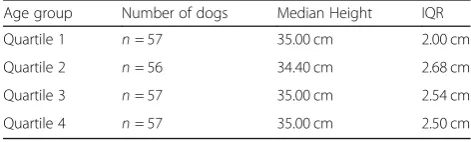
date of birth was available (P= 0.26) (Table5). Linear
re-gression also confirmed this.
Unadjusted linear regression revealed a statistical
association between genotype and height (P = 0.006),
and the association appeared linear, although only marginally (P-value for departure from linearity = 0.06) (Fig.1a).
We next conducted an analysis of height and genotype comprising height using all measures that adjusted for sex, age and method of measurement. The association
re-duced in significance (P = 0.02). With adjustment for the
confounding effects of these variables, the association now appeared to depart from linearity (P-value = 0.02) (Fig. 1b). Adjusted mean heights of affected PBGV (n= 21) was
33.49 cm (95% CI 32.78–34.19). The mean height of
car-rier PBGV (n = 85) was 34.88 cm (95% CI 34.53–35.23).
The mean height of clear PBGV (n = 121) was 34.92 cm
(95% CI 34.62–35.21). Using a genotypic model with
ad-justment as above, there was a significant difference in
height between clear and affected PBGV (P = 0.001) but
not between clear and carrier PBGV (P= 0.91).
SP results
Population data
Height data from 66 SP were collected. Of these, 9 (14%) were affected, 31 (47%) were carrier and 26 (39%) were clear.
Data on biological sex were available for all 66 SP in the study, of which 22 (33%) were male and 44 (67%) were fe-male. Significantly more female than male dogs were
pre-sented for examination (P = < 0.01). The sex distribution
was not significantly different between genotype groups
(P= > 0.05) (Table6). Height was significantly different
between males and females (P = < 0.0001). The mean
height of females was 46.40 cm (SD 3.07) and the mean height of males was 50.00 cm (SD 3.04).
Data on date of birth were available for 60 of the 66 SP in
the study (Table7). The Kruskal-Wallis one-way ANOVA
revealed that there was a significant difference in the ages
between genotypes (P= 0.007). Mann-Whitney U tests with
Bonferroni correction revealed that there was a statistically significant difference in the age between affected and clear
SP (P= 0.002), affected and carrier SP (P= 0.004), but not
between carrier and clear SP (P= 0.64).
Comparisons between measuring techniques
All SP were measured either with the commercially available measuring stick, or by using a spirit level to mark the height of the withers on a wall then measuring the distance between the mark and the floor.
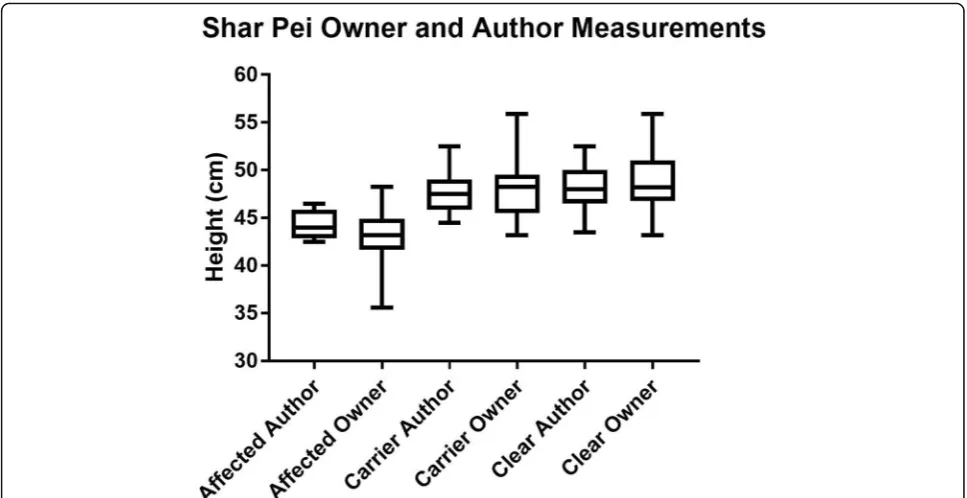
We assessed the correlation between height measure-ments of 21 SP that were taken using the stick by owners
Table 1Sex distribution of PBGV, with comparison between genotypes
Total Affected Carrier Clear
Female 140 (60.09%) 13 (61.90%) 54 (62.07%) 73 (58.40%)
Male 93 (39.91%) 8 (38.09%) 33 (37.93%) 52 (41.60%)
Total 233 21 87 125
Table 2Age of PBGV, with comparison between genotypes
Median Age Number of dogs IQR
Total 4.46 years n= 227 4.73 years
Affected 5.31 years n= 21 3.93 years
Carrier 4.96 years n= 85 4.62 years
Clear 3.68 years n= 121 4.27 years
Table 3Comparison of height measurement results between the stick measurement technique and the laser measurement technique
Mean Height Number of dogs SD
Height (stick measurement) 34.35 cm 13 1.78
and the lead author. The correlation was 0.93, indicating a strong correlation between measurements performed
be-tween owners and the lead author (P= < 0.00001) (Fig.2,
Table 8). There was no statistically significant difference
between the mean of these groups (P= 0.76).
Height data
The mean height of affected SP (n = 9) was 43.32 cm
(SD 3.56). The mean height of carrier SP (n = 31) was
48.01 cm (SD 3.04). The mean height of clear SP (n =
26) was 48.57 cm (SD 2.93) (Fig.1b).
Using Pearson’s correlation, there was no correlation
between height and age for the 60 SP for which the date
of birth was available (P= 0.43) (Table9). Linear
regres-sion also confirmed this.
Similar to the PBGV, we found a statistical association between height and genotype using linear regression
(P = 0.0004), and the association did not appear linear
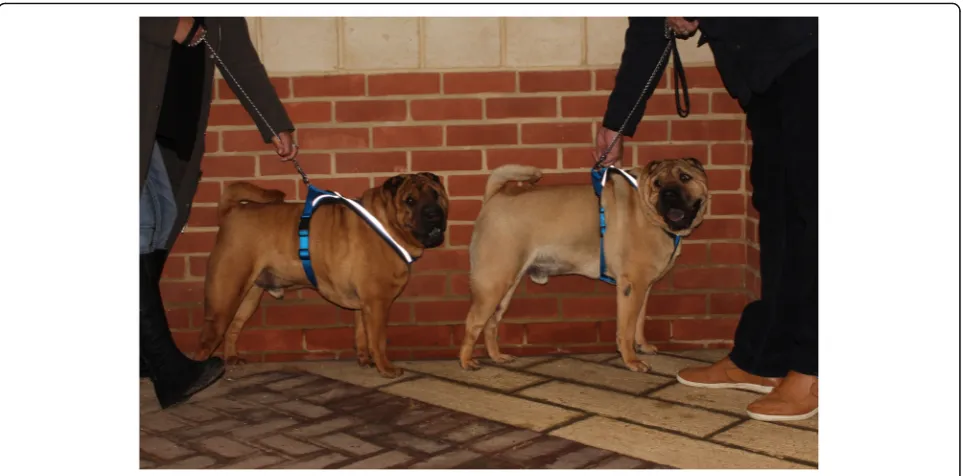
(P = 0.009) (Fig. 1a). Figure 3 shows an example of the
height difference between two full sibling male SP, one affected (left) and one a carrier (right).
We generated a variable comprising height using all mea-sures that adjusted for sex, age and method of measure-ment. With adjustment for these variables, the association between height and genotype increased in significance
des-pite the smaller number of dogs in the analysis (P= 0.0001)
and showed a linear shape of association (P-value for
de-parture from linearity = 0.15) (Fig. 1b). Adjusted mean
heights of affected SP (n= 9) was 43.96 cm (95% CI 41.88–
46.05). The mean height of carrier SP (n= 28) was 47.56
cm (95% CI 46.50–48.63). The mean height of clear SP
(n= 23) was 48.95 cm (95% CI 47.80–50.11). Using a
geno-typic model with adjustment as above, there was a suggest-ive difference in height between clear and carrier PBGV
(P = 0.07) and the difference between clear and affected
PBGV was significant (P< 0.0001).
Discussion
Our data show that two breed-specific mutations in ADAMTS17in dogs are associated with height as well as POAG/PLL, with affected individuals significantly shorter than clear individuals. Humans with WMLS due to ADAMTS17mutations are also shorter than average [14].
It is likely thatADAMTS17plays a role in skeletal
devel-opment in the dog as it does in humans.
Whilst the effect on height found in this study is likely
a functional effect of the ADAMTS17 mutations, this
needs to be determined by future studies including func-tional analyses of the relevant tissue in dogs of different genotype categories. The suggestive effects on height in mutation carriers also needs to be investigated further in larger datasets to confirm or refute a per allele effect. It is also possible that the association with height is due to
linkage disequilibrium between anADAMTS17mutation
and a nearby gene that influences height, rather than
due to a direct effect ofADAMTS17 itself. Future work
could include linkage disequilibrium analysis to confirm or refute this hypothesis.
More variation in height over ADAMTS17 genotypes
was seen in the SP compared to in the PBGV, with far less overlap in the height distribution of affected and carrier/clear dogs. Several factors could potentially be contributing to this difference in effect between breeds. The greater variation in height could be due to the fact that the SP is a much taller breed than the PBGV, with subsequently greater scope for height variation. There-fore, other genetic factors could be impacting on height in the PBGV, subsequently reducing the variance in height of this breed and therefore showing this weaker
effect of ADAMTS17 genotype. Since the PBGV breed
has been recently developed from the taller Grand Bas-set Griffon Vendeen, there has been strong selection pressure on the PBGV for a short stature that has not been placed on the SP. We know that the PBGV
segre-gate an expressedFgf4retrogene insert causing
chondro-dysplasia, contributing to its short height, height to length ratio < 1 and bowed forelimb conformation [16]. Furthermore, a study by Rimbault et al. [17], looked at the frequencies of six genetic variants which have been shown to be associated with reduced height in various dog breeds. More of these genetic variants were identi-fied, and at greater frequency, in the PBGV than in the SP [17]. Therefore, the presence of multiple other gen-etic variants which are linked to short height in the
PBGV could be modifying the effect of the ADAMTS17
mutation. Secondly, different mutations are present in ADAMTS17 in the SP and the PBGV. It is possible that the mutated genes still retain a degree of function, and that this could be different between the two breeds. Fur-ther work is necessary to investigate the precise
func-tionality ofADAMTS17in these breeds.
Table 4Comparison of height measurement results between repeated measurements using the stick measurement technique
Mean Height Number of dogs SD
Height (first measurement) 34.43 cm 7 1.10
Height (repeat measurement) 35.00 cm 7 0.91
Table 5Comparison of height and age of PBGV
Age group Number of dogs Median Height IQR
Quartile 1 n= 57 35.00 cm 2.00 cm
Quartile 2 n= 56 34.40 cm 2.68 cm
Quartile 3 n= 57 35.00 cm 2.54 cm
Many dog breeds, including the PBGV and SP, are sub-jected to strong selection pressure to meet specific breed standards. The UK breed standards for the PBGV state that it should stand 34-38 cm high at the withers [18], and the American breed standards specify a height at the withers of 33-38 cm [19]. The SP breed standards (both American and UK) specify that it should stand
46-51 cm high at the withers [20, 21]. Departure from
these exact breed standards is heavily penalised in the show ring, so there is likely to be strong selection pres-sure for genes controlling height.
It is possible that by breeding dogs to meet a specific height criteria, as specified by the breed standard, the
frequency of the ADAMTS17 mutation has been
inad-vertently increased within the gene pool. It is notable
that theADAMTS17 mutation is widespread among the
PBGV, but has not been reported in the GBGV from which the PBGV breed was developed. The mean heights of affected dogs in our study were at the bottom
end or slightly below the heights specified by the UK and American breed standards. However, it is possible that prior to genetic testing, breeders mated affected dogs with taller dogs to try and reduce the height of their offspring. Other dog breeds with described
muta-tions in ADAMTSgenes are also commonly bred to be
of short stature, such as the Basset Hound, the Basset Fauve de Bretagne, the Miniature Bull Terrier, and many
other terrier breeds. Indeed, the word “basset” comes
from the medieval French for “of low stature” [22]. It
could therefore be speculated, given that five different ADAMTS17 mutations have now been identified in
breeds of small stature [3–5,13], that this locus could be
under positive selection.
A significantly higher proportion of PBGV and SP in our study were female than male. Female dogs tend to be shorter than male dogs [23]. Chi-squared analysis did not reveal any significant difference between the male: female ratio between genotypes. Covariable adjustment
a
b
Fig. 1Association between height andADAMTS17genotype.a. Unadjusted mean heights and 95% confidence intervals for each genotypic category.b. Age and sex-adjusted mean heights and 95% confidence intervals for each genotypic category
Table 6Sex distribution of SP with comparison between genotypes
Total Affected Carrier Clear
Female 44 (66.67%) 8 (88.89%) 18 (58.06%) 18 (69.23%)
Male 22 (33.33%) 1 (11.11%) 13 (41.94%) 8 (30.77%)
Total 66 9 31 26
Table 7Age of SP with comparison between genotypes
Median Age Number of dogs IQR
Total 3.33 years n= 60 2.70 years
Affected 5.80 years n= 9 3.83 years
Carrier 2.51 years n= 28 2.76 years
was performed to ensure that our results were not skewed by the larger proportion of females. The high proportion of female dogs in our study could be due to the proportions of male and female dogs kept by breeders or the proportions presented to dog shows, since the majority of our data were generated at dog shows or by visiting kennels. When the proportion of male and female dogs was grouped by genotype, the ra-tio of male to female dogs was not significantly different across affected, carrier and clear groups in the PBGV and SP. The male to female ratios were more varied be-tween genotype in the SP, but this could be due to the smaller dataset. Female dogs were found to be shorter than male dogs, so covariate adjustment was performed to adjust for this confounder.
We also analysed the age of the dogs that were pre-sented for our study, as we hypothesised that affected dogs may be presented at a younger age due to the owners being more motivated to enrol them in the study. Only dogs over 12 months old were enrolled in the study to prevent incompletely grown animals from
skewing the data. The majority of growth in young dogs occurs between 3 and 6 months, and 90% height is
achieved by 9 months [24,25]. Radiographical analysis of
the growth plates in the skeleton indicates that these are closed in the dog by 12 months of age [26]. Affected dogs were on average significantly older than carrier or clear dogs in both breeds. The average age of carrier dogs was also greater than that of dogs clear for the mu-tation in the PBGV. Covariate adjustment was per-formed to adjust for this potential confounder. Since
DNA tests for the ADAMTS17 mutations have been
available commercially (2015 for the PBGV and 2017 for the SP), breeders have been able to genotype their dogs. We hypothesise that the availability of these tests has en-abled breeders to only breed carrier or clear puppies, thus reducing the number of affected puppies being born in recent years.
Limitations of the study design
Ideally height measurements would have been per-formed with the examiner blinded to the genotype of the Fig. 2Box and Whiskers plot to show the height at the withers of affected, carrier and clear SPs, stratified by measurer, demonstrating the upper and lower values, the interquartile range and the median value
Table 8Comparison of height measurement results between measurements taken by owners and the lead author using the stick measurement technique
Mean Height Number of dogs SD
Height (author measurement) 47.12 cm 21 2.91
Height (owner measurement) 47.19 cm 21 2.98
Table 9Comparison of height and age of SP
Age group Number of dogs Median Height IQR
Quartile 1 n= 15 47.00 cm 3.00 cm
Quartile 2 n= 15 48.00 cm 3.53 cm
Quartile 3 n= 15 47.00 cm 3.26 cm
dog, but this was not always possible in this study. When measurements were performed by the authors, in-formation on the genotype was not collected until after the height measurement had been made. However, while clear and carrier animals cannot be distinguished pheno-typically, the vast majority of affected animals were se-verely buphthalmic due to glaucoma, or had had unilateral or bilateral enucleations performed to relieve intraocular pain. These affected animals were therefore clearly identifiable at the time their height was measured. When height measurements were performed by the owners, they were already aware of the genotype of their dog.
Many of the measurements were performed by the owners of the dogs, rather than by the authors, and there was variation in the different measuring techniques used. Variations in technique and between measurers will have introduced a degree of variability into the data set, although we did adjust for this in our analyses to
some extent by generating a ‘measurement’ covariate
that we included in our regression models. However, by allowing data to be collected by owners we were able to obtain a far larger dataset, including data from animals worldwide, which would otherwise not have been pos-sible. Written instructions with diagrams were provided
to all owners who were asked to measure their dog’s
height to help minimise individual variation in measur-ing technique. We expected that the variability intro-duced by having multiple individuals involved in data collection would be offset by the increased amount of data available. Analysis of the data provided by owners compared with that provided by authors did show that the owner measurements had a greater variability.
However, comparison between measurements taken by owners and the author at a show showed a strong cor-relation between measurement techniques.
The laser measurement technique measured dogs as
“shorter” than the commercially available measuring
stick. We found that when the laser technique was used, the dogs tended to crouch as the ruler was rested on their back. Covariate adjustment was therefore used to ensure that this difference did not affect the height ana-lysis while not losing any power from the study.
The mean age of the affected dogs available to the study was higher than that of the mean age of the population. This may be because fewer affected dogs are likely to have been bred since the DNA tests became available. The in-creased average age of carriers compared to clear dogs in the PBGV indicates that there is also a trend for breeders to select clear dogs over carriers for breeding purposes. Covariate adjustment was used to adjust for the con-founder of age. This increased both the strength and
linearity of the association between height and
ADAMTS17genotype, as older dogs were slightly taller, but affected dogs were both older and significantly shorter.
Conclusions
Two independent mutations causing POAG in two inde-pendent breeds are also associated with short stature in these breeds. We suspect that selection for short stature has inadvertently led to an increase in mutation fre-quency within each breed and thus increased prevalence of POAG.
Methods
Study design and population
PBGV and SP that had been genotyped for their
breed-specificADAMTS17mutation were invited to take
part in the study. (These DNA tests are commercially available.) The dogs were classified as affected, carrier or clear. The height of each dog was measured at the with-ers. Height measurements were performed by the au-thors (EJ, CM, JO and DG) at different locations across the UK between December 2016 and March 2018; by of-ficials at breed shows; or by the owners of the dogs. These sessions took place at various events; including dog shows; breed information days; and visits to kennels. The measuring sessions were arranged by contacting owners who had purchased DNA tests from the Animal Health Trust directly, and promoted via breed club web-sites, social media, and word of mouth. All dogs over the age of 1 year that were volunteered for measurement were accepted, regardless of age, sex, or Kennel Club registration status. Dogs less than 1 year of age at the time of measurement were excluded from the analysis. For each dog, data were collected on sex and age at time of measurement. If data on sex and age were not sup-plied by the owners, these data were obtained from Ken-nel Club online records if available. All dogs were pets and measurement was only performed after informed owner consent. All experiments were approved by the
Animal Health Trust’s Research and Ethical Approval
Committee (Ref. 44-2017E).
Measurement procedure
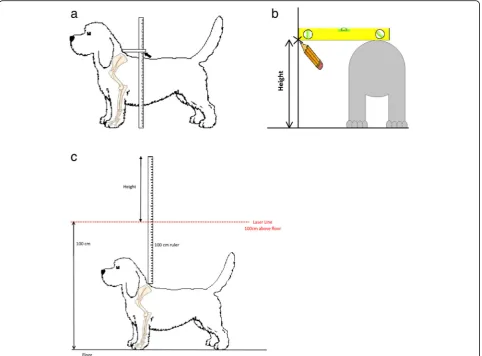
Each dog was stood square on a flat level surface and held by an assistant, and the top of the withers was palpated. A ruler held parallel with the floor with the aid of a spirit level was lowered onto the withers and held in contact with the skin. The distance between the base of this ruler and the floor was then measured and recorded as the
dog’s height. The measurement was done either directly
with the aid of a commercially available device (http:// www.dogmeasuringsticks.co.uk/) (Fig.4a, Additional files1 and2), or indirectly by marking a wall at the level of the withers, then measuring the distance between the mark
and the floor (Fig.4b, Additional files1and2).
These measurements were either done by the authors, by officials at a show, or by the owners at home and the results emailed to the authors. Written instructions with diagrams were provided to all owners who were asked to
measure their dog’s height to help minimise individual
variation in measuring technique (Additional file 3). A
subset of SP at a show were measured both by the au-thor (EJ) and by the owner to compare the accuracy of owner measurements. The owners were blinded to the result of the measurement taken by the author.
Alternatively, a ruler held vertically with“0”at the top
was lowered onto the withers and held in contact with the skin. A laser pointer was set to dissect the ruler at 100 cm from the floor. The point at which the laser
crossed the ruler was recorded as the dog’s height (Fig.
4c, Additional files1and2).
Statistical analyses
Age at measurement (in years) was calculated by
gener-ating an age variable = (date of measurement – date of
birth)/365.25. If the dog had been measured more than once, the date of the first measurement with the stick was used to calculate the age. In both the PBGV and SP age was not normally distributed (Shapiro-Wilk test, SPSS Statistics, IBM, NY, USA). For non-parametric data, a Kruskal-Wallis one-way ANOVA (SPSS Statistics, IBM, NY, USA) was used to assess for significant
differ-ence in age between genotypes, withP< 0.05 considered
to be significant. Comparison between genotype groups (clear vs. affected, clear vs. carrier, and carrier vs. clear) was performed using Mann-Whitney U tests, employing
Bonferroni’s correction with P < 0.017 considered to be
significant (SPSS Statistics, IBM, NY, USA).
Chi-squared analysis with Yates’correction (Microsoft
Excel, Microsoft Office, LA, USA) was used to assess whether the male: female ratio of animals presented
var-ied significantly from the 50:50 ratio expected, with P<
0.05 considered to be significant. Chi-squared analysis was used to assess for any difference between the female ratio between genotypes, using the overall male:-female ratio as the expected ratio. Comparison between the height of male and female dogs was employed for all dogs and for each genotype using Mann-Whitney U
tests, with P < 0.05 considered to be significant (SPSS
Statistics, IBM, NY, USA).
For height data, the measurement taken by the author using the measuring stick was used where available. If two or more stick measurements were available the mean of both measurements was used. If a measurement taken by the author was not available, then a measurement taken by the owner, at a show or by the laser method was used. The Shapiro-Wilk test (SPSS Statistics, IBM, NY, USA)
was used to assess height data for normality, withP< 0.05
considered to be significant. Mann-Whitney U tests (SPSS Statistics, IBM, NY, USA) were used to compare height data between male and female dogs for the whole dataset
and for each genotype, withP< 0.05 considered to be
sig-nificant. Kruskal-Wallis one-way ANOVA (SPSS Statistics, IBM, NY, USA) was used to assess for significant
differ-ence in height between genotypes, with P < 0.05
employing Bonferroni’s correction withP< 0.017 consid-ered to be significant (SPSS Statistics, IBM, NY, USA).
The effect of age on height was analysed using
Pearson correlation (SPSS Statistics, IBM, NY,
USA), with P < 0.05 considered to be significant.
We also analysed this using linear regression coding age into quartiles.
For all analyses with all data a ‘measure’ variable was
generated for use as a covariate in the regression ana-lyses to adjust for the variation in measurement method. For PBGV this was made up of four values: 1 = stick; 2 = laser (if stick was not available); 3 = owner (if stick and laser were not available); 4 = show (if stick, laser and owner were not available). For SP this was: 1 = stick; 2 = owner (if stick was not available).
The correlation between measurement methods and between author and owner-generated data was
assessed using Pearson’s pairwise correlation (STATA
10.0, College Station, TX, USA), and tested for a sig-nificant difference between the means between these
groups using a paired t-test (Microsoft Excel, Micro-soft Office, LA, USA). We used linear regression (per allele and genotypic models) to assess the association
between the PBGV and SP ADAMTS17 mutations
and height as a continuous variable (unadjusted
ana-lysis – measurement method as a covariate only);
and to assess the association between ADAMTS17
mutations and height using a model adjusted for measurement method, age (continuous variable) and sex (binary variable). (Age was assessed for departure from linearity by comparing a model containing age as a continuous variable to a model containing age as an indicator variable using the likelihood ratio test. As there was no statistical difference between these two models, age was kept as a continuous vari-able.) We used linear regression and likelihood ratio tests to compare a general model with a linear (per allele) model to assess the shape of the association
between ADAMTS17 mutations and height, using
STATA 10.0 (College Station, TX, USA).
Additional files
Additional file 1:Raw data from PBGV measurements. (XLSX 47 kb)
Additional file 2:Raw data from SP measurements. (XLSX 18 kb)
Additional file 3:Written instructions for the measurement of height provided to owners. (DOCX 252 kb)
Abbreviations
ADAMTS:A Disintegrin and Metalloproteinase with Thrombospondin motifs;
ADAMTS17: A Disintegrin-like and Metalloproteinase with Thrombospondin type 1 motif, 17; CI: Confidence Interval; DNA: Deoxyribonucleic Acid; ECM: Extracellular Matrix; IOP: Intraocular Pressure; IQR: Interquartile Range; PBGV: Petit Basset Griffon Vendeen; PCAG: Primary Closed Angle Glaucoma; PLL: Primary Lens Luxation; POAG: Primary Open Angle Glaucoma; RGC: Retinal Ganglion Cells; SD: Standard Deviation; SP: Shar Pei; UK: United Kingdom; USA: United States of America; WGS: Whole Genome Sequence; WMLS: Weill-Marchesani-like Syndrome; WMS: Weill-Marchesani Syndrome
Acknowledgements
The authors would like to acknowledge their colleagues at the Animal Health Trust and the Kennel Club Genetics Centre at the Animal Health Trust for their help with this project, the Basset Griffon Vendeen Club of Great Britain, the Shar Pei Club of Great Britain, and the Petit Basset Griffon Vendeen Club of America for their support, and the owners of all the dogs who contributed to this study.
Funding
Two of the authors (CM and SR) are supported by the Kennel Club Genetics Centre at the Animal Health Trust.
Availability of data and materials
Raw data available for publication (with confidential information such as owners’names and contact details removed).
Authors’contributions
EJ Data collection, statistical analysis and manuscript preparation. JO Project design, data collection and manuscript editing. SR Statistical analysis and manuscript editing. DG Project design, data collection and manuscript editing. CM Project design and manuscript editing. All authors read and approved the final manuscript.
Ethics approval and consent to participate
All experiments were approved by the Animal Health Trust’s Research and Ethical Approval Committee (Ref 44-2017E).
Consent for publication
Not applicable.
Competing interests
Two of the authors (CM and SR) are employed by the Animal Health Trust that provides commercial DNA testing for mutations inADAMTS17. Publisher’s Note
Springer Nature remains neutral with regard to jurisdictional claims in published maps and institutional affiliations.
Author details
1Centre for Small Animal Studies, Animal Health Trust, Lanwades Park, Kentford, Newmarket CB8 7UU, UK.2Canine Genetics Research Group, Kennel Club Genetics Centre, Animal Health Trust, Lanwades Park, Kentford, Newmarket CB8 7UU, UK.3Davies Veterinary Specialists, Manor Farm Business Park, Higham Gobion, Hitchin SG5 3HR, UK.
Received: 22 January 2019 Accepted: 26 April 2019
References
1. Plummer CE, Regnier A, Gelatt KN. The Canine Glaucomas. In: Gelatt KN, Gilger BC, Kern TJ, editors. Veterinary Ophthalmology. 5th ed. Ames: Wiley Blackwell; 2013.
2. Nickells RW. Retinal ganglion cell death in glaucoma: the how, the why and the maybe. J Glaucoma. 1996;5:345–56.
3. Forman OP, Pettitt L, Komáromy AM, Bedford P, Mellersh C. A novel genome-wide association study approach using genotyping by exome sequencing leads to the identification of a primary open angle Glaucoma associated inversion disruptingADAMTS17. PLoS One. 2015;10:e0143546. 4. Oliver JAC, Forman OP, Pettitt L, Mellersh CS. Two independent
mutations inADAMTS17are associated with primary open angle Glaucoma in the basset hound and basset fauve de Bretagne breeds of dog. PLoS One. 2015;10:e0140436.
5. Oliver JAC, Rustidge S, Pettitt L, Jenkins CA, Farias FHG, Giuliana EA, Mellersh CS. Evaluation of ADAMTS17 in Chinese Shar-Pei with primary open-angle glaucoma, primary lens luxation, or both. Am J Vet Res. 2018;79:98–106. 6. Kuchtey J, Olson LM, Rinkoski T, Mackay EO, Iverson TM, Gelatt KN, Haines
JL, Kuchtey RW. Mapping of the disease locus and identification of ADAMTS10 as a candidate gene in a canine model of primary open angle glaucoma. PLoS Genet. 2011;7:e1001306.
7. Kuchtey J, Kunkel J, Esson D, Sapienza JS, Ward DA, Plummer CE, Gelatt KN, Kuchtey RW. Screening ADAMTS10 in dog populations supports Gly661Arg as the glaucoma-causing variant in beagles. Investig Ophthalmol Vis Sci. 2013;54:1881–6. 8. Ahonen SJ, Kaukonen M, Nussdorfer FD, Harman CD, Komaromy AM, Lohi
H. A novel missense mutation in ADAMTS10 in Norwegian elkhound primary Glaucoma. PLoS One. 2014;9:e111941.
9. Bedford PGC. Open-angle glaucoma in the petit basset griffon Vendeen. Vet Ophthalmol. 2017;20:98–102.
10. Kelwick R, Desanlis I, Wheeler GN, Edwards DR. The ADAMTS (a Disintegrin and Metalloproteinase with Thrombospondin motifs) family. Genome Biol. 2015.https://doi.org/10.1186/213059-015-0676-3.
11. Lazarus JA, Pickett JP, Champagne ES. Primary lens luxation in the Chinese Shar Pei: clinical and hereditary characteristics. Vet Ophthalmol. 1998;1:101–7. 12. Farias FH, Johnson GS, Taylor JF, Giuliano E, Katz ML, Sanders DN, Schnabel RD,
McKay SD, Khan S, Gharahkhani P, O’Leary CA, Pettitt L, Forman OP, Boursnell M, McLaughlin B, Ahonen S, Lohi H, Hernandez-Merino E, Gould DJ, Sargan DR, Mellersh C. An ADAMTS17 splice donor site mutation in dogs with primary lens luxation. Investig Ophthalmol Vis Sci. 2010;51:4716–21.
13. Gould D, Pettitt L, McLaughlin B, Holmes N, Forman O, Thomas A, Ahonen S, Lohi H, O’Leary C, Sargan D, Mellersh C. ADAMTS17 mutation associated with primary lens luxation is widespread among breeds. Vet Ophthalmol. 2011;14:378–84.
14. Morales J, Al-Sharif L, Khalil DS, Shinwari JM, Bavi P, Al-Mahrougi RA, Al-Rajhi A, Alkuraya FS, Meyer BF, Al Tassan N. Homozygous mutations in ADAMTS10 and ADAMTS17 cause lenticular myopia, Ectopia Lentis, Glaucoma, Spherophakia, and short stature. Am J Hum Genet. 2009;85:558–68.
15. Hubmacher D, Schneider M, Berardinelli SJ, Takeuchi H, Willard B, Reinhardt DP, Haltiwanger RS, Apte SS. Unusual life cycle and impact on microfibril assembly of ADAMTS17, a secreted metalloprotease mutated in genetic eye disease. Nat Sci Rep. 2017;7:41871.
16. Parker HG, VonHoldt BM, Quignon P, Margulies EH, Shao S, Mosher DS, Spady TC, Elkahloun A, Cargill M, Jones PG, Maslen CL, Acland GM, Sutter NB, Kuroki K, Bustamante CD, Wayne RK, Ostrander EA. An expressedFgf4 retrogene is associated with breed-defining chondrodysplasia in domestic dogs. Science. 2009;325:995–8.
17. Rimbault M, Beale HC, Schoenebeck JJ, Hoopes BC, Allen JJ, Kilroy-Glynn P, Wayne RK, Sutter NB, Ostrander EA. Derived variants at six genes explain nearly half of size reduction in dog breeds. Genome Res. 2013;23:1985–95. 18. https://www.thekennelclub.org.uk/services/public/breed/standard.aspx?id=
1004. Accessed 5 May 2019.
19. http://images.akc.org/pdf/breeds/standards/PetitBassetGriffonVendeen.pdf. Accessed 7 Jan 2019.
20. https://www.thekennelclub.org.uk/services/public/breed/standard.aspx?id= 4178. Accessed 5 May 2019.
21. http://images.akc.org/pdf/breeds/standards/ChineseSharPei.pdf. Accessed 5 May 2019.
23. Frynta D, Baudyšová J, Hradcová P, Faltusová K, Kratochvil L. Allometry of sexual size dimorphism in domestic dog. PLoS One. 2012;7:e46125. 24. Carrig CB. Growth abnormalities of the canine radium and ulna. Vet Clin
North Am Small Anim Pract. 1983;13:91–115.
25. Smith RN. The developing skeleton. J Am Vet Radiol Soc. 1963;9:30–6. 26. Von Pfeil DJF, DeCamp CE. The epiphyseal plate: physiology, anatomy and