C O M M E N T A R Y
Open Access
Non-coding RNAs enter mitosis: functions,
conservation and implications
Jun Wei Pek
*, Toshie Kai
*Abstract
Nuage (or commonly known as chromatoid body in mammals) is a conserved germline-specific organelle that has been linked to the Piwi-interacting RNA (piRNA) pathway. piRNAs are a class of gonadal-specific RNAs that are ~23-29 nucleotides in length and protect genome stability by repressing the expression of deleterious retrotransposons. More recent studies inDrosophilahave implicated the piRNA pathway in other functions including canalization of embryonic development, regulation of maternal gene expression and telomere protection. We have recently shown that Vasa (known as Mouse Vasa Homolog in mouse), a nuage component, plays a mitotic role in promoting chromosome condensation and segregation by facilitating robust chromosomal localization of condensin I in theDrosophilagermline. Vasa functions together with Aubergine (a PIWI family protein) and Spindle-E/mouse TDRD-9, two other nuage components that are involved in the piRNA pathway, therefore providing a link between the piRNA pathway and mitotic chromosome condensation. Here, we propose and discuss possible models for the role of Vasa and the piRNA pathway during mitosis. We also highlight relevant studies implicating mitotic roles for RNAs and/or nuage in other model systems and their implications for cancer development.
Introduction
Germline granules were first described in rat spermatids more than 100 years ago and were subsequently named
“chromatoid bodies” in mammalian cells [1,2]. They were later found to be widely-conserved in germline cells of many animals, where they are referred to as
“nuage” and “P granules” in Drosophila melanogaster
andCaenorhabditis elegans, respectively [3,4]. Under the electron microscope, germline granules appear as elec-tron-dense fibrous structures, are not bound by any membrane and localize to the cytoplasmic peri-nuclear region [3]. Since their discovery, germline granules have remained mysterious due to the fact that their precise function has not been identified.
Recent studies inDrosophilahave linked these germline granules (hereafter referred to as nuage) to a novel class of small non-coding RNAs known as Piwi-interacting RNAs (piRNAs). piRNAs are a class of gonadal-specific RNAs that are ~23-29 nucleotides in length and produced in a Dicer-independent manner [5-9]. They are mainly derived from transposons or repetitive sequences that are
clustered in the peri-centromeric and sub-telomeric regions of the chromosome [10,11]. Interestingly, many proteins that are required for the biogenesis of piRNAs are found to localize to the nuage. For example, inDrosophila, the PIWI subfamily proteins, Aubergine and Argonaute3, which bind piRNAs, are components of the nuage [11-14]. In mouse, the PIWI family proteins, MILI and MIWI, also localize to the chromatoid body [5]. In theDrosophila
nuage, Aubergine and Argonaute3 are believed to function in a secondary piRNA amplification pathway known as the
“ping-pong”cycle in germline cells [11,15]. Other germline piRNA pathway proteins, such as Vasa (Mouse Vasa Homolog), Spindle-E (mouse TDRD-9), Krimper, Mael-strom (mouse MaelMael-strom), Cutoff (yeast Rai1) and Tejas (mouse TDRD-5 and TDRD-7), also localize to nuage although their exactly molecular function in piRNA pro-cessing remains unknown [16-20]. Of note, some piRNA pathway components (Piwi, Rhino and Armitage/mouse MOV10L1) do not localize to nuage, but play a role in the primary production of germline piRNAs [21-24], and Maelstrom has an additional role in the nucleus to regu-late germline stem cell differentiation [25].
The first identified role for the piRNA pathway is to repress deleterious retrotransposons and the repeated * Correspondence: [email protected]; [email protected]
Department of Biological Sciences and Temasek Life Sciences Laboratory, 1 Research Link, The National University of Singapore, 117604, Singapore
Stellateelements in theDrosophilagermline [8,26,27]. This process appears to occur in part at the transcrip-tional level involving Piwi as the effector protein to pro-mote heterochromatin formation [28-30]. It has also been proposed that post-transcriptional silencing of ret-rotransposons occurs at“pi-bodies”- cytoplasmic nuage in conjunction with Processing body components [31]. As germline cells function to give rise to the next genera-tion, it is not difficult to imagine that they would adopt multiple mechanisms to protect their genome integrity.
Recent studies have shown that the piRNA pathway functions not only to repress transposons but also to regulate embryonic development and telomere protec-tion. Studies of Heat Shock Protein 90 (Hsp90) and Piwi have linked the piRNA pathway to the canalization of embryonic development by consecutively suppressing genetic variation via an epigenetic mechanism and silen-cing transposon activity [32,33]. The piRNA pathway has also been shown to regulate deadenylation and decay of maternal mRNAs in the embryo [34], therefore implicating additional functions of the piRNA pathway outside the germline. Besides regulating gene expression, another emerging role of the piRNA pathway is to pro-tect the telomeres by regulating the telomere capping complex and telomere length [35,36]. Therefore, we are only beginning to understand the functional roles of the piRNA pathway in various biological processes.
Discussion
Nuage and the piRNA pathway in mitotic chromosome condensation and segregation
We recently reported that inDrosophila, Vasa, a piRNA pathway component, promotes mitotic chromosome con-densation and segregation by facilitating robust chromo-somal localization of two condensin I components: CAP-H (also known as Barren in Drosophila) and CAP-D2 [37]. Condensin complexes are major regulators of mito-tic chromosomes that promote robust chromosome con-densation and segregation [38,39].vasaencodes a RNA helicase that is specifically expressed in germline cells [12,40]. Since its discovery inDrosophila, Vasa has been shown to be involved in various biological processes, including germline stem cell differentiation, piRNA-mediated transposon silencing, pole-plasm assembly, and germline proliferation [17,40,41]. InDrosophila, Vasa functions in part by interacting with eukaryotic initiation factor 5B (eIF5B) to promote the expression of proteins required for proper differentiation including Mei-P26 [41]. In mouse, the Mouse Vasa Homolog has also been shown to regulate germline proliferation and piRNA-mediated transposon silencing [2,5,12].
We found that Vasa functions in an eIF5B-indepen-dent manner in promoting mitotic chromosome con-densation and segregation in Drosophila [37]. During
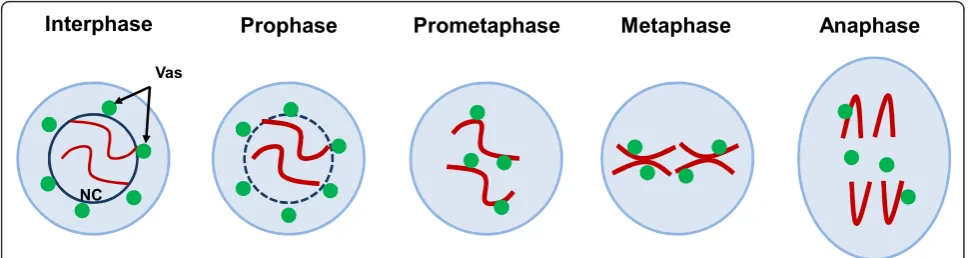
mitosis, Vasa forms mitotic bodies with Aubergine and Spindle-E (two other piRNA pathway proteins) and binds to piRNA-generating chromosomal loci at the peri-centromeric regions (Figure 1). In the piRNA path-way mutants, aubergine andspindle-E, chromosomal condensation and segregation were defective and conco-mitantly mitotic localization of Vasa is abolished. This suggests a link between the piRNA pathway and mitotic chromosome configuration. Furthermore, Vasa associ-ates with CAP-H and CAP-D2, implying a direct role for Vasa in regulating their chromosomal localizations.
How does Vasa regulate condensin I localization? We hypothesize that Vasa may directly function to promote recruitment of condensin I during mitosis (Figure 2). This model is favored because it has been shown that during mitosis, CAP-H loading begins at centromeric regions and subsequently spreads distally towards the chromosomal arms [42]. During mitosis, Vasa localizes near peri-centromeric piRNA-generating loci possibly via Aubergine-bound piRNAs. This localized region con-sisting of Vasa (and also Spindle-E) promotes recruit-ment of CAP-H to the chromosomes. Our studies on the genetic and physical interaction between Vasa and condensin I components also support this model. It would be interesting to test the functional significance of the Vasa-CAP-H interaction to further refine this model. Another model which may also seem possible but is less supported is the idea that the Vasa/Spindle-E/Aubergine-piRNA complex may localize to peri-cen-tromeric piRNA-generating loci and stabilize CAP-H chromosomal localization (Figure 2). This model sup-poses a long-range action of Vasa on chromosomes by an unknown mechanism.
Mitotic roles of germline granules and/or RNAs in other organisms
Multiple lines of evidence for the role of germline gran-ules and/or RNAs during mitosis have emerged over the past few years. Studies inC. elegans first demonstrated that some of the P granule (nuage equivalent) compo-nents, including Argonaute CSR-1, RNA-dependent RNA polymerase EGO-1, Dicer-related helicase DRH-3 and Tudor-domain protein EKL-1, promote chromo-some segregation during mitosis by regulating proper chromosome organization in germline cells [45,46]. These proteins may form a mitotic complex that binds to CSR-1-interacting small RNAs (22G-RNAs) and loca-lizes to mitotic holocentric chromosomes at the 22G-RNA target loci. Therefore, the 22G-22G-RNAs appear to mediate recruitment of proteins to the mitotic chromo-somes to promote chromosome segregation. These observations are intriguingly similar to what we see in
Drosophila, where we observe that the RNA helicase Vasa, the Tudor-domain-containing RNA helicase Spindle-E and the PIWI subfamily protein Aubergine all localize to mitotic chromosomes [37]. Despite the differ-ences between the two systems, it seems that, in general, small non-coding RNAs and germline granules appear to play important roles in organizing chromosomal con-figuration in germline cells during cell division.
In addition to the dynamic localization of nuage/P granules during mitosis, cell cycle-dependent expression of non-coding RNAs has also been reported in Schizo-saccharomyces pombe(fission yeast) and mouse [47-49]. In mouse, it was reported that satellite repeats from the pericentric heterochromatin were transcribed during mitosis, suggesting a mitotic role for such non-coding RNAs [47]. Interestingly, non-coding centromeric satel-lite repeats are shown to be a component of the chro-mosome passenger complex (CPC) and potentiates
Aurora A kinase activity in murine cultured cells [50]. In yeast, centromeric repeats are transcribed during the S phase before the loading of condensin, suggesting that such non-coding RNAs may promote recruitment of condensin during mitosis to silence the expression of centromeric repeats in a cell cycle-dependent manner [48].
RNAs also appear to have some function not only in chromosomal configuration, but also in spindle forma-tion. Studies in Xenopus laevis and human cell lines have shown that mRNAs localize to mitotic spindles and appear to have a function independent of protein coding during mitosis: regulating spindle assembly [51,52]. This further implicates the functional roles of RNAs, either short non-coding RNAs or mRNAs, in var-ious processes, including but not limited to chromo-some organization and spindle assembly, during mitosis.
Disease implications
Piwi, a founding member of the piRNA pathway, was originally found to regulate stem cell division in the
Drosophila germline [53]. It was also reported that human and mouse Piwi homologues, Hiwi, PiwiL2, and PiwiL2-like proteins, are expressed in certain human and mouse stem cells and tumors [54-57], raising the possibility that the development of cancer may be linked to the piRNA pathway and stem cells. Using the Droso-phila brain as a model system, a recent study indeed demonstrated that ectopic expression of germline and piRNA pathway genes are responsible for formation and development of brain tumors [58]. Although the mechanisms of how the piRNA pathway promotes tumorigenesis remain unknown, these data highlight the importance of understanding the role of the piRNA pathway during somatic cell division, with the idea that this pathway may be a target for cancer therapeutics.
Interphase
Prophase
Prometaphase
Metaphase
Anaphase
Vas
NC
Figure 1The dynamic localization of Vasa during mitosis inDrosophilagermline stem cells. During interphase and prophase, Vasa (green) localizes as peri-nuclear bodies in the cytoplasm (nuage). When the nuclear envelope (dark blue line) begins to break down during
Conclusions
Our recent work on the role of Vasa and the piRNA path-way in promoting chromosome condensation and segrega-tion during mitosis provides one example of a mitotic role for non-coding RNAs. Similar roles for such non-coding RNAs have also been described in various model organ-isms, including yeast,C. elegans, Xenopusand mouse. Future studies would likely uncover more examples of the fascinating interplay between RNAs and the cell cycle.
List of abbreviations used
mRNA: messenger RNA; piwi: P-element induced wimpy testis.
Acknowledgements and Funding
This research was supported by the Temasek Life Sciences Laboratory and the Singapore Millennium Foundation.
Authors’contributions
JWP and TK drafted, read and approved the manuscript.
Competing interests
The authors declare that they have no competing interests.
Aub
Vas
Spn-E
CAP-H
piRNA
centromere
Chromosome arm
Aub
Vas
Spn-E
CAP-H
piRNA
centromere
Chromosome arm
Recruitment model
Stabilization model
A
B
Received: 10 February 2011 Accepted: 28 February 2011 Published: 28 February 2011
References
1. Yokota S:Historical survey on chromatoid body research.Acta Histochem Cytochem2008,41:65-82.
2. Kotaja N, Sassone-Corsi P:The chromatoid body: a germ-cell-specific RNA-processing centre.Nat Rev Mol Cell Biol2007,8:85-90.
3. Eddy EM:Germ plasm and the differentiation of the germ line.Int Rev Cytol1975,43:229-281.
4. Updike D, Strome S:P granule assembly and function inCaenorhabditis elegansgerm cells.J Androl2010,31:53-60.
5. Saito K, Siomi MC:Small RNA-mediated quiescence of transposable elements in animals.Dev Cell2010,19:687-697.
6. Senti KA, Brennecke J:The piRNA pathway: a fly’s perspective on the guardian of the genome.Trends Genet2010,26:499-509.
7. Khurana JS, Theukauf W:piRNAs, transposon silencing, and Drosophila germline development.J Cell Biol2010,191:905-913.
8. Vagin VV, Sigova A, Li C, Seitz H, Gvozdev V, Zamore PD:A distinct small RNA pathway silences selfish genetic elements in the germline.Science
2006,313:320-324.
9. Aravin AA, Lagos-Quintana M, Yalcin A, Zavolan M, Marks D, Snyder B, Gaasterland T, Meyer J, Tuschl T:The small RNA profile duringDrosophila melanogasterdevelopment.Dev Cell2003,5:337-350.
10. Saito K, Nishida KM, Mori T, Kawamura Y, Miyoshi K, Nagami T, Siomi T, Siomi MC:Specific association of Piwi with rasiRNAs derived from retrotransposon and heterochromatic regions in theDrosophilagenome.
Genes Dev2006,20:2214-2222.
11. Brennecke J, Aravin AA, Stark A, Dus M, Kellis M, Sachidanandam R, Hannon GJ:Discrete small RNA-generating loci as master regulators of transposon activity inDrosophila.Cell2007,128:1089-1103.
12. Arkov AL, Ramos A:Building RNA-granules: insight from the germline.
Trends Cell Biol2010,20:482-490.
13. Nishida KM, Saito K, Mori T, Kawamura Y, Nagami-Okada T, Inagaki S, Siomi H, Siomi MC:Gene silencing mechanisms mediated by Aubergine piRNA complexes inDrosophilamale gonad.RNA2007,13:1911-1922. 14. Nagao A, Mituyama T, Huang H, Chen D, Siomi MC, Siomi H:Biogenesis
pathways of piRNAs loaded onto AGO3 in theDrosophilatestis.RNA
2010,16:2503-2515.
15. Gunawardane LS, Saito K, Nishida KM, Miyoshi K, Kawamura Y, Nagami T, Siomi H, Siomi MC:A slicer-mediated mechanism for repeat-associated siRNA 5’end formation inDrosophila.Science
2007,315:1587-1590.
16. Vagin VV, Klenov MS, Kalmykova AI, Stolyarenko AD, Kotelnikov RN, Gvozdev VA:The RNA interference proteins andvasalocus are involved in the silencing of retrotransposons in the female germline of
Drosophila melanogaster.RNA Biol2004,1:54-58.
17. Lim AK, Kai T:Unique germ-line organelle, nuage, functions to repress selfish genetic elements inDrosophila melanogaster.Proc Natl Acad Sci USA2007,104:6714-6719.
18. Patil VS, Kai T:Repression of retroelements inDrosophilagermline via piRNA pathway by the Tudor domain protein Tejas.Curr Biol2010,
20:724-730.
19. Findley SD, Tamanaha M, Clegg NJ, Ruohola-Baker H:Maelstrom, a
Drosophilaspindle-class gene, encodes a protein that colocalizes with Vasa and RDE1/AGO1 homolog, Aubergine, in nuage.Development2003,
130:859-871.
20. Chen Y, Pane A, Schupbach T:cutoffandauberginemutations result in retrotransposon upregulation and checkpoint activation inDrosophila.
Curr Biol2007,17:637-642.
21. Saito K, Inagaki S, Mituyama T, Kawamura Y, Ono Y, Sakota E, Kotani H, Asai K, Siomi H, Siomi MC:A regulatory circuit forpiwiby the large Maf genetraffic jaminDrosophila.Nature2009,461:1296-1299.
22. Klattenhoff C, Xi H, Li C, Lee S, Xu J, Khurana JS, Zhang F, Schultz N, Koppetsch BS, Nowosielska A, Seitz H, Zamore PD, Weng Z, Theurkauf WE:
TheDrosophilaHP1 homolog Rhino is required for transposon silencing and piRNA production by dual-strand clusters.Cell2009,138:1137-1149. 23. Malone CD, Brennecke J, Dus M, Stark A, McCombie WR, Sachidanandam R,
Hannon GJ:Specialized piRNA pathways act in germline and somatic tissues of theDrosophilaovary.Cell2009,137:522-535.
24. Li C, Vagin VV, Lee S, Xu J, Ma S, Xi H, Seitz H, Horwich MD, Syrzycka M, Honda BM, Kittler EL, Zapp ML, Klattenhoff C, Schulz N, Theurkauf WE, Weng Z, Zamore PD:Collapse of germline piRNAs in the absence of Argonaute3 reveals somatic piRNAs in flies.Cell2009,137:509-521. 25. Pek JW, Lim AK, Kai T:DrosophilaMaelstrom ensures proper germline
stem cell lineage differentiation by repressingmicroRNA-7.Dev Cell2009,
17:417-424.
26. Aravin AA, Klenov MS, Vagin VV, Bantignies F, Cavalli G, Gvozdev VA:
Dissection of a natural RNA silencing process in theDrosophila melanogastergerm line.Mol Cell Biol2004,24:6742-6750.
27. Aravin AA, Naumova NM, Tulin AV, Vagin VV, Rozovsky YM, Gvozdev VA:
Double-stranded RNA-mediated silencing of genomic tandem repeats and transposable elements in theD. melanogastergermline.Curr Biol
2001,11:1017-1027.
28. Yin H, Lin H:An epigenetic activation role of Piwi and a Piwi-associated piRNA inDrosophila melanogaster.Nature2007,450:304-308.
29. Brower-Toland B, Findley SD, Jiang L, Liu L, Yin H, Dus M, Zhou P, Elgin SC, Lin H:DrosophilaPIWI associates with chromatin and interacts with HP1a.Genes Dev2007,21:2300-2311.
30. Klenov MS, Lavrov SA, Stolyarenko AD, Ryazansky SS, Aravin AA, Tuschl T, Gvozdev VA:Repeat-associated siRNAs cause chromatin silencing of retransposons in theDrosophila melanogastergermline.Nucleic Acids Res
2007,35:5430-5438.
31. Lim AK, Tao L, Kai T:piRNAs mediate posttranscriptional retroelement silencing and localization to pi-bodies in theDrosophilagermline.J Cell Biol2009,186:333-342.
32. Specchia V, Piacentini L, Tritto P, Fanti L, D’Alessandro R, Palumbo G, Pimpinelli S, Bozzetti MP:Hsp90 prevents phenotypic variation by suppressing the mutagenic activity of transposons.Nature2010,
463:662-665.
33. Gangaraju VK, Yin H, Weiner MM, Wang J, Huang XA, Lin H:DrosophilaPiwi functions in Hsp90-mediated suppression of phenotypic variation.Nat Genet2011,43:153-158.
34. Rouget C, Papin C, Boureux A, Meunier AC, Franco B, Robine N, Lai EC, Pelisson A, Simonelig M:Maternal mRNA deadenylation and decay by the piRNA pathway in the earlyDrosophilaembryo.Nature2010,
467:1128-1132.
35. Khurana JS, Xu J, Weng Z, Theurkauf WE:Distinct functions for the
DrosophilapiRNA pathway in genome maintenance and telomere protection.PLoS Genet2010,6:e1001246.
36. Savitsky M, Kwon D, Georgiev P, Kalmykova A, Gvozdev V:Telomere elongation is under the control of the RNAi-based mechanism in the
Drosophilagermline.Genes Dev2006,20:345-354.
37. Pek JW, Kai T:A role for Vasa in regulating mitotic chromosome condensation inDrosophila.Curr Biol2011,21:39-44.
38. Hirano T:Condensins: organizing and segregating the genome.Curr Biol
2005,15:R265-275.
39. Hudson DF, Marshall KM, Earnshaw WC:Condensin: architect of mitotic chromosomes.Chromosome Res2009,17:131-144.
40. Styhler S, Nakamura A, Swan A, Suter B, Lasko P:vasais required for GURKEN accumulation in the oocyte, and is involved in oocyte differentiation and germline cyst development.Development1998,
125:1569-1578.
41. Liu N, Han H, Lasko P:Vasa promotesDrosophilagermline stem cell differentiation by activating mei-P26 translation by directly interacting with a (U)-rich motif in its 3’UTR.Genes Dev2009,23:2742-2752. 42. Oliveira RA, Heidmann S, Sunkel CE:Condensin I binds chromatin early in
prophase and displays a highly dynamic association withDrosophila
mitotic chromosomes.Chromosoma2007,116:259-274. 43. Lécuyer E, Yoshida H, Parthasarathy N, Alm C, Babak T, Cerovina T,
Hughes TR, Tomancak P, Krause HM:Global analysis of mRNA localization reveals a prominent role in organizing cellular architecture and function.
Cell2007,131:174-187.
44. Lécuyer E, Yoshida H, Krause HM:Global implications of mRNA localization pathways in cellular organization.Curr Opin Cell Biol2009,
21:409-415.
45. van Wolfswinkel JC, Claycomb JM, Batista PJ, Mello CC, Berezikov E, Ketting RF:CDE-1 affects chromosome segregation through uridylation of CSR-1-bound siRNAs.Cell2009,139:135-148.
argonaute CSR-1 and its 22G-RNA cofactors are required for holocentric chromosome segregation.Cell2009,139:123-134.
47. Lu J, Gilbert DM:Proliferation-dependent and cell cycle-regulated transcription of mouse pericentric heterochromatin.J Cell Biol2007,
179:411-421.
48. Chen ES, Zhang K, Nicolas E, Cam HP, Zofall M, Grewal SIS:Cell cycle control of centromeric repeat transcription and heterochromatin assembly.Nature2008,451:734-737.
49. Lu J, Gilbert DM:Cell cycle regulated transcription of heterochromatin in mammals vs. fission yeast.Cell Cycle2008,7:1907-1910.
50. Ferri F, Bouzinba-Segard H, Velasco G, Hube F, Francastel C:Non-coding murine centromeric transcripts associate with and potentiate Aurora B kinase.Nucleic Acids Res2009,37:5071-5080.
51. Blower MD, Nachury M, Heald R, Weis K:A Rae1-containing
ribonucleoprotein complex is required for mitotic spindle assembly.Cell
2005,121:223-234.
52. Blower MD, Feric E, Weis K, Hearld R:Genome-wide analysis demonstrates conserved localization of messenger RNAs to mitotic microtubules.J Cell Biol2007,179:1365-1373.
53. Cox DN, Chao A, Lin H:piwiencodes a nucleoplasmic factor whose activity modulates the number and division rate of germline stem cells.
Development2000,127:503-514.
54. Sharma AK, Nelson MC, Brandt JE, Wessman M, Mahmud N, Weller KP, Hoffman R:Human CD34+ stem cells express thehiwigene, a human homologue of theDrosophilagenepiwi.Blood2001,97:426-434. 55. Ye Y, Yin D-T, Chen L, Zhou Q, Shen R, He G, Yan Q, Tong Z, Issekutz AC,
Shapiro CL, Barsky SH, Lin H, Li J-J, Gao J-X:Identification of Piwil2-Like (PL2L) proteins that promote tumorigenesis.PLoS ONE2010,5:e13406. 56. Qiao D, Zeeman A-M, Deng W, Looijenga LHJ, Lin H:Molecular
characterization ofhiwi, a human member of thepiwigene family whose overexpression is correlated to seminomas.Oncogene2002,
21:3988-3999.
57. Wu Q, Ma Q, Shehadeh LA, Wilson A, Xia L, Yu H, Webster KA:Expression of the Argonaute protein PiwiL2 in adult mouse mesenchymal stem cells.Biochem Biophys Res Commun2010,396:915-920.
58. Janic A, Mendizabal L, Llamazares S, Rossell D, Gonzalez C:Ectopic expression of germline genes drives malignant brain tumor growth in
Drosophila.Science2010,330:1824-1827.
doi:10.1186/1747-1028-6-6
Cite this article as:Pek and Kai:Non-coding RNAs enter mitosis: functions, conservation and implications.Cell Division20116:6.
Submit your next manuscript to BioMed Central and take full advantage of:
• Convenient online submission
• Thorough peer review
• No space constraints or color figure charges
• Immediate publication on acceptance
• Inclusion in PubMed, CAS, Scopus and Google Scholar
• Research which is freely available for redistribution