Review Article
Measures of human development: a narrative
Ramprasad Vasthare
1*, Shriya Dhaundiyal
1, Sunaina Puri
2INTRODUCTION
Over the years, using indicators to measure progress towards achieving sustainable development (SD), or even as supplemental strategies like „learning for sustainability‟ and „sustainable livelihood‟ has obtained adequate support. The implementation of such models is supported by logical reasoning as demonstrated by the comprehensive usage of indicators in environmental and economic management. One can still perceive the apparent frustration in literature pertaining to sustainable development with respect to the deficiency of advancement of indicators that will be able to influence future policies. The major problem lies with usage of such indicators presently.1
Human freedom is the most important aspect of human development. It is crucial for not only a few, but for every single human being to be self-sufficient. Human development is about creating such opportunities for the population so as to enable them a decent standard of living. The first human development report (HDR) was published by UNDP in the year 1990. Since its inception, it has not only released over 800 global, regional, national and subnational HDRs but has also been actively involved in conferences, workshops and other outreach activities to promote human development. The work done by UNDP has helped in furthering the interests of and centralizing the people and their well-being amidst policies and strategies.
ABSTRACT
Human development is a direct function of human capability, understood through the different facets of the human development index. The impact of gender inequality, women empowerment, environmental and socioeconomic sustainability has also been described in this review. It brings forth and reinforces that national development is an assessment of not only per capita income but by other influential factors which affect development comprehensively, such as educational achievements and health. A thorough primary screening was done for articles on human development index using the data bases of PubMed, Scopus and Google Scholar using the key words human development, United Nations, measures, indicators and index, followed by a secondary screening, with due concern to avoid overlap of information. The articles were categorized based on the subject of Human Development with due prioritization. Human development index has evolved periodically taking into consideration the developments, limitations and criticisms. It has become an important indicator of human progress and serves as a guide to state, societal, community and individual developments. India currently holds a rank of 130 denoting medium human development.
Keywords: Human development, United Nations, Measures, Indicators, Index
1
Department of Public Health Dentistry, Manipal College of Dental Sciences, Manipal, Manipal Academy Of Higher Education, Udupi, Karnataka, India
2
Manipal College of Dental Sciences, Manipal, Manipal Academy of Higher Education, Udupi, Karnataka, India
Received: 18 December 2018
Accepted: 05 January 2019
*Correspondence:
Dr. Ramprasad Vasthare, E-mail: [email protected]
Copyright: © the author(s), publisher and licensee Medip Academy. This is an open-access article distributed under the terms of the Creative Commons Attribution Non-Commercial License, which permits unrestricted non-commercial use, distribution, and reproduction in any medium, provided the original work is properly cited.
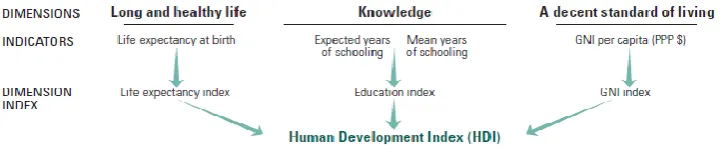
human development: to lead a long and healthy life measured by life expectancy at birth; the ability to acquire knowledge, measured by mean years of schooling and expected years of schooling; and the ability to achieve a decent standard of living, measured by gross national income per capita in PPP US$. Thus the concept of HDI mirrors the accomplishments in the fundamental and primary capabilities of a human. It is so much more than just an all-inclusive estimate of per capita income. Income is just an asset to human development, but does not define its entirety. Neither is it the grand total of human lives. Therefore, by paying attention to parameters apart from income and recognizing income as a substitute for good quality of life, the HDI lays down for a more detailed description of human life as compared to income on its own. The HDI value ranges between 0 and 1.2
Estimation of human development index requires two steps for its calculation:-
Creating the dimension indices
[Dimension Index= (Actual value - Minimum value) / (Maximum value - Minimum value)]
Aggregating the sub indices to produce the human development index.3
The HDI classification for the year 2015 are relative and built upon qualities of HDI distribution comparing 188 nations, denoting a very high (49), high (56), medium (38) and low (45) countries. At the top of HDI rankings are the countries of Norway, Australia and Switzerland, while at the bottom are Niger and Central African Republic. India belongs to the medium HDI category, ranking at number 130. Inequalities between regions is pretty notable with a few countries needing to cover more ground as compared to others. The correlation between human development and the economic prosperity is neither involuntary nor is it conspicuous. Two countries with comparable income per capita may have very distinct HDI values, and vice versa.2
The human development index, symbolizes Amartya Sen‟s “capabilities” perspective to understand well-being of a human, which highlights the significance of ends (like a good quality of life) over means (for example income per capita).4 Major capabilities are instrumental in HDI by the incorporation of substitutes for three extremely important ends of development: access to education, health and goods. When uplifted by these along with other capabilities, anyone will be able to achieve the standard of living they desire.5
A profound correlation exists between human morality and maturity on human development and progress. Moral psychology and biological evolutionary paradigms formed the basis of studies and an evolution to a higher, better version of self is thought to be the key factor for progress of society. This lays down the foundation for
educational programs that assist in the growth of virtue, clarity of thinking and judgement, and help them live with an optimistic outlook on life.6
The working principle of the HDI which forms its basic backbone had a revolutionary effect in the 1990s. It stated in unassailable words that: National development should not only be measured in terms of income per capita, but should also be defined in terms of achievements in the fields of health and education.
The conclusions of human development due to social change are because of myriad factors at individual, group and institutional levels. Studies published in Greenfield‟s theoretical framework (2009) stated clear linkage among particular socio-demographic features (like schooling and commercial activities) and personal cognitive and social behavior that can tap the subconscious forces that makes one strive for their development.7
With the introduction of the multidimensional poverty index (MPI), the gender inequality index (GII), the Inequality-adjusted human development index (IHDI) in 2010 and the gender development index (GDI) in 2014, a step towards better monitoring of poverty, inequality and gender empowerment which were major setbacks to human development was established.
The indicators of human development are: health outcomes, population trends, education achievements, work and employment, human and capital mobility, national income and composition of resources, human security, additional indicators: impressions of well-being and the status of most basic human rights treaties.
The composite indices of human development include: human development index and its components, gender development index, inequality adjusted human development index, multidimensional poverty index, developing countries gender inequality index.
Calculating human development: The HDI focusses on three fundamental needs given as under:3
To get a better insight into human development and overcome its shortcomings, the human development report introduces 4 more composite indices.
The Inequality-adjusted HDI - It reduces the HDI on the basis of the scope of inequality.
The gender development index - It compares the HDI values of females and males.
The gender inequality index – It is used to highlight empowerment of women.
Figure 1: Human development index (HDI).
Statistical dashboards were added, besides the various HDR tables, to highlight the correlation amongst well-being of a human and 5 themes:
Human development conditions
Inequality between the genders during course of life
Empowerment of women
Environmental feasibility
Socioeconomic feasibility
HDI values for 189 nations with up to date statistics for the year of 2017 have been revised with the 2018 Update. Out of these, 59 countries belong to the very high human development group, 53 belong to the high group, 39 belong to the medium group and only 38 countries are in the low group. While in 2010, 49 nations belonged to the group of low human development.
A significant increase in enrolment in primary education in more than 130 countries and an increased average lifespan of seven years has been noted since 1990. The work of the UNDP over the years has successfully helped HDI achieve its basic aims of generating a healthier, more educated population with various opportunities to utilize for a better living. The growth of HDI was deeply effected in the last decade due to the 2008-2009 international financial, economic and food crises. It is widely known that life expectancy is definitely limited biologically, and the slowing in the growth of HDI is unavoidable- as seen with OECD countries.8 Income is the sole component that grows indefinitely subjected to economic maturity. HDI is subjected to reversal due to crisis in economy or due to terrorism.
Human development has matured from being a discipline influenced by divided, reductionist principles to an interdisciplinary field looking forward to create a synthetic, co-actional system incorporating variables from strata of organization.9
INEQUALITIES IN HUMAN DEVELOPMENT– A
BRIEF INSIGHT
Gaps in human development index of various countries are a reflection of unequal opportunity of education access, health services, employment, disparities in income. Inequality just isn‟t wrong; it is extremely
the amount of inequality is high, it may result in negative repercussions for social cohesion which in turn retards the progress of human development.10
Inequality in income
Globally, the most significant inequality is inequality of income trailed by inequality in literacy and life span. The wide difference between the lowest and the highest parameters on every dimension of the HDI represent an undesirable level of inequality.11
The Oxfam International reports show that “eight men own the same wealth as the 3.6 billion people who make up the poorest half of humanity” as well as that “82 percent of all global wealth in the last year went to the top 1 percent, while the bottom half of humanity saw no increase at all”5
It simply means that cherishing the wealth of the affluent 1 percenters or even the 0.1% relative to the rest of the population does no good and is detrimental because it is contributing to inequality by shifting the focus from the middle-income population who face an increased risk to fewer chances at beneficial economic opportunities.10
Gender inequality
To keep a check on the growing disparity between men and women and to keep a proper check on these important components of human development, two composite indices and two statistical dashboards have been established.
The gender development index or GDI, brings out a comparison in the achievements of the two sexes in the simplest aspects of human development. A huge disparity exists due to lower income, fewer job and education opportunities for women in many countries.
education, income or basic independence as even consideration options and a life within the household ends up defining them and their options.
Narrowest gender gap has been observed in Latin America and the Caribbean (2.3 percent) and the widest one has been seen in South Asia (16.3 percent) and the Arab States (14.5 percent).11
Health inequality
Variations in life expectancy and life span of populations in different countries differ in accordance with the availability of basic human needs like food, shelter, clean water, sanitation services, medicine and vaccines availability and accessibility to the people, basic health awareness and campaigns in the area. Recent studies have shown a massive downturn in the environment and its detrimental effects on climate, flora and fauna, and the finishing of resources of freshwater and land which endanger humankind and health in general. The biggest contributors to environmental degradation are the very high development index countries.
Studies show a significant inverse relation between mortality to incidence ratio (MIR) and human development index in the developing countries. The low HDI countries face a greater risk of cancer development due to inadequate measures and modalities required to combat major risk factors, deficient facilities for screening, early diagnosis and treatment of disease. They should focus on strengthening their policies on health systems for the masses and economic development and progression in the field of research.12
Research shows a swift rise in overweight prevalence in developing countries can be attributed to industrialization, economic development and urbanization. Also, the ratio of rural to urban population, GDP per capita, the proportion of elderly in a country‟s population and the average years of schooling are correlated with overweight prevalence.13
It has been evident that there is a direct and significant correlation between incidence of suicide with percentages of urbanization of countries, GNI and life expectancy in women. Suicide rates are directly proportional to level of HDI and have higher prevalence amongst males since they are more likely to be affected by unemployment and socioeconomic status in society and responsible for funding their families.14
Multidimensional poverty index (MPI) measures non-income aspects of poverty and identifies the overlapping human deprivations.15
QUALITY OF HEALTH
Life expectancy has seen a numerical increase over the years but this is not a significant indicator about the
quality of life or good health or if it was lived without any discomfort. The quantity and quality of health services available and accessible to the public has a direct implication on the population‟s health in the area.
QUALITY OF EDUCATION
The quality of education has upgraded manifold over the past years. When compared to the number of primary school students per teacher in high human development countries there are thrice the number of primary school students per teacher in the countries with a medium human development index. The education and the quality of training the teachers receive and the use of communication and educational technologies in schools have a great impact on the quality of education.
In a study conducted in 2013, keeping HDI, Failed State Index and GNI as independent parameters under consideration, it was found that a total of 11,952 dental research articles were published across the world and just five countries (United States, Brazil, India, Japan and United Kingdom) were the major contributors to 50 percent of all articles. These were also the countries which were found to be politically stable. The rise of developing countries as major contributors has demonstrated that rapidly developing economies realize the significance of research and correlate prosperity with priority for scientific research.16
In India, the population demand per dental seat is inversely proportional to the increase in economic index and human development index. Dental colleges appear to be clustered in mainly five large states of India (Uttar Pradesh, Karnataka, Tamil Nadu, Andhra Pradesh and Maharashtra) with higher economic, health and human development status.17
The human development dashboards are:
Human development quality
Human development quality was measured under the following criteria: -
Health Quality (physicians, lost health expectancy, hospital beds, etc.)
Education Quality (pupil-teacher ratio in primary schools, primary school teachers trained to teach, number of schools with internet access, Programme for International Student Assessment (PISA) score
Quality of standard of living (vulnerable employment, population using improved drinking water sources, rural population with access to electricity and population using improved sanitation facilities).
Gender gap in life-course
Childhood and youth (sex ratio at birth, youth unemployment rate and gross enrolment ratio,)
Adulthood (population having some amount of secondary education, rate of unemployment, percentage of parliamentary seats, time spent on household chores, etc.)
Older age (old-age pension recipients)
Women’s empowerment was based on the following indicators
Family planning and reproductive health: (maternal mortality ratio, antenatal care coverage for at least one visit, proportion of births attended by skilled health personnel, adolescent birth rate, unmet need for family planning, contraceptive prevalence any method)
Violence against females (Underage marriage – girls being married off by 18; brutality experienced by women by intimate as well non-intimate partners)
Socioeconomic empowerment (Share of female graduates graduating in science, mathematics, engineering, manufacturing and construction at tertiary level; female share of employment in senior and middle management; mandatory paid maternity leave women with account at financial institution or with mobile money service provider)
Environmental sustainability
Measured under the criteria of consumption of energy obtained from fossil fuels, Consumption of energy from Renewable sources, Carbon footprints, Area under Forest coverage, Fresh water withdrawals, Unsafe water, Ambient air and Household pollution, sanitary and hygiene services; Red List Index
Socioeconomic sustainability
Measured under
Economic Feasibility (Total debt service, Adjusted net savings, Gross capital formation, Concentration index of exports, Skilled labor force, research and development expenditure)
Social Feasibility (Expenditure on health and education versus military expenditure; Inequality leading to a loss in HDI values; Gender Inequality Index, Income quintile ratio)
High human development country rankings:
Norway
Switzerland
Australia
Ireland
Germany
Sweden
Singapore
The Netherlands
India is on the 130th position under medium human development.
CRITICISM OF HUMAN DEVELOPMENT INDEX
Criticism of the human development index has occurred on lots of points, taking into consideration its apparent lack of deliberation on advancement of technology and its contribution in the growth of a population, paying attention to only the performance of the nation and its ranking, error in the measurement of the veiled statistics, and especially on the UNDP's changes in formula which may result in severe misclassification in the categorizing of 'low', 'medium', 'high' or 'very high' human development countries.18
CONCLUSION
Human Development Index has proved to be a vital parameter of assessment and guidance for administrators, bureaucrats, policy developers, legislators and health professionals, in spite of its criticisms and limitations. India currently categorized under medium human development, with a rank of 130, needs to address the fundamental components better in the coming decade to improve community health outcomes with increased longevity and quality of life for its citizen, thereby contributing to enhanced human development in the region.
ACKNOWLEDGEMENTS
Library Health Sciences and Staff, Manipal, Manipal Academy of Higher Education, Manipal, Udupi district, Karnataka, India. Dr. Prateek Mansingh, Former Dental Intern, MCODS, Manipal, MAHE for allied support.
Funding: No funding sources Conflict of interest: None declared Ethical approval: Not required
REFERENCES
1. Patten MA, Remsen JV. Complementary Roles of Phenotype and Genotype in Subspecies Delimitation. J Hered. 2017;108(4):462–4.
2. UNDP. Human Development Report 2015. Work for Human Development. United Nations Development Programme (UNDP). 2015: 288. 3. Available at: UNDP.
HDR_2011_EN_Complete.pdf. 2011. Accessed on 12 June 2017.
4. Sen A. Development As Capability Expansion. Readings Hum Dev. 2005: 41–58.
6. Damon W, Colby A Why a true account of human development requires exemplar research. In Matsuba MK, King PE, Bronk KC, eds. Exemplar methods and research. Strategies for investigation. New Directions for Child and Adolescent Development. 2013;142:13-25.
7. Chen X. Exploring the implications of social change for human development: Perspectives, issues and future directions. Int J Psychol. 2015;50(1):56-9. 8. Organisation for Economic Co-operation and
Development. Education at a Glance 2017 : OECD Indicators. OECD Publishing; 2017.
9. Lerner RM. Promoting positive human development and social justice: Integrating theory, research and application in contemporary developmental science. Int J Psychol. 2015;50(3):165-73.
10. United Nations. Human development indices and indicators: 2018 statistical update. 2018. Available at: http://hdr.undp.org/sites/default/files/hdr2018_ technical_notes.pdf. Accessed on 10 December 2018.
11. Update S. Human Development Indices and Indicators 2018. Available at: http://www.un-ilibrary.org/economic-and-social-development/
human-development-indices-and-indicators-2018_656a3808-en. Accessed on 18 December 2018.
12. Pervaiz R, Faisal F. Cancer incidence and mortality are associated with human development index and health set ups in Africa. J Egyptian National Cancer Institute. 200729:123-6.
13. Carmen ND. Global analysis of overweight prevalence by level of human development. J Global Health. 2015;5(2).
14. Khazaei S, Armanmehr V, Nematollahi S, Rezaeian S, Khazaei S. Suicide rate in relation to the Human Development Index and other health related factors : A global ecological study from 91 countries. J Epidemiol Global Health. 2017;7:131-4.
15. Human Development Reports. Available at: http://hdr.undp.org/en/2018-update. Accessed on 24 December 2018.
16. Allareddy V, Allareddy V, Rampa S, Nalliah R P, Elangovan S. Global Dental Research Productivity and its association with human development, gross national income, and political stability. J Evid Base Dent Pract. 2015;15:90-6.
17. Allareddy V. Concentrations of Undergraduate Dental College Admissions in areas with high health and human development in India. J Dental Educ. 2015;79(3):301-11.
18. Wolff H, Chong H, Auffhammer M. Classification, Detection and Consequences of Data Error: Evidence from the human development index. Econ J. 2011;121(553):843–70.