Original Research Article
Domestic accidents among under-5 year children: a study
on the modern day epidemic
Samreen Khan
1*, Nazia Tauheed
2, Sana Nawab
1, Suboohi Afzal
1, Najam Khalique
1INTRODUCTION
Home accidents are the main cause of mortality and morbidity in early childhood and a major factor in lost productive life.1,2 The public health experts have created the term “Modern Day Epidemic” for domestic accidents.3 WHO calls domestic accidents as a priority problem.4 An infant is fragile, helpless and innocent when it enters the world. It is completely dependent on its care-takers.5 Children are especially at risk for injury because of their normal curiosity, impulsiveness and desire to master new skills. Also, children try to imitate adult behaviour from an early age.6 It is important to know the pattern of trauma in children from developing countries as significant differences exist in
socio-economic pattern and government regulatory policies in comparison with the developed nations.7
The largest number of accidents happens in the living room, however the most serious accidents happen in the kitchen.8 The main causes of accidents in the home are falls, fires and burns, suffocation, drowning, choking, poisoning and cuts and lacerations.9 Earlier in history, epidemiologists have compared domestic accidents to tuberculosis and called both of them together as “social diseases”.1
The term is pretty relevant in today’s time as well where both the entities, in entirely different ways and mechanisms, have managed to infiltrate the social fabric.
ABSTRACT
Background: Domestic accidents are a priority problem, and urgent attention is required to prevent considerable morbidity and mortality in children of the under-five age group.
Methods: Community based cross-section study done in the peri-urban areas of Aligarh, India. Mothers/care-givers
were interviewed about any domestic accident faced by children under 5 year age, in the last 1 year, through a semi-structured, pilot tested questionnaire. Multivariable logistic regression was performed using SPSS 24.0 software.
Results: Majority of respondents were in the age group 20-35 years, majority of the children affected were male (35.6%), and in the age group of 3 to <4 years (22.3%). Most accidents occurred inside home, most commonly due to falls, followed by sharp injury and burn. Mother’s education level had a significant association with the occurrence of domestic accidents (odd’s ratio: 2.34, CI: 1.08-5.07).
Conclusions: Domestic accidents among children are prevalent in the study area. Dissemination of injury prevention
information with special focus on household modification and increased parental supervision are effective strategies to prevent unintentional injury.
Keywords: Domestic accidents, Under-five children, Caregivers
1Department of Community Medicine, 2Department of Anesthesiology, Jawahar Lal Nehru Medical College, A.M.U.,
Aligarh, India
Received: 08 January 2019
Accepted: 07 February 2019
*Correspondence:
Dr. Samreen Khan,
E-mail: [email protected]
Copyright: © the author(s), publisher and licensee Medip Academy. This is an open-access article distributed under
the terms of the Creative Commons Attribution Non-Commercial License, which permits unrestricted non-commercial use, distribution, and reproduction in any medium, provided the original work is properly cited.
Many household level injury risks are avoidable requiring environmental modification which can be done with minimal efforts, suited to the affordability and feasibility for the family.10 However, there is a dearth of research work with comprehensive household level injury hazard identification for children in lower-income settings like rural India. There is currently a lack of data on the subject and this study aims to create a high level of interest in efforts to reduce the incidence of accidents in childhood. The objective is to find out the prevalence of unintentional injury among children under the age of five years and to describe the profile of injury.
METHODS
It is a cross-sectional study done in peri-urban field practice area of Department of Community Medicine, J.N. Medical College, Aligarh Muslim University, India and from January 2017 to December 2017 with 160 households as sample. Sample size per centre was calculated according to the formula: 4pq/L2. After taking prevalence as 9.6% and absolute precision of 7%, non-response of 10%, and design effect of 2 to compensate for the systematic random sampling done, the sample size was calculated as 155.85.11 The study tools were pre-designed semi-structured proforma, which was pilot tested in the study area with a sample of 30 families.
The proforma consisted of questions on the socio-demographic profile of the study population. All consenting care givers of under-five children residing in the urban field practice area of J.N. Medical College were included in the study. The case definition was “any child of less than 5 years of age who suffered from an unintentional injury and consulted any health care professional for the same”. The exclusion criteria included children presenting with intentional injury including; assaults (stabbing, gun-shot wounds, gang violence, and child abuse), sexual assaults, self-inflicted
injury or injuries related to drugs or alcohol; child older than 5 years of age, any child without parent or legal guardian. The surveillance questions were based on previous work done internationally and in India. The questionnaire included questions related to age, sex; type, mechanism and place/time of occurrence of injury, mechanisms of injury taken into consideration were falls, sharp injury, fire/burns, electrocution, aspiration,, road traffic injuries, animal bites, machinery incidents, near-drowning and injury from a stationary object.
The data collectors were trained specifically for this study, and the consent form was translated into Hindi.
Data analysis
The data were then analysed using Microsoft Excel and SPSS statistical software version 24.0. The value of p<0.05 was considered as statistically significant.
RESULTS
Socio-demographic profile
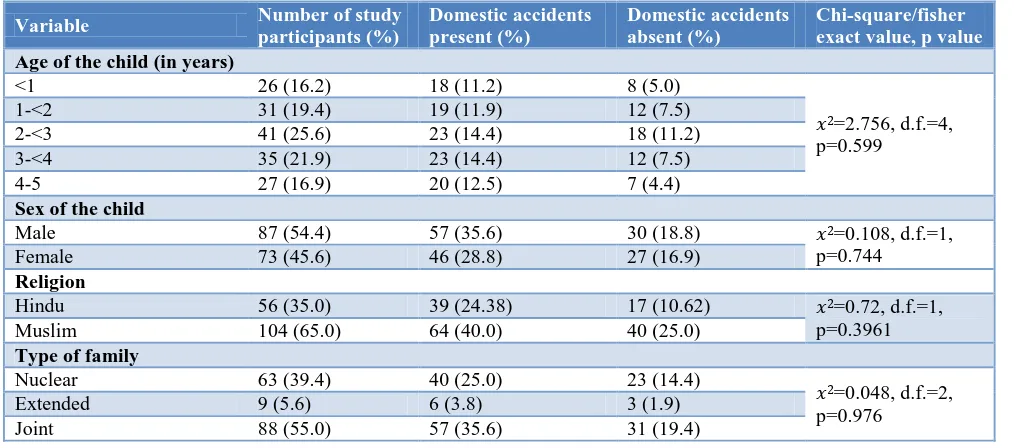
The study was conducted among 160 families. The majority (91%) of respondents were in the age group 20-35 years. In the present study slight male preponderance was observed as out of 160 study participants, 57.5% were male and 43.5% were female. As seen in Table 1, majority of the children were in the age group of 2-3 years (25.6%). Among all families, 35.0% were from Hindu families and rest 65.0% were from Muslim families. Majority of the children’ fathers (40.0%) and mothers (26.9%) studied up to graduation. Maximum of the children’ fathers were engaged in work (93.8%) and mothers were housewives (73.1%). Large numbers of children have 1-2 siblings (66.2%). Majority of the children (55.0%) belong to joint families.
Table 1: Socio-demographic characteristics of study population.
Variable Number of study
participants (%)
Domestic accidents present (%)
Domestic accidents absent (%)
Chi-square/fisher exact value, p value
Age of the child (in years)
<1 26 (16.2) 18 (11.2) 8 (5.0)
𝑥2=2.756, d.f.=4, p=0.599
1-<2 31 (19.4) 19 (11.9) 12 (7.5) 2-<3 41 (25.6) 23 (14.4) 18 (11.2) 3-<4 35 (21.9) 23 (14.4) 12 (7.5) 4-5 27 (16.9) 20 (12.5) 7 (4.4)
Sex of the child
Male 87 (54.4) 57 (35.6) 30 (18.8) 𝑥2=0.108, d.f.=1, p=0.744
Female 73 (45.6) 46 (28.8) 27 (16.9)
Religion
Hindu 56 (35.0) 39 (24.38) 17 (10.62) 𝑥2=0.72, d.f.=1, p=0.3961 Muslim 104 (65.0) 64 (40.0) 40 (25.0)
Type of family
Nuclear 63 (39.4) 40 (25.0) 23 (14.4)
𝑥2=0.048, d.f.=2, p=0.976
Variable Number of study participants (%)
Domestic accidents present (%)
Domestic accidents absent (%)
Chi-square/fisher exact value, p value
Father’s education
Professional degree 21 (13.1) 15 (9.4) 6 (3.8)
𝑥2=8.99, d.f.=6, p=0.174 Graduate & PG 64 (40.0) 41 (25.6) 23 (14.4)
Intermediate/Post High 21 (13.1) 15 (9.4) 6 (3.8)
School diploma
High School Certificate 31 (19.4) 17 (10.6) 14 (8.8) Middle School Completion 4 (2.5) 3 (1.9) 1 (0.6) Primary School 9 (5.6) 3 (1.9) 6 (3.8) Illiterate 10 (6.2) 9 (5.6) 1 (0.6)
Mother’s education (if mother not present, then care-giver’s education status)
Professional degree 5 (3.1) 2 (1.2) 3 (1.9)
𝑥2=0.7.87, d.f.=6, p=0.248
Graduate & postgraduate 43 (26.9) 23 (14.4) 20 (12.5) Intermediate/post high 14 (8.8) 8 (5.0) 6 (3.8)
School diploma
High school certificate 37 (23.1) 27 (16.9) 10 (6.2) Middle school completion 9 (5.6) 8 (5.0) 1 (0.6) Primary school 18 (11.2) 13 (8.1) 5 (3.1) Illiterate 34 (21.2) 22 (13.8) 12 (7.5)
Father’s occupation
Professional 32 (13.8) 22 (13.8) 10 (6.2)
𝑥2=5.35, d.f.=5, p=0.374 Semi professional 65 (40.6) 40 (25.0) 25 (15.6)
Clerk, shop owner, farm
owner etc. 19(11.9) 10 (6.2) 9 (5.6) Skilled
worker/semi-skilled worker 22 (13.8) 13 (8.1) 9 (5.6) Unskilled worker 12 (7.5) 9 (5.6) 3 (1.9) Unemployed 10 (6.2) 9 (5.6) 1 (0.6)
Mother’s occupation (if mother not present, then care-giver’s occupational status)
Professional 4 (2.5) 2 (1.2) 2 (1.2)
𝑥2=2.779, d.f.=5, p=0.734
Semi professional 5 (3.1) 4 (2.5) 1 (0.6) Clerk, shop owner, farm
owner etc.
10 (6.2) 7 (4.4) 3 (1.9)
Skilled worker 5 (3.1) 2 (1.2) 3 (1.9) Semi-skilled worker 19 (11.9) 11 (6.9) 8 (5.0) Unskilled worker
Homemakers/ unemployed 117 (73.1) 77 (48.1) 40 (25.0)
Socio-economic class
I 101 (63.1) 67 (21.2) 34 (21.2)
𝑥2=19.536, d.f.=4, p=0.001
II 20 (12.5) 15 (9.4) 5 (3.1)
III 18 (11.2) 15 (9.4) 3 (1.9)
IV 11 (6.9) 1 (0.6) 10 (6.2)
V 10 (6.2) 5 (3.1) 5 (3.1)
Number of siblings
<=2 106 (66.2) 66 (41.2) 40 (25.0) 𝑥2=0.610, d.f.=1, p=0.273
>2 54 (33.8) 37 (23.1) 17 (10.6)
Prevalence and profile of injuries among under 5 children
In the present study, 103 (64.4%) children sustained one or more domestic injuries in past one month; while 57 (35.6%) children either did not have any history of domestic injury in past one month or their parents can’t remember of any such incident in past one month at time of data collection. We observed (Figure 1) that most
commonly occurring indoors usually among children of 2 to <3 years (18.4%). But, outdoor injuries were most commonly found in age group of 4 to <5 years (9.7%).
The most common site of injury was lower extremity (46.6%) (Figure 3).
Figure 1: Distribution of accidents (N) on the basis of type of injury.
Figure 2: Distribution of accidents (N) with age and site of injury.
Figure: 3. injury profile among under-five children and association with the employment and education
status of mother/care-givers.
Association of injury profile among under 5 children and selected variables
According to Table 2, the occurrence of domestic accidents is only affected significantly by the education status/level of literacy of the mother/caregiver (X=4.829, d.f.=1, p=0.031) the odds being more than two (OR=2.33, CI=1.084-5.069). Other variables like employment status, sex of the baby and even age of the child does not significantly affect the occurrence of domestic accidents. Among employment, literacy, sex and age of the baby, only proper education is enough for the mother to take adequate steps for considerate child-rearing and the avoidance of home based accidents. In our paper, we
30
9
6
1 0 0
7
4 25
6 5
0
2 1
6
1
0 5 10 15 20 25 30 35
FALL SHARP INJURY BURN ELECTROCUTION ASPIRATION DROWNING RTA ANIMAL BITE
N
u
m
b
er
o
f
a
cc
id
en
ts
Type of injury
Pattern of injury on the basis of sex distributon
BOYS GIRLS
11
17
19
17
10
7
2
4
6
10
0 2 4 6 8 10 12 14 16 18 20
< 1 year 1 to <2 years 2 to <3 years 3 to <4 years 4 to <5 years
N
u
m
b
er
o
f
a
cc
id
en
ts
Age groups
Distribution of accidents on the basis of place of occurence
INDOOR OUTDOOR
14.56
38.83 46.6
Site of Injury (in percentage) in children
further inspected the different aspects of injuries in context with the working status and education status of mothers (Table 3). We found that presence of disability, place of injury (whether home or outside) and severity of injury (mild, moderate or severe) is not significantly affected by either of them.
Treatment/management of the injury
It was observed that among all cases (n=103) of domestic injury, first aid was made available in 78 (48.4%) cases, 48 cases (30.0%) were taken to the nearest health care delivery point, and majority among them (69.4%) were taken to the facility within 24 hours.
Table: 2. Association of selected variables with presence of domestic accidents.
Domestic accidents present
Domestic accidents absent
Chi square value, degree
of freedom, p value Odd’s ratio
95% Confidence interval
Employment status of mothers/caregivers
Working mothers 26 (16.2%) 17 (10.6%)
𝑥2=0.392, d.f.=1, p=0.578 0.794 0.386-1.634 Non-working mothers 77 (48.1%) 40 (25.0%) 1
Education status of mothers/caregivers
Illiterate 37 (23.1%) 11 (6.9%)
𝑥2=4.829, d.f.=1, p=0.031 2.344 1.084-5.069
Literate 66 (41.2%) 46 (28.8%) 1
Sex of the baby
Male 57 (35.6%) 30 (18.8%)
𝑥2=0.108, d.f.=1, p=0.7441 1.115 0.583-2.134
Female 46 (28.8%) 27 (16.9%) 1 0.824-1.312
Age of the child (in year)
<1 9 (5.6%) 4 (2.5%)
𝑥2=0.145, d.f.=1, p=0.773 0.788 0.232-2.683
>1 94 (58.8%) 53 (33.1%) 1
Table: 3. Injury profile among under-five children and association with the employment and education status of mother/care-givers.
Working status of mothers Education status of mothers
Study variable Employed
N (%)
Not employed N (%)
Illiterate N (%)
Literate N (%) Presence of disability
Yes 5 (4.9) 7 (6.8) 𝑥2=1.942, d.f.=1, p=0.149
4 (3.9) 8 (7.8) 𝑥2=0.04, d.f.=1, p=1
No 21 (20.4) 70 (68.0) 33 (32.0) 58 (56.3)
Place of injury
Home 17 (16.5) 57 (55.3) 𝑥2=1.718, d.f.=1, p=0.453
27 (26.2) 47 (45.6) 𝑥2=0.036, d.f.=1, p=1.00
Outside 9 (8.7) 20 (19.4) 10 (9.7) 19 (18.4)
Severity of injury
Mild 15 (14.6) 40 (38.8)
𝑥2=1.618, d.f.=2, p=0.734
22 (21.4) 33 (32.0)
𝑥2=1.003, d.f.=2, p=0.606
Moderate 6 (5.8) 24 (23.3) 10 (9.7) 20 (19.4) Severe 5 (4.9) 13 (12.6) 5 (4.9) 13 (12.6)
DISCUSSION
In the present study, it was observed that, 64.4% under five children in the study area sustained domestic injuries during the study period. A review article by Deen et al reported that Childhood DALY rates attributable to injuries were highest in sub-Saharan Africa and India and were higher among males than females and among children aged 0±4 years than among those aged 5±14 years.12 In their study, falls, drownings and road traffic accidents were the main causes of unintentional injuries, while the largest number of intentional injuries was caused by war. In present study domestic injuries were more common among male children (55.3%), and this is also similar to a study conducted by other studiesl where
(32.4%).19 Of the various other factors that had influenced the domestic accidents in our study were the place of occurrence (fallen from bed/furniture) and the activity during occurrence (playing), also reported by Sudhir et al.20 Majority of the accident victims required first-aid at home rather than the hospitalization. In a study by Nath and Naik, injury by cuts and lacerated wounds, burns and bite wounds were found to be 11.8%, 3.8% and 0.8% respectively21, while in our study, they were 11.6%, 10.7% and 4.9%, respectively. According to Zia et al, the home is the most common place where unintentional childhood injuries occur from surveillance data, also found in our study.22 A lot of working women in, particularly the rural community of India are blamed for not attending to the needs of their children, thus the frequent occurrence of the domestic accidents. Our study shows that among employment, literacy, sex and age of the baby, education is of foremost importance for the avoidance of home based accidents as supported by other studies.5-6 In the opinion of Bhanderi & Choudhary, the
consequences of domestic accident may be disastrous both for the individual and the society when the accident results in permanent disability as it could lead to loss of future productivity.23 Our study reported disability in 11.7% of cases, which is a significant number, should be prevented at all costs.
CONCLUSION
This study revealed that there was high prevalence of domestic accident in preschool children in the study area. Fall from height was most common type of domestic injury. Most children received first aid for their injuries and parents mostly used Dettol/Betadine to care the wound. Sex and age of the child, family type, and occupation did not play a significant role in regards to occurrence of domestic injuries in our set up. Accident is usually seen as inevitable and part of normal child growth and development. All these may be attributed to lack of importance attached to domestic accidents, lack of detailed information and awareness on the severity and consequences. The inclusion of accident prevention in strategies for the health of children will certainly bring to the fore the issue of domestic accidents which is neglected in the environment where the study was conducted. Child safety is of social value that demands attention, hence these findings therefore call for prompt and target group interventions. A multi-faceted integrated preventive approach such as safety measures and education about the early treatment of domestic accidents can play important role in the prevention of domestic accidents at the home.
Recommendations
Worldwide, domestic accidents are an emerging cause of death in children and they could be minimized or prevented through measures that could be taken by parents at home. Parents should control and supervise the environmental conditions, eliminate hazardous conditions
from the areas where children play and live which could minimize the frequency of home accidents. So caregivers, particularly mothers should be educated to prevent home accidents so as to protect the 0-5 age group children from accidents. Overall improvement in women’s literacy will definitely help in changing the current scenario. Our recommendation are in line with those given by Kendrick et al who quoted, that above the age of 1, accidental injuries pose the greatest threat to a child's life throughout childhood (OCPS, 1993).24
Funding: No funding sources Conflict of interest: None declared
Ethical approval: The study was approved by the Institutional Ethics Committee
REFERENCES
1. Colver AF, Hutchinson PJ, Judson EC. Promoting children’s home safety. Br Med J. 1982;285(6349):1177–80.
2. Laffoy M. Childhood accidents at home. Ir Med J. 1997;90(1):26–7.
3. Park K. Preventive and Social Medicine, 20th edition. Jabalpur: M/s Banarsidas, 2009: 355–356. 4. Manciaux M, Romer CJ. Accidents in childhood
and adolescence: the role of research. World Health Organization and Institute National de la Sante.et de la Recherche Medicale (INSERM): Geneva; 1991: 1-7.
5. Debnath M, Reang T, Tripura A. A study to assess the knowledge of rural mothers regarding common domestic childhood injuries and home-safety measures adopted by them in west district of Tripura, India. J Evol Med Dent Sci. 2014;3(20):5522–8.
6. Ashwill JW, Droske SC. "Nursing care of children principal and practice", W.B. Saunders company, Philadelphia; 1997: 256-296.
7. Akhtar J. Making Home Safe for Children. APSP J Case Rep. 2012;3:1–2.
8. Hadd F. Consumer safety unit, home accidents death data in consumer safety", 19th annual report, home accidents surveillance system, London, Department of Trade and Industry. 1994: 45-75. 9. Walker V. Child safety in your home. Available at:
www.childsafety.com. Accessed on 12 October 2018.
10. Banerjee S, Paul B, Bandyopadhyay K, Dasgupta A. Domestic unintentional injury of 1 to 5-year-old children in a rural area of West Bengal, India: a community-based study. Tanzania J Health Res. 2016;18(3):1-8.
11. Ramesh MNR, Kishore SG, Gangaboriah. Prevalence of domestic accidents in the rural field practice area of a medical college in Bangalore, Karnataka. Indian J Public Health. 2012;56(3):235-7.
health problems of children in developing countries. Bulletin of the World Health Organization 1999;77(6):518-24.
13. Eldosoky RSH. Home-related injuries among children: knowledge, attitudes and practice about first aid among rural mothers. Eastern Mediterranean Health J. 2012;18:1021.
14. Attias D, Tal Y, Winter ST, Jaffe M. Hospital admissions following childhood accidents. Isr J Med Sci. 1982;18:917-20.
15. Neghab M, Fard AR, Habibi M, Choobineh A. Home accidents in rural and urban areas of Shiraz, 2000-02. East Mediterr Health J. 2006;12(6):824-33.
16. Department of Health and Social Security. Basic principles of child accident prevention: a guide to action. London: Department of Health, 1989. 17. Matanhire DN, Nsungu M, Mabhiza ET. Factors
associated with incidence of domestic accidents in children aged 0-5 years in Chikomba District, Mashonaland East, Zimbabwe. Central African J Med. 1994;40(5):113-9.
18. Erkal S, Safak S. Determination of the risks of domestic accidents for the 0-6 age group in the Tuzluçayır Village Clinic neighbourhood. Turkish J Pediatr. 2006;48:56-62.
19. Zaidi SHN, Khan Z, Khalique N. Injury pattern in children: a population based study. Indian J Community Health. 2013;25:45-51.
20. Sudhir, Krishna D, Channabasappa AN, Dhar M. Prevalence of Domestic Accidents in Rural India: A Cross Sectional study. Sch J App Med Sci. 2014;2(2):657-9.
21. Nath A, Naik V. Accidents in Children Less than Five Years of Age Belonging to Rural Community in Belgaum District. Indian J Community Med. 2007;32(2).
22. Zia N, Khan UR, Razzak JA, Puvanachandra P, Hyder AA. Understanding unintentional childhood home injuries: pilot surveillance data from Karachi, Pakistan. BMC Res Notes. 2012;5(1):37.
23. Bhanderi DJ, Choudhary CS. A study of occurrence of domestic accidents in semi- urban community. Indian J Community Med. 2008;33(2):104-6. 24. Kendrik D, Watson M, Mulvaney C, Burton P. How
useful are home safety behaviours of predicting childhood injury. Health Educ Res. 2005;20(6):709-18.
Cite this article as: Khan S, Tauheed N, Nawab S,