Original Research Article
Syndromic approach to identify cases of vaginal discharge:
a cross-sectional study among females of Shaheed Nagar,
Bhopal, Madhya Pradesh
Nisha Singh
1*, Seema Patel
2, Anshuli Trivedi
2, Yogendra Chouhan
3INTRODUCTION
Management of Sexually Transmitted Infections (STIs) is of ultimate importance in controlling STIs and to break the chain of infection and transmission.1 Syndromic case management is a standardized evidence-based approach which utilizes clinical management algorithms and
flowcharts that are handy and can be consistently used across health care providers. Syndromic case management thus makes it possible for primary healthcare providers in resource-poor settings to deliver appropriate and effective STI treatment. The treatment is based on the identification of consistent groups of symptoms and easily recognized signs.2,3 Syndromic
ABSTRACT
Background: Management of Sexually Transmitted Infections (STIs) is important in controlling STIs and to break
the chain of infection and transmission. Syndromic case management is a standardized evidence-based approach which utilizes clinical management algorithms and flowcharts that are handy and can be consistently used across health care providers. The objectives of the study were to identify cases of vaginal discharge in Shaheed Nagar, Bhopal and to provide them treatment following syndromic approach.
Methods: Prospective cross-sectional study carried out over a period of three months among reproductive age group
females (15-45 years) in Shaheed Nagar, Bhopal. Purposive sampling by conducting door- to- door survey until 150 women fulfilling study criteria was interviewed. A pre-designed questionnaire used for data collection. Educational intervention given to all participants. 37 participants identified with vaginal discharge syndrome and were assisted by study team to gynecological OPD for obtaining treatment based on syndromic approach. Data entered in MS Excel 2007 and statistical analysis carried out using epi-info 7.2. Proportions and percentages were calculated. Chi-square was used to find out association between prevalence of vaginal discharge and qualitative variables. P value <0.05 considered statistically significant.
Results: Prevalence of vaginal discharge was 24.67%. The most common presenting complaint was general weakness
(52%). The most common diagnosis was cervicitis (8.67%) followed by vaginitis (4.67%). Statistically significant correlation was found between presence of disease (STI) and use of intra- uterine device (IUD), non-use of sanitary pads, marital status, occupation and socio- economic class.
Conclusions: Abnormal vaginal discharge can both be the cause as well as the effect of pelvic inflammatory disease.
Keywords: Vaginal discharge, Syndromic approach, Reproductive age-group females, Cross- sectional study
Department of Community Medicine, 1
Govt. Medical College, Khandwa, 2Gandhi Medical College, Bhopal, Madhya Pradesh, India
3
Indore Diagnostics, Dewas, Madhya Pradesh, India
Received: 16 October 2018
Revised: 27 November 2018
Accepted: 30 November 2018
*Correspondence: Dr. Nisha Singh,
E-mail: [email protected]
Copyright: © the author(s), publisher and licensee Medip Academy. This is an open-access article distributed under
the terms of the Creative Commons Attribution Non-Commercial License, which permits unrestricted non-commercial use, distribution, and reproduction in any medium, provided the original work is properly cited.
approach for the management of STIs is now being widely utilized. In resource poor settings these flowcharts are taken to be the standard of care.
Vaginal discharge is a common genital tract symptom among women. Studies have shown that out of those women who seek medical care in primary and secondary health care settings in India 11% to 38.4% avail treatment for vaginal discharge.4-8 Vaginal discharge can be of normal physiologic occurrence or can be a pathological manifestation. It is often challenging to distinguish abnormal from normal discharge, both for the patient as well as the health care provider. Moreover, normal physiologic variations may occur due to biological or hormonal changes.9,10 In India, vaginal discharge is also associated with psychosocial factors.11
A pathological vaginal discharge may originate either from vagina or the cervix. Discharge of vaginal origin may be associated with Bacterial vaginosis (BV), and infection with Candida and Trichomonas vaginalis (TV), while discharge of cervical origin is usually due to infection with Neisseria gonorrhoeae (NG), Chlamydia trachomatis (CT), and Mycoplasma genitalium (MG). Symptomatic cases of STIs represent only the tip of the iceberg as most of the cervical STIs are asymptomatic and thus syndromic management will not prove to be effective for such asymptomatic cases as it is primarily based on signs and symptoms.12,13
STIs if not treated timely and appropriately can lead to Pelvic inflammatory disease (PID). PID is a collective term that includes acute, sub-acute and chronic infection of uterus, fallopian tubes, ovaries, connective tissue and peritoneum. The prevalence of PID in India is 24-32%. 7%-22% of PID is associated with HIV infection. Multiple sexual partners, use of intrauterine device and poor personal hygiene are some of the risk factors both for STI and PID. Most common signs and symptoms include general weakness, fever, lower abdominal pain, foul smelling vaginal/ cervical discharge, painful micturition and often irregular menses. If not timely treated it may lead to dreaded complications like infertility and ectopic pregnancies which may lead to tubal rupture, severe pain, haemorrhage and even death.14
Aims and objectives
The objectives of the present study were to identify the cases of vaginal discharge in the residential area of Shaheed Nagar, Bhopal and to provide them treatment following syndromic approach.
METHODS
A prospective cross-sectional study was carried out over a period of three months from 1st September 2016 to 30th November 2016, among reproductive age group females (15-45 years) residing in Shaheed Nagar area of Bhopal district, which comes under Lady Bhore Urban Health
Training Centre catchment area and is the field practice area of Department of Community Medicine, Gandhi Medical College, Bhopal. Initially a list of households in Shaheed Nagar was prepared according to serial number of houses. This was followed by a door- to- door survey of all the households of Shaheed Nagar. Women in the reproductive age group willing to participate in the study with or without complaints of vaginal discharge were included. Sampling method was purposive sampling and we continued the survey till we interviewed 150 females who fulfilled the study criteria.
The study was carried out after taking permission from The Head of the Department of Community Medicine, GMC, Bhopal and after obtaining ethical clearance from Institutional Ethical Committee. Participants were interviewed only after assuring them the full confidentiality of the information provided by them.
A pre-designed questionnaire was used for data collection which included respondents’ socio-demographic details, personal history, family history, menstrual history and risk behaviors related to sexual activity. This was followed by an educational intervention for all the participants ant their partners separately along with distribution of pamphlets issued by MPSACS and NACO. 37 females were identified with vaginal discharge syndrome and personal counseling was done for them explaining etiopathogenesis and complications of vaginal discharge. They were also explained about syndromic approach for the management of vaginal discharge and were convinced to come along with our team to obtain treatment from the STI/RTI OPD of Sultania Zanana Hospital, Bhopal, which is the Obstetrics and Gynecology teaching hospital of Gandhi Medical College, Bhopal. They were provided with syndromic management kits for treatment of vaginal discharge as well as for partner treatment and followed- up at regular intervals.
Data were entered in MS Excel 2007 and statistical analysis was carried out using epi-info 7.2 software. Proportions and percentages were used to summarize categorical variables. Chi-square test was used to find out association between prevalence of vaginal discharge and qualitative variables. P<0.05 was considered as statistically significant.
RESULTS
54.67% women agreed using sanitary pads during menstruation.
Table 1: Distribution of study participants according to socio- demographic, lifestyle and menstrual factors.
S. No.
Socio- demographic factor
Frequency (n=150)
Percentage (%)
1. Age group (years)
15- 29 72 48.00
30- 45 78 52.00
2. Education
Illiterate 20 13.33
Up to high- school 86 57.33 Above high- school 44 29.34
3. Marital status
Unmarried/ Widow 29 19.33
Married 121 80.67
4. Socio- economic class
High (I, II) 28 18.67
Middle (III) 45 30.00
Low (IV, V) 77 51.33
5. Occupation
Housewife 101 67.33
Employed/ Working 49 32.67
6. Religion
Hindu 23 15.33
Muslim 127 84.67
Lifestyle factors and menstrual factors
7. Diet
Vegetarian 18 12.00
Non-vegetarian 132 88.00
8. Tobacco consumption
Yes 49 32.67
No 101 67.33
9. Body mass index (BMI)
Up to 29.99 Kg/m2 94 62.67 ≥30 Kg/m2
56 37.33
10. Use of intra- uterine device
Yes 24 16.00
No 126 84.00
11. Use of sanitary pads
Yes 82 54.67
No 68 45.33
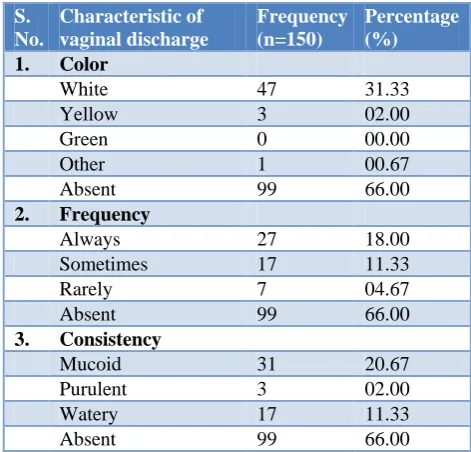
Table 2 shows distribution of study participants according to presenting complaints. The most common presenting complaint was general weakness (52%) followed by backache (36.67%) and lower abdominal pain (19.33%). Table 3 shows distribution of study participants according to characteristic of vaginal discharge. Out of 150 study participants, 99 did not complain of any type of vaginal discharge. Out of the remaining 51 participants who complained of vaginal discharge, majority (31.33%) said that the discharge was white in color. Regarding frequency of occurrence of
vaginal discharge, 18% women complained that discharge existed almost always and 20.67% women complained of mucoid consistency of discharge.
Table 2: Distribution of study participants according to presenting complaints.
S.
No. Presenting complaint
Frequency (n=150)
Percentage (%)
1. General weakness 78 52.00
2. Fever 20 13.33
3. Lower abdominal pain 29 19.33
4. Backache 55 36.67
5. Irregular menses 30 20.00 6. Burning micturation 12 8.00 7. Itching around groin 12 8.00
Table 3: Distribution of study participants according to characteristic of vaginal discharge.
S. No.
Characteristic of vaginal discharge
Frequency (n=150)
Percentage (%)
1. Color
White 47 31.33
Yellow 3 02.00
Green 0 00.00
Other 1 00.67
Absent 99 66.00
2. Frequency
Always 27 18.00
Sometimes 17 11.33
Rarely 7 04.67
Absent 99 66.00
3. Consistency
Mucoid 31 20.67
Purulent 3 02.00
Watery 17 11.33
Absent 99 66.00
Table 4: Distribution of study participants according to diagnosis obtained after clinical examination.
S.
No. Diagnosis
Frequency (N=150)
Percentage (%)
1. Lower abdominal pain 2 1.33
2. Cervicitis 13 8.67
3. Vaginitis 7 4.67
4. Not significant
discharge 2 1.33
5. Diagnosis not
available 13 8.67
6. No disease 113 75.33
participants, the most common diagnosis was cervicitis (8.67%) followed by vaginitis (4.67%). As Cervicitis was the most common diagnosis followed by vaginitis, Kit 1 and Kit 2 were given to most of the women who were found to have infection for the first while lower abdominal pain was most commonly seen in recurrent cases and were given Kit 6. Table 5 shows distribution of study participants according to relation between disease presence and socio- demographic and lifestyle factors. Chi- square was used as the test of significance and p<0.05 was taken to be statistically significant. It can be concluded that there is a correlation between presence of disease (STI) and use of intra- uterine device (IUD), as STI was found to be more common among IUD users than non- users and the difference was found to be
statistically significant. The table also suggests that there is a co-relation between presence of STI and non-use of sanitary pads as non- users of sanitary pads were found to be more commonly affected with STI as compared to those who used sanitary pads and the difference was found to be statistically significant. Likewise, co-relation was also found between presence of STI and socio- economic class with low socio- economic class women being more commonly affected with STI than those belonging to middle and high class and the difference was statistically significant. Similarly a statistically significant co-relation was found between presence of STI and marital status and occupation. Religion and education did not show statistically significant association with presence of disease (STI).
Table 5: Distribution of study participants according to relation between disease presence and socio- demographic and lifestyle factors.
Variables Group
Disease present
Total (%)
Significance (*Statistically significant)
Yes (n=37) N (%)
No (n=113) N (%) Use of intra-
uterine device
Yes 14 (58.33) 10 (41.67) 24 (100.00) 2
=17.427; df=1; P=0.0001*
No 23 (18.25) 103 (81.75) 126 (100.00)
Use of sanitary pads
Yes 14 (17.07) 68 (82.93) 82 (100.00) 2
=5.6163; df=1; p=0.017*
No 23 (33.82) 45 (66.18) 68 (100.00)
Religion Hindu 8 (34.78) 15 (65.22) 23 (100.00)
2
=1.496; df=1; p=0.22
Muslim 29 (22.83) 98 (77.17) 127 (100.00)
Marital status Unmarried/ Widow 12 (41.38) 17 (58.62) 29 (100.00)
2
=5.404; df=1; p=0.02* Married 25 (20.66) 96 (79.34) 121 (100.00)
Occupation Housewife 10 (9.90) 91 (90.10) 101 (100.00)
2
=36.277; df=1; p=0.0001* Employed/Working 27 (55.10) 22 (44.90) 49 (100.00)
Education
Illiterate 7 (35.00) 13 (65.00) 20 (100.00) 2
=4.061; df=2; p=0.131 Up to high school 16 (18.60) 70 (81.40) 86 (100.00)
Above high school 14 (31.82) 30 (68.18) 44 (100.00)
Socio- economic class
High (I, II) 8 (28.57) 20 (71.43) 28 (100.00) 2
=16.682; df=2; p=0.0002* Middle (III) 20 (44.44) 25 (55.56) 45 (100.00)
Low (IV, V) 9 (11.69) 68 (88.31) 77 (100.00)
DISCUSSION
In the present study, prevalence rate of vaginal discharge correlates very closely with the study done by Singh et al (29%), Kulkarni et al(27.47%), Mani et al (23.7%) and Guntoory et al(28.99%).15-18
The prevalence of vaginal discharge was more in unmarried women and widows than women living with spouse in our study and this difference was found to be statistically significant. This can be due to depression and psychosocial stress which is described as the medically unexplained component of white discharge.19 This finding is similar to the finding reported by Guntoory et al.18 In the present study, the correlation between education and the prevalence of vaginal discharge was found not to be statistically significant, which is dissimilar to the findings reported by Guntoory et al, Patel et al and Chaudhary et al who reported a decrease in
the prevalence of vaginal discharge with increasing educational status of the woman.18,20,21 Vaginal discharge was found to be more prevalent in women belonging to lower class than middle and high class women and the difference was found to be statistically significant. These findings are similar to that reported by Guntoory et al, Kulkarni et al, Chaudhary et al.18,16,21 The most probable reason for this could be poor personal and genital hygiene among lower class women. In the present study, the prevalence of vaginal discharge was higher in women who were employed than those who were housewives and this difference was found to be highly statistically significant. This finding is similar to that reported by Guntoory et al.18 The most probable reason could be high degree of stress among working women.
This finding is comparable with the findings reported by Pant et al and Vidya et al.22,23 The most probable reason could be poor hygiene and increasing frequency of infection ascending through the tail of IUD. The present study reveals an inverse association between the use of sanitary pads and prevalence of vaginal discharge and this was found to be statistically significant. Similar finding was reported by Mani et al where it was found that the prevalence of reproductive tract infections was higher among women who used cloth or homemade pads.17 However, no association was noted between discharge and the usage of sanitary pads or use of cloth pads during periods in the study conducted by Guntoory et al.18
General weakness, backache and lower abdominal pain were found to be the most common morbidities associated with vaginal discharge. Neither of the women complained of ulcers or sores on external genitalia. These findings were found to be comparable with that of Chaudhary et al.21
CONCLUSION
Symptomatic STIs represent only the tip of the iceberg. A large number of cases are asymptomatic carrier and thus syndromic management will not prove to be effective for such asymptomatic cases as it is primarily based on signs and symptoms. It can be concluded from the present study that abnormal vaginal discharge can both be the cause as well as the effect of pelvic inflammatory disease. Vaginal discharge was found to be most commonly associated with use of intra- uterine device, poor menstrual hygiene and low socio-economic class. The most common clinical diagnosis was found to be cervicitis followed by vaginitis.
Recommendations
Apart from clinical examination, microbiological tests and psychosocial evaluation should be a part of the complete workup of the women presenting with complaints of vaginal discharge. In addition to this, social and economic empowerment of women must be stressed upon to bring about a positive change in the reproductive health of women. Also, education and increasing awareness about personal and menstrual hygiene along with use of barrier contraceptives plays an important role in alleviating the problem of vaginal discharge.
Limitations
The present study had certain limitations also. First of all, in our study lab investigations were not done to rule out the infectious etiology of vaginal discharge. Treating women complaining of recurrent episodes of vaginal discharge with syndromic approach may be inappropriate without microbiological investigations. Time constraints limited the study to a small sample size. Validity of the
information provided by the participants, as details were self- reported including sexual behavior.
ACKNOWLEDGEMENTS
Authors would like to thank the Professor and Head of the Department of Community Medicine Dr. D.K. Pal and the Professor and Head of the Department of Obstetrics and Gynecology Dr. Aruna Kumar and all the participants of this study for their cooperation.
Funding: No funding sources Conflict of interest: None declared
Ethical approval: The study was approved by the Institutional Ethics Committee
REFERENCES
1. Organization WH. Global strategy for the prevention and control of sexually transmitted infections: 2006-2015. Breaking the chain of transmission. 2007.
2. Mayaud P, Mabey D. Approaches to the control of sexually transmitted infections in developing countries: old problems and modern challenges. Sex Transm Infect. 2004;80(3):174-82.
3. Pepin J, Deslandes S, Khonde N, Kintin DF, Diakite S, Sylla M, et al. Low prevalence of cervical infections in women with vaginal discharge in west Africa: implications for syndromic management. Sex Transm Infect. 2004;80(3):230-5.
4. Valsangkar S, Selvaraju D, Rameswarapu R, Kamutapu S. Impairment of quality of life in symptomatic reproductive tract infection and sexually transmitted infection. J Reprod Infertil. 2014;15(2):87-93.
5. Philip PS, Benjamin AI, Sengupta P. Prevalence of symptoms suggestive of reproductive tract infections/sexually transmitted infections in women in an urban area of Ludhiana. Indian J Sex Transm Dis. 2013;34(2):83-8.
6. Ray K, Muralidhar S, Bala M, Kumari M, Salhan S, Gupta SM, et al. Comparative study of syndromic and etiological diagnosis of reproductive tract infections/sexually transmitted infections in women in Delhi. Int J Infect Dis. 2009;13(6):e352-9. 7. George R, Thomas K, Thyagarajan SP, Jeyaseelan
L, Peedicayil A, Jeyaseelan V, et al. Genital syndromes and syndromic management of vaginal discharge in a community setting. Int J STD AIDS. 2004;15(6):367-70.
8. Moges B, Yismaw G, Kassu A, Megabiaw B, Alemu S, Amare B, et al. Sexually transmitted infections based on the syndromic approach in Gondar town, northwest Ethiopia: a retrospective study. BMC Public Health. 2013;13:143.
10. Mlisana K, Naicker N, Werner L, Roberts L, van Loggerenberg F, Baxter C, et al. Symptomatic vaginal discharge is a poor predictor of sexually transmitted infections and genital tract inflammation in highrisk women in South Africa. J Infect Dis. 2012;206(1):6-14.
11. Patel V, Pednekar S, Weiss H, Rodrigues M, Barros P, Nayak B, et al. Why do women complain of vaginal discharge? A population survey of infectious and pyschosocial risk factors in a South Asian community. Int J Epidemiol. 2005;34(4):853-62.
12. Organization WH. Guidelines for the Management of Sexually Transmitted Infections. 2003.
13. Organization WH. Sexually transmitted and other reproductive tract infections. A guide to essential practice. 2005.
14. Park’s Textbook of Preventive and Social Medicine 23rd edition.
15. Singh AJ. Vaginal discharge: Its causes and associated symptoms as perceived by rural north Indian women. Indian J Community Med. 2007;32(1):22-6.
16. Kulkarni RN, Durge PM. A study of leucorrhoea in reproductive age group women of Nagpur city. Indian J Public Health. 2005;49(4):238-9.
17. Mani G. Prevalence of Reproductive tract infections among rural married women in Tamil Nadu, India: A Community based study. J Pioneer Med Sci. 2014;4(1):18-24.
18. Guntoory I, Tamaraba NR, Nambaru LR, Kalavakuri AS. Prevalence and sociodemographic correlates of vaginal discharge among married women of reproductive age group at a teaching
hospital. Int J Reprod Contracept Obstet Gynecol. 2017;6:4840-6.
19. Patel V, Oomman N. Mental health matters too: gynecological symptoms and depression in South Asia, Reproductive Health Matters. 1999,7(14):30- 8.
20. Choudhary V, Kumar R, Agrawal VK, Singh A, Narula R, Sharma M. Prevalence and Determinants of Vaginal Discharge among Women of Reproductive Age Group in Tertiary Care Hospital of Northern India. Natl J Community Med. 2012;3(4):661-5.
21. Patel V, Weiss HA, Kirkwood BR, Pednekar S, Nevrekar P, Gupte S et al. Common genital complaints in women: the contribution of psychosocial and infectious factors in a population based cohort study in Goa; India. Int J Epidemiol. 2006;35:1478-85.
22. Pant B, Singh J, Bhatnagar M, Garg S, Chopra H, Bajpai S. Social correlates in reproductive tract infections among married women in rural area of Meerut. Indian J Community Med. 2008;33(1):52-3. 23. Rani V, Dixit AM, Singh NP, Kariwala P. KAP study on reproductive tract infections among married women (15-44 yrs) in rural area of Etawah,Uttar Pradesh. Ind J Comm Health. 2016;28:78-83.