Journal of Engineering Sciences, Volume 5, Issue 2 (2018), pp. E 1–E 6 E 1 JOURNAL OF ENGINEERING SCIENCES
УРНА ІН Н РН Х НАУ
УРНА Н Н РНЫХ НАУ
Web site: http://jes.sumdu.edu.ua DOI: 10.21272/jes.2018.5(2).e1 Volume 5, Issue 2 (2018)
UDC 681.5.03
Application of Rough TOPSIS Technique for the Analysis
of Engineering System Failure Causes
Emovon I.*, Nwaoha T. C.
Federal University of Petroleum Resources, P.M.B. 1221, Effurun, Delta State, Nigeria
Article info: Paper received:
The final version of the paper received: Paper accepted online:
May 28, 2018 June 28, 2018 June 30, 2018
*
Corresponding Author’s Address:
[email protected]
Abstract. The prioritization of the causes of engineering system failure posed to be a challenge. Therefore, there is a need to develop a tool that will be used to identify critical problems of an engineering system to facilitate deci-sion making in allocation of available resources in ensuring optimal system performance. In this paper, a rough tech-nique for order preference by similarity to the ideal solution (Rough-TOPSIS) is proposed, which combines rough set theory and TOPSIS for the prioritization exercise in uncertain engineering environment. The technique is exemplified with a numerical example and advanced using information from experts. From the result of the analysis, fac-tors/causes hampering the optimal performance of the engineering system have been revealed in order of importance. The proposed approach have comparative advantages over other hybrid methods as it can easily be implemented with hand calculation/spreadsheet, without requiring additional tools to evaluate decision criteria weights and aggregate experts opinions.
Keywords: rough set theory, Rough TOPSIS, engineering system, failure causes, decision criteria.
1
Introduction
Many developing countries are characterized with in-effective water transportation system, poor telecommuni-cation system, poor health care delivery system, ineffec-tive rail way system and ineffecineffec-tive power generation system. These have hampered their economic and social growth. The engineering systems failures have been at-tributed to ineffective maintenance, misappropriation of fund among other reasons. The level of impact of the different failure causes on engineering system varies. The analysis of the various failure causes in the order of im-portance is therefore imperative.
However, in the literature, most of the authors have been mainly worried with the bane of power generation with specific reference to Nigeria. Ohajianya et al. [1] in their studies, identified factors such as inept manpower and deficient power reform as the causes of epileptic electricity supply in Nigeria. Olaoye et al. [2] in a similar research work, examined the bases of power crisis in Nigeria and recommended the use of renewable energy as means of reducing and / or eliminating the crisis. Sambo et al. [3] identified elements such as deficiency of fund and low involvement of private sector, as the reason for
energy predicament in their paper. The above papers only identified the causes of engineering system failure, with-out prioritizing them in order of importance.
Only limited papers are found in existing literature with respect to prioritization of the causes of engineering system failure but specifically for power generation sys-tem problems. Emovon and Nwaoha [4] utilised an inte-grated AHP and MOORA method for ordering the prob-lems of power generation in Nigeria. Emovon and Samu-el [5] applied a combination of entropy and Multi-Attribute utility Theory (MAUT) methods in the ranking of alternative solutions to power generation problems.
Nevertheless, the methods utilized by the above au-thors have shortcomings, which are addressed in the ap-proach suggested in this paper, for the prioritization of engineering system failure causes. The method proposed is the Rough TOPSIS technique, which is an integration of the Rough Set Theory and the TOPSIS method. Fur-thermore, the analysis in this paper is not limited to pow-er genpow-eration system but addresses majority of enginepow-er- engineer-ing system.
E 2 MECHANICAL ENGINEERING: Computational Mechanics poor telecommunication and poor health care service
delivery. Some common causes of the system failure are ineffective maintenance, misappropriation of fund, insuf-ficient fund, insufinsuf-ficient skilled manpower and wrong industrial setting location and are described as follows:
1. Ineffective maintenance (AT1): the engineering tem is poorly safeguarded and in most scenarios, the sys-tem is allowed to fail before being fixed. This approach has resulted to collapse of engineering system.
2. Misappropriation of fund (AT2): the meagre fund available for engineering system maintenance and expan-sion are misappropriated by bodies entrusted with the management of the systems.
3. Insufficient funding (AT3): the fund available for sustainability of the engineering system in most cases is grossly insufficient.
4. Insufficient skilled manpower (AT4): the skilled manpower needed for effective operation and mainte-nance of engineering system are lacking or inadequate.
5. Wrong location (AT5): the engineering systems are in most scenarios sited in wrong location, and this is gen-erally due to nepotism and ethnicity. The locations are normally far away from energy sources and skilled man-power which do result to industries incurring extra cost in terms of moving materials and human resources to sys-tem sites.
The above factors were carefully selected from the nine factors, Emovon and Nwaoha [4] identified as the problems of power generation in Nigeria. The five factors were selected and modified because they affect all engi-neering system.
The different engineering system failure causes are ranked in this paper with reference to some decision crite-ria. The decision criteria are listed and described as fol-lows:
1. Damages (DC1): the failure of engineering system can damage firm image, cause personnel death or injuries and product or services delay. The different failure causes have vary degree of damaging effect and the one with the greatest effect is generally the most critical.
2. Environmental degradation (DC2): the failure of en-gineering system can produce reversible and irreversible damages to the environment. The engineering system failure cause with greater negative effect on the environ-ment is considered most critical.
3. Engineering system efficiency (DC3): the failure cause that will impact more negatively on the system service delivery is considered as most critical failure cause. The decision criteria are the modified version of Emovon and Nwaoha [4] to make them applicable to all engineering system rather than limiting it to power gener-ation.
2
Research Methodology
2.1
Rough set theory
The approach commonly applied in overcoming vagueness of human mind which generally have negative impact on group decision making is the Rough Set Theo-ry (RST) [6]. The approach was introduced by Pawlak [7]. RST resolve the challenges of uncertainty in group
decision making, by applying lower and upper approxi-mation [8].
Supposing U is the universe, comprising all elements and Y a random elements of U. R is defined as a set of classes organized as D1 < D2 … < Dn [6]. The lower
ap-proximation, APM(Di) upper approximation, APM(Di) and boundary region, are thereforeexpressed as [9]:
(1)
(2)
(3)
Di can be denoted in the form of Rough number,
RN(Di), with the lower limit and upper limit expressed as equations 4 and 5 respectively [10]
(4)
(5) The difference between the upper limit and the lower limit of RN(Di), is BD(Di) expressed as
(6) where PL and PU denote number of elements in
APM(Di) and APM(Di) respectively.
The interval arithmetic operation such as addition and division is also applicable to rough numbers, the opera-tion can be found in the work of [10].
2.2
Rough TOPSIS
The Rough TOPSIS is a hybrid approach for analyzing group decision problem which combines Rough Set The-ory with TOPSIS method. The RST is applied in operat-ing vague data from experts involves in the group deci-sion making process. The analyzed data then serve as input information into the TOPSIS method for final rank-ing of alternatives.
The analysis steps in the Rough TOPSIS are expressed as follows [9]:
Step 1. Decision matrix X, formation, having m num-ber of alternatives ATi (i =1, 2, …,m) and n number of
decision criteria, DCj (j = 1, 2,… , n). Z representing
Journal of Engineering Sciences, Volume 5, Issue 2 (2018), pp. E 1–E 6 E 3 (7)
where r = 1, 2,… , z, and xijr (i= 1, 2, …, m) denote rating of r-th expert for i-th alternative with respect to criterion j.
Step 2. The decision matrix is transformed into rough decision matrix S using the equations (1) – (6), and the details of the transformation process can be found in the work of [10]:
(8) where xij
L and xij
U
indicate lower and upper limits of rough number
Step 3. Evaluation of standardized decision matrix with regard to rough number as follows:
(9)
(10) where NxijL and NxijU denote the upper and lower limits of the standardized rough matrix.
Step 4. Determination of the weighted standardized rough matrix expressed as:
(11)
(12) The rough weights of decision criteria; WijL and WijU analytical steps based on the equations (1) – (6) can be found in [9].
Step 5. Definition of positive ideal solution (PS) and negative ideal solution (NS) as follows:
(13)
(14) where Vj+ and Vj– denote the values of PS and NS re-spectively while B and C represent the beneficial criterion and non-beneficial criterion respectively.
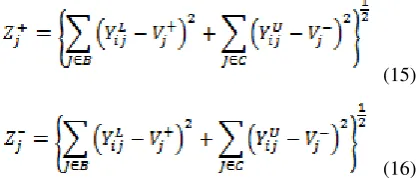
Step 6. The evaluation of each alternative separation from the PS and NS respectively as follows:
(15)
(16) where Zj+ and Zj– represent the separation of each al-ternative from PS and NS respectively
Step 7. The rough TOPSIS performance value of each alternative, , is evaluated as follows:
(17)
3
Results and Discussion
3.1
Numerical Example
The proposed Rough TOPSIS suitability in analyzing different causes of engineering systems failure is illus-trated with a numerical example. In the numerical exam-ple, twoexperts assigned score to each causes of engineer-ing system failurebased on 3 decision criteria whilst uti-lizing 5-point likert scale. The assigned rating which form the decision problem is shown in Table 1.The two experts also assigned rating to the three decision criteria; DC1, DC2 and DC3 in the order of importance based on 5 point likert scale, as shown in Table 2.
Table 1 – Experts assigned rating to alternatives
S/N Expert 1 Expert 2
DC1 DC2 DC3 DC1 DC2 DC3
AT1 5 4 5 4 3 5
AT2 4 3 3 3 4 3
AT3 4 3 2 2 3 2
AT4 3 4 2 3 3 4
AT5 2 2 1 1 4 1
Table 2 – Ratings for decision criteria importance
Expert DC1 DC2 DC3
1 4 2 5
2 4 2 3
3.2
Rough TOPSIS Analysis
E 4 MECHANICAL ENGINEERING: Computational Mechanics Table 3 – Decision criteria rough weights
S/N Rough weights Normalized rough weights
DC1 [4, 4] [0.889, 0.889]
DC2 [2, 2] [0.444, 0.444]
DC3 [3.5, 4.5] [0.778, 1.000]
The above process is proceeded with Rough TOPSIS analysis which begins with the formation of the group rough decision matrix. To form the matrix, the individual expert ratings in Table 1 is aggregated using the equa-tions (1) – (6) with the detailed procedure in the reference [10]. The group rough matrix developed from the analysis is indicated in Table 4.
The assigned rating for alternative, AT2 against deci-sion criteria, DC1 (AT2 / DC1) [3–4] is applied to demonstrate the analysis:
The lower limits and upper limits values are now aver-aged to form rough number
2 2
DC AT
RN as follows:
Table 4 – Group rough decision matrix
S/N DC1 DC2 DC3
AT1 4.25 4.75 3.25 3.75 5.0 5.0
AT2 3.25 3.75 3.25 3.75 3.0 3.0
AT3 2.50 3.50 3.00 3.00 2.0 2.0
AT4 3.00 3.00 3.25 3.75 2.5 3.5
AT5 1.25 1.75 2.50 3.50 1.0 1.0
After the formation of the group rough decision ma-trix, the next step is the development of the normalized form of it using the equations (9) – (10), and the generat-ed result is shown in Table 5. The is followgenerat-ed with the formation of the weighted normalized matrix in Table 6, applying the equations (11) – (12) on data in Tables 3, 5. The values of PS and NS is then evaluated, applying the equations (13) – (14) on data in Table 6, and the results obtained are shown in Table 7. Applying the equations (15) – (17) Z +, Z– and rough TOPSIS performance index, ZA, are evaluated respectively and the results produced
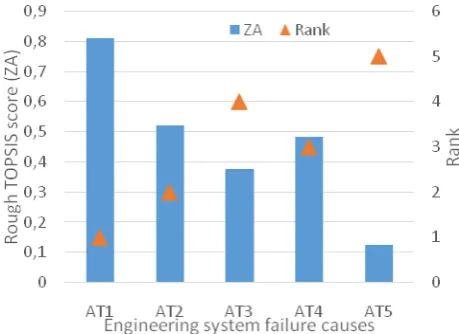
are shown in Table 8. The engineering system failure causes; AT1, AT2, AT3, AT4 and AT5 are ranked based on their respective rough performance scores. The rank orders of the alternatives are shown in Table 8 and Figure 1.
Table 5 – Normalized rough decision matrix
S/N DC1 DC2 DC3
AT1 0.895 1.000 0.867 1.000 1.000 1.000 AT2 0.684 0.789 0.867 1.000 0.600 0.600 AT3 0.526 0.737 0.800 0.800 0.400 0.400 AT4 0.632 0.632 0.867 1.000 0.500 0.700 AT5 0.263 0.368 0.667 0.933 0.200 0.200
Table 6 – Weighted normalized rough decision matrix
S/N DC1 DC2 DC3
AT1 0.796 0.889 0.385 0.444 0.778 1.000
AT2 0.608 0.701 0.385 0.444 0.467 0.600
AT3 0.468 0.655 0.355 0.355 0.311 0.400
AT4 0.562 0.562 0.385 0.444 0.389 0.700
AT5 0.234 0.327 0.296 0.414 0.156 0.200
Table 7 – Values of PS and NS
Parameter DC1 DC2 DC3
PS 0.889 0.444 1.000 NS 0.234 0.296 0.156 Table 8 – Rough TOPSIS performance score (ZA) and rank
S/N Engineering system failure causes Z
+
Z– ZA Rank
AT1 Ineffective
mainte-nance 0.248 1.079 0.813 1
AT2 Misappropriation
of fund 0.606 0.661 0.522 2 AT3 Insufficient fund 0.812 0.490 0.376 4
AT4 Insufficient skilled
manpower 0.696 0.652 0.484 3 AT5 Wrong location 1.079 0.157 0.127 5
From Table 8 and Figure 1, the most critical cause of engineering system failure in most developing countries is ineffective maintenance; AT1 having the highest value of rough TOPSIS performance score of 0.813. The least cause of the systems failure is wrong location AT5 hav-ing the least rough TOPSIS performance score and ranked fifth position among the five alternative causes of failure.
Journal of Engineering Sciences, Volume 5, Issue 2 (2018), pp. E 1–E 6 E 5 Figure 1 – Rough TOPSIS performance score (ZA) and rank
3.3
Rough TOPSIS comparison with other
existing MCDM tools in literature
Although, other multi-criteria decision making (MCDM) tools such as, PROMETHEE, AHP, ELECTRE and DEMATEL when applied as stand alone or in con-junction with other techniques can produce similar result with that of Rough TOPSIS. However, the choice of tools
generally depends on the analysts’ which is normally guided by appropriateness and computational effort re-quired [11]. In the light of this, a similar technique ap-plied by Emovon [12] in comparing different MCDM tools is utilized in this paper to compare Rough TOPSIS with other hybrid MCDM tools.
Hand calculation / spreadsheet: tick – easy to calculate using hand calculation / spreadsheet, and cross – difficult to calculate using hand calculation / spreadsheet.
Software code: tick – easy to code and cross – difficult to code.
Additional tool: Tick- no additional tool required to implement & Cross- additional tool is required for im-plementation.
From Table 9, it is clearly shown that the Rough TOPSIS can be more easily analyzed and implemented than other hybrid methods due to the fact that the meth-odology process can be solved with either hand calcula-tion or spreadsheet with less effort. Furthermore, from the Table, no additional tool is required, in the implementa-tion of the tool and this is as a result of the Rough Set Theory capability of evaluating decision criteria weights and at the same time managing the uncertainty of differ-ent experts’ opinions.
Table 9 – Level of computational effort required of MCDM tools
Program Approach
Rough TOPSIS
FUZZY-AHP
FUZZY-DEMATEL
AHP-DEMATEL
AHP-ELECTRE
AHP-PROMETHEE
Hand calculation × × × × ×
Spreadsheet × × × ×
Easy to code × × × × ×
Additional tool × × ×
4
Conclusion
This paper presented a technique for analyzing engi-neering system failure causes. The technique utilized Rough TOPSIS which integrate Rough Set Theory and TOPSIS method for evaluating causes of engineering system failure causes. The result of the analysis indi-cate that ineffective maintenance is the most critical cause of engineering system failure in most developing countries.
The Rough TOPSIS approach used in the analysis is simpler in terms of implementation when comparedto other hybrid techniques, as the approach is easier to code and implement with the use of hand calcula-tion/spreadsheet. Furthermore, the approach does not require the use of additional tools for it implementation as opposed to most other approaches which require additional tool for decision criteria weights analysis and experts information aggregation.
References
1. Ohajianya, A. C., Abumere, O. E., Owate, I. O., & Osarolube, E. (2014). Erratic Power Supply in Nigeria: Causes and Solutions.
International Journal of Engineering Science Invention, Vol. 3, No. 7, pp. 51–55.
2. Olaoye, T., Ajilore, T., Akinluwade, K., Omole, F., & Adetunji, A. (2016). Energy crisis in Nigeria: Need for renewable energy
mix. American Journal of Electrical and Electronic Engineering, Vol. 4, No. 1, pp. 1–8.
3. Sambo, A. S., Garba, B., Zarma, I. H., & Gaji, M. M. (2012). Electricity generation and the present challenges in the Nigerian
power sector. Journal of Energy and Power Engineering, Vol. 6, No. 7, pp. 1050.
4. Emovon, I., & Nwaoha, T. (2018). Power generation problems ranking using a combination of AHP AND MOORA techniques.
Research in Logistics and Production, Vol. 8, No. 2, pp. 155–168.
E 6 MECHANICAL ENGINEERING: Computational Mechanics
6. Stević, Ž., Tanackov, I., Vasiljević, M., & Rikalović, A. (2017). Supplier evaluation criteria: AHP rough approach. 27th
Interna-tional Scientific Conference on Industrial Systems, pp. 298–303.
7. Pawlak, Z. (1982). Rough sets. International Journal of Computer and Information Sciences, Vol. 11, No. 5, pp. 341–356.
8. Abu-Donia, H. M. (2012). Multi knowledge based rough approximations and applications. Knowledge-Based Systems, Vol. 26,
pp. 20–29.
9. Song, W., Ming, X., Wu, Z., & Zhu, B. (2014). A rough TOPSIS approach for failure mode and effects analysis in uncertain
en-vironments. Quality and Reliability Engineering International, Vol. 30, No. 4, pp. 473–486.
10. Zhai, L. Y., Khoo, L. P., & Zhong, Z. W. (2009). A rough set based QFD approach to the management of imprecise design
in-formation in product development. Advanced Engineering Informatics, Vol. 23, No. 2, pp. 222–228.
11. Löken, E. (2007). Use of multicriteria decision analysis methods for energy planning problems. Renewable and Sustainable
En-ergy Reviews, Vol. 11, No. 7, pp. 1584–1595.
12. Emovon, I. (2016). Multi-criteria decision making support tools for maintenance of marine machinery systems. PhD thesis,
School of Marine Science and Technology, Newcastle University, UK.
і
Rough TOPSIS
і
і
і
Е І., Н .
ь , P.M.B. 1221, . Е , Н
А і . .
В , є
ь ь
. Rough
-TOPSIS ь . є є
TOPSIS . Н
. ь , ( ), ь
ь , . З є
,
,
ь .
і : , Rough TOPSIS, , ,