http://www.ijcmph.com pISSN 2394-6032 | eISSN 2394-6040
Original Research Article
Mid-term assessment of mass drug administration for elimination of
lymphatic filariasis: in Bundelkhand region of Madhya Pradesh
Ram K. Panika, Rakesh K. Mahore*
INTRODUCTION
Lymphatic Filariasis is a vector borne parasitic disease caused by lymphatic dwelling nematode parasite namely Wuchereria bancrofti, Brugia malayi and Brugia timori. The disease produces progressive physical deformities in limb and reduces work capacity of affected individuals.1 Lymphatic filariasis is one of the world's leading causes of permanent and long-term disability with an estimated 5.1 million disability adjusted life years (DALYs) are lost
due to this disease.2 Physical deformities due to obstructional defect result in loss of man power.3 It is a major social and economic scourage in the tropics and subtropics of Africa, Asia, Western Pacific and parts of the Americas, affecting over 73 countries. More than 1.4 billion people live in areas where there is a risk of infection, of whom 120 million are infected and in need of treatment, including 40 million people with overt disease.4 The WHO has estimated that 600 million people are at risk of infection in South-East Asia and 60 million are actually infected in the region. Lymphatic filariasis is
ABSTRACT
Background: Lymphatic filariasis is a vector borne parasitic disease caused by lymphatic dwelling nematode
parasite. It is one of the world's leading causes of permanent and long-term disability with an estimated 5.1 million disability adjusted life years (DALYs) are lost due to this disease. The National Health Policy 2002 aims at Elimination of Lymphatic filariasis by 2015 through Annual Mass Drug Administration (MDA) of single dose of DEC. Objective was to assess coverage and compliance of MDA Program and awareness about lymphatic filariasis in Chhatarpur district of Madhya Pradesh.
Methods: Cross-sectional Study was conducted. Total 120 households were surveyed in four selected clusters of Chhatarpur district of MP.
Results: Out of total 835 persons only 94.37% persons were eligible and 47 (5.62%) were not eligible for MDA for
MDA. Coverage rate was 90.22% and compliance rate was 75.24%. The main reason for non-compliance was not having the concerned disease 34.38 % followed by fear of side effect (24.90%). Only 37.5% among the surveyed families were aware about MDA. Majority of respondent 21 (46.66%) acquired knowledge from health workers.
Conclusions: The compliance of MDA program was low and the awareness about the lymphatic filariasis in the study
population was limited in Chhatarpur district. Poor compliance of MDA is attributed to inadequate consumption of drugs due to poor awareness among eligible population. For elimination of lymphatic filariasis active involvement of community is very essential. It can be made possible through behavior change communication and health education of people.
Keywords: Coverage rate, Compliance rate, Lymphatic filariasis, Mass drug administration
Department ofCommunity Medicine, Bundelkhand Medical College, Sagar, Madhya Pradesh, India
Received: 25 November 2018
Revised: 05 January 2019
Accepted: 07 January 2019
*Correspondence:
Dr. Rakesh K. Mahore,
E-mail: [email protected]
Copyright: © the author(s), publisher and licensee Medip Academy. This is an open-access article distributed under
the terms of the Creative Commons Attribution Non-Commercial License, which permits unrestricted non-commercial use, distribution, and reproduction in any medium, provided the original work is properly cited.
a public health problem in India. There are about 553 million people at the risk of infection with 48 million (80% i.e., 48 out of 60 million) infected with parasite in India. Lymphatic filariasis is prevalent in 250 districts in 20 states and union territories.5 The Global Program to Eliminate Lymphatic Filariasis (GPELF) was established in 1999 with the objective of interrupting transmission of the parasites in all endemic countries by 2020.6 The global strategy to interrupt transmission of LF, is a once-yearly, single-dose, two-drug regimen (Albendazole with either Diethylcarbamazine (DEC) or Ivermectin) to be used by communities at risk with the goal of reaching 80% coverage for 4–6 years. In mass drug administration approach DEC is given to almost everyone in community irrespective of whether they have microfilaraemia, disease manifestation or no signs of infection except children below 2 years, pregnant women and seriously ill patients but people are reluctant to consume drugs in the absence of obvious signs of disease or symptoms.7 The Government of India in 2004 began a nationwide MDA program in all the known lymphatic filariasis endemic districts with the aim of eliminating filariasis as a public health problem by the year 2015.8 In 2007 India changed its strategy from delivery of DEC alone to delivery of DEC plus Albendazole; the number of people treated with combinations has increased steadily. India has reduced the prevalence to less than 1% in 192 out of 250 districts.9 The unofficial reports from field suggested that actual drug consumption was much lower than the reported coverage by district malaria/filarial offices. Therefore, the state government proposed Mid-Term Evaluation of MDA activities to review the progress of activities of single dose of DEC mass administration in Madhya Pradesh.10 Present study was undertaken i) to evaluate the coverage, compliance and awareness about MDA in Chhatarpur district of Madhya Pradesh ii) to assess the reasons for non-compliance.
METHODS
A cross-sectional study was conducted for evaluation of MDA through household survey in four randomly selected clusters (three rural and one urban) of Chhatarpur district as per national vector borne disease control program guidelines. For selection of rural clusters, one village was selected from PHC/CHC with low coverage i.e. below 50%, one village was selected from PHC/CHC with medium coverage i.e. between 50%-80% and one village was selected from PHC/CHC with high coverage i.e. above 80%. For urban cluster one ward of was selected randomly. Selected PHCs/CHCs and their representative village were-In rural area were– Badamalehra: Mangwari village, Sattai: Majagawan Khurd village and Bameetha: Ganj village. In Urban area–Ward No 4 of Chhatarpur municipality was selected. House to house survey was done. In each of the selected clusters 30 households were surveyed. Thus a total 120 households were surveyed. The predesigned questionnaire (Provided by DHS, State Health Committee and NVBDCP) was used to collect information regarding
consumption of DEC and other relevant information. Data was compiled and analyzed using percentages and proportions in MS Office Excel 2007.
Study area: Chhatarpur district of M.P.
Study period: 01 month, from 30 June 2018 to 29 July 2018.
Study design: Cross-sectional Study.
Inclusion criteria: All the sampled eligible population in the study area.
Exclusion criteria: Pregnant and lactating mother,
children below 2 years, seriously ill persons, severely debilitated patient and people of extreme age.
RESULTS
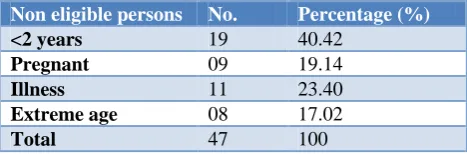
In surveyed 120 families, out of total 835 persons only 788 (94.37%) persons were eligible and 47 (5.62%) were not eligible for MDA. The main reason for non-eligibility for MDA was age <2 years 19 (40.42%) followed by illness 11 (23.40%), 09 (19.14%) were non eligible due to pregnancy. 08 (17.02%) and 11 (23.40%) were non eligible because of extreme and illness respectably (Table 1).
Table 1: Reasons for non-eligibility for DEC.
Non eligible persons No. Percentage (%)
<2 years 19 40.42
Pregnant 09 19.14
Illness 11 23.40
Extreme age 08 17.02
Total 47 100
knowledge about MDA program. Only10% respondents were aware of recommended dosage of MDA, no respondent had knowledge of contraindications of MDA (Table 5). Among the 120 respondents, 21 (46.66%)
acquired knowledge from health workers, 19 (42.22%) gained knowledge from last year’s MDA. 05 (11.11%) acquired knowledge from other sources like ,TV, radio, newspaper etc (Table 6).
Table 2: Age wise distribution of coverage rate and compliance rate.
Age (year)
Coverage rate Compliance rate
No. of eligible person
No. of persons
received tablets %
No. of persons received tablets
No. of persons
swallowed tablets %
2-5 68 58 88.23 58 40 68.96
6-14 158 142 89.87 142 106 74.64
>15 562 511 90.92 511 389 76.12
Total 788 711 90.22 711 535 75.24
Table 3: Sex wise distribution of coverage rate and compliance rate.
Sex Coverage rate Compliance rate
No. of eligible person
No. of persons received tablets
% No. of persons
received tablets
No. of persons swallowed tablets
%
Male 381 319 83.72 319 250 78.36
Female 407 392 96.31 392 285 72.70
Total 788 711 90.22 711 535 75.24
Table No. 4: Distribution according reason for non-compliance (n=253).
Reasons for non-compliance No. ofeligible person Percentage (%)
Think it is not necessary or forgot to take 52 20.55
Fear of side effects 63 24.90
Not suffering from filariasis so why to take 87 34.38
Had fever or any minor ailment 23 9.09
Other 28 11.06
Total 253 100
Table 5: Distribution of according to awareness about lymphatic filariasis.
Awareness area No. ofrespondents (n=120) %
Lymphatic filariasis 65 54.16
Symptom of lymphatic filariasis 43 35.83
Mode of transmission of filariasis 58 48.33
Availability of treatment 47 39.16
Recommended dosage 12 10
Contraindications 00 00
Side-effects 08 06.66
MDA programme 45 37.5
Table 6: Distribution according to source of information regarding MDA.
Source of information No. %
Last year’s MDA 19 42.22
Health workers 21 46.66
Others 05 11.11
DISCUSSION
The concept of MDA is to approach every eligible individual in the target community and administer annual
India.11 In present study in surveyed population, out of total 835 persons only 788 (94.37%) persons were eligible and 47 (5.62%) were not eligible for MDA. The main reasons for non-eligibility for MDA was age <2 years 19 (40.42%) followed by illness 11 (23.40%), 09 (19.14%) persons were non eligible due to pregnancy. In a similar study conducted in Madhya Pradesh Pankaj et al observed that eligibility rate in Rewa and Chhindwara district was found to be 93.75% and 92.34% respectively. The main reasons for non-eligibility for DEC was children <2 years followed by pregnancy in both the districts.10
As far as coverage and compliance of MDA is concerned, in present study coverage rate was 90.22% and compliance rate was 75.24%. Gender wise coverage rate was higher 96.31% in female as compare to 83.72% in males while higher compliance rate was observed among males (78.36%) as compare to females (72.70%). Age wise compliance rate was highest (76.12%) in 15 years and above age group and lowest (68.96%) in 2-5 years age group. Biradar MK et al in their study found that the overall coverage of MDA in Kalaburgi district was 86.1% and compliance rate was 86.7%.2 In a study Anil NS found that the coverage rate was 82.97% and compliance rate was 73.99%.6 Lata GB et al in their study observed that coverage rate was 89.37% and consumption rate was merely 73.1%.7 Naveenkumar G revealed that the coverage rate was 93.42% in Gulbarga district and 74.12% in Yadgiri district and compliance rate is 86.35% in Gulbarga district and 75.78% in Yadgiri district.8 Kishore Y in their study showed that coverage rate among study population was 73.29% and compliance rates was 72.05%.12 In a similar study conducted in Madhya Pradesh Amarnath G observed coverage rate of 77.47% and compliance rate of 76.21%.13 Muralidhar et al in their study found coverage rate 84.6% and compliance rate of 56.5%.14 Abhayet al in their study revealed the overall coverage rate 79.7% and compliance rate 43.04%.15
In present study we found that the main reason for non-compliance was not suffering from the concerned disease 87 (34.38%) which was followed by fear of side effects 63 (24.90%), 52 (20.55%) forget to consume/ Think it is not necessary, 23 (9.09%) did not consumed tablet as they had minor ailments, 28 (11.06%) did not swallow due to some other reason. Biradar et al in their study noticed that main reason for not taking drug was fear of side effects (51.2% ).2 In a study Anil NS noted that 23% individuals didn’t consume drugs due to old age and fearing illness, 7% were absent at their homes during drug distribution, 5% felt they were healthy and didn’t consume drugs, 3% didn’t consume due to illness.6
In their study Lata et al observed thatmain reason for non-compliance was fear of side reactions in 45.38%.7 Kishore et al in their study found that most common reason for noncompliance was fear of side effects (76.47%) followed by being unaware of benefits of medication (21.56%).11 Amarnath in a similar study
observed that the main reason for non-compliance was fear of side effect (37.96%) followed by forget to take the tablets (22.22%), (18.81%) people were not at home when drug distributor visited their home. 11.11% respondents had no faith on the drugs and 10.18% persons did not consumed the tablets due to some other reasons.13 Karmakar PR observed that 30.57% persons did not consume. The most frequent cause was fear of side effect (36.84%) followed not having any clinical manifestation of filariasis (27.82%).16 In contrary to other study conducted by Biradar et al, Lata et al, Kishoreet al, Amarnath et al in present we observed that not suffering from the concerned disease was the main reason of non-compliance.
The awareness about the lymphatic filariasis and MDA in the study population was limited. Only 54.16% respondents had heard about lymphatic filariasis, 48.33% had knowledge about transmission of disease, 35.83% had knowledge about at least one symptoms of disease. 39.16% persons were aware of availability of treatment and 37.5% had knowledge about MDA program. Only 10% respondents were aware of recommended dosage of MDA, no respondent had knowledge of contraindications of MDA. Lata GB in a their study revealed that 19.06% people told that they don’t know about lymphatic filariasis.7 Amarnath in his study found that only 60% respondents had heard about lymphatic filariasis and 60% had knowledge about at least one symptoms of disease. Only 17.5% had knowledge about transmission of disease, 46.66% had knowledge about availability of treatment and 55.83% had knowledge about MDA programme.13 Kulkarni MM et al in their study found that only 49% of subjects had proper knowledge about the disease.14 Karmakar PR observed that only 55.42% interviewed persons have heard about LF. Only17.36% in rural area and 42.22% in urban area knew atleast one correct presenting symptom of LF. Only 13.86% knew the mode of transmission of filariasis correctly, only 20% in urban area and 4.13% respondents in rural area had correct knowledge of mode of prevention of LF. Only 8.47% knew about availability of treatment of filariasis and 21.08% were aware about filaria elimination programme. Only 38.04% respondents knew that drug administration was being done on every house.16 In present study we observed that among the respondent 21 (46.66%) acquired knowledge from health workers, 19 (42.22%) gained knowledge from last year’s MDA. 05 (11.11%) acquired knowledge from other sources like, TV, radio, newspaper etc. Karmakar PR observed that important sources of information were anganwadi
worker, Auxiliary Nurse Midwife (ANM) and
community volunteer.16
CONCLUSION
consumption of drugs due to poor awareness among eligible population. Due importance of MDA program should be given and every effort should be made by drug distributors to convince people to consume drug in his/her presence. There is need for intensive health education campaigns for increasing awareness about lymphatic filariasis. This can be done by explaining all about lymphatic filariasis disease and the purpose of MDA to the community people by using locally appropriate media like Dhol, Nagada and Nukkad Natak. The present study reveals the coverage as 90.22%, compliance rates as 75.24 %.The main reason for non-compliance was not suffering from the concerned disease. The awareness about the lymphatic filariasis in the study population was only 54.16%. There is an urgent need for improved social mobilization and supervision to increase compliance with MDA.
ACKNOWLEDGEMENTS
The authors are grateful to Director Health Services Madhya Pradesh for providing this project and giving us financial support & cooperation to conduct this evaluation study. We are thankful to Dean, Bundelkhand Medical College, Sagar (Madhya Pradesh) for his continuous guidance and support. We are also grateful to CMHO and DMO of Chhatarpur districts for supporting and helping us all the time during our survey. We are also very thankful to our respondents who spent their time and responded to the rather lengthy questionnaires with tremendous patience and without any expectation from us.
Funding: Funding from Directorate Health Services Bhopal (M.P.)
Conflict of interest: None declared
Ethical approval: The study was approved by the Institutional Ethics Committee
REFERENCES
1. Sundar LAP. Text book of community medicine, preventive and social medicine, 4th ed. CBS Publishers & distributors Pvt Ltd; 2014: 476-77.
2. Biradar MK, Holyachi SK. Coverage and
compliance of mass drug administration against lymphatic filariasis in Kalaburgi district. Int J Community Med Public Health. 2017;4(7):2502-5. 3. Mahajan, Gupta. Textbook of preventive and social
medicine, 4th ed. Jaypee Brothers medical publishers (P) Ltd New delhi; 2013: 319.
4. Park. Textbook of Preventive and Social Medicine, 23rd ed. M/s Banarsidas Bhanhot Publishers Jabalpur; 2015: 270.
5. Kishore J. National health programs of India, 11th ed. Century Publications New Delhi; 2014: 390.
6. Anil NS. Assessing coverage of mass drug
administration against lymphatic filariasis in
Gulbarga District, Karnataka. Int J Med Public Health. 2012;2(3):P25-8.
7. Godale LB, Balaji UV. A study on coverage evaluation, compliance and awareness of mass drug administration for elimination of lymphatic filariasis in Osmanabad district. Natl J Community Med. 2012;3(3):391-4.
8. Havale NK. Evaluation of coverage and compliance of elimination of lymphatic filariasis by mass drug administration campaign in Gulbarga and Yadgiri districts of Karnataka state. Int J Res Med Sci. 2015;3(8):2105-8.
9. Satapathy DM, Pradhan SK, Acharya HP, Nayak U,
Agrawal SK, Naik G. Rural and urban differences in MDA coverage for filariasis in Jharsuguda district of Odisha. Int J Med Res Prof. 2016;2(5):70-4. 10. Prasad P, Arya RS, Bansal M, Singh SP. Mid - term
assessment of mass drug Administration of DEC for filariasis in Rewa and Chhindwara districts of Madhya Pradesh. Natl J Community Med. 2013;4(3):520-4.
11. Mehta S, Shah V, Verma A, Patel NB, Bansal RK. Comparison of coverage and compliance of mass drug administration 2012 in Surat, India. Natl J Community Med. 2012;3(3):448-72.
12. Jothula KY, Naidu NK, Malhotra VM, Prasad VG, Kabra PR, Nagaraj K. Evaluation of mass drug administration programme for elimination of lymphatic filariasis in Nalgonda district, Telangana, India. Int J Med Public Health. 2016;3(8):2008-12. 13. Gupta A. Evaluation of mass drug administration for
elimination of lymphatic filariasis in Panna district of Madhya Pradesh. PARIPEX Indian j res. 2015;4(5):269-71.
14. Kulkarni MM, Veena GK, Sujatha K, Darshan BB,
Varun N, Asha. Coverage & Compliance of mass drug administration program against filariasis in Bijapur district, Karnataka. J Pub Health Med Res. 2013;1(1):9-12.
15. Nirgude AS, Naik PR, Nagaraj K, Reshmi SS, Takalkar AA, Prasad VG. Evaluation of coverage and compliance of Mass drug administration programme 2011 for Elimination of lymphatic filariasis in Nalgonda district of Andhra Pradesh, India. Natl J Community Med. 2012;3(2):288-93. 16. Karmakar PR, Mitra K, Chatterjee A, Jana PK,
Bhattacharya S, Lahiri SK.A study on coverage, compliance and awareness about mass drug administration for elimination of lymphatic filariasis in a district of West Bengal, India. J Vector Borne Dis. 2011;48:101–4.
Cite this article as: Panika RK, Mahore RK.