* To whom all correspondence should be addressed. E-mail: [email protected]
An Improved Feature Selection (IFS) Algorithm
for Detecting Autistic Children Learning Skills
M.S. Mythili and A.R. Mohamed Shanavas
1Department of Computer Applications, Bishop Heber College, Tiruchirappalli - 620 017, TamilNadu, India.
2Department of Computer Science, Jamal Mohamed College, Tiruchirappalli - 620 020, TamilNadu, India.
DOI: http://dx.doi.org/10.13005/bbra/1691
(Received: 03 February 2015; accepted: 01 March 2015)
Children with autism spectrum disorder follow a special process pattern from other children and develop at a special rate. Educating children with autism is expounded to intensive endeavor, involving a team of professionals of assorted special instruction and therapies to subsume children behavioral and activity, biological process, social and academic needs. Students with autism usually need explicit teaching across a range of settings to generalize skills. The knowledge and information gained from analysis helps the parents and school teachers to convey decent learning surroundings for the autism children. Feature Selection is a very important topic in data mining, particularly for high dimensional datasets. Feature Selection is a method usually employed in machine learning, whereby subsets of the options accessible from the data are described for the application of a learning algorithm. The Main purpose of this paper is to propose the Improved Feature Selection algorithm. The Improved algorithm is developed by combining the filters and wrappers. The Correlation Based Feature Selection (CFS) with the best first search act as a filter for removing impertinent options. Wrapper Subset Evaluator with the best first search is employed as a wrapper and it absolutely reduces the redundant options. It is accustomed to improve the accuracy of the classification for the autism children by analyzing the four totally different classifiers such as SVM, J48, Multilayer
Perceptron and IB1are used. The overall purpose of this paper work is to propose the foremost effective algorithmic program for autism children with sensible potency and accuracy.
.
Key words: Data Mining, Classification, Filter Approach, Feature Selection Algorithms.
The data mining is customary recently as a result of all the information is captured with every dealing by the transaction process method and thus the system’s capability is extremely store huge data and therefore the measurement is among the vary of terabytes. Data Mining is that the method
In filter approach, the features were supported based on criteria which are independent of the actual learning algorithmic rule to be applied to the data. In wrapper approach, the Feature Selection is predicated on a wrapper, which may be a set of attributes and are evaluated with a learning algorithmic rule. Feature Selection can be divided in filter methods and wrapper methods. Filter methods is outlined as using some actual property of the data so as to pick the feature using the classification algorithmic rule. Entropy measure has been used as filter technique for feature selection for classification. Wrapper approaches apply classification algorithmic rule to every candidate feature subset then measure the feature subset by threshold functions that utilize the classification result. This paper is structured as follows. Section two discusses the Autism children role with their signs and symptoms. Section three describes the related work. Section four elaborates and presents the idea of Classification and discusses the aspects of classification algorithmic rule. Section five enumerates a Data Preprocessing. Section six explains the Implementation of model construction. Section seven narrates the idea of filter approach with the wrappers. Section eight clearly explains the proposed methodology with the algorithm results and discussions. Section nine accurately elaborates the results and discussion via in table and in the graphical representation. Section ten gives the conclusion and future work.
AUTISM
Autism Spectrum Disorder (ASD) is a Pervasive Developmental Disorder (PDD). It is a bio-neurological developmental disability typically showing before the age of three, best renowned for impairing a child’s ability to speak and move. Life-long disabilities considerably impact in many areas of development: communication impairments, social issue, sensory process deficits and a necessity for solid routines among their lives. Characteristics of Autism manifests in an exceedingly myriad of ways: delay in verbal development, a necessity to end what they start, a rather h3 resistance to vary in daily routine, lack of spontaneousness, distress at being touched and also the ability to indicate any reasonably feeling of emotion, as well as an inability to process their method and reply to humor.
Literature review
Perceptrons, NaïveBayes classifiers and Support vector machines with three kernel functions were used for sleuthing intruders. The Precision, Recall and F- Measure for all the technique were calculated.
Classification
Classification technique is a supervised learning technique and it plays an important role in data mining. It generates the models and very useful to classify the dataset. The technique is a two step process .The first process helps for the model construction and it builds a model from the training data. The second one is the model usage to check the accuracy of the model. It fully predicts the categorized class labels for all the samples data. Classification Algorithms
The classifier algorithm deals with SVM, J48, Multilayer Perceptron and IB1algorithm .The classifiers are mentioned below
J48
The J48 classifier inherited all the concepts from ID3.The whole concepts of J48 classifier was developed by Quinlan Ross. It gets all the additional information from the Hunt’s classifier. J48 splits the attribute into two levels and it is determined by the threshold values. The surrogate splitting is needed to check the missing values. It starts the classification of records from the test data by traversing the nodes from the root node to leaf node and it performs the conditional test .It also checks the attributes, the best attribute should be selected and made the attribute as the root node of the attribute. Attribute selection such as Gini index, Information gain helps in ranking the classification of the attributes. An attribute selection measure is used and analyses to construct the decision tree. The Information gain reduces the entropy value to the level which reduces the level of impure splitting. The main aim of pruning is to construct the optimal classifiers inside the decision tree to bolster the accuracy of classification.
Support Vector Machine
The Support Vector Machine is a supervised learning technique and it is easily associated with learning algorithms. It analyzes the data and acknowledges patterns. It is mainly used for classification and statistical analysis purpose. It is a non-probabilistic binary linear classifier to build a model and it assigns the new
samples into one category to the other. SVM expeditiously perform a non-linear classification .SVM Classification is undergone by the kernel, which map their inputs into high-dimensional feature area. It plays an important role in hand written character recognition, face detection and it is widely applied in classification and regression. Multilayer Perceptron
An artificial neural network model has the Input and output data and they are connected with the corresponding weights. In a directed graph, every layer is correctly connected to the other one. Multilayer Perceptron is the supervised learning technique and it is called as back propagation for training the network. The Multilayer Perceptron has three layers - input layer, output layer and the hidden layers of nodes. The main advantages are straightforward, easy to use, and they easily map input/output nodes.
IB1
It is a supervised learning classifier. It has the class labels for each record and with the help of the nearest neighbor classifier the distance is calculated. If there is not any class label for the records the mostly used label is used. It is a faster algorithm classifier and it sometimes is called as lazy classifier.
Attribute Identification
Dataset collected from autism children database consists of
Attributes Description
Attention Attention Skills of autism child Hand writing Hand Writing Skills of autism child Spell Spelling Skills of autism child Lang Language Skills of autism child Reading Reading Skills of autism child Writing Writing Skills of autism child Interaction Interaction Skills of autism child Memory Memory Skills of autism child of child
Listen Listening Skills of autism child Speaking Speaking Skill of autism child s Maths Mathematical Skills of autism child Science Science Skills of autism child Art Art Skills of autism child Music Music Skills of autism child physical Physical Skills of autism child Child class Levels of autism child(High,Medium,
Data preprocessing
Data preprocessing is an important one to eliminate the noisy data, missing data and redundant attributes over the Datasets. The Datasets utilized in the classification algorithmic rule applied the data preprocessing to remove the unwanted data’s. The data have to be clear, correct and it is preprocessed for handling missing or redundant attributes. The data should be a complete and it should be consistent data to induce the best outcome from the Data Mining methodology. Implementation of model construction
The Weka is the open provide software system tools and it is the integration of machine learning algorithms and the data preprocessing. It is widely utilized in data mining applications which contain the association rule mining, classification and clustering. It accepts only the ARFF (Attribute Relational File Format), CSV (Comma Separated Value) file. The detection of autism children learning skills has different attributes such as attention skills, Handwriting skills, spelling skills, language skills, Reading skills, writing skills, memory skills, listening skills.maths skills, science skills, music skills, physical skills, speaking skills, art skills, and the interaction skills, 200 instances were taken for the detection. The filter and the wrapper approaches have been implemented in Weka tool.
Generalized Filter and Wrapper Approaches WEKA provides a supervised attribute filter that is versatile be flexible and permits varied search and analysis strategies to be combined. It makes use of two properties that are evaluator and search. Evaluator determines the factors used for choosing the attribute.
Different evaluators that can be used are: Correlation-based feature selection
It considers the prophetic ability of every feature and finds out the relevancy. It conjointly checks for redundancy between the chosen options. Finally the set of attributes that are extremely correlated with the category and are less redundant is chosen.
ff cf Sk r k k k r K Merit ) 1 ( Best First
It searches for the attribute set by greedy hill climbing method together with backtracking.
The backtracking relies on the conception that if some variety of consecutive nodes is found such they are not improve the performance then backtracking is completed. It should apply forward approach wherever it starts from empty set of attributes and goes on adding the consecutive one. It should conjointly choose backward approach wherever it starts from a collection of all attributes and removes one by one. It should conjointly adopt a midway between each approaches wherever search is completed in each directions that is additionally referred to as hybrid approach Wrapper Subset Eval
Evaluates attribute sets by employing a learning scheme. Cross validation is employed to estimate the accuracy of the learning scheme for a collection of attributes.
Ranker
Individual evaluations of the attributes are done and that they are ranked consequently. Proposed Algorithm
The proposed Algorithm is as follows:
Input: D (F1, F2,…..Fn)// Training data with n features
Output: Best Subset with maximum Accuracy and minimum error rate
//Feature selection
1. Let S= set of n features F1, F2 ….Fn
2. Evaluate the subsets of features into S, where S is the feature Subset.
3. for each Feature Selection S, 4. Begin
5. Retrieved data=evaluate AS(S) // AS=Attribute Selection
// Compute the Filter process by
6. Perform the filter process to compute Correlation-based heuristic evaluation on Best feature subset . ff cf Sk r k k k r K Merit ) 1 (
7. If Retrieved data>Initial data then 8. Initial data=Retrieved data //Keeping track of the Initial Subset encountered in the filter process.
9. Compute Accuracy 10. End
// Compute the Wrapper Process by
and threshold value 12. Final data=Initial data 13. Repeat
14. Begin
15. within each Initial data 16. End
17. Until (Initial data>Final data)// Keeping track of the Final Subset in wrapper process
18. Best Subset =Initial data 19. Compute Accuracy
///Classification Process
20. Run a 10-fold cross validation on the Best Subset by the classifiers such as SVM, J48, Multilayer Perceptron and IB1
21. Performance Evaluations gives the maximum Accuracy and minimum error rate
22. Return Best Subset
RESULTS AND DISCUSSION
The analysis and interpretation of classification is time consuming process that needs a deep understanding of statistics. The process needs a large amount of time to finish and expert analysis to look at the classification and relationships within the data.
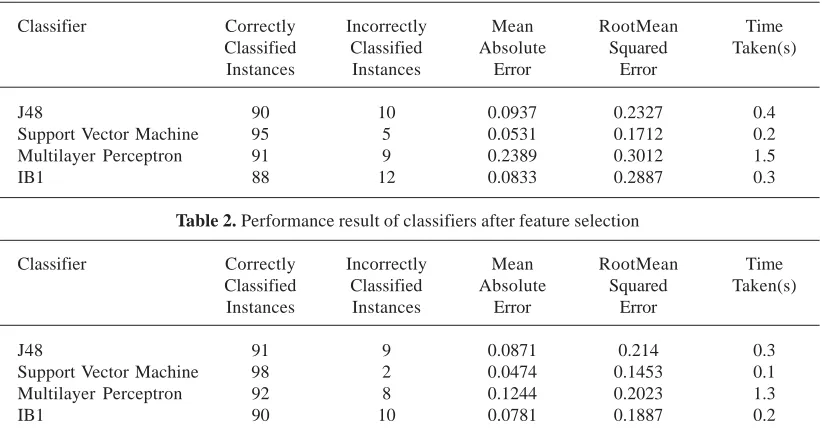
In Table I the performance result of classifiers without the feature selection is studied. Hence Support Vector Machine with Normalized Polykernel can be termed as more accurate than other classifiers.
In Table II the performance result of classifiers with the feature selection is discussed. The proposed algorithm is applied to the dataset and all the classifiers performance (accuracy), is increased and the time, error rate is decreased. With the proposed algorithm Support Vector Machine with Normalized Polykernel can be termed as more accurate than other classifiers with 98%
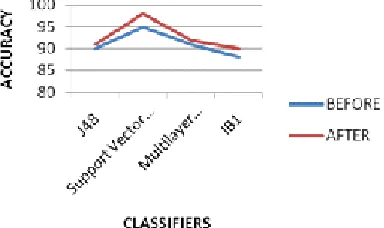
The Figure 1 shows that the graphical representation of accuracy of the classifier algorithm. It clearly enumerates that with the feature selection all the classifiers algorithm accuracy has been increased. The proposed algorithm suggests that the Support Vector Machine is a very best classifier for analyzing the autism children Proposed Methodology
Fig. 1. Accuarcy of the classifier algorithm
performance consuming less time coupled with good accuracy with 98%.
The Figure 2 elaborates the performance related to time by the various classification algorithms. It clearly deals that with the feature selection all the classifiers algorithm time has been decreased. The proposed algorithm performance with the Support Vector Machine is very fast for analyzing the results within 0.1 seconds
The Figure 3 compares Mean absolute error rate among completely different classifiers .All the classifiers got the lower error rate. Support Vector Machine has lower error rate compared to different classifiers after the feature selection.
The Figure 4 elaborates the representation of root mean squared error rate among completely different classifiers in a graphical way. All the classifiers got the lower error rate after the feature selection. The algorithm which
Table 1. Performance result of classifiers before feature selection
Classifier Correctly Incorrectly Mean RootMean Time
Classified Classified Absolute Squared Taken(s)
Instances Instances Error Error
J48 90 10 0.0937 0.2327 0.4
Support Vector Machine 95 5 0.0531 0.1712 0.2
Multilayer Perceptron 91 9 0.2389 0.3012 1.5
IB1 88 12 0.0833 0.2887 0.3
Table 2. Performance result of classifiers after feature selection
Classifier Correctly Incorrectly Mean RootMean Time
Classified Classified Absolute Squared Taken(s)
Instances Instances Error Error
J48 91 9 0.0871 0.214 0.3
Support Vector Machine 98 2 0.0474 0.1453 0.1
Multilayer Perceptron 92 8 0.1244 0.2023 1.3
IB1 90 10 0.0781 0.1887 0.2
Fig. 3. Mean absolute error rate of different classifiers Fig. 4. Root mean squared error rate of different classifiers
proposed concludes that Support Vector Machine has lower error rate compared to different classifiers.
CONCLUSION
applied to autism dataset by reducing its attributes and enforced using WEKA machine learning tool. The machine learning is a good methodology which can be utilized in the field of autism detection. In future, the proposal of new algorithm is to create a learning framework for the autism children in fuzzy cognitive map and in the Multilayer Perceptron Network with fuzzy inference rules to boost the performance.
REFERENCES
1. Harun Uguz, “A hybrid approach for text categorization by using x2 stastics, Principal Component Analysis and partical swam optimization”, Academic Journals, (8) 37, PP 1818-1828, 2013.
2. Hyunjin Yoon et al. “Feature Subset Selection and feature ranking for multivariate time series”, IEEE Transactions on Knowledge and Data engineering, Vol.17, no. 9, September 2005. 3. Kemal Polat, Salih Gunes, “Prediction of
hepatitis disease based on principal component analysis and artificial immune recognition system”, Applied Mathematics and Computation 189(2007) 1282-1291.
4. Tahseen A. Jilani et.al, “PCA-ANN classification of hepatitis- c patients”, International Journal of Computer Applications, volume-14-No.7, Febraury 2011.
5. Hung lian, “on feature selection with principal component analysis for one-class SVM”, Pattern
Recognition Letters 33(2012) 1027-1031. 6. Hlip-Ling Chen Et.al, “A new hybrid method
based on local fisher discriminant analysis and support vector machines for hepatitis disease diagnosis” . Expert Systems with Applications 38(2011) 11796-11803.
7. Yilmaz Kaya, Murat Uyar, “ A hybrid decision support system based on rough set and extreme learning machine for diagnosis of hepatitis disease”. Applied Soft Computing 13(2013) . 8. Huda yasin et al., “hepatitis-c classification using
data mining techniques”, International Journal of Computer Applications, Volume 24, No.3, June 2011.
9. Javad salami sartakhiti, mohammad Hossein Zangooei, Kourosh Mozafari, “ Hepatitis disease diagnosis using a novel hybrid method based on support vector machine and simulated annealing(SVM-SA)’’, Computer methods and programs in Biomedicine 108 (2012)570-579. 10. Diana Dumitru , “Prediction of recurrent events
in breast cancer using the Naive Bayesian classification”, Annals of University ofCraiova Math. Comp. Sci. Ser. Volume 36(2), 2009. 11. M.S. Mythili, A.R.Mohamed Shanavas,”A
Study on Autism Spectrum Disorders using classification Techniques”,IJSCE,ISSN:2231-2307,Volume 4,Issue 5,Nov 2014.