Original Research Article
The impact of smart phones and mobile devices on
human health and life
Sumaiya Mushroor
1, Shammin Haque
1*, Riyadh A. Amir
2INTRODUCTION
The advent of new touch technologies and widespread use of smart phones and mobile devices have made humans embrace with technology more and extensively dependent upon them. The wireless devices like cell phones, tablet, laptops, audio players and digital cameras, are used by Wi-Fi which are connected to exchange information.Social networks allow people to interact and make new friends, but their use without any knowledge
will result in harmful effects. Since these smart devices are portable, they allow continuous communication, regardless of place or situation. As these digital devices provide various convenient features, people have become reluctant in active participation such as visiting friends, buy things from stores, etc. Consequently, people will suffer from different health issues due to lack of exercise and radiations from electrical devices. Moreover, the advent of mobile technology has increased divorce rates and broken families. Smart phones and other similar devices have integrated with the most innovative ABSTRACT
Background: Overuse of smart devices provides comfort and problems both physically and mentally.The aim of this study was to assess the impact of smart phone and mobile devices on human health and life.
Methods: This descriptive type of cross sectional study was conducted for three months in Dhaka city among general population aged 18 to 70 years. Four hundred and forty respondents were selected by non-probability convenient sampling technique. Data were collected by face to face interview with a semi-structured pre-tested questionnaire.
Results: Among 440 respondents majority (76.6%) were below 25 years where 72.0% were students. A large proportion (90.5%) used smart phones for communication, 53.4% used for less than 5 hours daily. Majority (65.7%) had other electronic devices, most common 197 (68.1%) were laptop users where 118 (40.8%) used for studying. More than half 322 (73.2%) used earphones, 91 (20.7%) had ear problems and 223 (50.7%) lacked concentration. Many 299 (68.0%) had good relationship with family members, 208 (47.3%) stated that increased use of mobile devices hampered family life, 88 (42.3%) thought it reduced quality family time. Majority users 253 (57.5%) experienced physical discomfort after prolonged use and 95 (37.7%) suffered from headache. Association between age of respondents and time spent on smart devices was statistically significant (p<0.05). There was significant (p<0.05) association between ear problem and ear phone usage.
Conclusions: Excessive use of smart phones should be avoided and social awareness increased through health programmes. Potential risks of cell phones and smart devices can be avoided by limiting the use.
Keywords: Cell phone, Smart phone, Smart devices
1Department ofCommunity Medicine, Dr. Sirajul Islam Medical College and Hospital, Dhaka, Bangladesh 2Department of Physiology, Medical College for Women and Hospital, Dhaka, Bangladesh
Received: 19 October 2019
Revised: 01 December 2019
Accepted: 04 December 2019
*Correspondence:
Dr. Shammin Haque,
E-mail: [email protected]
Copyright: © the author(s), publisher and licensee Medip Academy. This is an open-access article distributed under the terms of the Creative Commons Attribution Non-Commercial License, which permits unrestricted non-commercial use, distribution, and reproduction in any medium, provided the original work is properly cited.
invention of modern time; the internet. It is a great tool and allows people to access information on any imaginable topic instantly. These mobile smart devices also make individuals available anywhere, anytime, which changes the way that individuals are choosing to interact within and outside the society.
In the last 20 years, worldwide mobile phone subscriptions have grown from 12.4 million to over 5.6 billion, penetrating about 70% of the global population. Its usage has also become an important public health problem as there have been reports of plenty of health hazards, both mental and physical, in people of all age groups.1 Its user participation is increasing day by day with increase in number of social networking sites like Facebook, Twitter, MySpace etc. Since its inception by Mark Zuckerberg on February 4, 2004, Facebook has grown leaps and bound over the past decade. As of the third quarter of 2014, Facebook has 1.35 billion active monthly users with majority of its users as teenagers. With the mission “to make the world more open and connected” Facebook has become an integral part of social life of a person.2 Mobile phones have many perceived benefits, including increased accessibility and social connection, efficiency in the workplace, convenience and improved safety. However, in recent years, there has been increasing public interest in the negative consequences of mobile phone use. Mobile phones emit radio frequency or microwave radiation. Exposure to such radiation could affect health directly. There is concern that microwaves might induce or promote cancer, and the symptoms associated with their use include sleep disturbance, memory problems, headaches, nausea, and dizziness. Changes in the
permeability of the blood brain barrier,
electroencephalographic activity, and blood pressure have also been reported. The use of mobile phones also results in indirect effects, such as car accidents.3 This paper will address many threats to human health caused by smart phones and other smart mobile devices and also will try to find out some methods for raising awareness of such issues are explored.
METHODS
This descriptive type of cross sectional study was conducted from December 2018 to February 2019 among general population aged 18 to 70 years residing in some selected areas of Dhaka city such as Malibagh, Rampura, Banosree, Hatirjeel, Gulshan, Shahbagh and Dhaka University area. People who were co-operative, mentally sound, willing to participate were selected from these areas by non-probability convenient sampling technique. After introduction with the respondents, informing about the study purpose and objective, data were collected by face to face interview with the help of a pretested semi-structured questionnaire. Data were edited, coded and categorized to detect errors and maintain consistency and validity. It was then finally analysed by using MS Excel and Statistical package for social sciences (SPSS)
software. For descriptive statistics, mean, median, standard deviation for numerical data and frequencies, percentage for categorical data were calculated as required. For inferential statistics Chi-square test was used. Data were presented in frequency tables and pie charts as per needed.
RESULTS
The present study showed that among 440 respondents majority 268 (60.9%) were males, most of them 337 (76.6%) belonged to age group below 25 years age. Large proportion 317 (72.0%) were students and maximum 331 (75.2%) were unmarried. It was also found that most of the respondents 375 (85.2%) were from nuclear family and among them 154 (35.0%) had monthly family income within 40000-60000 taka (Table 1).
Table 1: Socio-demographic characteristics of the respondents.
Socio-demographic
characteristics Frequency %
Age group (years)
<25 337 76.6
26-35 71 16.1
36-45 21 4.8
>45 11 2.5
Sex
Male 268 60.9
Female 172 39.1
Religion
Islam 413 94.4
Hindu 26 5.9
Occupation
Student 317 72.0
Job holder 77 17.5
Businessman 35 8.0
Home maker 11 2.5
Type of family
Nuclear family 375 85.2
Joint family 65 14.8
Marital status
Married 109 24.6
Unmarried 331 75.2
Monthly family income
<20000 75 17.0
20000-40000 113 25.7
40000-60000 154 35.0
>60000 98 22.3
Table 2: Pattern of use of smart mobile devices.
Pattern of use of mobile devices N %
Purpose of use of smart mobile phone
Communication with others 398 90.5
Entertainment 64 9.5
Duration of use in 24 hours
<5 235 53.4
5-10 162 36.8
>10 43 9.8
Use of other electronic device
Yes 289 65.7
No 151 34.3
Type of other electronic devices used (n=289 )
Computer 77 26.6
Laptop 197 68.1
Tablet 15 5.3
Purpose of use of other electronic device (n=289)
For study purpose 118 40.8
Communication with others 27 9.3
For work 67 23.2
Others 77 26.6
Use of earphone
Yes 322 73.2
No 118 26.8
Place of mobile during sleep
Bed side 262 59.5
In a distance place 178 40.5
Duration of using smart phone before sleep at night (in hours)
<1 122 27.7
1-2 214 48.6
2-3 41 9.3
>4 23 5.2
Monthly expense for use and maintenance of smart devices
<500 tk 139 31.6
500-1000 tk 224 50.9
1000-2000 tk 52 11.8
2000-3000 tk 17 3.9
>3000 tk 8 1.8
Figure 1: Distribution of respondents by source of money for monthly expenses.
Earphones were also commonly used by 322 (73.2%). More than half 262 (59.5%) of the respondents admitted
that they kept their mobile sets at bedside during sleep and 214 (48.6%) used their phones for 1-2hours before sleep at night. Majority 224 (50.9%) among them spent 500-1000 taka monthly for using smart mobile devices (Table 2). Many 211 (48.0%) spent from their own income for monthly expenses (Figure 1).
Table 3: Information related to Facebook use.
Variables Frequency %
Facebook use
Yes 410 93.2
No 30 6.8
Duration of Facebook usage (in hours)
<5 333 81.2
5-10 53 12.9
>10 24 5.9
Facebook friends
<100 28 6.8
100-500 179 43.7
500-1000 122 29.8
>1000 81 19.8
Ways of sharing feelings
By giving like 291 71.0
By writing comments 216 52.7
By uploading photographs 192 46.8
Others 63 15.4
Purpose of Facebook use
Social communication 383 93.4
Recreation and entertainment 27 6.6
Dislike option found in Facebook
Yes 263 64.1
No 147 35.9
A large group of respondents 410 (93.2%) used Facebook and maximum 383 (93.4%) used it for social communication with majority 333 (81.2%) using for less than 5 hours per day. Many 179 (43.7%) Facebook users had 100-500 friends in number where mostly 291 (71.0%) shared their feelings by giving like in Facebook. Among the Facebook users, maximum 383 (93.4%) stated they used Facebook for maintaining social communication and majority 263 (64.1%) agreed to have found dislike option in Facebook (Table 3).
Figure 2: Distribution of respondents by relationship with family members.
46.1 48
5.9
Parents
Myself
Others
Relationship with family members
24.1
68.0
8.0 Very good
Out of the total 440 respondents, majority 253 (57.5%) had physical discomfort after prolong use of mobile devices. Maximum 223 (50.7%) smart device users felt lack of concentration followed by 95 (37.7%) suffered from headache and 91 (20.7%) had ear problems (Table 4). This study also revealed that majority 299 (68.0%)
had very good relationship with family members, 208 (47.3%) respondents thought that increased use of mobile device hampered family life and among them majority 88 (42.3%) stated that increased use of mobile reduced valuable quality family time (Figure 2 and Table 5).
Table 4: Information related to physical and mental hazards due to use of smart mobile devices.
Variable Frequency (N) %
Physical discomfort
Yes 253 57.5
No 187 42.5
Type of physical discomfort (n=253)
Pain in shoulder 35 13.9
Pain in hand 36 14.3
Back pain 23 9
Headache 95 37.7
Eye pain 60 25.1
Feeling of mental symptoms
Headache 163 37
Lack of concentration 223 50.7
Anxiety 132 20.0
Emotional imbalance 72 16.4
Poor academic performance 65 14.8
Vertigo 9 2.0
Ear problem
Yes 91 20.7
No 349 79.3
Table 5: Distribution of respondents by opinion on impact of mobile device hampering family life and time.
Distribution of respondents by opinion Frequency (N) %
Family life hampered
Yes 208 47.3
No 232 52.7
Type of impact (n=208)
Increase family demand 39 18.7
Reduce quality family time 88 42.3
Increase distance between family members 64 31
Others 11 5.1
None 6 3.0
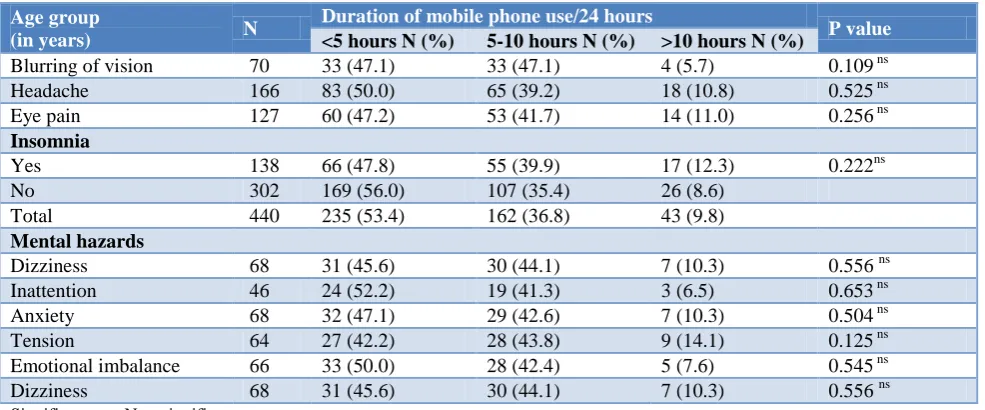
Table 6: Association between duration of mobile phone use with age of respondents, physical and mental hazards.
Variable N Duration of mobile phone use/24 hours P value
<5 hours N (%) 5-10 hours N (%) >10 hours N (%) Age group (in years)
<25 337 161 (47.8) 139 (41.2) 37 (11.0)
0.001s
26-35 71 51 (71.8) 18 (25.4) 2 (2.8)
36-45 21 15 (71.4) 4 (19.0) 2 (9.5)
>45 11 8 (72.7) 1 (9.1) 2 (18.2)
Total 440 235 (53.4) 162 (36.8) 43 (9.8)
Physical discomfort
Pain in shoulder 61 30 (49.2) 25 (41.0) 6 (9.8) 0.752ns
Pain in hand 63 31 (49.2) 25 (39.7) 7 (11.1) 0.763 ns
Back pain 51 24 (47.1) 21 (41.2) 6 (11.8) 0.617 ns
Age group
(in years) N
Duration of mobile phone use/24 hours
P value
<5 hours N (%) 5-10 hours N (%) >10 hours N (%)
Blurring of vision 70 33 (47.1) 33 (47.1) 4 (5.7) 0.109 ns
Headache 166 83 (50.0) 65 (39.2) 18 (10.8) 0.525 ns
Eye pain 127 60 (47.2) 53 (41.7) 14 (11.0) 0.256 ns
Insomnia
Yes 138 66 (47.8) 55 (39.9) 17 (12.3) 0.222ns
No 302 169 (56.0) 107 (35.4) 26 (8.6)
Total 440 235 (53.4) 162 (36.8) 43 (9.8)
Mental hazards
Dizziness 68 31 (45.6) 30 (44.1) 7 (10.3) 0.556 ns
Inattention 46 24 (52.2) 19 (41.3) 3 (6.5) 0.653 ns
Anxiety 68 32 (47.1) 29 (42.6) 7 (10.3) 0.504 ns
Tension 64 27 (42.2) 28 (43.8) 9 (14.1) 0.125 ns
Emotional imbalance 66 33 (50.0) 28 (42.4) 5 (7.6) 0.545 ns
Dizziness 68 31 (45.6) 30 (44.1) 7 (10.3) 0.556 ns
s: Significant; ns: Non-significant.
Table 7: Association between ear problem and use of ear phone or mobile phone.
Ear problem N
Use any earphone during using
mobile devices P value
Yes N (%) No N (%)
Yes 91 78 (85.7) 13 (14.3)
0.002s
No 349 244 (69.9) 105 (30.1)
Total 440 322 (73.2) 118 (26.8)
s: Significant.
Table 8: Association between prolong use of mobile devices with poor academic performance and impairment of family life.
Poor academic
performance N
Duration of mobile phone use/24 hours
P value
<5 hours N (%) 5-10 hours N (%) >10 hours N (%)
Yes 65 27 (41.5) 30 (46.2) 8 (12.3)
0.115ns
No 375 208 (55.5) 132 (35.2) 35 (9.3)
Total 440 235 (53.4) 162 (36.8) 43 (9.8)
Hamper family life
Yes 208 105 (50.5) 82 (39.4) 21 (10.1)
0.496ns
No 232 130 (56.0) 80 (34.5) 22 (9.5)
Total 440 235 (53.4) 162 (36.8) 43 (9.8)
ns: Non-significant.
This study assessed the association between age of respondents and time spent on smart phone and devices, which was statistically significant (p<0.05) and therewas no significant association between total usage time of mobile devices with physical discomfort, insomnia and mental hazards (p>0.05) (Table 6). The association between ear problems and use of ear phones was statistically significant (p<0.05) (Table 7). The association between prolong use of mobile devices with poor academic performance and impact on family life was not significant (p>0.05) (Table 8).
DISCUSSION
This descriptive type of cross sectional study was carried out with the objective to assess the impact of smart phone
and mobile devices on human health and life. Among 440 respondents majority of them 268 (60.9%) were males with mostly 337 (76.6%) below 25 years age, 317 (72.0%) were students and maximum 331 (75.2%) were unmarried.
exposure to radio frequency radiation waves may have a negative impact on tissues that are near the handset, such as the auditory nerve. These risks include tumours, acoustic neuromas, and other potential concerns. Also that audiologic disturbances may be increased with increase in cell phone usage.5,6 These findings were similar to the present study.
According to our work, 37.7% suffered from headache, followed by 28.9% and 42.9% from eye pain and ear pain, respectively. Almost half 223 (50.7%) suffered from experienced lack of concentration. Qasim et al found similar results that most smart phone users suffer from headaches (65.5%), eye irritation (66.7%) and ear problems (72.5%), also there was a strong relation between the time spent using smart phones and these variables.7 Another similar study by Acharya, found that the most common symptom was headache followed by irritability and lack of concentration.1
We found that only 31.4% (138) suffered from sleep disturbance but majority 262 (59.5%) kept their mobile set at bedside during sleep and maximum 214 (48.6%) used smart phone for 1-2 hours before sleep at night. There was no significant association between insomnia or sleep disturbance and use of mobile phone. Some other researchers found different results compared to our work where some young peoples’ sleep was disturbed when friends gave a phone call or texted messages.8,9 A cross-sectional study on “effects of smart phones on sleep” was conducted among 236 undergraduate students of SKIMS Medical College, Srinagar, Jammu and Kashmir from October 2017 to December 2017, where 62.7% were identified as poor sleepers.9
A large group 398(90.5%) used smart phone for communication followed by entertainment 2.7%, study 2.5%, browsing 2.3%, business 2.7%, others 3.6% with majority 235 (53.4%) used smart phone less than 5 hours daily. It was also found that, majority of the respondents 289 (65.7%) had other electronic devices, among them majority were laptop 197 (68.1%) users. Maximum 118 (40.8%) used electronic devices for studying while majority 227 (78.5%) used for less than 5 hours daily. Nawwaz et al found that their subjects spent 137 minutes on mobile daily on average, 16% used for alarm, 15% played games, 13% played songs, 12% used camera,11% used calculator, 11% used calendar and 8% used to listen to radio.10 These findings differed from our study. Another research found that 45% of urban population used mobile for entertainment while 65% of rural population used for entertainment.11
This study assessed the association between prolong use of mobile device with poor academic performance which was not statistically significant. Nawaz et al found that, time spent on mobile daily and time spent in studying were inversely related with each other which was comparable to our study.12 They also found that on average a student’s pocket money is 1179 rupees and
spent 632 rupees on mobile. In our study, majority 224 (50.9%) spent 500-1000 taka for mobile phones monthly. These findings were similar to our study.
The present study revealed that duration of use of smart phone was less than 5 hours daily for majority 235 (53.4%) which was similar to a study in Switzerland where maximum used their phones for 1- 2 hours 501 (33%).12
There was no significant association between prolong use of mobile devices with anxiety, depression and tension, lack of concentration in our work. Youssef et al found that mobile phone use was significantly associated with vertigo, tinnitus and dizziness.3 Pamukcu et al found that women significantly complained more often of headache, vertigo or dizziness, fatigue, forgetfulness and tension-anxiety than men.13 These findings contradict with our study.
CONCLUSION
Use of mobile smart devices acts as a risk factor for development of various types of disease in human body and hampers our family life. Thus it is suggested that excessive use of mobile phones should be avoided and social awareness should be increased through health programmes. In this research we tried to bring attention to the potential risks that cell phones and other devices can cause to users and provide some solutions as how to mitigate side-effects of cell phones and mobile devices on the users by limiting its use.
Funding: No funding sources Conflict of interest: None declared
Ethical approval: The study was approved by the Institutional Ethics Committee
REFERENCES
1. Acharya JP, Acharya I, Waghrey D. A study on some of the common health effects of cell-phones amongst college students. J Community Med Health Educ. 2013;3:214.
2. Navied U, Rashid N, Sultan Q. Implication of facebook usage on social behavior of teenagers in public and private institutes of Lahore. Biomedica. 2017;33(1):14-9.
3. Youssef M, Mansour T, Abdelsalam HA. The
relationship between mobile phone use and ear Problems among medical students. Biomed Res. 2016;27(4):1251-4.
4. Meo SA, Al-Drees AM. Mobile phone
related-hazards and subjective hearing and vision symptoms in the Saudi population. Int J Occup Med Environ Health. 2005;18(1):53-7.
6. Galeev AL. The effects of microwave radiation from mobile telephones on humans and animals. Neuro sci Behav Physiol. 2000;30(2):187-94.
7. Qasim T, Obeidat M, Al-Sharairi S. The effect of smart phones on human health relative to user’s addiction: a study on a wide range of audiences in Jordan. Intl J Med Health Sci. 2017;11(5):304-7. 8. Anderson L. Sleepless teens spend half the night
calling friends. The Advertiser; 2003: 7.
9. Nowreen N, Ahad F. Effect of smart phone usage on quality of sleep in medical students. Natl J Physiol Pharm Pharmacol. 2018;8(10):1366-70.
10. Nawaz S, Ahmad Z. Statistical study of impact of mobile on student’s life. IOSR J Human Soc Sci. 2012;2(1):43-9.
11. Gyeltshen T, Dema D. How Cell phone Changed
Bhutanese Society. Available at:
https://www.academia.edu/15601976/How_have_Ce ll_Phones_changed_Bhutanese_Society. Accessed on 3 December 2018.
12. Haug S, Castro RP, Kwon M, Filler A, Kowatsch T, Schaub MP. Smartphone use and smartphone addiction among young people in Switzerland. J Behav Addict. 2015;4(4):299-307.
13. Kucer N, Pamukcu T. Self-reported symptoms associated with exposure to electromagnetic fields: a questionnaire study. Electromagnet Biol Med. 2013;3:1-4.