Correlation Analysis In The Triger Modeling
Process
Tetyana D. Sherban, Inokentii O. Korniienko, Olga Yu. Voronova, Taisayu.Yamchuk
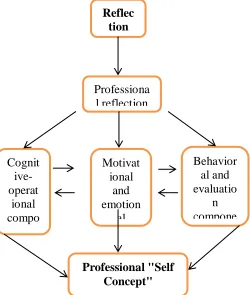
Abstract: . The article reflects the study results of the search for trigger points in the process of trigger modeling for the development of psychological properties that are components of professional development. Based on the theoretical analysis, a model of the three-component psychological structure of professional reflection of preschool education specialists has been identified: cognitive-operational, motivational-emotional and behavioral-evaluative. Reflection is considered as a human ability to arbitrarily manipulate images in the internal plane and direct a beam of awareness to those objects and mechanisms that, as a rule, remain unconscious. Professional reflection (that is, the focus of consciousness on oneself as a specialist, on the con tent of one's professional actions, in the performance of professional tasks) is an important factor in professionalism, competenc e, professional maturity, as it increases the efficiency of solving a wide range of everyday pedagogical tasks. Professional reflection is an important mecha nism of the process of self-regulation both at the operational-technical and motivational levels, since it allows a person to take an external position in relation to himself/herself and his/her actions, which makes their conscious regulation possible. In order to confirm the professional reflection structural model of specialists of preschool education institutions, a factor analysis has been carried out. Based on the results of this analysis, 4 factors have been identified that take into account the structural units of the three-component model. To search for sensitive triggers for the development of reflection in the context of the proposed three-component model, a correlation analysis has been carried out using the r-Pearson correlation criterion. Based on the results of correlation analysis, it is possible to design the development of the reflectivity of future kindergarten teachers by developing the qualities-triggers. A program of integrative training of professional reflection has been developed, that is aimed at the implementation of psychological conditions and the development of professional reflection in three vectors: cognitive-operational, motivational-emotional and behavioral-evaluative, which involves the development of certain reflective skills in the field of professional activity of future kindergarten teachers of preschool educational institutions.
Key words: reflection; professional reflection; structural model of professional reflection; trigger modeling.
—————————— ——————————
1. INTRODUCTION
Today, society requires higher education to train specialists capable of performing productive functions effectively and successfully. For this, universities need to use professional models of a modern specific specialist. Such models include professional knowledge, practical skills, communication and interaction skills, mastery of self-education and self-realization methods. In this context, the leading property of the individual is professional reflection, which is also the basis of the professional model of the specialist. According to such models, higher education institutions should develop and implement training models for the required specialists. Formation of models of vocational training should be scientifically grounded, based on the results of modern scientific researches in psychology, use technologies that are objective and non-manipulative. One of such technologies is trigger modeling. Trigger models are based on probabilistic-statistical analysis, assessment of phenomena and use an algorithmic approach. The basis of trigger models is the determination of trigger points. In many psychological studies, it is necessary to determine what causes certain behavioral reactions. The answer to this question can give the calculation of trigger points. So a trigger is an irritant, a stimulant that can cause a certain behavior or a certain effect. That is, by developing "trigger points" we can improve all indicators of the trigger model. The problem of using trigger models has been reflected in many scientific papers. However, the issue of the specific methodology for finding trigger points remains open. The use of trigger points to build a trigger model for the development of psychological properties that are components of a vocational training model is of particular importance. Thus, the conducted research confirms the need to revise modern professional-psychological models of specialist training. In such models, psychological properties are becoming increasingly important – triggers that affect self-development and professional self-improvement. Then, an
important task of higher education is to create optimal conditions for the formation and development of professional reflection of future professionals. The purpose of the article. Thus, the relevance of the study led to its purpose – to develop a method of applying correlation and factor analysis in the construction of a trigger model of vocational training.
2.
THEORETICAL BASIS OF THE RESEARCH
work; the desire to improve one‘s reflective skills); 3) behavioral-evaluation – self-esteem (of knowledge, skills and professionally significant personal qualities); self-control; correction.
Fig. 1. Structural model of professional reflection of preschool education institution specialists
Thus, on the basis of theoretical generalization, we have identified a model for the formation of professional reflection of future kindergarten teachers [18]. This model should be formed in the process of training. In other words, vocational training at the institution of higher education should be aimed at the development of professional reflection. In order to optimize this process, it is necessary: firstly, to identify trigger points (sensitive properties); secondly, to develop a program for the development of professional reflection through the influence on triggers. Thus, the process of development of reflection will be optimized, because it is necessary to influence only part of the factors (triggers), and the development of these triggers determines the development of all other indicators.
3.
RESEARCH METHODOLOGY
A complex of theoretical, empirical and statistical methods has been used in the study, namely:
- theoretical: analysis, synthesis and generalization of materials presented in the scientific literature on the problem under study; - empirical - psychodiagnostic techniques: ―Diagnosis of reflection‖ (A. V. Karpov) [19]; ―self-attitude‖ questionnaire (V.V. Stolin, S.R. Panteleev) [20]; methodology ―Diagnostics of interpersonal relations‖ (T. Leary, adaptation L. N. Sobchik) [21]; the methodology aimed at studying the level of subjective control (E. F. Bazhyn, E. A. Golinkin, O. M. Etkind) [22];
methodology ―Study of emotional-volitional qualities‖ (J. H. Taylor, G. Yu. Aizenck, D. Roong, J. Rotter, processing by A. S. Kondratieva) [23]; A. O. Rean's methodology ―Motivation for success and fear of failure‖ [24].
- statistical: methods of mathematical statistics - correlation and factor analysis; IBM SPSS Statistics 21 software.
Experimental work was carried out on the basis of Mukachevo State University. The total number of respondents (students of 1-3-4 year of study of pedagogical faculty; employees of institutions of pre-school education) was 120 persons.
4.
RESULTS OF THE RESEARCH
Summarizing, it is possible to distinguish the tasks of empirical research: to check the structural model of professional reflection highlighted on the basis of theoretical generalization; to find trigger points (sensitive properties); to develop a trigger model for the development of professional reflection of future kindergarten teachers. A factor analysis has been performed to confirm the structural model of professional reflection of education specialists. For this purpose, research data were used according to the methods of Diagnosis of reflection (DR), self-attitude questionnaire (SAQ), Diagnostics of interpersonal relations (DIR), Level of subjective control (LSC) and Study of emotional-volitional qualities (EVQ). Factor analysis resulted in factors that included scales from the listed questionnaires. Despite the fact that 4 factors have been identified, they generally correspond to the general theoretical model of the concept of reflection and take into account the structural units of the three-component model. To find sensitive triggers for the development of reflection in the context of the proposed three-component model, a correlation analysis has been performed using the r-Pearson correlation criterion. This analysis has identified the most sensitive personal constructs, influencing which it is possible to improve, optimize the reflection of the future teacher in the context of all selected components. Therefore, the following correlation relationships of the scales have been found using the following methods. A strong correlation between the index of "reflection" according to the method DR with the scales "global self-esteem" (scale S) (r = 0,617 at p = 0,01) and confidence" (scale 1) (r = 0,566 at p = 0 , 01) and "self-blame" (scale V) (r = 0,556 at p = 0,01) according to the SAQ method. The obtained result indicates an increase in the level of self-esteem - a person‘s ability to turn to the beginning of his/her actions, thoughts, the ability to take the position of an outside observer, reflect on what he/she is doing, how cognizes. Such a connection is not only a natural result, but a result of training. The connection with the ―self-confidence‖ scale is explained by the fact that this property is a consequence of a positive assessment by an individual of his/her own skills and abilities, as sufficient to achieve professional goals that are significant for him/her and satisfy his/her needs. During the training of students, their professional self-confidence grows. Gaining professional experience while undergoing practical training, students analyze themselves, their behavior, that is, conduct a reflective analysis. A significant relationship has been diagnosed with ‗self-respect‖ indicators (scale I) (r = 0.433 at p < 0.01), ―self-interest‖ indicator (scale IV) (r = 0.428 at p < 0.01) and ―self-interest‖ ( scale 6) (r = 0.447 at
Reflec
tion
Professiona
l reflection
Behavior
al and
evaluatio
n
compone
nt
Motivat
ional
and
emotion
al
compon
ent
Cognit
ive-operat
ional
compo
nent
p < 0.01) according to the SAQ method. The "self-respect" scale reflects that aspect of self-esteem that unites emotionally and meaningfully the belief in one's strength, abilities, independence, allows to control one‘s professional life, to understand oneself in the future profession. This positive fact is explained by the acquisition of professional skills. Therefore, it is very important to stimulate students' self-interest in the process of preparing future preschool education professionals to develop their self-respect. Moderately correlate the indicators ―self-understanding‖ (scale 7) according to the SAQ methodology (r = 0.347 at p < 0.01) and ―responsibly-generous‖ (scale VIIII S-r) according to the DIR methodology (r = 0.301 at p < 0.01). This is a positive dynamics. Self-understanding is ―coming to oneself‖, carried out through awareness of the content of internal reality in the process of personality development. It is also advisable to note that by acquiring theoretical and practical knowledge, future specialists of pre-school education institutions are willing to help others, are characterized by a developed sense of responsibility. A moderate inverse correlation of the ―aggressive‖ scale (III octant S-r) (r = -0.332 at p < 0.01) and the ―suspicious‖ scale (IV octant S-r) (r = -0.376 at p < 0.01 ) according to the DIR method with the ―dominant-leading‖ scale (I octant S-i) according to the DIR method have been diagnosed. This indicates that over-evaluation of one‘s own abilities, severity and harshness in evaluating others, a tendency to doubt everything can inhibit interpersonal contacts due to uncertainty in self, suspicion and fear of a bad attitude. A moderate inverse correlation between the indicator of the scale "authoritarian" (I octant S-i) according to the DIR method with the indicator of the scale of "internality in the sphere of industrial relations" according to the method of LSC (r = -0,35 at p < 0,01) have been stated. The value of both scales decreases among the first and fifth year students. This indicates that subjects tend to attach more importance to external circumstances - seniors, teammates, luck/setbacks. A moderate correlation has been found between the ―authoritarian‖ scale (I octant S-i) (r = 0.36 at p < 0.01), ―selfish‖ (II octant S-i) (r = 0.30 at p < 0, 01) according to the method of DIR with the scale "internality in the sphere of interpersonal relations" according to the method of LSC. This is a positive trend. In the process of education, future specialists of preschool education institutions learn to control their formal and informal relations with colleagues, with other people, to arise respect and sympathy to themselves, and consider themselves responsible for building interpersonal relationships. Positive correlation between the ―selfish‖ scale (II octant S-i) according to the DIR method with the ―cooperative-conventional‖ scale (r = 0.31 at p < 0.01) (VII octant S-r) according to the DIR method has been revealed. This link indicates that sometimes an adequate propensity for rivalry can contribute to a positive dynamic in the group. The scale ―internality in the field of interpersonal relationships‖ according to the methodology LSC with a group of indicators has positive correlation. Notable is the correlation relationship of the ―dominant-leading‖ (I-octant S-i) scales (r = 0.43 at p < 0.01); "rectilinear-aggressive" (III octant S-i) (r = 0.43 at p < 0.01); "responsible- generous" (VIII octant S-i) (r = 0.44 at p = 0.01) according to the method of DIR. Moderate correlation with ―independent-dominant‖ indicators (II octant S-i) (r = 0.30 at p < 0.01);
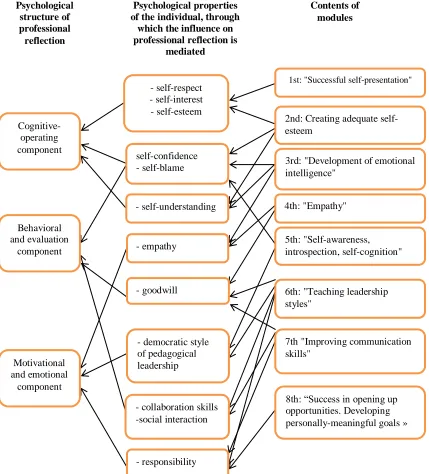
and esteem, attitude; respect and self-confidence; self-interest ; self-understanding, etc.). Indeed, affecting sensitive triggers, we can get a change in all indicators of the structural model of professional reflection. According to the results of the correlation analysis, it is possible to design the development of the reflectivity of future kindergarten teachers by developing the qualities-triggers. The development of triggers has become the basis of the content-dynamic model of the formation of professional reflection in future kindergarten teachers (see Fig. 2). This model is the basis of vocational training and can be implemented in training.
Figure 2. The content-dynamic model of professional reflection formation in future specialists of preschool institutions
Psychological structure of professional reflection
Psychological properties of the individual, through
which the influence on professional reflection is
mediated
Contents of modules
1st: "Successful self-presentation"
2nd: Creating adequate self-esteem
3rd: "Development of emotional intelligence"
4th: "Empathy"
5th: "Self-awareness, introspection, self-cognition"
6th: "Teaching leadership styles"
7th "Improving communication skills"
8th: “Success in opening up opportunities. Developing personally-meaningful goals » - self-respect
- self-interest - self-esteem
self-confidence - self-blame
- self-understanding
- empathy
- goodwill
- democratic style of pedagogical leadership
- collaboration skills -social interaction
- responsibility
Cognitive-operating component
Behavioral and evaluation
component
Motivational and emotional
According to this model, the influence on the development of professional reflection (its structural components) is mediated through a series of triggers (psychological properties of student personality) that have been identified through correlation analysis. Moreover, the development of these triggers (to which the content of training modules is directed) is both a purpose of training and a means of influencing the formation of professional reflection as a process that begins at the institution of higher education and continues throughout the professional life of the person. In the proposed integrative training, the formation of professional reflection is carried out not only by focusing on conscious, purposeful work on their psychological characteristics, but due to the use of the procedure for updating reflection (which, in particular, contributes to the acquisition of new skills, new ways of professional activity). Thus, the theoretical model presents the conditions for the development of professional reflection, namely: 1) stimulation and support of reflexive processes, in particular, the use of reflexive programming, certain types of control of reflexive processes and structures, reflexive simulation; 2) a problematic approach; 3) taking into account the age-related psychological characteristics of student youth and the characteristics of their leading activities; 4) the development of personality traits through which the influence on professional reflection is mediated; 5) professional and psychological direction of training.
5.
CONCLUSIONS AND PROSPECTS OF THE
RESEARCH
The use of trigger modeling in scientific research helps to determine more clearly the determinants by which further development can be optimized. Reflection is one of the important factors in personal self-development in general and professional development in particular. Based on a generalization of theoretical principles and the results of empirical research, a structural model of professional reflection of preschool education specialists has been presented, in which the components are distinguished: 1) cognitive-operational – knowledge and reflective skills; 2) motivational-emotional – needs and motives in the implementation of professional reflection; 3) behavioral-evaluative – self-esteem, self-control; correction. The empirical study made it possible to: check the structural model of professional reflection highlighted on the basis of theoretical generalization; find trigger points (sensitive properties); develop a trigger model for the development of professional reflection of future kindergarten teachers. To confirm the structural model of professional reflection of educational institutions specialists, a factor analysis has been carried out. To find sensitive triggers for the development of reflection in the context of the proposed three-component model, a correlation analysis has been performed using the r-Pearson correlation criterion. This analysis has identified the most sensitive personal constructs, influencing which it is possible to improve, optimize the reflection of the future teacher in the context of all selected components. The development of triggers has become the basis of a content-dynamic model of the formation of future kindergarten teachers‘ professional reflection, which is the basis of professional training. Based on the results of the study, a program of integrative training of professional reflection has been developed. The purpose
of the training was the realization of psychological conditions and the development of professional reflection in three vectors: cognitive-operative, motivational-emotional and behavioral-evaluative, which implies the development of certain reflexive skills and skills in the field of professional activity of future kindergarten teachers. The practical significance of the results lies in the fact that developed integrative training of professional reflection can be used to improve the educational process at higher education institutions that train specialists for preschool education, as well as in refresher education courses. The implementation of the developed program should become an integral part of the training of students at pedagogical universities, and the end result should be the creation of such training parameters for a teacher at a preschool educational institution, in which purposeful development of professional reflection becomes possible, which, in turn, will significantly improve the quality of training of specialists.
6 REFERENCES
[1]K. A. Abulkhanova, Psychology and consciousness of personality (problems of methodology, theory and the research of personality). Izbrannie psykholohycheskye trudi. Voronezh, 1999 (in Russian).
[2]H. S. Kostiuk, Training and personal development. Educational process and mental development of the personality. Kyiv: Rad. Shkola, 1985 (in Russian).
[3]A.N. Leontev, Activity. Consciousness. Personality. 2-e yzd. Moskva: Polytyzdat, 1997 (in Russian). [4]S. D. Maksymenko, K. S. Maksymenko, M. V.
Papucha, Personality psychology: a textbook. Kyiv : TOV KMM, 2007 (in Ukrainian).
[5]T. D. Shcherban, Psychological principles of teacher training. Aktualni problemy rozvytku osobystosti v suchasnomu suspilstvi : monohrafiia / za zah. redaktsiieiu T.D. Shcherban. Mukachevo : Interservis, 2015, s.218-234. (in Ukrainian).
[6]Yu. M. Shvalb, The psychological organization of the individual‘s life space: the logos of everyday life. Aktualni problemy psykholohii: Zbirnyk naukovykh prats Instytutu psykholohii imeni H.S.Kostiuka NAPN Ukrainy. Zhytomyr : «Vyd-vo ZhDU imeni I. Franka», T.VII. Ekolohichna psykholohiia, Vyp. 29, 2012, p.478 – 486 (in Russian).
[7]I.O. Korniienko, Student coping behavior strategies in a failure situation : monograph. Mukachevo, 2011 p. 292 (in Ukrainian).
[8]R. Т. Clift, R. Houston, M. C. Pugach, Encouraging Reflective Practice in Education: An Analysis of Issues and Programs. Teaching Education. Volume 8, Issue 1, 1996, pp. 173-175. (in English). [9]L. Valli, Reflective teacher education: Cases and
critiques. New York : State University of New York Press, Albany, 1992. (in English).
[11]F. A. J. Korthagen ―Reflectie en de professionele ontwikkeling van leraren‖, Pedagogische Studiën. № 69 (2), 1992, pp. 112-123. (in Dutch).
[12]L. F. Burlachuk, Psychodiagnostics: Textbook for universities. 2-e yzd. SPb.: Pyter, 2008 (in Russian).
[13]M. B. Yevtukh, M. S. Kulyk, E. V. Luzik, T. V. Ilina, Mathematical modeling in psychological and sociological research: A textbook.. K.:, 2011 (in Ukrainian).
[14]A.M. Vein, Pain syndromes in neurological practice. M.: MEDpressynform, 1999 (in Russian). [15]R. H. Esyn, F. Y. Devlykamova, A. V. Karlov, ―
Myofascial trigger zone - a local phenomenon with generalized consequences‖, Nevrolohycheskyi zhurnal, № 4, 2002, p. 21-24 (in Russian). [16]O. O. Korolovych ―Trigger model for ensuring the
financial security of small business‖, Formation of modern economic area benefits, risks, implementatition mechanisms: proceedings of the Conference, Part III, s.184-187 (April 29, 2016), Tbilisi, 2016 (in Ukrainian).
[17]D. A. Leontev, ―The psychology of meaning. Nature, structure and dynamics of semantic reality‖: monograph ‖: monohrafyia. Moskva : Smisl, 1999. p. 486 (in Russian).
[18]O. Yu. Voronova, ―Model of reflection in the professional activity of teacher-educator‖, Aktualni problemy psykholohii: Zbirnyk naukovykh prats Instytutu psykholohii im. H. S. Kostiuka NAPN Ukrainy. Zhytomyr : Vyd-vo ZhDU im. I. Franka, Tom VII. Ekolohichna psykholohiia. № 36, 2014, p. 113-120 (in Ukrainian).
[19]A.V. Karpov, Psychology of reflexive mechanisms of activity. Moskva : Yzd-vo «Ynstytut psykholohyy RAN», 2004 (in Russian).
[20]V. V. Stolyn, S. R. Pantyleev, Self-Relationship Questionnaire. Workshop on psychodiagnostics: Psychodiagnostic materials. Moskva, s. 123-130, 1988 (in Russian).
[21]L. N. Sobchyk, ―Diagnostics of interpersonal relationships. A modified version of the interpersonal diagnosis T. Liri method. Guide‖, Metodi psykholohycheskoi dyahnostyky, Vip. 3, s. 64-67, Moskva, 1990 (in Russian).
[22]E. F. Bazhyn, E. A. Holinkyna, A. M. Etkynd, ― The method of the level of subjective control researching‖. Psykholohycheskyi zhurnal. Tom 5, № 3, s. 153-154, 1984 (in Russian).
[23]S. B. Kominko, H. V. Kucher, Diagnosis of temperament and character. Best Psychodiagnostic Methods: A Tutorial. Ternopil : Kart-blansh, p. 95-219, 2005 (in Ukrainian).
[24]A. A. Rean Psychology and psychodiagnostics of personality: [theory, research methods, practical work: practical armory of psychologist]. Praim-Evroznak, 2008, s. 178-182 (in Russian).
[25]Tetyana D. Sherban, DSc in Psychology, Professorof Psychology Department of Mukachevo State University, (Mukachevo, Ukraine)mail: [email protected]
[26]https://orcid.org/0000-0002-3702-8029
[27] Inokentii O. Korniienko, DSc in Psychology, Associate Professorof Psychology Department of Mukachevo State University, (Mukachevo, Ukraine)mail: [email protected]
[28]https://orcid.org/0000-0003-1451-4128
[29]Olga Yu. Voronova, PhD in Psychology, Senior lecturer of Psychology Department of Mukachevo State University, (Mukachevo, Ukraine)mail: [email protected]
[30]https://orcid.org/0000-0002-6504-240Х
[31]Taisa Yu.Yamchuk, PhD in Psychology,Senior lecturer of Psychology Department of Mukachevo State University, (Mukachevo, Ukraine)mail: [email protected]