183
Effects Of Material Management Techniques On
Construction Project Success: Perspective Of
Material Managers In Northern Region Of Ghana
Napoleon Kuebutornye D.K., Eugene Ayoakateng S., Asubonteng A Joseph., Tom Asigri., Alubokin Anthony A.
Abstract: Construction materials management process is key to the success of a construction project; however, globally, the problem of material management is a critical issue in the construction industry; especially in the developing economies of which Ghana is no exception. This study sought to identify and assess the material management techniques required for construction firms in the Tamale Metropolis of Ghana. Using empirical data obtained from administering questionnaires to 96 material management personnel in Tamale Metropolis. The data was analyzed using descriptive and inferential statistics such as factor analysis, and Pearson product moment correlation coefficient. The study adopted descriptive quantitative survey approach. Using empirical data obtained from ninety-six administered questionnaires of material managers in Tamale Metropolis; the data was analyzed using descriptive and inferential statistics such as factor analysis, and Pearson product moment correlation coefficient. The study indicated that firms often employed store keepers and security personnel on site; list of materials in project that includes for example (material name, material number and unit price), and provide clear specifications to suppliers. However, they seldom use ICT; and rarely offer training for their workers. The study further revealed that planning and monitoring of material schedule; establishing good business relations with suppliers; the use of security measures on site; use of information communication technology; and also use of competent workers as well as effective training of workers is significant for effective material management on construction site, and has direct effect on construction project delivery success. The study therefore concluded that the more the number of the material management approach adopted on a project, the higher the project delivery success. It was recommended that construction companies should make use of more than one material management technique on construction projects so as to achieve maximum project delivery success.
Index Terms: Techniques, effective, material, management, project success.
————————————————————
1 Introduction
The construction industry plays an important role in the economy and the activities of the industry are vital to the achievement of national socio-economic development goals such as shelter, infrastructure and employment. Shen and Tam (2002) indicated that the construction industry plays an important role in meeting the needs of society and enhancing quality of life. Construction has been an important player in many countries economy, especially developing countries. The sector currently accounts for more than 11% of global GDP (Betts et al., 2011). The construction industry is becoming increasingly competitive and materials management is now considered to be one of the frontiers for cost reduction to improve profitability and productivity, as construction materials constitute a major cost component in any construction project. The total cost of installed materials (or value of materials) may be 50% or more of the total cost (Stukhart, 1995), even though the factory cost may be a minor part of the total, probably less than 20-30%. This is because the item must be stored, transported, and re-stored before it is put in place or "consumed" at the site. The total cost of materials includes, in addition to the manufacturer’s selling cost, the cost of procurement (cost of placing, processing and paying the material, physical distribution, the distributor's cost, and the transportation of the materials), and the site-handling costs (cost of receiving, storage, issuing, and disposal) (Haddad, 2006). The efficient procurement and handling of material represent a key role in the successful completion of any project. It is important for the contractor to consider that, there may be significant difference in the date that the material was requested or date when the purchase order was made and the time at which the material will be delivered. These delays can occur if the contractor needs a large quantity of materials which the supplier is not able to produce at the time or by any other factors beyond his control. The contractor should always consider that procurement of materials is a potential cause for delay (Haddad, 2006). Ballot (1971 as cited
appropriately specified on time, are obtained at a reasonable cost and are available when needed. Dobler and Burt (2009) stated that material management is designed to improve the activities related to the flow of materials. They added that material management should coordinate purchasing, inventory control, receiving, warehousing, materials handling, planning, and transportation. Materials management involves an integrated coordination of all material related functions. These functions can be carried out efficiently only when sufficient emphasis is placed on early project planning, use of qualified personnel, adequate personnel training and proper communication amongst those involved in the process (Keitany & Mutwol, 2014). According to Ebole (2005), the essential and desired site materials management characteristics of right quality, right quantity, right time and reasonable cost are evidently scarce on construction projects as it is characterized by emergency purchases of materials, inadequate storage, material shortages and sometimes condemnation of materials and works by consultants. Past research has revealed that effective material management techniques contribute to construction project success with respect to delivery time, project cost, quality, and safety (Ademeso & Windapo, 2012; Keitany & Mutwol, 2014; Sundararaja & Shanmugapriya, 2014). Therefore, it is believed that effective implementation of effective materials management techniques could go a long way to enhance project success in the Ghanaian construction industry. It is against this background that this study is conducted to identify and assess the effect of effective materials management practices on construction project success to enhance the industry’s development and the economy at large.
2. Research Justification
Anecdotal evidence indicates that the essential and desired site materials characteristics (materials attribute) of right quality, right quantity, right time and reasonable cost are evidently scarce on construction project sites particularly, in the Northern Region. According to Association of Building and Civil Engineering Contractors of Ghana (2015), Transport difficulties, improper handling of construction materials on site, misuse of specification, lack of proper work plan, inappropriate materials delivery and excessive paperwork, all adversely affect materials management practices on most sites in the Northern Region. Similarly an interview conducted with Architectural and Engineering Service Limited Northern Region (2016), revealed that, most construction project sites in the Northern region are characterized by emergency purchases of materials, inadequate storage, double handling of materials, material shortages, theft and sometimes condemnation of materials and works by consultants. All these problems have associations with poor materials management practices used on project sites. Although, effective management of materials can lead to a reduction in cost, enhance project delivery time, enhance quality and reduces health and safety problems on site resulting in a significant saving, yet effective materials management techniques have not received a lot of attention on most project sites in the Northern region of Ghana. Additionally, it is found that there is a significant relationship between effective materials management practices and project delivery success hence, this project is aimed at examining the effect of effective materials management practices on construction project delivery success; as it focuses on effective materials
management techniques, safety management and quality management practices on sites. The aforementioned arguments underscore the objectives of this paper.
3. Research Design
The study made use of both quantitative and qualitative research tools. Thus, survey design was used because the study sought to examine the effect of material management technique on construction project delivery success; hence, quantitative survey approach using structured questionnaire was deemed appropriate. The qualitative aspect of the design took the form of description of the analyzed data to make more meaning. The population for the study comprised material managers of construction firms in the Tamale Metropolis of Ghana currently registered with the Association of Building and Civil Engineering Contractors of Ghana (ABCECG). The main reason for using this category of people is that their activities directly or indirectly have a bearing on material management techniques practices in their various firms.
3.1 Purpose of the Research
The purpose of this study is to examine the effect of materials management techniques on construction project delivery success. The specific objective is: To evaluate the effect of the identified materials management techniques on construction project delivery success. The study is significant for the following reasons. Construction firms would be aware of the efficient materials management practices to be adopted to ensure project success. Findings from the study will help the stakeholders to develop policies and practices that could improve material management on sites. The study will serve as a reference material for other researchers.
3.2 Method of Data Analysis
The data was analyzed using descriptive statistics which include mean, standard deviation, frequency and percentages. This was done with the aid of Statistical Software SPSS (Statistical Package for Social Sciences). In addition descriptive statistics, Factor Analysis and Pearson’s product moment correlation coefficient (PMCC) were used (Keitanye & Mutwol, 2014; Ademeso & Windapo, 2012)
3.3 Factor Analysis
The method seeks to collapse various variables into a few dimensions of interrelated attributes called principal components. The Eigenvalue determines the principal components, which are orthogonally varimax, and are rotated to obtain more evenly distributed factor loadings within the components. The factor analytical approach was adopted to group the interrelated factors of the 15 factors identified from literature into components.
3.4 Correlation Technique
185
4 Critical Success Factors for Materials
Management on Construction Site
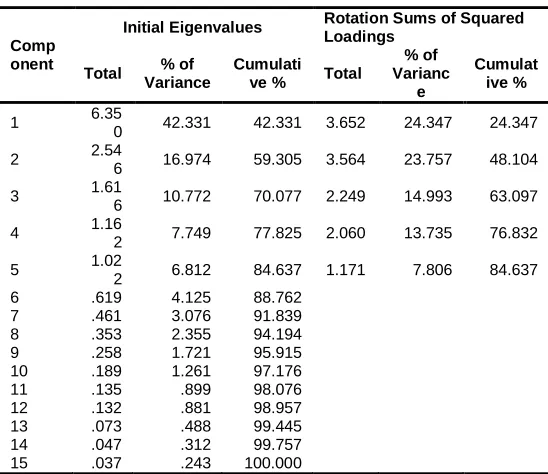
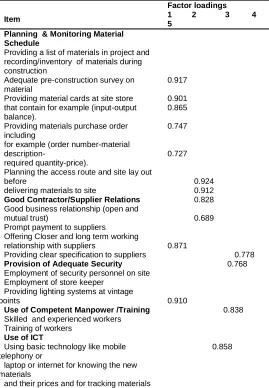
Factor analysis was used to establish the underlying interrelations existing among the many variables identified from literature and materials managers. This makes it possible to reduce the variables to a more meaningful framework to support effective management and policy decisions (Amoah, Ahadzie & Dansoh, 2012). The rotated component matrix of the significant factors is presented in Table 4.1. In the preliminary analysis, the Kaiser-Meyer-Olkin (KMO) test of sampling adequacy which measures the degree to which variables are measuring a common concept, achieved a high of 0.815. Furthermore, Bartlett’s test of sphericity, which tests the hypothesis that the variables are collinear, was significant at the p < 0.01 level (see Table 4.1). Hence, PCA was found to be a suitable data reduction technique. PCA was conducted and five (5) components were extracted using Kaiser’s criterion, which retains only those components whose variance is greater than 1.0. A Varimax rotation was applied to the components to ensure the components were uncorrelated. Observation of the correlation matrix of the significant factors indicate that they all have significant correlation at the 5% level, indicating that there would be no need to eliminate any of the variables for the principal component analysis. These five (5) components explained almost 84.64% of the variation in the data (see Table 4.2). Table 4.3 shows the extracted components and the variables most strongly correlated to each one. With respect to component 1, providing a list of materials in project that includes for example (material name, material number and unit price) and recording/inventory of materials during construction emerged highest with a factor loading of (0.917). This is followed by adequate pre-construction survey on material (0.901), providing material cards at site store that contain for example (input-output balance) (0.865), providing materials purchase order including for example (order number-material description- required quantity-price) (0.747), as well as planning the access rout and site lay out before delivering materials to site (0.727) follow in that order. The combined effect of the above variables on construction materials management is 42.33%. With respect to component 2, Table 4.3 shows that good business relationship (open and mutual trust) with suppliers emerged highest with a factor loading of (0.924). This is followed by prompt payment to suppliers (0.912), offering closer and long term working relations with supplies (0.828), and providing clear specification to suppliers (0.689) follow in that order. The combined effect of the variables on construction material management is 16.97%. Table 4.3 further indicates that, employment of security personnel on site emerged highest in component 3 with a factor loading of (0.871). This is followed by employment of store keeper (0.778); and providing lighting systems at vintage points (0.768) follow in that order. The combined effect of the above variables on construction material management is 10.77%. Table 4.3 shows that use of skilled and experienced workers emerged highest in component 4 with a factor loading of (0.910); this was followed by training of workers (0.838). The combined effect of the variables on construction materials management is 7.75%. Table 4.3 indicates that using basic technology like mobile telephony or laptop or internet for knowing the new materials and their prices and for tracking materials in the opinion of the respondents should be the 5th most significant factor for construction materials management
with a factor loading of (0.858). The effect of the above variable on construction materials management is 6.81%. Given that most of the variables in factor 1 are directly linked to adequate planning and monitoring material schedule, the researcher decided to name this factor as planning and monitoring materials schedule-related factor. A cursory look at factor 2 shows that the variables are linked to good business relations, hence, the researcher named it good contractor/supplier relations -factor. Similarly, the variables in factor 3 are directly linked to security; therefore, this factor is labelled provision of adequate security-related factor. The variables in factor 4 are directly linked to the use of competent workers/training, the researcher labelled this component as competent manpower or training-related factor. The 5th factor is labelled adoption of information communication technology (ICT). The results therefore reveal that the significant factors for construction materials management in the Tamale Metropolis of Ghana could be categorized into five (5) main themes; namely: adequate planning and monitoring of materials schedule-related factor, good contractor or supplier relations-factor, adequate security-related, manpower or training-related factor, and adoption of ICT. This finding corroborates with the studies reported by authors such as (Ebole, 2005; Haddad, 2006; Donyavi & Flanagan, 2009; Maccord, 2010; Imbeah, 2012; Ademeso & Windapo, 2012) in similar studies.
Table 4.1: KMO and Bartlett's Test
Kaiser-Meyer-Olkin Measure of Sampling Adequacy. .815
Bartlett's Test of Sphericity
Approx. Chi-Square 1.745E3
Df 105
Sig. .000
Table 4.2 Total Variance Explained
Comp onent
Initial Eigenvalues Rotation Sums of Squared Loadings
Total % of Variance
Cumulati ve % Total
% of Varianc
e
Cumulat ive %
1 6.35
0 42.331 42.331 3.652 24.347 24.347
2 2.54
6 16.974 59.305 3.564 23.757 48.104
3 1.61
6 10.772 70.077 2.249 14.993 63.097
4 1.16
2 7.749 77.825 2.060 13.735 76.832
5 1.02
2 6.812 84.637 1.171 7.806 84.637
6 .619 4.125 88.762
7 .461 3.076 91.839
8 .353 2.355 94.194
9 .258 1.721 95.915
10 .189 1.261 97.176
11 .135 .899 98.076
12 .132 .881 98.957
13 .073 .488 99.445
14 .047 .312 99.757
Extraction Method: Principal Component Analysis.
Table 4.3: Principal Component Analysis of Construction
Material Management Technique
Item
Factor loadings
1 2 3 4 5
Planning & Monitoring Material Schedule
Providing a list of materials in project and recording/inventory of materials during construction
Adequate pre-construction survey on material
Providing material cards at site store that contain for example (input-output
balance).
Providing materials purchase order
including for example (order number-material
description- required quantity-price).
Planning the access route and site lay out before delivering materials to site
Good Contractor/Supplier Relations Good business relationship (open and mutual trust)
Prompt payment to suppliers Offering Closer and long term working relationship with suppliers
Providing clear specification to suppliers
Provision of Adequate Security
Employment of security personnel on site
Employment of store keeper Providing lighting systems at vintage
points
Use of Competent Manpower /Training Skilled and experienced workers
Training of workers
Use of ICT Using basic technology like mobile
telephony or laptop or internet for knowing the new
materials
and their prices and for tracking materials 0.917
0.901 0.865
0.747
0.727
0.924 0.912 0.828
0.689
0.871
0.778 0.768
0.910
0.838
0.858
4.3.1 Application of Material Management Techniques on Construction Sites
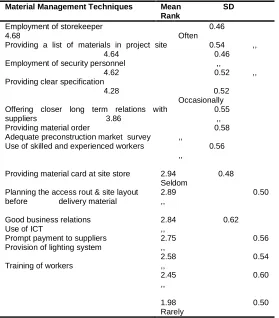
The responses of the materials managers on the level of practice of the material management techniques to project success delivery were compared, and the results showed no significant difference at 5% significance level. The responses of the groups (small, medium and large) were therefore combined. The mean value of respondents who evaluated the level of practice of the various techniques from “rarely” to “very often” are shown in Table 4.4,4.5,4.6,4.7, and 4.8, 4.9. Table 4.4 indicates that provision of adequate security had the highest mean (3.92) while the use of competent manpower or training had the lowest mean (2.70). Provision of adequate security (mean = 3.92, std = 0.50) rank first followed by planning and monitoring material schedule on site (mean = 3.53, std = 0.52); Good contractor or supplier relations (mean = 3.39, std = 0.62), Use of ICT (mean = 2.75, std = 0.54), and Use of competent manpower or training (mean = 2.70, std = 0.56) in that order. Table 4.5 shows that with regard to provision of adequate security category, employment of store keeper (mean = 4.68), followed by employment of security personnel on site (mean = 4.62), while providing
lighting systems at vintage points had a mean of (2.45). Table 4.6 shows that on planning and monitoring material schedule category, providing a list of materials in project that includes for example (material name, material number and unit price) and recording or inventory of materials during construction emerged highest with a mean of (4.64). This is followed by providing materials purchase order including for example (order number-material description- required quantity-price) (mean = 3.74), adequate pre-construction survey on material (mean = 3.46), providing material cards at site store that contain for example (input-output balance) (mean = 2.94), while planning the access route and site lay out before delivering materials to site had a mean of (2.89). Table 4.7 indicates that the use of basic information communication technology (ICT) like mobile telephony or laptop or internet for knowing the new materials and their prices and for tracking materials had a mean value of (2.75). Table 4.8 shows that regarding good contractor supplier relations category, providing clear specification to suppliers emerged highest with a mean of (4.28). This is followed by offering closer and long term working relations with suppliers (3.86); good business relationship (open and mutual trust) with suppliers had a mean of (2.84), while prompt payment to suppliers had a mean of (2.58). Table 4.9 indicates that with respect to manpower or training, the use of skilled and experienced workers emerged highest with a mean of (3.42); while training of workers had a mean of (1.98).
Table 4.4: Ranking of Application of Material Management
Techniques Category Surveyed
Category Mean Rank
Provision of Adequate Security 3.92 1 Planning /Monitoring material
schedule on site Good Contractor/Supplier Relations
The Use of ICT
3.53 3.39 2.75
2 3 4
Manpower/Training 2.70 5
Table 4.5: Ranking of Application of MM Techniques in the
Provision of Adequate Security Category
MM Techniques Mean Rank Employment of storekeeper 4.68 1 Employment of security personnel
Provision of lighting system
4.62 2.45
2 3
Table 4.6: Ranking of Application of MM Techniques in the
Planning or Monitoring Materials Schedule Category
Material Management
Techniques Mean Rank Providing a list of materials in
project 4.64 1
Providing material order Adequate pre-construction market survey
3.74 3.46
2 3
Providing material Card at site Planning the access rout and site layout before delivery of material to site
2.94 2.89
187
Table 4.7: Application of MM Techniques in the Use of ICT
Category
Material Management
Technique Mean Rank
Use of ICT 2.75 1
Table 4.8: Ranking of Application of MM Techniques in the
Contractor or Supplier Relations Category
Material Management Techniques Mean Rank Providing clear specifications to suppliers 4.28 1 Good business relations with suppliers
Offering closer and long term relations with suppliers
3.86 2.84
2 3
Prompt Payment to suppliers 2.58 4
Table 4.9: Ranking of Application of MM Techniques in the
Manpower or Training Category
Material Management
Techniques Mean Rank
Use of Skilled & Experienced
workers 3.42 1
Training of workers 1.98 2
Table 4.10: Overall Ranking of Application of MM Techniques
Surveyed
Material Management Techniques Mean SD Rank
Employment of storekeeper 4.68
Providing a list of materials in project site 4.64
Employment of security personnel 4.62 Providing clear specification
4.28
Offering closer long term relations with suppliers 3.86
Providing material order 3.74
Adequate preconstruction market survey 3.46 Use of skilled and experienced workers 3.42 0.46 Often
0.54 ,, 0.46
,,
0.52 ,,
0.52
Occasionally 0.55
,,
0.58 ,,
0.56 ,,
Providing material card at site store
Planning the access rout & site layout before delivery material
2.94 0.48 Seldom
2.89 0.50 ,,
Good business relations Use of ICT
Prompt payment to suppliers Provision of lighting system
Training of workers
2.84 0.62 ,,
2.75 0.56 ,,
2.58 0.54 ,,
2.45 0.60 ,,
1.98 0.50 Rarely
Table 4.11: Effect of the Material Management Techniques on
Project Delivery Success
Effect Mean SD
Improvement in labour productivity
Improvement in project schedule
Better relations with suppliers
4.24 3.88 3.84
0.55 0.54 0.50
Improved cooperation and communication
Reduces the overall cost of materials
3.82 3.78
0.48 0.42
Increased profitability
Improved the quality of the project
Reduces accidents rates on site
3.75 3.72 3.65
0.54 0.56 0.52
4.5 Effect of the Identified Material Management Techniques on Construction Project Delivery Success The respondents were given propositions on the effect of the material management approach identified on their project delivery success and asked to indicate their level of agreement. Their responses are presented in Table 4.10. The respondents pointed out that the material management techniques identified are important factors for construction project success. From Table 4.10, the various descriptive statistics on the effects of the identified material management approach on construction project success were performed. The effect with the highest mean was improvement in labour productivity (4.24), implying that the respondents strongly agree that improved productivity was an effect of material management approach on construction project delivery. This was followed by improvement in project schedule (3.88), better relations with suppliers (3.84), improved cooperation and communication (3.82), reduces the overall cost of materials (3.78), Increased profitability (3.75), improved the quality of the project (3.72), and reduces accidents rates on site (3.65) in that order. The mean of all the responses exceeded the mid-point (3). Impliedly, the respondents “Agree” with those effects. All the responses were with lower standard deviations. This implies that the responses were not varied and thus were significant. The study therefore deduced that the identified materials management approach have effect on construction project delivery.
5. Summary of Findings
The study revealed that, the benefits of material management approach which have strong positive effect on construction project delivery success in terms of project schedule, overall cost of materials, quality of the project and reduction of accidents rates on site will elude most of the firms since material management techniques is not properly practice.
7. Recommendations
For materials management characteristics to achieve on site materials managers should be encouraged to use computerized construction materials management systems to save effort, time and cost, and to achieve more accurate results.
Materials managers should acquire the requisite knowledge, skills and ability to implement effective materials management techniques on sites, top management of contracting firms can put in incentives for their staff members to attend training courses or in-service training in construction materials management and its applications.
8. Conclusion
The study has confirm that effective materials management techniques on construction site are important for project success and since there is a significant link between it and the recommendations thus, materials managers of construction firms should be more concerned about planning and monitoring of material schedule, establishing good business relations with suppliers, the use of security measures on site use of information communication technology, and also the use of competent workers as well as effective training of workers, to enhance their materials management and ultimately improve their project delivery success.
9. References
[1] Shen, L. Y. & Tam, W. Y. V. (2002). Implementation of environmental management in the Hong Kong construction industry. International Journal of Project Management, 20, (7), 535-543s
[2] Stukhart, G. (1995). Construction Materials Management. New York: Marcel Dekker Inc.
[3] Haddad, A. E. A. EL-Q. (2006). A Construction Materials Management System for Gaza Strip Building Contractors. A Thesis Submitted in partial fulfillment of the Requirements for the Degree of Master of Science in Construction Management.
[4] htt\\www.shodhganga.infliben, introduction materials (access on November 9, 2016)
[5] R. Nicole, "The Last Word on Decision Theory," J. Computer Vision, submitted for publication. (Pending publication)
[6] Ifeanyi D. Nwachukwu and Elechi F. Asawalam Stukhart, G. (1995). Laboratory evaluation of freshly prepared juice from garlic (Allium sativum L.) Liliaceae as protectants against the maize weevil, Sitophilus zeamais (Motsch.) [Coleoptera: Curculionidae] Construction Materials Management. New York: Marcel Dekker Inc.
[7] Ebole, A. J. (2005). Materials management on construction projects: A Case study of concreting works on sites in Nairobi. A Research Project Presented As Part of the Fulfillment for The Award of the Degree of Master of Arts In Construction Management of The
Department Of Real Estate And Construction Management of The University Of Nairobi.
[8] Dobler, D. W. & Burt, D. N. (2009). Purchasing and Supply Management: Text and Cases, McGraw-Hill Series in Management, the McGraw-Hill Companies Inc, USA.
[9] Keitany, J .P. & Mutwol, L. (2012, 2014). An Investigation of the Effect of Interdepartmental Coordination between Material Related Departments on Organizational Performance: A Survey of Eldoret Water and Sanitation Company Limited (Eldowas) Kenya. International Journal of Science and Research (IJSR). 3(5) 319-7064.
[10]Ademeso, O. S. & Windapo, A. O. (2012). Relationship between Material Management Approach and Scheduled Project Completion Time. University of Lagos, Akoka-Nigeria.
[11]Association of Building and Civil Engineering Contractors of Ghana (ABCECG) (2015), Tamale Northern Region of Ghana.
[12]Architectural and Engineering Service Limited Northern Region (2016)
[13]Naoum, S. G. (2007). Dissertation Research and Writing for Construction Students. Oxford: Butterworth-Heinemann.
[14]Haddad, A. E. A. EL-Q. (2006). A Construction Materials Management System for Gaza Strip Building Contractors. A Thesis Submitted in partial fulfillment of the Requirements for the Degree of Master of Science in Construction Management.
[15]Kothari, C.R. (2004). Research Methodology, (2nd ed.). New Delhi: New Age International Limited Publishers.
[16]Keitany, J .P. & Mutwol, L. (2012, 2014). An Investigation of the Effect of Interdepartmental Coordination between Material Related Departments on Organizational Performance: A Survey of Eldoret Water and Sanitation Company Limited (Eldowas) Kenya. International Journal of Science and Research (IJSR). 3(5) 319-7064.
[17]Pallant, J. (2005). SPSS Survival Manual: A Step by Step Guide to Data Analysis Using SPSS.
[18]Saunders, M., Lewis, P. & Thornhill, A. (2007). Research Methods for Business Students, (4th ed.). Prentice Hall.