Measuring The Effectiveness Of Online Personal
Branding Program For Job Seekers To Improve
The Intention Of Developing Digital Reputation
Abdul Haris Fitri Anto, Sugiyarta Stanislaus, Sugiariyanti, Amri Hana Muhammad, Chamila Ahda Soraya Rahma
Abstract: Today employment providers consider the digital reputation of job applicants as one aspect in evaluating the suitability of a pplicants with the position for which they are applying. Therefore, it is important for every job applicant to develop a digital reputation. The purpose of this study is to measure the effectiveness of online personal branding (OPB) training in increasing the intention to develop a digital reputat ion among job applicants. This research was conducted with the pretest-posttest experimental design method without a control group. By involving 21 experiments from job seekers, the OPB training focused on aspects of the person, paper, and internet. The online personal branding intention questionnaire (KIOPB) consisting of aspects of attitude, subjective norm, and perceived behavioral control was used as an instrument to collect pretest-posttest data. Overall, paired t-test results indicate that the intention of job applicants has increased significantly. This means that OPB training has succ eeded in increasing the intention of job seekers to build a digital reputation for the success of applying for a job. The findings and limitations of the study are further discussed in the article.
Index Trems: Job seekers, online personal branding, digital reputation, millenials
————————————————————
1. INTRODUCTION
The labor market in Indonesia has recently experienced an interesting dynamic. Not only concerning the number of job seekers, but also concerning new methods used to present themselves and convince job providers. Nationally, every year, the number of job seekers in Indonesia is higher than the number of job vacancies and job seekers engaged in the world of work. Data collected by Kurniawan [7] states, in 2016 there were 1.4 million more job seekers in Indonesia and only 742 thousand were occupied in employment. Previously, in 2013, there were one million job seekers in Indonesia and only absorbed 409 thousand jobs. This means that there is a relatively tight competition between job seekers to get the coveted job. These competitions are generally responded by preparing themselves well in applying for a job. The application letter and curriculum vitae are displayed in such a way as to be considered by agencies providing job vacancies. However, as time has changed, a job application letter and several pages of curriculum vitae are not quite interesting to get the job providers’ attention. Today, job applicants, as well as job vacancies, involve internet support to gain work or find workers. It is undeniable, the 4.0 industrial revolution driven by the presence of the Internet has changed many ways of thinking and acting in society. Included in the dynamics of the labor market, the internet is the basis for the emergence of new standards. The quality of the internet to store and provide big data for job seekers and job providers has changed the behavior of the labor market. Job seekers, on one side, the internet provides quick access to find out which jobs are matched with their qualifications. Job providers, on the other side, the internet is a quick tool to socialize job openings. So inevitably, due to its rapid nature and transcending geographical and territorial boundaries, the internet has become a strategic place for meeting the demand and supply of the labor market.
Beyond its strategic function in the labor market, the internet with the quality of big data stores such as vast information, including personal information of job applicants (recruitee). Especially over the past decade, social media such as Facebook, blog networks, and messengers have become a global phenomenon as well as increasingly personal – particularly for millennials who were born and grew as the internet evolved. It is almost certain that information about them is available on the Internet. So it is not surprising that today the recruitment providers are trying to get the recruitment information not only from people and curriculum vitae but also based on their digital footprint scattered on the internet [8]. Brooks and Anumudu [2] state that today, to convince recruiters, recruitees not only require personal branding on 1) people and 2) paper, but also 3) the internet. That is, to convince recruiters, job seekers are no longer sufficient to rely on their attributes or life history, but they need to manage their digital reputation too. At present, the third point has become a trend among job providers. Ideally, from the perspective of job seekers, they can use the internet to upload information or content that will increase the interest of job providers. But the motivation of each person to move in cyberspace cannot be limited by one goal. Likely, job seekers do not associate their uploads on social media with their interests in finding work. Our preliminary survey data shows that 56% (n: 366, of psychology alumni in Universitas Negeri Semarang (UNNES) who are looking for work) do not know that job providers employ social media such as Facebook and Twitter to figure out information about recruitees and investigate their personalities. It is surprising considering the characteristics of these respondents are millennials who are familiar with gadgets and the internet. Furthermore, respondents who were aware of the contribution of the internet and social media, 78% had no intention of managing their digital reputation and tended to upload information of their own volition. This behavior is contrary to the results of our preliminary interviews with four UNNES psychology alumni who work as recruitments. According to them, in addition to examining the personal attributes and curriculum vitae of recruitees, they also sought information about recruitees in ————————————————
online search engines, blog networks, and their uploads on social media. They did it to get more data and then frame more complete profiling of recruitees. Sources of information on the internet that they often refer to include google.com, and various social media platforms such as Facebook, Twitter, Instagram, and LinkedIn. Through these platforms, the online identities of the recruitees are compiled, analyzed and evaluated along with other documents such as psychological assessments and job interviews. Based on the results of the preliminary study, the trends of recruiters to incorporate digital footprints in the recruitment process, as well as the behavior of job seekers who are reluctant to manage digital reputation to attract recruiter's attention, are the two basic points that this research focuses on. Therefore, this study aims to improve the digital reputation of the job seeker so that they will attract recruiters. The term for managing one's digital footprint is named online personal branding. The initial concept of personal branding, according to Philbrick & Cleveland [10], is people's perception of someone. For instance, because a student always gets the highest academic index, he is perceived (read: having a personal brand) as a smart student. He socially builds his reputation as a smart student. Socially, everyone has a personal brand whether other people know it or not. Moreover, Labrecque, Markos, and Milne, [8] see the personal brand is not just a perception that is framed naturally, however, there is an effort from that person to mark his self-narrative to others, especially related to strengths and uniqueness. However, the motivation of people for developing personal branding is widely diverse. Shepherd in Labrecque, Markos, and Milne [8], identified that personal branding is aimed at distinguishing itself from others, making it easier to recognize, improving careers, socializing, or for self-expression only. The presence of the internet then makes personal branding efforts also done in an online or digital way. Initially, online personal branding was applied by artists and national figures. For example, the results of the Anshari, Yuanita, and Novaria [11] revealed that judging from his facebook and twitter accounts, Anies Baswedan was indeed less well known by late teens (17-24 years), but they perceived Anies as a good figure. That means the impression of Anies's branding was perceived even though they did not know who the social media account owner was. Furthermore, in general, online personal branding can be done by anyone (journalists, teachers, students, online shop owners, etc.) through social media such as Facebook, Twitter, Instagram, Linkedin, Pinterest, Pinterest, Blogs, and the like Brems, Temmermam, Broersma [1], Chen [3], and Johnson [5]. Thus online personal branding can be defined as an effort to narrate oneself (its strengths and uniqueness) digitally for certain purposes. In the context of alumni who have just graduated and are looking for work, online personal branding aims to get a job by narrating their strengths and uniqueness. The effort must be carried out on physical attributes, printout documents, and digital reputation. Another urgency of this online personal branding program is related to the results of the preliminary study above which shows that the majority of UNNES Psychology alumni, who are currently looking for vacancies, prefer to share their social media innocently and don't realize that social media accounts might also determine their future. Based on these considerations, however, the research of developing online personal branding in UNNES Psychology alumni is very important. The main goal is that they have a digital reputation,
attract more attention from the vacancy holders, and have a higher chance of getting jobs that match their competencies.
2. METHOD
This study used an experimental work with a pretest-posttest without a control group design. This design was utilized with ethical considerations that all UNNES psychology alumni who look for a job are eligible to attend the online personal branding training. Variable X: Online Personal Branding Training. The experimental variable in this study was an "online personal branding training program" consisting of three aspects: person, paper, and internet. These three aspects form the basis for developing personal branding online training materials and designs. Variable Y: Intention to do Online Personal Branding. The Y variable is the variable measured as the treatment result of variable X. In this program, the "intention to conduct online personal branding" is the Y variable utilized as a pretest and posttest instrument to measure the effectiveness of the treatment. The measured intention aspects are: attitude, subjective norm, and perceived behavioral control. The "Intention to do Online Personal Branding" scale is employed for the pretest and posttest. This program involved 21 trainees from psychology alumni of UNNES who are job seekers.
3. RESULT
3.1 Online Personal Branding Training
consistency (for example the use of hijab photos, shades of pink, etc.) among the files is important in order to give a strong impression to others. However, it is important to write down and describe the contents of an authentic curriculum vitae and the accompanying evidence. The internet aspect is third. This aspect also distinguishes personal branding in terms of before and after the internet discovery. In this aspect, the training instructor presented the importance of the internet, especially social media to support OPB. Furthermore, the instructor encourages graduates to manage the digital footprint that supports the person component in conducting online personal branding. Besides, participants who have been active on social media are asked to evaluate their uploads and synchronize with their theme. The last point to deliver is consistency. Whether consistency in holding the OPB theme or consistency in bringing up the OPB theme in person, paper, and especially uploads on the internet.
3.2 Instrument Validity and Reliability Test
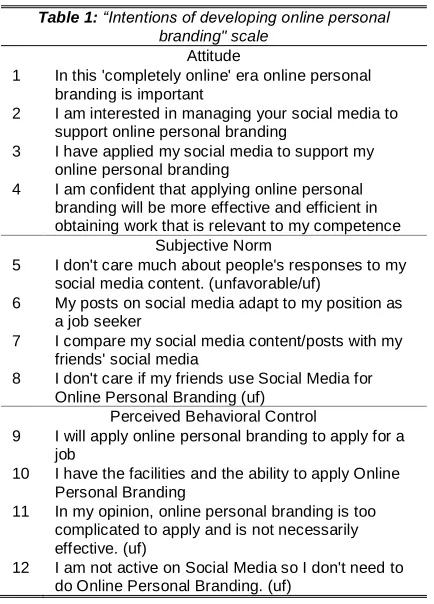
Content and logical validity tests are evaluated by expert justification. However, the validity and reliability test of the "intention to develop online personal branding" questionnaire employs a product-moment Pearson formula which gains the validity level of 0.312. While the reliability of 0.796 was obtained using the alpha Cronbach formula. The following are the OPB intention scale items:
Table 1: “Intentions of developing online personal branding" scale
Attitude
1 In this 'completely online' era online personal branding is important
2 I am interested in managing your social media to support online personal branding
3 I have applied my social media to support my online personal branding
4 I am confident that applying online personal branding will be more effective and efficient in obtaining work that is relevant to my competence
Subjective Norm
5 I don't care much about people's responses to my social media content. (unfavorable/uf)
6 My posts on social media adapt to my position as a job seeker
7 I compare my social media content/posts with my friends' social media
8 I don't care if my friends use Social Media for Online Personal Branding (uf)
Perceived Behavioral Control
9 I will apply online personal branding to apply for a job
10 I have the facilities and the ability to apply Online Personal Branding
11 In my opinion, online personal branding is too complicated to apply and is not necessarily effective. (uf)
12 I am not active on Social Media so I don't need to do Online Personal Branding. (uf)
3.3 Differential test on Pretest-Posttest
The basis for the differential test assumptions is the data normality. Applying the Shapiro Wilk formula, it was obtained sig. 0.414 (> 0.05) for the pretest and sig. 0.324 (> 0.05) for the posttest. It means that the data were distributed normally and were propper to perform the differential test by using the Paired T-test formula. Based on the paired t-test formula, there was a significant increase in the general mean from pretest
(33.67) to posttest (36.57) with a gap of -2.905. The significance level of the paired t-test revealed 0.003 (<0.01). It was comprehended that this training has significantly enhanced the participants' intention to perform personal online branding during their job pursuit periods. Based on the difference in the pretest (11.90) and posttest (12.62) on the attitude aspect, a mean gap of 0.714 was generated. This means that the trainees' attitude has positively grown towards the OPB program. However, such a positive attitude escalation of 0,714 was not significant since it only supported the results of the P-value of the Paired T-test of 0.074 (> 0.05). Meaning that although trainees' attitude in generall has massively increased for applying OPB, such enhancement was not statistically substantial. Based on the difference in the pretest (10.24) and posttest (11.38) on the subjective norm aspect, the mean gap was -1.1143. Meaning, the social influence around the participants has become stronger to apply the OPB. Furthermore, the growth in subjective norm -1,143 was significant because it was supported by the P-value of the Paired T-test of 0.003 (<0.01). Meaning, the increase of the posttest’s value was significant to the previous pretest's result. In other words, the subjective norm has a massive impact to improve the intention to establish OPB. Based on the pretest (11.52) and posttest score (12.57) on the aspect of Perceived Behavior Control (PBC), a mean gap of -1.048 was obtained. Meaning, the participants' perception of the difficulty level in conducting PBC has become lower. In other words, trainees were increasingly confident that they might easily carry out PBC. The advance in the posttest score compared to the pretest was significant because it was supported by the P-value of the Paired T-test of 0.030 (<0.05). This means that the PBC of training participants was not only rising but also significantly improving the participants' perception to do the things required by the OPB.
4. DISCUSSION
publicized. Diverse studies such as Rampersad [12], Harris and Rae [4], Wetsch [14], Rokka, Karlsson, and Tienari [13], Khedher [6], Philbrick and Cleveland [10], and Johnson [5] offer important points, concepts, designs, and procedures for conducting OPB. However, from the various journals, none have reported the evaluation and effectiveness of the OPB concept or design. On the other side, the studies in the preceding paragraph mostly aimed at evaluating the OPB of other parties - not developing the OPB design and then measuring its effectiveness. Based on researchers' investigations, OPB research by offering OPB development designs and evaluations is yet to scientifically published. Based on the results of the OPB research above, the main point of the results of this study is the development of the OPB experiment where the results can be measured for effectiveness. However, Meinarno & Sarwono [9] said what is measured by the effectiveness of the OPB experiment is not the actual OPB behavior of the participants, but the intention to build OPB. Researchers are optimistic they will develop OPB because the intention is a direct predictor of behavior. Measurement of OPB training conducted with pretest and posttest covers three aspects, namely attitude (ATT), subjective norm (SJ), and perceived behavioral control (PBC). Based on the results of the study, it appears that attitude is the only aspect that does not show a significant improvement. However, this can be understood because the average attitude of participants towards OPB has been relatively high. That is, they already have a positive attitude towards OPB. It seems they just have not been persuaded to develop it.
Table 2: pretest and posttest mean of OPB intention
Aspects pretest posttest Gap Pretest-Postest Attitude 11,90 12,62 0,714 Subjective norm 10,24 11,38 1,143 Perceived
behavioral control 11,52 12,57 1,048
Based on the table, it is generated that the pretest (11.90) and posttest score (12.62) from the attitude aspect is the highest of the two other aspects. Yet, the gap between those scores is the lowest (0.714) between the two other aspects. This represents that OPB training participants have already had a positive gesture to conduct OPB. So, it is not surprising that the differential test between pretest and posttest does not show significant results. It can be assumed the high positive attitude of participants towards OPB is determined by the fact that they belong to the millennial generation and are active in social media. Thus, OPB activities that involve the use of social media are certainly attractive to the millennial job seeker. The second aspect is the subjective norm (SN). This aspect is the most interesting one because it shows the highest pretest-posttest gap between the other two aspects (1,143). This gap has been statistically significant. Nevertheless, this is fascinating because the SB represents the social pressures perceived by the training participants. It can be interpreted that their status as job seekers, HRD activities that use the internet to find information on job applicants, as well as many job seekers who applying OPB, become social pressures that determine them to apply OPB to be fruitful in applying for work. The highest difference in pretest and posttest scores on subjective norms indicates that environmental factors are the most powerful determinant in
influencing OPB trainees - compared to two other aspects. The third aspect is perceived behavioral control (PBC). This aspect also shows a significant difference between pretest (11.52) and posttest (12.57) interpreting that the beliefs and perceptions of participants about the ease of conducting OPB are magnificently increasing. This aspect also accounts that OPB training has provided the knowledge and skills for them to conduct OPB more easily. Based on these three aspects, it was generally revealed that trainees knew the OPB and were positive about it. However, this positive attitude does not seem to be enough to encourage participants to perform OPB. It can be noticed from the high pretest score, low pretest and posttest gap, and the insignificance of the pretest-posttest difference. It is precisely the subjective norm aspect that plays an important role in 'force' the trainees to conduct OPB. External pressures such as their status as job seekers, the strategies used by HRD, and social comparison with fellow job seekers, are some of the pressures aimed at participants. Also, the PBC aspect made a significant contribution by directing training participants to utilize appropriate methods for conducting OPB. These three aspects indeed are statistically proven to meaningfully increase the intention of job seekers to apply OPB.
5. CONCLUSION
Online Personal Branding (OPB) training program for job seekers have significantly improved their intention to conduct OPB. These conclusions have both research's strengths and weaknesses. On one side, it becomes a strength because the OPB program and its scientific measurement have been rarely published still. On the other side, It also becomes a weakness because it measures the behavior intention only, not the actual behavior. However, researchers believe that the intention will be manifested in behavior. Based on the measurement aspects, it can be concluded that the trainees already have an upper positive attitude towards OPB training. While the subjective norm (SN) is the most determining aspect of the training party to conduct OPB. Those two aspects are reinforced by the perceived behavioral control (PBC) aspect which participants know that it is easier to perform OPB than what they have thought. The researcher's suggestion is pointed to several parties. To the alumni management, it is important to plan OPB on their respective members to improve their readiness to enter the workforce. For everyone who applies OPB, it is a moral imperative to always keep the congruence between the real-world reputation and the digital reputation so that OPB does not fall into a hoax image. Whereas for both further OPB researchers and design developers, it is necessary to construct instruments for measuring actual behavior for people who have applied OPB.
ACKNOWLEDGMENT
This research was funding by the Education Faculty of Universitas Negeri Semarang, Indonesia in 2019 under the title: Program pengembangan online personal branding untuk fresh graduate dan job seeker pada alumni psikologi FIP UNNES. And we would like to express our sincere thanks to everyone who has helped us to conduct this study.
REFERENCES
and freelance journalists stage themselves on social media,‖ Digit. Journal., vol. 5, no. 4, pp. 443–459, 2017. [2] A. K. Brooks and C. Anumudu, ―Identity Development in
Personal Branding Instruction,‖ Adult Learn., vol. 27, no. 1, pp. 23–29, 2015.
[3] C. P. Chen, ―Exploring Personal Branding on YouTube,‖ J. Internet Commer., vol. 12, no. 4, pp. 332–347, 2013. [4] L. Harris and A. Rae, ―Building a Personal Brand through
Social Networking,‖ J. Bussiness Strateg., vol. 32, no. 5, pp. 14–21, 2011.
[5] K. M. Johnson, ―The Importance of Personal Branding in Social Media: Educating Students to Create and Manage their Personal Brand,‖ Int. J. Educ. Soc. Sci., vol. 4, no. 1, pp. 21–27, 2017.
[6] M. Khedher, ―personal branding phenomenon,‖ Int. J. Information, Bussiness Manag., vol. 6, no. 2, pp. 29–40, 2014.
[7] F. Kurniawan,‖ Situasi Genting Angkatan Kerja Indonesia,‖ https://tirto.id/situasi-genting-angkatan-kerja-indonesia-cFal. 2019
[8] L. I. Labrecque, E. Markos, and G. R. Milne, ―Online Personal Branding: Processes, Challenges, and Implications,‖ J. Interact. Mark., vol. 25, no. 1, pp. 37–50, 2011.
[9] E. Meinarno and S.W. Sarwono, Psikologi Sosial. 2nd edition. Jakarta: Salemba Publishers, pp. 111, 2018 [10]J. L. Philbrick and A. D. Cleveland, ―Personal Branding:
Building Your Pathway to Professional Success,‖ Med. Ref. Serv. Q., vol. 34, no. 2, pp. 181–189, 2015.
[11]R.F. Anshari, S. Yuanita, and M. Novaria, ―Personal Branding of Anies Baswedan Through Facebook And Twitter Account: Study Of Image Grid Analysis in Banjarmasin Society Aged 17 – 24 Years,‖ J. Gov. Polit., vol. 7, no. 3, 2016.
[12]H. K. Rampersad, ―A New Blueprint for Powerful and Authentic Personal Branding,‖ Perform. Improv., vol. 47, no. 6, pp. 34–37, 2008.
[13]J. Rokka, K. Karlsson, and J. Tienari, ―Balancing acts: Managing employees and reputation in social media,‖ J. Mark. Manag., vol. 30, no. 7–8, pp. 802–827, 2014. [14]L. R. Wetsch, ―A Personal Branding Assignment Using
Social Media,‖ J. Advers. Educ., vol. 16, no. 1, pp. 30–36, 2012.