3322
An Experimental Study On Effect Of Polystyrene
On The Marshall Properties Of Bituminous
Concrete Mix
Bharat Kumar, Sharanabasappa Kori ,. Brijbhushan S
Abstract: Health and wealth are the two basic things which the country always wants for the betterment of country. Development of country will always be based on the giving all the fundamental facility to the entire citizen of our country which leads a better environment for growth of country. According to the survey in 2015.around 360 billion tones of plastic waste is generating in the world. The disposal & incineration of these waste result in pollution of environment hence management of these waste material is essential, around 9-10% waste is produced in India this waste plastic will have high viscoelastic behavior and they are resistance to water absorption hence this materials are shredded and mixed with bitumen to improve its property
Index Terms:Voids Filled Bitumen, Voids in Mineral Aggregates, Volume of Voids, Polystyrene, Specific Gravity, Bituminous Concrete, Stability.
—————————— ——————————
1 I
NTRODUCTIONThe development of the nation depends on the development of education, culture, health, wealth, man power and transportation. From the transportation point of view our country having 2nd largest road connectivity, with an road density of 1.72km per square km, about 66 trillion is invested in the construction of pavement, as the demand for construction of pavement increasing cost of the construction also increasing, similarly in India waste plastic management is also a major problem the nation facing, this plastic materials are made up of polymers which is having high elastic property and are non- biodegradable and do not allow water to flow through it hence it is used in the construction of pavement as an admixture to increase the material property. Polymers are having good binding property to the construction materials, it resist the stripping of aggregates when it is comes in contact with the water. Plastic is a non-biodegradable material which sully the earth and it furthermore a non-recyclable material therefore it is conceivable that we stop the use of plastic or we have to another one which is condition very much arranged. The non-recyclable waste plastic is used being developed of bituminous black-top layer it improves the material property as decrease in vulnerability, increase in quality, increase in solidness, decrease in cost of advancement. PET (Poly Ethylene Terephthalate), HDPE (High Dense Poly Ethylene) are recyclable yet Poly Propylene, Polystyrene, LDPE (Low Density Poly Ethylene) are non-recyclable therefore reuse or abhorrence of use is significant in this manner so these materials can be used as black-top material. Extension of engineered to be explicit zinc oxide will absorb the carbon di oxide from the earth which reduces the nursery sway. The various forms of plastic is using in day to day life which end result in formation of non-biodegradable plastic waste which form an hazardous situation to the world so management of waste plastic and reduction in plastic production may leads a environmental friendly climate. Plastic does not produce air pollution when heated but it softens which make layer over aggregate.
2
P
ROCEDUREstrength of the bituminous mixes is calculated by stability check test in which the material mix sample is prepared and various load is applied such that at which point of load the material will break or losses its resisting strength for failure is the capacity of that mixture and the material are suitably
proportioned such that each should be has higher material property and desirable characteristics
For Marshall test conduction following are the different steps carried out such as
a) Collection of the all materials needed for preparation of mix
b) Check for the suitability of the materials such as conducting the basic test on aggregates
c) Pre heating of the materials and the apparatus and oiling of the mould will be done.
d) After the preparation of mixture it is placed in a mould and load is applied in the form of giving blows (75 no.s) and then it is ejected out
e) Preparation of the test sample as per standard procedure is done and then it is kept for curing at air for a duration of 24 hours and the placed in standard temperature water for a period of 30min at 600c
f) After the specified time interval it is taken out and weight is measured at both air and water and then it is placed in a Marshall Test mould and test is conducted
g) At a specific load the load acting on the specimen remains constant without increasing the value is noted and the corresponding flow is measured by using the gauge.
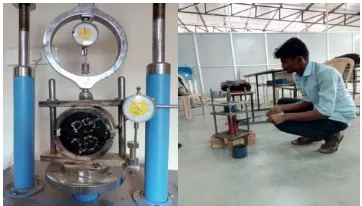
Fig 2.1: Marshall Stability Test Machine
3 MATERIAL
STUDY
Presently in our study main aim is on construction of economic and environment friendly pavement such that it should be possess all the desirable property. For my study purpose i had collected all the construction materials nearby to me.
Following are the materials which are used in the construction of plastic pavement
3323 The selected coarse aggregates should be tougher, harder
and durable such that life span of pavement can be effective. The basic tests are conducted on coarse aggregates such that it will possess all the desirable properties as per the IRC specification. Sieve analysis test is conducted for the gradation distribution as per MORTH 5th revision. according to the guidance of Indian road congress major proportion of pavement is mainly made of this materials only so it will be a satisfactory choice and taken from utmost desirable place and it will be nearby to the construction site if desirable property material is far then locally available material is used with an increased property by addition of admixture and filler materials.
3.2 Fine Aggregates
particles having size of less than 2.36mm and greater than 75µm are known as fine aggregates, these are mainly obtained in natural or by crushed aggregates or in the mixture of both, for a base course construction natural occurring fine aggregates such as sand are not allowed, although up to 50% of the total fine aggregates sand is permitted in base course as construction material according to IS 2720 (part 37).
3.3 Filler Materials
Filler materials are those which passes through 200 mesh sieve and it is mainly function as an filler to fill the voids present in the coarse aggregates and result in increase in the density of mix and stability and toughness of a conventional bituminous paving mix. Filler materials are the dust particles in a inert state. The use of filler material is the formation of filler mastic asphalt where the dust particles are coated with asphalt, this combined mix of filler mastic asphalt plays as a cementing agent. The filler mastic asphalt mix will improves the volume of mix and increases the stability, brittleness and resistance to cracking. Reduction of filler content in the mix will increase the void content and reduces stability and softens the mix. The filler material will be such that it will not undergo the chemical reaction, the filler material will be coated with bituminous mixes such that all the voids in coarse aggregates are completely filled with fillers and it will reduces the passage of water through it and increases the strength and durability of the pavement mix.
3.4 Bitumen
For the production of bituminous paving mix bitumen is used as a binding material. Bitumen has a different properties and has a characteristics such that its benefits has over the different pavement development materials, bitumen fills the voids in the fillers and increases the strength of the mix, it is made up of carbonaceous material. The main disadvantages of the bituminous mix are that it has great affinity towards water.
3.5 Polystyrene
polystyrene is an organic material made up of hydro-carbon content which is in plastic form so it is light in weight but softens when comes in contact with heat or fire which is main drawback. as a admixture it is used in road construction but it is mainly used as a packing and for making models of structure so more quantity of expanded polystyrene is used in the todays life on the other side after its use it become a waste material hence disposal is essential which result in
environmental pollution or reuse is necessary can be done by many ways.
4 EXPERIMENTAL
STUDY
For a flexible pavement construction cost is less than compare
to rigid pavement at the same time life span is also less so improvement in construction of flexible pavement is necessary and can be improved by addition of admixtures, the property of construction materials also vary with addition of additives hence calculation of variation in property of materials and mix is necessary such that at changing the quantity of substituent how the behavior vary.
Following are the tests conducted on the construction material to check its property.
4.1 Tests on Aggregates
i. Aggregate Crushing value test ii. Aggregate Impact Value Test iii. Los Angeles Abrasion Value Test iv. Elongation and Flakiness Index test v. Specific Gravity Test
4.2 Test on Bitumen Binder i. Softening Point Test ii. Penetration Test iii. Ductility Test
iv. Flash and Fire Point Test v. Viscosity Test
4.3 Test on Filler Materials i. Sieve Analysis
ii. Plasticity Index
4.4 Marshall Method of Mix Design
5 E
QUATIONSThe general equation used for the calculation of Marshall Mix design such as properties of the mix as follows.
))
4
/
4
(
)
3
/
3
(
)
2
/
2
(
)
1
/
1
/((
100
W
G
W
G
W
G
W
G
Gt
Where, W1=Percentage of coarse aggregates present in total
Weight
W2=Percentage of fine aggregates W3=Percentage of filler
W4=Percentage of weight of bitumen in the total mix
Gt
Gb
Gt
Vv
(
100
(
))
/
Gt=Theoretical specific gravity Gb=Bulk specific gravity
b
Wb
Gb
Vb
(
)
/
Wb=percentage of weight of bitumen ρb=specific gravity of bitumen
Vb
Vv
VMA
VMA
Vb
VFB
(
100
)
/
6
CALCULATION
AND
TEST
RESULTS
6.1 Test results of aggregates
3324
Table 1: aggregates test results and Requirements
SL. NO TEST NAME SPECIFICATION S OBTAINED RESULTS REFER ENCE
1 Specific
Gravity - 2.7595
IS:2386( Part 3)-1963 2 Aggregate Crushing Value
- 18.0566
IS:2386( Part 4)-1963 3 Aggregate Impact Value
Maximum 24% 20.9470
IS:2386( Part 4)-1963 4 Los Angeles Abrasion Value
Maximum 30% 28.2133
IS:2386( Part 4)-1963 5 Elongation And Flakiness Index
Maximum 35% 23.56
IS:2386( Part 1)-1963 6 Water Absorption Test
Maximum 2% 0.75
IS:2386( Part 3)-1963
6.2 Test Results of bitumen
Following tests are conducted and its calculation is shown as
Table 2: Bitumen Test Results and Requirements
Table 3: Comparison for Conventional and Modified Bitumen test results
SL.N O
TEST NAME
MODIFIED BITUMEN BINDER (POLYSTYERENE CONTENT)
CONVENTI ONAL BITUMEN
5% 10% 15% 20%
1
Flash Point(0C ) 219. 33 225. 33 238.6
67 243.667 233
2
Fire Point(0C
) 225. 53 230. 33 243.3
3 249 241
3 Ductility
(cm) 45 38 17.33 10.933 86.33
4 Penetrat ion Test(m m) 50.6
67 55
57.66
7 59 68
5
Softenin g Point Test(0C)
64 55.3
3 43 49.667 63.33
6 Viscosit y Test(Se c) 47.3
3 56 83.33 99.33 42.667
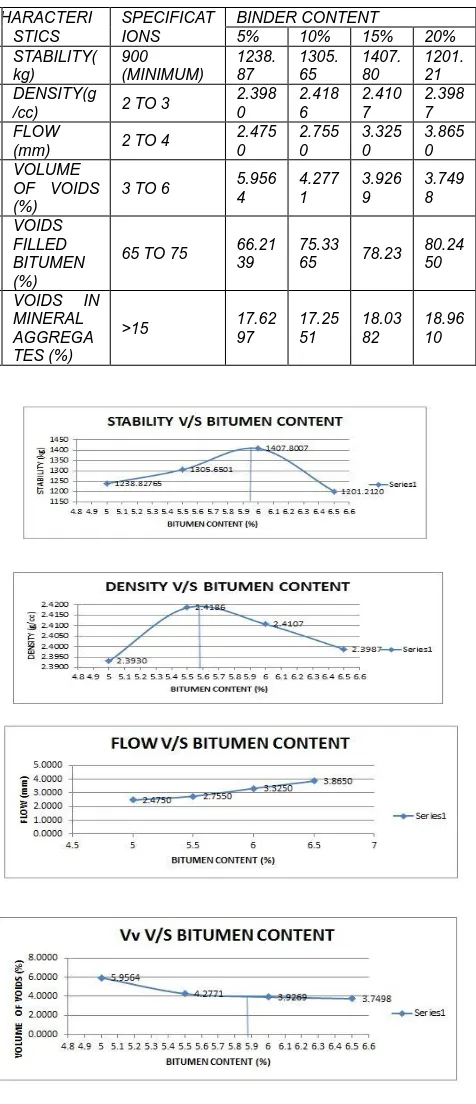
Table 4: Marshall test characteristics for different percentage of bitumen
SL. NO CHARACTERI STICS SPECIFICAT IONS BINDER CONTENT
5% 10% 15% 20%
1 STABILITY(
kg) 900 (MINIMUM) 1238. 87 1305. 65 1407. 80 1201. 21
2 DENSITY(g
/cc) 2 TO 3
2.398 0 2.418 6 2.410 7 2.398 7
3 FLOW
(mm) 2 TO 4
2.475 0 2.755 0 3.325 0 3.865 0 4 VOLUME OF VOIDS (%)
3 TO 6 5.956
4 4.277 1 3.926 9 3.749 8 5 VOIDS FILLED BITUMEN (%)
65 TO 75 66.21
39
75.33
65 78.23
80.24 50
6
VOIDS IN
MINERAL AGGREGA TES (%)
>15 17.62
97 17.25 51 18.03 82 18.96 10 SL.
NO TEST NAME
SPECIFI CATION S OBTAIN ED TEST RESULT S REFERENCE
1 Flash Point(0C) >220 233 IS 1209-1978
2 Fire Point(0C) >240 241 IS 1209-1978
3 Ductility (cm) >40 86.33 IS 1208-1978
4 Penetration Test(mm) >45 63.33 IS 1203-1978
5 Softening Point
Test(0C) >47 68 IS 1205-1978
6 Viscosity
3325
Fig 1: Representation Of Marshall Characteristics
OBC value is obtained from the graph such that the average value of bitumen content for the corresponding maximum stability, density and volume of voids at 4%.From the above graph OBC for maximum stability is 5.95%, for density it is 5.6% and that for Vv it is 5.7% hence the average value for OBC calculation is 5.75% so the optimum bitumen content is taken as 5.75% for the construction of pavement.
Table 5: Marshall Test Characteristics for OBC check value
SL.NO CHARACTERISTICS SPECIFICATION
OPTIMUM BITUMEN CONTENT
1 STABILITY(kg) 900
(MINIMUM) 1494.744
2 DENSITY(g/cc) 2 TO 3 2.39
3 FLOW (mm) 2 TO 4 3.65
4 VOLUME OF VOIDS (%) 3 TO 6 4.70
5 VOIDS FILLED
BITUMEN (%) 65 TO 75 74.90
6 VOIDS IN MINERAL
AGGREGATES (%) >15 18.71
From the obtained satisfactory OBC value, Marshall Test is conducted for the different percentage of polystyrene with respect to the weight of bitumen as a substituent to bitumen in the form of admixture (additive) to check the material behavior with addition of additives to bitumen and to obtain the maximum stability for the percentage of polystyrene.
Table 6: Marshall Characteristics for Dry mix method
SL. NO
CHARACTERI STICS
AT OPTIM
UM BITUM
EN CONT
ENT
POLYSTYRENE CONTENT
5% 10% 15% 20%
1 STABILITY(kg
)
1494.7 44
1427.8 575
1548.1 251
1616.8 965
1511.3 604
2 DENSITY(g/cc
) 2.39 2.3880 2.3973 2.4067 2.4215
3 FLOW (mm) 3.65 3.45 4.5 5.4 6.45
4 VOLUME OF VOIDS (%) 4.70 4.9507 4.5967 4.2260 3.3980
5
VOIDS FILLED BITUMEN (%)
74.90 72.844
1
73.321 2
73.925 7
76.945 2
6
VOIDS IN MINERAL AGGREGATE
S (%)
18.71 18.230
1
17.226 1
16.201 0
14.737 6
Fig 2: Marshall Characteristics for Dry Mix Method
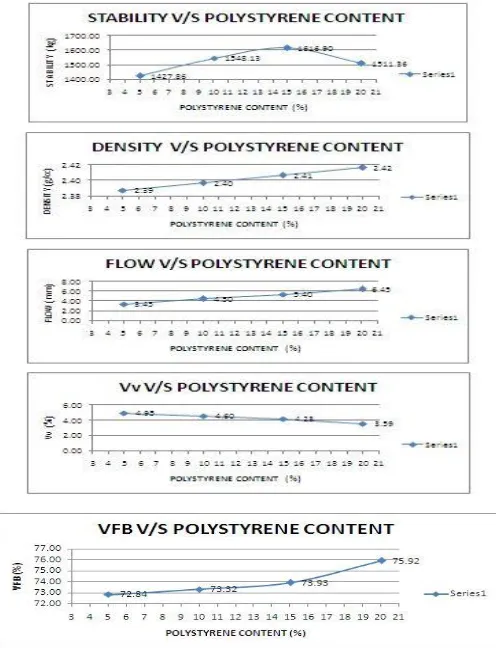
From the above figure obtained it gives a value such that with the addition of polystyrene to mixture increase the characteristics of the mix up to a percentage of 15% of polystyrene as a substituent to bitumen and then the stability, Vv and density decreases at the same time VFB and flow value increases such that it result in a conclusion that polystyrene content of 15% is allowable to conventional mix beyond which decreases the stability of the mix
Table 7: Marshall Characteristic’s value for Wet Mix Method
SL. NO
CHARACTER ISTICS
AT OPTIM UM BITUM EN CONT ENT
`POLYSTYRENE CONTENT
5% 10% 15% 20%
1 STABILITY(kg
)
1494.7 44
1340. 7678
1490. 6265
1512.8 3355
1464. 0732
2 DENSITY(g/c
c) 2.39
2.376 8
2.387
8 2.3990
2.406 7
3 FLOW (mm) 3.65 3.25 4.25 5.35 6.15
4 VOLUME OF
VOIDS (%) 4.70
5.394 9
4.974
8 4.5327
3.986 8
5
VOIDS FILLED BITUMEN (%)
74.90 71.0144 71.6640 72.4793 73.8696
6
VOIDS IN MINERAL AGGREGATE
S (%)
3326
Fig 3: Marshall Characteristics value for Wet Mix Method
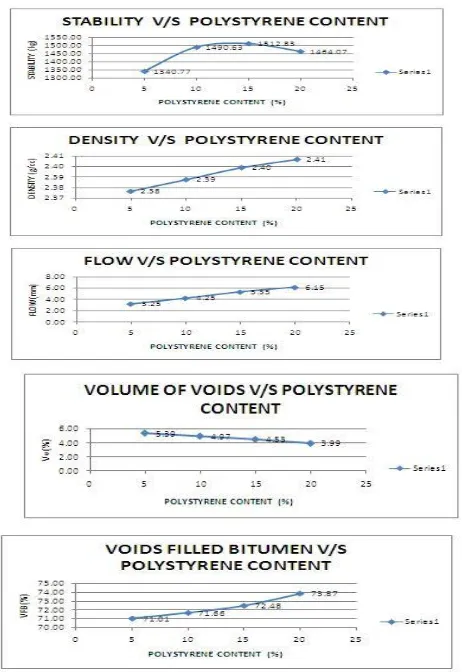
Bitumen properties can be increased by addition of additives to the bitumen in percentage to weight of bitumen content, the result obtained will have the better material property and for a mix design wet mix method will give higher Marshall Characteristics value than compare to the conventional mix. From the above graph the stability value increases up to a polystyrene percentage of 15% and then its value decreases, a maximum value obtained in between 10 and 15% such that it results in consideration of polystyrene in conventional mix is allowable up to 15% with respect to the weight of bitumen .
4 C
ONCLUSIONConstruction of flexible pavement with substitution of polystyrene will enhance the properties of mix with respect to the conventional mix and the optimum polystyrene content required for both wet and dry method is 15% for substituting with the bitumen binder. For a dry mix method the Marshall properties such as stability will be more than 8% with respect to the conventional mix which shows strength increment with addition polystyrene and other properties as flow is 47.94%, density is 0.69% and decrease in the volume of voids and voids in mineral aggregates. For wet mix method increases in the Marshall characteristics such as stability is 1.21%, density is 0.37% and flow is 46.57% and decrease in volume of voids and voids filled bitumen. Marshall Characteristics in addition to polystyrene to the mix will increase the property but the choice of suitability in between the wet and dry method will be given
by comparison such as stability of mix for optimum polystyrene content in dry method is 6.87% more than the wet mix method similarly density is 0.32% and flow is 0.93% hence it result in a conclusion that dry mix method is more suitable with respect to wet mix method at an optimum polystyrene content of 15%.
R
EFERENCES[1] Ankita Chakraborty, Sapna Mehta (2017) ―Utilization and Minimization of Waste Plastic in Construction of Pavement: A Review‖. International journal of engineering technology science and research IJETSR. www.ijetsr.com ISSN 2394-3386 Volume 4, Issue 8 August 2017
[2] Ayu Listiani, Emenda Sembiring, Harmein Rahman ―Evaluation Of Expanded Polystyrene (EPS) Plastic Waste Utilization As An Asphalt Substitution Material In Asphalt Concrete Wearing Course Layer‖.
http://www.researchgate.net/publiccation/319242355
[3] G. Ramesh Kumar, S. Bharani, R. S. Sujith Kumar.(2017) ―Partial Replacement Of Bitumen By Waste Plastic And Polypropylene In Road
Construction‖
ISSN(PRINT):2393-8374,(ONLINE):2394-0697, VOLUME-4, ISSUE-11,2017
[4] G. Vijaya Raju, K. Ganesh Kumar And N. N. Pavan Kumar (2017) ―Design of Flexible Pavement by Using Waste Plastic in Bitumen‖ international journal of innovative research in technology. April 2017 | IJIRT | Volume 3 Issue 11| ISSN: 2349-6002
I. M. Nassar, K. I. Kabel, I. M. Ibrahim (2012) ―Evaluation of the Effect of Waste Polystyrene on Performance of Asphalt Binder‖. ARPN Journal of Science and Technology. ISSN 2225-7217 VOL. 2, NO. 10, Nov 2012.
[5] Israa Saeed Jawad Al-Haydari and Ghadah Ghassan Masued (2017) ―Benefit of Using Expanded Polystyrene Packaging Material to Improve Pavement Mixture Properties‖. http://arjournal.org ISSN: 2423-4796 Vol. 3, Issue, 11, pp.332-342, November, 2017. [6] Dr. K. Sreenivasa Reddy, S. Mounika, M. Parvage, B.
Padmakar Reddy. (2017) ―Modified Flexible Pavement Design By Using Foamed Polystyrene Waste‖. IJSRD- International Journal for Scientific Research & Development| Vol. 5, Issue 02, 2017| ISSN (online): 2321-0613.
[7] MR. Mahesh M Barad (2015) ―Use Of Plastic in Bituminous Road Construction‖. Journal of Information, Knowledge and Research in Civil Engineering. ISSN: 0975-6744| NOV 14 TO OCT 15| Volume 3, Issue 2.
[8] Mr. P. B. Rajmane, Prof. A. K. Gupta, Prof. D. B. Desai. ―Effective Utilization of Waste Plastic in Construction of Flexible Pavement for Improving Their Performance‖. IOSR Journal of Mechanical and Civil Engineering (IOSR-JMCE) ISSN: 2278-1684, PP: 27-30. www.iosrjournals.org
3327 [10]S. Abinaya, M. Clement, Dr. S. Shanmugam (2016)
―An Experimental Study on the Properties of Extruded Polystyrene Waste Polymer Modified Bitumen for Flexible Pavement‖. International Research Journal Of Engineering And Technology (IRJET) e-ISSN: 2395-0056
[11]p-ISSN: 2395-0072 Volume: 03 Issue: 06 | June-2016
www.irjet.net
[12]S. Rajasekaran, Dr. R. Vasudevan, Dr. Samuvel Paulraj (2013) ―Reuse Of Waste Plastic Coated Aggregates- Bitumen Mix Composite For Road Application- Green Method‖. American Journal Of Engineering Research (AJER) e-ISSN: 2320-0847 p-ISSN: 2320-0936 Volume-02, Issue-11, pp-01-13
www.ajer.org
[13]Shweth. N. Rokdey, P. L. Naktode, M. R. Nikhar ―Use Of Plastic Waste in Road Construction‖. International Journal of Computer Application (0975-8887) International Conference on Quality Up-Gradation in Engineering. Science And Technology (ICQUEST2015) www.ijcaonline.org
[14]Utibe. J. Nkanga, Johnson. A. Joseph, Feyisayo V. Adams, Obioma U. Uche (2017) ―Characterization of Bitumen/Plastic Blends for Flexible Pavement Application‖. www.sciencedirect.com
[15]Yash menaria, rupal sankhla ―use of waste plastic in flexible pavements-green roads‖. Open journal of civil
engineering, 2015, 5, 299-311
http://www.scirp.org/journal/ojce
http://dx.doi.org/10.4236/ojce.2015.53030
[16]Highway Engineering By S.K.Khanna And C.E.G.Justo, Ninth Edition.
[17]Ministry Of Road Transport And Highways, Specifications For Roads And Bridge Works (Fifth Revision) Indian Roads Congress, New Delhi
[18]IS 2386 (Part III) – 1963. ―Methods Of Tests For
Aggregates For Concrete –
Specific Gravity, Density, Voids And Bulking.‖ Bureau
Of Indian Standards, New