JOHNSON MATTHEY
TECHNOLOGY REVIEW
www.technology.matthey.com
Durability and Degradation Issues in PEM
Electrolysis Cells and its Components
The second international workshop organised by the NOVEL EU-funded
programme
Reviewed by Emily Price
Johnson Matthey Technology Centre, Blounts Court, Sonning Common, Reading RG4 9NH, UK
Email: [email protected]
The second workshop on “Durability and Degradation Issues in PEM Electrolysis Cells and its Components” was held at Fraunhofer-Institut für Solare Energiesysteme ISE in Freiburg, Germany, from 16th–17th February 2016. The workshop was organised as part of the European Union (EU)-funded 7th Framework Programme, NOVEL, of which project Johnson Matthey Fuel Cells is a partner, along with several other European companies and research institutions. The workshop was attended by over 100 people from all around the world; however, the majority came from Germany.
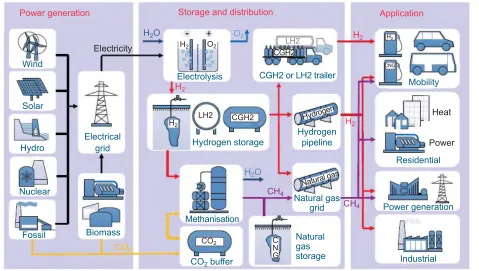
The talks were given by several NOVEL partners, electrolysis system manufacturers and research institutions or universities, and were followed by short question and answer sessions (Figure 1). The presentations described here can be freely accessed on the workshop web page (1).
Polymer Electrolyte Membrane
Magnus Thomassen (SINTEF, Norway) headed up the NOVEL talks, introducing the audience to the project and its main targets and achievements. NOVEL has focused on all areas necessary for improving the performance and reducing the cost of polymer electrolyte membrane (PEM) electrolysis, including degradation protocols, novel membranes and catalysts, bipolar plates and stack testing.
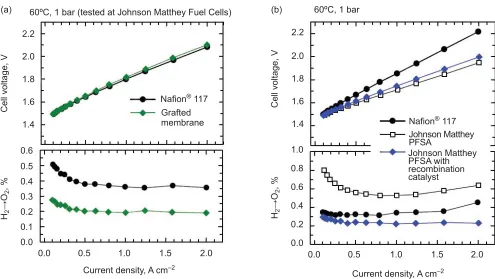
Lorenz Gubler (Paul Scherrer Institut (PSI), Switzerland) spoke to the audience about NOVEL’s work on novel membranes for PEM water electrolysis. There is a resistance-gas crossover ‘trade-off’ with electrolysis membranes, which means that the operational range can be limited. NOVEL has focused on increasing the gas barrier properties of electrolysis membranes and has taken two approaches within the project. The first approach is PSI’s radiation grafted membrane, comprising chemically and mechanically robust polymers (such as ethylene tetrafl uoroethylene (ETFE) or ethylene chlorotrifl uoroethylene (ECTFE)) grafted with a styrenic monomer, which is later sulfonated, a co-monomer and a cross-linker (2). The radiation grafted membrane gave similar performance
®
Hydrogen
Natural gas
Power generation Storage and distribution Application
Wind
Electricity
H2O
Electrolysis
H2 O2
H2
O2
LH2
CGH2
CGH2 or LH2 trailer
H2 H2
CNG
Mobility
Solar
H2
LH2 CGH2
H2 Heat
Hydrogen Electrical
Hydrogen storage pipeline Power
Hydro grid
Residential
H2O
Nuclear CH4 Natural gas
CH4
grid Power generation Methanisation
Biomass
Fossil CO Natural
2 C
CO2 N gas
G storage Industrial CO2 buffer
Fig. 1. Why hydrogen? Hydrogen is an energy carrier able to facilitate decarbonisation of the energy system. Coupling renewable energies and hydrogen, new market opportunities for electrolysis (Reproduced from (1) with kind permission from Tom Smolinka, Fraunhofer ISE)
crossover by ~50%, as demonstrated in Figure 2(a). NOVEL’s alternative membrane approach is Johnson Matthey’s reinforced polyfluorosulfonic acid (PFSA) membrane, which is adapted from an automotive membrane, measures just 60 μm in thickness and has functionality included within it that reduces hydrogen crossover. The effect of the addition of recombination catalyst functionality is shown in Figure 2(b).
Georg Andreas (Fraunhofer ISE) summarised the ongoing work within NOVEL by both Fraunhofer ISE and Teer Coatings Ltd, Miba Coatings Group, UK, on coatings for bipolar plates and current collectors. Titanium is frequently used for electrolyser bipolar plates and current collectors, but when left uncoated, it can form a highly resistive oxide passivation layer. The thickness of the passivation layer can be estimated by its colour. Protective coatings are recommended for use on these parts to prevent the growth of the passivation layer and to prevent drops in conductivity and cell effi ciency. Sputtered coatings from Teer Coatings Ltd, Miba Coatings Group have been shown to decrease the contact resistance both before and after corrosion testing.
Membrane Electrode Assembly
(b) 60ºC, 1 bar 2.2 2.0 2.2 2.0 1.8 1.6 1.4
Nafion® 117
Grafted membrane 0.6 0.5 0.4 0.3 0.2 0.1 0.0
0.0 0.5 1.0 1.5 2.0
Current density, A cm–2
60ºC, 1 bar (tested at Johnson Matthey Fuel Cells)
H 2
→
O 2
, %
Cell voltage, V
(a)
H 2
→
O 2
, %
Cell voltage, V
1.8
1.6
Nafion® 117
1.4
Johnson Matthey PFSA
1.0 Johnson Matthey
PFSA with
0.8 recombination
catalyst 0.6
0.4
0.2
0.0
0.0 0.5 1.0 1.5 2.0
Current density, A cm–2
Fig. 2. (a) Cell performance and gas crossover data showing PSI’s radiation grafted membrane; (b) cell performance and gas crossover data showing Johnson Matthey Fuel Cells’ PFSA membrane with and without recombination catalyst functionality (Reproduced from (1) with kind permission from Lorenz Gubler)
Ed Wright (Johnson Matthey Technology Centre, Sonning Common, UK) spoke about Johnson Matthey Fuel Cells’ work on the link between non-uniformity in PEM electrolysis MEAs and high gas crossover. Higher gas crossover was observed with novel anode catalysts and lower loading or thinner anode catalyst layers (Figure 3). The effect is believed to be more of a problem with newer, thinner membranes, as they will reduce the ability of the catalyst coated membrane (CCM) to cope with hardware non-uniformity; uneven compression for example. Johnson Matthey Fuel Cells found that hydrogen crossover can be controlled by using thicker or more compressible cathode layers, which are believed to improve tolerance to non-uniformity issues (Figure 3).
Moving on to non-NOVEL talks, Tomás Klicpera (Functional Membranes and Plant Technology (FuMA-TECH BWT GmBH, Germany)) presented an overview of the different membranes that FuMA-Tech have available for PEM water electrolysis. Its membranes can swell significantly in the z-direction
finished off by stating that FuMA-Tech believe that a simpler membrane, such as a woven web reinforced membrane, is a better choice for PEM water electrolysis.
Insights into PEM electrolysis capabilities and requirements at the larger stack-level were provided by National Renewable Energy Laboratory (NREL), USA, and the electrolysis system manufacturer, Proton OnSite, USA. Kevin Harrison (NREL) introduced us
3 2.5 2 1.5 1 0.5 0
0 0.2 0.4 0.6 0.8 1.0 1.2 1.4 1.6 1.8 2.0 3 2.5 2 1.5 1 0.5 0 Potential, V Crossover , %
IrO2|Pt black voltage, V
Novel IrO2|Pt black voltage, V
Novel IrO2|Pt on carbon voltage, V
IrO2|Pt black crossover, %
Novel IrO2|Pt black crossover, %
Novel IrO2|Pt on carbon
crossover, %
by up to 40% and are very sensitive to cell assembly. Furthermore, it has had to work through performance problems with its membranes – membranes giving bad performance for one customer have been found to give excellent performance for another customer. Klicpera
Current density, A cm–2
to NREL’s goal of integrating its renewable hydrogen
system to provide support to the grid and to reduce the cost of hydrogen. NREL is currently producing around 50 kg of hydrogen per day, which it intends to double by the end of 2016. It compresses and stores its hydrogen for lab use as well as for fuelling fork lifts and buses, and will produce a 250 kW stack this year.
Proton OnSite has been working with hydrogen energy systems for 20 years and has racked up hundreds of thousands of hours worth of stack testing and data. Everett Anderson (Proton OnSite) stated that it has achieved ~60,000 hours lifetime in its commercial stacks without any detected voltage decay. With its megawatt-scale M-series stack demonstration, it has recently achieved over 500,000 cumulative stack cell testing hours without failures and without any loss in efficiency. Its biggest problem affecting reliability and durability is customer contamination. Anderson stated that Proton OnSite is interested in fi nding reliable accelerated stress tests to understand the degradation mechanisms of polymer electrolyte membrane water electrolyser (PEMWE) and to shorten development times.
Catalysis
Marcelo Carmo (Forschungszentrum Jülich (FZJ), Germany) spoke about his work on both anode and cathode catalysts for PEMWE and their degradation. PtxMy alloy cathode catalysts (M = cobalt, iron,
nickel, bismuth) were de-alloyed via acid leaching and compared with standard platinum/carbon. The cathodes were durability tested by cycling for one week in 0.5 M sulfuric acid at 60ºC. FZJ did not observe a difference in durability and performance between cathodes of loading 0.8 mg Pt cm–2 and cathodes of loading 0.05 mg Pt cm–2. Additionally, a benchmark iridium black catalyst was used for an anode loading study. Initial performance at a low loading, for example, 0.3–0.6 mg Ir cm–2 was similar to initial performance at a high loading, for example, 2.25 mg Ir cm–2. However, the extent of degradation experienced with lower anode loadings was larger than that experienced with higher anode loadings. Carmo recommended that if low anode loadings are to be utilised for PEMWE, then anode supports are required otherwise the layers are too thin to be durable due to low catalyst areas.
Antonino Aricὸ (Consiglio Nazionale delle Ricerche (CNR)-Instituo di Tecnologie Avanzate per l’Energia (ITAE), Italy) summarised work on degradation
mechanisms and low catalyst loadings during the Fuel Cells and Hydrogen Joint Undertaking funded project, ElectroHypem. CNR-ITAE studied MEAs comprising of an IrRuOx anode, a Pt/C cathode and an Aquivion®
membrane (4). The contributing factors to PEM electrolysis performance degradation were found to be: accumulation of Na and Fe in the catalyst; loss of Ru from IrRuOx anode; degradation of the Ti plates;
membrane thinning and restructuring. Aricὸ suggested mitigation of degradation via pre-leaching of catalysts in acid to remove impurities; Ir surface enrichment of the anode catalyst; chemical stabilisation of the membrane and in agreement with NOVEL findings, coating of Ti plates. Similar to Carmo’s work, it was found that a reduced total catalyst loading resulted in an increased degradation rate.
Conclusion
The workshop provided an excellent opportunity for review and discussion of the growing area of PEM water electrolysis and was well attended by a range of international researchers. PEM water electrolysis was shown to be a promising area of research that is steadily growing in an effort to provide a fossil-free source of hydrogen. The workshop also provided an opportunity for consortium members of the EU-funded programme, NOVEL, to summarise their progress and achievements within the field before the end of the project. The success of the workshop can be attributed to the large range of topics presented, the variety of speakers and the organisation of Tom Smolinka and Magnus Thomassen.
References
1. NOVEL, Novel materials and system designs for low cost, efficient and durable PEM electrolysers, Second international workshop on durability and degradation issues in PEM electrolysis cells and its components, Presentations:https://www.sintef.no/projectweb/novel/ news-and-events/second-international-workshop-on durabiltiy-and-de/presentations/ (Accessed on 2nd November 2016)
2. L. Gubler, Adv. Energy Mater., 2014, 4, (3), 1300827 3. M. Chandesris, V. Médeau, N. Guillet, S. Chelghoum,
G. Thoby and F. Fouda-Onana, Int. J. Hydrogen Energy, 2015, 40, (3), 1353
The Reviewer