89
EVALUATION OF VINICULTURE AND
VITICULTURE IN THE CZECH REPUBLIC
FROM THE PERSPECTIVE OF INDUSTRY AND
PREDICTION OF DEVELOPMENT UNTIL 2020
ACCORDING TO SELECTED VARIABLES
Z. Hicl
Received: July 3, 2012
Abstract
HICL, Z.: Evaluation of viniculture in the Czech Republic from the perspective of industry and prediction of development until 2020 according to selected variables. Acta univ. agric. et silvic. Mendel. Brun., 2012, LX, No. 7, pp. 89–100
This article analyzes the viniculture and viticulture in the Czech Republic from the perspective of industry and predicts the outlook of Czech viniculture and viticulture until 2020. The fi rst part of the article defi nes the methods and procedures of calculation and SWOT analysis. The contribution using the method of reliability bands predicts consumption of grapes per capita per year and further predicts sugar content in grapes during harvest in future years. Sugar content of grapes has been chosen as the indicator of quality of grapes and indicator of the level of wine growing systems. Based on an evaluation of the current state of viniculture and viticulture in the Czech Republic and results of statistical calculations it recommends in well-arranged way the basic directions of development of viniculture and viticulture. If the development does not deviate too much from statistically estimated parameters, it can be expected that viniculture and viticulture will develop successfully in the conditions existing in the Czech Republic as predicted by the article.
viniculture, viticulture, wine market, consumer, Czech Republic
Motto:
Strategy is not a coincidence or a piece of luck, or intuition, but it is the result of goal oriented process. Successful development of a business entity is subject to the creation of balance with the external environment.
prof. Ing. Pavel Tomšík,CSc.
Viniculture and viticulture are not only cultural and social phenomenon, but its economic importance is considerable as well and therefore it deserves the full attention of the wider professional community. In order to understand the possibilities of viticulture development it is necessary to analyze and explore the internal links between viniculture and viticulture as well to analyze all factors and parameters that aff ect this sector from outside
and vice versa. Over the last decade wineries and viticulture were mostly infl uenced by our joining the European Union. The consequence of joining the European Union was the moratorium on vineyards planting.
Based on analysis this article sets out (or aims) to prove the viability of Czech viniculture and viticulture even in the tough competition in the globalised world.
MATERIALS AND METHODS
and literature are mentioned in the summary of sources and literature.
Appropriate statistical methods were used for data processing. In view of the fact that processed data are not cross-sectional data of the fi le of units but data presented in chronological order in the form of time series, the chosen basic statistical method was the method of analysis of time series.
The overall direction of development is characterized by trend. Trend function equalizing is used in this paper.
21
min
n i i iy
y
1 1 n n i i i iy
na
b
t
2
1 1 1
n n n
i i i i
i i i
y t a t b t
.When calculating trend function of the equation the method of minimum squared deviations of empirical and theoretical values of dependent variables is used, on basis of which the system of so called normal equations is set and thus the parameters of the function are calculated:
The parameter b in the trend line gives the average gain (loss) per interval (e.g. year) in given period. It shows the expected change of the examined phenomenon in next period. By using other values for time variable short term forecasts (while maintaining the same conditions) can be made as demonstrated on the chart.
y’i = a + bti + cti
2
2 3
1 1 1 1
n n n n
i i i i i
i i i i
y t a t b t c t
2 2 3 4
1 1 1 1
n n n n
i i i i i
i i i i
y t a t b t c t
2
1 1 1
n n n
i i i
i i i
y na b t c t
.In the case of nonlinear time series non-linear trend functions, usually polynomials are used.
The narrower the reliability band the higher is the value of the coeffi cient of determination. The band width is aff ected by the set reliability. Its width increases with the higher probability.
Graphic picture of the reliability band around the trend line:
The dependence of the time series characterizes the casual relationships in the development of time series. Regression and correlation of two or more time series based on the relationships between members of the time series pertaining to the same intervals or moments of time, may occur also in the time shi of dependent variable. In examining the dependence of the time series it is necessary to exclude possible autocorrelation as quoted (DUFEK, J., 1997). These matters are also dealt by R. Hindls, S.Hronová and J.Seger (2002).
Time series for the past eight years are used for statistical calculations. The most important sources of numerical data and other information are the Czech Statistical Offi ce, Ministry of Finance, General Customs Directorate, Ministry of Agriculture, National Agriculture and Food Inspection, Association of Wine Makers of the Czech Republic, Central Control and Testing Institute of Agriculture, Wine Fund, Offi cial Journal of the European Union. The article uses SWOT analysis as basic analytical method. It identifi es main Strengths and
2005 2006 2007 2008 2009 2010 2011 2012 2013 35 40 45 50 55 z z z z z z z Estimate 2013 Estimate 2012
r o k 1 2 3 4 5 6 7 8 9 Time variable
i
y
c
y
iWeaknesses of the business venture and compares them with main infl uences from the surroundings of the business venture. SWOT analysis is in this case used in a more structured form than usually. It is not meant as a list of Strengths, Weaknesses, Opportunities and Threats. Crucially it is about search and perception of Opportunities. The estimation of relative competition strength, which follows, will show if the business venture is stronger or weaker in the main factors of success than his competitors. Such analysis can identify relative competitive strengths and resulting strategic competitive advantage. The synthesis of results represents extraordinary demanding activity and in fact is the top step in strategic analysis. (KOTLER, P., 2007). SWOT analysis stems also from (CYVÍNOVÁ, P., 2004).
SWOT analysis of viticulture and viniculture in the Czech Republic
Strengths
• Czech consumers traditionally prefer Moravian wines
• Cultural and social tradition of wine growing and drinking
• Quality legal codifi cation of viticulture and viniculture
• The existence of Wine Fund and Union of Winemakers of the Czech Republic
• High professional qualifi cation of people • Very good level of science and research.
Weaknesses
• Awareness of our wines outside the Czech Republic is small or non-existent.
• Lack of coordination of support of local wines • Fluctuation of quality of Czech wines
• Lower quality of red wines
• High administrative burden of wine growers and winemakers
• Low margin of wine growers and producers
• No coordination of marketing and thus sale of wines from particular regions.
Opportunities
• Further support of viticulture and viniculture from government and EU
• Expansion of market to new regions
• Export – mainly to China, Russia, Poland and Slovakia
• Internet presentations and sales
• Standing growing consumption of wine per capita • New varieties
• Subsidies for landscape
• Sale from the cellar i.e. directly from winegrower • Wines with Original Certifi cate
• Production of bio wines
• Production of wines with higher added value • Individualisation – wines for specifi c customers or
interest group
• Promotion in media – internet, fi lms, TV
• Participation in international competitions and shows
• Consistent control of origin and quality of wine • Planting of table varieties and sale of table grapes
on home market
• Development of small family fi rms
• Lifestyle connected with wine as sign of prosperity and satisfaction.
Threats
• Unfavourable economic situation, low growth rate of main branches of national economy
• Political instability
• Import of competitive products, mainly cheap wines
• Introduction of new taxes for wine makers, higher taxation
• Weather and diseases
• EU infl uences – new regulations about sugar in wines, sizes of vineyards etc.
x
x x
x x
x x
x
x x
x
y
,
i
y
) (H iy
) (D i
y
• Monopolizing by large fi rms, brand wines…. • Abolition of planting limits
• Competition of substitutes and their pressure against wine.
Yield of grapes 1995–2010
Prediction of Czech viniculture and viticulture until 2020
The basic assumption of long-term and successful development of viniculture and viticulture is to create a competitive economic environment in relation to other EU countries and non EU Countries. Wine makers in the Czech Republic
should have the same support as his colleagues in other EU member countries, due to natural conditions maybe even higher.
It is essential that there is advertising and marketing support for quality wines from the Czech Republic on the home market, support of the participation of our wines in competitions abroad and support of the presentation of our wines abroad. Wine Fund and the State Agricultural Intervention Fund must play a decisive role here. The role of the Support and Guarantee Agricultural and Forestry Fund (PGRLF) in providing loans to wine makers and wine growers is irreplaceable in this respect. The greatest importance of PGRLF is in providing guarantees to banks. If the fund is
Yieldofgrapes(t/ha)
3: Yield of grapes 1995–2010 Source: Czech Statistical Offi ce
Sugarcontent(ºNM)
abolished, it will be necessary to fi nd a similar tool to help wine makers and wine growers. Viticulture and viniculture are global industries. It is the agricultural sector, which we see in Western, Central and Eastern Europe, North and South America, South Africa, Oceania and Asia. It is a strategic sector by its nature, because it is based on perennial vegetation of vineyards (25 years) and subsequent technologies are long-term expensive investment. Entrepreneurs and managers in this industry determine with their present decisions long-term strategic direction of the business. The sector is also under the infl uence of external world environment, but at the same time under the infl uence of national (internal) environment (TOMŠÍK, SEDLO, 2007) Further also (ZENTKOVÁ, 2010).
As noted above, wineries and viticulture are of strategic nature even in the Czech Republic. Wine makers are increasingly under the pressure from traders as in most sectors of agriculture production. There is a fundamental change in the concept of traditional distribution channels.
European countries, due to its infl exible policy adapt with delay to new conditions on the global market. Europe tied by EU regulations created opportunities for countries from the New World. At the same time countries of the New World planted 80 000 ha of international varieties with two thirds share of red varieties (Cabernet Sauvignon, Merlot, Syrah, Pinot Noir, Chardonnay, Sauvignon) during 1994–1997. New vineyards are modern, adapted to use of machines, irrigated, exploiting climatic conditions, which enabled substantially reduced costs of production.
In order to infl uence more the costs and quality of wine, traders integrate (purchase of vineyards or contracting). Thanks to this they eff ect wine improvement, vineyards maintenance, supplies in price, quantity and quality, which in turn gives
producers some certainty. This could be the example for Czech viniculture and viticulture.
Globally the Czech Republic is not market leader and due to EU joining conditions never will be. This does not mean that the Czech Republic should not have a strategy in a global world and set the direction and parameters to approach main global players. It should follow global macro environment, clarify the opportunities and threats, which it will face, if it wants to maintain or even aggressively develop wine production and wine growing. On the other hand global problems need not have local impact. On the contrary development of production, quality and price can support the wine industry and agriculture as a whole. In more detail (TOMŠÍK, 2003).
Even from this perspective viniculture and viticulture are very attractive. When following the development of wine consumption per capita in the last decade, continuing upward trend is obvious and is likely to continue in the near future. We can predict this from the fact that the average consumption in EU countries is 34 litres per capita and we know that consumer habits within an integrated Europe are gradually converging. It is major competitive factor in the class of lower quality wines. These types of wine are supplied mostly to chain stores. Prices of suppliers are comparable, advantage and resulting sales can be gained by a strong promotional support from the producer. Here is room for wines from Moravia and wines from Bohemia. Advertising campaigns aimed at the Czech production may give domestic wines advantage over wines imported from abroad, especially in white wines.
In contrast in the case of higher quality wines producers have signifi cantly more room to take into account production costs and reasonable profi t, because the low price in this segment may even discourage the customer from buying.
Reliability band for the development of consumption of table wine grapes and wine
per capita per year in the Czech Republic
Table wine grapes (kg per capita per year)
,
2 .0,72
2, 446
1 8 1 1
i i y x
y y
s
n k
, ( , )
1 2
1
i H D i y t
P
y
y
t
s
,
( , )
2, 447 0,346
1 0,05
i H D i
P y
y
i H D( , )3,36 0,15
i0,847
0,95
P y
t
.Prediction of consumption of table wine grapes till 2020
Based on statistical calculations steady growth in consumption of table grapes can be expected. It is supported by the tendency to a healthy lifestyle and highlighting the positive health aspects of their consumption.
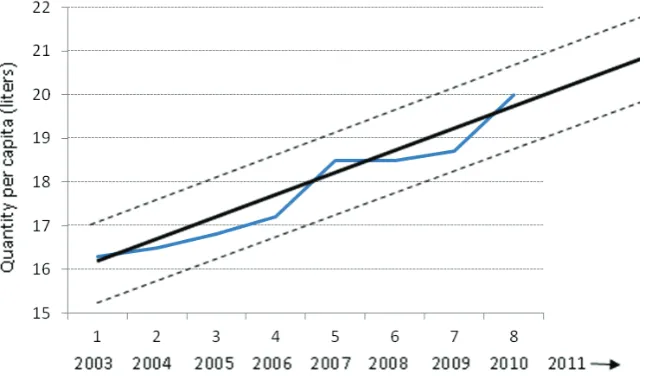
WINE (litres per capita per year)
,
2 .0,77 0,358
1 8 1 1
i i y x
y y
s
n k
Q
uantit
y
per ca
pita
(k
g)
2003 2004 2005 2006 2007 2008 2009 2010
6: Reliability band of wine grapes consumption per capita with 95 % probabilitySource: author
, ( , ) 1
2
1
i H D i y tP
y
y
t
s
,
( , )
2, 447 0,358
1 0,05
i H D iP y
y
i H D( , )15, 49 0,52
i0,876
0,95
P y
t
.When considering the evolution of wine consumption in 2020, we can use time period from 2003 to 2010. Reliability band was calculated from the further development of this indicator. The research was based on time period of 8 years because of relevancy of data. Prediction till 2020 relates to time horizon, which predictions are made for or calculations done in state sphere and planning at community level. It can be said with 95% probability that wine consumption per capita will reach 25.9 litres / per capita i.e. 271.84 million litres. It is the increase by about 61.84 million litres, subject to the same number of inhabitants of the Czech Republic. There is good opportunity for wine importers, because release of planting right for next period is not likely. The current reserve is approximately 2 000 hectares. There will be a price increase of wines from Czech and Moravian wine makers through strengthening awareness of consumers about wine quality and origin.
As we can see from the statistics, domestic consumption greatly exceeds the capacity of domestic producers. Price and tradition is refl ected in the preferences of domestic attributive wines over comparable foreign wines. The opposite situation is in table wines. Experience of chain stores with shares of diff erent quality classes in the total volume of sales shows that in this type of store customers are from lower income groups, so that over three quarters of the volume sold are table wines which are mostly imported. Nevertheless due to public awareness of the classifi cation of wines according to the Act on viticulture and viniculture the demand for higher quality wines is growing.
There is another feature of viticulture and viniculture, which is the subjectivity of evaluation of the main product of the industry, which is the wine itself. Every consumer, expert or not, can have diff erent requirements for taste of wine. However it is fair to say that wine must not have off -fl avour, bad colour and smell. Czech or international competitions help supply objective evaluation. Every country may have other tastes however no wine with an objectionable fl aw could place well. In this regards we can evaluate, without prejudice, very positively wines from Moravia and Bohemia.
Czech wines competed at 9 shows in Europe and North America according to statistics of National Wine Centre in 2010. 244 samples have received prizes, 93 golden ones, which is 38%, 84 silver ones, which is 34% and 67 bronze ones, which is 28%.
This trend is confi rmed by results of the fi rst half of 2012, when 328 wines placed well at international level in Europe and America. 89 samples got gold medal, 114 samples got silver one and 125 bronze one. This is the result from 8 events for the fi rst half only. Statistics are again from the National Wine Centre. Surely this is not a bad result for our wines at international level? According to evaluations and trends there is nox reason to be afraid that our viticulture and viniculture would not continue in these successes. The richness and attractiveness of the wine market is intensifi ed by the nature of production (large infl uence of climatic and soil conditions on the taste characteristics of the grapes and the limited opportunity to standardize these characteristics), the tradition of varietal wines as well as a large number of relatively small wine makers, who are also wine growers.
Very exceptionally, consumers prefer a specifi c brand (specifi c producer). Preferences are rather focused on colour or variety of wine. In this respect newly emerging fi rms are in better position to succeed on the market thanks to low preference of the brand.
Changes in legislation were important factors associated with the preference of consumers for higher quality wines. Legislative classifi cation of wines allows consumers to easily identify the description of wine and contributes to their better awareness.
Viniculture and viticulture are regulated by a number of sanitary and other regulations and standards not only in relation to production, but also to storing and sale. Seasonal character of wine production and wine growing will logically continue to show also in the coming years. Particularly important is the time of grape harvest and processing and also the end of the calendar year, when the fi rst wines produced from grapes, harvested in that year, emerge. St.Martin’s wine will be of even greater signifi cance in the coming years. The biggest sales of wine, however, occur annually in the time before Christmas. For the rest of the year wine consumption is relatively stable (TOMŠÍK, P., 2006; BEČVÁŘOVÁ, V., 2005).
There is much room for improvement of Czech viniculture and viticulture in training and consulting for small and medium sized wineries. Consultancy should be provided nationwide and should be available for all wine makers. It should be based on knowledge of basic skills such as weather forecast, soil science, knowledge of grapes tissues, agricultural chemistry, composition of wine, etc.
The main target group for the sale of Czech wine on home market are mainly active people, well educated, with higher average income, who are looking for and can recognize quality wine, who are ready to actively search for Czech wine.
Wine makers, but also wine merchants will focus primarily on the wines of higher and the highest quality. It is necessary to support the pride of our wine makers and wine merchants that they produce a Czech product, which is comparable and in many respects even better than products from abroad. Home consumers will prefer Moravian and Bohemian wine due to its quality, familiarity, reasonable price and also because of national origin. Production of bio wines is another important direction of development. 649 hectares within the programme EAFRD are included in the system of ecological farming in 2010. There were no request to join programme HRDP. Integrated production of grapes and wine is practiced on 11 454 hectares within the programme EAFRD and 39 hectares within the programme HRDP.
Marketing strategy and communication must focus primarily on home customers. This is the main target group for sale of Bohemian and Moravian wine. Wine does not have an option like the “fruit in schools“ promotion, therefore consumer focus must be diff erent. Generally the support programmes are for three years and the cost must be demonstrated fi rst, only then are they reimbursed. Italy has spent
3 million’s in EU markets, mainly in Belgium, Latvia, Lithuania and Estonia. The promotion was mainly for a wine with a protected designation of origin, but also as a wine from Europe, which is diff erent compared to the rest of the world. The target group were specialized journalists, importers, restaurants, hotel management, sommeliers, wine teachers, etc. They are educated about SOT system with wine, regulations for the DOC. Target groups were also invited to come to Italy. Monitoring of the wine market is also part of the project. Without sales support Italy cannot imagine exporting their wines any more (SEDLO, 2011).
The main message for the customers is:
• Go for quality wines with tradition you know, the wines from Moravia and Bohemia.
• Moravian and Bohemian wine production and wine growing went through quality change in the last ten years. Wines from Moravia and Bohemia are fully comparable with top wines from other parts of Europe or the world. It is necessary to emphasize qualitative peculiarities and advantages of natural acids from our areas.
Long-term advertising and marketing campaign will bring results in the form of convinced and loyal 8: Prediction of consumption of wine till 2020 in litres per capita and year
Source: author
customer, who can see advantages of Moravian and Bohemian wines and will require them from the merchant.
Political and legislative factors
Political and legislative infl uences or factors will aff ect the viniculture and viticulture in diff erent directions For example, in the area of taxes, subsidies, tariff s and the like. It is very likely to expect introduction of consumer tax for all kinds of wines and continuous increase of VAT. According to existing development the subsidy policy will stagnate at current level. There are no funds for higher subsidies neither in the Czech Republic nor in EU. Lower subsidies should not happen because the rate of subsidies for viniculture and viticulture in the Czech Republic is already low.
Economic factors
The growth of GDP is the most important economic factor for viniculture and viticulture. GDP is important for viniculture from the point of view of obtaining grants from EU. These grants are allocated to individual countries on the basis of the size of GDP. GDP development in Czech was very satisfactory before the crisis until 2008. In respect to macroeconomic development its growth can be expected again when the crisis is over. However the increase will not be as high as before the crisis.
Further the sector of viniculture and viticulture will be infl uenced by infl ation. Considering that the Czech Republic is directed at the adoption of Euro, it is unlikely that long term infl ation trends will not be kept. The sector of viniculture and viticulture will be infl uenced also by average wage. Wine and grapes are non-essential products, therefore their purchase will be infl uenced by average wage. If there are no unforeseen fl uctuations of the economy of the Czech Republic, the average wage will slowly grow, the standard of living of the population will rise. There is relationship also with the unemployment rate. The unemployment will remain the same as in past years according to macroeconomic prediction of Czech National Bank and Czech government. Such an unemployment rate will not threaten the sector of viniculture and viticulture.
Social factors
Social factors infl uencing the sector of viniculture and viticulture in next ten years will not change in favour of consumption of quality wine which our wine already defi nitely became.
The percentage of population with higher education and higher age structure of the population with conservative attitude to wine consumption can help to the consumption of quality products of home origin.
Technological factors
Factor of technological and technical level will more and more infl uence the sector of viniculture
and viticulture. Modern technologies touch also such sectors as viniculture and viticulture. New procedures and new technologies or equipment enable for example to produce wine already in a few days a er the harvest. Another example is new separators connected with cooling and economical clarifi cation. Most fi rms in Moravia have modern equipment. Winemakers are capable today of making relatively quality wines even from a bad vintage.
Thanks to science, winemakers can use also the best kinds of yeast, which further suppress not such suitable micro-organism (only within allowed limits of course). Since 2006 Foodstuff Inspection has nuclear magnetic resonance available, which can safely reveal disallowed sugar or dilution of wines and also juices, honey and other foodstuff s, for which there are high fi nes for wine makers.
However even modern technology cannot replace the human factor. In the opinion of wine makers wine needs, above all, human work and time in order to gain its typical properties.
Technical and technological infl uences are very important, because they help decide the quality of production and also about the costs and profi t. On the other side even the latest technology cannot produce top wine from inferior raw materials. Further development is expected in this fi eld in the future. Companies involved in production and development of new technology for wine industry will try to overtake the competitors and to gain the largest market share. We can also say, that the range of products will grow due to cultivation of new grape varieties.
DISCUSSION
TOMŠÍK and SEDLO (2006) believe that support of maintenance of landscape, landscape pattern, ecology, development of villages and employment are important functions of viniculture and viticulture. National subsidies for grapevine improvements, European support to growers involved in certifi ed organic viticulture and controlled integrated production of grapes, European subsidies for restructuring vineyards should signifi cantly help to achieve these functions. An important task is the liquidation of aged vineyards or their recovery. This idea should be supported. It is the way to greater effi ciency of viniculture and viticulture in the Czech Republic. The main task is to fi nd a way, how to ensure eff ective use of money from subsidies. One way could be a “manual” how to increase effi ciency of viniculture and viticulture.
them) the event of “open cellars” at certain times of the year. The project could include the setting up or opening of a wine shop in the village, if the operator is committed to exclusively off er wines from the village. Tomšík’s idea of open cellars has already been put into practice in some regions. The Project of wine shop in the village still faces legislative organizational obstacles. Local wine shops in France are under local authority. This is a challenge for the future.
TOMŠÍK and SEDLO (2006) In addition to traditional distribution through retail chains and through specialized wine shop outlets an increasing share of the distribution have gastronomy, internet sale and last but not least direct sale from the producer, vineyard owner. This method is directly linked to wine tourism and is of great importance especially for the development of small wineries and vineyards. In large cities wine makers manage to establish contacts with gastronomy. Regions can proceed according to similar model. Project gastronomy and viniculture may be benefi cial to both sectors.
CONCLUSION
Viniculture and viticulture in the Czech Republic has been given great attention recently. Small enterprises especially can get support both from the government and European Union. We should also mention e.g. Supportive and Guarantee Rural and Forest Fund (PGRLF), Programme Farmer and Soil and support from Wine Fund. Also commercial events like exhibition Vinex, Wine and Spirits, Holiday World etc. contribute to the development of viniculture in the Czech Republic. Further contributing events are wine shows, seminars, recently rapidly growing wine tourism, in particular events ‘Open Cellars’, vintages and so on. In spite of these positive aspects we cannot say that the viniculture is on the top of its life cycle. Legislative measures, limits on planting vineyards, make entry in wine sector very diffi cult. According to existing laws the measures will remain in force until 1st January 2014, when development of competitive businesses will be made possible. At the moment the sector of viniculture is in the initial stage of maturing, in the period when number of businesses on the market stabilizes and weak businesses are driven out. The sector should get in the phase of growth a er 2014.
Based on the analysis, it is recommended to strengthen the competitiveness of Czech viticulture and viniculture in all winegrowing regions and production areas, which means not to focus just on one or two selected areas. In this way to diversify the risk of uneven development of regions.
The goal is to ensure a high level of economic development of viniculture and viticulture with emphasis on information and knowledge. The great advantage of Czech viniculture is a high level of knowledge and skills of Bohemian and Moravian wine makers. They have not only skills and knowledge related to wine, but also economic and business skills and knowledge. In order to make the best of this advantage even in coming years it is necessary to bring up the next generation of wine makers, who will continue the work of their fathers also a er 2020. Czech viniculture and viticulture must be prepared to face global trends and local conditions. It is necessary to link global trends and experiences from abroad with local personal touch of wine makers and workers in viticulture.
Through the development of viniculture and viticulture and related fi elds it is necessary to maintain and to increase employment in rural wine growing regions.
If viniculture and viticulture perish in wine regions, it would be diffi cult to fi nd something to ensure jobs and prosperity. Therefore it is necessary to seek ways to further develop wineries and vineyards as potential employers in wine regions. A good example is Mikulov and Znojmo – previously unknown frontier areas and important economic centres of the country today.
Viniculture and viticulture must be in line with the principles of sustainable development where they are respected ecological, economic and social aspects and also regional aspect. To achieve the level of Austrian viniculture and viticulture, we must learn from their experience. They bet on originality, ecology and especially on sustainable development. According to the analysis of viniculture and viticulture in EU the development in coming years will resemble the situation in Austria, which is certainly good news for sustainable development of viniculture and viticulture in the Czech Republic. It is related to achievement of effi cient use of input, cycles of elements and ecological knowledge so that viniculture and viticulture rely mainly on resources within the agriculture sector.
SUMMARY
This paper is about prediction of development of viniculture and viticulture in the Czech Republic from the perspective of industry and provides outlook of Czech viniculture and viticulture until 2020. The fi rst part of article defi nes methods and procedures of calculations and the method of SWOT analysis. The contribution using the method of reliability bands predicts consumption of grapes per capita per year and further predicts sugar content in grapes during harvest in next years. Sugar content of grapes has been chosen as indicator of quality of grapes and indicator of the level of wine growing systems. It could be demonstrated that the quality of produced grapes as far as sugar content and thus overall quality of grapes has changed. Statistics prove that sugar content will stay higher in comparison with past years.
Further indicator of growing quality is the comparability of wine quality. For this purpose the comparison of placement of wine samples at international exhibitions and shows has been used. In 2010 244 wines placed at international events with following result – 38% of gold medals, 34% of silver medals and 28 % of bronze medals. 328 samples placed only in the fi rst half of 2012–89 received gold medal, 114 silver medal and 125 bronze medal. These results prove that the Czech Republic has top wine makers and wine growers. The current state is however a challenge for the future. It is necessary in coming years to bring up new generation of wine makers, who will continue the work of their fathers a er 2020. Czech viniculture and viticulture must be ready to react to global trends, with emphasis on local conditions. It is necessary to link global trends and experiences from abroad with local personal touch of wine makers and workers in viticulture. Through the development of viniculture and viticulture and related fi elds maintain and increase employment in rural wine growing regions. The development of viniculture and viticulture must be in line with the principles of sustainable development, ecological, economic and social aspects and also regional aspects must be respected. It is necessary to strengthen the ability of wineries and wine growers to adapt to the adverse eff ects of climate change. If viniculture and viticulture do not deviate from the trends over the last ten years, it can be expected that conclusions will be met as predicted in this article.
REFERENCES
BEČVÁŘOVÁ, V., 2005: Podstata a ekonomické souvislosti formování agrobyznysu. 1. vyd. Brno: Mendelova zemědělská a lesnická univerzita, 68 s. ISBN 80-7157-911-4.
CYVÍNOVÁ, P., 2004: Charakteristika problematiky společné organizace trhu s vínem. Acta Universitatis Agriculturae et Silviculturae Mendelianae Brunensis. Lil, č. 6, s. 211–221. ISSN 1211-8516. DUFEK, J., 1997: Marketing: cesta k úspěchu fi rmy. 1. vyd.
Brno: Cathy, 233 s. ISBN 80-238-0982-2.3.
HINDLS, R., HRONOVÁ, S., SEGER, J., 2002: Statistika pro ekonomy. Druhé vydání. Professional Publishing. ISBN 80-86419-30-4.
KORGO, L., ZENTKOVÁ, I., 2010: Ekonomika výroby vína u vybraných malopestovateľov viniča v Nitrianskej vinohradníckej oblasti. In: Viticulture – Viniculture fórum 2010: medzinárodné vinohradnícke a vinárske fórum, Trenčianske Teplice 17.–19. 2. 2010. [Nitra: Slovenská poľnohospodárska univerzita]. ISBN 978-80-552-0388-1.
KOTLER, P., 2007: Marketing management, Grada Publishing. ISBN 978-80-247-1359-5.
MZe ČR, 1999: Situační a výhledová zpráva réva vinná a víno 2006.
MZe ČR, 1999: Situační a výhledová zpráva réva vinná a víno 2007.
MZe ČR, 1999: Situační a výhledová zpráva réva vinná a víno 2008.
MZe ČR, 1999: Situační a výhledová zpráva réva vinná a víno 2010.
MZe ČR, 2008: Situační a výhledová zpráva réva vinná a víno 2009. ISBN 978-80-7084-793-0. TOMŠÍK, P. a kol., 2006: Perspektivy vývoje a návrhy
opatření politiky vinohradnictví a vinařství a rozvoje venkova v Jihomoravském regionu. Brno: MENDELU, 156 s. ISBN 80-157-971-8.
TOMŠÍK, P., SEDLO, J., 2006: Odvětví vinohradnictví a vinařství v České republice a jeho atraktivita ve fázi adaptace na jednotný trh Evropské unie. In: Firma a konkurenční prostředí 2006. Brno: MZLU Bmo, 2006, s. 259–270. ISBN 80-7302-117.
TOMŠÍK, P., SEDLO, J., 2006: Přizpůsobování od-větví vinohradnickovinařského České republiky na podmínky Evropské unie.In: Zborník príspevkov z medzinárodnej vedeckej konferencie Medzinárodné ve-decké dni 2006. Nitra: Slovenská poínohospodárska univerzita v Nitře, 2006, s. 10–23. ISBN 80-8069-704-3.
TOMŠÍK, P., ŽUFAN, P., SEDLO, J., 2006: Atraktivita odvětví vinohradnictví a vinařství v České republice ve fázi adaptace na jednotný trh Evropské unie.In: Acta universitatis agriculturae et silviculturae mendelianae Brunensis, s. 101–113. ISSN 1211-8516.
TOMŠÍK, P., 2003: Komparační analýza odvětví vinohradnicko vinařského ČR. In: Aktuálně problémy manažmentu a marketingu vo výučbe na vysokých školách. 1. vyd. Nitra: SPU Nitra, s. 96–101. ISBN 80-8069-284.
Bill No. 321/2004 Sb,. o vinohradnictví a vinařství ve znění pozdějších předpisů. Sbírka zákonů č. 215/2006.
Bill No. 462/2004 Sb., úplné zněni zákona č. 147/2002 Sb., o Ústředním kontrolním a zkušebním ústavu zemědělském a o změně některých souvisejících zákonů.
Address