3707
Design Of Dynamic Energy Efficient Multi-Hop
Protocols For Wireless Body Area Network
Shaik Jhani Bhasha, Dr. Sunita Panda
Abstract:Technological and scientific improvement in wireless technology has led to the creation of a state-of-the-art health care Wireless body area networks (WBANs). It facilitates remote monitoring by doctors and helps them continue providing patients with an appropriate diagnosis. Besides, each person has a WBAN, transmits body sensing data from different sensors, used on the human body, to sink node. Because these sensors are equipped with limited battery power, space, and processing instruments. The transmission of data via WBANs is a resource-hungry process, especially in terms of resources. While routing plays a significant role in the lifetime of WBAN activity. The implementation of an effective, multi-hop node selection process is one of the major challenges in the network. Therefore this paper provides an energy-aware link efficient routing approach for WBANs (EALER-W) as a communication system. This paper also introduces the initial proposal to incorporate the Efficient Time division Multiple (E-TDMA) focused on WBAN technologies to establish a system that meets the criteria of real-time communication. It shows significantly improved lifetime, linking efficiency and efficient packet delivery and minimizes network latency.
Keywords: Wireless body area networks (WBANs); link reliability; residual energy; Cost Function
————————————————————
1.
INTRODUCTION
For users, their machines have been easily wired to sensors and connected to the Internet in recent days. As the smartphones are based on their operating systems and manufacturers of different data interfaces, such as USB or earphone links, there is no common wire interface between smartphones and the sensor network [1] in terms of the wire link. Nonetheless, the Wireless Sensor Network (WSN) incorporates common wireless technology IEEE 802.15.4 that does not include phones as well as other wireless technologies such as Bluetooth Low Energy (BLE) or WLAN. The Internet network can also be attached to the mid-station system when the machines are wirelessly wired to iPhones. Currently, sensors and actuators can be connected to software applications and industry frameworks. Thanks to their multifunctional ability and versatility, Raspberry Pi [2] or Arduino [3] developers and investigators prefer to be their creation platforms associated with particular applications. For Raspberry Pi or Arduino boards, people often make great advancements; they still need time and resources to evolve, even though they have skilled programming experience. For context, Raspberry Pi uses the Linux system, which can sometimes take extra effort to get new Linux users began. More relevantly, costs are of major importance in terms of global production in the industrial application. In comparison with typically used microcontrollers, Raspberry Pi and Arduino seem to be overqualified for minimal-cost, quickly-developed industrial final products. Similarly, the Medical Internet of Things is the community of internet-related tools that conduct healthcare procedures and facilities. MIoT has arisen as a modern e-healthcare application that captures patients' critical body parameters and tracks their clinical data via smaller wearable technology or implantable sensors. MIoT has also shown huge potential to provide a better guarantee of human health and supports a wide range of applications from implantable medical devices to the WLAN.
The MIoT structure is generally comprised of three layers: the sensor layer, the network layer, and the application layer, as shown in Fig.1.
Fig. 1. Structure of Medical Internet of Things
Wireless body area sensors are used with limited energy capital for human health tracking. Sensed patient data must be obtained accurately for more review by the medical professional. An opportunistic technique was provided in [4]. The proposed strategy facilitates mobility at low-performance costs and additional relay node hardware costs. They use a sink at their wrist. So when the sink node is relocated from the node-set, it uses a relay node that collects data from sensor nodes.
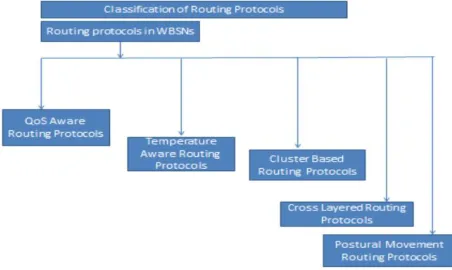
Fig. 2. Classification of WBANs Routing Protocols
______________________________________
Shaik Jhani Bhashaiscurrently working as an Assistant Professor inElectrical Electronics and Communication Engineering, GITAM Deemed to be University, Hyderabad Campus, Telangana, India. Dr. Sunita Pandaiscurrently working as an Assistant Professor in
In an opportunistic protocol, the wireless link between the sink and sensor nodes disconnects whenever the patient moves his hands. Link failure absorbs more sensor node power and the relay node often utilizes more packets, leading to a loss of sensitive and essential data. We are proposing a new system to reduce energy consumption and increase throughput. Routing protocols were classified for WBANs into different types, namely MAC layer protocols, QoS-aware, etc. Fig. 2 shows the WBAN protocol categorization. The main contributions and organization of this paper are summarized as follows: In section 2 we describe background works of routing protocol. The section 3 methods and methodology. The section 4 Results and discussion work, finally in section 5 we concluded the paper.
2.
BACKGORUND
WORKS
In [5], the authors suggested a routing protocol that endures network changes. They use the processing and forward method to increase data packet count to the corresponding sink node with more reliability. Each node stores the data packet and transmits it to the following node from source to destination. Through processing a data packet and transmitting it, energy consumption is increased and the delay is extended. The authors proposed in [6] the Body Area Networks Self-Organization Protocol (Anybody). This protocol aims to directly reduce the rate of transmission in the network. This increases the level of performance with the associated CHs in the given network. In [7], the authors suggested a protocol more or less like a storage and forward scheme. They implement this transmission power adaptation (TPA) processing and forward strategy. Every node is aware of its neighbors to control the use of transmission power. Nodes transmit data with low power and constant connection performance. In [8] the authors proposed a routing protocol that often provides a lowering of the energy consumption in the network and thus extends the network's lifetime. In Cluster Head (CH), data transfer from the cluster nodes remains constant.In [9], when the packet is transmitted with a weak node, the authors addressed the scenario and condensed the link between the source node as well as the target node in the network system. It is difficult to determine the false route when routing. The node in the given network sometimes intentionally misleads the forwarding mechanism to detect the wrong path. Such a node as that of the interruption attacker node will obstruct contact including its peer node on a different routing path. Besides, [10] each round has an energetically modified distance value with a different β factor that significantly reduces energy use and improves network existence. The proposed method also minimizes the rear transmission problem and perceiving of the sensor network at all points with stable energy savings. In [11, 12], the authors studied WBAN lag and various methods of media access. The authors suggest a delay-tolerant protocol in [13]. They contrasted their protocol with various other protocols.
3.
METHODS
AND
METHODOLOGY
In this section, the proposed framework mainly relies on the radio energy model as mentioned in the [15].
Radio Energy Model:
In this model d, the distance between the transmitter and the receiver and d2, energy loss due to the transmitting channel, are listed. Equations of the first order radio model are given. ETx(k, d, n) = ETx-elec(k) + ETx-amp(n)kd
ETx(k, d, n) = ETx-elec × k + Eamp × k × n × d 2
(1)
ERx (k) = ERx-elec(k)ERx(k) = ERx-elec × k
ERx(k) = ERx-elec × k (2)
where ETx is the energy expended in transmission, ERx is the
energy expended by the receiver, ETx-elec, and ERx-elec are the
energies essential to run the electronic circuit of transmitter and receiver, respectively. The energy needed for the amplifier circuit is Eamp, while k is the packet size and n is the
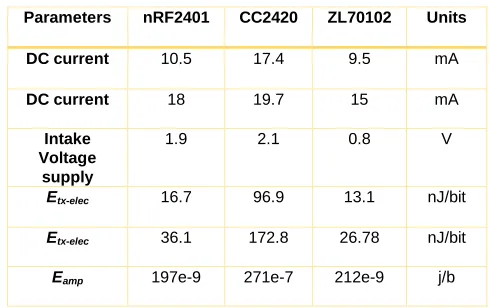
path loss coefficient. In WBAN the media is a human body that probably contributed to the attenuation of the radio signal. The energy parameters in Equation 1 are hardware-dependent. We take into account two generally used transceivers in WBAN technology. The Nordic nRF 2401A is a single chip, low-power transceiver and Chipcon CC2420 is another transceiver.
Table.1 Radio Parameters
Parameters nRF2401 CC2420 ZL70102 Units
DC current 10.5 17.4 9.5 mA
DC current 18 19.7 15 mA
Intake Voltage
supply
1.9 2.1 0.8 V
Etx-elec 16.7 96.9 13.1 nJ/bit
Etx-elec 36.1 172.8 26.78 nJ/bit
Eamp 197e-9 271e-7 212e-9 j/b
Both transceivers have a frequency of 2.4GHz. We use the Nordic nRF 2401A transceiver energy parameter possess of less consumption of power than Chipcon CC2420. Table 1 displays the required parameters for the simulation purpose.
Path Loss Model:
During the propagation of a signal in WBANs, it suffered from long term shadow and fading on the body area of a person. Table 2 shows frequency bands which are presented as channel models for each channel model in this document. This quantity of signal is directly proportional to the distance d with associated exponent term d. At a certain distance d, the direction loss in dB is:
( ) ( ) ( ) (3)
When path loss (i.e., Pl0 in dB) is d=1m, PL0 is an intercept point, 10log10 (d/d0) each is the intercept point of the mean
3709
exponent. The shadow fading term S has rms value of dB, and PL0 and are selected that is reduced. The selection of frequency of the carrier is a significant transceiver factor. For industrial, scientific and medical (ISM) radio frequencies, the two options available are 2.4GHz or sub-GHz.
Table. 2 channel models
Channel Model
Description Frequency band(s) CM2 Implant to Body Surface 400 MHz CM3 Body Surface to Body Surface
(LOS)
400, 600, 900 MHz 2.4 GHz
UWB Body Surface to Body Surface
(NLOS)
CM4 Body Surface to External (LOS) UWB Body Surface to External (NLOS)
Some benefits of sub-GHz over 2.4GHz are revealed:
• Range and quality signals. The message weakens when
radio waves travel across walls and other barriers. The 2.4GHz propagation can be degraded quickly in highly congested areas, impacting the signal quality adversely. • Biological tissues as a feature of frequency consume RF
power. Without being absorbed, lower frequencies will easily penetrate the skin, indicates improved RF connection expended by a sub-GHz as related to the 2.4GHz frequency.
• Radio waves, while they propagate, turn when reaching a solid edge. When frequencies decline, the diffraction angle decreases, helping sub-GHz signals to curve around an obstruction and increasing the blocking effect.
As shown in Fig.3, the usage of power consumption in WBS indicates the payload data rate on the x-axis and power on the y-axis. After payload data reaches 10Mbps, the power has exponential growth shows the goodness of the transceiver.
Fig. 3. Average Power versus Payload Data Rate of a Wireless Sensor Using the ZL70102 Transceiver
A 100 kbps limit is often seen as a means of improving energy efficiency. Attempting to compare RF transceivers means energy is better per bit than energy consumption. But, high-data radios sometimes have higher peak levels. They are strongly undesirable for most small batteries, as they produce significant, leaky storage condensers, typically several hundred μF. Fig. 4 shows a WBAN application block diagram that has a ZL70102 ZARLINK Semiconductor device
built [14]. By having wake-up mode, this chip can operates in ISM band thus, allowing a higher power wakeup to be broadcast, and the primary radio is functioning on the MICS band (400 MHz).
Fig. 4. A simple WBAN using ZL70102 transceiver system
Because of node deployment, on the human body, they have to consume less power so that it does not harm them. Nevertheless, there can quiet be substantial signal attenuation, because all organs of a person possess particular dielectric constant and signal absorption happens accordingly. We present a new routing protocol for WBANs in this section. The limited number of nodes in the WBANs enables the routing protocols to be relaxed. Taking into account routing restrictions, we increase the network stability time and network performance.
A. System Model
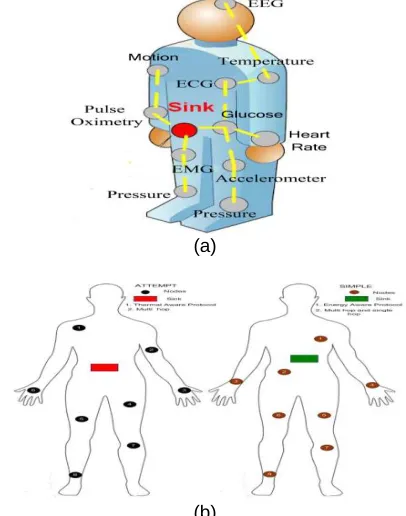
We deploy eight sensor nodes on the human body in this system. Both sensor nodes have almost the same capacity and processing resources. Sink node is on the hip. Node 1 is a sensor ECG, while Node 2 is the sensor node Glucose. Such two nodes immediately send data to the sink. Fig. 5 illustrates the positioning of the human body of the nodes and sinks.
(a)
(b)
B. Initial Phase
Hello, packets are used in this phase to keep adjacency
among neighboring nodes. Through circulating HPs
periodically, BSNs exchange their modified residual capacity, required hops, distance and channel link strength.
It maps both sensor nodes to neighbors' and sink positions. With the help of Eq 4, we can compute the residual energy (Eres) of the node and emptiness in the queue (Qempty) when
the node is open. Thus the required hop count to reach the sink can be achieved by placing in the last fragment. The interpretation of HOPminis as follows:
| 1,
HOPmin i minimum HOPj jNi (4)
Where HOPj is the minimum hop counts of node sj to the sink
node. In this Eq 4 is added to the minimum hop counts of the neighboring nodes because the hop count of node si to its
neighboring nodes is 1.
Link reliability:
Link stability among two nodes impacts quality of service needs and energy consumption, as the poor connection among the nodes increases, that results in frequent packet retransmission takes place. This link stableness (LinkRij) can
be considered with its weights of exponential in the nodes as:
,1
,
Txsucc ij LinkRij LinkRij
Txtotal ij
(5)
Where Txsucc ij, packets success ratio from one node Si to
the other node Sj , Txtotal ij, denoted as total attempts of
packets transmission and retransmission and γ is the average weighting factor.
Link cost function:
The link cost function is used to locate the next hop node. This role involves sj node residual resources, Sj node queue
length emptiness and the strength of communication with Si
and Sj nodes. Costij has the following definitions:
, ,
, ,
Eres j Qempty j
Costij CE CQ CL LinkRij
Einit j Qtotal j
(6)
WhereEres j, , Einit j, ,Qempty j, , and Qtotal j, are residual
energy, initial energy, vacant queue length, and maximum queue size of node sj respectively. LinkRij is the link
reliability between two nodes si and sj. Additionally,CE, CQ
and CL denoted constant coefficients.
Also link reliability of the nodes increases the reliability of the network. The objective link cost function for node Si is defined
by
,maximize Costij j SNi (7)
where SNi is obtained from the Eq 8
| , , , 1
SNi j j N HOPi min j HOPmin i (8)
where Ni prepared list of neighbor nodes si and HOPmin j,
denoted as hop count of minimum for node sj to the sink
node.
C. Selection of next hop and routing algorithm
The process of choosing best next hop node that acts as forwarder for packet transmission with less energy resources. When a node receives a HELLO packet from its next node, the node changes the previously mentioned neighbor list. The node regularly chooses the next hop address. The process of choosing best next hop node can be summarized in pseudo code as:
Pseudo code for next hop node: Input:Ni, Hopmin, i, SNi
Output:NHi
1: for (Gather entire nodes in list Ni) do
2: Calculate Costij, j∈Ni
3: end for
4: j = first element of Ni
5: while (Not end of list Ni) do
6: if (HOPmin, j+1 == HOPmin, i) then
7: add j to SNi
8: end if
9: j = next element of Ni
10: end while
11: Sort SNi (in descending order of Costij)
12: NHi = First element of the list SNi
D. Improved Scheduling
When the nodes have successful interaction, with that of the main controller, it sends time slots as requests to query several TDMA slots from the controller. The initial number of TDMA slots to be requested is one of the network configuration parameters and should be set as soon as the network is set. The TDMA system should also be allowed to fill all slots throughout the TDMA with nodes that do not allow any additional free-time slots to be used to achieve a maximum degree of accuracy. In comparison, the TDMA device slots must be evenly distributed here between nodes at the end of network services. After acquiring the TDMA slots order, the controller registers the necessary number of slots for each node in a control frame that determines the TDMA framework. The above control system controls the network and specifies the parameter values for the TDMA cycle. Such a mechanism helps nodes to access the channel whenever the TDMA slot query is issued by the controller. If the request is first accepted, the resulting node utilizes the channel before anyone else. The controller also provides multiple timeslots equal to the number of slots available for each node. It announces the events list being responsible for all the aspects with a framework. Also, during its time slots, a node wakes up and begins to relay the packets. For every successful packet transmission, there should be an acknowledgment of the corresponding node from the
controller end. If the node does not obtain the
3711
until the latest TDMA round comes to an end. New nodes will start to use the channel as planned.
4.
RESULT
AND
DISCUSSIONS
The simulations are carried out in 11 BSNs and a sink is placed on the human body as shown in the figure. 5(a) is not allowed. All BSNs produce constant CBR traffic. All the simulations are carried on ZL70102, which is a low power chip most suitable for BAN, so, we regarded simulation parameters with several evaluations employing Matlab 2013a that have been conducted to determine the efficiency evaluation of the current EALER-W Protocol. Also, the findings are comparable to standard SIMPLE protocols and ATTEMPT as shown in the figure. 5(b).
Fig. 6.WBAN network lifetime analysis
Fig. 6, showing comparison in various forms of dead nodes of the proposed EALER-W with traditional SIMPLE. The analysis shows that the very first three nodes of traditional SIMPLE died 2800 times because of heavy loads on those nodes. The first node dies accordingly at 2780 and 5500 rounds in
traditional SIMPLE and EALER-W.
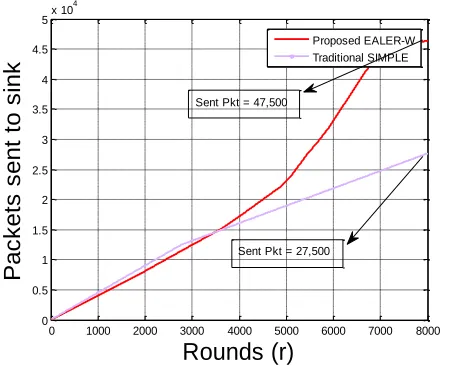
Fig. 7.WBAN throughput analysis for transmitted packets to SINK
As shown in Fig.7, the EALER-W protocol achieves high performance than the traditional SIMPLE. The number of packets that are sent to the sink depends on the number of nodes. More alive nodes transmit more packets to drop, which improves network performance.
Fig. 8.WBAN throughput analysis for received packets at SINK
Fig. 8 shows that conventional SIMPLE collect numbers of packets efficiently at sinks, and EALER-W is almost 18500, 37500 respectively. Because of the longer reliability of individual BSNs, the EALER-W protocol obtained an increased value of active packets received. The BSNs died in the conventional SIMPLE in the early stages, resulting in a lower number of BNC packets.
Fig.9.WBAN remaining energy Analysis
Fig. 9 The evaluation of EALER-W's energy consumption with existing protocols demonstrates that EALER-W energy consumption is lower than traditional SIMPLE. It also shows that residual energy is more stable than competitive protocols. Results indicate that the energy consumption of the ELR-W is
14% to 45% smaller than traditional SIMPLE. 0 1000 2000 3000 4000 5000 6000 7000 8000
0 2 4 6 8 10 12
No.of rounds
N
o.
of
s
ens
or
dea
d
nod
es
Proposed EALER-WTraditional SIMPLEAt 2800 At 6800
0 1000 2000 3000 4000 5000 6000 7000 8000 0
0.5 1 1.5 2 2.5 3 3.5 4 4.5
5x 10
4
Rounds (r)
Pac
k
et
s
s
ent
t
o
s
ink
Proposed EALER-W Traditional SIMPLE
Sent Pkt = 47,500
Sent Pkt = 27,500
0 1000 2000 3000 4000 5000 6000 7000 8000 0
0.5 1 1.5 2 2.5 3 3.5x 10
4
Rounds (r)
Pac
k
et
s
rec
eiv
ed
at
s
ink
Proposed EALER-W Traditional SIMPLEl
Received Pkt = 37,500
Received Pkt = 18,500
0 1000 2000 3000 4000 5000 6000 7000 8000 0
0.5 1 1.5 2 2.5 3 3.5 4
Rounds (r)
R
es
idua
l ene
rgy
(J
)
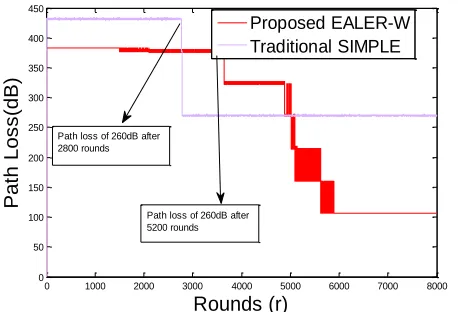
Fig. 10. Path loss (dB) Vs Rounds
Fig.10 shows that EALER-W initially works well with a 380dB Path Loss. After 2000 rounds, indeed, the path loss of traditional SIMPLE decreased dramatically to 260 dB because certain topology nodes die. The lowest possible number of live nodes in the lowest cumulative loss of path. By having more stability timeslot for EALER-W it can achieve less path loss compared to simple protocol.
5.
CONCLUSION
In this paper, we suggest a process for WBAN routing data. The proposed scheme uses a cost function to select a suitable sinking route. By introducing new route costs based on residual resources like required hops, link quality, and distance for selecting the best next-hop node for transmitting the packets successfully. The simulation results reported a reduction in consumption of energy among two nodes decreased a lot with minimal delay and higher throughput. The proposed EALER-W routing protocol maintains a longer network lifetime as related to the traditional SIMPLE protocol. It often demonstrates that the proposed routing system increases the stability in the network and the number of packets transmitted to the sink.
6 REFERENCES
[1] Nie, H., Joshi, R. & Li, Z. (2016). Demonstration of a joint power harvesting and communication technology for smartphone centric ubiquitous sensing applications. 2016 13th IEEE Annual Consumer Communications &
Networking Conference, 252-253.
DOI:10.1109/CCNC.2016.7444766.
[2] Kumar, R. & Rajasekaran, M. R. (2016). An IoT based patient monitoring system using Raspberry Pi. 2016 IEEE International Conference on Computing Technologies and Intelligent Data Engineering, 1-4. doi:10.1109 /ICCTIDE. 2016.7725378.
[3] Matsuoka, H., Wang, J., Jing, L., Zhou, Y., Wu, Y. & Cheng, Z. (2014). Development of a control system for home appliances based on BLE techniques. 2014 IEEE
International Symposium on Independent Computing, 1-5. doi: 10.1109 /INDCOMP. 2014.7011751.
[4] Maskooki, Arash, et al. “Opportunistic routing for body
area network.” Consumer Communications and
Networking Conference (CCNC), 2011 IEEE. IEEE, 2011. [5] Quwaider, M.; and Biswas, S. (2009). On-body packet routing algorithms for body sensor networks. Proceedings of the First International Conference on Networks and Communications, IEEE-NETCOM, 171-177.
[6] Watteyne, T.; Augé-Blum, I.; Dohler, M.; and Barthel, D. (2007). AnyBody: A self-organization protocol for body area networks. Proceedings of the ICST 2nd International Conference on Body Area Networks, Article No. 6. [7] Nabi, M.; Basten, T.; Geilen, M.; Blagojevic, M.; and
Hendriks, T. (2010). A robust protocol stack for multi-hop wireless body area networks with transmit power adaptation. Proceedings of the Fifth International Conference on Body Area Networks, 77-83.
[8] G.R. Annushakumar, V. Padmathilagam, k “Efficient Multi Hop Inter Cluster Routing in Wireless Sensor Network”, International Journal of scientific & technology research volume 8, issue 11, Nov 2019, 2404-2408.
[9] Dr.R.Aruna, Dr.J.RajeshKumar “Performance Analysis of Stable Energy Maintenance in MANET”. International Journal of scientific & technology research volume 9, issue 1, Jan 2020, 2429-2436.
[10]C.Sudha, D.Suresh “A Simple Balanced CH Selection Method for Network Life Time Maximization and EnergyUtilization in Heterogeneous WSN”. International Journal of scientific & technology research volume 9, issue 1, Jan 2020, 4332-4338.
[11]Javaid, N.; Yaqoob, M.; Khan, M. Y.; Khan, M. A.; Javaid, A.; and Khan, Z. A. (2013). Analyzing delay in wireless multi-hop heterogeneous body area networks. Research
Journal of Applied Sciences, Engineering and
Technology, 7(1), 123-136.
[12]Javaid, N.; Israr, I.; Khan, M.A.; Javaid, A.; Bouk, S.H.; and Khan, Z.A. (2014). Analyzing medium access techniques in wireless body area networks. Research
Journal of Applied Sciences, Engineering and
Technology, 7(3), 603-613.
[13]Quwaider, M.; and Biswas, S. (2009). Probabilistic routing in on body sensor networks with postural disconnections. Proceedings of the 7th ACM international symposium on Mobility management and wireless access, 149-158. [14]Zarlink Semiconductor. Data sheet for ZL70102, a
Medical Implantable RF Transceiver. URL: http:// www. zarlink.com/zarlink /zl70102-shortformdatasheet.pdf. [15]Heinzelman, W.R.; Chandrakasan, A.; Balakrishnan, H.
Energy-efficient communication protocol for wireless microsensor networks. In Proceedings of the 33rd Annual Hawaii International Conference on System Sciences, Maui, HI, USA, 7 January 2000; p. 10.
0 1000 2000 3000 4000 5000 6000 7000 8000 0
50 100 150 200 250 300 350 400 450
Rounds (r)
Pat
h
Los
s
(dB)
Proposed EALER-W Traditional SIMPLE
Path loss of 260dB after 2800 rounds
3713
AUTHORS BIO-DATA
Author 1:
Shaik Jhani Bhasha is presently working as Assistant Professor in the Department of Electrical Electronics and Communication
Engineering, GITAM Deemed to be
University, Hyderabad Campus. He has 19 years of teaching experience. He is presently doing his research in the field of Medical IoT. His areas of interests include Embedded Systems, Mobile Ad-hoc Networks and IoT.
Author 2:
Dr. Sunita Panda is presently working as Assistant Professor in the Department of Electrical Electronics and Communication
Engineering, GITAM Deemed to be