O R I G I N A L R E S E A R C H
Long Non-Coding RNA ASB16-AS1 Functions as
a miR-760 Sponge to Facilitate the Malignant
Phenotype of Osteosarcoma by Increasing HDGF
Expression
This article was published in the following Dove Press journal:
OncoTargets and Therapy
Ruofeng Yin1
Junzhi Liu2
Dongxu Zhao1
Fei Wang1
1Department of Orthopedics,
China-Japan Union Hospital Jilin University, Changchun, Jilin 130033, People’s Republic of China;2Department of
Quality Control, China-Japan Union Hospital Jilin University, Changchun, Jilin 130033, People’s Republic of China
Purpose: ASB16 antisense RNA 1 (ASB16-AS1) is a cancer-associated long non-coding RNA that contributes to tumorigenesis and tumor development. Nevertheless, to the best of our knowledge, whether and how ASB16-AS1 is implicated in osteosarcoma (OS) malig-nancy remains unclear and therefore warrants exploration. Our current study focused on making in-depth investigation of ASB16-AS1 in OS. In the present study, the expression pattern of ASB16-AS1 in OS tissues and cell lines was analyzed. In addition, we examined the clinical value of ASB16-AS1 for OS patients. Furthermore, we explored the impacts of ASB16-AS1 on the malignant phenotype of OS cells in vitro and in vivo as well as the underlying mechanism.
Methods: ASB16-AS1, microRNA-760 (miR-760) and hepatoma-derived growth factor (HDGF) expressions were measured using reverse transcription-quantitative PCR. Cell proliferation and apoptosis were evaluated using CCK-8 and flow cytometry analyses, respectively, and cell migration and invasion were determined via cell migration and invasion assays.
Results: ASB16-AS1 expression was significantly elevated in OS tissues and cell lines, and increased ASB16-AS1 expression was related to patients’tumor size, TNM stage, and distant metastasis. The overall survival rate of OS patients presenting high ASB16-AS1 expression was shorter than that of patients presenting low ASB16-AS1 expression. Reduced ASB16-AS1 expression inhibited OS cell proliferation, migration, and invasion; promoted cell apoptosis; and impaired tumor growth in vivo. Mechanistically, ASB16-AS1 served as a sponge for miR-760 and positively modulated the expression of its target HDGF. Finally, inhibiting miR-miR-760 and restoring HDGF expression abolished the impacts of ASB16-AS1 knockdown on the malignant characteristics of OS cells.
Conclusion:ASB16-AS1 is a novel oncogenic lncRNA in OS cells. ASB16-AS1 increased HDGF expression by sponging miR-760, thereby conferring cancer-promoting roles in OS. ASB16-AS1 is a potential early diagnostic and therapeutic target in OS.
Keywords: osteosarcoma therapy, ASB16-AS1, hepatoma-derived growth factor, microRNA-760
Introduction
Osteosarcoma (OS), a malignancy originating from mesenchymal cells, mainly
occurs in adolescents and young adults.1 OS accounts for approximately 56% of
all malignant neoplasms and ranks third among the most common cancers of
Correspondence: Fei Wang
Department of Orthopedics, China-Japan Union Hospital Jilin University, No. 126, Xiantai Road, Changchun, Jilin 130033, People’s Republic of China
Email [email protected]
OncoTargets and Therapy
Dove
press
open access to scientific and medical research
Open Access Full Text Article
OncoTargets and Therapy downloaded from https://www.dovepress.com/ by 118.70.13.36 on 25-Aug-2020
adolescents.2The metaphysis of the long tubular bone is the principle site of OS, although other bones can be
affected.3Patients with OS are usually treated with
surgi-cal resection in combination with adjuvant chemotherapy,
transplantation, and radiotherapy.4With the development
of early diagnostic methods and therapeutic techniques, clinical outcomes of patients with OS have noticeably improved. However, OS continues to pose considerable
threat to patients’ survival due to early metastasis,
che-moresistance, and recurrence.5The 5-year survival rate of
OS patients without metastasis is 55%–70% following
first-line therapy; however, it has fallen to approximately
5%–20% in OS patients with metastasis.6,7The
pathogen-esis of OS is complex and involves a number of compli-cated biological events; however, detailed mechanisms
remain to be investigated and confirmed.8,9 Accordingly,
there is an urgent need to explore the mechanism of OS onset and progression to develop promising therapeutic strategies.
Long non-coding RNAs (lncRNAs) are a family of evolutionarily non-protein-coding RNA molecules with
transcripts containing over 200 nucleotides.10 They are
involved in several aspects of physiological and patholo-gical processes, and their regulatory functions are
mediated via diversified mechanisms involving chromatin
modification, gene transcriptional regulation, epigenetic
modulation, mRNA post-transcriptional processing, and
interaction with proteins or microRNAs (miRNAs).11–13
In recent years, alteration of lncRNA expression has been widely reported in numerous human malignancies and is likely to exert a great impact on carcinogenesis
and cancer progression.14–16Regarding OS, extensive
evi-dence has demonstrated that many lncRNAs are dysregu-lated and that this dysregulation is important in tumor
onset and development.17–19 For instance,
FBXL19-AS1,20 GClnc1,21and DLX6-AS122are highly expressed
in OS and play cancer-promoting roles in regulating
can-cer aggressiveness. On the contrary, TUSC7,23AWPPH,24
and HAND2-AS125 are weakly expressed in OS and
restrain malignant cancer cell phenotypes. Therefore,
understanding of the detailed roles of OS-related
lncRNAs may lead to the identification of potential targets
for treating patients with this disease.
ASB16 antisense RNA 1 (ASB16-AS1) is a cancer-associated lncRNA that contributes to tumorigenesis and
tumor development.26,27 However, to the best of our
knowledge, whether and how ASB16-AS1 is implicated in OS malignancy remains unclear and therefore warrants
exploration. Therefore, the present study aimed to investi-gate the detailed functions of ASB16-AS1 in OS. Our
findings advance the understanding of crucial functions
of ASB16-AS1 in OS and may promote the identification
of promising therapeutic targets for patients with this fatal disease.
Materials and Methods
Patients and OS Tissues
The present study was approved by the ethics committee of China-Japan Union Hospital Jilin University and was per-formed in accordance with the Declaration of Helsinki. A written informed consent was provided by all participants prior to their enrollment in the study. A total of 47 patients with OS were recruited. OS tissues and their corresponding adjacent normal tissues were collected after surgical exci-sion and immediately stored in liquid nitrogen prior to usage. No patients had received chemotherapy, transplanta-tion, radiotherapy, or other anticancer treatments.
Cell Lines
A normal human osteoblast hFOB1.19 and five OS cell
lines (HOS, 143B, MG-63, U2OS, and SAOS-2) were
purchased from American Type Culture Collection
(Manassas, VA, USA). Dulbecco’s Modified Eagle
Medium: Nutrient Mixture F-12 (DMEM/F-12) containing
150 mg/L L-glutamine, 1.5 g/L NaHCO3, and 10% fetal
bovine serum (FBS; all from Gibco, Invitrogen, Carlsbad, CA, USA) was used for culturing hFOB1.19 cells. OS cell lines were maintained in DMEM supplemented with 10% FBS plus 1% penicillin and streptomycin (Sigma-Aldrich,
Milan, Italy). All cells were cultured in 5% CO2at 37°C in
a humidified atmosphere.
Cell Transfection
ASB16-AS1-targeting small interfering RNA (siRNA; si-ASB16-AS1) and target-free siRNA (si-NC) were obtained from GenePharma (Shanghai, China). The si- ASB16-AS1
sequences were 5ʹ- GGTTCTGAATCATTCAGTT-3ʹand the
si-NC sequences were 5ʹ-UUCUCCGAACGUGUCACG
UTT-3ʹ. To increase endogenous HDGF expression, the
pcDNA3.1 plasmid carrying full-length HDGF or the empty pcDNA3.1 plasmid was chemically generated by RiboBio (Guangzhou, China). miR-760 agomir (agomir-760) and miR-760 antagomir (antagomir-(agomir-760) used to over-express and silence miR-760 over-expression, respectively, were purchased from GenePharma; agomir-NC and antagomir-NC
OncoTargets and Therapy downloaded from https://www.dovepress.com/ by 118.70.13.36 on 25-Aug-2020
were controls. Cells in the logarithmic growth phase were collected and seeded into 6-well plates. When the cell density
reached 60% confluence, transient transfection was
con-ducted using Lipofectamine 2000 (Invitrogen; Thermo Fisher Scientific, Inc.).
Reverse Transcription-Quantitative PCR
(RT-qPCR)
TRIzol reagent (Invitrogen; Thermo Fisher Scientific, Inc.)
was used for total RNA isolation, and the isolated total RNA was subjected to determination of RNA quality with
a NanoDrop™ 2000 spectrophotometer (Thermo Fisher
Scientific, Inc.). To assess the expression of miR-760,
total RNA was reverse transcribed to cDNA using the miScript Reverse Transcription Kit (Qiagen GmbH, Hilden, Germany). Quantitative PCR systems were pre-pared through a miScript SYBR Green PCR kit (Qiagen GmbH). U6 small nuclear RNA functioned as an internal control for determination of miR-760 expression. To quan-tify ASB16-AS1 and HDGF mRNA, cDNA was produced
using the PrimeScript™RT reagent Kit, and then used for
qPCR with a SYBR®Premix Ex Taq™(both from Takara
Biotechnology Co., Ltd., Dalian, China).β-actin was used
for the normalization of ASB16-AS1 and HDGF mRNA.
All gene expressions were analyzed by the 2−ΔΔCqmethod.
Cell Counting Kit-8 (CCK-8) Assay
After a 24-h culture, cells transfected with the abovemen-tioned molecular products were harvested and suspensionswere prepared at a density of 2 × 10⁴cells/mL. A total of
100 µL cell suspension was inoculated into each well of 96-well plates. Five replicates were made for each group. Cells were grown for 0, 24, 48, and 72 h at 37°C in
a humidified atmosphere with 5% CO2, at which point
10 µL CCK-8 (Dojindo Laboratories Co. Ltd., Kumamoto, Japan) was added. Following incubation for additional 4 h, optical density (OD) was recorded at 450 nm using a microplate reader (Bio-Rad, Hercules, CA, USA).
Flow Cytometry
Sufficient number of transfected cells were harvested after
a 48-h incubation, washed twice with ice-cooled phosphate buffer solution and centrifugated 716 ×g for 5 min to discard
the phosphate buffer solution. An Annexin V fluorescein
isothiocyanate (FITC) apoptosis detection kit (Biolegend, San Diego, CA, USA) was applied for measurement of cell apoptosis. In short, transfected cells were resuspended in
100 µL 1× binding buffer. Prior to determination of the
apoptosis rate on the flow cytometer (FACScan; BD
Biosciences, Franklin Lakes, NJ, USA), the transfected cells were treated with 5 µL of Annexin V and 5 µL of PI and kept at room temperature under darkness for 15 min. Cell Quest acquisition software (version 2.9; BD Biosciences) was used for data analysis.
EDTA-free trypsin was used to treat transfected cells at 48 h post-transfection. Subsequent to washing twice using pre-cooled phosphate buffer solution, transfected cells
werefixed in 70% ethanol at 4°C for 1 h. Following this
treatment, transfected cells were collected and incubated with 50 µL of RNase (100 µg/mL). Then, 25 µL of the propidium iodide solution was added into 425 µL of cell staining buffer (both from Biolegend, San Diego, CA, USA). The cells were resuspended and incubated at room temperature for 30 min. Cell cycle status was tested using
aflow cytometer.
Cell Migration and Invasion Assays
For the invasion assay, Matrigel (BD Biosciences, Franklin Lakes, NJ, USA) diluted with FBS-free DMEM was added into the upper chamber. After ~6 h of
incuba-tion until the Matrigel was solidified, 5×10⁴ transfected
cells suspended in FBS-free DMEM medium were seeded into the upper chamber. The basolateral chambers were
covered with 500μL DMEM that was supplemented with
10% FBS. Cells were maintained at 37°C in a humidified
atmosphere with 5% CO2 for 24 h, then fixed with 4%
paraformaldehyde, and stained with 0.5% crystal violet. Thereafter, the non-invasive cells were eliminated with cotton ball, and the invasive cells were imaged under an inverted microscope (Olympus, Tokyo, Japan). Cell migra-tion assay was carried out in the same way as the invasion assay, except that the upper chambers were no pre-coated with Matrigel. The number of migratory and invasive cells
was counted infive visualfields to count the mean value.
Xenograft Mouse Model
All animal studies were approved by the Committee on the Ethics of Animal Experiments of China-Japan Union Hospital Jilin University, and were conducted in compliance
with the Animal Protection Law of the People’s Republic of
China-2009 for experimental animals. We mentioned this information in the manuscript. The lentiviral plasmids
(Hanbio Biotechnology Co., Ltd.) that specifically and stably
expressed ASB16-AS1-targeting short hairpin RNA (sRNA; sh- ASB16-AS1) and target-free shRNA (sh-NC) were
OncoTargets and Therapy downloaded from https://www.dovepress.com/ by 118.70.13.36 on 25-Aug-2020
chemically produced by Hanbio Biotechnology Co., Ltd (Shanghai, China). U2OS cells were infected with the above lentiviral plasmids and then selected via Puromycin. U2OS cells stably expressing sh-ASB16-AS1 or sh-NC were subcutaneously injected into BALB/c male nude mice (Beijing HFK Bioscience Co., Ltd; Beijing, China). A vernier caliper was utilized to record the width and length of tumor xenografts. The tumor volume was determined with
the following formula: volume = 1/2 × length × (width).2At
the termination of the in vivo assay (4 weeks post-injection),
all mice were sacrificed, and tumor xenografts were collected
for further use.
Hematoxylin and Eosin (HE) Staining
Tumor xenografts werefixed by means of 10%
formalde-hyde, embedded in paraffin and then cut into 4 μm
sec-tions. After dewaxing using xylene, the section were hydrated with gradient ethanol and stained with hematox-ylin for 5 min, after which were differentiated in hydro-chloric acid alcohol and counterstained with eosin for 2 min. After that, the sections treated with different con-centrations ethanol for dehydration, transparentized with
xylene I and xylene II, andfinally mounted in neutral gum.
An inverted microscope (Olympus, Tokyo, Japan) was utilized for for photography and observation.
Bioinformatic Prediction
The interaction between ASB16-AS1-miRNA was predicted
using the online database starBase 3.0 (http://starbase.sysu.
edu.cn/). Putative targets of miR-760 were predicted with
starBase 3.0, TargetScan algorithms (http://www.targetscan.
org) and miRDB (http://mirdb.org/).
Subcellular Fractionation
The nuclear and cytoplasmic fractions of OS cells was
separated with a Cytoplasmic and Nuclear RNA
Purification Kit (Norgen Biotek, Thorold, Canada). RNA
from the nuclear and cytoplasmic fractions was extracted and subjected to RT-qPCR for the assessment of ASB16-AS1 expression distribution in OS cells.
RNA Immunoprecipitation (RIP) Assay
The assay was processed based on the EZ-Magna RIPRNA-binding protein immunoprecipitation kit (Millipore,
Billerica, MA, USA) instructions. OS cells were incubated with pre-cooled lysis buffer containing protease inhibitor and ribonuclease inhibitor. The lysate was incubated with RIP immunoprecipitation buffer supplemented with magnetic
beads coated with human anti-argonaute2 (AGO2) or IgG antibody. Next, after extensive washing with wash buffer, the immunoprecipitate complex was treated with Proteinase K buffer at 55°C to digest protein. Finally, immunoprecipi-tated RNA was extracted and subjected to RT-qPCR.
Luciferase Reporter Assay
The 3′-UTR of HDGF containing the wild-type (wt) or
mutant (mut) binding site for miR-760 was amplified by
GenePharma and inserted into pmirGLO dual-luciferase vec-tor (Promega, Madison, WI, USA). The synthesized
lucifer-ase reporter plasmids were respectively defined as HDGF-wt
and HDGF-mut. The plasmids AS1-wt and ASB16-AS1-mut were constructed via similar experimental steps. Either wt or mut plasmid was transected into OS cells in the presence of agomir-760 or agomir-NC. After a 48-h culture, the transected cells were collected and subsequently sub-jected to a dual-luciferase reporter assay (Promega) to detect thefirefly andRenillaluciferase activities.Renillaluciferase activity was used for data normalization.
Western Blotting
The total protein was extracted using RIPA buffer (Beyotime Institute of Biotechnology; Haimen, China), and its
concentra-tion was quantified with the bicinchoninic acid protein assay
kit (Beyotime Institute of Biotechnology). Equal amounts of protein were separated by 10% SDS-polyacrylamide gel
elec-trophoresis and transferred to polyvinylidene difluoride
mem-brane. Following 2-h blocking with 5% fat-free milk, the membranes were incubated with primary antibodies against HDGF (1:1000; ab128921; Abcam, Cambridge, UK) or GAPDH (1:1000; ab128915; Abcam) at 4°C overnight. On the next day, the membranes were treated with goat anti-rabbit
horseradish peroxidase-conjugated secondary antibody
(1:5000; ab150077; Abcam) at room temperature for 2 h, followed by processing with the Immobilon Western Chemiluminescent HRP Substrate kit (EMD Millipore) for visualizing the protein signals. GAPDH was used as an endo-genous control for data normalization.
Statistical Analysis
All results are shown as mean and standard deviation. SPSS (version 16.0; SPSS Inc.) was used for all statistical
ana-lyses. The statistical significance among multiple groups
was analyzed with one-way analysis of variance followed
by Tukey’s test. Student’s t-test was employed to test the
differences between two groups. The association between ASB16-AS1 expression and clinicopathological parameters
OncoTargets and Therapy downloaded from https://www.dovepress.com/ by 118.70.13.36 on 25-Aug-2020
of patients with OS was examined via Chi-square test. The
overall survival curves were plotted using Kaplan–Meier
analysis and compared using the Log rank test.
Associations among the expression of ASB16-AS1 and miR-760, miR-760 and HDGF as well as between ASB16-AS1 and HDGF were explored via Spearman correlation analysis. P<0.05 was considered statistically significant.
Results
ASB16-AS1 Is Upregulated in OS Tissues
and Cell Lines and Is Correlated to Poor
Prognosis
To examine the implication of ASB16-AS1 in OS, its
expression profiles in 47 pairs of OS tissues and their
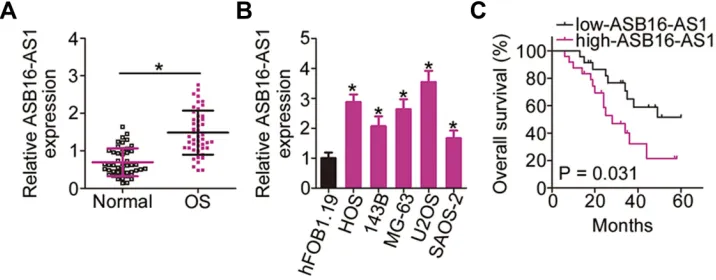
corresponding adjacent normal tissues were detected via RT-qPCR. ASB16-AS1 expression was higher in OS tis-sues than in the corresponding adjacent normal tistis-sues (Figure 1A). In addition, ASB16-AS1 expression was
analyzed in five human OS cell lines (HOS, 143B,
MG-63, U2OS, and SAOS-2), with the normal human osteo-blast hFOB1.19 as a control. RT-qPCR data revealed that ASB16-AS1 was overexpressed in all tested OS cell lines
compared with that in hFOB1.19 (Figure 1B).
To estimate the clinical value of ASB16-AS1 in patients
with OS, all participants were classified into either
low-ASB16-AS1 (n = 23) or high-low-ASB16-AS1 (n =24) groups based on the median value of ASB16-AS1 expression in the OS tissues. Chi-square was used to evaluate the correlation between ASB16-AS1 expression and clinicopathological
characteristics of patients with OS. As presented inTable 1,
High ASB16-AS1 expression was closely associated with the tumor size (P = 0.036), TNM stage (P = 0.041), and distant
metastasis (P = 0.015) (Table 1). Furthermore, patients with
OS exposing high ASB16-AS1 tended to have a shorter overall survival than patients with OS expressing low
ASB16-AS1 (Figure 1C, P = 0.031). Together, these data
showed that ASB16-AS1 was overexpressed in OS and may be involved in its progression.
ASB16-AS1 De
fi
ciency Inhibits OS Cell
Proliferation, Migration, and Invasion and
Induces Cell Apoptosis in vitro
The HOS and U2OS cell lines, which exhibited relatively
higher ASB16-AS1 expression among the five OS cell
lines, were selected for further cell-based experiments. To uncover the possible regulatory roles of ASB16-AS1 in the malignancy of OS cells, ASB16-AS1 expression was knocked down in HOS and U2OS cells through
trans-fection with si-ASB16-AS1. RT-qPCR analysis verified
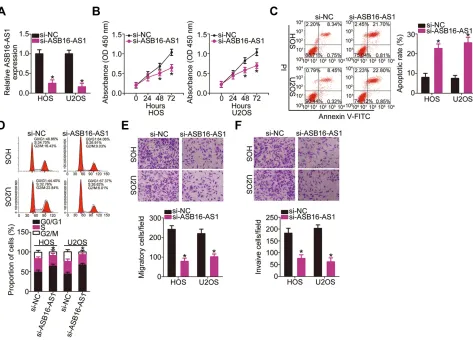
successful ASB16-AS1 knockdown (Figure 2A). CCK-8
assay was used to determine the effects of ASB16-AS1 on cell proliferation in OS. Compared with that of the si-NC cells, the proliferative ability of HOS and U2OS cells with siRNA-induced ASB16-AS1 knockdown was decreased (Figure 2B). Flow cytometry analysis revealed that the proportion of apoptotic HOS and U2OS cells was elevated
following AS16-AS1 knockdown (Figure 2C). In addition,
ASB16-AS1 deficient-HOS and U2OS cells presented an
obvious increase in the proportion of G0–G1 transition
cells and decrease in the proportion of S phase cells (Figure 2D), indicating that silencing of ASB16-AS1
resulted in G0–G1 arrest in OS cells. Furthermore, cell
migration and invasion assays showed that transfection
with si-ASB16-AS1 resulted in a significant impairment
Figure 1High expression of ASB16-AS1 in OS predicts poor prognosis. (A) RT-qPCR was conducted to examine ASB16-AS1 expression in 47 pairs of OS tissues and their corresponding adjacent normal tissues. *P < 0.05 vs adjacent normal tissues. (B) Expression of ASB16-AS1 infive human OS cell lines (HOS, 143B, MG-63, U2OS, and SAOS-2) and a normal human osteoblast hFOB1.19 was analyzed with RT-qPCR. *P < 0.05 vs hFOB1.19. (C) The association between ASB16-AS1 expression and overall survival of OS patients was evaluated using Kaplan–Meier analysis and Log rank test. P = 0.031.
OncoTargets and Therapy downloaded from https://www.dovepress.com/ by 118.70.13.36 on 25-Aug-2020
of the migratory (Figure 2E) and invasive (Figure 2F) abilities of HOS and U2OS cells. Together, these results suggested that ASB16-AS1 functions as a cancer-promoting lncRNA in OS progression.
ASB16-AS1 Operates as an miRNA
Sponge for miR-760 and Negatively
Modulates Its Expression
To uncover the mechanisms through which the oncogenic
activities of ASB16-AS1 are mediated in OS cells, wefirst
employed subcellular fractionation and RT-qPCR to assess the localization of ASB16-AS1 expression in OS cells. ASB16-AS1 was mostly distributed in the cytoplasm of
HOS and U2OS cells (Figure 3A). The results implied that
ASB16-AS1 may function as a competing endogenous RNA (ceRNA) that regulates the expression of targets of miRNAs by competitively binding to miRNA. Next, through the online platform starBase 3.0, miR-760 was discovered to harbor two binding sites for ASB16-AS1 (Figure 3B).
After confirming the effects of agomir-760 on increasing
endogenous miR-760 expression (Figure 3C), luciferase
reporter assay was utilized to verify whether the binding site was functional. Reduction in the luciferase activity of
ASB16-AS1-wt (both 1 and 2) induced by miR-760 overexpression was observed in HOS and U2OS cells; however, mutagenesis of the binding site (both 1 and 2) abrogated the inhibitory
influence of miR-760 upregulation on the luciferase activity
(Figure 3D). Additionally, distinct enrichment of ASB16-AS1 and miR-760 in anti-AGO2 group was validated using RIP analysis (Figure 3E), further demonstrating the direct interac-tion between ASB16-AS1 and miR-760 in OS cells. To further test the association between ASB16-AS1 and miR-760, RT-qPCR was employed to quantify miR-760 expression in 47 pairs of OS tissues and their corresponding adjacent normal tissues. miR-760 was weakly expressed in OS tissues (Figure 3F), showing an inverse relationship with
ASB16-AS1 expression (Figure 3G; r = −0.6271, P < 0.0001).
Furthermore, interference of ASB16-AS1 expression resulted in increased miR-760 accumulation in HOS and U2OS cells (Figure 3H). Therefore, ASB16-AS1 served as a ceRNA by sponging miR-760 in OS cells.
HDGF Is a Direct Target of miR-760 in
OS Cells
After revealing the aberrant downregulation of miR-760 in OS, we explored whether miR-760 contributed to the
oncogenicity of OS. CCK-8 and flow cytometry analyses
revealed that transfection with agomir-760 resulted in a conspicuous decrease of HOS and U2OS cell
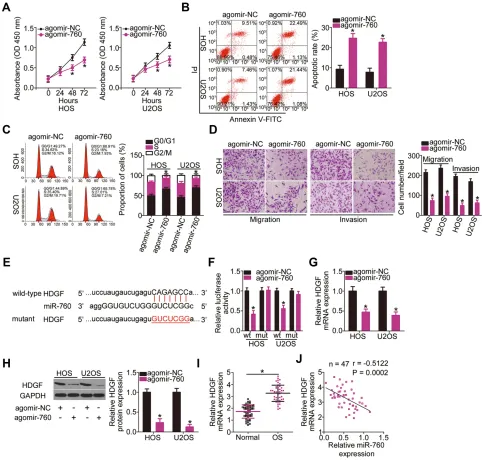
prolifera-tion (Figure 4A), promotion of cell apoptosis (Figure 4B)
and induction of G0–G1 arrest (Figure 4C) compared with
transfection with agomir-NC. In addition, the migratory and invasive abilities of HOS and U2OS cells were remarkable hindered following forced miR-760 overex-pression, as evidenced by cell migration and invasion
assays (Figure 4D).
To elucidate the mechanism underlying miR-760 over-expression-induced suppression of the malignant phenotype of OS, bioinformatic predictions were performed to screen for the putative targets of miR-760. HDGF was predicted as
a potential target of miR-760 (Figure 4E). Luciferase
repor-ter assay was adopted to investigate whether miR-760 could
bind to the 3′-UTR of HDGF. miR-760 overexpression
inhibited the luciferase activity of the plasmid carrying a wild-type miR-760 binding site, while no obvious reduc-tion of luciferase activity was observed for HDGF-mut (Figure 4F). Furthermore, the mRNA (Figure 4G) and
pro-tein (Figure 4H) levels of HDGF were conspicuously
reduced in HOS and U2OS cells following agomir-760 introduction, as shown by RT-qPCR and Western blotting,
Table 1 The Correlation Between ASB16-AS1 Expression and Clinicopathological Parameters of the Patients with OS
Clinicopathological Parameters
ASB16-AS1 P value
High (n=24)
Low (n=23)
Age (Years) 0.772
< 18 12 10
≥18 12 13
Gender 0.766
Male 14 15
Female 10 8
Tumor size (cm) 0.036*
< 5 11 18
≥5 13 5
TNM stage 0.041*
I–II 9 16
III–IV 15 7
Distant metastasis 0.015*
Presence 11 19
Absence 13 4
Note:*P < 0.05 byχ2 test.
OncoTargets and Therapy downloaded from https://www.dovepress.com/ by 118.70.13.36 on 25-Aug-2020
respectively. Moreover, HDGF mRNA expression was higher in OS tissues than in the adjacent normal tissues (Figure 4I). Spearman correlation analysis revealed that miR-760 expression was negatively correlated to HDGF
mRNA expression in OS tissues (Figure 4J; r = −0.5122,
P = 0.0002). These observations collectively identified
HDGF as a direct target of miR-760 in OS cells.
ASB16-AS1 Positively Affects HDGF
Expression in OS Cells via Sponging of
miR-760
After validating ASB16-AS1 as a molecular sponge of miR-760 and HDGF as a direct target of miR-miR-760, we further assessed whether ASB16-AS can alter HDGF expression in OS cells. As expected, transfection with si-ASB16-AS1
dra-matically decreased HDGF mRNA (Figure 5A) and protein
(Figure 5B) expression in HOS and U2OS cells compared with si-NC-transfection. In addition, ASB16-AS1 expression
was positively correlated to HDGF mRNA expression in OS
tissues (Figure 5C; r = 0.5087, P = 0.0003). Subsequently,
si-ASB16-AS1 plus antagomir-NC or antagomir-760 was transfected into HOS and U2OS cells, and HDGF expression
was then determined. RT-qPCR analysis confirmed that
antagomir-760 efficiently silenced miR-760 expression in
HOS and U2OS cells (Figure 5D). ASB16-AS1
knockdown-induced downregulation of HDGF mRNA (Figure 5E) and
protein (Figure 5F) expression was mostly reversed by
antag-omir-760 cotransfection. These observations imply that ASB16-AS1 functioned as a ceRNA for miR-760 and posi-tively regulated HDGF expression.
miR-760/HDGF Axis Responsible for the
Cancer-Promoting Roles of ASB16-AS1 in
OS Cells
Rescue experiments were performed to clarify whether the miR-760/HDGF axis mediates the promotive activities of Figure 2Interference of ASB16-AS1 expression inhibits HOS and U2OS cell proliferation, migration, and invasion and promotes cell apoptosis. (A) The knockdown efficiency for si-ASB16-AS1 in HOS and U2OS cells was determined via RT-qPCR analysis. *P < 0.05 vs si-NC. (B) The impact of ASB16-AS1 silencing on the proliferation of HOS and U2OS cells was examined via the CCK-8 assay. *P<0.05 vs si-NC. (C, D) The apoptosis rate and cell cycle status of HOS and U2OS cells transfected with si-ASB16 -AS1 or si-NC was detected viaflow cytometry. *P<0.05 vs si-NC. (E, F) The migratory and invasive abilities of HOS and U2OS cells with ASB16-AS1 knockdown were evaluated via cell migration and invasion assays. *P<0.05 vs si-NC.
OncoTargets and Therapy downloaded from https://www.dovepress.com/ by 118.70.13.36 on 25-Aug-2020
ASB16-AS1 in OS progression. To this end,
ASB16-AS1-deficient HOS and U2OS cells were further transfected
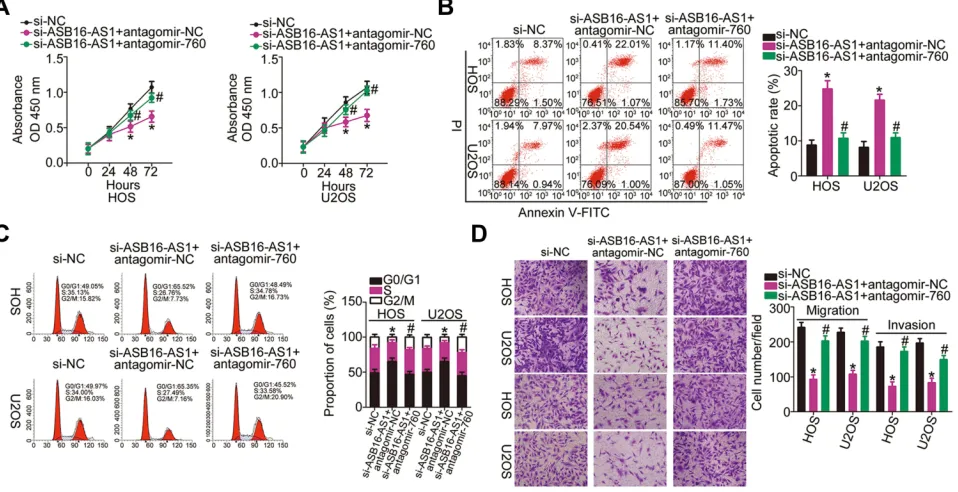
with antagomir-NC or antagomir-760. Functional experi-ments indicated that ASB16-AS1 silencing attenuated
HOS and U2OS cell proliferation (Figure 6A), promoted
cell apoptosis (Figure 6B), induced cell G0–G1 arrest
(Figure 6C), and impaired cell migration and invasion (Figure 6D). However, these were reversed by miR-760 inhibition.
In addition to verifying that HDGF was successfully
overexpressed by HDGF overexpression plasmid
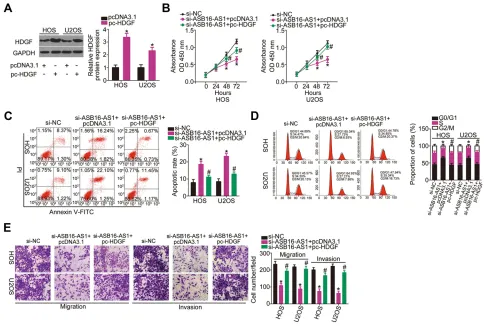
pc-HDGF (Figure 7A), rescue experiments were
con-ducted in HOS and U2OS cells by transfecting with si-ASB16-AS1 in the presence of either pc-HDGF or empty pcDNA3.1 plasmid. Recovery of HDGF
expres-sion counteracted si-ASB16-AS1-induced influences on
the proliferation (Figure 7B), apoptosis (Figure 7C),
cell cycle status (Figure 7D), migration, and invasion
(Figure 7E) of HOS and U2OS. Taken together, these results suggest that the oncogenic roles of ASB16-AS1 in OS cells depend on the regulation of the miR-760/ HDGF axis.
Figure 3ASB16-AS1 operates as an miRNA sponge for miR-760 and negatively modulates its expression. (A) Subcellular fractionation followed by RT-qPCR analysis was used for assessing the localization of ASB16-AS1 expression in HOS and U2OS cells. (B) Schematic representation of the wild-type and mutant binding sites of miR-760 for ASB16-AS1. (C) The efficiency for agomir-760 transfection in HOS and U2OS cells was evaluated via RT-qPCR. *P < 0.05 vs agomir-NC. (D) Luciferase reporter assay indicated that ASB16-AS1-wt activity was impaired by miR-760 overexpression; however, the ASB16-AS1-mut activity was unaffected upon miR-760 upregulation. *P < 0.05 vs agomir-NC. (E) RIP assay displayed the enrichment of ASB16-AS1 and miR-760 in anti-AGO2 group. *P < 0.05 vs IgG. (F) RT-qPCR analysis was conducted to detect the expression of miR-760 in 47 pairs of OS tissues and their corresponding adjacent normal tissues. *P < 0.05 vs adjacent normal tissues. (G) The analysis of the expression correlation between miR-760 and ASB16-AS1 in OS tissues was performed with Spearman correlation analysis. r=−0.6271, P < 0.0001. (H) HOS and U2OS cells were transfected with si-ASB16-AS1 or si-NC. Forty-eight h after transfection, the cells were harvested for the evaluation of miR-760 expression using RT-qPCR. *P < 0.05 vs si-NC.
OncoTargets and Therapy downloaded from https://www.dovepress.com/ by 118.70.13.36 on 25-Aug-2020
ASB16-AS1 Silencing Suppresses Tumor
Growth of OS in vivo
The ability of ASB16-AS1 knockdown to hinder OS growth in vivo was assessed in a xenograft mouse model. U2OS cells stably transfected with sh-ASB16-AS1 or sh-NC were subcutaneously injected into BALB/c nude mice. The volume of tumor xenografts formed by
ASB16-AS1-silenced U2OS cells lower than that of xenografts formed
by sh-NC cells (Figure 8AandB). After 4 weeks, all tumor
xenografts were collected and weighted. HE staining was performed to demonstrate that the tumor xenografts were
derived from U2OS cells (Figure 8C). The average weight
of the tumor xenografts was lower in the sh-ASB16-AS1
group than in the sh-NC group (Figure 8D). Furthermore,
Figure 4Validation of HDGF as a direct target of miR-760 in OS cells. (A–C) CCK-8 assay andflow cytometry analysis was utilized to respectively evaluate the influence of miR-760 upregulation on the proliferation, apoptosis and cell cycle status of HOS and U2OS cells. *P < 0.05 vs agomir-NC. (D) The migratory and invasive capacities of agomir-760 or agomir-NC-transfected HOS and U2OS cells were detected using cell migration and invasion assays. *P < 0.05 vs agomir-NC. (E) The wild-type miR-760-binding site in the 3′-UTR of HDGF mRNA. The mutant binding sequences were also presented. (F) The luciferase activity of HDGF-wt or HDGF-mut was measured after cotransfection with agomir-760 or agomir-NC in the HOS and U2OS cells. *P < 0.05 vs agomir-NC. (G, H) RT-qPCR and Western blotting respectively showed that agomir-760 transfection decreased HDGF mRNA and protein expression in HOS and U2OS cells. *P < 0.05 vs agomir-NC. (I) RT-PCR analysis showed the upregulation of HDGF mRNA expression in OS tissues relative to that in their corresponding adjacent normal tissues. *P < 0.05 vs corresponding adjacent normal tissues. (J) The expression correlation between HDGF mRNA and miR-760 in OS tissues was tested via Spearman correlation analysis. r =−0.5122, P = 0.0002.
OncoTargets and Therapy downloaded from https://www.dovepress.com/ by 118.70.13.36 on 25-Aug-2020
the tumor xenografts harvested from the sh-ASB16-AS1
group exhibited significantly lower sh-ASB16-AS1
expres-sion (Figure 8E), higher miR-760 expression (Figure 8F),
and lower HDGF protein expression (Figure 8G)
than tumor xenografts in the sh-NC group. Together, our data suggest that ASB16-AS1 downregulation inhibits Figure 5ASB16-AS1 positively regulates HDGF expression in OS cells via sponging miR-760. (A, B) si-ASB16-AS1 or si-NC was introduced into the HOS and U2OS cells. After transfection, the mRNA and protein levels of HDGF were detected through RT-qPCR and Western blotting, respectively. *P < 0.05 vs si-NC. (C) Spearman correlation analysis was adopted to assess the expression correlation between ASB16-AS1 and HDGF mRNA levels in the OS tissues. r = 0.5087, P = 0.0003. (D) The knockdown efficiency for antagomir-760 in HOS and U2OS cells was determined with RT-qPCR analysis. *P < 0.05 vs antagomir-NC. (E, F) HOS and U2OS cells were cotransfected with si-ASB16-AS1 and antagomir-760 or antagomir-NC. ASB16-AS1 silencing the reduced HDGF mRNA and protein expression, which was reversed by the antagomir-760. *P < 0.05 vs si-NC.#
P < 0.05 vs si-ASB16-AS1+antagomir-NC.
Figure 6Inhibition of miR-760 rescues the actions of ASB16-AS1 silencing in OS cells (A–C) si-ASB16-AS1 plus antagomir-760 or antagomir-NC was introduced into the HOS and U2OS cells. HOS and U2OS cells transfected with si-ASB16-AS1 inhibited proliferation, promoted apoptosis and induced G0–G1 arrest, whereas the effects were reversed by miR-760 inhibition. *P<0.05 vs si-NC.#
P < 0.05 vs si-ASB16-AS1+antagomir-NC. (D) The impaired migratory and invasive abilities of HOS and U2OS cells were partially abolished by antagomir-760 cotransfection. *P < 0.05 vs si-NC.#
P < 0.05 vs si-ASB16-AS1+antagomir-NC.
OncoTargets and Therapy downloaded from https://www.dovepress.com/ by 118.70.13.36 on 25-Aug-2020
tumor growth of OS in vivo through controlling the miR-760/HDGF axis.
Discussion
A great deal of attention is being recently paid to the
expres-sion profiles and roles of lncRNAs in carcinogenesis and
cancer progression.28–30An increasing number of studies
sug-gest that the alteration of lncRNA expression is closely linked
to the onset and progression of OS.31–33Therefore, an
inves-tigation of specific molecules that are dysregulated in OS may
reveal potential therapeutic targets. Despite the tremendous progress in the research on lncRNA, its association with OS remained to be investigated. In the present study, the expres-sion pattern of ASB16-AS1 in OS tissues and cell lines was analyzed. In addition, the clinical value of ASB16-AS1 in OS patients was examined. The effects of ASB16-AS1 on malig-nant phenotypes of OS cells in vitro and in vivo as well as the mechanism of action were also explored.
A previous study reported the expression level and
vital roles of ASB16-AS1 in glioma26 and hepatocellular
carcinoma.27ASB16-AS1 was elevated in glioma and was
significantly associated with tumor staging and grading.26
ASB16-AS1 was also upregulated in hepatocellular carci-noma, and closely related with low survival rate. In addition, upregulation of ASB16-AS1 predicted low disease-free
sur-vival rate for patients with hepatocellular carcinoma.27
Functionally, ASB16-AS1 exerted pro-oncogenic roles in
glioma26 and hepatocellular carcinoma.27 Nevertheless, its
expression and functions in OS have not been thoroughly investigated. Data from the current study revealed that ASB16-AS1 expression was increased in OS tissues and cell lines. An increased ASB16-AS1 expression exhibited
significantly relation with OS patients’ tumor size, TNM
stage, and distant metastasis. Patients with OS expressing high ASB16-AS1 tended to show a shorter overall survival than those with expressing low ASB16-AS1. In terms of function, interference of ASB16-AS1 expression decreased OS cell proliferation, migration, and invasion in vitro. Furthermore, ASB16-AS1 silencing facilitated OS cell apop-tosis and impaired tumor growth in vivo. To the best of our Figure 7HDGF reintroduction abrogates the impacts of ASB16-AS1 knockdown in OS cells (A) The efficiency of pc-HDGF transfection in HOS and U2OS cells was evaluated using RT-qPCR. *P < 0.05 vs pcDNA3.1. (B–E) The ASB16-AS1-deficient HOS and U2OS cells were further transfected with pc-HDGF or pcDNA3.1. The decreased proliferation, promotion of apoptosis, and hindered migration and invasion caused by ASB16-AS1 knockdown in HOS and U2OS cells was abrogated by HDGF upregulation. *P < 0.05 vs si-NC.#
P < 0.05 vs si-ASB16-AS1+ pcDNA3.1.
OncoTargets and Therapy downloaded from https://www.dovepress.com/ by 118.70.13.36 on 25-Aug-2020
knowledge, the present study is thefirst endeavor to
investi-gate the significant regulatory roles of ASB16-AS1 in OS.
Having validated the pro-oncogenic activities of ASB16-AS1, we subsequently elucidated the molecular mechanism through which ASB16-AS1 affects OS cells. Mechanically, cytoplasmic lncRNAs have miRNA responsive elements that work as miRNA sponges to negatively regulate the miRNAs available to interact with their target mRNAs, thereby
decreasing the suppression of these mRNAs.34 In this
study, subcellular fractionation followed by RT-qPCR analy-sis demonstrated ASB16-AS1 localization in the cytoplasm of OS cells. Following bioinformatic analysis, ASB16-AS1 was predicted to sponge miR-760. The interaction between
ASB16-AS1 and miR-760 in OS cells was then verified by
luciferase reporter and RIP assays. Additionally, miR-760 expression was decreased in OS and was inversely correlated with ASB16-AS1 expression. Furthermore, miR-760 expres-sion was increased by ASB16-AS1 silencing in OS cells.
Moreover, HDGF was identified as a direct target gene of
miR-760 in OS cells, and its expression could be positively modulated by ASB16-AS1 via sponging miR-760. Given these results, we propose that ASB16-AS1 acts as a ceRNA for miR-760 and thereby positively controlling HDGF expression in OS.
Some previous studies reported that miR-760 was weakly
expressed in breast cancer,35 lung cancer,36 colorectal
cancer,37 and hepatocellular carcinoma38 but was highly
expressed in ovarian cancer.39However, the expression and
effects of miR-760 on the oncogenicity in OS have been rarely explored. Our results showed that miR-760 was underex-pressed in OS and exerted an inhibitory role on the malignant characteristics of OS cells. Mechanically, HDGF was vali-dated as a direct target gene of miR-760 in OS cells. HDGF,
first purified from a culture medium conditioned with the
hepatoma cell line HuH7, has been verified as a
heparin-binding growth factor.40HDGF is upregulated in OS, and its
high expression is closely related with tumor size.41This gene
plays cancer-promoting roles in OS progression and is involved in the modulation of multiple aggressive behaviors
both in vitro and in vivo.41,42However, the molecular events
that lead to the decrease of miR-760 and increase of HDGF have not been investigated in OS. Our results also showed that ASB16-AS1 harbors miR-760 to indirectly regulate HDGF expression in OS cells. Consequently, a novel regulatory net-work involving ASB16-AS1, miR-760, and HDGF was
iden-tified to play an important role in the pathogenesis of OS.
Increasing number of studies uncovered that a small group of cells with stem-like characteristics called cancer stem-like cells are implicated in the OS initiation and
pro-gression because of their stronger stemness.43–45 In
addi-tion, lncRNA and miRNA is reported to be involved in the regulation of stemness of OS cells. For instance, Liang et al found that the activation of DNA methyltransferase 1 pro-moted the methylation of miR-34a and thereby decreased Figure 8ASB16-AS1 inhibition restricts tumor growth of OS cells in vivo. (A) The growth curve of the tumor xenografts after inoculation of either the sh-ASB16-AS1-transfected or sh-NC-sh-ASB16-AS1-transfected U2OS cells into nude mice. *P < 0.05 vs sh-NC. (B) Representative photographs of the tumor xenografts derived from groups“ sh-ASB16-AS1”and“sh- NC.”(C) Tumor xenografts detected by HE staining (magnification: x400). (D) The weight of the tumor xenografts obtained from groups“sh-ASB16-AS1”and
“sh- NC.”*P < 0.05 vs sh-NC. (E, F) The expression of ASB16-AS1 and miR-760 in tumor xenograft derived from sh-ASB16-AS1-transfected or sh-NC-transfected U2OS cells was detected via RT-qPCR analysis. *P < 0.05 vs sh-NC. (G) The tumor xenografts were evaluated under Western blotting to detect the HDGF protein expression. *P < 0.05 vs sh-NC.
OncoTargets and Therapy downloaded from https://www.dovepress.com/ by 118.70.13.36 on 25-Aug-2020
miR-34a expression, resulting in the sustaining the
stem-ness of OS cells.46 LncRNA THOR overexpression
increased the stemness of OS cells through enhancing SRY (sex determining region Y)-box 9 mRNA stability
and raising its expression.47 However, in this study, we
did not test the impacts of ASB16-AS1/miR-760/HDGF pathway on the cancer stem cells of OS cells. We will resolve this limitation in the near future.
Conclusion
The results of this study suggest the contribution of ASB16-AS1 to the progression of OS via the miR-760/HDGF path-way. ASB16-AS1 seemed to function as a ceRNA to reduce the endogenous negative regulatory effect of miR-760 on its
target HDGF. Thesefindings highlight the expression and roles
of ASB16-AS1 in OS as well as underscore a novel molecular mechanism through which ASB16-AS1 exerts its oncogenic effects. Therefore, targeting the ASB16-AS1/miR-760/HDGF pathway may be an effective therapeutic target in OS.
Data Sharing Statement
The datasets used and/or analyzed during the present study are available from the corresponding author on reasonable request.
Ethics Approval and Informed
Consent
The present study was approved by the ethics committee of China-Japan Union Hospital Jilin University and was
performed in accordance with the Declaration of
Helsinki. A written informed consent was provided by all participants prior to their enrollment in the study. All animal studies were approved by the Committee on the Ethics of Animal Experiments of China-Japan Union Hospital Jilin University, and were performed in
compli-ance with the Animal Protection Law of the People’s
Republic of China-2009 for experimental animals. We mentioned this information in the manuscript.
Funding
This study was supported by a special fund for Key Laboratories by Jilin Provincial Science and Technology Agency (#20190201282JC).
Disclosure
The authors declare that they have no competing interests in this work.
References
1. Isakoff MS, Bielack SS, Meltzer P, Gorlick R. Osteosarcoma: current treatment and a collaborative pathway to success. J Clin Oncol.
2015;33(27):3029–3035. doi:10.1200/JCO.2014.59.4895
2. He J-P, Hao Y, Wang X-L, et al. Review of the molecular pathogen-esis of osteosarcoma. Asian Pac J Cancer Prev. 2014;15 (15):5967–5976. doi:10.7314/APJCP.2014.15.15.5967
3. Lin Y-H, Jewell BE, Gingold J, et al. Osteosarcoma: molecular pathogenesis and iPSC modeling. Trends Mol Med. 2017;23 (8):737–755. doi:10.1016/j.molmed.2017.06.004
4. Kager L, Zoubek A, Potschger U, et al. Primary metastatic osteosar-coma: presentation and outcome of patients treated on neoadjuvant cooperative osteosarcoma study group protocols. J Clin Oncol.
2003;21(10):2011–2018. doi:10.1200/JCO.2003.08.132
5. Anderson ME. Update on survival in osteosarcoma. Orthop Clin
North Am.2016;47(1):283–292. doi:10.1016/j.ocl.2015.08.022
6. Durfee RA, Mohammed M, Luu HH. Review of osteosarcoma and current management. Rheumatol Ther. 2016;3(2):221–243. doi:10. 1007/s40744-016-0046-y
7. Yang Y, Han L, He Z, et al. Advances in limb salvage treatment of osteosarcoma. J Bone Oncol. 2018;10:36–40. doi:10.1016/j. jbo.2017.11.005
8. Kushlinskii NE, Fridman MV, Braga EA. Molecular mechanisms and microRNAs in osteosarcoma pathogenesis. Biochem Biokhimiia.
2016;81(4):315–328. doi:10.1134/S0006297916040027
9. Denduluri SK, Wang Z, Yan Z, et al. Molecular pathogenesis and therapeutic strategies of human osteosarcoma. J Biomed Res.
2015;30.
10. Mattick JS, Makunin IV. Non-coding RNA.Hum Mol Genet.2006;15 Spec No 1:R17–29. doi:10.1093/hmg/ddl046
11. Smolle MA, Pichler M. The role of long non-coding RNAs in Osteosarcoma. Non-Coding RNA. 2018;4:1. doi:10.3390/ncrna 4010007
12. Sparber P, Filatova A, Khantemirova M, Skoblov M. The role of long non-coding RNAs in the pathogenesis of hereditary diseases.BMC Med
Genomics.2019;12(Suppl 2):42. doi:10.1186/s12920-019-0487-6
13. Cui YS, Song YP, Fang BJ. The role of long non-coding RNAs in multiple myeloma.Eur J Haematol.2019;103(1):3–9. doi:10.1111/ ejh.13237
14. Zhang L, Meng X, Zhu XW, et al. Long non-coding RNAs in oral squamous cell carcinoma: biologic function, mechanisms and clinical implications.Mol Cancer.2019;18(1):102. doi:10.1186/s12943-019-1021-3
15. Flippot R, Beinse G, Boileve A, Vibert J, Malouf GG. Long non-coding RNAs in genitourinary malignancies: a whole new world.Nat Rev Urol.2019;16(8):484–504. doi:10.1038/s41585-019-0195-1
16. Wu Y, Shao A, Wang L, et al. The Role of lncRNAs in the distant metastasis of breast cancer.Front Oncol.2019;9:407. doi:10.3389/ fonc.2019.00407
17. Shi D, Wu F, Mu S, et al. LncRNA AFAP1-AS1 promotes tumor-igenesis and epithelial-mesenchymal transition of osteosarcoma through RhoC/ROCK1/p38MAPK/Twist1 signaling pathway.J Exp
Clin Cancer Res.2019;38(1):375. doi:10.1186/s13046-019-1363-0
18. Guo W, Jiang H, Li H, et al. LncRNA-SRA1 suppresses osteosar-coma cell proliferation while promoting cell apoptosis. Technol
Cancer Res Treat. 2019;18:1533033819841438. doi:10.1177/15330
33819841438
19. Li G, Zhu Y. Effect of lncRNA ANRIL knockdown on proliferation and cisplatin chemoresistance of osteosarcoma cells in vitro.Pathol
Res Pract.2019;215(5):931–938. doi:10.1016/j.prp.2019.01.042
20. Pan R, He Z, Ruan W, et al. lncRNA FBXL19-AS1 regulates osteo-sarcoma cell proliferation, migration and invasion by sponging miR-346. Onco Targets Ther. 2018;11:8409–8420. doi:10.2147/ OTT.S160963
OncoTargets and Therapy downloaded from https://www.dovepress.com/ by 118.70.13.36 on 25-Aug-2020
21. Sui Y, Han Y, Zhao X, Li D, Li G. Long non-coding RNA GClnc1 promotes tumorigenesis in osteosarcoma by inhibiting p53 signaling.
Biochem Biophys Res Commun.2018;507(1–4):36–42. doi:10.1016/j.
bbrc.2018.10.135
22. Zhang RM, Tang T, Yu HM, Yao XD. LncRNA DLX6-AS1/miR-129-5p/DLK1 axis aggravates stemness of osteosarcoma through Wnt signaling.Biochem Biophys Res Commun.2018;507(1–4):260– 266. doi:10.1016/j.bbrc.2018.11.019
23. Cong M, Jing R. Long non-coding RNA TUSC7 suppresses osteo-sarcoma by targeting miR-211. Biosci Rep. 2019;39. doi:10.1042/ BSR20190291
24. Ding W, Wu D, Ji F, Zhang H. Inhibition of long non-coding RNA-AWPPH decreases osteosarcoma cell proliferation, migration and invasion. Oncol Lett. 2019;18(5):5055–5062. doi:10.3892/ ol.2019.10898
25. Chen S, Xu X, Lu S, Hu B. Long non-coding RNA HAND2-AS1 targets glucose metabolism and inhibits cancer cell proliferation in osteosarcoma. Oncol Lett. 2019;18(2):1323–1329. doi:10.3892/ ol.2019.10445
26. Ji L, Fan X, Zhou F, Gu J, Deng X. lncRNA RPL34-AS1 inhibits cell proliferation and invasion while promoting apoptosis by competi-tively binding miR-3663-3p/RGS4 in papillary thyroid cancer.
J Cell Physiol.2019;235(4):3669–678.
27. Yao X, You G, Zhou C, Zhang D. LncRNA ASB16-AS1 promotes growth and invasion of hepatocellular carcinoma through regulating miR-1827/FZD4 axis and activating Wnt/beta-catenin pathway.
Cancer Manag Res. 2019;11:9371–9378. doi:10.2147/CMAR.
S220434
28. Yao F, Wang Q, Wu Q. The prognostic value and mechanisms of lncRNA UCA1 in human cancer. Cancer Manag Res. 2019;11:7685–7696. doi:10.2147/CMAR.S200436
29. Huang J, Chen J, Liu L, Cai X, Yao Z. Progress in the study of long noncoding RNA in tongue squamous cell carcinoma.Oral Surg Oral
Med Oral Pathol Oral Radiol.2019.
30. Fattahi S, Kosari-monfared M, Golpour M, et al. LncRNAs as poten-tial diagnostic and prognostic biomarkers in gastric cancer: a novel approach to personalized medicine. J Cell Physiol. 2019;235 (4):3189–3206.
31. Chen J, Wu Z, Zhang Y. LncRNA SNHG3 promotes cell growth by sponging miR-196a-5p and indicates the poor survival in osteosarcoma.
Int J Immunopathol Pharmacol. 2019;33:2058738418820743.
doi:10.1177/2058738418820743
32. Su P, Mu S, Wang Z. Long noncoding RNA SNHG16 promotes osteosarcoma cells migration and invasion via sponging miRNA-340. DNA Cell Biol. 2019;38(2):170–175. doi:10.1089/ dna.2018.4424
33. Liang R, Liu Z, Chen Z, et al. Long noncoding RNA DNAJC3-AS1 promotes osteosarcoma progression via its sense-cognate gene DNAJC3. Cancer Med. 2019;8(2):761–772. doi:10.1002/cam4. 2019.8.issue-2
34. Abdollahzadeh R, Daraei A, Mansoori Y, Sepahvand M, Amoli MM, Tavakkoly-bazzaz J. Competing endogenous RNA (ceRNA) cross talk and language in ceRNA regulatory networks: a new look at hallmarks of breast cancer.J Cell Physiol.2019;234(7):10080–10100. doi:10.1002/ jcp.27941
35. Hu S-H, Wang C-H, Huang Z-J, et al. miR-760 mediates chemoresis-tance through inhibition of epithelial mesenchymal transition in breast cancer cells.Eur Rev Med Pharmacol Sci.2016;20(23):5002–5008. 36. Yan C, Zhang W, Shi X, Zheng J, Jin X, Huo J. MiR-760 suppresses
non-small cell lung cancer proliferation and metastasis by targeting ROS1. Environ Sci Pollut Res Int. 2018;25(19):18385–18391. doi:10.1007/s11356-017-1138-0
37. Cao L, Liu Y, Wang D, et al. MiR-760 suppresses human colorectal cancer growth by targeting BATF3/AP-1/cyclinD1 signaling.J Exp
Clin Cancer Res.2018;37(1):83. doi:10.1186/s13046-018-0757-8
38. Sun D, Lu J, Hu C, et al. Prognostic role of miR-760 in hepatocel-lular carcinoma. Oncol Lett. 2018;16(6):7239–7244. doi:10.3892/ ol.2018.9546
39. Liao Y, Deng Y, Liu J, et al. MiR-760 overexpression promotes proliferation in ovarian cancer by downregulation of PHLPP2 expression. Gynecol Oncol. 2016;143(3):655–663. doi:10.1016/j. ygyno.2016.09.010
40. Huang J-S, Chao C-C, Su T-L, et al. Diverse cellular transformation capability of overexpressed genes in human hepatocellular carcinoma. Biochem Biophys Res Commun. 2004;315(4):950–958. doi:10.1016/j.bbrc.2004.01.151
41. Chen Z, Qiu S, Lu X. The expression and clinical significance of HDGF in osteosarcoma. Onco Targets Ther. 2015;8:2509–2517. doi:10.2147/OTT.S91708
42. Liu X, Ma W, Ma J, Xiao L, Hao D. Upregulation of miR95-3p inhibits growth of osteosarcoma by targeting HDGF. Pathol Res
Pract.2019;215(8):152492. doi:10.1016/j.prp.2019.152492
43. Abarrategi A, Tornin J, Martinez-cruzado L, et al. Osteosarcoma: cells-of-origin, cancer stem cells, and targeted therapies.Stem Cells Int.2016;2016:3631764. doi:10.1155/2016/3631764
44. La Noce M, Paino F, Mele L, et al. HDAC2 depletion promotes osteosarcoma’s stemness both in vitro and in vivo: a study on a putative new target for CSCs directed therapy.J Exp Clin Cancer Res.2018;37(1):296. doi:10.1186/s13046-018-0978-x
45. Paino F, La Noce M, Di Nucci D, et al. Human adipose stem cell differentiation is highly affected by cancer cells both in vitro and in vivo: implication for autologous fat grafting. Cell Death Dis.
2017;8(1):e2568. doi:10.1038/cddis.2016.308
46. Liang X, Xu C, Wang W, Li X. The DNMT1/miR-34a axis is involved in the stemness of human osteosarcoma cells and derived stem-like cells. Stem Cells Int. 2019;2019:7028901. doi:10.1155/ 2019/7028901
47. Wu H, He Y, Chen H, et al. LncRNA THOR increases osteosarcoma cell stemness and migration by enhancing SOX9 mRNA stability.
FEBS Open Bio.2019;9(4):781–790. doi:10.1002/feb4.2019.9.issue-4
OncoTargets and Therapy
Dove
press
Publish your work in this journal
OncoTargets and Therapy is an international, peer-reviewed, open access journal focusing on the pathological basis of all cancers, potential targets for therapy and treatment protocols employed to improve the management of cancer patients. The journal also focuses on the impact of management programs and new therapeutic
agents and protocols on patient perspectives such as quality of life, adherence and satisfaction. The manuscript management system is completely online and includes a very quick and fair peer-review system, which is all easy to use. Visit http://www.dovepress.com/ testimonials.php to read real quotes from published authors.
Submit your manuscript here:https://www.dovepress.com/oncotargets-and-therapy-journal
OncoTargets and Therapy downloaded from https://www.dovepress.com/ by 118.70.13.36 on 25-Aug-2020