1 Bad news from Fallujah
By Florian Zollmann, Lecturer in Media, Director of the Archbishop Desmond Tutu Centre for War and Peace Studies, Liverpool Hope University
Abstract
This study uses the thematic analysis developed by the Glasgow University Media Group to explore how the US, UK and German national press covered the US/Coalition assault on the Iraqi city Fallujah in November 2004. The study relies on quantitative and qualitative full text content analyses to assess 428 news, editorial and commentary items. The article suggests that, while government and military officials of the US/Coalition had argued the military ‘operation’ was necessary to secure Iraq and defeat an ‘insurgency’, organisations and actors from the Iraqi society refer to the ‘operation’ as ‘collective punishment’ and a ‘massacre’ that targeted the Iraqi population. The article investigates how the press represented each of these perspectives. The findings suggest that the press overemphasised the US/Coalition perspective despite striking counter evidence. Critical aspects of coverage largely focused on tactical elements of the military dimension of the event. The article concludes that such findings are in accord with hegemonic models of media performance.
Keywords
Iraq War; occupation; press coverage; international news; hegemony; thematic analysis
Introduction
In April and November 2004, US/Coalition forces launched military ‘operations’ in Fallujah -
one of the most densely populated cities in Iraq. US officials had argued the ‘operations’ were
necessary to crush the Iraqi resistance rooted in Fallujah in order to provide security for the
upcoming elections in Iraq.
The first ‘operation’ took place about one year after US President George W. Bush had
proclaimed the end of the 2003 Iraq War at a speech on the aircraft carrier USS Abraham
Lincoln where he had claimed that, from then on, ‘our coalition is engaged in securing and
reconstructing’ Iraq (cited in CNN 2003). During its ‘transition from dictatorship to
democracy’, Bush had further stressed, the US-led Coalition would support ‘the new leaders of Iraq as they establish a government of, by and for the Iraqi people’ (cited in ibid).
The historical and documentary record of the occupation of Iraq suggests different policy
goals: the US/Coalition administered the privatisation of Iraq’s state-owned industries in
accordance with the neoliberal shock-doctrine (see Klein 2007; Schwartz 2008). This policy
aimed to divest Iraq’s resources – including its oil – by opening the economy to multinational
2 Shortly after the ending of the Iraq War, in September 2003, the Coalition Provisional
Authority (CPA), headed by US governor L. Paul Bremer III, enforced Order Number 39 to
replace ‘all existing foreign investment law’ (Coalition Provisional Authority 2003: 2). Bremer also instigated the dissolution of the Ba’athist state and military apparatus leaving
hundreds of thousands of former state and military employees unemployed.
A deteriorating security situation stimulated by civic unrest against Bremer’s policies,
inhibited foreign investment forcing the country into a downturn spiral of unemployment and
economic depression. These developments encouraged an economically driven rebellion
rooted in the Sunni cities of the Al Anbar Governorate where Fallujah is located (see
Schwartz 2008).
As a counter measure, the US/Coalition administered military ‘operations’ throughout 2003
and 2004 mostly against Sunni but also Shiite resistance forces, in Baghdad, Najaf, Ramada,
Samarra, Haditha, Baquba, al Qa’im, Mosul and Fallujah – under the umbrella of ‘counterinsurgency offensives’ (al-Fadhily 2007; GlobalSecurity.org n.d.a).
Already in April 2003, US/Coalition forces had established a base in Fallujah and at the end
of the month, 17 unarmed demonstrators were killed by US forces (Human Rights Watch
2003). This incident started a cycle of violence which culminated in a military ‘operation’ in
April 2004 during which about 600 Iraqi civilians were killed (IBC 2004). Because the
US/Coalition aimed to prevent its angered Iraqi collaborators from resigning their positions in
the Governing Council (IGC), an Iraqi advisory body that worked under the auspices of the
CPA, the April ‘operation’ was halted. An Al-Jazeera television team, headed by reporter and
talk-show host Ahmed Mansour, was the only television crew in Fallujah broadcasting
gruesome pictures out of the city. The US military had later blamed the Arab network for
inciting the Iraqi public.
After intensive preparations, which included diverse propaganda measures to restrict the
information flow from Fallujah, the city was attacked for a second time in November 2004.
This was the largest military ‘operation’ during the occupation. Depending on estimates,
3 This study assesses US, UK and German national press news coverage of the US/Coalition
military ‘operation’ conducted in Fallujah in November 2004. For several reasons, this case
study can be regarded as important: First, to this date, national press news coverage of the
occupation of Iraq more generally, and the ‘operations’ in Fallujah in particular, have not
been systematically studied (see Robinson et al. 2010: 181). Consequently, Piers Robinson et
al. (2010: 181) see the time period spanning the occupation ‘as important as the invasion itself
for what it can tell us about the dynamics of news media coverage’ stressing that this period ‘demands detailed scholarly analysis’. Secondly, the Fallujah case is important because it
exemplifies the failures of US/Coalition ‘counter-insurgency’ strategy in Iraq. As already
indicated, military policies had caused mass civilian death, public infrastructure damage and
widespread rebellion in Iraq (see Schwartz 2008). Newspaper coverage of Fallujah was thus
of great importance for the US/Coalition governments which had the aim of remaining in
Iraq. In fact, it could be argued that a substantially critical press could have ended the
occupation by pressuring the US and UK governments to withdraw their forces from Iraq.
Because of its devastating outcomes, the Fallujah ‘operation’ could have provided an entry
point for such critical coverage. The extent of critical reporting is thus to be assessed in this
article. And finally, the Fallujah case study also sheds light on whether the press performed in
accord with a liberal pluralist model that theorises the media as an independent and critical
monitor of the powerful, or with a hegemonic model that theorises the media as an extension
of the dominant state-military-corporate sector.
Research on media coverage of war
There seems to be agreement among US-American and British scholars that during
international conflicts and wars ‘as institutions, the media have generally served the military
rather well’ (Carruthers 2000: 271-2; see also Bennett 1990; Bennett, Lawrence and
Livingston 2007; DiMaggio 2009; Hallin 1989; Herman and Chomsky 2008; Keeble 1997;
Mermin 1999; Robinson et al. 2010).
The poor performance of the news media can be further explained on the basis of the well
established ‘indexing’ and ‘manufacturing consent’ models which broadly suggest that news
media discourses are elite-driven and thus hegemonic (see Cottle 2006; McChesney 2008;
Robinson et al. 2010). Both approaches assume that, as the US media scholar W. Lance
Bennett (1990: 106) writes, professional journalists ‘tend to “index” the range of voices and
4 mainstream government debate’. Accordingly, non-official perspectives are only incorporated
in news and editorials if they convey judgements already expressed in political officialdom.
Furthermore, the news media includes critical viewpoints if there is political elite opposition
whereas media marginalises critical perspectives if there is bipartisan agreement over policies.
This performance likely leads the media to focus on issues that were highlighted by
parliamentary officials. As a consequence, perspectives critical of government actions are not
sufficiently reported if they have not been debated in official circles. This has great
implications: Jonathan Mermin (1999: 6) argues that if critical views existent in society are
ignored or marginalised when they have not been articulated in official government circles,
then press performance contradicts ‘the First Amendment ideal of a press independent of government’.
Elite ‘indexing’ and ‘manufacturing consent’ also suggest criticism in the media to deal with
tactical/procedural and not fundamental/substantive issues because officials tend to agree on
‘first principles [i.e. fundamental/substantive issues] even if they disagree on how to translate those principles into policy [i.e. tactical/procedural issues]’ (Althaus 2003: 383; see also
Hallin 1989: 110; Hertog 2000: 613; Robinson et al. 2009: 538).
The ‘manufacturing consent’ paradigm established by Edward S. Herman and Noam
Chomsky (2008) further explains media performance with the fact that due to limitations in
time and resources journalists have to largely rely on official sources and public relations
during the news selection process. Moreover, the media’s integration in the global market
system and consequent constraints are regarded as factors as to why the media largely adopt
the frames and explanatory models provided by officials (see Herman und Chomsky 2008).
The internet with its myriad information channels has yet not been able change such pattern
because the large majority of online news organisations are subsets of traditional news
providers. Furthermore, traffic is heavily concentrated and users largely rely on online news
syndicated by traditional media that display the same pattern of coverage described above
(see Curran 2012: 19-20; McChesney 2013). Nonetheless, digital communication provides the
potential for more diverse media coverage (see Hoskins and O’Loughlin 2010). Moreover,
scholars found that after the unfolding of sudden, dramatic and uncontrollable non-routine
events, political institutions were not able to set the agenda (e.g. Bennett, Lawrence and
5 mobile devices, which enable journalists to abandon their conventional working routines and
may thus be evident in coverage of international affairs with their ‘steady stream of wars,
terrorist incidents, famines, and humanitarian crises’ (Livingston and Bennett 2003: 367).
Indeed, studies suggest that the media provided more diverse coverage since the end of the
Cold War and this might partly relate to technological changes (see Entman 2004; Robinson
et al. 2010).
Research on German media representations of war does not allow for broad conclusions
because the interaction between the media and political system has not been sufficiently
studied (see Löffelholz 2004: 38). Moreover, in comparison to Anglo-American scholarship,
which has produced a large amount of theoretically grounded empirical studies, academic
work on German media coverage of international conflict is deficient – it lacks theoretical
underpinnings and reference to other research (see Eilders and Hagen 2005: 208; Löffelholz
2004: 54). On the other hand, the work of German scholar Christiane Eilders (2005) indicates
that the ‘indexing’ norm also applied to coverage of the 1999 intervention in Kosovo and the 2003 Iraq War. As Eilders (ibid: 642) concludes about German media performance: ‘[…]
parliamentary consensus is reflected in media opinion, and the media system consequently
lacks its most important basis for acting as monitor and critic.’
The aim of this article is to assess the relevance of hegemonic, elite-driven models by
investigating how the Fallujah case was represented in the US, UK and German press.
Thematic analysis
This study relies on the thematic analysis developed by the Glasgow University Media Group
(GUMG) (e.g. Philo and Berry 2011). Greg Philo and Mike Berry (ibid: 174) argue that
during public controversies, explanatory perspectives or themes compete in struggles for
legitimacy. In the context of this study, explanatory perspectives explain the reasons,
justifications and goals for government, military and other policies (see Philo and Berry 2011:
187, 348-349; also Hammond 2007: 19). If perspectives are linked to interests, they can be
classified as ideologies (i.e. interest-linked perspectives) (ibid).
Thematic analysis as a methodology investigates the prevalence of official and alternative
explanations in media content. Substantial imbalances in the distribution of official and
6 performance. As Philo (2012: 151) argues, explanatory themes are ‘contested and the main
purpose of propaganda […] is to achieve dominance for particular ways of understanding’.
On the other hand, the heavy inclusion of alternative explanations would be evidence for the
applicability of pluralist models of media performance. Accordingly, Philo and Berry (2011:
176) argue that the existence of a range of explanations indicates the adherence to the
requirement of journalistic balance.
It is also of interest how critical the media evaluated different perspectives. In media studies,
criticism is regarded as important: Entman and Page (1994: 82) hold the opinion that ‘how
much critical distance the news can [emphasis in the original] develop from the position taken
by the president and his administration’ is ‘one of the central issues in the study of media and
foreign policy’.
Hegemonic models would be confirmed if media-criticism is confined to procedural/tactical
while marginalising substantial/fundamental criticism. As Chomsky explains, media ‘reflect
the range of debate over tactical questions among dominant elites’ (1989: 11). ‘Controversy
may rage’, Chomsky argues, ‘as long as it adheres to the presuppositions that define the consensus of elites’ (ibid: 48). Within this universe, Chomsky stresses, professional
journalism can operate with integrity and commitment (ibid: 11). In this sense, the media are
not monolithic, however, diversity is bounded by an elite consensus. Hence, under such
considerations, the procedural/tactical nature of criticism is part of hegemonic reporting.
It is generally understood that procedural/tactical criticism scrutinises the choices, means,
conducts and outcomes of policies or the qualities of leaders (see Hertog 2000: 613; also
Robinson et al. 2009: 538). This includes a review of political (e.g. diplomacy, support for
local groups, the general situation etc.) and military strategies (e.g. use of forces, choice of
forces, outcomes like casualties and destruction etc.) (Herman and Chomsky 2008: 189-190;
Hertog 2000: 613). In contrast, substantial/fundamental criticism is concerned with basic
doctrines (i.e. first principles or fundamental objectives) of foreign policy, nefarious
behaviour patterns or ethical standards (see Hertog 2000: 613, 618; also Althaus 2003: 383;
Robinson et al. 2009: 538).
An assessment of criticism can be linked to the thematic analysis. Official explanations might
7 substantial/fundamental criticism. As a consequence, the prevalence of alternative
explanations would also point to the media’s use of substantial/fundamental criticism and thus
more pluralist reporting than a hegemonic model predicts.
Method of research
This study uses quantitative content analysis in order to assess ‘the inclusion or exclusion of
certain types of [...] explanations’ (Philo and Berry 2011: 175). Particularly, the frequency
and placement of official and alternative explanations was measured (see Philo and Berry
2011: 348).
An official explanation was coded if a newspaper mentioned explicitly or implicitly one or
more of the justifications, reasons, aims, or goals of the Fallujah ‘operation’ as raised by
US/Coalition officials. Officials had argued that the military attack was necessary to (1)
defeat, crush or weaken the resistance in Fallujah, (2) prepare for the upcoming Iraqi
elections, or (3) stabilise, democratise, or otherwise liberate Fallujah and Iraq. These
explanatory themes were important because they related to the broader official justifications
that had been given for the Iraq invasion conducted in March 2003 and the subsequent
occupation.
Alternative explanations were coded if a newspaper mentioned explicitly or implicitly one or
more justifications, reasons, aims, or goals of the Fallujah ‘operation’ which were in
disharmony with those given by the US/Coalition. Alternative explanations largely emerged
from Iraqi actors and groups as well as the Western anti-war movement and its supporters in
the intellectual community. Iraqi and anti-war actors and organisations had argued that the
military attack was conducted to: (1) collectively punish Iraqi civilians; (2) crush the
resistance because it set an example by defying US/Coalition power; (3) destroy the resistance
because it threatened US/Coalition ambitions to privatise the Iraqi economy/oil; and or (4)
undermine civilian support for the resistance by targeting the population. These explanatory
themes were important because they de-stabilised the official explanations and suggested that
the US/Coalition set up a neo-colonial regime in Iraq.
The two sets of explanations were initially determined through a close reading of newspaper
articles and secondary sources. A code book, to be used as a guideline by the author and two
8 explanations. Explanations were identified in sentences or paragraphs and if an article
included at least one explanation it was coded. Hence, the primary unit of analysis was the
article. There were a few articles that included official and alternative explanations. In such
instances, both occurrences were coded and the article was displayed as mixed. This was done
in order to keep mutual exclusiveness of the categories (see Holsti 1969: 99). If a news item
procedurally contested official explanations it was still coded as official because such
criticism did not question the validity of the official rationale (i.e. it did not question the
ideological content of the explanation). A total of 428 items were coded. They included news,
editorial and commentaries. 10 per cent of the data set was coded by second coders and
reliability figures were acceptable.1
The thematic analysis was complemented by a qualitative content analysis based on a
procedure outlined by David Altheide (1996). Altheide (ibid: 2) blends ‘the traditional notion
of objective content analysis with participant observation to form ethnographic content
analysis [all emphasis in the original]’. Ethnographic content analysis (ECA) refers to the
researcher’s way of interacting with documents (ibid). ECA uses a research protocol to identify ‘questions, items, categories, or variables’ in order to structure the data collection process (ibid: 26). ECA, therefore, relies on ‘qualitative’ categories that include ‘text, narrative and descriptions’ and can additionally incorporate ‘quantitative’ categories that
count certain attributes of the text (ibid: 27). That is why ECA is suitable to be used in
conjunction with ‘quantitative’ content analysis.
When conducting ECA, each news item has its own protocol sheet comprising of categories
covering the content to be assessed (ibid: 28). The data collected in each category are
compared to identify similarities and differences in order to establish typical and extreme cases (ibid: 41). These types or clusters can then be displayed in case study analysis (ibid: 42).
In this study, ECA was used as follows: (1) Similarities and differences within the
explanatory categories were clustered to identify different types of explanations (see Miles
and Huberman 1994: 69); (2) the handling of official and alternative explanations was
assessed in relation to external evidence; (3) the media’s use of criticism was coded and
related to the explanations. Criticism was merely studied qualitatively. This was regarded as
9 The content analyses survey the first two weeks after the US ‘operations’ in Fallujah
November 2004 unfolded. A two-week period was chosen because it includes the indicative
peak coverage of the ‘operations’ (Esser, Schwabe and Wilke 2005: 320; Mermin 1999: 42)
and is long enough to capture critical angles that might have developed later (Mermin 1999:
42).
The newspaper sample
This study compares US, UK and German national press news coverage. Generally,
comparative, international research based on CA is regarded as an important research area
(see Alexseev and Bennett 1995: 396) and comparative studies are desiderata in the field
(Hallin and Mancini 2010: 103-104; Löffelholz 2004: 38, 54).
For practical reasons, this study is confined to an assessment of national elite newspaper
coverage. Such a selection is in accord with a ‘best-case approach’ which looks at those media that are regarded as having ‘large foreign news staffs, high prestige and sophistication,
and a record of willingness to take on the government’ (Entman 2004: 77). Hence, findings of
such a study, although limited, might still be a good indicator for the general performance of a
given media system.
The study assesses coverage in TheNew York Times and Washington Post. Both are the
leading agenda-setting media in the USA and can be regarded as the newspapers most widely
read by American politicians, economists, academics and journalists.The UK sample
incorporates the national ‘quality’ titles TheGuardian, TheIndependent, The Times, and The
Daily Telegraph as well as their respective Sunday papers TheObserver, TheIndependent on
Sunday, TheSunday Times and TheSunday Telegraph. These newspaperscan be seen as the
major agenda-setting media in the UK whose main target audiences are the professional elites
or ‘upmarket’ audiences.The German sample comprises the five so called ‘German national
prestige newspapers’ whose editorial position can be measured on a left-right scale and who
are regarded as representative for the entirely political spectrum in Germany (Eilders 1999:
304, 308; Eilders and Lüter 2000: 418). They include, on the very left-hand side, the
tageszeitung and, on the opposite right-hand side, Die Welt. Between them, located from left
to right, are the Frankfurter Rundschau, Süddeutsche Zeitung, and Frankfurter Allgemeine
10 Fallujah: background and official explanations
About 15,000 US/Coalition soldiers took part in the November ‘operation’ in Fallujah which
the US/Coalition named ‘Operation Phantom Fury’ (Camp 2009: 123, 131, 169; U.S.
Department of Defence 2004). The battle plan provided a frontal attack with six battalions
entering Fallujah from the north then pushing southwards on a three mile line accompanied by
tank platoons as well as artillery and air support (Camp 2009: 128; West 2005: 268). About
3,000 resistance fighters were entrenched in Fallujah together with an expected number of
50,000-100,000 civilians, according to an 8 November estimate by General George Casey,
Commander of the Multinational Force in Iraq (U.S. Department of Defence 2004).
On 4 November 2004, two days after being re-elected as US-president, George W. Bush
portrayed the US/Coalition as a stabilising force that supported a newly constituting Iraq with
its actions in Fallujah:
In order for Iraq to be a free country, those who are trying to stop the elections and stop
a free society from emerging must be defeated. And so Prime Minister Allawi and his
government, which fully understands that, are working with our generals on the ground
to do just that. (Bush cited in The New York Times 2004: 20)
The official goals of the ‘operation’ were to crush the ‘insurgency’ and its leadership which,
according to officials, constituted of former Ba’athists, local tribesmen, foreign Islamist
fighters, and Abu Musab al-Zarqawi said to be the top al-Qaida terrorist in Iraq, residing in
the city. At the official US Department of Defense meeting, on 8 November, General Casey
described the rebellion as an ‘amorphous group of insurgents and terrorists’ (U.S. Department
of Defence 2004) which had hijacked Fallujah as a hub for its activities.
Findings
The following section discusses the frequency and prominence of explanatory items featured
in coverage as identified with quantitative content analysis. Afterwards, in the next section,
the press’s explanatory themes are to be discussed in more detail and on the basis of the
qualitative content survey. This includes an assessment of the different clusters of official and
alternative explanations. Moreover, it will be discussed how the alternative explanatory
context was marginalised in the press. As part of this discussion, the prevalence of criticism
11 explanations in news coverage will not be discussed consecutively, on a country-by-country
basis, as this is beyond the scope of this study.
Frequency and prominence of explanatory items
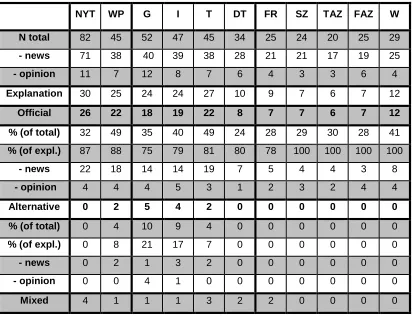
As table 1 shows, the press’s explanatory theme for the US assault on Fallujah predominately
constituted of explanations put forward by the US/Coalition.
Considering the amount of official explanatory items, TheGuardian in which still 75 per cent
of articles carrying explanations were coded as official, ranked at the lowest end. In the other
British newspapers roughly 80 per cent of articles featuring explanations were coded as
official, with slight differences: TheIndependent came to 79 per cent, TheDaily Telegraph to
80 per cent and The Times to 81 per cent. This was quite similar to the left-leaning German
Frankfurter Rundschau which registered 78 per cent in this category. TheNew York Times
and TheWashington Post scored higher with 87 and 88 per cent respectively. These
differences are likely related to the political distance and the US-newspapers exemplified
greatest ideological closure.
In the other German newspapers all explanatory articles mirrored the official rationale (100
per cent). A possible reason for the German press’s dominance of official explanations could
be its reliance on agency copy and generally low quantity of coverage. The news selection
process of agencies is heavily routinised and in accord with dominant news values which
transport official views. Secondly, there was nearly no ‘on-site’ reporting by German
journalists stationed in Iraq who could have included different perspectives. The low quantity
of coverage further suggested that the German media was less interested in the Fallujah story
which was rather detached from German politics.
As table 1 further reveals, the Guardian incorporated the largest amount of articles featuring
alternative explanations: 21 per cent of explanatory articles were coded in this category.
Significantly, four out of five alternative explanatory articles were provided by comment
writers and published on consecutive dates in the back pages (these were two columnists and
two outside contributors). Of 40 news items in the Guardian, only one featured an alternative
explanation. This suggests that regular news coverage in the Guardian did not significantly
12
TheIndependent included a slightly lower amount: 17 per cent of explanatory articles
included alternative explanations. Here, three out of four articles were actually news items.
TheTimes carried alternative explanations in two explanatory news articles (7 per cent),
which was the same amount as identified in TheWashington Post. The other newspapers did
not feature articles which solely carried alternative explanations. In the New York Times, the
Daily Telegraph and the Frankfurter Rundschau alternative explanations were only carried in
conjunction with official ones. Such articles were coded as mixed. TheNew York Times
featured four mixed articles in the explanatory category (14 per cent). TheDaily Telegraph
and the Frankfurter Rundschau came to two which still constituted about 20 per cent of all
explanatory articles. The Times had three mixed explanatory articles and TheIndependent, the
Guardian and TheWashington Post came to one each.
If all alternative and mixed explanatory articles are considered, the British press was quite
congruent in providing the largest amount of mixed/alternative explanations of the three
countries under review.
Table 1: Number and percentages of articles featuring official, alternative and
mixed explanations
NYT WP G I T DT FR SZ TAZ FAZ W
N total 82 45 52 47 45 34 25 24 20 25 29
- news 71 38 40 39 38 28 21 21 17 19 25
- opinion 11 7 12 8 7 6 4 3 3 6 4
Explanation 30 25 24 24 27 10 9 7 6 7 12
Official 26 22 18 19 22 8 7 7 6 7 12 % (of total) 32 49 35 40 49 24 28 29 30 28 41
% (of expl.) 87 88 75 79 81 80 78 100 100 100 100
- news 22 18 14 14 19 7 5 4 4 3 8
- opinion 4 4 4 5 3 1 2 3 2 4 4
Alternative 0 2 5 4 2 0 0 0 0 0 0
% (of total) 0 4 10 9 4 0 0 0 0 0 0
% (of expl.) 0 8 21 17 7 0 0 0 0 0 0
- news 0 2 1 3 2 0 0 0 0 0 0
- opinion 0 0 4 1 0 0 0 0 0 0 0
13 % (of total) 5 2 2 2 7 6 8 0 0 0 0
% (of expl.) 14 4 4 4 11 20 22 0 0 0 0
- news 4 1 0 1 1 2 1 0 0 0 0
- opinion 0 0 1 0 2 0 1 0 0 0 0
Generally, the findings are conservative because articles were used as the unit of analysis. If
paragraphs or sentences had been coded the amount of official explanations would have been
higher. On the other hand, and as previously noted, statements which questioned official
explanations on procedural grounds were included in this category because they accepted the
credibility of the official rationale and were thus not regarded as alternative. That is why the
low amount of alternative explanatory articles should not be regarded as evidence for an
uncritical press. It could also be argued that a quantitative advantage of official over
alternative explanations was inevitable because the procedural discussion of official policies
is to be expected in liberal democratic press systems.
Notwithstanding, the overwhelming quantitative advantage of official over alternative
explanatory articles, ranging between 75 to 100 per cent, suggested that officials acted as
‘primary definers’ (Hall et al. 1978: 58). As a consequence, and in further accord with
‘indexing’ (see Bennett 1990), all newspapers overrepresented the official explanatory theme.
This is further supported by the prominence given to official explanations as indicated in
tables 2 and 3. Alternative explanations were virtually not carried on the newspapers’ front
pages. Only the US-American press included alternative explanations in three page one
articles (see table 2). The same applied to headlines and first paragraphs in which only the
British press incorporated a marginal amount of alternative explanations (see table 3).
Surprisingly, the Guardian’s news section used the highest amount of official explanations in
headlines or first paragraphs. Similarly, the New York Times gave high prominence to official
explanations (see table 3).
Table 2: Explanations in front page articles
NYT WP G I T DT FR SZ TAZ FAZ W
Official 11 4 4 4 2 3 2 2 1 4 1
14
Table 3: Explanations in headlines or first paragraphs
NYT WP G I T DT FR SZ TAZ FAZ W
Official 5 5 11 5 4 3 4 4 2 2 5
Alternative 0 0 3 1 1 1 0 0 0 0 0
The qualitative context of official explanations in news coverage
In the qualitative survey of press coverage, all identified official explanations were clustered
into three categories. US/Coalition actions in Fallujah were broadly explained with reference
to one or more of the following official themes:
(1) Enable elections/democracy/security/stability,
(2) battle/eliminate insurgents/rebels/terrorists/Zarqawi/resistance fighters, and/or
(3) liberate/free/help/control/retake Fallujah/Iraq.
As the labelling of the clusters and the ‘quantitative’ assessment suggest, there were differing
explanations and variations in regard to the descriptions of the resistance. Some news items
emphasised a terrorist element others painted a picture of a domestic insurgency consisting of
local Iraqi fighters and former Ba’athists. In rare instances, articles included statements
classifying the uprising as a resistance movement fighting a reasonable war against the
US/Coalition. Yet significantly, the existence of the resistance in Fallujah was generally
referenced in order to explain the assault. This is evidence that it was regarded as problematic
in nature.
The explanations provided by the US/Coalition could vary in dependence on the different
spokespersons that were quoted. Critical newspapers also assessed whether the official aims
of the ‘operation’ were tactically manageable. Some newspapers opposed a military assault on
tactical grounds because it was assumed that the proclaimed aims could be reached with other
policies. In some cases, articles included official explanations together with statements that
15 Because the explanatory themes were placed across sentences and paragraphs there was also
room for thematic variations if other sections of the news items were considered.
Sporadically, the press included fundamental criticism in its reporting and it seems such
statements were incorporated due to professional newsgathering practices (see Althaus et al.
1996). For example, actors of the newly established Iraqi political elite, who voiced such
criticisms, had become news sources worthy to be ‘indexed’ by the press. Moreover, there
were country-specific features. For instance, the German press, which was less critical in its
regular reporting and relied more heavily on agency material, still featured critical statements
in its news analyses.
Yet significantly, despite of these differences, virtually all official explanatory themes
accepted the credibility of the US/Coalition and suggested the need to police in Fallujah in
order to stabilise Iraq. And due to the dominance of official explanations, this thematic
emphasis diffused into other parts of coverage suggesting the existence of a dominant
explanatory theme.
An indicative example of news coverage was a front-page article by London Times’
diplomatic editor Richard Beeston (2004) on 9 November. The article included official
explanations that fit into all categories. According to Beeston (ibid: 1):
The US intends to [...] force the insurgents into a fight. By seizing the rebel
headquarters, the Americans hope to stabilise Iraq long enough for elections to take
place in late January.
The primary focus is to eliminate Abu Musab al-Zarqawi, the Jordanian-born terrorist
whose suicide bombings have made Iraq ungovernable. [...]
Iyad Allawi, the Iraqi interim Prime Minister, said: “We have seen more criminal acts
committed by these terrorists who continue to use Fallujah as a base for their operations.
We have no other option but to take necessary measures to protect the Iraqi people.”
[all emphasis added]
This example also shows how ambiguous terms such as ‘insurgents’ were contextualised as
problematic. Here, this is done by suggesting their defeat would stabilise Iraq and by
16
In the same fashion, on 9 November, a title story in the Frankfurter Rundschau (AP/DPA
2004: 1) paraphrased Ayad Allawi stating he had authorised ‘Fallujah’s liberation from
“terrorists”’. The sub-heading of an Independent front-page article by Kim Sengupta and
Justin Huggler (2004: 1, 4) proclaimed on the same day: ‘US forces fight street-by-street in
bid to wrest town from Iraqi insurgents.’ And in a 10 November story on the Washington
Post’s title, Jackie Spinner, Karl Vick and Omar Fekeiki (2004: A 1) wrote: ‘U.S. and Iraqi
leaders hope the assault will break the grip of insurgents who have held Fallujah for nearly
seven months.’ While the latter two examples do not depict the ‘insurgents’ as problematic even in these cases a military assault appears to be reasonable because the ‘insurgents’
controlled the town.
It is well established by Gatekeeper studies that news coverage in the corporate-capitalist
press is routinised and attempts to consider statements by authoritative spokesperson.
Considerations of efficiency lead news organisations to rely on ‘routine channels for
newsgathering’ (Sigal 1973: 187) and ‘“routinized events”’ such as press conferences, official
hearings and speeches by authoritative persons (Epstein 2000 [1973]: 32). That explains why
official explanations appeared to be ‘indexed’ by the Western press.
However, professional standards of objectivity and balance tempt journalists to include
critical statements particularly during times of official conflict (see Althaus 2003). And as
already indicated, critical articles involving tactical considerations about the official
explanation could be found in all newspapers. This performance related to official elite
conflict within and between the US and UK governments about how to handle occupation
policies. News items included evaluative statements discussing if the enunciated policies of
overwhelming military force were appropriate means to reach the officially proclaimed goals.
Critical views could be related to actors from various elite fractions including US, British and
Iraqi officials as well as Iraqi religious organisations. Criticism was also generated from
non-elite actors such as UN-personnel, Western experts, Iraqi civilians, or members of relief
organisations.
Accordingly, an 8 November Independent article by Kim Sengupta (2004a: 26) stated: ‘The
UN secretary general, Kofi Annan, has voiced fears that an assault could trigger a wave of
violence that could jeopardise the January elections.’ Annan, who generally accepted the right
17
coverage of TheNew York Times, TheGuardian, the Süddeutsche Zeitung, the Frankfurter
Rundschau and the Tageszeitung. Generally, Annan was cited more frequently in the liberal
German and British press than in the US-American.
Another example appeared in a 10 November front-page article in the conservative German
Frankfurter Allgemeine Zeitung.Rainer Hermann cited a warning by the Sunni politician
Adnan Pachachi, who was part of the former Governing Council (IGC), that the Fallujah
operation might increase ‘the bitterness and the instability in the Country’ (Hermann 2004: 1). ‘Should many people be killed’, Hermann (ibid) paraphrased Pachachi, ‘the Iraqis could
rethink their readiness for their participation at the elections in January’. Concerns that high
civilian casualties could endanger the official aims of the Coalition were frequently voiced in
the newspapers under review.
In the Frankfurter Allgemeine, Hermann (2004: 1) further displays a highly critical statement
by Harith al Dhari, the General Secretary of the Association of Muslim Scholars, saying he
regarded the resistance as legitimate and describing the Fallujah assault as a ‘massacre’ (cited
in ibid). This is an example where an official explanatory item which is generally supportive
to US/Coalition actions includes substantive criticism. Yet, the article did not go further in
providing an alternative explanation. If the operation was a massacre, could there have been
other operational goals than to defeat an ‘insurgency’ and enable elections? Such a question
was not asked. The Frankfurter Allgemeine did not include critics such as Dhari on a regular
basis. Furthermore, if newspapers transported such deviant statements they were often
embedded within quotes voiced by officials. Indeed, it was striking that al Dhari’s indignant
concerns were also reported on 10 November in the New York Times, the Washington Post,
the Guardian, and The Times, and on 11 November, in the Frankfurter Rundschau. Yet, all
these newspapers did not quote al Dhari’s statement labelling the assault as a ‘massacre’. The newspapers were only able to quote al Dhari’s other statements which encouraged Iraqis to boycott the election which he claimed was to be held ‘over the corpses of those killed in Fallujah’ (cited in Spinner, Vick and Fekeiki 2004: A 1) and to protect the Iraqi people ‘from
injustices by all means’ (cited in McCarthy 2004: 4). The handling of this dissident source
demonstrates how comments that were incompatible with the official explanatory theme were
marginalised and excluded. Such views are not regularly considered because it is anticipated
that extensive deviant coverage increases the costs for journalists and news operations
18 illustrates how it is much easier for journalists to follow official over alternative perspectives
thereby only including criticism emerging from elite circles. Finally, it should be mentioned
that US troops later raided al Dhari’s house and arrested him (Filkins and Worth 2004). This
episode did not elicit any concern in the newspapers under review although the raid was
reported in the New York Times, Washington Post and Die Welt (see Filkins and Worth 2004;
Kalnoky 2004; Vick and Sebti 2004).
Explanatory articles criticising tactical aspects of the assault were frequently voiced. In the
New York Times’ 10 November edition, Edward Wong and Eric Schmitt (2004: 1) cited ‘American military officials’ who had ‘said that they anticipated a surge in violence timed to the Falluja invasion’. Furthermore, ‘military officials in Baghdad and Washington are
expressing concern that the operation could end up being both a public relations disaster and
strategic setback if some top leaders are not captured’ (ibid). This provides an example of
how procedural criticism which questioned official explanations still accepted the validity of
US/Coalition goals. Criticism thus operated as a corrective for the varying tactical policies
which could be employed.
Tactical criticisms evaluating as to whether the military strategy was jeopardising the
officially proclaimed goals were part of news coverage of all countries under review and, as
in the above case, correlated with elite conflict.
The qualitative context of alternative explanations in news coverage
The November attack on Fallujah had enraged Arab populations in the Middle East, the Iraqi
Sunni community, whose leaders threatened to boycott the upcoming elections, and the Iraqi
Shiite communities. Because prominent Sunni and Shiite spokespersons had, to some extent,
become part of the range of legitimate debate, their criticisms were mentioned in the press.
This encouraged the inclusion, albeit marginal, of alternative explanations. Thus, newspapers
incorporated alternative explanations only sporadically and, as mentioned above, in many
cases they were provided by Arab sources. Moreover, alternative explanations in news
coverage were rather featured at the bottom of the inverted pyramid and in the back-pages.
Furthermore, they often appeared as isolated quotes and in the context of procedural criticism
of US/Coalition actions. Commentaries also included alternative explanations and in rare
instances a developed alternative explanations could be identified in a comment piece (see
19 All identified alternative explanations were clustered into three categories. US/Coalition
actions in Fallujah were broadly explained with reference to one or more of the following
alternative themes:
(1) attack/fight/kill/massacre Fallujah’s/Iraq’s people, or Islam,
(2) act as a terrorist/crusader/imperialist/oppressor, and/or
(3) prevent elections/democracy/security/stability.
An example was a 10 November article in the New York Times in which Wong (2004a: 14)
discussed the Iraqi Islamic Party’s ‘withdrawing from the interim Iraqi government’ (ibid).
The article included the following alternative explanation:
[…] Moktada al-Sadr, the popular Shiite Muslim cleric […], said through a spokesman
that the attack on Falluja ‘is an attack on all the Iraqi people,’ and that Iraqis must not
help the American forces [emphasis added]. (ibid)
Alternative perspectives regarded US/Coalition actions as nefarious. In this case, it was
suggested that the assault on Fallujah was virtually an attack against the Iraqi population (see
added emphasis).
A closer examination of all alternative explanatory articles in the sample indicated a broader
Iraqi discourse which argued that the assault directly targeted the civilian population. On 9
November, Spinner and Vick of the Washington Post cited a statement by the Association of
Muslim Scholars, which represented Iraq’s 3,000 Sunni Muslim clerics, warning Iraqi soldiers
not to participate in the assault which was, as the Association stated, not about ‘fighting terrorists from outside the country’ but about ‘fighting the townspeople and targeting its men,
women and children’ (cited in Spinner and Vick 2004: A1; see also La Guardia 2004: 4).
Similarly, the Associations leader, al-Dhari, appeared in a 14 November New York Times
article by Wong claiming what Fallujah was going through was ‘genocide at the hands of the occupiers’ (cited in Wong 2004b: 13). Mohsen Abdel Hamid, the leader of the Iraqi Islamic
Party, which had resigned from the IIG in protest of the offensive, had the same view which
was presented in a 10 November article by Sengupta in the Independent: ‘The American
20
mercy from the Americans.’ (cited in Sengupta 2004b: 4) In the 11 November Independent,
Kim Sengupta (2004c: 4) cited Dr Sami al-Jumaili, who had witnessed an US air strike that
hit a clinic in Fallujah killing 20 Iraqi doctors and dozens of civilians, with the words: ‘I really don’t know if they want to tackle the insurgents or the innocent civilians from the city.’
In the Frankfurter Rundschau, Erwin Decker (2004: 2) cited an Iraqi civilian saying the
Americans would ‘proceed against a large population of the city’.
The handling of the Iraqi sources demonstrated how the press mitigated the alternative
explanatory theme. For instance, the announcement by the Association of Muslim Scholars
was mentioned in two other articles in Die Welt and the New York Times. Yet, both
newspapers excluded the critical alternative explanation (i.e. ‘fighting the townspeople and
targeting its men, women and children’ (Spinner and Vick 2004: A 1)). Perhaps more
importantly, the Association of Muslim Scholars had, in October 2004, held a conference
during which it publicised announcements that featured several alternative explanations (see
e.g. Janabi 2004). Yet again, in many cases newspapers only mentioned the Association’s
demand for an election boycott without providing the alternative and substantive context it
had actually raised at its conference. Moreover, like the ‘massacre’ quote discussed earlier, al-Dhari’s ‘genocide’ statement was ignored and not published in any other newspaper than the
New York Times (see Wong 2004b: 13). In the same fashion, the Iraqi Islamic Party’s
resignation from the IIG was reported on 10 November in 11 news items throughout all
countries under review. But its chairman’s statement saying the assault was leading to
‘genocide’ was only published in the Independent of the same day (Sengupta 2004b: 4).
These examples suggested that deviant statements which depicted US/Coalition actions as
nefarious were extenuated.
Three news articles mentioned or discussed the Iraqi and international Arab media discourse
on Fallujah (see Darwish 2004; MacFarquhar 2004; Theodoulou 2004). In a short news item
published in the 9 November Daily Telegraph,Adel Darwish (2004: 4) summarised the Arab
media discourse as follows:
A few – mainly newspapers in Iraq – saw the offensive as an attempt to ensure elections
are held in January, but most accused the Americans of isolating the city in preparation
21 It appeared to be significant that alternative explanations could have been prominently
featured in the Arab media and might have been held by a majority of the Arab world. This
would mean a striking discordance between Arab and Western press discourses.
In general, a comprehensive reading of all alternative explanations indicated the existence of a
different discourse. However, in each newspaper this perspective was not developed and
alternative explanatory statements appeared as garbled information. While news items
prominently carried the US/Coalition perspective – taking its representatives as lead sources
on numerous occasions – the same standard was not applied to spokespersons of the
Association of Muslim Scholars, the Iraqi Islamic Party or the Iraqi resistance, who largely
remained confined to back spaces.
The Qualitative explanatory context in editorials and commentaries
Editorials provided further criticism about the feasibility of the Fallujah operation. Yet, even
the most critical editorial writers were not able to establish a rationale for the attack on
Fallujah that substantially deviated from the administration line. It was particularly striking
that editorials were entirely devoid of alternative explanations.
The following examples are indicative of critical editorials: On 9 November, the Guardian’s
editorial scrutinised the range of the given official explanations and criticised Prime Minister
Allawi. For instance, the Guardian (2004: 21) wrote: ‘the aim – backed by Tony Blair’ was
‘to “pacify” Falluja before January’s elections’. However, critics such as ‘Javier Solana, the EU’s foreign policy chief, publicly questioned whether the elections would indeed be able to
go ahead on schedule, all but accusing Mr Allawi of deliberately distorting the picture’. The
Guardian worried about civilian casualties, the Sunnis’ participation in the political process
and an inflation of violence – issues seemingly neglected by Allawi (ibid). Despite such
critiques, the Guardian accepted the official explanatory theme that Fallujah was part of ‘the
centrepiece of the US-British exit strategy and of hopes that post-Saddam Iraq can progress
towards democracy and stability’ (ibid).
The German Süddeutsche Zeitung (Münch 2004: 4) displayed the official view in a 10
November editorial, writing the USA were enforcing a ‘decision’ in Fallujah: ‘A quick victory [...] could be a signal for the whole country’ (ibid). Furthermore, the newspaper
22 the rebel regime in Fallujah, the newspaper wrote: ‘Reports suggest there is Taliban style strictness in the inside, terror is spread to the outside.’ (ibid) Again, despite of the usage of a
seemingly positive term like resistance the movement is contextualised as problematic.
Considering US/Coalition actions, the Süddeutsche Zeitung raised tactical concerns about
civilian casualties which could enhance ‘the dangers of this mission’, the newly established
Iraqi Army, which was part of the assault and could hardly survive a long fight against its
fellow citizen, and the Sunnis which might be ‘further radicalising’ as a result (ibid).
As a preliminary conclusion it appears to be striking how all newspapers’ editorials accepted
the officially established first principles of US/Coalition policies when explaining the assault
on Fallujah – to enable ‘democracy’ and ‘stability’ – and only acted as correctives in regard to
the appropriateness of secondary (i.e. procedural or tactical) means which were employed. As
common tactical considerations the press suggested the use of diplomacy and inclusion of the
Sunni minority in the democratic process. When it became apparent that the ‘operation’ had
not reached its proclaimed aims thenewspaperincluded a range of tactical criticisms.
Commentators have larger leeway than editorial writers because their perspectives do not
need to reflect the line of a newspaper. Comments can thus include personal views or those by
actors from other institutions.
The US press only provided official explanations in its commentary pages. The British press
featured a broader spectrum of commentary writers. The Guardian stood out for featuring the
largest amount of commentaries including alternative explanations.
In his 10 November comment, Ramadani (2004: 30) explained Fallujah as ‘defiance of a new empire’ because ‘Bush and Blair, not the Iraqi resistance’ feared ‘free elections’.
23 Since the nominal handover of sovereignty on June 30, we have witnessed an escalation
of Israeli-style collective punishment of Iraqi cities. Civilian carnage, coupled with
enormous damage to homes and infrastructure, has became our daily reality.
Both authors placed the assault on Fallujah within a neo-colonial framework implicating that
the US/Coalition aimed at violently establishing a ‘pro-US order’ (Ramadani 2004: 30) and robbing the ‘country’s resources’ (Zangana 2004: 26). Moreover, the uprising was regarded as
legitimate resistance.
Alternative explanations were also included in two further Guardian comments by Madeleine
Bunting (2004) and Naomi Klein (2004). Generally, in the Guardian’s comment pages,
alternative explanations prevailed. The comments by Bunting, Ramadani, Klein and Zangana,
appearing on 8, 10, 13, and 17 November, represented the critical end of the explanatory
discourse in the Guardian and perhaps in all newspapers under review.
In the Independent of 13 November, Anthony Sampson (2004) included an alternative
explanation. Sampson (2004: 41) compared the attack on Fallujah with the tactic of ‘Shock
and Awe’ saying it ‘was designed to instil fear, even terror’. Again, there is no further
elaboration of state terroristic tactics. Moreover, Sampson (ibid) appeared to be concerned to
lend support to the Americans advising them to ‘change their image’, because, ‘it is crucial
that the Americans – and the British who are now more closely implicated – are seen as
peacemakers rather than as warmongers’. Other commentaries in the Independent would only
feature the official explanation.
Three commentaries in The Times carried official and alternative explanations. For instance,
Jenkins (2004: 16) refuted the official set of explanations saying US troops would not be able
to hold or stabilise Fallujah and could not rely on the new Iraqi army for that purpose either.
Furthermore, Jenkins (ibid) provided the following alternative explanation: ‘The Pentagon’s
handling of the Sunnis seems designed to ensure that they boycott elections and thus speed
the break-up of Iraq.’ Jenkins alleged that the US goal was to encourage sectarian conflict in
order to have a justification for staying in Iraq. Jenkins did not follow this argument to its
logical conclusion. If that was the goal of the USA, then the occupation had not failed but
24 theme could not be elaborated in all newspapers under review because the US/Coalition was
regarded as a benevolent force.
A comment in the German Frankfurter Rundschau, which provided one of the two alternative
explanations in the set of German newspapers, made a similar point as Jenkins. According to
Karl Grobe (2004: 3) ‘democracy’ was ‘driven out’ by ‘force of arms’ in Iraq and the ‘perpetrators’ of these policies were ‘seated in Washington’. Nonetheless, Grobe’s criticism appeared to be procedural, because, as he (ibid) also stated, ‘Fallujah must be liberated’.
In general, German commentaries provided virtually no alternative explanations and thus
operated within the official explanatory theme which suggested that Iraq needed to be
democratised and that the US/Coalition was a legitimate actor fighting an uprising in Fallujah.
On the other hand, there were some important differences in comparison with the
Anglo-American writers regarding procedural criticisms. The German commentators, particularly in
the left-liberal newspapers, appeared to be more critical towards the use military force in
Fallujah. For instance, in a 10 November commentary, the Frankfurter Rundschau’s Dietmar
Ostermann (2004: 3) abided to the official explanation that ‘the rebel stronghold Fallujah shall be brought under control’. But, the author criticised how a radicalised US strategy had ‘no mercy with the Sunni voter’.
In the comment sections of the Western press, there were variations: In the New York Times
and Washington Post commentators relied on the official explanatory theme and where
sympathetic to the US/Coalition. The British press provided the most critical commentary
discourse. Perhaps because of its political distance, the German press did also not feature
alternative explanations in this category, with the Frankfurter Rundschau as the only
exemption. However, commentaries in the left-liberal newspapers (Frankfurter Rundschau
and Süddeutsche Zeitung) heavily scrutinised official explanations on procedural grounds and
were cautious towards the use of military force. Die Tageszeitung was less critical in carrying
official explanations. The conservative papers (Frankfurter Allgemeine and Die Welt) largely
included commentaries in support of the official rationale.
Conclusion
The explanatory composition of newspapers across countries was relatively similar. This
25 consideration of ‘the increasingly international scope of news organisations, one would expect
that reporting on international issues is quite similar in the United States, Italy, France,
Germany, and other comparable democracies’. But such homogenous press performance has
political implications: The official explanation had a significant quantitative advantage over
alternative/mixed explanatory articles: 108:18 news items, 12:0 editorials and 24:9
commentaries. If the placement of explanations in news items is considered, official
explanations attained higher prominence and news stories were mostly built on official
perspectives. Alternative explanations appeared only cursory and in the back pages and were
often not granted the necessary space for contextual development. Evidence also suggests that
alternative voices were muted. The existence of a few alternative explanations within the
official explanatory theme and the infrequent inclusion of critical commentaries based on
alternative explanations can hardly compensate for the Western press’s failure to develop an
alternative framework in its news and editorial coverage. Explanations were largely based on
the official proclaimed aim to establish ‘democracy’ and ‘security’ and criticism procedurally
questioned the means and justifications of policies. And yet, a several Iraqi actors sourced in
coverage argued that the US/Coalition was targeting the population during its effort to
institute a neo-colonial regime. But, this context was not further developed in the press
although evidence in support of this perspective was available at the time of reporting (see
evidence in Schwartz 2007; Holmes 2007; Zollmann 2011). Consequently, alternative
explanations and substantive criticism remained subordinate in the fashion theorised by
hegemonic models (see Hall 1977: 345-346; Herman and Chomsky 2008; Bennett, Lawrence
and Livingston 2007).
Procedural/tactical criticism was, however, substantial arguably surpassing the criticism
found during coverage of the initial Iraq War phase: the outcomes of policies, the official
definitions of and military approaches applied against the Fallujah resistance, and the broader
US/Coalition Iraq strategy were under heavy tactical scrutiny. This supports the prediction
brought forward by Robinson et al. (2010: 181-182) that during the occupation phase the
press would critically cover the quagmire scenario. Nonetheless, it should also be noted that
tactical criticisms largely focused on the USA. The UK press for example, heavily scrutinised
the US/Coalition administration led by Washington as well as US-military tactics. And most
significantly, procedural/tactical criticism does not refute the applicability of a hegemonic
26 powerful [i.e. the corporate sector], not that it will protect state managers from their
criticisms’ (Chomsky 1989: 149).
If countries are further compared, the US media were the least open to fundamental criticism
and included, together with the German press, the largest amount of official explanations (in
relative terms). The British and German press were more adversarial in their use of procedural
criticism. Such variations might, as Nacos et al. (2000: 41) further postulate, ‘reflect distinct
national and regional interests, policies, and politics’. In fact, regional elites had converging
interests in Iraq. For instance, the British oil industry was initially not in favour of an
invasion. Furthermore, there were important political differences between the US and the UK
as well as German governments. Anthony DiMaggio (2009: 55) points out how differences in
economic and military investments can impact on foreign policy reporting. For instance, the
USA has larger economic and military stakes in the Middle East than Britain as well as
Germany and this might increase elite pressure on the media (cf. ibid). Several studies on the
Iraq War, indeed, found more critical and diverse coverage in the UK and Germany than in
the USA (see Eilders 2005: 640-641; Kegel 2003; Krüger 2003; Robinson et al. 2010).
Differences in coverage also support the assumption that the European media enable greater
spaces for media diversity in sources and opinions (see DiMaggio 2009: 52-55; Hallin and
Mancini 2010; Robinson et al. 2010: 177; Sparks 2007: 77). However, this should not divert
from the more important fact that the explanatory context provided in the US, UK and
German press shielded the rationale of a military ‘operation’ which, in the words of
independent journalists Amy Goodman and Denis Moynihan, can be situated ‘among the
most violent and devastating attacks on a civilian population in recent decades’ (cited in
Jamail 2007: xi).
In conclusion, the international press displayed strikingly similar ideological areas which
appear to be in accord with a trans-Atlantic state-corporate elite consensus. It was quasi off
debate, that the Fallujah ‘operations’ could have been launched in order to crush a popular
resistance which aimed to prevent the West from accessing the mineral resources of its
country. Instead, as my discussion on the explanatory themes revealed, the Western press
largely transported the official ideology. This evidences how diversity is bounded within ‘the
27 Acknowledgements
I would like to thank the anonymous reviewers and my PhD supervisors Professor Richard
Lance Keeble and Professor Ann Gray as this article presents a revision of research originally
undertaken for my PhD dissertation. The title was inspired by the work of the Glasgow
University Media Group.
Declaration of Conflicting Interests
The author(s) declared no potential conflicts of interest with respect to the research,
authorship, and/or publication of this article.
Funding
This research received no specific grant from any funding agency in the public, commercial,
or not-for-profit sectors.
Notes
1 I coded the data together with two further raters, one English coder for the US and UK newspapers and one
German coder for the German newspapers. 10 per cent of the data set was selected with a random generator. The following formula, derived from Holsti (1969: 140), was used: CR = 2M/(N1 + N2). M is the amount of coding decisions on which two coders are in agreement, and N1 and N2 describe the number of coding decisions administered by raters 1 and 2 (ibid). For the US/UK newspapers the aggregated rating for explanations was [.81] for the German newspapers the rating was [.96]. It should also be mentioned that all quotes from German newspapers were translated by the author.
References
Alexseev, Mikhail A. and Bennett, W. Lance (1995) For Whom the Gates Open: News Reporting and Government Source Patterns in the United States, Great Britain and
Russia. Political Communication, 12, pp. 395-412
Al-Fadhily, Ali (2007) Another US Military Operation in Iraq, More Unrest. Inter Press
Service, [online] 22 August.Available at: <http://www.ipsnews.net/2007/08/iraq-another-us-military-operation-more-unrest/> [Accessed 2 September 2012].
Althaus, Scott L., Edy, Jill A., Entman, Robert M., and Phalen, Patricia (1996) Revising the
Indexing Hypothesis: Officials, Media, and the Libya Crisis. Political Communication,
13(4), pp. 407-421.
Althaus, Scott L. (2003) When News Norms Collide, Follow the Lead: New Evidence for
Press Independence. Political Communication, 20(3), pp. 381-414.
Altheide, David L. (1996) Qualitative Media Analysis. London: Sage
AP/DPA (2004) Irak Macht Grenzen Dicht. Frankfurter Rundschau, 9 November, p. 1.
Beeston, Richard (2004) Marines Storm Fallujah as Street Fighting Begins. The Times, 9
November, p. 1.
Bennett, W. Lance (1990) Toward a Theory of Press-State Relations in the United States.
28
Bennett, W. Lance, Lawrence, Regina G. und Livingston, Steven (2007) When the Press
Fails: Political Power and the News Media from Iraq to Katrina. Chicago: University of Chicago Press.
Bunting, Madeleine (2004) Screams Will not be Heard. The Guardian, 8 November, p. 17.
Camp, Dick (2009) Operation Phantom Fury: The Assault and Capture of Fallujah, Iraq.
Minneapolis, MN: Zenith Press.
Carruthers, Susan L. (2000) The Media at War. New York: Palgrave Macmillan.
Chomsky, Noam (1989) Necessary Illusion. London: Pluto Press.
CNN (2003) Bush Makes Historic Speech Aboard Warship. CNN U.S., [online] 1 May.
Available at: <http://articles.cnn.com/2003-05-01/us/bush.transcript_1_general-franks-major-combat-allies?_s=PM:US> +[Accessed 01 February 2012].
Coalition Provisional Authority (2003) Order Number 39. [online] 19 September. Available
at:
<http://www.iraqcoalition.org/regulations/20031220_CPAORD_39_Foreign_Investmen t_.pdf> [Accessed 20 May 2011].
Cottle, Simon (2006) Mediatized Conflict. New York: Open University Press.
Curran, James (2012) Reinterpreting the Internet. In: Curran, James, Fenton, Natalie and
Freedman, Des, eds. Misunderstanding the Internet. London: Routledge, pp. 3-33.
Darwish, Adel (2004) Onslaught Starts the War of Words. The Daily Telegraph, 9 November,
p. 4.
Decker, Erwin (2004) Störrisch in Falludscha. Frankfurter Rundschau, 10 November, p. 2.
DiMaggio, Anthony (2009) When Media Goes to War: Hegemonic Discourse, Public Opinion
and the Limits of Dissent. New York: Monthly Review Press.
Eilders, Christiane (1999) Synchronization of Issue Agendas in News and Editorials of the
Prestige Press in Germany. Communications, 24(3), pp. 301-328.
Eilders, Christiane (2005) Media Under Fire: Fact and Fiction in Conditions of War.
International Review of the Red Cross, 87 (860), pp. 639-648.
Eilders, Christiane und Lüter, Albrecht (2000) Germany at War: Competing Framing
Strategies in German Public Discourse. European Journal of Communication, 15(3), pp.
415-428.
Eilders, Christiane and Hagen, Lutz M. (2005) Kriegsberichterstattung als Thema
Kommunikationswissenschaftlicher Forschung: Ein Überblick zum Forschungsstand
und den Beiträgen in diesem Themenheft. Medien & Kommunikationswissenschaft,
53(2-3), pp. 205-221.
Entman, Robert M. and Page, Benjamin I. (1994) The News Before the Storm: the Iraq War Debate and the Limits to Media Independency. In: Bennett, W. Lance and Paletz, David
L., eds. Taken by Storm: the Media, Public Opinion, and U.S. Foreign Policy in the
Gulf War. Chicago: University of Chicago Press, pp. 82-101.
Entman, Robert M. (2004) Projections of Power: Framing News, Public Opinion, and U.S.
Foreign Policy. Chicago: University of Chicago Press.
Epstein, Edward Jay (2000 [1973]) News from Nowhere: Television and the News. Chicago:
Ivan R. Dee.
Esser, Frank, Schwabe, Christine, and Wilke, Jürgen (2005) Metaberichterstattung im Krieg. Wie Tageszeitungen die Rolle der Nachrichtenmedien und der Militär-PR in den
Irakkonflikten 1991 und 2003 framen. Medien & Kommunikationswissenschaft, 53(2-3),
pp. 314-332.
Filkins, Dexter and Worth, Robert F. (2004b) Armored Forces Blast their Way Into Rebel
29
GlobalSecurity.org (n.d.a) Iraq Pacification Operations. [online] Available at:
<http://www.globalsecurity.org/military/ops/iraq_ongoing_mil_ops.htm> [Accessed 22 January 2012].
Grobe, Karl (2004) Vietnam Lässt Grüßen. Frankfurter Rundschau, 8 November, p. 3.
Hall, Stuart (1977) Culture, the Media and the ‘Ideological E