Article
1
A Fusion Link Prediction Method Based on Limit
2
Theorem
3
Yiteng Wu *, Hongtao Yu*, Ruiyang Huang, Yingle Li and Senjie Lin
4
National Digital Switching System Engineering and Technological R&D Center, Zhengzhou 450002, China
5
* Correspondence: [email protected] (Y.W.); [email protected] (H.Y.); Tel.: +86-150-9348-9229
6
Abstract: The theoretical limit of link prediction is a fundamental problem in this field. Taking the
7
network structure as object to research this problem is the mainstream method. This paper
8
proposes a new viewpoint that link prediction methods can be divided into single or combination
9
methods, based on the way they derive the similarity matrix, and investigates whether there a
10
theoretical limit exists for combination methods. We propose and prove necessary and sufficient
11
conditions for the combination method to reach the theoretical limit. The limit theorem reveals the
12
essence of combination method that is to estimate probability density functions of existing links
13
and nonexistent links. Based on limit theorem, a new combination method, theoretical limit fusion
14
(TLF) method, is proposed. Simulations and experiments on real networks demonstrated that TLF
15
method can achieve higher prediction accuracy.
16
Keywords: link prediction; combination method; theoretical limit; TLF method
17
18
1. Introduction
19
Limit theory is a basic theoretical issue and has attracted wide interest across many fields. On
20
the 100th anniversary of its foundation, Science raised 125 unresolved scientific questions, and many
21
of these issues related to limit theory [1]. Link prediction predicts missing links in current networks
22
and new or dissolution links in future networks [2]. With continuous improvement of link
23
prediction methods and, the theoretical limit of link prediction has attracted considerable research
24
interest [3].
25
Considering structure or attribute features, link prediction methods based on classification have
26
been proposed by computer science community [4]. Subsequently, more insightful methods of
27
network structure, such as similarity based methods, have become a focus, these methods pay more
28
attention to the physical meaning. At the same time, similarity index fusion methods are springing
29
up [5,6]. Recent years, with the development of deep learning, some deep features extraction
30
methods have been proposed [7,8], the fusion of structure and attribute information has been
31
attached importance again [9]. These methods have strong consistency. We divide link prediction
32
method into single and combination methods, based on whether they use multidimension
33
information, and whether they define the relation of multidimension information directly. For
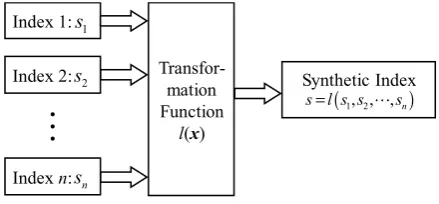
34
example, single methods, such as RA index [10], which defines the relation of common neighbors
35
and degree of nodes directly; and classification based methods, index fusion methods, fusion of
36
structure and attribute information methods belong to link prediction combination methods.
37
Most combination methods perform better than single methods, and are robust to many
38
network types. However, what is the reason for this improved accuracy and robustness, and is there
39
a theoretical limit for combination methods? This paper proposes the mathematic description of
40
combination methods, and obtains the necessary and sufficient conditions for theoretical limit. The
41
limit theorem also has important practical application value. It reveals the ultimate goal of
42
combination methods that is to estimate probability density functions of existing links and
43
nonexistent links. Thus, an appropriate form of the transformation function could be selected from
44
the complete set. Based on limit theorem, a new combination method, theoretical limit fusion (TLF)
45
method, is proposed. We use Parzen kernel method [11] of destiny estimation in the TLF method.
46
Simulations and empirical studies have shown that TLF method can achieve higher prediction
47
accuracy.
48
Section 2 introduces a mathematical description for the theoretical limit of combination
49
methods and evaluation metrics for link prediction. Section 3 proposes and proves necessary and
50
sufficient conditions for the theoretical limit of combination methods. Section 4 proposes a fusion
51
link prediction method based on limit theorem (TLF method). Section 5 provides simulation
52
examples for limit theorem and proposed TLF method with other combination methods, and gives
53
comparison experiments in real networks. Section 6 and 7 discuss some results and conclude the
54
paper.
55
2. Problem Description and Evaluation Metrics
56
2.1. Problem description
57
Given a network G V E( , ) at time t, where V =
{
v v1, , ,2 vN}
is the set of nodes and58
{
1, , ,2 M}
E= e e e is the set of links. The observed links, E, are randomly divided into training, ET ,
59
and probe, EP , sets, where E E= TEP and ETEP = ∅. Link prediction aims to predict
60
missing links at current network or new links for a future time t t'( '>t)[2]. Link prediction
61
combination methods fuse several similarity indices and obtain a synthetic index and can be
62
described in mathematic as follows. Let ( 1, 2, , )T n
X X X
=
X be the scores of existing links as given
63
by n structural similarity indices, and follow probability density function (pdf)f( )x =f x x( , , , )1 2xn .
64
LetY=( , ,Y Y1 2 , )Yn Tbe the scores of nonexistent links as n structural similarity indices, and follow
65
1 2
( ) ( , , , )n
g x =g x x x . We need to find the transformation function, l( )x , and obtain the synthetic
66
score, X =l( )X , Y l= ( )Y that maximizes evaluation metrics. Figure 1 is the diagram of
67
combination methods.
68
Index 1:
Transfor-mation Function
l(x)
Synthetic Index
1
s
Index 2:s2
Index n:sn
(1, , ,2 n)
s l s s= s
Figure 1. Combination methods
2.2. Evaluation metrics
69
Let the synthetic score X =l( )X follow pdf f xX( ), and Y l= ( )Y follow g xY( ). X and Y are
70
independent. We have the following metrics.
71
2.2.1. Area under the receiver operation characteristics curve (AUC)
72
A receiver operating characteristics (ROC) curve is a two-dimensional depiction of classifier
73
performance [12]. In the field of link prediction, the ROC curve abscissa represents the probability
74
of nonexistent links i.e., the false positive rate (FPR), when the link prediction score is greater than
75
some threshold,
μ
, andFPR=μ∞g x dxY( ) . The ordinate represents the probability of missing links,76
i.e., the true positive rate (TPR), when score >
μ
, and TPR=μ∞f x dxX( ) , TPR is equivalent to Recall.77
According to [13], AUC can be derived as
(
)
( ) ( ) ( )
1 1
( ) ( ) 1 ( ) ( )
2 2
1 1
sgn( ) ( ) ( )
2 2
1
sgn 1 , 2
X Y
X Y
X Y X Y
X Y X Y
X Y
P X Y f x g y dxdy
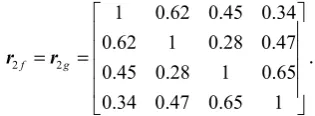
f x g y dxdy f x g y dxdy
x y f x g y dxdy
X Y >
> ≤
> =
= + −
= − +
= − +
(1)
where
79
1, 0 sgn( ) 0, 0
1, 0 x
x x
x >
= =
− <
. (2)
In the real network, original data is randomly divided into training set and the probe set. Eq. (1)
80
means that for n independent comparisons, if there are n’ comparisons where the missing link
81
returns a higher score and n’’ comparisons where the missing and nonexistent links return the same
82
score, we can obtain the algorithm expression of AUC:
83
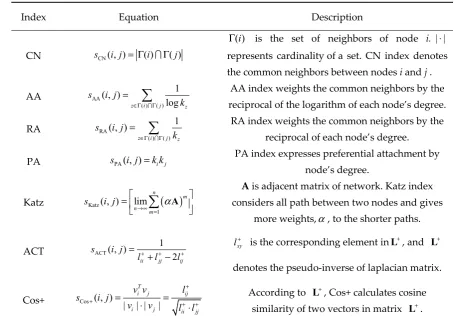
' 0.5 ''
AUC n n
n
+
= . (3)
2.2.2. Precision
84
Precision can be defined as the ratio of correct to (correct and error) prediction proportions
85
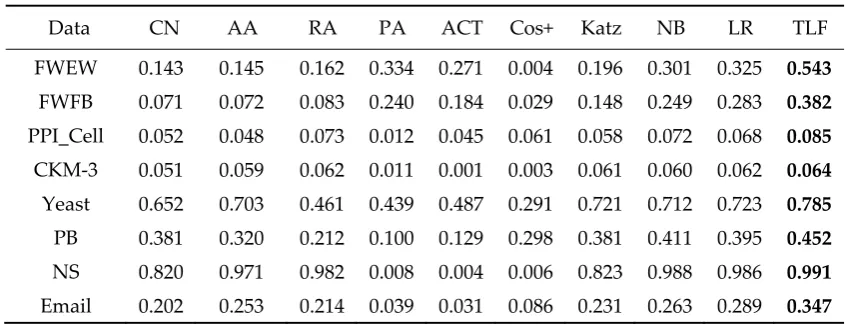
when score >μ , i.e.,
86
1
1 2
1
1 2
( ) ( )
Precision
( ) ( ) ( ) ( )
( )TPR . ( )TPR ( )FPR
X
X Y
P f x dx
P f x dx P g x dx
P
P P
μ
μ μ
ω
ω ω
ω
ω ω
+∞
+∞ +∞
=
+
=
+
(4)In the real network, if the top L links are predicted ones, with m links being right (i.e., there are
87
m links in EP), then
88
Precision m L
= . (5)
Owing to the imbalance of positive and negative samples, link prediction usually uses AUC
89
metric. In application, high Precision means target links are accurate, and these links can be used
90
directly. AUC and Precision are two important metrics in link prediction, we will study the
91
theoretical limit using the two metrics.
92
3. Theoretical Limit Theorem
93
Theorem. Let ( 1, 2, , )T
n
X X X
=
X and ( ,1 2, , )T
n
Y Y Y
=
Y be random vectors following the joint
94
distributions f( )x and g( )x , respectively, where m{ : ( ) ( )x f x g x =C g, ( ) 0,x ≠ ∀ ∈C } 0= . (m
95
represents the measure of a set.) Then the following conditions are equivalent.
96
(a) A monotonically increasing function r x( ) exists, such that l( )x =r f[ ( ) ( )], ( ) 0x g x g x ≠ ,a.e.
97
n ∈
x .
98
(b) Transformation function l( )x produces maximum AUC.
99
If we add a condition in Theorem that prior probability of existing and nonexistent links be P( )ω1 and
100
2
( )
Pω , respectively. Then the following conditions are equivalent to (a) and (b):
(c) for any α , there exists the corresponding threshold μl for transformation l( )x , and satisfies
102
1 2
( ) l X( ) ( ) l Y( )
P μ f x dx P μ g x dx
α = ω +∞ + ω +∞ , such that transformation function l( )x produces
103
maximum Precision.
104
Proof. (a)(b):
105
From the equivalent definition, AUC maximum is the maximum area under the ROC curve. For
106
any FPR, if the TPRs corresponding to the ROC curve reach maximum, then the AUC reaches the
107
maximum, i.e.,
108
( ( ) )
FPR Y( ) ( )
E l
g x dx g d
μ μ
∞
>
=
=
x x x, (6)
( ( ) )
TPR X( ) ( )
E l
f x dx f d
μ μ
+∞
>
=
=
x x x, (7)
where E l
(
( )x >μ)
is a set{
x∈n: μ∈, ( )l x >μ}
, and m{
x: ( )l x =C, ∀ ∈C }
=0.109
We use Lagrange’s undetermined multipliers to solve this problem. For any specified FPR
110
(denoted as FPR0), the TPR corresponding to the ROC curve reaches maximum is equivalent as ϕ
111
reaches maximum,
112
[
]
0
( ( ) ) ( ( ) )
0 ( ( ) )
( ) FPR ( )
FPR ( ) ( ) .
E l E l
E l
f d g d
f g d
μ μ
μ
ϕ λ
λ λ
> >
>
= + −
= + −
x x
x
x x x x
x x x (8)
Function ϕ will be maximized if we choose set E l( ( )x >μ) such that the integrand is
113
positive, i.e., if
114
( ) ( ) 0
f x −λg x > , (9)
then x∈E l( ( )x >μ). Which means, no matter what is λ, if we select the set of x which
115
makes the integrand f( )x −λg( )x always be positive, the function ϕ will reach maximum; if the
116
set contains x that makes the integrand be negative, function ϕ will decrease. Let
117
( ) ( ) ( )
l x = f x g x and μ λ= , and the set, E l( ( )x >μ), equals toE f( ( ) / ( )x g x >λ), which satisfies
118
(8), i.e.
119
[
]
0 ( ( )/ ( ) )
FPR ( ) ( )
E f g λ f g d
ϕ λ= +
x x> x −λ x x. (10)Thus, for any FPR, the TPR corresponding to the ROC curve reaches the maximum, so the AUC
120
reaches the maximum when X and Y are transformed by l( )x = f( ) ( )x g x .
121
Let r x( ) be a monotonically increasing function; and h x( )be the inverse function of r x( ). If
122
'( ) 1 '( )
h x = r x , then h x( ) and r x( ) have the same monotonicity, and both are increasing functions.
123
Thus, | '( ) |h x =h x'( ). The pdf of X2 =r X( 1) is fX2( )x = f h x h xX1[ ( )] '( ), and the pdf of Y2=r Y( )1 is
124
2( ) 1[ ( )] '( )
Y Y
g x =g h x h x . Thus,
125
(
)
(
)
2 2
1 1
1 1
2 2
1 1
AUC ( ) ( ) ( )
( ) '( ) ( ) '( ) ( ) ( )
( ).
x
X Y
x
X Y
x
X Y
P X Y f x g y dydx
f h x h x g h y h y dydx
f x g y dydx
P X Y
+∞
−∞ −∞ +∞
−∞ −∞
+∞
−∞ −∞
= > =
=
=
= >
(11)We have proved (a)(b).
126
(b)(a): If l2( )x ≠r l[ ( )]x , where r x( ) is increasing function, there exists l2( )x such that
127
,X Ytransforming from l2( )x can also produce maximum AUC, and then the corresponding ROC
128
curves are the same. Otherwise, if ROC curves are different, except the same part, for any FPR, there
129
is at least a ROC curve which doesn’t reach maximum TPR, and contradict with maximum AUC.
130
Since m{ : ( ) ( )x f x g x =C, g( ) 0,x ≠ ∀ ∈C } 0= and the ROC curve is the same for any point
131
(FPR,TPR) on the two ROC curves, thus,
i. For any FPR [0,1]∈ , and any μFPR , there exist μ2 FPR , such that E l( ( )x >
μ
FPR)133
2 2FPR
( ( ) )
E l
μ
= x > for a.e. x∈n;
134
ii. For any μFPR* >μFPR, if
* FPR
( ( ) )
E l x >μ *
2 2FPR
( ( ) )
E l μ
= x > and E l( ( )x >μFPR)=E l( ( )2 x >μ2FPR), then
135
*
2FPR 2FPR
μ >μ .
136
Let y1=l( )x , then a set of y1 exist with nonzero measure, such that l2( )x ≠r l[ ( )]x , i.e.,
137
1 2
{ : ( ) [ ( )]} 0
m y l x ≠r l x ≠ . Let σ ={y l1: ( )2 x ≠r l[ ( )]}x . If y1∈σ , l2( ), ( )x l1 x satisfies function
138
relation l2( )x =s l[ ( )]x , but s x( ) is not increasing, then for any μ σ1∈ , condition (ii) does not hold.
139
If y1∈σ , l2( )x and l( )x are not functionally related, then neither condition (i) or (ii) hold. Thus
140
(b)(a) is established.
141
(c)⇔(b): Let k=TPR FPR be the slope of the secant for any point on the ROC curve to the
142
origin, then Precision=k k( +λ λ), =P( )ω2 P( )ω1 . For any α , that l( )x produces maximum
143
Precision is equivalent that k reaches maximum. And equivalent that for any α , α=
144
1 2
( ) l X( ) ( ) l Y( )
Pω μ+∞ f x dx P+ ω μ+∞g x dx, TPR ( ) l f x dxX μ
+∞
= is maximum. Since this condition is established
145
for any α , then it is equivalent that for any FPR [0,1]∈ , the corresponding TPR reaches maximum,
146
and equivalent to l( )x produces maximum AUC.
147
4. A fusion link prediction method based on limit theorem
148
The limit theorem of combination method shows that when selecting transformation function
149
as l( )x = f( ) / ( )x g x or its monotone increasing transformation, the AUC and Precision of synthetic
150
score reaches the maximum. In the real network, because f( )x and g( )x are unknown, the pdfs
151
need to be estimated from multidimensional data. Let the estimated pdfs be fˆ( )x and gˆ( )x . On
152
the basis of limit theorem, we define the transformation function as the ratio of estimated pdfs, i.e.,
153
ˆ( ) ˆ( ) / ( )ˆ
l x = f x g x . (12)
Then we obtained the synthetic score, s l=ˆ( )x , and used for link prediction. This method is called
154
theoretical limit fusion (TLF) method.
155
Before evaluating f( )x and g( )x , the input link prediction scores need to be normalized,
156
2 *
1 1
0.5 ( , )
( , ) , 1, 2, ,
( , )
k
k N N
k
i j
N s i j
s i j k n
s i j = =
⋅
= =
. (13)( , )
k
s i j represents the k-th similarity score for node pair i j, . N is the dimension of adjacent matrix,
157
and n is the number of similarity indices.
158
The limit theorem of combination method transformed the link prediction indices fusion
159
problem into the estimation of pdfs. Statistical methods for estimating density functions can be
160
applied to this problem, directly. Parzen kernel method [11] of destiny estimation is used in this
161
paper. The multivariate kernel density estimate defined as:
162
(
)
1
1 1
ˆ ( ) d n i
i
f K
h nh =
= −
x x x , (14)
where h is the window width, and K
( )
x is a multivariate kernel defined for d-dimensional x,163
such that
164
( )
1dK d =
x x . (15)A form of the pdf estimate commonly used is Gauss kernel,
165
( )
( )
/ 21 exp
2 2
T
d K
π
−
=
x x
x . (16)
In summary, the steps of TLF are listed as Table 1.
166
Table 1. The steps of TLF method.
168
Step 1 Divide the network into training set, ET, and probe set, EP;
Step 2 According to Eq. (13), normalize these similarity indices, then we distinguish existing links and nonexistent links in the training set;
Step 3
Based on Eq. (14), estimate the pdfs of existing links and nonexistent links, and
we obtain the estimated pdfs as fˆ( )x and gˆ( )x ;
Step 4 Obtain the synthetic score of n structure similarity indices according to Eq. (12); Step 5 Calculate the accuracy such as AUC metric or Precision metric on the probe set.
5. Simulation and experiment
169
5.1. Simulation examples
170
Four types of structural similarity indices were simulated to evaluate node pairs with and
171
without links. The pdfs of the structural similarity indices are also provided. We construct 3 groups
172
of known distributions for the similarity indices pdfs. One thousand samples extracted from
173
10000 existing links and 100000 samples of nonexistent links were generated following the
174
appropriate pdfs. The 1000 samples serve as probe set; the 100000 samples with 1000 probe links
175
serve as unknown links for training; and the (10000 1000)− samples serve as train set of existing
176
links. Each sample had 4 dimensions to simulate 4 similarity scores. We first compute AUC and
177
Precision for each dimension, then use proposed TLF method to obtain the synthetic score and
178
calculate the AUC and Precision, compared with other combination methods such as Naïve Bayes
179
and logistic regression. Finally, we calculate AUC and Precision using the theoretical limit theorem
180
and compare with the above methods.
181
Let random vectors X=(X X1, 2,X3,X4)T and Y=( ,Y Y Y Y1 2, ,3 4)T be the scores of existing and
182
nonexistent links, which follow f( )x = f x x( , , , )1 2 xn and g( )x =g x x( , , , )1 2 xn pdfs,
183
respectively.
184
Let f( ), ( )x g x are 4-dimensional normal distributions,
185
(
)
1(
)
1/2 / 2
1 1
( ) exp
2 (2 )
T p
f
π
−
= − − −
Σ
Σ
x x μ x μ , (17)
where diag
( )
Σ 1=(
σ σ σ σ12, 22, 32, 42)
T, and Σij =rijσ σi j.186
The parameter sets for the 2 groups of simulation examples are as follows.
187
Group 1: Θ =1f {μ1f,Σ1f}, and Θ =1g {μ1g,Σ1g};
188
Group 2: Θ =2f {μ2f,Σ2f} and Θ =2g {μ2g,Σ2g}.
189
In each group, 1 (1, 2,1.7, 2.1)
T f =
μ ,1 (1.3,2.5,2.1,2.8)T g =
μ , 2 (1, 2,1.7, 2.1)
T f =
μ , 2 (1.5,3.5, 2.8,3)
T g =
μ ,
190
( )
(
2 2 2 2)
1
diag Σ f 1= 1.5 , 2.2 ,3 , 2.5 T , diag
( )
1(
2 , 2.2 ,3 , 2.52 2 2 2)
T
g =
Σ 1 , diag
( )
2(
1.5 , 2.2 ,3 , 2.52 2 2 2)
T f =
Σ 1 ,
191
( )
(
2 2 2 2)
2
diag Σg 1= 2.5 ,3.5 , 4 , 2.5 T,
192
1 1
1 0.8 0.76 0.56 0.8 1 0.85 0.74 0.76 0.85 1 0.93 0.56 0.74 0.93 1
f g
= =
r r ,
193
and
2 2
1 0.62 0.45 0.34 0.62 1 0.28 0.47 0.45 0.28 1 0.65 0.34 0.47 0.65 1
f g
= =
r r .
195
The window width h of TLF method in the group 1 and 2 is h = 0.1.
196
Group3. Let
197
3 1 2 3 4 1 4 3 1 2
1 2 3 4
( )
exp( )log( )
(0
3,1
3,3
5, 2
3.5)
f
x x x x
x x
x
x
x
x
x
x
x
=
+
+
≤ ≤
≤ ≤
≤ ≤
≤ ≤
x
, (18)
and
198
3 1 2 3 4 3 1 2
1 2 3 4
( )
exp( ) log( )
(0
4,1
3,3
5, 2.5
5)
g
x x x x
x
x
x
x
x
x
x
=
+
≤ ≤
≤ ≤
≤ ≤
≤ ≤
x
. (19)
We ignore the constant that makes the integral of f( ), ( )x g x equal to 1. The simulation results
199
of group 3 are shown as Table. 2.
200
Table 2. Simulation results of group 1 and group 2.
201
Parameters Accuracy Dim1 Dim2 Dim3 Dim4 NB LR TLF Theoretical Limit
Transform by increasing function
Group 1 AUC 0.554 0.566 0.547 0.585 0.610 0.668 0.691 0.738 0.738
Precision 0.047 0.015 0.014 0.027 0.038 0.020 0.097 0.120 0.120
Group 2 AUC 0.569 0.660 0.604 0.622 0.765 0.676 0.786 0.792 0.792
Precision 0.114 0.140 0.081 0.038 0.153 0.051 0.212 0.241 0.241
The simulation results in Table 2 and Table 3 show us that we can calculate the theoretical limit
202
of combination method based on theorem 1, and the limit AUC and Precision are highest among all
203
listed methods, though we cannot list all possible conditions. Results also show that TLF method
204
can fuse the information effectively, and obtain the optimum accuracy. We also verify that the
205
transformation of monotonically increasing function does not change the theoretical limit. Theorem 1
206
provides a platform that can compare each combination method by constructing some distributions,
207
and direct an effect combination method TLF.
208
Table 3. Simulation results of group 3.
209
Accuracy Dim1 Dim2 Dim3 Dim4 NB LR TLF Theoretical
Limit
Transform by increasing function
AUC 0.770 0.505 0.488 0.878 0.938 0.923 0.950 0.956 0.956
Precision 0.567 0.007 0.007 0.654 0.711 0.100 0.815 0.858 0.858
The window width h of TLF method in the group 3 is h = 0.1.
210
5.2. Experiments in real networks
211
The significance of simulation is that the theoretical limit can be derived by theoretical
212
calculation or numerical calculation, and all combination methods can be used to compare with it,
213
finding shortcomings and gaps to design a more rational method. However, the simulation data is
214
different from real network data. We use TLF method to fuse several similarity indices and test in
215
real networks. The basic similarity indices we use are Common Neighbor index (CN) [14],
216
Adamic-Adar index (AA) [15], Resource Allocation index (RA) and Preferential Attachment index
217
(PA) [16,17]. These indices are local indices. Several global indices such as Katz index [18], Average
218
Commute Time index (ACT) and Cosine Similarity Time index (Cos+) are served as comparisons
219
[19,20]. The definitions of the above indices and their meanings are listed as Table 4.
Table 4. Definitions and descriptions of similarity indices.
221
Index Equation Description
CN sCN( , )i j = Γ( )i Γ( )j
( )i
Γ is the set of neighbors of node i. | |⋅ represents cardinality of a set. CN index denotes the common neighbors between nodes i and j .
AA AA
( ) ( )
1 ( , )
log
z i j z
s i j
k ∈Γ Γ
=
AA index weights the common neighbors by the reciprocal of the logarithm of each node’s degree.
RA RA
( ) ( )
1 ( , )
z i j z s i j
k ∈Γ Γ
=
RA index weights the common neighbors by the reciprocal of each node’s degree.
PA sPA( , )i j =k ki j
PA index expresses preferential attachment by node’s degree.
Katz Katz
( )
1
( , ) lim n m n m
s i j α
→∞ =
=
A A is adjacent matrix of network. Katz index considers all path between two nodes and gives
more weights,α , to the shorter paths.
ACT ACT
1 ( , )
2 ii jj ij
s i j
l+ l+ l+
=
+ −
xy
l+ is the corresponding element inL+, and L+
denotes the pseudo-inverse of laplacian matrix.
Cos+ Cos ( , ) | | | |
T
i j ij
i j ii jj
v v l
s i j
v v l l
+
+ = = + +
⋅ ⋅
According to L+, Cos+ calculates cosine similarity of two vectors in matrix L+.
We use TLF method to fuse 4 local similarity indices, and compare with fusion method such as
222
naïve Bayes and logistic regression and other global indices. Our experiments are performed on 8
223
different real networks. (1) FWEW [21], (2) FWFB [22], (3) PPI_Cell [23], (4) CKM-3 [24], (5)
224
netscience (NS) [25], (6) Yeast [26], (7) PB [27], (8) email [28]. The basic topological features of 8 real
225
networks are listed in table 5. Each original data is randomly divided into training set of 90% links,
226
and the probe set of 10% links.
227
Table 6 and Table 7 show the comparisons between TLF method and other combination
228
methods or global indices using AUC and Precision metrics. Each result is the average of 10
229
realizations.
230
Table 5. Basic topological features of 6 example networks. |V| and |E| are the total numbers of
231
nodes and links, respectively. <k> represents the average degree of nodes in a network, and <d>
232
represents the average distance between nodes in a network. C and r are the clustering coefficient
233
and assortative coefficient respectively. H is the degree heterogeneity, defined as 22
k k H < >
< > = .
234
Data |V| |E| <k> <d> r C H
FWEW 69 880 25.51 1.636 -0.298 0.560 1.275
FWFB 128 2075 32.42 1.78 -0.112 0.335 1.24
PPI_Cell 127 237 3.732 4.450 0.035 0.455 1.649
CKM-3 246 423 3.439 4.240 0.102 0.356 1.335
Yeast 2375 11693 9.85 5.10 0.469 0.378 3.48
PB 1222 16717 27.36 2.74 -0.221 0.361 2.97
NS 1589 2742 3.451 1.333 0.462 0.889 2.011
Table 6. Comparisons of the AUC value between TLF and other combination methods or global
235
indices. In each network, the selected window width h is along with the AUC value.
236
Data CN AA RA PA ACT Cos+ Katz NB LR TLF
FWEW 0.687 0.694 0.714 0.819 0.793 0.511 0.727 0.825 0.832 0.876 (h=0.1) FWFB 0.624 0.624 0.624 0.742 0.727 0.649 0.680 0.749 0.762 0.781 (h=0.1) PPI_Cell 0.736 0.745 0.740 0.699 0.779 0.783 0.822 0.753 0.679 0.831 (h=0.3) CKM-3 0.661 0.665 0.661 0.585 0.560 0.535 0.928 0.683 0.675 0.713 (h=0.15)
Yeast 0.918 0.918 0.915 0.869 0.903 0.958 0.962 0.925 0.934 0.968 (h=0.2) PB 0.922 0.928 0.928 0.906 0.890 0.932 0.934 0.931 0.936 0.949 (h=0.3) NS 0.994 0.994 0.995 0.709 0.558 0.507 0.996 0.998 0.999 0.999 (h=0.2) Email 0.849 0.852 0.851 0.817 0.801 0.889 0.908 0.865 0.870 0.912 (h=0.15)
Table 7. Comparisons of the Precision value between TLF and other combination methods or global
237
indices. In each network, the corresponding window width h is the same as Table 6.
238
Data CN AA RA PA ACT Cos+ Katz NB LR TLF
FWEW 0.143 0.145 0.162 0.334 0.271 0.004 0.196 0.301 0.325 0.543 FWFB 0.071 0.072 0.083 0.240 0.184 0.029 0.148 0.249 0.283 0.382 PPI_Cell 0.052 0.048 0.073 0.012 0.045 0.061 0.058 0.072 0.068 0.085 CKM-3 0.051 0.059 0.062 0.011 0.001 0.003 0.061 0.060 0.062 0.064 Yeast 0.652 0.703 0.461 0.439 0.487 0.291 0.721 0.712 0.723 0.785 PB 0.381 0.320 0.212 0.100 0.129 0.298 0.381 0.411 0.395 0.452 NS 0.820 0.971 0.982 0.008 0.004 0.006 0.823 0.988 0.986 0.991 Email 0.202 0.253 0.214 0.039 0.031 0.086 0.231 0.263 0.289 0.347 The results show us that TLF method performs better than other fusion methods such as naïve
239
Bayes and logistic regression, no matter what evaluation metric use. Almost all combination
240
methods are better than 4 basic indices. From the limit theorem, combination methods are
241
dependent with each dimension. The promotion of fusion index is restrict to each similarity index.
242
Experiment results also exposed this problem: if the single similarity indices perform not well, the
243
fusion index cannot significantly improve the accuracy. For example, in the CKM-3 network, though
244
we use TLF method to fuse 4 basic similarity indices can improve the AUC obviously, it cannot be
245
better than Katz index (0.928).
246
6. Discussion
247
Many combination methods try to find the nonlinear relation of every dimensions, and want to
248
obtain a more reasonable fusion function to promote the prediction accuracy. For example, link
249
prediction method based on the choquet fuzzy integral [5] uses fuzzy measures to measure the
250
importance of each similarity index in the fusion process and the interaction between them. Logistic
251
regression based index adopts logistic function to learn the relation of multiple structural features
252
and obtain an adaptive link prediction method [29]. In fact, according to the limit theorem, the
253
nonlinear relation is the ratio of two joint probability destiny functions or its monotone increasing
254
transformation. The best fusion function is a measurement of difference between existing and
255
nonexistent links, and it reflects the relativity of existing and nonexistent links. The essence of
256
combination methods is trying to approximate the pdfs from many aspects. Limit theorem provides
257
a unified interpretation for all combination methods. On the basis of theoretical limit theorem, the
proposed TLF method evaluates two pdfs directly, and it has a better fusion effect from results of
259
simulation and experiment in real network.
260
5. Conclusions
261
This paper proposes mathematic description of link prediction combination methods and
262
derives the limit theorem. Before the mathematic description we proposed, many combination
263
methods have been put forward and widely used. However, all these methods are groping
264
respectively without unified explanation. Limit theorem solved this problem and provided a
265
guidance for link prediction method design. The TLF method based on limit theorem can achieve
266
higher prediction accuracy.
267
Acknowledgments: We acknowledge professor Guo’en Hu for inspirations. This work was partially supported
268
by the Foundation for Innovative Research Groups of the National Natural Science Foundation of China (No.
269
61521003), and National Natural Science Foundation of China (No. 61601513).
270
Author Contributions: Yiteng Wu and Hongtao Yu proposed mathematical description of combination
271
method; Yiteng Wu proposed and proved the theoretical limit theorem; Yiteng Wu and Ruiyang Huang
272
designed the experiments and analyzed the results. Yingle Li and Senjie Lin wrote part of code.
273
Conflicts of Interest: The authors declare no conflict of interest. The founding sponsors had no role in the
274
design of the study; in the collection, analyses, or interpretation of data; in the writing of the manuscript, and in
275
the decision to publish the results.
276
References
277
1. Seife, C. What are the limits of conventional computing, Science, 2005, 309.5731:96, DOI:
278
10.1126/science.309.5731.96
279
2. Wang, Peng, et al. Link prediction in social networks: the state-of-the-art, Science China Information Sciences,
280
2015, 58.1:1–38, DOI: arXiv:1411.5118.
281
3. Lü L, Pan L, Zhou T, et al. Toward link predictability of complex networks. Proceedings of the National
282
Academy of Sciences, 2015, 112(8): 2325–2330, DOI: 10.1073/pnas.1424644112.
283
4. Lü L, Zhou T. Link prediction in complex networks: A survey. Physica A: statistical mechanics and its
284
applications, 2011, 390(6): 1150–1170, DOI: https://doi.org/10.1016/j.physa.2010.11.027.
285
5. Yu H T, Wang S H, Ma Q. Link prediction algorithm based on the Choquet fuzzy integral. Intelligent Data
286
Analysis, 2016, 20(4): 809–824, DOI: 10.3233/IDA-160833.
287
6. He Y, Liu J N K, Hu Y, et al. OWA operator based link prediction ensemble for social network. Expert
288
Systems with Applications, 2015, 42(1): 21–50, DOI: 10.1016/j.eswa.2014.07.018.
289
7. Liao, Lizi, et al. Attributed Social Network Embedding,Transactions on Knowledge and Data Engineering,
290
2017.
291
8. Grover, Aditya, and J. Leskovec. node2vec: Scalable Feature Learning for Networks. KDD, 2016:855.
292
9. Li, Wenjie, W. Li, and W. Li. Predictive Network Representation Learning for Link Prediction. International
293
ACM SIGIR Conference on Research and Development in Information Retrieval ACM, 2017:969-972.
294
10. Ou, Q., et al. Power-law strength-degree correlation from resource-allocation dynamics on weighted
295
networks, Physical Review E Statistical Nonlinear & Soft Matter Physics, 2007, 75.1:021102, DOI:
296
10.1103/PhysRevE.75.021102.
297
11. Parzen, E. On estimation of a probability density function and mode, Ann. Math. Statist., 1962, 33, 1065–
298
1076.
299
12. Fawcett T. An introduction to ROC analysis. Pattern recognition letters, 2006, 27(8): 861–874, DOI:
300
10.1016/j.patrec.2005.10.010.
301
13. Hanley J A, McNeil B J. The meaning and use of the area under a receiver operating characteristic (ROC)
302
curve. Radiology, 1982, 143(1): 29–36, DOI: 10.1148/radiology.143.1.7063747.
303
14. François Lorrain, Harrison C. White. Structural equivalence of individuals in social networks. Social
304
Networks, 1977, 1(1):67–98, DOI: 10.1080/0022250X.1971.9989788.
305
15. Adamic L A, Adar E. Friends and neighbors on the web. Social networks, 2003, 25(3): 211–230.
306
16. Zhou T, Lü L, Zhang Y C. Predicting missing links via local information. The European Physical Journal
307
B-Condensed Matter and Complex Systems, 2009, 71(4): 623–630, DOI: 10.1140/epjb/e2009-00335-8.
17. Barabasi A L, Albert R. Emergence of scaling in random networks. Science, 1999, 286(5439):509–512, DOI:
309
10.1126/science.286.5439.509.
310
18. J. Coleman, E. Katz, and H. Menzel. The Diffusion of an Innovation Among Physicians Sociometry, 1957,
311
20:253–270, DOI: 10.2307/2785979.
312
19. Klein d J, Randić M. Resistance distance. Journal of Mathematical Chemistry, 1993, 12(1):81–95, DOI:
313
10.1007/BF01164627.
314
20. Fouss F, Pirotte A, Renders J, et al. Random-Walk Computation of Similarities between Nodes of a Graph
315
with Application to Collaborative Recommendation. IEEE Transactions on Knowledge & Data
316
Engineering, 2007, 19(3):355-369, DOI: 10.1109/TKDE.2007.46.
317
21. R. E. Ulanowicz, D. L. DeAngelis, US Geological Survey Program on the South Florida Ecosystem, 2005,
318
114.
319
22. Ulanowicz R E, Bondavalli C, Egnotovich M S. Network Analysis of Trophic Dynamics in South Florida
320
Ecosystem, FY 97: The Florida Bay Ecosystem. Technical report, CBL, 1998: 98–123.
321
23. E.D. Kolaczyk, Statistical Analysis of Network Data: Methods and Models, Springer, New York, 2009, DOI:
322
10.1111/j.1751-5823.2010.00109_2.x · Source: RePEc.
323
24. Coleman J, Katz E, Menzel H. The Diffusion of an Innovation among Physicians 1. Social Networks, 1977,
324
20(4):107-124, DOI: 10.2307/2785979.
325
25. Newman M E J. Finding community structure in networks using the eigenvectors of matrices. Physical
326
Review E Statistical Nonlinear & Soft Matter Physics, 2006, 74(3 Pt 2):036104, DOI:
327
10.1103/PhysRevE.74.036104.
328
26. Von Mering C, Krause R, Snel B, et al. Comparative assessment of large-scale data sets of protein protein
329
interactions. Nature, 2002, 417: 399–403, DOI: 10.1038/nature750.
330
27. Adamic L A, Glance N. The political blogosphere and the 2004 U.S. election: divided they blog,
331
International Workshop on Link Discovery. ACM, 2005:36-43, DOI: 10.1145/1134271.1134277.
332
28. R. Michalski, S. Palus, P. Kazienko, Matching Organizational Structure and Social Network Extracted from
333
Email Communication, Business Information Systems, Springer, 2011, pp. 197-206, DOI:
334
10.1007/978-3-642-21863-7_17.
335
29. Ma C, Bao Z K, Zhang H F. Improving link prediction in complex networks by adaptively exploiting
336
multiple structural features of networks. Physics Letters A, 2017.