Do w n l o a d e d fr o m : h t t p ://i n si g h t . c u m b r i a . a c . u k /i d/ e p ri n t/ 2 3 8 5 /
U s a g e o f a n y i t e m s f r o m t h e U n i v e r s i t y o f C u m b r i a’ s i n s t i t u t i o n a l r e p o s i t o r y ‘I n s i g h t ’ m u s t c o n f o r m t o t h e f o l l o w i n g f a i r u s a g e g u i d e l i n e s .
Any it e m a n d it s a s s o ci a t e d m e t a d a t a h el d i n t h e U niv e r si ty of C u m b r i a ’s in s ti t u ti o n al r e p o si t o r y I n si g h t ( u nl e s s s t a t e d o t h e r wi s e o n t h e m e t a d a t a r e c o r d ) m a y b e c o pi e d , di s pl ay e d o r p e rf o r m e d , a n d s t o r e d i n li n e wi t h t h e JIS C f ai r d e a li n g g ui d eli n e s ( av ail a bl e h e r e) fo r e d u c a t i o n al a n d n o t-fo r-p r ofi t a c tiviti e s
p r o v i d e d t h a t
• t h e a u t h o r s , ti tl e a n d full bi blio g r a p h i c d e t ail s of t h e it e m a r e ci t e d cl e a rly w h e n a n y p a r t
of t h e w o r k is r ef e r r e d t o v e r b a lly o r i n t h e w ri t t e n fo r m
• a h y p e rli n k/ U RL t o t h e o ri gi n al I n si g h t r e c o r d of t h a t it e m is i n cl u d e d i n a n y ci t a ti o n s of t h e w o r k
• t h e c o n t e n t is n o t c h a n g e d i n a n y w a y
• all fil e s r e q ui r e d fo r u s a g e of t h e it e m a r e k e p t t o g e t h e r wi t h t h e m a i n it e m fil e.
Yo u m a y n o t
• s ell a n y p a r t of a n it e m
• r e f e r t o a n y p a r t of a n it e m wi t h o u t ci t a ti o n
• a m e n d a n y it e m o r c o n t e x t u ali s e it i n a w a y t h a t will i m p u g n t h e c r e a t o r ’s r e p u t a t i o n
• r e m ov e o r a l t e r t h e c o py ri g h t s t a t e m e n t o n a n it e m .
T h e full p oli cy c a n b e fo u n d h e r e.
Citation
Khalid,L. (2016) ‘How do beginning teachers develop their knowledge of early-years pedagogy?, TEAN Journal, 8(1), pp.56-66.
56 How do beginning teachers develop their
knowledge of early-years pedagogy?
Teacher Education Advancement Network Journal Copyright © 2016 University of Cumbria Vol 8(1) pages 56-66
Louise Khalid
Birmingham City University
Abstract
The focus of this paper is on the development of early-years pedagogy for a beginning teacher during her initial training and newly qualified teacher year. A series of interviews was conducted with the beginning teacher and the class teacher and mentor she worked alongside. The findings suggested that a shared pedagogy of early-years practice developed between the participants during their interactions within the setting. Three themes emerged from the data analysis highlighting the importance of learning through observation; learning through critical reflection; and learning as an apprentice for the development of a personal pedagogy. The implications for mentors and class teachers in their interactions with beginning teachers are considered.
Key words
Early years, pedagogy, beginning teacher, observation, reflection, apprentice, communities of practice.
Introduction
This study was set against the background of debate taking place in initial teacher training (ITT) in England to determine the most effective methods for training teachers. The publication Towards the Next Generation of Outstanding Teachers (Department for Education [DfE] 2011) was pertinent as the Coalition Government began its reforms of ITT and stipulated that more training should take place in schools. The recent Carter Review (Carter 2015), an independent review of initial teacher training in England, suggested that there was no one way for teachers to be trained and advocated continuing with a range of training programmes and entry points into the profession. Carter did, however, recommend that “subject knowledge development” and “subject specific pedagogy” should form part of the framework for ITT content and stressed the importance of “effective mentoring” (Carter 2015: 67). These viewpoints appeared to suggest that beginning teachers (BTs) develop a strong pedagogy and identity as a teacher through close interaction with experienced teachers in the classroom setting. The Tickell Report on the Early Years Foundation Stage (EYFS) (DfE 2011) reopened the debate surrounding effective pedagogy in the early-years and recommended a new statutory curriculum framework for early-years in England (DfE 2012). It promoted three characteristics of effective teaching and learning: play and exploration; active learning; and creating and thinking critically. These three reports were influential in shaping this research which seeks to explore how beginning early-years teachers developed their knowledge of early-years pedagogy during their training period and on into their newly- qualified-teacher (NQT) year.
Research question
57 Early-years BTs are exposed to a variety of different pedagogical models through interaction with tutors, teachers and peers during training. Learning how to be a teacher can be viewed as a
transformation in terms of knowledge, skills and practice and beginning teachers undergo a series of changes as they take on the identity of the teacher. It seems sensible to assume that beginning teachers, in this case, post-graduate certificate of education (PGCE) trainees following an early-years (3-7) route at a university in England, gained the required pedagogical and subject knowledge during the course through the combined experiences of study at university and practice in schools.
Literature review
In this research, early-years BTs and the class teachers and mentors they were working alongside were interviewed during the foundation-stage teaching practice experience and during their NQT year to determine how their personal pedagogy and identity were shaped. In defining pedagogy for this research, the psychological model of pedagogy of Grossman, Wilson and Shulman was useful (in Reynolds 1989) as they explored the importance of “subject matter knowledge” for teaching and considered that an effective teacher will have detailed subject content knowledge for teaching, an ability to promote learning and also a deep understanding of the children being taught. In early-years practice the “subject content knowledge” is often linked to the idea of ‘learning through play’. Many commonly-held views of early-years pedagogy have emphasised ‘playful experiences’, ‘child-initiated activities’ and children having the freedom to choose their activities (Drake 2005; Edgington 2004). This view of a play pedagogy is not, however, uncontested. Wood (2010a) and Rogers (2011) explored the idea that play in settings is used by adults as a means of instruction. Wood (2010b) argued that adults are challenged by the idea of ‘free play’ and that play is organised through the curriculum frameworks to “harness children’s learning and development” (p13). Brooker (2002:168) earlier recognised the role of instruction as she stated “a theory of play must explicitly include a theory of instruction”. This was underpinned by the findings of the Study of Pedagogical
Effectiveness in Early Learning (Moyles et al. 2002) and the Researching Early Pedagogy in the Early Years (Siraj-Blatchford et al. 2002) projects that concluded that effective practice should involve direct instruction. These research projects have influenced the development of the latest curriculum framework (The Early Years Foundation Stage DfE 2012) as it promotes adult-led learning in the foundation stage to ensure that children are ready for more formal learning as they move into Year 1. The contested nature of the role of play and how it is used by adults in early-years settings presents a particular pedagogical challenge for early-years teachers.
McDonald (2009:7) explored the idea of the beginning teacher “reshaping their pedagogical content knowledge” as she believed that BTs need encouragement to engage with this area of
professionalism through interaction with class teachers willing to discuss their own personal pedagogy. However, this contrasts with Shulman (1987) and Atkinson and Claxton (2000) who believed that it is difficult for teachers to articulate what they know as a great deal of teachers’ knowledge about their own professional conduct is implicit in their actions. Polanyi (1983:4) referred to the ‘tacit dimension’ and believed “we know more than we can tell”. The value of meaningful interaction is discussed by Bruner (1996:162) who described “a sub-community of mutual learners” where teacher and learners (in this case, BTs) are actively involved in the learning process. This can be linked to the work of Schön (1987) who advocated a “reflection-in-action” approach to
developing practice. The notion of reflection and its part in developing pedagogy proved useful for this study.
58 and Rogoff (1990) who emphasised the importance of constructing an identity within a community of practice. BTs in schools are not passive recipients of knowledge but are active in co-constructing their pedagogies. In taking a situated view of learning, the development of pedagogy can be viewed as an interactive process where beginning teachers learn from and are guided by more experienced teachers during time spent in school. It is not realistic to assume, however, that every BT will be continuously considering their practice and that of the experienced teachers they work with,
critically and reflectively in order to become members of the community of early-years practitioners. This process is not without difficulty as Trent (2010) found in his work with BTs that research led to greater uncertainty – those BTs who engaged most in reflective practice and learning from the practice of others may find they have more ‘critical incidents’ where their pedagogy and identity as an early-years teacher is challenged. Adopting the dominant pedagogy within a setting could be an easier route to acceptance than “confronting the core problems of pedagogy” (Scardamalia and Bereiter in Reynolds 1989:29). The status of BTs may also be a barrier to establishing a culture of enquiry and discussion. McIntyre (2009) raised this issue and stated that those with the lowest status in schools cannot be expected to be ‘agents of change’. Whilst McIntyre was considering the influence BTs can have on the pedagogy of the school, it is possible to view status as a potential barrier to developing a pedagogy that is not merely a reflection of a particular setting or based upon unchallenged “folk pedagogies” in order for BTs to gain a place in the community of practice of early-years teachers.
Methodology Case study approach
A qualitative case-study approach was adopted as this research sought to understand the way social interactions were involved in the shaping of pedagogy and identity. These concepts are bound within the social constructivist tradition (Bruner 1999; Lave and Wenger 1999) and this is the substantive theoretical position underpinning this research. Employing a case-study approach facilitated the use of a range of methods suited to the particular needs of the “bounded situation” under investigation (Yin 2003). Stake (cited in Punch 1998) explored the use of an ‘instrumental’ case study where a case is examined to illuminate particular issues and it is pertinent to this research. The term ‘early-years community of practice’ is used in this paper to describe the early-years settings, the practitioners working in them, the policies and curriculum frameworks that the BT interacted with during her training and her NQT year. This community of practice formed the “bounded situation” (Yin 2003) that was necessary to establish for a qualitative case-study approach to research.
Participants
The participants for the wider study were drawn from the cohort of Post-Graduate Certificate of Education (PGCE) trainees following the 3-7 (early-years) route that began their training in September 2012. Six participants indicated their willingness to participate in the research project following completion of a cohort-wide initial questionnaire. The class teachers, mentors and tutors who worked with these trainees during their training period and their NQT year were also
interviewed. For the purpose of this paper, the focus will be on one exemplar trainee.
Materials
59 interactive process was at the heart of this study as the views, opinions, feelings and perceptions of those involved were central in gaining an understanding of how pedagogy developed. Cohen et al. (2007) referred to the ‘intersubjectivity’ involved in an interview where the interviewer and interviewee can discuss and co-construct their interpretations of a particular situation.
Procedure
The initial questionnaire was given to 60 of the trainees following the 3-7 (early-years) PGCE route and sixteen responses were received. Nine respondents indicated that they were willing to
participate further and six of these were subsequently interviewed on three occasions during their training. The class teachers working with them during their Foundation-Stage teaching practice were also interviewed. Four of the initial group of six trainees were interviewed towards the end of their NQT year and, in three cases, the mentor was interviewed. As noted above, the focus in this paper is on the interview data of one exemplar trainee.
Analysis
In analysing the data a grounded-theory approach (Charmaz, 2011) was adopted and the
questionnaire and interview questions relating to each beginning teacher were subjected to a line-by-line textual analysis and coded. These codes were then compared and grouped to give the five a priori themes: pedagogy; change; identity; relationships; and structures which were derived from the questions asked in the interviews. The codes for each individual BT were then compared and
analysed to identify themes emerging from the responses to determine how their view of pedagogy had evolved during the research period.
Ethics
The focus group were PGCE trainees and, as the researcher was also a member of staff at the University, there were particular ethical implications to be considered. As Lindsay (in Hartas 2010) recommends, permission was sought from the University to approach trainees to take part in the research. The University was satisfied that the requirements of their ethics committee (BCU 2010) had been met. The codes issued by the British Educational Research Association (2011) and the British Psychological Society (2000) regarding the ethical implications in terms of conduct, consent and confidentiality for research were incorporated into the research design.
For this research, the hierarchical situation between the participants and the researcher as member of staff was of particular significance. Lindsay (in Hartas 2010:117) urges the researcher to “minimise the risk of negative consequences”. A key challenge for this research was to ensure that the trainees did not feel obliged to participate in order to meet a request from a tutor. It was made clear to any potential participant that their involvement in the research was entirely voluntary and that they were free to withdraw at any time during the period of the research. The professional contact the researcher had with this particular cohort of trainees was minimised as she did not teach, act as personal tutor or supervise the teaching practice experiences of any trainees in this cohort to avoid any possible conflicts of interest.
Results
60 an above-average number were eligible for additional funding through ‘pupil premium’. The
Reception class was one of three occupying a large, open plan area and the three teachers planned collaboratively.
A priori theme of pedagogy
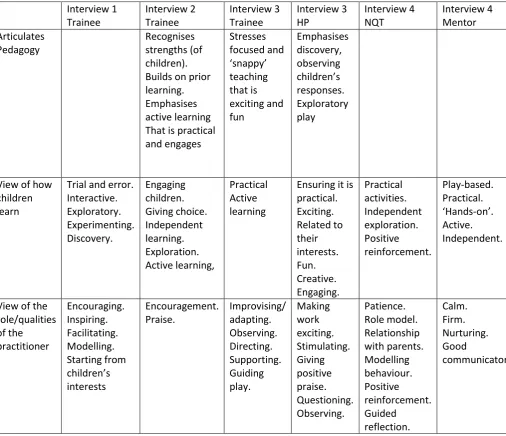
The following Table 1. indicates key elements and associated words derived from the interview responses related to the a priori pedagogy theme:
Table 1. Key words and elements associated with the a priori pedagogy theme.
Interview 1 Trainee Interview 2 Trainee Interview 3 Trainee Interview 3 HP Interview 4 NQT Interview 4 Mentor Articulates Pedagogy Recognises strengths (of children). Builds on prior learning. Emphasises active learning That is practical and engages Stresses focused and ‘snappy’ teaching that is exciting and fun Emphasises discovery, observing children’s responses. Exploratory play
View of how children learn
Trial and error. Interactive. Exploratory. Experimenting. Discovery. Engaging children. Giving choice. Independent learning. Exploration. Active learning, Practical Active learning
Ensuring it is practical. Exciting. Related to their interests. Fun. Creative. Engaging. Practical activities. Independent exploration. Positive reinforcement. Play-based. Practical. ‘Hands-on’. Active. Independent.
View of the role/qualities of the practitioner Encouraging. Inspiring. Facilitating. Modelling. Starting from children’s interests Encouragement. Praise. Improvising/ adapting. Observing. Directing. Supporting. Guiding play. Making work exciting. Stimulating. Giving positive praise. Questioning. Observing. Patience. Role model. Relationship with parents. Modelling behaviour. Positive reinforcement. Guided reflection. Calm. Firm. Nurturing. Good communicator.
All participants (BT, class teacher and mentor) were asked in the interviews to give their views on how young children learn and the role/qualities of the early-years teacher.
61 activities. Brooker’s (2002:68) view that a “theory of play requires a theory of instruction” was also represented as each participant identified specific strategies that the teacher employed: modelling, questioning, guiding, facilitating and positive reinforcement in her role consistent with a
constructivist approach. There was a high level of consistency and compatibility among the views expressed and a shared understanding of early-years pedagogy with play as a means of instruction developed during their interactions within this community of practice.
Emergent themes
Beyond the a priori theme related to pedagogy, the following themes emerged from the data set: i) learning through observation; ii) learning through critical reflection; iii) the BT as an apprentice. These themes provided an interesting insight into how the BT’s personal pedagogy developed.
i) Learning through observation
Further analysis of the a priori theme of pedagogy indicated that all participants emphasised the importance of learning through observation in supporting her pedagogical development.
In the initial questionnaire the BT indicated that she expected her initial views to be ‘challenged’ and was open to developing ‘new perspectives by having first-hand experience within the role and working closely with others in similar situations’.
In interview one, in responding to a question asking what had influenced her ideas about the role of the early-years teacher prior to joining the course she explained it was ‘from observing what I’ve seen in practice’. In this interview she also indicated that she found observing children valuable in gaining an understanding of how young children learn.
The next interview took place during preparations for the early-years teaching practice experience and the beginning teacher explained that observation had a key role in developing her confidence ‘I’ve done a lot more observations of teachers … I observed in KS2’ and she made a conscious effort to use observation to integrate herself into the new school setting.
During the practice a third interview was conducted and the beginning teacher was asked if she had an understanding of the personal pedagogy of the class teacher she was working alongside and her response gives further evidence of the value she places on observation – ‘I haven’t actually directly spoken to her but, obviously, I’ve observed her teaching a lot’. This view aligned with that of the class teacher who, when asked to explain what had instigated the changes in the BT’s practice, stated ‘she’s observed throughout the school, she’s observed me teach as well early on in her placement’.
Towards the end of the beginning teacher’s NQT year a final interview was conducted and the BT reflected on how her practice continued to develop through observations in the open-plan Reception setting – ‘I can look over and see that they are doing it in a different way and then I do stop and question myself’. The value of observation for reflective practice was clearly stated and the views of the mentor about her role in developing the BT’s practice extended this further – ‘it’s enabling her to observe good practice and see what bits she wants to bring to her own teaching style’. Each of the participants clearly aligned themselves with the view that providing opportunities for observation had a key role in enabling the BT to develop her personal pedagogy.
ii) Learning through critical reflection
62 In interview two, during preparations for the early-years practice, she expressed her approval for aspects of the observed practice – ‘they use lots of props and things…it’s really engaging, the activities are designed so they can follow-up from guided activities and extend their own learning’. These views matched with her previously articulated ideas of how young children learn. It is also clear that she reflected on the practice of the class teacher who – ‘always gives them praise and encouragement which I feel is really important in the early-years to recognise their strengths and build on them’. There were areas where she disagreed with the practice and this led her to rethink her approach even though she was not convinced of the benefits – ‘I think I will adapt slightly to how they approach their teaching because it’s consistency for the children’. Throughout the interviews she referred to learning from reading, research and theoretical perspectives that she valued as a contribution to her understanding – ‘the knowledge that I’ve gained from my last course and this course reading around the different theories of development’.
The reflective approach to her practice continued into her NQT year and in interview four when asked if she had made changes to her practice she stated ‘I feel like it has continually changed throughout the year, every day is new and different and every day I think of something that I would do differently to improve my practice’.
iii) The beginning teacher as an apprentice
The third theme that emerged from the analysis was the BT as an apprentice. During the interviews she made reference to her view of her role, status and credibility within the school. She cast herself clearly as an ‘apprentice’ and actively developed this role. In interview two she identified an element of the practice that she was not comfortable with and deferred to the experience of the class
teacher – ‘obviously she knows the class a lot better than I do’. She explained the need to – ‘keep that consistent throughout because if I come with too many new strategies it’s just going to confuse them’.
In interview three, when asked if she felt ‘part of the team’ she stated – ‘I feel really welcome as part of this team. I always go out of my way to ask if there is anything that needs doing’. Later in this interview when asked if the development of her practice had been encouraged or constrained she expressed a desire to ‘fit in’ and again questioned her own status and credibility ‘when you are a student there is a little bit of you that’s always held back because you know that it’s not your class’. Her success in ‘fitting in’ was noted by the class teacher who commented – ‘whatever we’ve suggested she’s taken on board’ and described a strategy used to develop the beginning teacher’s practice – ‘we’ve showed her how we do it’. She praised her practice and stated – ‘she’s been good, she’s followed on from what we’ve done’.
In interview four (towards the end of the NQT year), there was a marked contrast in the responses the BT gave when asked whether her practice continued to develop during the year she stated – ‘with my class I can introduce anything I want to really. I feel a bit more in control because they are mine’. Her confidence and status had increased as she was no longer a trainee in the setting but her view of the BT as an apprentice remained firm as she advised other NQTs to – ‘build up a good relationship with the people you work with and … try to establish yourself as a competent face within the school and get involved’. When asked in the final interview if she felt that she was part of the team in the setting she confidently responded – ‘Yes, definitely I do now’.
Discussion
Learning through observation
63 develop their teaching through interaction with more experienced colleagues is commonly accepted but there is little consideration of what type of interactions are effective in helping BTs to develop. For the BT, this view of the transmission of expertise through observation was reflective of the views of Lave and Wenger (1991) whose “situated view” of learning requires the learner to engage in an authentic situation with experienced members of the community they are seeking to join. This learning process involves a gradual absorption in the practices and values of the community and the acquisition of expertise through observation and imitation. The Office for Standards in Education (2014) stated that trainee teachers should have opportunities to observe outstanding teachers during their training period in order to “learn from outstanding practice”. The class teacher, the mentor and the wider school context have clearly influenced her development and a shared understanding of early-years pedagogy emerged. This co-construction of pedagogy does not,
however, emphasise an exchange of ideas and discussion and reflection. Bruner (1996:162) reflected the importance of interaction as he referred to “a sub-community of mutual learners” where
teacher (class teacher) and learners (BTs) were actively involved in the learning process. For this BT, the interaction appeared to be lacking – ‘I haven’t actually directly spoken to her’ (about her
pedagogy). McDonald (2009) believed that BTs need encouragement to engage in discussion and interaction with class teachers who are willing to share their own personal pedagogy. As previously noted, Shulman (1987), Atkinson and Claxton (2000) and Polanyi (1983) all considered that it can be difficult for teachers to articulate what they know. The interviews conducted with the class teacher and mentor demonstrated their ability to articulate their own pedagogy but they did not appear to attach as much importance to this aspect of their role as they did to providing opportunities for observation. The mentor expected to act as a guide – ‘I don’t want to tell her how she should be doing it’ and afforded the BT numerous opportunities to observe the process of learning and
teaching. Lave and Wenger (1991) and Rogoff (1990) emphasised the importance of participants in a community of learning being active in co-constructing their pedagogies and the second emergent theme (learning through critical reflection) explores how the beginning teacher takes an active role.
Learning through critical reflection
It has been noted that the BT developed a pedagogy that was closely aligned with that of the school in which she undertook her teaching placement and was subsequently employed as an NQT. It could be inferred that she did not fully engage in ‘confronting the core problems of pedagogy’ and merely adopted the dominant pedagogy within the setting. The analysis of the interviews demonstrated that she did engage in constructing her own pedagogy and was a reflective practitioner who drew on a number of sources as her ideas developed. As previously stated, early-years pedagogy is not an uncontested area. The BT experienced challenges to her previously held ideas and, as suggested by Beauchamp and Thomas (200:178), shaped and re-shaped her identity as an early-years practitioner by confronting these challenges. She was receptive to the idea that her practice would change and actively engaged in its construction through critical reflection and adapting her practice as a result of the challenges posed to her existing ideas from her observations. During this process, she
experienced uncertainty and began to question and reflect. Trent (2010) noted that those beginning teachers who were most open to reflection experienced greater uncertainty. This can be viewed as a form of “reconceptualization” that Bennett et al (1997) observed when the early-years teachers in their study reflected on and questioned their practice. The BT in this study was highly reflective and made changes to her pedagogy through her interactions within the community of practice. Her role in that community is discussed in the third emergent theme.
The beginning teacher as an apprentice:
64 (McIntyre 2009) and actively deferred to the knowledge of more experienced colleagues. She was ‘held back’ during her teaching placement as it was not her class and worked on integrating herself into the existing community of practice through hard work and ‘fitting in’. Lave and Wenger (1990:87) suggested that legitimate peripheral participation “is about being located in the social world...developing identities and forms of membership” and it is possible to see that her development was aligned with this view of learning. Shulman (1987) explored the idea of “transformation” in developing an understanding of pedagogical reasoning and this is pertinent here. This BT was involved in a transformation through her chosen role as an ‘apprentice’ in the setting and, as her credibility increased towards the end of her NQT year, she became confident of her place within the community of practice and acquired the credibility to make changes.
Conclusion
The emergent themes from the research indicated that BTs were active in constructing their own pedagogy through observation, reflection and interaction with more experienced colleagues in the community of early-years practice. There are implications for developing the role of mentors and class teachers involved in ITT. Those working with BTs should be aware of the value of sharing and discussion in the development of pedagogy and create opportunities for this to happen. The commonly-held view of observation being the key to developing the practice of beginning teachers that is promoted by the DfE needs to be challenged to ensure that an emphasis is placed on discussion and reflection. The BT in this study was open to change and co-constructed her personal pedagogy using a number of different strategies to gain her place in the community of practice. It is recommended that BTs should be viewed as active participants who engage in observation,
discussion and reflection to develop their pedagogy rather than passive observers of good practice.
References:
Atkinson, T. & Claxton, G. (2000) The Intuitive practitioner: On the value of not always knowing what one is doing. Buckingham. Open University Press
Beauchamp, C and Thomas, L (2009) Understanding teacher identity: an overview of issues in the literature and implications for teacher education. Cambridge Journal of Education, 39:2, 175-189.
Bennett, N., Wood, L., Rogers, S. (1997) Teaching Through Play. Buckingham. Open University Press. Brooker, L. (2002) Starting School: Young Children Learning Cultures. Buckingham. Open University
Press.
Bruner, J. (1996) The Culture of Education. Harvard USA. Harvard University Press.
Bruner, J. (1999) Culture, mind and education in Moon, B., Murphy, P. (eds) Curriculum in context. London, Paul Chapman Publishing Ltd.
Carter, A. (2015) Carter Review of Initial Teacher Training (ITT). Crown Copyright.
Charmaz, K. (2011) Grounded theory methods in social justice research. In N. M. Denzin and Y. S. Lincoln (eds) The SAGE Handbook of Qualitative Research (pp.359-380). Thousand Oaks, Cal.: Sage.
Cohen, L., Manion, L and Morrison, K (2007) (6th ed) Research Methods in Education. Oxon. Routledge.
DfE (2010) The Importance of Teaching: The School’s White Paper 2010. The Stationery Office. Norwich.
DfE (2011) Report into the EYFS: Recommendations from C. Tickell. Press Notice 30th March 2011 published online. Last accessed 15/05/2011.
65 Grossman, P.L., Wilson, S. M., Shulman L Teachers of Substance: Subject Matter Knowledge for
Teaching in Reynolds, M.C. (ed) (1989) ‘Knowledge Base for the Beginning Teacher’. Oxford. Pergamon Press.
Hobson, A.J., and Townsend, A. Interviewing as an Educational Research Method in Hartas, D. (2010) Educational Research and Inquiry. London. Continuum.
Lave J. and Wenger, E. (1990) Legitimate Peripheral Participation in Murphy, P (ed) ‘Learners, Learning and Assessment’. London. Sage.
Lave J. and Wenger, E. (1991) Situated Learning: Legitimate Peripheral Participation. Cambridge. Cambridge University Press.
Lave, J. and Wenger, E. (1999) Legitimate Peripheral Participation in Communities of Practice in McCormick, R. and Paecheter, C. (eds) ‘Learning and Knowledge’ London, Paul Chapman Publishing Ltd.
Lindsay, G., Ethical Considerations and Legal Issues in Educational Research in Hartas, D. (2010) Educational Research and Inquiry. London. Continuum.
MacGregor, D. (2009) Identity formation – Influences that shape beginning teachers’ professional identity – Crossing the border from pre-service to in-service teacher. Paper presented at ‘Teacher education crossing borders: Cultures, contexts, communities and curriculum’ the annual conference of the Australian Teacher Education association (ATEA), Albury, 28 June – 1 July.
McDonald, L (2009) Responsiveness of student teachers to the supervision of associate teachers. Paper presented at the British Educational Research Association Annual Conference, University of Manchester, 2-5 September 2009.
McIntyre, D (2009) The difficulties of inclusive pedagogy for initial teacher education and some thoughts on the way forward. Teaching and Teacher Education, 25, 602-608.
Moyles, J., Adams, S., Musgrove, A (2002) Study of Pedagogical Effectiveness in Early Learning (SPEEL). DfES Publications.
Office for Standards in Education (Ofsted), (2014) Initial Teacher Education Inspection Handbook. Polanyi, M. (1983) The Tacit Dimension. Gloucester, MA: Peter Smith.
Punch, K., (1998) ‘Introduction to Social Research’. London. Sage.
Rogers, S (2011) Play and Pedagogy: a conflict of interests? in Rogers, S (2011) Rethinking Play and Pedagogy in Early Childhood Education. Abingdon. Routledge.
Rogoff, B. (1990) Apprenticeship in Thinking: Cognitive Development in Social Context. Oxford. Oxford University Press.
Scardamalia, M., Bereiter, C. Conceptions of Teaching and Approaches to Core Problems in Reynolds, M.C. (ed) (1989) ‘Knowledge Base for the Beginning Teacher’. Oxford. Pergamon Press. Schön, D.A., (1987) Educating the Reflective Practitioner: Toward a new design for teaching and
learning in the professions. San Francisco.
Shulman, L.S., (1987) Knowledge and Teaching: Foundations of the New Reform. Harvard Educational Review 57.1, 1-23
Siraj-Blatchford, I., Sylva, K., Muttock, S., Gilden, R., Bell, D (2002) Researching Effective Pedagogy in the Early Years (REPEY). DfES Publications.
Trent, J., (2010) Teacher education as identity construction: insights from action research. Journal of Education for Teaching, 36: 2, 153 — 168
Varghese, M, Morgan, B, Johnston, B, Johnson, K (2005) Theorizing language Teacher Identity: Three Perspectives and Beyond. Journal of Language, Identity and Education, 4: 1, 21-44.
Wood, E (2010a) Developing Integrated Pedagogical Approaches to Play and Learning in Broadhead, P., Howard, J and Wood E (2010) Play and Learning in the Early Years. London. Sage.
Wood, E (2010b) Reconceptualizing the Play-Pedagogy Relationship in Brooker, E and Edwards, S (2010) Engaging Play. Maidenhead. OU Press.