Background:
The liver is most frequently injured solid organ in abdominal trauma. The non-operative management
is the standard treatment for hemodynamically stable patients. This study analyse the epidemiological aspects, injury
patterns, treatment modalities and outcome in patients with liver injuries only and associated injuries outside the liver.
Methods:
This was a retrospective study in patients with liver injuries admitted from 1
stMarch 2014 to 31
stJanuary
2019 at Chitwan Medical College and Hospital, Nepal. The patients were divided into two groups. Group A consisted
of isolated liver injury and Group B liver injury with associated injury of other organs. Data were analysed by using
descriptive statistics and Mann-Whitney U test.
Results:
A total of 61 patients were admitted with liver injury. There were 18 (29.5 %) patients with liver injury
alone (group A) and 43 (70.5 %)liver injury associated with other organs (group B). Low grade liver injuries were 48
(78.7 %) and high grade 13 (21.3 %). The operative management was done for one liver injury with biliary peritonitis
in group A. In group B, 16 patients required laparotomy and operative management for associated abdomen injuries.
Conclusions:
Non-operative treatment modality in hemodynamically stable patients with isolated liver injuries was
safe and effective.
Keywords:
Liver injury; management; scoring; trauma.
Management of Traumatic Liver Injury in a Tertiary
Care Hospital in Nepal
Harish Chandra Neupane,1 Kishor Kumar Tamrakar,1 Abhishek Bhattrai,1 Tseten Yonjen Tamang,1 Bishnu Bista,2 Rajib Chaulagain3
1Department of Surgery, Chitwan Medical College, Bharatpur, Chitwan, Nepal, 2School of Nursing, Chitwan
Medical College, Bharatpur, Chitwan, Nepal, 3Department of Oral Pathology, Chitwan Medical College, Bharatpur, Chitwan, Nepal.
Correspondence:
Harish Chandra Neupane, Department of Surgery, Chitwan Medical College, Bharatpur, Chitwan, Nepal. Email: [email protected], Phone: +9779855055155.ABSTRACT
J Nepal Health Res Counc 2019 Oct-Dec;17(45): 537-42
INTRODUCTION
Liver is frequently affected organ in abdomen trauma due to its anatomical size and location.1-3Liver trauma is one of the most common cause of death following abdominal injury because of associated multiple injuries, bleeding and shock.4,5 Together with spleen injury, it accounts for more than 75% of injuries in blunt abdominal trauma.6,7
Management of high-grade liver injuries remains a challenge due to hemodynamic instability, other associated injuries and development of complications requiring operative management. Associated injuries outside liver have a high injury severity score, morbidities and death.8
Although few studies on liver injuries have been conducted in Nepal,9-11 details on the incidence and outcome is lacking. This study aims to review the
epidemiological aspects, injury patterns, treatment modalities and outcome in patients with liver injuries and associated injuries outside the liver.
METHODS
A hospital-based retrospective study was carried out from 1st March 2014 to 31st January 2019. Ethical clearance was obtained from Institutional review committee of Chitwan Medical College. All patients with a diagnosis of liver injury with or without associated injuries attending the Department of Surgery of Chitwan Medical College and Teaching Hospital were included. Data were obtained from the medical records section. Patients with abdominal trauma treated initially in other hospitals and patients who were declared dead at the scene or on arrival to our hospital were excluded from the study.
All trauma patients were initially resuscitated at the emergency room, according to the advanced trauma life support (ATLS) protocols. Contrast enhanced CT scan (CECT) was done in all hemodynamically stable patients with positive Focussed Assessment with Sonograph for Trauma (FAST) scan.
Liver and other organ injuries were categorized according to the revised injury scale given by the American Association for the Surgery of Trauma.12 The study variables included age, sex, date and time of admission, mode of injury, associated intra and extra-abdominal injuries, Glasgow Coma Scale (GCS), Injury Severity Score (ISS), Revised Trauma Score (RTS), vital signs, liver function tests, intra-operative findings, mode of management, post-operative complications and mortality.
Patients were divided into two groups, Group A liver injury only and Group B liver injury associated with other injuries outside the liver. On the basis of their hemodynamic stability(Respiratory rate, Heart Rate, Systolic Blood pressure, RTS), the patients were treated by operative and non-operative means.
Data were entered directly into SPSS version 16 and were analysed by using descriptive statistics and Mann-Whitney U test was used. The statistical significance was considered at p-value <0.05.
RESULTS
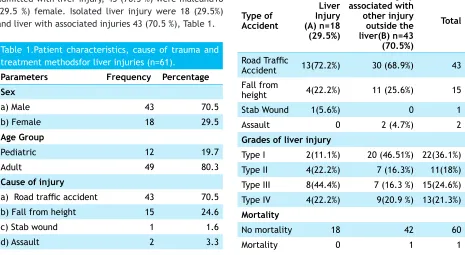
During four years study period, 61 patients were admitted with liver injury, 43 (70.5 %) were maleand18 (29.5 %) female. Isolated liver injury were 18 (29.5%) and liver with associated injuries 43 (70.5 %), Table 1.
Table 1.Patient characteristics, cause of trauma and treatment methodsfor liver injuries (n=61).
Parameters Frequency Percentage
Sex
a) Male 43 70.5
b) Female 18 29.5
Age Group
Pediatric 12 19.7
Adult 49 80.3
Cause of injury
a) Road traffic accident 43 70.5
b) Fall from height 15 24.6
c) Stab wound 1 1.6
d) Assault 2 3.3
Grade of liver injury
a) Grade I 22 36.1
b) Grade II 11 18.0
c) Grade III 15 24.6
d) Grade IV 13 21.3
Type of injury
a) Blunt 53 86.9
b) Penetration 8 13.1
Treatment method
a) Non-Operative 44 72.1
b) Operative 17 27.9
High and low grade
Low grade (I-III) 48 78.7
High grade (IV-VI) 13 21.3
Group A and Group B
Liver Injury (A) 18 (29.5 %) Liver injury associated
with other injury
outside the liver(B) 43 (70.5)
Blunt trauma was the commonest mode (more than 75%) of injury in both groups (Table 2).There were 48 (78.7 %) patientswith low-grade (I-III) liver injuries and 13 (21.3 %) in high-grade (IV-VI). There was one mortality in group B.
Table 2. Comparisonof modes of injuries and grades of livery injury inGroup A (n=18, liver alone) and Group B (n=31, liver with other associated injuries).
Type of Accident
Liver Injury (A) n=18 (29.5%)
Liver injury associated with other injury outside the liver(B) n=43 (70.5%)
Total
Road Traffic
Accident 13(72.2%) 30 (68.9%) 43 Fall from
height 4(22.2%) 11 (25.6%) 15
Stab Wound 1(5.6%) 0 1
Assault 0 2 (4.7%) 2
Grades of liver injury
Type I 2(11.1%) 20 (46.51%) 22(36.1%) Type II 4(22.2%) 7 (16.3%) 11(18%) Type III 8(44.4%) 7 (16.3 %) 15(24.6%) Type IV 4(22.2%) 9(20.9 %) 13(21.3%) Mortality
No mortality 18 42 60
Type of injury
Blunt 14(77.8%) 39 (90.7%) 53 Penetration 4(22.2%) 4 (9.3%) 8
Laparotomy with operative intervention was done in one patient for liver injury. All patients in group B had involvement of more than one organ or system. Sixteen patients in group B required operative management for associated abdomen injuries. The most commonly involved organ was ribs and thoracic cage including lungs, in 18 patients. Associated spleen injury was seen in 13 patients of which 3 received operative
management. Involvement of the bowel and mesentery was seen in 11 patients (Table 3), they all received operative management.
The revised trauma score was same in both groups (7.84) while the injury severity score was slightly high in group B (21) than in group A (20). The ALT and AST at admission were higher in group A. However, all these parameters were not statistically significant (Table 4).
The median duration of hospital stay was six days in group A and 12 days in group B (Table 4). During hospital stay five patients in group B developed complications.
Table 3. Injury to organs.
Abdomen organs
involved Group A (n=18)(isolated liver injuries) Group A Operative management
Group B (n=43) (liver with other abdomen injuries)
Group B Operative management (n=16)
Liver 18* 1 43
Spleen 13 3
Bowel and mesentery 11 11
Renal 4 1
Pancreas 2 0
intraperitoneal bladder
rupture 1 1
Table 4. Clinical presentation and injuries score of liver injurypatients in group A and group B.
Parameters
Liver Injury (A)
(n=18) Liver injury associated with other injury outside the liver(B) (n=43) p-value
Median Q1 Q3 Median Q1 Q3
Respiratory rate 24 21.5 26.25 22 20 26 .073
Glasgow Coma Scale 15 10 15 15 10 15 .739
Pulse 102 83.5 113.25 98 80 112 .358
Mean arterial pressure 71.5 57.5 80.83 73.3 70 90 .084
Systolic BP 100 77.5 102.5 100 90 120 .073
Diastolic BP 60 47.5 70 60 60 80 .122
Pulse pressure 30 30 40 40 30 40 .197
Revised Trauma Score 7.84 6.1 7.8 7.84 6.1 7.84 .552
Injury Severity Score 20 15.25 25 21 18 29 .124
Duration of hospital
stay 6 5 8.3 12 8 19 .001
AST at admission 267.1 45.25 418.5 66 42 385 .272
ALT at admission 280.5 43.5 490.75 78 41 309 .272
Total bilirubin at
admission 0.7 .6 .9 0.9 0.8 1.4 .008
Hb at admission 11.30 9.3 12.175 10.2 9.50 11.9 .506
Four patients developed hemothorax and one patient developed pneumothorax. All 5 cases were managed with intercostal chest tube drain. All the patients were kept in follow up at intervals of 1 to 6 weeks depending upon the status of patients.
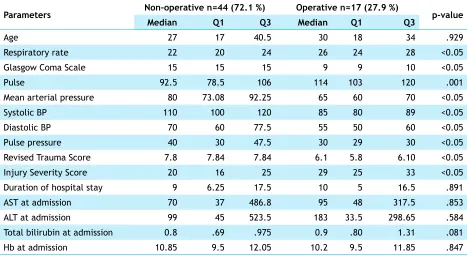
With regards to management of patients with operative and non-operative management, there was statistically significant differences in parameters such as respiratory rate, Glasgow coma scale, pulse, systolic and diastolic BP, pulse pressure, revised trauma score and injury severity score (Table 5). Duration of hospital stay, ALT, AST and total bilirubin at admission were high in the operative groups, but the difference was statistically not significant (Mann-Whitney U test, p>0.05).
DISCUSSION
Our study has shown that 72.1 % of patients were treated with non-operatively and 27.9 % of patients were treated operatively. In addition, majority of patients (86.9 %) had blunt abdominal injury in both groups, which is similar to published study.14 In contrast other studies report penetrating injury as the most common.2,15Road traffic accidents (RTA) is the main cause of death in the low and middle income countries (LMIC) with estimated 1.2 million deaths annually16 and, RTA is the main cause of blunt abdominal trauma.9,17-20More than 80 % of the liver trauma are due to automobile accidents.17 The study from India shows RTA is the main mechanism of
liver injury, out of 50 liver injury patients, 40 cases were due to RTA.18 Similar to our findings, other studies from
Nepal have also reported injury to the liver due to RTA.
9-11
Liver injuries associated with other injuries are more frequently seen in the thorax, spleen, mesentery and intestine. Less frequently involved organs are kidney, pancreas and urinary bladder.2,10 A higher proportion of the patients with associated other injury needs operative management than isolated liver injury.In our study 16 patients belonging to liver injury associated with other injuries underwent operative management while only one patient from isolated liver injury had operative management. Similar kind of result has noticed by Malhotra et al in 2007, that patients with blunt abdominal trauma, and with a concomitant injury to other organ has, a higher mortality rate and a higher rate for operative management.21
Majority of the patients in our study had a low-grade injury in both groups, but the incidence varies as reported in the literature.22,23 Group B showed the majority had grade I liver injury suggestive of primary impact was outside the liver whereas in group A, the majority of them were in grade III reflecting the primary impact is within the liver. In a similar kind of study, 17.5 % of patients had grade I injury, 31.7 % had grade II, 25 % had grade III, 16.9 % had grade IV and 8.8% had grade V.24 Table 5. Comparison between patients undergoing non operative and operative management.
Parameters Non-operative n=44 (72.1 %) Operative n=17 (27.9 %) p-value
Median Q1 Q3 Median Q1 Q3
Age 27 17 40.5 30 18 34 .929
Respiratory rate 22 20 24 26 24 28 <0.05
Glasgow Coma Scale 15 15 15 9 9 10 <0.05
Pulse 92.5 78.5 106 114 103 120 .001
Mean arterial pressure 80 73.08 92.25 65 60 70 <0.05
Systolic BP 110 100 120 85 80 89 <0.05
Diastolic BP 70 60 77.5 55 50 60 <0.05
Pulse pressure 40 30 47.5 30 29 30 <0.05
Revised Trauma Score 7.8 7.84 7.84 6.1 5.8 6.10 <0.05
Injury Severity Score 20 16 25 29 25 33 <0.05
Duration of hospital stay 9 6.25 17.5 10 5 16.5 .891
AST at admission 70 37 486.8 95 48 317.5 .853
ALT at admission 99 45 523.5 183 33.5 298.65 .584
Total bilirubin at admission 0.8 .69 .975 0.9 .80 1.31 .081
Hb at admission 10.85 9.5 12.05 10.2 9.5 11.85 .847
Earlier over the past few decades, operative management of liver injury was the treatment of choice. However, many literature suggest the choice of operative and non-operative management of liver trauma depends upon the hemodynamic stability of the patient, the grades of liver injury, presence or absence of associated intra-abdominal injuries and the neurological status of patients.13,23,24 With the advent of newer diagnostic tools and a better understanding of the course of liver injuries, non-operative management is now the standard of care in hemodynamically stable patients with high success rates.15,25 Easy availability of CECT and more frequent use of interventional radiology techniques accurately identify the severity of the injury and also delineate the associated injury and monitoring of other complications. It also helps to manage the liver injury with minimally invasive techniques.26 Studies have shown that 80-90 % of liver injuries can be successfully managed by non-operative procedures which supports our findings.20,24,26-28
Between operative and non-operative groups, patients in the operative group had a significantly high pulse and injury severity score but low mean arterial pressure, systolic BP, revised trauma score. Other parameters such as RR, ALT, AST, Hb at admission were elevated in operative group but were not statistically significant which is similar to otherstudy.24 in their study. Higher injury severity score but low systolic BP, revised trauma score in the operative group has been demonstrated by other studies.9,10,23,26
Postoperative complications such as bleeding, abdominal abscess, bile leak, cyst formation do occur following treatment of a liver injury. These complications are often related to the associated severity of liver trauma.3,26Out of 61 patients, complications occurred only in five: hemothorax in four and pneumothorax in one patient. All were managed with intercostal chest tube drain. In analysis of 257 patients with blunt liver trauma had very few complications such as biloma and pseudoaneurysm.26High-grades of liver injury, although less common, are associated with a high rate of morbidity and mortality.15 The reported mortality rate varies between 3%26to 17.8%2 in the literature. In our study period, there was one mortality in the non-operative group. The patient was of advanced age (80 years old) with hollow viscus injury and peritonitis and later died of respiratory distress. The less number of mortality may be due to improved selection of patients for non-operative management, careful monitoring of selected operative patients, availability of hepatobiliary surgeons and enhanced treatment protocol with follow up of the patients.
Most of the studies done in the context of abdominal trauma and liver injury have used parametric statistics and presented only mean and standard deviations.9,10,14,15,24,29,30 However, these parameters often are not normally distributed. Similarly, in our study the parameters studied were not normally distributed, the non-parametric test had to be used.
The main limitation of this study was the retrospective data and small sample size 61 patients with liver injury during four years period. A prospective study could provide better outcome data in the future.
CONCLUSIONS
Management of liver injury depends on hemodynamic stability of the patients, the severity of injury and other associated injuries. From this study we can conclude that non-operative management is safe in hemodynamically stable patient with isolated liver injury, whereas a number of patients with associated injuries outside the liver requires operative intervention.