Boric Acid Role in Different Cutting Fluids in
CNC End Milling by Measuring Surface
Roughness
Pravin A. Lad M. J. Deshmukh
M. Tech Scholar Associate Professor
Department of Production Engineering Department of Mechanical Engineering Government College of Engineering, Amravati – 444 604
[M.S.] India
Government College of Engineering, Amravati – 444 604 [M.S.] India
Abstract
Since the past years various manufacturing operations which includes the machining of metals uses various types of collants and lubricants which are composed of chemicals and other polluants factors. This collants and lubricants which are used, very dangerous and hazardous to the nature and human. This operations includes manufacturing operations like turning, milling, drilling, forming and grinding, forming, sheet métal operations etc. heat generated in the cutting zone results into bad work piece quality and more tool wear. Hence there is need to find and use the alternative coolants and lubricants which will reduce the hazards machining cost and other cost and, factors. In this paper boric acid is mixed with different oils coconut oil, soluble oil and potassium chloride and this mixture is used as cutting fluid and experimentation was done and performance was calculated and results are compared with the conventional and cutting oil without boric acid. Based on the experimental data we can say that boric acid and coconut oil showed that using better performance. New coolants potassium chloride is used in this project that gives more weightage.
Keywords: Boric Acid, Cutting Fluid, Lubricant, Machining, Quality
________________________________________________________________________________________________________
I.
INTRODUCTION
Automobile industry, shipbuilding aerospace, textile and other manufacturing industries uses End milling and has wide applications in a different manufacturing sector. In the recent trends industries are trying to minimize the errors occurring in the end milling operation, attempts are going on high level. These errors could be due to the problems in machine tools, cutters and the machining process itself. Of these, the error due to cutting force is one of the major problems for precision machining. Therefore, in milling operations, cutting forces and specific energy are important parameters by which the performance can be assessed. It is also important to minimize the cutting forces of milling process since it is intermittent cutting process, which can lead to undesirable vibrations, resulting in poor surface finish.
Fig. 1: Schematic Diagram of End Milling Operation
II.
SURFACE ROUGHNESS
Each new generation of manufacturing component is lighter in weight, used more exotic materials and process has higher horse power output, increase efficiency and lower defects than previous one. One of the secret to successful components of any machined or any other is ability to machine within the tolerance in the workshop. Some of the, most yet at least regulated machining specifications for components are the various surface finishes. The quality of machined surface is characterized by the accuracy of its manufacture with respect to the dimensions specified by the designer .some components surface finish can only be accurately measured with surface texture analyzer /roughness taster and all workshops should regularly the component and then produced to ensure their achieving required specification. Company manufactures typically specify surface finish with both Ra. or Rz. values and Rt readings. These values are measured in millionths of inch (10-6 inches, µ or microns or micrometer out of these we have taken Ra value to measure. Every machining operation leaves characteristic evidence on the machined surface. This evidence in the form of finely spaced micro irregularities left by the cutting tool. Each type of cutting tool leaves its own individual pattern which therefore can be identified. This pattern is known as surface finish or surface roughness. Surface roughness, often shortened to roughness, is a measure of the texture of a surface. It is defined as the arithmetic average of the deviation of the surface irregularities from the mean depth.
III.
SYSTEM DEVELOPMENT
The various instruments and machines used in the experimentation are as follows.
Taylor Hobson surface finish taster
Batliboi vertical milling machine
Batliboi vertical milling machined centre was used for end milling of EN-8 material. Below fig. 2. Shows the experimental set up for machining
Fig. 2: Schematic Diagram of Machined Used
The experimentation was carried out under different input condition for different cutting fluid and results were tasted.
Fig. 3: Taylor Hobson Surface Roughness Taster
The above equipment was used for measuring the surface Roughness taster having Uncertainty of measurement =± 0.001 mm The experiments procedures were carried out in the following.
First the capability of coconut oil and boric acid were studied
By selecting En-8 as workpiece and HSS End mill cutter as tool machining was done.
Depth of cut, feed and speed were fixed up and machining was done.
After that using Taylor Hobson surface finish taster surface finished value were checked.
Table – 1:
Experimental Investigation Table
Tool material Workpiece material Condition
K 10 HSS 14Ømm
En-8 Steel 50×50×5 mm
Boric acid in Soluble oil
Boric acid in vegetable oil
Potassium chloride and boric acid in vegetable oil
The numeric values of experimentation for various speed, feed, depth of cut and input cutting fluids environment are shown in the table 2
Table – 2: Machining Parameters
Levels Speed(RPM) Feed(mm/min) Depth of Cut(mm)
1 800 20 0.2
2 1000 25 0.25
3 1200 30 0.3
IV.
PERFORMANCE ANALYSIS
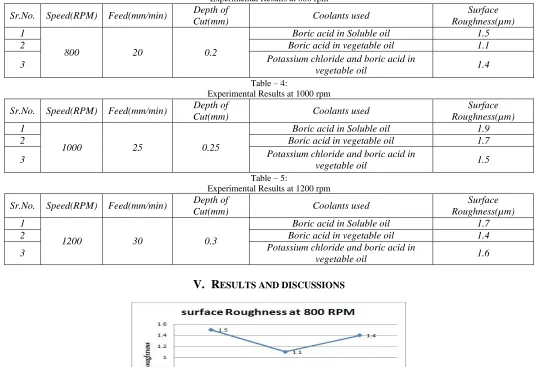
Table 4.1, 4.2, 4.3 shows the surface roughness values at different speed, feed, depth of cut and cutting fluid environment. Table – 3:
Experimental Results at 800 rpm
Sr.No. Speed(RPM) Feed(mm/min) Depth of
Cut(mm) Coolants used
Surface Roughness(µm) 1
800 20 0.2
Boric acid in Soluble oil 1.5
2 Boric acid in vegetable oil 1.1
3 Potassium chloride and boric acid in
vegetable oil 1.4
Table – 4:
Experimental Results at 1000 rpm
Sr.No. Speed(RPM) Feed(mm/min) Depth of
Cut(mm) Coolants used
Surface Roughness(µm) 1
1000 25 0.25
Boric acid in Soluble oil 1.9
2 Boric acid in vegetable oil 1.7
3 Potassium chloride and boric acid in
vegetable oil 1.5
Table – 5:
Experimental Results at 1200 rpm
Sr.No. Speed(RPM) Feed(mm/min) Depth of
Cut(mm) Coolants used
Surface Roughness(µm) 1
1200 30 0.3
Boric acid in Soluble oil 1.7
2 Boric acid in vegetable oil 1.4
3 Potassium chloride and boric acid in
vegetable oil 1.6
V.
RESULTS AND DISCUSSIONS
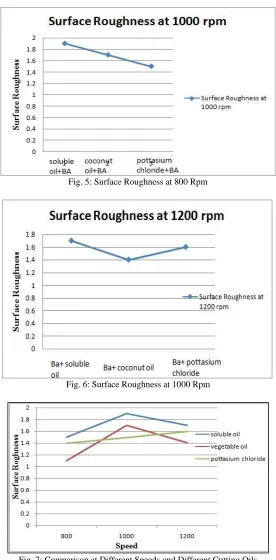
Fig. 5: Surface Roughness at 800 Rpm
Fig. 6: Surface Roughness at 1000 Rpm
Fig. 7: Comparison at Different Speeds and Different Cutting Oils
VI.
CONCLUSION
REFERENCES
[1] P. Vamsikrishnan et al 50 (2010). Experimental investigation on the performance of nanoboric acids suspensions in SAE-40 and coconut oil during turning of AISI1040steel . International Journal of Machine Tools & Manufacture. (Online) pp. (911–916) 1304. Available: http:// www.sciencedi rect.com/machine tools and structure.
[2] N.H. Jayadasa et al. (2007).Tribological evaluation of coconut oil as an environment-friendly lubricant. Tribology International.(Online) pp(350–354). 40. Available : http:// www.sciencedirect.com
[3] Jitendra Kumar (May – 2014). The Prospects of Vegetable based Oils as Metal Working Fluids in Manufacturing Application –A Review. International Journal of Engineering Research & Technology (Online). (IJERT )Vol. 3 Issue 5. Available : http:// www.ijert.com/pappers
[4] Nageswara Rao et al. (2008).The influence of solid lubricant particle size on machining parameters in turning. International Journal of Machine Tools & Manufacture pp (107–111). www.sciencedirect.com/machine tools and structure.
[5] Dilbag Singh et al. (2007).Performance improvement of hard turning with solid lubricants, International Journal of Advanced Manufacturing Technology (Online) .pp(170–17). 32. Available: http://www.sciencedirect.com
[6] M.M.A. Khan, M.A.H. Mithu, N.R. Dhar, Effects of minimum quantity lubrication on turning AISI 9310 alloy steel using vegetable oil-based cutting fluid, Journal of Materials Processing Technology 209 (2009) 5573–5583.
[7] Smith E. Kuram, et al.(2008). Optimization of the Cutting Fluids and Parameters Using Taguchi and ANOVA in milling. International Communications in Heat and Mass Transfer (pp. 120–129). 35. http://www.shodhganga.inflibnet.ac.in/bitstream/10603/11279/16/16