Copyrights © International Journal of Intellectual Advancements and Research in Engineering Computations, www.ijiarec.com Abstract—Internet of Things (IoT) allows for small devices with
sensing, processing and communication ability to be designed, which enable the development of sensors, embedded devices and other ‘things’ ready to realize the environment. In this paper, a distributed framework based on the internet of things archetype is proposed for monitoring human biomedical signals in activities involving physical action. The main advantages of the proposed system are the flexibility in computing the health application by using resources from available devices inside the body area network of the user. This proposed framework can be applied to other mobile environments, especially those where intensive data possession and high processing needs take place. Finally, we present a case study in order to validate our proposal that consists in monitoring footballers’ heart rates during a football match. The real-time data acquired by these devices presents a clear social objective of being able to forecast not only situations of sudden death but also possible injuries.
IndexTerms- Internet of Things; healthcare monitoring; wearable sensing; sensor network; case studies.
I.INTRODUCTION
According to research, we found that approximately 2000 people died monthly due to the only lack of care of their health. This is because they don’t have time for themselves and not remember about their health management due to a heavy workload. The reason behind to make this project is the growing world of technology and people forget their health checkup which is needed to be done monthly.we all know that internet of things makes our life easier. So, we have decided to make internet of things based healthcare project.People who provide them all the personal information about their health on their mobile and they can check their all historical health data. The best part of this project is used by everyone and makes our health management easier. Android applications help a person to access the information anytime anywhere in the mobile only. It will save a lot of money of user which is going to be spent on curing of any disease, by giving early warning of health disorder.
Internet of Things (IoT) is a hot technology worldwide. The Government, academic world, and industry are involved in different aspects of research, implementation, and business with IoT. These domains include agriculture, space, healthcare, manufacturing, construction, water, and mining,which are presently transitioning their birthright infrastructure to support IoT.Today it is possible to visualize connectivity, storage, and computation, which, in turn, gives differentIoT solutions. IoT-based applications such as innovative shopping system, infrastructure management in both metropolitan and rural areas. Remote health monitoring and emergency notification systems are increasingly relying on IoT based systems. Therefore, it is very important to learn the fundamentals of this healthcare technology.
Fig.1. Internet of Things
II.RELATEDWORK
The advantage of sensor and interconnect technologies, healthcare can now include collecting patient data dynamically to advance preventive care, diagnostics, and even measure treatment results. Automation and real-time aspects reduce errors and improve quality and efficiency. Today, wireless sensor-based systems meet medical data that was never before
Volume-6 Issue-2
International Journal of Intellectual Advancements
and Research in Engineering Computations
Smart Healthcare using IoT
1
Ms. N. ZahiraJahan, M.C.A., M.Phil., Associate Professor/MCA,
2Ms. A.G. JananisriKamatchi, II M.C.A.,
3Ms. R. Pavithralakshmi, II M.C.A.,
4
Ms. S. M. Mehala, II M.C.A.,
5Ms. S. Shanmugapriya, II M.C.A.,
Department of MCA, Nandha Engineering College (Autonomous), Erode-52.
Email ID: [email protected], [email protected], [email protected],
[email protected], [email protected]
Copyrights © International Journal of Intellectual Advancements and Research in Engineering Computations, www.ijiarec.com
accessible and deliver care directly to patients. IoT-related healthcare isaccess a network of devices that connect directly with each other to capture and share essential data through a secure service layer (SSL) connecting to a server in the cloud. It combines sensors, microcontrollers, microprocessors, and gateways where sensor data is further analyzed and sent to the
cloud and then on to caregivers.
Remote monitoring translates into a greater number of patients worldwide having access to sufficient healthcare. Data is captured via sensors, complex algorithms analyze the data, and medical professionals can wirelessly access the information and make diagnoses and treatment recommendation. Patients can also be monitored around the clock so that fine changes are detected and drug intoxication isavoided.
As the population ages, sensors living independently may use a monitoring device to detect a fall and report it automatically to emergency responders. Strategically-placed sensors can monitor daily activities and report anomalies to care providers or family members via cell phone. Applications processing and wireless connectivity can be embedded in mobile personal health gateways to monitor human body parameters and manage health.
Fig.2. Components of a remote patient monitoring system that is based on IoT-Cloud architecture.
Data Acquisition: It is performed by multiple wearable sensors that measure physiological biomarkers, such as skin temperature, respiratory rate, and etc. The sensors connect to the network though an intermediate data aggregator or concentrator, which is typically a smart phone located in the vicinity of the patient.
The Data Transmission components of the system are responsible for conveying recordings of the patient from the
patient’s house (or any remote location) to the data center of the Healthcare Organization (HCO) with assured security and privacy, ideally in near real-time. Typically, the sensory acquisition platform is equipped with a short range radio such as Zigbee or low-power Bluetooth, which it uses to transfer sensor data to the concentrator. Aggregated data is further relayed to a HCO for long term storage using Internet connectivity on the concentrator, typically via a Smartphone’sWiFi or cellular data connection. Sensors in the data acquisition part form an Internet of Things (IoT)-based architecture as each individual sensor’s data can be accessed through the Internet via the concentrator.Often a storage/processing device in neighborhood of a mobile client, sometimes referred to as a cloudlet, is used to augment its storage/processing capability whenever the local mobile resources do not fulfill the application’s requirements. The cloudlet can be a local processing unit (such as a desktop computer) which is directly accessible by the concentrator through WiFi network. In addition to providing temporary storage earlier to communication of data to the cloud, the cloudlet can also be used for running time critical tasks on the patient’s aggregated data. Moreover, the cloudlet can be used to transmit the aggregated data to the cloud in case of limitations on the mobile device such as temporary lack of connectivity or energy.
Cloud Processing has three different components: storage, analytics, and visualization. The system is designed for long term storage of patient’s biomedical information as well assisting health professionals with diagnostic information. Cloud based medical data storage and the upfront challenges have been extensively addressed in the literature.Analytics that use the sensor data along with e-Health records that are becoming established diagnoses and prognoses for a number of health conditions and diseases. Additionally, Visualization is a key requirement for any such system because it is impractical to ask physicians to hole over the voluminous data or analyses from wearable sensors. Visualization methods that make the data and analyses accessible to them in a readily digestible format are essential if the wearable sensors are to impact clinical practice.
III. SMART HEALTHCARE
Copyrights © International Journal of Intellectual Advancements and Research in Engineering Computations, www.ijiarec.com
secure, especially if it is being exchanged with other devices.
This essential guide will look at some of the current applications of healthcare IoT, including how it's being used in one Boston hospital to keep track of newborns in the NICU. Next, the guide explores some of the challenges of IoT in healthcare, such as the need to manage multiple connected devices and a lack of interoperability with EHR systems. Finally, this guide will posit the future of healthcare IoT, including how physicians can turn IoT data into actions. There is no doubt that the Internet of Things is transforming the healthcare industry completely by redefining how apps, devices and people interact and connect with each other in delivering healthcare solutions. That is, IoT is constantly offering new tools as well as efficiencies that make up an integrated healthcare system with the view of ensuring patients are cared for better, health care costs are reduced significantly and treatment outcomes are improved.
Thus, it is a conglomeration of multiple opportunities that wellness promoters and hospitals can tap into even as they optimize resources through automated workflows as well as process excellence. For instance, a majority of hospitals use IoT for asset management and controlling humidity and temperature within operating rooms.
Fig3.Architecture of System
IV.APPLICATION OF SMART HEALTH CARE
The applications of IoT in the healthcare industry are numerous
a) Real Time Location Services
Through IoT, doctors can use real time location services and track the devices used for treat patients. Medical staff may sometimes keep the devices in out-of-sight areas which makes them difficult to find when another medical staff comes on the scene.Medical apparatus and devices like wheelchairs, scales, defibrillators, nebulizers, pumps or monitoring equipment can be tagged with sensors and
located easily with IoT. Apart from real time location services, there are IoT devices that help in environmental monitoring as well (checking the refrigerator temperature, for example).
b) Predicting the Arrival of Patients in PACU
With the intervention of Internet of Things, clinicians can predict the arrival of patients who are recuperating in the Post-Anesthesia Care Unit (PACU). They can also monitor the status of patients in real time.
c) Hand Hygiene Compliance
There is hand hygiene monitoring systems that would detect the degree of cleanliness in a healthcare worker. According to the Center for Disease Control and Prevention in the United States, about one patient out of every 20 gets infections from lack of proper hand hygiene in hospitals. Numerous patients lose their lives as result of hospital acquired infections.The interactions in the hand hygiene monitoring systems are done in real time and if a clinician comes near a patient’s bed without washing his hands, the device would start buzzing. And that's not all. The information about the healthcare worker, his ID, time and location will all be fed into a database and this information would be forwarded to the concerned authorities.
d) Tighten Budgets and ImprovePatient Journey
The healthcare industry has to keep a watchful eye on the budget and at the same time have updated infrastructure to provide better patient experiences. Thanks to the seamless connection between devices that IoT has made possible, it is now possible for the medical staff to access patient information from the cloud as long as they are stored in there. The goal is to provide quality medical care to patients, and by spending a small amount on IT infrastructure, hospitals can provide good care to patients at affordable rates. IoT aims to provide better patient journey by: Room lighting through personal control Communicate to family and friends through email services immediate attention to patient needs.
e) Remote Monitoring
Copyrights © International Journal of Intellectual Advancements and Research in Engineering Computations, www.ijiarec.com
even hospital re-admission. This kind of intervention is a boon to people living alone, especiallysenorious. If there is any interruption in the daily activity of a person, alerts would be sent to family members and concerned health providers.
These monitoring devices are available in the form of “wearable” too.
f) Focus on the Research Side of Healthcare
Protein research and composition analysis benefits from Internet of Things. Through IoT, researchers are able to analyze the accuracy of the equipment, and it rewards them by shortening their workflow through quantitative and reproducible analysis of proteins. When an infinite array of devices is connected, the healthcare industry is able to provide scalable solutions to its patients. A number of healthcare apps providing cutting-edge personalized solutions are released to them. Here are a few of them:
Medication Dispensing Device by Philips - so patients will not miss a dose anymore; perfect for elderly patients.
Niox Mino by Aerodrome - for routine measurements of Intric Oxide in a patient's breath.
UroSense by Future Path Medical - for catheterized patients to check their core body temperature and urine output.
GPS SmartSole - this is a shoe-tracking wearable device for dementia patients who have the habit of forgetting things.
Fig. 4.Application of Smart Health Care
V. DEVICES IN SMART HEALTHCARE USING IOT
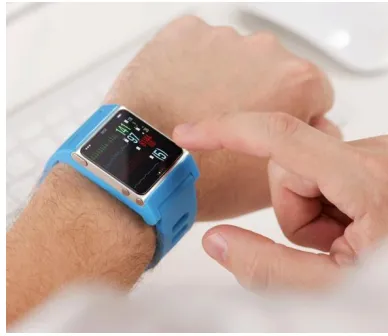
A.SMART WEARABLE MONITORING WATCH
Wearable and related health apps were featured at CES (International Consumer Electronics Show), and while most are still focused on fitness, many believe they will soon play a significant role in medicine and can develop into useful tools for patients. A few devices are already providing valuable medical data such as the wearable ECG, and the wearable EEG headband, which uses sensor technology.
Fig. 5.Smart Wearable Monitoring Watch
B. PULSE OXIMETER-FINGERTIP WELLNESS DEVICES
It indicated for cardiac care and monitoring it is a compact blood oxygen meter for checking pulse rate and saturation level at home, clinics. It exercise and high-activities pulse oximetry is used to measure how much oxygen your blood is carrying. It is indicated for the people suffering with COPD,asthma Congestive Heart Failure (CHF) and related conditions.
Fig. 6. Pulse Oximeter-Fingertip Wellness Devices
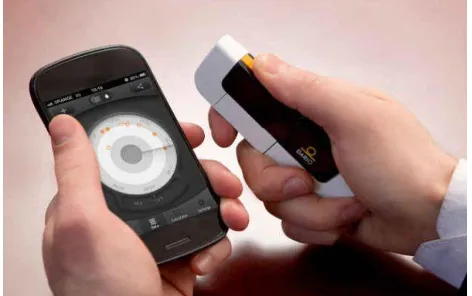
C.DARIO DIABETES TRACKER TURNS YOUR
Copyrights © International Journal of Intellectual Advancements and Research in Engineering Computations, www.ijiarec.com
The patients to carry many added accessories, while exercising (or any physical activity) like lancets, alcohol swabs and a relatively large glucometer. "The technique requires a sophisticated electrochemical sensing technique and sufficient electrical energy, which makes the technique difficult to be fully integrated in a compact and portable fashion. The sensing platform holds considerable promise for efficient diabetes management, and a fully integrated system with a simple readout can be realized toward continuous non-invasive glucose monitoring.
Fig7. Dario diabetes tracker turns your Smartphone into glucometer
D.SMART INHALER
It is created for patients with COPD and asthma will use smart inhalers to monitor patients’ adherence and then provide patients with personalized advice based on their condition and medication use. In the future, it will also likely incorporate additional sensors designed to monitor a patient’s condition and potentially assess a patient’s personalized risk factors.
Fig. 8. SMART INHALER
VI. ADVANTAGES OF SMART HEALTHCARE
The major advantages of the Internet of Things in that healthcare organizations can take advantage of1 include the following:
1.
Decreased Costs–When healthcare providers take advantage of the connectivity of the healthcare solutions, patient monitoring can be done on a real time basis, thus significantly cutting down on unnecessary visits by doctors. In particular, home care facilities that are advanced are guaranteed to cut down on hospital stays and re-admissions.2. Improved Outcomes of Treatment – Connectivity of health care solutions through cloud computing or other virtual infrastructure gives caregivers the ability to access real time information that enables them to make informed decisions as well as offer treatment that is evidence based. This ensures health care provision is timely and treatment outcomes are improved.
3. Improved Disease Management – When patients are monitored on a continuous basis and health care providers are able to access real time data, diseases are treated before they get out of hand.
4. Reduced Errors – Accurate collection of data, automated workflows combined with data driven decisions are an excellent way of cutting down on waste, reducing system costs and most importantly minimizing on errors.
5. Enhanced Patient Experience–The connectivity of the health care system through the internet of things, places emphasis on the needs of the patient. That is, proactive treatments, improved accuracy when it comes to diagnosis, timely intervention by physicians and enhanced treatment outcomes result in accountable care that is highly trusted among patients.
6.
Enhanced Management of Drugs –Creation as well as management of drugs is a majorexpense in thehealthcare industry. Even then, with IoT processes and devices, it is possible to manage these costs better.Copyrights © International Journal of Intellectual Advancements and Research in Engineering Computations, www.ijiarec.com
For more reliable and low complexity of the system the controller section can be replaced by other Advanced Microcontrollers. The applications can be added by adding the more modules and sensors. Accuracy can be increased by using high sensitive sensors and more reliable modules. For more security and functionality in the cloud can be increased by using paid clouds or won cloud. Using the X-bee Module we can create a wireless zone and this device may communicate with the other devices also in big hospitals. Ethernet Module can be replaced by Wi-Fi module and GSM module for Internet Connectivity. For simpler GUI we can draw Sketches and Graphs in the Mobile applications.
VII.CONCLUSION
IOT platform provides a simple environment to connect the hardware devices through the cloud and users. Then by using IOT we can make any type of devices by different type of sensors and modules. This project is useful for Patient who required regular check the parameters.The previous data storage facility provides to the doctors to better treatment environment by this friendly device. The simpler working and Mobile app GUI provides the friendly connection between the devices to users. As device also provides the location updates, body condition status and medicine alerts, it is very useful for take care the patients by doctors and relatives.
REFERENCES
[1] 2015 IEEE International Conference on Services Computing 978-1-4673-7281-7/15 $31.00 © 2015 IEEE DOI 10.1109/SCC.2015.47 PP:285 Health Monitoring and Management Using Internet-of-Things (IoT) Sensing with Cloud-based Processing: Opportunities and Challenges.
[2] Available online at www.sciencedirect.comThe 7th International Conference on Ambient Systems, Networks and Technologies (ANT 2016) Patient Monitoring System Based on Internet of Things.
[3] http://h30614.www3.hp.com/collateral/Barcelona2013/pres entations/IT3112.
[4]
http://www.gsma.com/newsroom/wp-content/uploads/15625-Connected-Living-Report