INTRODUCTION
The quality of river water is a result of the ef-fects of natural and anthropogenic factors acting in the river basin area. The factors related to agri-cultural work and inflow of municipal and indus-trial waste are of particular significance [Chang 2008, Hillel et al. 2015, Kowalczyk et al. 2014, Renwick et al. 2008, Zhou et al. 2016]. High level of inflow of pollutants from the arable land is a consequence of using mineral fertilisers and in-tense animal breeding [Bogdał and Kowalik 2015, Wiatkowski and Wiatkowska 2006]. The dynam-ics of the outflow of pollutants from arable land depends on the hydrological and meteorological conditions, sculpture of the landscape and perme-ability of the soil [Álvarez-Cabria et al. 2016, Kra-sowska and Banaszuk 201, Ravichandran 2003]. Strong water pollution restricts their use for economic, industrial and recreational purposes. Deterioration in river water quality leads to
ad-verse changes in the natural environment, mostly water and water-dependent ecosystems.
Progressing degradation of surface water prompted implementation of a number of meas-ures to restrict the inflow of pollutants [Policht-Latawiec et al. 2015]. In order to improve the quality of surface waters the EU countries have introduced a common policy of water quality monitoring in the river basin areas [Molina-Na-varro et al. 2014, Murat-Błażejewska and Sojka 2011, Sojka and Murat-Błażejewska 2009]. The main aim of introduction of the Framework Wa-ter Directive [Directive 2000] was to undertake all kinds of measures that would permit achieve-ment of good quality of river waters up to 2015. The effectiveness of these operations is verified by the Regional Inspectorates of Environmental Protection (Wojewódzkie Inspektoraty Ochrony Środowiska – WIOŚ), obliged to carry out moni-toring of water quality. The monimoni-toring is con-ducted in the surface water bodies on the basis
TREND OF CHANGES IN PHYSICOCHEMICAL STATE OF THE RIVER NER
Joanna Jaskuła1, Mariusz Sojka1, Joanna Wicher-Dysarz2, Tomasz Dysarz2
1 Institute of Reclamation, Land Improvement and Geodesy, Faculty of Environmental Engineering and
Landscape Planning, Poznan University of Life Sciences, Piątkowska 94 Str., 60-649 Poznań, Poland, e-mail: [email protected], [email protected]
2 Department of Hydraulic and Sanitary Engineering, Faculty of Environmental Engineering and Landscape
Planning, Poznan University of Life Sciences, Piątkowska 94 Str., 60-649 Poznań, Poland, e-mail: jwicher@ up.poznan.pl, [email protected]
Volume 17, Issue 5, Nov. 2016, pages 27–34
DOI: 10.12911/22998993/64447 Research Article
ABSTRACT
The paper presents the results of changes in the physicochemical status of the water of the river Ner in the Dąbie profile, observed in the period 2000 – 2006. The river Ner flows through the lowland in central part of Poland and its basin area is 1835 km2. The physicochemical status of the river water was evaluated on the basis of 16 parameters
characterising the physical state, oxygen condition, organic pollution, salinity and
acidity. The results of a series of analyses performed over 6 years provided the evi
-dence that the extension of sewage system and enlargement and upgrading of the sew
-age treatment plant have had positive effect on the state of water in the river Ner. The oxygen conditions have improved and the loading with organic substances from insuf
-ficiently purified sewage has decreased. The level of the water salinity has increased. Keywords: lowland river, water and sewage management, physicochemical status,
trend of changes Received: 2016.08.11
Accepted: 2016.09.26
of measurement of physicochemical, chemical and biological elements. The data collected by WIOŚ are used for analyses and determination of the pace and direction of changes in water qual-ity. The information is necessary for planning and realisation of water management [Shrestha and Kazama 2007, Walker et al. 2015].
The aim of the study reported was evalua-tion of the level and identificaevalua-tion of direcevalua-tion of changes in the physicochemical state of the river Ner in the Dąbie profile, over the period 2000–2006. The utilitarian aim was the evalua-tion of the effectiveness of the operaevalua-tions applied in this period to improve water-sewage manage-ment in the river Ner basin area.
MATERIALS AND METHODS
Changes in the physicochemical state of the river Ner water were evaluated on the basis of the data provided by the Regional Inspectorate of En-vironmental Protection (WIOŚ) in Łódź. The data included values of 45 parameters characterising the quality of the river Ner water collected once a month over the period from 2000 to 2006. From this database the following 16 physicochemical parameter were chosen for analysis: physical pa-rameters (Water temperature – WT, Suspension – SP), parameters characterising oxygen conditions and organic pollution (Dissolved oxygen – DO, Bio-chemical oxygen demand – BOD, Chemical oxygen demand – CODMn, Total organic carbon – TOC and Chemical oxygen demand – CODCr), parameters describing salinity (Electrical conductivity – EC, Solutes – SOL, Sulfates – SO4, Chlorides – Cl, Calcium – Ca, Magnesium – Mg and Hardness – Hard) and those describing acidity (pH and To-tal alkalinity – TA). The physicochemical state of the river Ner water was evaluated in the way recommended in the Directive of the Minister of Environment of 22nd October, 2014, on the way
of classification of surface water bodies and envi-ronmental norms of the contents of priority sub-stances. The classification of water quality was made on the basis of comparison of mean annual values of the parameters analysed with the limit-ing values [Directive… 2014]. The annual mean values, minimum and maximum values of the parameters and standard deviations were calcu-lated. Correlation analysis was performed to find the types and strengths of relations between the parameters analysed and the
hydrometeorologi-cal conditions. Trends of the changes in the pa-rameters studied were identified on the basis of testing the hypotheses of zero slope of the regres-sion curves. Analyses of changes were to reveal the directions of changes in the physicochemical parameters determined for the water of the river Ner. The analysis based on monthly values of pa-rameters. Statistical analyses were carried out at the level of significance pα= 0.05 in the STATIS-TICA 12 software [StatSoft, Inc. 2014].
Information on the meteorological conditions in the years 2000–2006 in the river Ner basin area was provided by results of everyday measure-ments of precipitation and air temperature avail-able at the address www.freemeteo.pl for the sta-tion in Łódź. The annual total precipitasta-tions and annual average temperatures were calculated and compared with the mean values from the period 1961–2000. The hydrological conditions in the river basin area were characterised on the basis of everyday measurements of water flow in the river Ner in the Dąbie profile for 2000–2006, provided by the Institute of Meteorology and Water Man-agement – National Research Institute (Instytut Meteorologii i Gospodarki Wodnej – Państwowy Instytut Badawczy – IMGW-PIB) in Warsaw. The annual characteristic flows and unit outflows were calculated. The values were presented against the data measured in the period 1961–2000 ob-tained from the comment to the Hydrographic Map of Poland.
The boundaries of the river Ner basin area were delimited on the basis of the Raster Hydro-graphical Map of Poland (MPHP) in the scale 1:50 000 [2010], provided by the National Water Management Authority (Krajowy Zarząd Gos-podarki Wodnej – KZGW). The abiotic type of the surface water bodies in the basin area was de-termined on the basis of the report of the Minis-try of Environment for the river Odra basin area [2005]. The abiotic type for river in the Dąbie profile was classified as a medium sized river in the area affected by peat-formation processes (PLRW600024183299).
The type of landscape sculpture was charac-terised on the basis of the Digital Terrain Model (DTM) of the mesh size of at least 100 m, provided by the Main Centre of Geodetic and Cartographic
Documentation (Centralny Ośrodek
the Chief Inspectorate of Environmental Protec-tion (Główny Inspektorat Ochrony Środowiska GIOŚ). The point sources of pollutants were identified on the basis of the National Mosaic Report on the state of the natural environment in particular voivodships in the years 2000–2007 [2010]. The state of water-sewage management in the river Ner basin area was characterised on the basis of the statistical data from the Central Statistical Office of Poland (Główny Urząd Staty-styczny – GUS). The water-sewage management state is described for 18 communes whose area is occupied by the basin area in over 50%.
RESULTS
The river Ner is a right tributary to the Warta river which join at 444+400 km. The total area of the river basin is 1835 km2, while the length
of the river is 124 km. In the Polish classifica-tion system of hydrographic basins it is labelled with code number 1832. According to abiotic typology, five surface water bodies of the river were identified: from the springs to Dobrzyn-ka (PLRW600017183229) Ner was classified as lowland sandy stream, from Dobrzynki to Zalewki (PLRW600020183235), from Zalewki to Dopływ spod Łężek (PLRW600020183271) and from Dopływ spod Łężek to Zbylczycki Canal (PLRW600020183275) it is a lowland gravel river, from Zbylczycki Canal to the mouth (PLRW600024183299) it is a medium-sized river in the area affected by peat-formation processes.
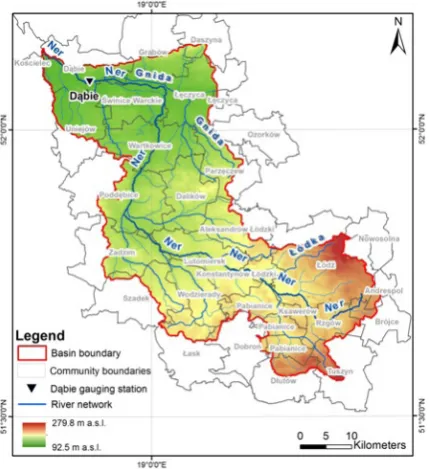
According to the physico-geographic divi-sion proposed by Kondracki (2002), the river Ner basin area is situated in the following macrore-gions: Wzniesienie Południowomazowieckie, Nizina Południowowielkopolska and Nizina Środkowomazowiecka. The area has a lowland character, the absolute altitudes of the terrain vary from 92.50 to 279.8 m a.s.l. (Fig. 1.). The mean slope of the basin is 1.17 % . The area is mainly covered by arable land, occupying 63.35% of the total basin area. Other forms of land use are forests (14.2%), greenery (10.8%) and urbanised land (11.4%). The total area of lakes is 4.5 km2,
which – with respect to the total basin area – gives the lake index of 0.25% . The density of river net-work is 1.59 km∙km-2.
Taking the administrative division into con-sideration, the basin area of the river Ner occupies 31 communes (Fig. 1). In the years 2000–2006,
the water supply system was expanded by almost 250 km, whereas the sanitary sewage system was expanded by about 165 km. Along with sanitary sewage system construction also the rain drain system was enlarged by 33 km. In 2002 the ac-cess to water supply system and sanitary sewage system had 78.79% and 34.11% inhabitants of these communes, respectively. As a result of the construction works realised up to 2006 , the per-centage of inhabitants able to use the water and sewage systems increased to 82.11% and 36.02%. In the period 2000–2006 the number of municipal wastewater treatment plants increased from 11 to 15, of which 67% are biological treatment plants and 33% have facilities for enhanced removal of biogenic contents. In 2000, the wastewater treat-ment plants served upto 81.50% inhabitants, while in 2006 – 92.60%. In 2006 the river basin area hosted 10 industrial wastewater treatment plants, including 3 mechanical ones and 7 biological ones. Their number did not change in the period considered. The total amount of municipal and industrial waste released to the river Ner and its tributaries in 2006 was 66.52.106 m3 , which was
by 11.85.106 m3 less than in 2000. Over 90% of the
wastewater was treated and of the remaining 10% of untreated wastewater, about 1% was industrial wastewater and the other 9% – municipal waste. In the period 2000 – 2006, the proportion between treated and untreated wastewater was similar.
The Ner basin area is situated in the Central Greater Poland and Central Poland climatic
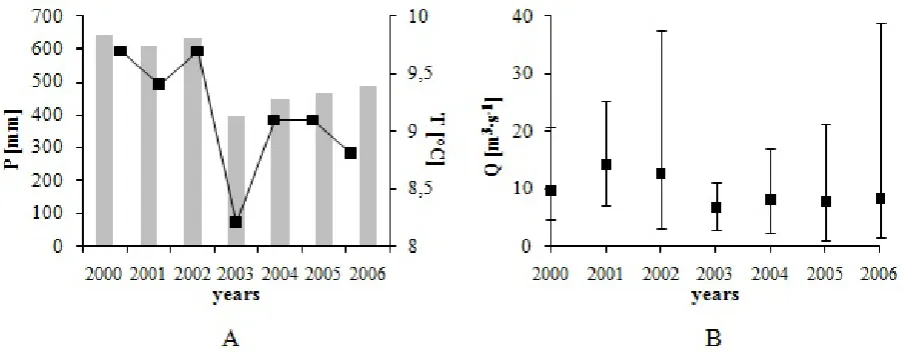
gions (Woś, 1993). The annual mean air tempera-ture is 8.0°C, while the annual mean precipitation is 522 mm. In the period 2000–2006 the tempera-tures were slightly higher so the annual mean was 9.1°C. The coldest was 2003 with the annual mean temperature of 8.2°C, while the warmest were 2000 and 2002 with the annual mean of 9.7°C (Fig. 2A). The annual mean sum of pre-cipitations in the period 2000–2006 was close to the mean from the period 1961–2000 and equal to 527 mm. The mean annual precipitations varied in a wide range. The lowest annual precipitation of 396 mm was observed in 2003, while the high-est of 644 mm in 2000 (Fig. 2A).
The river Ner is characterised by snow and rain regime of supply, with a single maximum (March, April) and a single minimum (July-September) in a year. The annual mean flow of the river Ner in the Dąbie profile in the period 1961–2000, according to IMGW-PIB, was 11.2 m3·s-1 , with the minimum of 0.7 m3·s-1 and the
maximum of 87.0 m3·s-1. In the period 2000–2006
the mean flow was 9.7 m3·s-1, with the range of
variation 1.1 m3·s-1 – 39.1 m3·s-1. The annual
mean flows in the period 2000–2006 varied from 6.8 m3·s-1 in 2003 to 14.28 in 2001 (Fig. 2B). The
outflow index from the river Ner basin area in the period 2000–2006 was 167 mm, while the unit outflow was 5.29 dm3∙s-1∙km-2.
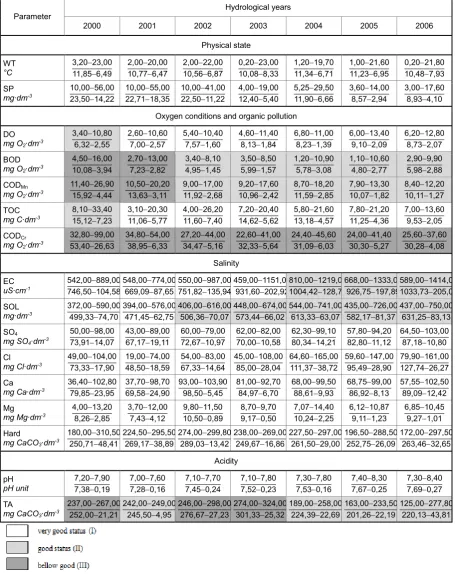
According to the physicochemical parameters determined for the water of the river Ner in the years 2000–2006, the water temperature, content of suspension, concentration of sulphates, chlo-rides, calcium, magnesium, values of hardness and pH, corresponded to the class I water qual-ity (very good). The mean contents of dissolved
oxygen and organic carbon in 2000, and the mean conductivity value in 2004 and 2006 were higher than those of class I water quality. Slight-ly higher than for class I water was the content of dissolved substances, only in 2000 and 2001 they corresponded to class I water quality, while in the other years – to class II water quality. The values of BOD, CODMn and total alkalinity corre-sponded in general to class II water quality. In the years 2000 and 2001 the mean values of BOD5 and CODMn , while in 2000, 2002, 2003 the val-ues of total alkalinity were higher than the valval-ues admissible for class II water quality. In the entire period studied the values of CODCr were too high for class II water quality.
In the period 2000–2006 the annual mean concentration of total suspension decreased, the values of BOD, CODMn and CODCr decreased and the content of dissolved oxygen increased. Analy-sis of the extreme values and standard deviations revealed a reduction in the range of variation in the total suspension content, the values of CODMn and CODCr and total organic carbon content (Table 1). In the years 2000–2006 an increase in the salinity of the river Ner water was noted along with an increase in the water conductivity, the concentrations of sulphates, chlorides, calcium and magnesium. The increase in the water salin-ity can be caused by an increased level of min-eral components related to the denudation pro-cesses in the basin area and agricultural works, mainly the use of fertilizers.
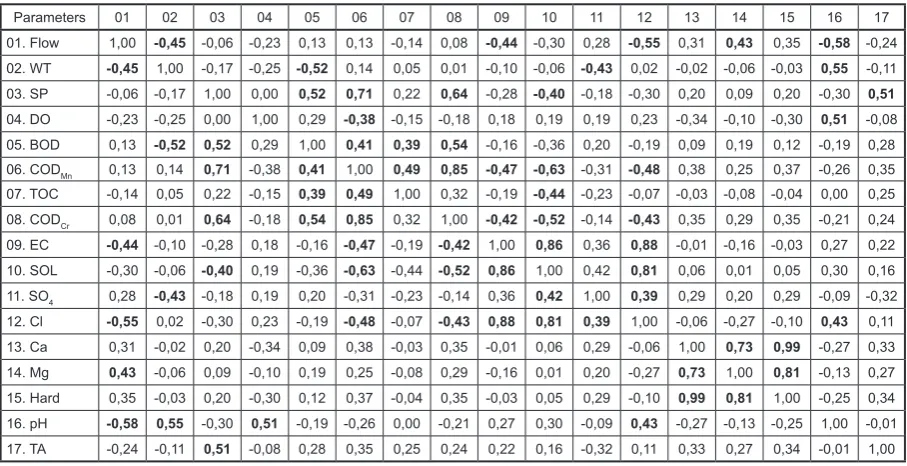
The correlation analysis revealed positive cor-relations between the parameters characterising oxygen conditions and pollution with organic com-pounds that is between BOD, CODMn, CODCr and
total content of organic carbon (Table 2). The cor-relations imply that the relevant pollutants to which these parameters refer come from the same source. Among the parameters characterising water salin-ity, statistically significant positive correlations were observed in two groups: between
conductiv-ity, content of dissolved substances, chlorides and sulphates and hardness and between the contents of calcium and magnesium and hardness. The val-ues of the water parameters were related not only to the inflow of pollutants but also with the hydro-logical and meteorohydro-logical conditions in the river
Table 1. Characteristic annual means of physicochemical parameters in the Ner river in the years 2000–2006 (minimum-maximum/mean-standard deviation)
Parameter Hydrological years
2000 2001 2002 2003 2004 2005 2006
Physical state
WT
°C 3,2011,8523,006,49
2,0020,00 10,776,47
2,0022,00 10,566,87
0,2023,00 10,088,33
1,2019,70 11,346,71
1,0021,60 11,236,95
0,2021,80 10,487,93
SP
mg∙dm-3 10,0023,5056,0014,22 22,7110,0055,0018,35 10,0022,5041,0011,22 12,404,0019,005,40 5,2511,9029,506,66 3,608,5714,002,94 3,008,9317,604,10
Oxygen conditions and organic pollution
DO
mg O2∙dm-3
3,4010,80 6,322,55
2,6010,60 7,002,57
5,4010,40 7,571,60
4,6011,40 8,131,84
6,8011,00 8,231,39
6,0013,40 9,102,09
6,2012,80 8,732,07
BOD
mg O2∙dm-3
4,5016,00 10,083,94
2,7013,00 7,232,82
3,408,10 4,951,45
3,508,50 5,991,57
1,2010,90 5,783,08
1,1010,60 4,802,77
2,909,90 5,982,88
CODMn
mg O2∙dm-3
11,4026,90 15,924,44
10,5020,20 13,633,11
9,0017,00 11,922,68
9,2017,60 10,962,42
8,7018,20 11,592,85
7,9013,30 10,071,82
8,4012,20 10,111,27
TOC
mg C∙dm-3 8,10
33,40 15,127,23
3,1020,30 11,065,77
4,0026,20 11,607,40
7,2020,40 14,625,62
5,8021,60 13,184,57
7,8021,20 11,254,36
7,0013,60 9,532,05
CODCr
mg O2∙dm-3
32,8099,00 53,4026,63
34,8054,00 38,956,33
27,2044,00 34,475,16
22,6041,00 32,335,64
24,4045,60 31,096,03
24,0041,40 30,305,27
25,6037,60 30,284,08
Salinity
EC
uS∙cm-1 542,00
889,00 746,50104,58
548,00774,00 669,0987,65
550,00987,00 751,82135,94
459,001151,00 931,60202,92
810,001219,00 1004,42128,79
668,001333,00 926,75197,89
589,001414,00 1033,73205,09
SOL
mg∙dm-3 372,00
590,00 499,3374,70
394,00576,00 471,4562,75
406,00616,00 506,3670,07
448,00674,00 573,4466,02
544,00741,00 613,3363,07
435,00726,00 582,1781,37
437,00750,00 631,2583,13
SO4 mg SO4∙dm-3
50,0098,00 73,9114,07
43,0089,00 67,1719,11
60,0079,00 72,6710,97
62,0082,00 70,0010,58
62,3099,10 80,3414,21
57,8094,20 82,8011,12
64,50103,00 87,1810,80
Cl
mg Cl∙dm-3 49,00
104,00 73,3317,90
19,0074,00 48,5018,59
54,0083,00 67,3314,64
45,00108,00 85,0028,04
64,60165,00 111,3738,72
59,60147,00 95,4928,90
79,90161,00 127,7426,27
Ca
mg Ca∙dm-3 36,4079,85102,8023,95 69,5837,7098,7024,90 93,0098,50103,905,45 81,0084,9792,706,70 68,0088,6199,509,93 68,7586,9299,008,13 57,5589,09102,5012,42 Mg
mg Mg∙dm-3 4,008,2613,202,85 3,707,4312,004,12 10,509,8011,500,89 8,709,179,700,50 10,247,0714,402,25 6,129,1110,871,23 6,859,2710,451,01 Hard
mg CaCO3∙dm-3
180,00310,50 250,7148,41
224,50295,50 269,1738,89
274,00299,80 289,0313,42
238,00269,00 249,6716,86
227,50297,00 261,5029,00
196,50288,50 252,7526,09
172,00297,50 263,4632,65
Acidity
pH
pH unit 7,20 7,90 7,380,19
7,007,60 7,280,16
7,107,70 7,450,24
7,107,80 7,520,23
7,307,80 7,530,16
7,408,30 7,670,25
7,308,40 7,690,27
TA
mg CaCO3∙dm-3
237,00267,00 252,0021,21
242,00249,00 245,504,95
246,00298,00 276,6727,23
274,00324,00 301,3325,32
189,00258,00 224,3922,69
163,00233,50 201,2622,19
Ner basin area. The concentration of magnesium was positively correlated with the flow of the river water, while the water temperature, conductivity, concentration of chlorides and pH were negatively correlated with it. The positive correlation of the concentration of magnesium and flow suggests their natural origin, while the negative correlation between the concentration of chlorides and flow suggests their anthropogenic origin.
The direction of changes in the physicochem-ical parameters of the river water was established by analysis of trends. The results confirmed the conclusions following from the analysis of an-nual mean values of the parameters. The contents of total suspension, the values of BOD, CODMn and CODCr and total alkalinity show a statistically significant negative trend. The concentration of dissolved oxygen, electrolytic conductivity, con-centrations of dissolved substances, sulphates and chlorides as well as pH value showed an increas-ing trend. The values of other parameters inform-ing about the river water quality revealed no ten-dencies in changes (Table 3).
Figure 3 presents the monthly mean values of dissolved oxygen concentration, BOD, CODMn and CODCr. The increase in the annual mean val-ues of oxygen concentration in the river Ner wa-ter over the years 2000–2006 was 0.4 mgO2.dm-3,
while the decrease in the annual mean values of BOD, CODMn and CODCr over the same period was 0.6, 0.9 and 2.5 mg O2∙dm-3, respectively.
CONCLUSIONS
Investment into water and sewage systems in the communes within the range of the river Ner basin area significantly improved the oxygen con-ditions in the river water and caused reduction in its pollution with organic compounds which in-fluence the self-cleaning processes. The above conclusion followed from the negative trends in the changes in BOD and COD and a positive
Table 2. Correlation analysis of physicochemical parameters and flow in the Ner river in the years 2000–2006 (Pearson’s correlation coefficient)
Parameters 01 02 03 04 05 06 07 08 09 10 11 12 13 14 15 16 17
01. Flow 1,00 -0,45 -0,06 -0,23 0,13 0,13 -0,14 0,08 -0,44 -0,30 0,28 -0,55 0,31 0,43 0,35 -0,58 -0,24 02. WT -0,45 1,00 -0,17 -0,25 -0,52 0,14 0,05 0,01 -0,10 -0,06 -0,43 0,02 -0,02 -0,06 -0,03 0,55 -0,11 03. SP -0,06 -0,17 1,00 0,00 0,52 0,71 0,22 0,64 -0,28 -0,40 -0,18 -0,30 0,20 0,09 0,20 -0,30 0,51 04. DO -0,23 -0,25 0,00 1,00 0,29 -0,38 -0,15 -0,18 0,18 0,19 0,19 0,23 -0,34 -0,10 -0,30 0,51 -0,08 05. BOD 0,13 -0,52 0,52 0,29 1,00 0,41 0,39 0,54 -0,16 -0,36 0,20 -0,19 0,09 0,19 0,12 -0,19 0,28 06. CODMn 0,13 0,14 0,71 -0,38 0,41 1,00 0,49 0,85 -0,47 -0,63 -0,31 -0,48 0,38 0,25 0,37 -0,26 0,35 07. TOC -0,14 0,05 0,22 -0,15 0,39 0,49 1,00 0,32 -0,19 -0,44 -0,23 -0,07 -0,03 -0,08 -0,04 0,00 0,25 08. CODCr 0,08 0,01 0,64 -0,18 0,54 0,85 0,32 1,00 -0,42 -0,52 -0,14 -0,43 0,35 0,29 0,35 -0,21 0,24 09. EC -0,44 -0,10 -0,28 0,18 -0,16 -0,47 -0,19 -0,42 1,00 0,86 0,36 0,88 -0,01 -0,16 -0,03 0,27 0,22 10. SOL -0,30 -0,06 -0,40 0,19 -0,36 -0,63 -0,44 -0,52 0,86 1,00 0,42 0,81 0,06 0,01 0,05 0,30 0,16 11. SO4 0,28 -0,43 -0,18 0,19 0,20 -0,31 -0,23 -0,14 0,36 0,42 1,00 0,39 0,29 0,20 0,29 -0,09 -0,32 12. Cl -0,55 0,02 -0,30 0,23 -0,19 -0,48 -0,07 -0,43 0,88 0,81 0,39 1,00 -0,06 -0,27 -0,10 0,43 0,11 13. Ca 0,31 -0,02 0,20 -0,34 0,09 0,38 -0,03 0,35 -0,01 0,06 0,29 -0,06 1,00 0,73 0,99 -0,27 0,33 14. Mg 0,43 -0,06 0,09 -0,10 0,19 0,25 -0,08 0,29 -0,16 0,01 0,20 -0,27 0,73 1,00 0,81 -0,13 0,27 15. Hard 0,35 -0,03 0,20 -0,30 0,12 0,37 -0,04 0,35 -0,03 0,05 0,29 -0,10 0,99 0,81 1,00 -0,25 0,34 16. pH -0,58 0,55 -0,30 0,51 -0,19 -0,26 0,00 -0,21 0,27 0,30 -0,09 0,43 -0,27 -0,13 -0,25 1,00 -0,01 17. TA -0,24 -0,11 0,51 -0,08 0,28 0,35 0,25 0,24 0,22 0,16 -0,32 0,11 0,33 0,27 0,34 -0,01 1,00
Table 3. Temporal trends of the selected physico
-chemical parameters in the Ner river in the years 2000–2006
Parameter significanceTrend
WT °C 0
SP mg∙dm-3 –
DO mg O2∙dm-3 +
BOD mg O2∙dm-3 –
CODMn mg O2∙dm-3 –
TOC mg C∙dm-3 0
CODCr mg O2∙dm-3 –
EC uS∙cm-1 +
SOL mg∙dm-3 +
SO4 mg SO4∙dm-3 +
Cl mg Cl∙dm-3 +
Ca mg Ca∙dm-3 0
Mg mg Mg∙dm-3 0
Hard mg CaCO3∙dm-3 0
pH pH unit +
trend in the content of dissolved oxygen. The in-crease in the salinity of the river water over the period 2000–2006 expressed by increasing trends of conductivity, dissolved substances, concen-trations of sulphates and chlorides, indicates the need for taking measures aimed at restriction of the inflow of these substances to the river.
Further limitation of the inflow of pollutants from point sources to surface waters requires bet-ter coordination of activities aimed at increased efficiency of water and sewage systems man-agement, including elimination of uncontrolled wastewater releases, expansion and improvement in the municipal and industrial sewage and waste-water treatment plants and improvement in the effectiveness of water treatment. More difficult is a restriction of pollutants originating from agri-culture. As recommended by the Code of Good Agricultural Practice [2002] use of natural and mineral fertilisers should be rationally optimised.
REFERENCES
1. Álvarez-Cabria M., Barquín J., Peñas F. J. 2016. Modelling the spatial and seasonal variability of
water quality for entire river networks: Relation-ships with natural and anthropogenic factors.
Sci-ence of The Total Environment, 545, 152–162.
2. Bogdał A., Kowalik T. 2015. Variability of values of physicochemical water quality indices along the length of the Iwoniczanka stream. Journal of Eco
-logical Engineering, 16(5), 168–175.
3. Directive 2000/60/EC of the European Parliament and of the Council of 23 October 2000 establishing a framework for Community action in the field of
water policy.
4. Directive of the Minister of Environment of 22nd October 2014, on the way of classification of sur
-face water bodies and environmental norms of the
contents of priority substances. [in polish].
5. Chang H. 2008. Spatial analysis of water quality
trends in the Han River basin, South Korea. Water
research, 42(13), 3285–3304.
6. Hillel N., Geyer S., Licha T., Khayat S., Laronne J. B., Siebert, C. 2015. Water quality and discharge
of the Lower Jordan River. Journal of Hydrology, 527, 1096–1105.
7. Code of Good Agricultural Practice. 2002. MRiRW, Warszawa [in polish].
8. Kondracki J. 2002. Polish Regional Geography. PWN, Warszawa [in polish].
9. Kowalczyk A., Kuźniar A., Kostuch M. 2014. Changes of water quality of the transboundary Wisznia river in the years 1990–2012. Woda-Środowisko-Obszary Wiejskie, 14, 75–88 [in polish].
10. Krasowska M., Banaszuk P. 2011. Application of factor analysis in hydrochemical research in a small agricultural catchment. Ecological Engineer
-ing, 147–155 [in polish].
11. Molina-Navarro E., Trolle D., Martínez-Pérez S., Sastre-Merlín A., Jeppesen E. 2014. Hydrological and water quality impact assessment of a Mediter
-ranean limno-reservoir under climate change and land use management scenarios. Journal of Hy
-drology, 509, 354–366.
12. Murat-Błażejewska S., Sojka M. 2011. Assessment of fish fauna structure and hydromorphological and physico-chemical status of the river in the aspect of good ecological status. Science, Nature, Technolo
-gies, 5(05) [in polish].
13. National Mosaic Report on the state of the natural environment in particular voivodships in the years
2000–2007. 2010. Chief Inspectorate of Environ
-mental Protection [in polish].
14. National Water Management Authority. 2010. Ras
-ter Hydrographical Map of Poland 1:50 000.
15. Policht-Latawiec A., Bogdał A., Kanownik W., Kowalik T., Ostrowski K. 2015. Variability of physicochemical properties of water of the trans
-boundary Poprad river. Journal of Ecological Engi
-neering, 16(1), 100–109.
16. Renwick W. H., Vanni M. J., Zhang Q., Patton J.
2008. Water quality trends and changing
agricul-tural practices in a Midwest US watershed, 1994– 2006. Journal of Environmental Quality, 37(5), 1862–1874.
17. Report of the Ministry of Environment for the river Odra basin area of the implementation art. 5 and 6, est. II , III , IV of Directive 2000 / 60 / EC. 2005. [in polish].
18. Ravichandran S. 2003. Hydrological influences on the water quality trends in Tamiraparani Basin, South India. Environmental Monitoring and As
-sessment, 87(3), 293–309.
19. Shrestha S., Kazama F. 2007). Assessment of sur
-face water quality using multivariate statistical techniques: A case study of the Fuji river basin, Japan. Environmental Modelling and Software, 22(4), 464–475.
20. Sojka M., Murat-Błażejewska S. 2009. Physico-chemical and hydromorphological state of a small lowland river. Yearbook of Environmental Protec
-tion, 11, 727–737 [in polish].
21. StatSoft, Inc. 2014. STATISTICA (data analysis software system), version 12, www.statsoft.com
22. Walker D., Jakovljević D., Savić D., Radovanović M. 2015. Multi-criterion water quality analysis of
the Danube River in Serbia: A visualisation
ap-proach. Water research, 79, 158–172.
23. Wiatkowski M., Wiatkowska B. 2006. Protection of the quality of water resources from the point of view of environmental programs. Infrastruc
-ture and ecology of rural areas, 4(3), 179–188 [in polish].
24. Woś A. 1993. Climatic regions of Poland in the
light of the frequency of various weather types.
Polish Academy of Sciences, z. 20 [in polish].
25. Zhou P., Huang J., Pontius R. G., Hong H. 2016. New insight into the correlations between land use and water quality in a coastal watershed of China:
Does point source pollution weaken it?. Science of