Clinical effect of platelet rich fibrin in the
treatment of periodontal intrabony defects.
Systematic review and meta-analysis.
Heber Arbildo,1,2,3 Luis Gamarra,4,5 Sandra Rojas,5
Edward Infantes,2,4,6 César Lamas7 & Hernán Vásquez.8
Affiliations:1Escuela de Odontología,
Univer-sidad Particular de Chiclayo. Chiclayo, Perú.
2Escuela de Estomatología, Universidad Señor
de Sipán. Chiclayo, Perú. 3Centro de Salud
Odontológico San Mateo. Trujillo, Perú. 4
Es-cuela de Estomatología, Universidad Privada Antonio Guillermo Urrelu. Cajamarca, Perú.
5Facultad de Estomatología, Universidad
Na-cional de Trujillo. Trujillo, Perú. 6Escuela de
Estomatología, Universidad César Vallejo.
Piu-ra, Perú.7Escuela de Odontología, Universidad
Católica los Ángeles de Chimbote. Chimbote,
Perú. 8Facultad de Odontología, Universidad
San Martín de Porres. Lima, Perú.
Corresponding author: Heber Arbildo. Av. Húsares de Junín 611. Trujillo, Perú. Phone: (044) 616644. E-mail: [email protected], [email protected]
Abstract: Background: There is currently no gold standard biomaterial for the treatment of periodontal intrabony defects (PIDs). One of the current options is the use of platelet-rich fibrin (PRF). Objective: To determine the clinical effect of PRF in the treatment of PID through a systematic review and meta-analysis. Materials and Methods: A literature search was conducted up to February 2017 in the following biomedical databases: Pubmed, Embase, Scielo, Science Direct, SIGLE, LILACS and in the Cochrane Central Register of Clinical Trials. The selection criteria included: randomized clinical trials published in the last 5 years, reporting clinical effects (probing depth, clinical insertion level or gingival reces-sion), with a follow-up time equal to or greater than 6 months, and sample size larger than or equal to 10 patients reporting the use of PRF as a treatment for PID. The methodological quality of the studies was analyzed using the Cochrane Handbook of Systematic Reviews of Interventions as a reference. Results: The search strategy yielded 20 articles. A reduction in probing depth and an increase in clinical insertion level or a reduction in gingival recession is reported, when using PRF alone or in combination with another biomaterial or substance that stimulates tissue regeneration. Conclusion: The literature suggests that the use of PRF in the treatment of PIDs has a beneficial clinical effect when compared to control treatments.
Keywords: Platelet-rich fibrin; periodontitis; review; meta-analysis.
INTRODUCTION.
Periodontal disease is characterized by clinical attachment loss with
subsequent destruction of periodontal tissues.1-3 If left untreated, the
condition will lead to a premature loss of teeth.2,4 Periodontal treatment
aims to eliminate the inflammatory process, prevent the progression of periodontal disease, maintain natural dentition in optimal health
and function, and regenerate lost periodontal tissues.3,5,6 Therapeutic
modalities for restoring the diseased periodontium have shown limited potential for good results because they fail to completely regenerate
periodontal tissues.4,5
One of the consequences of periodontal disease is the appearance of periodontal intrabony defects (PIDs). Several biomaterials, such as autogenous and allogeneic bone grafts, have been used to treat PIDs. However, there is no single graft material to date considered as the gold
standard for the treatment of DIP.3,5,7 The key to regeneration is to stimulate
a sequence of curative events that result in the formation of an integrated Conflict of interests: The authors declare no
con-flict of interest in relation to published results.
Ethics approval: This study was self-financed.
Funding: Self-financing.
Authors’ contributions: Both authors contribu-ted equality to the complete study.
Acknowledgements: None.
Cite as: Arbildo H, Gamarra L, Rojas S, Infan-tes E, Lamas C & Vásquez H. Clinical effect of platelet rich fibrin in the treatment of periodon-tal intrabony defects. Systematic review and me-ta-analysis. J Oral Res 2017; 6(5):127-135. doi:10.17126/joralres.2017.036
Receipt: 03/20/2017 Revised: 04/19/2017
tissue. Such modulators include the use of growth factors (GFs), the application of extracellular matrix proteins and binding factors, and the use of bone morphogenetic
proteins.2,8,9 There is evidence demonstrating the
effectiveness of GFs in periodontal regeneration.2,4,10,11
GFs play a key role in the multiplication and development of vascular endothelial cells, smooth muscle cells and fibroblasts. GFs have multiple effects on cellular remodeling phenomena and modulate the inflammatory reaction in the
healing and tissue regeneration processes.2,3,5,9,12-15
Platelet-rich fibrin (PRF) as described by Choukroun et
al.,16 is a second-generation platelet concentrate containing
platelets and GFs in the form of fibrin membranes prepared from the patient's own blood, free of any anticoagulant
or other artificial biochemical modifications.3,6 PRF
improves regeneration and wound healing and is superior to other platelet concentrates because of its ease of use and inexpensive preparation method, as no exogenous compounds such as bovine thrombin or calcium chloride are needed. PRF has emerged as one of the most promising
regenerative materials in the field of periodontics.3
Although some studies have evaluated the effect of PRF in the treatment of PID, the diverse nature among them makes it difficult to obtain clear interpretations. The aim of this article was to evaluate the clinical effect of PRF in the treatment of periodontal intrabony defects
MATERIALS AND METHODS.
This review was carried out according to a previously designed research protocol following the guidelines
established in the PRISMA standards.17
Search methodology
A broad search strategy was conducted in the biome-dical databases Pubmed, Embase, Scielo, Science Direct, SIGLE (System of Information on Grey Literature in Europe), LILACS, IBECS, and in the Cochrane Central Register of Clinical Trials. A manual search was also con-ducted in higher impact journals of periodontology such as: Periodontology 2000, Journal of Clinical Periodontolo-gy and Journal of Periodontology from the 2nd of January,
2012 until the 28th of February, 2017; using a
combina-tion of topic or thematic headings with the following keywords: ("fibrina rica en plaquetas” OR "platelet-rich fibrin” OR "PRF" OR "plasma rich in growth factors")
AND ("defecto intraóseo" OR "defecto periodontal” OR "infrabony defect" OR "periodontal defect").
Selection criteria
The following inclusion criteria were considered: arti-cles reporting the use of PRF in the treatment of PID; reporting clinical effects (reduction in probing depth, in-crease in clinical insertion level and reduction in gingival recession) when using in the treatment of PID; articles published in the last 5 years, reporting a follow-up time equal to or greater than 6 months, with sample sizes equal to or greater than 10 patients.Articles reporting the use of PRF in the control group, and articles published in non-indexed journals were excluded from the study.
Process of selection and extraction of data
Titles and abstracts of all the articles complying with the aforementioned inclusion and exclusion criteria were reviewed. Full texts of the articles that seemed to meet the selection criteria were obtained in order to assess the bias risk. A checklist was made in duplicate to evaluate the studies and to extract the information of interest. Two reviewers (LG and EI) independently performed the evaluation of the articles regarding title, author, year of publication, type of study, number of patients, ages of patients, follow-up time, country where it was conducted, number of areas treated per group, number of patients per group, type of PID treated, reduction in probing depth, increase in clinical insertion level, reduction in gingival recession, number of centrifugations, primers used, post-surgical medication and risk of bias. For the resolution of any discrepancy between the reviewers, they met and discussed with a third reviewer (SR) in order to reach an agreement.
Assessment of the methodological quality and risk of bias of the studies
For the assessment of the methodological quality and risk of bias, each study was analyzed according to the Cochrane Handbook of Systematic Reviews
of Interventions.18 Each study was evaluated in seven
unclear risk.
Analysis of results
Data from each study were placed and analyzed with RevMan 5.3 (Cochrane Group, UK). For performing the meta-analysis, results of the studies were combined independent of the follow-up period length.
RESULTS.
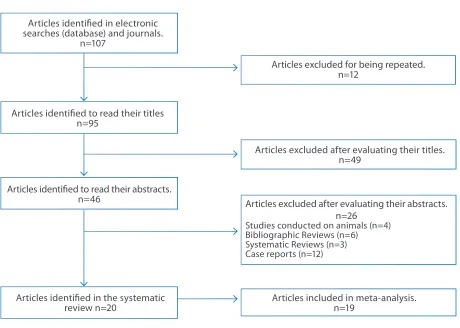
The initial search in the biomedical databases yielded107 titles; Figure 1 shows the article selection flowchart. Table 1 also shows the characteristics and variables considered in the 20 selected articles. Figure 2 presents the analysis of the methodological quality and the risk of bias of the studies.
Figure 3 shows the forest plot for the reduction in probing
Figure 1. Article selection flowchart.
Articles identified in electronic searches (database) and journals.
n=107
Articles excluded for being repeated. n=12
Articles excluded after evaluating their titles. n=49
Articles excluded after evaluating their abstracts. n=26
Studies conducted on animals (n=4) Bibliographic Reviews (n=6) Systematic Reviews (n=3) Case reports (n=12)
Articles included in meta-analysis. n=19
Articles identified to read their titles n=95
Articles identified to read their abstracts. n=46
Articles identified in the systematic review n=20
Figure 2. Risk of bias of the articles.
Agar
wal
20
16
Gupt
a 2
01
4
Random sequence generation (selection blas).
Allocation concealment (selection blas). Blinding of participants and personnel (performance blas).
Blinding of outcome assessment (detection blas). Incomplete outcome data (atrtrition blas).
Selective reporting (reporting blas).
Other blas.
Aj
wa
ni
20
15
Ka
no
riy
a 2
01
6
Ban
sal
20
13
M
ar
tan
de
20
16
Ch
ad
wic
h 2
01
6
M
at
hu
r 2
01
6
Ro
sa
mm
a 2
01
2
Ch
an
dr
ad
as
20
16
Pa
nd
a 20
16
Sez
gi
n 2
01
7
Ch
at
te
rje
e 2
01
6
Pr
ad
ee
p 2
01
2
Sh
an
20
15
Ga
lav
20
16
Pr
ad
ee
p 2
01
2a
Tu
rk
al 2
01
6
Gamal
20
16
Pr
ad
ee
p 2
01
5
+
+
?
+
+
+
+
+
+
+
+
?
+
+
+
+
+
?
+
+
+
+
-+
-+
-+
+
-?
+
+
+
+
-+
+
+
+
?
+
+
+
+
+
+
+
+
+
+
+
+
+
+
+
+
+
+
+
?
-+
+
+
+
+
+
+
-+
+
+
+
+
-+
+
+
+
-+
+
-+
+
-+
+
+
?
+
-+
+
+
+
+
+
+
+
+
+
+
+
+
+
+
+
+
+
+
+
+
+
+
?
+
?
+
?
+
+
+
+
+
+
+
+
+
?
+
Author Year Type o f N° P atients Mean Follo w-up Countr y Gr oups of N° of N° of RPD (mm) ICIL (mm) RGR (mm) Type of N° of Post-sur gic al stud y (males/ Ag e time stud y pa tients trea ted intrabon y centrifuga tion medic ation females) (range) per gr oup ar eas def ec t cy
cles (rpm x m)
Se zgin 2017 RC T 15 (8/7) (38-61) 6 mon ths Turk ey Con trol (IBBM) 15 15 4.21±1.21 3.27±1.34 -0.94±0.7 2 and
2700rpm x 12m
Do xy cy cline 200mg et al . 19 Test (IBBM+PRF) 15 15 4.93±1.22 4.47±16 -0.46±0.83 3 w alls
and P
arac etamol 100mg Gala y 2016 RC T 20 (30-55) 9 mon ths India Con trol ( ABG) NR NR
4.8 ± 1.37
4.5 ± 1.41
NR
3 w
alls
3000rpm x 10m
Amo
xicillin 500mg and
et al . 20 Test (PRF) NR NR
4.1 ± 1.53
3.9 ± 1.29
NR Ibupr ofen 800mg Chadwic 2016 RC T 36(20/16) 54.9±12.1 6 mon ths Unit ed Con trol (DFDBA 19 19 2.0±1.37 1.16±1.33 -0.84±0.88
2 and 3
3000rpm x 10m
Amo xicillin 500mg et al . 21 (18–89) Sta tes +S terile saline walls , ser um) bined 1,2,3 Test (PRF) 17 17 2.12±1.41 1.03±0.86 -1.06±1.18 walls cir fer en tial Chandr adas 2016 RC T 36(18/18) 44.4 9 mon ths India Con trol ( COFD ) 12 12 3.0±1.21 2.25±0.62 -1.33±0.78
2 and 3
3000 rpmx 12m
Amo xicillin 500mg , et al . 22 (35–50) Test 1 12 12 4.25±1.48
3.92 ± 0.9
-0.17±0.39
walls
,
Ibupr
ofen 400mg and
(PRF+DBMG) combined Par ac etamol 500mg
Test 2 (PRF)
12 12 3.82±0.75 3.27±0.65 -0.18±0.4 Kanoriy a 2016 RC T 90 (43/47) 40.29 9 mon ths India Con trol ( COFD ) 30 30 2.86±0.68
3.03 ± 0.18
-0.06±0.07
3 w
alls
300 rpm x 12m
Amo xicillin 500mg , et al . 23 (30–50)
Test 1 (
COFD + PRF
30 30 4.53±0.81 5.16±0.46 0.35±0.11 Metr onidaz
ole 500 mg
+ 1% A
lendr ona to) and D iclof enac sodium
Test 2 (
COFD+PRF)
30
30
3.7±0.91
4.2 ± 0.66
0.24±0.56 500mg Cha tterjee 2016 RC T 28 (≥ 18) 9 mon ths India Con trol ( COFD ) 32 32 3.68±0.72 4.14±0.76 NR 3 w alls
3000 rpm x 10m
Amo xicillin 500mg et al . 24
Test 1 (
COFD+PRF) 32 32 5.46±1.04 6.57±1.45 NR and D iclof enac sodium 50mg Ay demir 2016 RC T 28 (≥ 18) 6 mon ths Turk ey Con trol (EMD ) 28 28 3.88±1.26
3.29 ± 1.3
0.58 ± 0.78
1,2
,3
w
all
s;
3000rpm x 10m
NSAIDs
Turk
al
Test 1 (PRF+EMD
)
28
28
4.0 ±1.38
3.42±1.28
-0.71 ± 0.86
combined et al . 25 1,2,3 w alls Mar tande 2016 RC T 96 (48/48) 37.6 9 mon ths India Con trol ( COFD ) 30 30 2.76±1.43
2.5 ± 1.33
-0.06± 0.02 3 w alls 3000rpm x Amo xicillin 500mg , et al . 26
Test 1 (
OFD+PRF
30
30
4.06±1.22
3.66 ± 1.42
0.29± 0.18
12–14 m
Metr
onidaz
ole 500 mg
+ 1.2% A
tor
vasta
tin)
and Ibupr
ofen 800mg
Test 2 (
COFD+PRF) 30 30 3.76±1.12 3.4±1.13 0.22±0.1 Agar wal 2016 RC T 30 (17/13)
52 ± 7
1 y ear India Con trol (DFDBA 30 15 3.6±0.51 2.61±0.68 -1.0±0.61
2 and 3
400g x 12m
Amo xicillin 500mg , et al . 27 + S aline ser um) walls , and Ibupr ofen 800mg Test 30 15 4.15±0.84 3.73±0.74 -0.47±0.56 combined
(PRF + DFDBA
)
2, 3 w
alls
Gamal
2016
RC
T
30 (21 / 9)
39.6 ± 3.9
9 mon ths Egypt Con trol ( Xenogr aft) 10 10
3.8 ± 0.42
1.8 ± 0.5
NR NR NR Amo xicillin 500mg , or et al . 28
(28 – 51)
Test
10
10
3.6 ± 0.45
1.2 ± 0.36
NR
Clindam
ycin 300 mg
NR: Not r epor ted , R C T: R andomiz ed contr olled tr ial; C OFD: C on
ventional open-flap debr
idement; PRF : P lat elet -r ich fibr in; TPRF : T itanium-pr epar ed plat elet -r ich fibr
in; GTR: Guided tissue r
egeneration; ABBM: I
nor
ganic
bo
vine bone mineral; DFDBA: D
emineraliz
ed F
reez
e Dr
ied Bone Allog
raf
t; ABG: A
ut
ogenous bone g
raf
t; EMD: Enamel matr
ix der
ivativ
e; HA: H
ydr
ox
yapatit
e; DBMG: D
emineraliz
ed bone matr
ix g
raf
t; RPD: R
educ
tion in
pr
obing depth; ICIL: I
ncr
ease in clinical inser
tion le
vel; R
GR: R
educ
tion in g
ing ival r ecession; M m: M illimet ers; R pm: R ev
olutions per minut
e; M: minut
es; Mg: M
illig
rams; G: R
elativ e centr ifugal f or ce Panda 2016 RC T 18 38.12±2.06 9 mon ths India Con trol (R TG) 16 18 3.19±1.33 3.38±1.45
0.19 ± 0.4
NR
3000rpm x 10m
Amo xicillin 500mg et al . 29
(10 / 8)
(30 – 50)
Test (R
TG+PRF)
16
18
3.88±1.15
4.44 ± 1.5
0.56 ± 0.73
Ajw ani 2015 RC T 20 30.5 9 mon ths India Con trol ( OFD ) 20 20 1.6±0.84
1.3 ± 0.68
-0.3 ± 0.68
2 and
3000rpm x 10m
No
vamo
x LB 500mg
et al . 30 (10/10) Test ( COFD+PRF) 20 20 1.9±0.74
1.8 ± 0.63
-0.3 ± 0.48
3 w alls and D iclof enac 50mg Shah 2015 RC T 20 (20-55) 6 mon ths India Con trol 20 20
3.7 ± 0.68
2.97 ± 1.68
-0.32 ± 1.59
2 and
3000rpm x 10m
An tibiotics et al . 31 (COFD+DFDBA ) 3 w alls Test ( COFD+PRF) 20 20
3.67 ± 0.69
2.97 ± 1.56
-0.42 ± 1.38
Pradeep 2015 RC T 120 41±6 9 mon ths India Con trol ( COFD ) 30 30
3.0 ± 0.18
2.96 ± 0.18
-0.06 ± 0.04
NR
3000rpm x 10m
Amo xicillin 500mg et al . 32 (60/60) (30-50) Test 1 30 30
4.0 ± 0.18
4.03 ± 0.18
0.27 ± 0.07
Me tro nid azo le 5 00 mg (COFD+PRF) and Ibupr ofen 800mg
Test 2 (
COFD +
30
30
3.93 ± 0.25
3.93 ± 0.25
0.27 ± 0.05
1% Metf
ormin)
Test 3 (
COFD +
30
30
4.9 ± 0.3
4.9 ± 0.3
0.33 ± 0.07
PRF + 1%
Metf ormin) Ma thur 2015 EC A 25 39.66±5.72 6 mon ths India Con trol 19 NR 2.4±1.06 2.67±1.63 -0.27±0.8 3 w alls
3000rpm x 10m
Amo
xicillin 500mg and
et al
.
33
(14/11)
(30 – 65)
(COFD+ABG) Par ac etamol 500mg Test 19 NR 2.67±1.29 2.53±1.06 -0.07±0.46 (COFD+PRF) Gupta 2014 RC T 30
(30 – 65)
6 mon ths India Con trol (EMD ) 22 15
1.8 ± 0.56
2.0±0.53
NR
3 w
alls
3000rpm x 12m
Amo
xicillin 500mg and
et al . 34 (15/15) Test (PRF) 22 15
1.8 ± 0.77
1.87±0.92 NR Par ac etamol 500mg Bansal 2015 RC T 10 NR 6 mon ths India Con trol ( COFD 10 10 3.1±0.74 2.3±0.69 0.4±0.59 NR
3000rpm x 10m
Amo
xicillin 500mg and
et al . 35 + DFDBA ) Ibupr ofen 400mg Test ( COFD+ 10 10 4.0±0.82 3.4±0.61 0.2±0.42 DFDBA+PRF) Rosamma 2012 RC T 15 29.47±7.65 1 y ear India Con trol ( COFD ) 15 15 2.4±0.63 1.4±1.06 -1.13±0.74 NR
3000rpm x 10m
Amo
xicillin 500mg and
et al
.
36
(6/9)
(17 – 44)
Test ( COFD+PRF) 15 15 4.67±0.9 4.73±0.88 0.07±0.62 Par ac etamol 500mg Pradeep 2012 RC T 54 36.8 9 mon ths India Con trol ( COFD ) 17 18
2.97 ± 0.93
2.83 ± 0.91
-0.27 ± 0.58
3 w
alls
3000rpm x 10m
Amo
xicillin 500mg and
et al . 37 (27/27) Test 2( COFD+PRF) 16 18
3.77 ± 1.19
3.17 ± 1.29
0.2 ± 0.71
Ibupr ofen 800mg Pradeep 2012 RC T 63 39.7 9 mon ths India Con trol ( COFD ) 30 18
2.97 ± 0.93
2.67 ± 1.09
-0.17 ± 0.53
1, 2 and
3000rpm x 10m
Amo
xicillin 500mg and
et al . 38 (34/29) Test 1( COFD+PRF) 30 19
3.9 ± 1.09
3.03 ± 1.16
0.47 ± 0.73
3 w alls Ibupr ofen 800mg Test 2( COFD+HA ) 30 20
4.27 ± 0.98
3.67 ± 1.03
PRF Control Mean difference Study or Subgroup Mean SD Total Mean SD Total Weight IV Random, 95% CI Year
Only PRP
Pradeep 2012 3.77 1.19 16 2.97 0.93 17 3.8% 0.80 (0.07, 1.53) 2012 Agarwal 2016 4.67 0.9 15 2.4 0.63 15 4.3% 2.27 (1.71, 2.83) 2012 Pradeep 2012a 3.9 1.09 30 2.97 0.93 30 4.4% 0.93 (0.42, 1.44) 2012 Gupta 2014 1.8 0.77 22 1.8 0.56 22 4.6% 0.00 (-0.40, 0.40) 2014 Mathur 2015 2.67 1.29 19 2.4 1.06 19 3.8% 0.27 (-0.48, 1.02) 2015 Ajwani 2015 1.9 0.74 20 1.6 0.84 20 4.4% 0.30 (-0.19, 0.79) 2015 Shah 2015 3.67 0.69 20 3.7 0.68 20 4.5% -0.03 (-0.45, 0.39) 2015 Pradeep 2015 4 0.18 30 3 0.28 30 5.0% 1.00 (0.88, 1.12) 2015 Panda 2016 3.88 1.15 16 3.19 1.33 16 3.5% 0.69 (-0.17, 1.55) 2016 Kanoriya 2016 3.7 0.91 30 2.86 0.68 30 4.6% 0.84 (0.43, 1.25) 2016 Chatterjee 2016 5.46 1.04 32 3.68 0.72 32 4.5% 1.78 (1.34, 2.22) 2016 Martande 2016 3.76 1.12 30 2.76 1.43 30 4.0% 1.00 (0.35, 1.65) 2016 Chadwick 2016 2.12 1.41 17 2 1.37 19 3.4% 0.12 (-0.79, 1.03) 2016 Chandradas 2016 3.82 0.75 12 3 1.21 12 3.6% 0.82 (0.01, 1.63) 2016
Subtotal (95% CI) 309 312 58.4% 0.79(0.46, 1.11)
Heterogeneity: Tau2=0.29; Chi2=91.41, d
f =13 (p=0.00001); I2=86% Test for overall effect: Z=4.77 (p<0.00001)
PRP combined with another biomaterial
Pradeep 2012a 4.97 0.98 30 2.97 0.93 30 4.4% 1.30 (0.82, 1.78) 2012 Bansal 2013 4 0.82 10 3.1 0.74 10 3.9% 0.90 (0.22, 1.58) 2013 Pradeep 2015 4.9 0.3 30 3 0.28 30 5.0% 1.90 (1.75, 2.05) 2015 Agarwal 2016 4.15 0.84 30 3.6 0.51 30 4.7% 0.55 (0.20, 0.90) 2016 Kanoriya 2016 4.53 0.81 30 2.86 0.68 30 4.6% 1.67 (1.29, 2.05) 2016 Gamal 2016 3.6 0.45 10 3.8 0.42 10 4.6% -0.20 (-0.58, 0.18) 2016 Chandradas 2016 4.25 1.48 12 3 1.21 12 3.0% 1.25 (0.17, 2.33) 2016 Martande 2016 4.06 1.22 30 2.76 1.43 30 4.0% 1.30 (0.63, 1.97) 2016 Turkal 2016 4 1.38 28 3.88 1.26 28 3.9% 0.12 (-0.57, 0.81) 2016 Sezgin 2017 4.93 1.22 15 4.21 1.21 15 3.5% 0.72 (-0.15, 1.59) 2017
Subtotal (95% CI) 225 225 41.6% 0.96 (0.40, 1.52)
Heterogeneity: Tau2=0.72; Chi2=154.21, d
f =9 (p=0.00001); I2=94% Test for overall effect: Z=3.34 (p=0.0008)
Total (95% CI) 534 537 100.0% 0.86 (0.56, 1.15)
Heterogeneity: Tau2=0.45; Chi2=295.33, d
f =23 (p<0.00001); I2=92% Test for overall effect: Z=5.71 (p=0.007)
Test for subgroup differences: Chi2=0.27, d
f =1 (p<0.61); I2=0%
Figure 3. Forest plot of the event "Reduction of probing depth when using PRF in the treatment of periodontal intrabony defects".
Mean difference IV Random, 95% CI
Favours (Control)
-2 0 2
-4 -4
Favours (PRP)
depth when using PRF in the treatment of periodontal intrabony defects. Figure 4 shows the forest plot for the increase in clinical insertion level when using PRF in the treatment of periodontal intrabony defects. Figure 5 presents the forest plot for the reduction in gingival recession when using PRF in the treatment of periodontal intrabony defects.
DISCUSSION.
Results revealed that the use of PRF in the treatment of PID produced an increase in the clinical insertion level, a reduction in probing depth, and a reduction in gingival recession significantly greater than the control treatment. Subgroup analysis showed that all these clinical effects
were similarly beneficial if PRF was used alone, or if PRF was used in combination with another biomaterial or substance that stimulates tissue regeneration. In this study, a random effects model for the meta-analysis was used. In addition, it was found that there was no difference
if the RCT had a parallel21–23,26–28,32,34,37,38 or cross-over
design.19,24,25,29–31,33,35,36
The studies showed positive clinical effects for the use of PRF in the treatment of PID. This is similar to the findings
reported by Smail et al.,39 who performed a study that did
PRF Control Mean difference Study or Subgroup Mean SD Total Mean SD Total Weight IV Random, 95% CI Year
Only PRP
Pradeep 2012 3.17 1.29 16 2.83 0.91 17 3.8% 0.34(-0.43, 1.11) 2012 Rosamma 2012 4.73 0.88 15 1.4 1.06 15 4.0% 3.33 (2.63, 4.03) 2012 Pradeep 2012a 3.03 1.16 30 2.67 1.09 30 4.2% 0.36 (-0.21, 0.93) 2012 Gupta 2014 1.87 0.92 22 2 0.53 22 4.5% -0.13 (-0.57, 0.31) 2014 Ajwani 2015 1.8 0.63 20 1.3 0.68 20 4.5% 0.50 (0.09, 0.91) 2015 Pradeep 2015 4.03 0.18 30 2.96 0.18 30 4.9% 1.07 (0.98, 1.16) 2015 Mathur2015 2.53 1.06 19 2.67 1.63 19 3.6% -0.14(-1.01, 0.73) 2015 Shah 2015 2.97 1.56 20 2.97 1.68 20 3.3% 0.00 (-1.00, 1.00) 2015 Chandradas 2016 3.27 0.65 12 2.25 0.62 12 4.4% 1.02 (0.51, 1.53) 2016 Chadwick 2016 1.03 0.86 17 1.16 1.33 19 3.9% -0.13 (-0.85, 0.59) 2016 Chatterjee 2016 6.57 1.45 32 4.14 0.76 32 4.2% 2.43 (1.86, 3.00) 2016 Kanoriya 2016 4.2 0.66 30 3.03 0.18 30 4.8% 1.17 (0.93, 1.41) 2016 Martande 2016 3.4 1.13 30 2.5 1.33 30 4.1% 0.90 (0.28, 1.52) 2016 Panda 2016 4.44 1.5 1.6 3.38 1.45 16 3.2% 1.06 (0.04, 2.08) 2016
Subtotal (95% CI) 3.09 312 57.3% 0.87(0.51, 123)
Heterogeneity: Tau2=0.37; Chi2=129.34, d
f =13 (p=0.00001); I2=90% Test for overall effect: Z=4.72 (p<0.00001)
PRP combined with another biomaterial
Pradeep 2012a 3.67 1.03 30 2.67 1.09 30 4.3% 1.00 (0.46, 1.54) 2012 Bansal 2013 3.4 0.61 10 2.3 0.69 10 4.2% 1.10 (0.53, 1.67) 2013 Pradeep 2015 4.9 0.3 30 2.96 0.18 30 4.9% 1.94 (1.81, 2.07) 2015 Agarwal 2016 3.73 0.74 30 2.61 0.68 30 4.6% 1.12 (0.76, 1.48) 2016 Chandradas 2016 3.92 0.9 12 2.25 0.62 12 4.1% 1.67 (1.05, 2.29) 2016 Gamal 2016 1.2 0.36 10 1.8 0.5 10 4.6% -0.60 (1.05, 2.29) 2016 Turkal 2016 3.42 1.28 28 3.29 1.3 28 4.0% 0.13 (-0.55, 0.81) 2016 Martande 2016 3.66 1.42 30 2.5 1.33 30 4.0% 1.16 (0.46, 1.86) 2016 Kanoriya 2016 5.16 0.46 30 3.03 1.18 30 4.8% 2.13 (1.95, 2.31) 2016 Sezgin 2017 4.47 1.6 15 3.27 1.34 15 3.2% 1.20 (0.14, 2.26) 2017
Subtotal (95% CI) 225 225 42.7% 1.10 (0.56, 1.63)
Heterogeneity: Tau2=0.67; Chi2=220.89, d
f =9 (p=0.00001); I2=96% Test for overall effect: Z=4.01 (p<0.0001)
Total (95% CI) 534 537 100.0% 0.96 (0.65, 1.28)
Heterogeneity: Tau2=0.52; Chi2=475.30, d
f =23 (p<0.00001); I2=95% Test for overall effect: Z=6.02 (p<0.00001)
Test for subgroup differences: Chi2=0.49, d
f =1 (p=0.48); I2=0%
Figure 4. Forest plot of the event "Increase in clinical insertion level when using PRF in the treatment of periodontal intrabony defects".
Mean difference IV Random, 95% CI
Favours (Control)
-2 0 2
-4 -4
Favours (PRP)
data. This review also demonstrates that PRF does not have a clear standard protocol because the type of centrifuge and configuration also differ from one study to another. Therefore more standardized protocols are needed to allow for a better comparison and homogenize the results.
One strength of this systematic review was the selection of the studies, because an exhaustive search was performed in the most important databases and strict inclusion criteria were followed. However, there are also limitations such as the presence of many RCTs that presented a high and unclear risk of bias. Another positive aspect is the comparison of these results with other systematic reviews
on this subject.40,41 These reviews confirm that using PRF
produces a positive and beneficial clinical effect in the treatment of PIDs. It is important to consider that these reviews included RCTs published in years prior to those included in this study.
because Latin American countries have the greatest genetic diversification, culture, food and a wide range of climates.
CONCLUSION.
The clinical effect of PRF in the treatment of PID is
1. Pihlstrom BL, Michalowicz BS, Johnson NW. Periodontal disea-ses. Lancet. 2005;366(9499):1809–20.
2. Hou X, Yuan J, Aisaiti A, Liu Y, Zhao J. The effect of platelet-rich plasma on clinical outcomes of the surgical treatment of periodontal intrabony defects: A systematic review and meta-analysis. BMC Oral Health. 2016;16(1):71.
3. Preeja C, Arun S. Platelet-rich fibrin: Its role in periodontal regene-ration. Saudi J Dent Res. 2014;4:117–22.
4. Sander L, Karring T. Healing of periodontal lesions in monkeys following the guided tissue regeneration procedure. A histological study. J Clin Periodontol. 1995;22(4):332–7.
5. Shah M, Deshpande N, Bharwani A, Nadig P, Doshi V, Dave D. Effectiveness of autologous platelet-rich fibrin in the treatment of in-tra-bony defects: A systematic review and meta-analysis. J Indian Soc Periodontol. 2014;18(6):698–704.
6. Panda S, Ramamoorthi S, Jayakumar ND, Sankari M, Varghese SS. Platelet rich fibrin and alloplast in the treatment of intrabony defect. J Pharm Bioallied Sci. 2014;6(2):127–31.
7. Chen FM, Zhang J, Zhang M, An Y, Chen F, Wu ZF. A review on endogenous regenerative technology in periodontal regenerative medici-ne. Biomaterials. 2010;31(31):7892–927.
8. Cochran DL, Wozney JM. Biological mediators for periodontal
re-REFERENCES.
PRF Control Mean difference Study or Subgroup Mean SD Total Mean SD Total Weight IV Random, 95% CI Year
Only PRP
Pradeep 2012a 0.47 0.73 30 -0.17 0.53 30 2.5% 0.64(0.32, 0.96) 2012 Rosamma 2012 0.07 0.26 15 -1.13 0.74 15 1.7% 3.33 (0.80, 1.60) 2012 Pradeep 2012 0.2 0.71 16 -0.27 0.58 17 1.4% 0.47(0.03, 0.91) 2012 Ajwani 2015 -0.3 0.48 20 -0.3 0.68 20 2.0% 0.00 (-0.36, 0.91) 2015 Pradeep 2015 0.27 0.07 30 -0.06 0.04 30 13.1% 0.33 (0.30, 0.36) 2015 Mathur2015 -0.07 0.46 19 -0.27 0.8 19 1.6% 0.20 (-0.21, 061) 2015 Shah 2015 -0.42 1.38 20 -0.32 1.59 20 0.4% -0.10 (-1.02, 0.82) 2015 Chandradas 2016 -0.18 0.4 12 -1.33 0.78 12 1.2% 1.15 (0.62, 1.65) 2016 Chadwick 2016 -1.06 1.18 17 -0.84 0.88 19 0.6% -0.22 (-0.91, 0.47) 2016 Kanoriya 2016 0.24 0.06 30 -0.06 0.07 30 12.9% 0.30 (0.27, 0.33) 2016 Martande 2016 0.22 0.1 30 -0.06 0.02 30 12.8% 0.28 (0.24, 0.32) 2016 Panda 2016 0.52 0.73 16 0.19 0.4 16 1.7% 0.37 (-0.04, 078) 2016
Subtotal (95% CI) 2.55 258 51.9% 0.34(0.27, 0.41)
Heterogeneity: Tau2=0.00; Chi2=45.82, d
f =11 (p=0.00001); I2=76% Test for overall effect: Z=9.55 (p<0.00001)
PRP combined with another biomaterial
Pradeep 2012a 0.67 0.55 30 -0.17 0.53 30 3.2% 0.84 (0.57, 1.11) 2012 Bansal 2013 0.2 0.42 10 0.4 0.59 10 1.4% -0.20 (-0.65, 0.25) 2013 Pradeep 2015 0.33 0.07 30 -0.06 0.04 30 13.1% 0.39 (0.36, 0.42) 2015 Chandradas 2016 -0.17 0.39 12 -1.33 0.78 12 1.2% 1.16 (0.67, 1.65) 2016 Kanoriya 2016 0.35 0.11 30 -0.06 0.07 30 12.4% 0.41 (0.36, 0.45) 2016 Martande 2016 0.29 0.18 30 -0.06 0.02 30 11.5% 0.35 (0.29, 0.41) 2016 Turkal 2016 -0.71 0.86 28 -0.58 0.78 28 1.5% -0.13 (-0.56, 0.30) 2016 Agarwal 2016 -0.47 0.56 30 -1 0.61 30 2.8% 0.53 (0.23, 0.83) 2016 Sezgin 2017 -0.46 0.83 15 -0.94 0.7 15 1.0% 0.48 (-0.07, 1.03) 2017
Subtotal (95% CI) 215 215 48.1% 0.41 (0.33, 0.50)
Heterogeneity: Tau2=0.01; Chi2=35.10, d
f =8 (p=0.00001); I2=77% Test for overall effect: Z=9.64 (p<0.0001)
Total (95% CI) 470 473 100.0% 0.38 (0.32, 0.44)
Heterogeneity: Tau2=0.01; Chi2=111.17, d
f =20 (p<0.00001); I2=82% Test for overall effect: Z=13.27 (p<0.00001)
Test for subgroup differences: Chi2=1.49, d
f =1 (p=0.22); I2=32.9%
Figure 5. Forest plot of the event "Reduction in gingival recession when using PRF in the treatment of periodontal intrabony defects".
Mean difference IV Random, 95% CI
Favours (Control)
-2 0 2
-4 -4
Favours (PRP)
generation. Periodontol 2000. 1999;19:40–58.
9. Mihaylova Z, Mitev V, Stanimirov P, Isaeva A, Gateva N, Ishki-tiev N. Use of platelet concentrates in oral and maxillofacial surgery: an overview. Acta Odontol Scand. 2017;75(1):1–11.
10. Darby IB, Morris KH. A systematic review of the use of
growth factors in human periodontal regeneration. J Periodontol. 2013;84(4):465–76.
11. Maeda H, Wada N, Tomokiyo A, Monnouchi S, Akamine A.
Pros-pective potency of TGF-β1 on maintenance and regeneration of perio -dontal tissue. Int Rev Cell Mol Biol. 2013;304:283–367.
12. Babbush CA, Kevy SV, Jacobson MS. An in vitro and in vivo eva-luation of autologous platelet concentrate in oral reconstruction. Implant Dent. 2013;12(1):24–34.
13. Graves DT, Cochran DL. Periodontal regeneration with polypepti-de growth factors. Curr Opin Periodontol. 1994:178–86.
14. Prakash S, Thakur A. Platelet concentrates: past, present and futu-re. J Maxillofac Oral Surg. 2011;10(1):45–9.
15. Giannini S, Cielo A, Bonanome L, Rastelli C, Derla C, Corpaci F, Falisi G. Comparison between PRP, PRGF and PRF: lights and shadows in three similar but different protocols. Eur Rev Med Pharmacol Sci. 2015;19(6):927–30.
16. Choukroun J, Adda F, Schoeffler C, Vervelle A. Une opportunité en paro-implantologie: Le PRF. Implantodontie. 2001;42:55–62.
1 7. Urrútia G, Bonfill X. [PRISMA declaration: a proposal to impro-ve the publication of systematic reviews and meta-analyses]. Med Clin. 2010;135(11):507–11.
18. Higgins JPT, Green S. Cochrane Handbook for Systematic Re-views of Interventions. UK: The Cochrane Collaboration; 2011.
19. Sezgin Y, Uraz A, Taner IL, Çulhaoğlu R. Effects of platelet-rich fi -brin on healing of intra-bony defects treated with anorganic bovine bone mineral. Braz Oral Res. 2017;31:e15.
20. Galav S, Chandrashekar KY, Mishra R, Tripathi V, Agarwal R, Galav A. Comparative evaluation of platelet-rich fibrin and autogenous bone graft for the treatment of infrabony defects in chronic periodon-titis: Clinical, radiological, and surgical reentry. Indian J Dent Res. 2016;27(5):502–7.
21. Chadwick JK, Mills MP, Mealey BL. Clinical and Radiographic Evaluation of Demineralized Freeze-Dried Bone Allograft Versus Pla-telet-Rich Fibrin for the Treatment of Periodontal Intrabony Defects in Humans. J Periodontol. 2016;87(11):1253–60.
22. Chandradas ND, Ravindra S, Rangaraju VM, Jain S, Dasappa S. Efficacy of platelet rich fibrin in the treatment of human intrabony de-fects with or without bone graft: A randomized controlled trial. J Int Soc Prev Community Dent. 2016;6(Suppl 2):S153–9.
23. Kanoriya D, Pradeep AR, Singhal S, Garg V, Guruprasad CN. Sy-nergistic Approach Using Platelet-Rich Fibrin and 1% Alendronate for Intrabony Defect Treatment in Chronic Periodontitis: A Randomized Clinical Trial. J Periodontol. 2016;87(12):1427–35.
24. Chatterjee A, Pradeep AR, Garg V, Yajamanya S, Ali MM, Priya VS. Treatment of periodontal intrabony defects using autologous plate-let-rich fibrin and titanium plateplate-let-rich fibrin: a randomized, clinical, comparative study. J Investig Clin Dent. 2016:[Epub ahead of print].
25. Aydemir Turkal H, Demirer S, Dolgun A, Keceli HG. Evaluation of the adjunctive effect of platelet-rich fibrin to enamel matrix deriva-tive in the treatment of intrabony defects. Six-month results of a ran-domized, split-mouth, controlled clinical study. J Clin Periodontol. 2016;43(11):955–64.
26. Martande SS, Kumari M, Pradeep AR, Singh SP, Suke DK, Guru-prasad CN. Platelet-Rich Fibrin Combined With 1.2% Atorvastatin for Treatment of Intrabony Defects in Chronic Periodontitis: A Randomized Controlled Clinical Trial. J Periodontol. 2016;87(9):1039–46.
27. Agarwal A, Gupta ND, Jain A. Platelet rich fibrin combined with decalcified freeze-dried bone allograft for the treatment of human intra-bony periodontal defects: a randomized split mouth clinical trail. Acta Odontol Scand. 2016;74(1):36–43.
28. Gamal AY, Abdel Ghaffar KA, Alghezwy OA. Crevicular Fluid Growth Factors Release Profile Following the Use of Platelet-Rich Fibrin and Plasma Rich Growth Factors in Treating Periodontal Intrabony De-fects: A Randomized Clinical Trial. J Periodontol. 2016;87(6):654–62.
29. Panda S, Sankari M, Satpathy A, Jayakumar D, Mozzati M, Mor-tellaro C, Gallesio G, Taschieri S, Del Fabbro M. Adjunctive Effect of Autologus Platelet-Rich Fibrin to Barrier Membrane in the Treatment of Periodontal Intrabony Defects. J Craniofac Surg. 2016;27(3):691–6.
30. Ajwani H, Shetty S, Gopalakrishnan D, Kathariya R, Kulloli A, Dolas RS, Pradeep AR. Comparative evaluation of platelet-rich fibrin biomaterial and open flap debridement in the treatment of two and three wall intrabony defects. J Int Oral Health. 2015;7(4):32–7.
31. Shah M, Patel J, Dave D, Shah S. Comparative evaluation of pla-telet-rich fibrin with demineralized freeze-dried bone allograft in pe-riodontal infrabony defects: A randomized controlled clinical study. J Indian Soc Periodontol. 2015;19(1):56–60.
32. Pradeep AR, Nagpal K, Karvekar S, Patnaik K, Naik SB, Guru-prasad CN. Platelet-rich fibrin with 1% metformin for the treatment of intrabony defects in chronic periodontitis: a randomized controlled cli-nical trial. J Periodontol. 2015;86(6):729–37.
33. Mathur A, Bains VK, Gupta V, Jhingran R, Singh GP. Evaluation of intrabony defects treated with platelet-rich fibrin or autogenous bone graft: A comparative analysis. Eur J Dent. 2015;9(1):100–8.
34. Gupta SJ, Jhingran R, Gupta V, Bains VK, Madan R, Rizvi I. Effi-cacy of platelet-rich fibrin vs. enamel matrix derivative in the treatment of periodontal intrabony defects: a clinical and cone beam computed to-mography study. J Int Acad Periodontol. 2014;16(3):86–96.
35. Bansal C, Bharti V. Evaluation of efficacy of autologous plate-let-rich fibrin with demineralized-freeze dried bone allograft in the treatment of periodontal intrabony defects. J Indian Soc Periodontol. 2013;17(3):361–6.
36. Rosamma Joseph V, Raghunath A, Sharma N. Clinical effective-ness of autologous platelet rich fibrin in the management of infrabony periodontal defects. 2012;33(1):5–12.
37. Pradeep AR, Rao NS, Agarwal E, Bajaj P, Kumari M, Naik SB. Comparative evaluation of autologous platelet-rich fibrin and plate-let-rich plasma in the treatment of 3-wall intrabony defects in chro-nic periodontitis: a randomized controlled clichro-nical trial. J Periodontol. 2012;83(12):1499–507.
38. Pradeep AR, Rao NS, Agarwal E, Bajaj P, Kumari M, Naik SB. Comparative evaluation of autologous platelet-rich fibrin and plate-let-rich plasma in the treatment of 3-wall intrabony defects in chro-nic periodontitis: a randomized controlled clichro-nical trial. J Periodontol. 2012;83(12):1499–507.
39. Smaïl-Faugeron V, Fron-Chabouis H, Courson F, Durieux P. Com-parison of intervention effects in split-mouth and parallel-arm rando-mized controlled trials: a meta-epidemiological study. BMC Med Res Methodol. 2014;14:64.
40. Shah M, Deshpande N, Bharwani A, Nadig P, Doshi V, Dave D. Effectiveness of autologous platelet-rich fibrin in the treatment of in-tra-bony defects: A systematic review and meta-analysis. J Indian Soc Periodontol. 2014;18(6):698–704.