GAMUT 4/1 (2011) SPECIAL FEATURE—A MUSIC-THEORETICAL MATRIX: ESSAYS IN HONOR OF ALLEN FORTE (PART III)
E
DWARDR. P
HILLIPSNymphs of the woods, Goddesses of the fountains, Expert singers of all nations, Change your voices,
So clear and high,
To cutting cries and lamentations Since Atropos, the very terrible satrap, Has caught in her trap your Ockeghem, True treasure of music . . .
Dress in your clothes of mourning, Josquin, Piersson, Brumel, Compère, And cry great tears of sorrow for having lost Your dear father. . . .
n the late fifteenth century, Josquin set this text—“Nymphes des bois,” La déploration sur la
mort de Johannes Ockeghem—as a commemoration of the older composer, “le bon père” of
Josquin and his contemporaries Brumel, Compère, and Pierre de la Rue. This piece has been
suggested as musico-documentary evidence of a teaching relationship between Ockeghem and
the younger composers, a relationship that is not—given certain peculiarities of Ockeghem’s
style—easily verifiable in the music.
∑
Composers younger than Gabriel Fauré (1845–1924) have cited his influence on their
own work; some of these, like Charles Koechlin (1867–1950), were Fauré’s pupils;1
others, like
1 A letter to Henri Sauguet, in which Koechlin cites Fauré’s influence, is quoted in Otfrid Nies, “‘Ganz du selbst
Arthur Honegger (1892–1955), who wrote quite explicitly about Fauré’s influence in his Je suis
compositeur, were not.2
Francis Poulenc (1899–1963) once remarked that the harmonic
progres-sions of Fauré’s La bonne chanson made him physically ill; yet, one might suspect that this
extreme view masked an indebtedness to the elder composer.3
One writer from the first third of
the twentieth century claimed that Fauré’s influence was to be heard in the music of not only his
best-known pupil, Maurice Ravel (1875–1937), but in that of “l’école fauréenne,” consisting of
Florent Schmitt (1870–1958), Louis Aubert (1877–1968), and Jean Roger-Ducasse (1873–
1954).4
However, it is precisely because Fauré was the sort of teacher who did not impose his
compositional style on his students that he created no such school. Fauré, like his pupil Nadia
Boulanger (1887–1979), taught composition to individuals—individuals who he knew would
develop their art differently from each other and from their teacher. This is to not to say that
Fauré had no influence on younger musicians (and it is not to say that Boulanger’s pedagogical
flexibility had no clear limits) but rather to indicate just how difficult it is to read that influence
using the favorite stance of musical historiography: the analysis of style. (Indeed, a frustrating
paradox presents itself to the analyst of style: the more easily a composer’s style can be heard to
be influenced by his or her elder, the less interesting that composer’s output may be. For
example, Jean Roger-Ducasse has been described as a slavish imitator of Fauré—an epigone; and
his music has attracted only scant attention.) Instead of relying on a comparison of surface styles,
2 See Arthur Honegger, Je suis compositeur (Paris: Éditions du Conquistador, 1951), trans. Wilson O. Clough, in collaboration with Allan Arthur Willman, as I Am a Composer (London: Faber, 1966).
3 Wilfrid Mellers has suggested Fauré’s influence on Poulenc, but he gives neither documentary evidence nor
musical examples to support the idea (see Mellers, Francis Poulenc [Oxford: Oxford University Press, 1993]). 4 Robert Bernard, “Maurice Ravel” and “L’école fauréenne: Florent Schmitt, Louis Aubert, Roger Ducasse,” in
this paper will present musical evidence to suggest how an alternate approach might illuminate
the subject of influence.
In 1921, Aaron Copland began studies with Nadia Boulanger. In his autobiography,
Copland notes that “Gabriel Fauré was Boulanger’s favorite composer, and I soon shared her
admiration for him.”5
In 1923, Copland prepared an “Hommage à Fauré,” a diptych for string
quartet: the first movement was an arrangement of Fauré’s ninth prelude for piano, and the
second movement a Rondino. Copland describes this piece as follows: “The Rondino was based
on the letters of Fauré’s name. Mixed with his influence can be heard a hint of American jazz
and a bit of mild polytonality.”6
In 1924, Copland published an article titled “Gabriel Fauré, a
Neglected Master.”7
Given all the attention he paid to Fauré’s music in the early 1920s (as well
as Boulanger’s own admiration of it), it is reasonable to wonder if it had any lasting effects on
Copland’s composition.8
In the following discussion, I will leave to one side the consideration of certain aspects of
influence, most particularly whether it is conscious or unconscious on the part of teacher or
pupil, whether any influence is intentional. Instead, I will pursue the question of whether or not
some aspect of the music itself can reveal something about the relationships between composers.
Accordingly, rather than choose a piece about which Copland has already acknowledged an
influence, I have selected for examination other pieces of the same period: the song “Night,”
composed in 1918 before the composer’s move to Paris, and “Alone,” composed in Paris in
5 Aaron Copland and Vivian Perlis, Copland: 1900 through 1942 (New York: St. Martin’s, 1984), 87.
6 Copland and Perlis, Copland, 87f. When the movements were published as Two Pieces for String Quartet, Copland replaced the arrangement of the Fauré prelude with Lento molto.
7 Aaron Copland, “Gabriel Fauré, a Neglected Master,” Musical Quarterly 10/4 (1924): 573–586.
8 The possibility of Fauré’s influence on Lennox Berkeley, through the latter’s study with Boulanger, has
1922. Both were published, together with two other early songs, in 1989, and then in a revised
and corrected edition of 1995.9
Stylistically, little of “Night” seems to compare with Fauré’s work. Its surface ninth
chords recall Debussy, and the headmotive of the accompaniment becomes, later in the song
under a text describing water, a very impressionistic arabesque. The surface of “Alone” is
different—the style is much more contained—and yet there still seems little to recall Fauré. One
might note that the melody is primarily stepwise or that the opening gesture resembles the
fig-uration typical of piano accompaniments in the elder composer’s works. But such gestures are
typical of Lieder and art songs and could serve as points of comparison with the works of many
other composers.
An examination of the structure of the two songs, however, is more fruitful. In earlier
analyses I have used set theory (often employed as an analytical tool in discussions of the
reper-toires of the Second Viennese School and Stravinsky) to explain surface motions that Fauré
constructed over completely tonal, middleground prolongations.10
The analysis of Copland’s
songs by this same method can produce intriguing results, as long as care is taken in applying the
method—specifically, in segmenting the music. For a piece drawn from the atonal repertoire,
segmentation follows musically intuitive procedures. For example, a “primary segment” of a
9 Aaron Copland, Four Early Songs (London: Boosey & Hawkes, 1989 and 1995). Discussion of some of the errors in the first edition is found in Peter Dickinson, “Copland: Early, Late and More Biography,” Musical Times
131/1773 (1990): 582–585. The holograph manuscript for “Night” is held by the Harry Ransom Humanities Research Center, University of Texas at Austin; see “Notes for Notes,” Notes 43/2 (1986), 299. The dating of these pieces is taken from Vivian Perlis’s introduction to the editions. The date of “Alone” is also confirmed by information about the holograph sources generously supplied to me by Daniel Mathers: “There are several holographs of the piece in the Library of Congress: a draft for voice, piano, and viola dated 2 December 1921; recomposed versions for voice and piano in pencil dated 25 February 1922 and in ink dated 1922; and an orchestrated version of the last dated 1923. In addition, a sketch of the song exists in a notebook of juvenilia between pieces dated July 1921.”
piece is, according to Allen Forte, “a configuration that is isolated as a unit by conventional
means.”11
Imbrication, or the successive extraction of the subsets of a vertical or a melody, is
often employed. Further, a “composite segment” is one “formed by segments or subsegments
that are contiguous or that are linked in some way.”12
Central to these definitions is the notion of
contiguousness; notwithstanding the possibility of interlocking set structures of great complexity,
any segmentation of an atonal piece that completely ignores the proximity of pitches would be
deemed illogical or even fanciful.
However, when set theory is used to understand better the vocabulary of a piece that is
essentially tonal, segmentation must also be governed by the inevitably hierarchical structure of
tonality. Consider Figure 1, which describes (in terms of sets) the progression of V43, with a
sus-pension of the leading tone, as it resolves to I. The dominant seventh chord is equivalent to set
class 4-27 (0258); the false vertical created by the suspension is 4-23 (0257); the entire measure
constitutes 5-29 (01368). Just as we understand the dominant with the resolved suspension to
have greater structural weight than the suspension verticality, we understand 4-27 (0258) to be in
a similar superordinate relation to 4-23 (0257). The former set bears the designation “r”; the
11 Allen Forte, The Structure of Atonal Music (New Haven, CT: Yale University Press, 1973), 83. 12 Forte, The Structure of Atonal Music, 84.
latter set bears an asterisk to indicate its subordinate rank in the structure.13 The set 5-29 (01368)
is, in this simple configuration, of no structural significance; it has only a tenuous hold on the
analytical ear because of the proximity of pitches. Its status is indicated by a double asterisk.
In pieces not so revealing of their underlying tonal structure as this simple example, sets
of the double asterisk demand more attention of the listener and analyst because the usual
hierar-chical gestures are disguised. They assume a greater role in presenting the sonic vocabulary of
the piece. Such is the case in certain pieces by Fauré, notably those of his last compositional
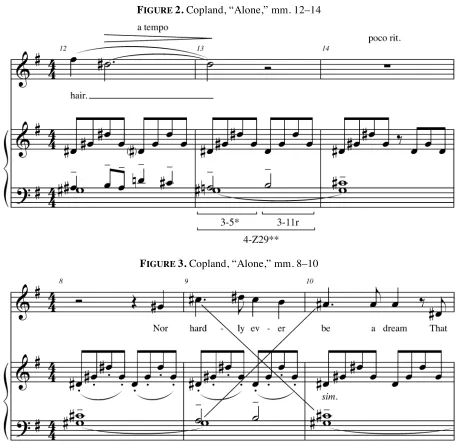
period, and such is the case also in Copland’s “Alone.” In the excerpt shown in Figure 2, m. 13
shows a structure that appears to be an upwardly resolving appoggiatura figure (An3 to B3, left
hand of the accompaniment) with the set of resolution being a triad, 3-11 (037). The set
contain-ing the appoggiatura is 3-5 (016); in this particular situation, it merits an asterisk while the set
comprising the entire measure, 4-Z29 (0137), receives a double asterisk.
Classification of sets by reference to tonal gesture is not, however, without its problems.
The excerpt of Figure 3 shows mm. 9–10, in which the appoggiatura gesture just discussed is not
so simply understood. The motion from A3 to B3, in the left hand of the piano part, here
contin-ues to Cs4 and is thus heard as the lower part of a voice exchange, the upper part being in the
vocal part (with a cross relation). That Cs is the main note in these measures seems further
underscored by the upper-neighbor motion in the vocal line: Cs5–Ds5–Cs5. Yet, at the same
time, Ds also seems to have a claim to the status of principal pitch, by virtue of its presence in
the ostinato of the right hand of the piano part (in these measures as well as in those that precede
and follow them). Does the set on the downbeat of m. 9 then receive an r, one asterisk, or two
asterisks?
Figure 4 shows the concluding measures of the song, where a similar situation obtains. In
the voice at m. 27, E5 moves to Fs5 as would an appoggiatura. But the tonality of the piece, as
indicated by the key signature and the final notes of the bass, makes E the note of greater weight.
Complicating the situation is the clouding of E minor in the sustained notes of the
accompani-ment, which become the final vertical. The last harmony of the piece is 4-16 (0157). As a set it
might merit a double asterisk for including both E and Fs, notes at odds with one another in the
FIGURE 2. Copland, “Alone,” mm. 12–14
vocal gesture in m. 27. Or it might merit an r by virtue of its position as the final—albeit
non-triadic—sonority.
Indeed, an exhaustive partitioning of this piece reveals that recurring sets often fulfill
various roles, as determined by tonal gesture and vestigial tonal structure. The table of Figure 5
lists sets that appear in “Alone.” Following Allen Forte’s work on set genera,14
it places these
sets in a reduced genera table in which each set—which may belong to only one genus or to
several genera—is assigned to a single genus according to the various characteristics of both the
set and its use in this particular piece. Some of the set vocabulary of Copland’s song falls into
genera 11 and 12—those described as the “tonal” genera—and genus 10, characterised as
“atonal-tonal.” The majority of sets, however, fall into genus 1, an “atonal” genus; others fall
into two genera linked with genus 1: genera 2 (“whole-tone”) and 3 (“diminished”).
14 Allen Forte, “Pitch-Class Set Genera and the Origin of Modern Harmonic Species,” Journal of Music Theory 32/2 (1988): 187–270.
FIGURE 5. Copland, “Alone”: reduced genera table, all sets NB: the symbol “*/**” denotes sets that appear in two ways:
as a set ornamenting a harmonically important set (like the 4-23 of Figure 1), and
as a set that occurs simply as contiguous pitches, without structural weight (like the 5-29 of Figure 1)
G1 G2 G3 G7 G9 G10 G11 G12
3- 2**
5r*
6*
9r*
4- 6
8 13
14r*
Z15*/** 16r*
17*
18*/**
19* 20* 22 23r* 26 28**
Z29*/**
5- 7**
Z12* 14** 16** Z18** 20**
21**
23**
24** 25**
27*/**
28* 29r** Z38
Invoking the hierarchy of tonal gesture (cautiously, given the ambiguities already
dis-cussed) provides a different profile of the piece’s vocabulary. As shown in Figure 6, when sets
are limited to those that appear at least once as r sets, we find that genera 10, 11, and 12 (the
“tonal” and “atonal-tonal” ones) become much more important. However, a significant number
of sets—including that of the cadence, 4-16 (0157)—still fall into “atonal” genus 1. The set
FIGURE 6. Copland, “Alone”: reduced genera table, r sets
G1 G10 G11 G12 3-5r*
3-9r*
3-11r*
4-6r 4-8r 4-13r
4-14r* 4-16r*
4-22r 4-23r* 4-26r 5-29r** 5-31r 5-Z38r
FIGURE 7. Copland, “Night”: reduced genera table, excerpts
G1 G2 G3 G12
3-8 3-10 3-11 4-16 4-21 4-24
4-25
profile of Copland’s “Night,” drawn from excerpts, is also different; see Figure 7. Emphasis here
is on genus 2 (“whole-tone”); the only set of “tonal” genus 12 is the triad.
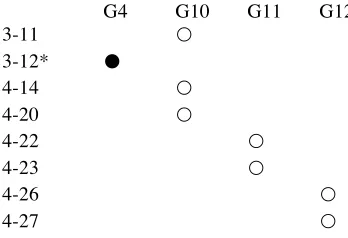
Consider now two set tables of works by Fauré. The first, shown in Figure 8, is of mm.
25–34 of “Cygne sur l’eau,” from the cycle Mirages (1919). These measures employ linear
chords to elaborate a secure, if obscured, tonal middleground structure: an extended
neighbor-note formation. In subsequent measures, the same sets provide the surface prolongation of a V7
chord. A tonal analysis of these passages is not without difficulty, but it is the surface that
pro-duces the non-tonal character of the music. This “non-tonality” is the result of the relation of
surface sonorities to one another and their refusal to confirm the tonal middleground structure.
Yet Fauré accomplishes this with sets that find their home in genera 10, 11, and 12—the “tonal”
and hybrid “atonal-tonal” genera. The second table, in Figure 9, relates to Fauré’s “Diane,
Séléné,” the third song of the cycle L’Horizon chimérique (1921); it is, at deep middleground
and background levels, solidly tonal. The non-tonal stasis of the surface is effected in various
ways but again uses the familiar set vocabulary anchored in genera 10, 11, and 12.
The musical evidence thus far might suggest that Copland’s tonal vocabulary—still his
own but closer to that of Fauré in “Alone” than in “Night”—changed during this time; and it is
tempting to assert that it did so because of Copland’s acquaintance with Fauré’s music in Paris.
This conclusion would be too easy. For while these four works by Fauré and Copland could not
seem more different on their stylistic surface, all four are tonal, and their set materials—their
vocabulary of sonorities—are, despite different distributions across the genera, all drawn from
the diatonic collection. That is, the important sets are all subsets of 7-35 (013568T), the set class
of the major heptachord. The difference is in how these materials are used and which are
“Alone.” And “Night,” for all its impressionistic flights, ends on a triad. The structural
differ-ences in terms of set vocabulary are slight; the principal differdiffer-ences appear still to be stylistic.
But consider now a tonal analysis of the two Copland songs, as shown in Figure 10. The
middleground/background structure of “Night” is relatively straightforward: a fifth descent with
the head note ornamented by the lowered sixth degree of the scale (BF, given enharmonically as
An). If the surface recalls Debussy, then the arpeggiated support for the extended neighbor, and
the enharmonic transportation to and fro, recall—if anyone—Brahms. The tonal structure of
Figure 8. Fauré, “Cygne sur l’eau,” mm. 25–34: reduced genera table, all sets† G4 G10 G11 G12
3-11
3-12*
4-14 4-20 4-22 4-23 4-26 4-27
FIGURE 9. Fauré, “Diane, Séléné”: reduced genera table, all sets†
G1 G2 G3 G4 G10 G11 G12 3-5r
3-7r 3-9r 3-10* 3-11r 3-12* 4-13r 4-14r 4-20r 4-21* 4-22r 4-23r* 4-26r 4-27r 4-Z29*
† The symbol indicates a set that appears at least once as an r set; the symbol
“Alone” is not so simple; Figure 11 provides a reduced middleground/background sketch of the
piece. The non-tonic beginning unfolds the dominant triad in the upper voice, first as motive B4–
Dn5, and subsequently as B4–Ds5; it then moves to an apparent sIII harmony in m. 8. This raised
mediant harmony is the result of the refusal of the leading tone (Ds) to be resolved to E. Over the
long span of the music, the dominant returns (in an admittedly obscure fashion) in mm. 18–23
and then resolves to the tonic (obscured itself, as already observed) at the close of the piece.
Between dominant and tonic there appears a key area based on a false IV, produced by the
coin-cidence of the dominant’s passing seventh (A) and another passing tone (C) connecting the
lowered leading tone with the fifth of the tonic triad (B).
A background that is essentially tonal but which, through the application of
prolonga-tional counterpoint, produces a middleground or foreground structure at odds with either the
prevailing tonality or the rules of harmonic progression itself (here, a progression that seems to
FIGURE 10. Copland, “Night”
be V–IV–I) is, as I have demonstrated elsewhere, a very fauréen trick, indeed.15 Equally fauréen
is the warping of counterpoint that produces the false sIII at the opening. Remember, too, the
detail of mm. 9–10 of Copland’s “Alone,” described in Figure 3. This situation, in which two
pitches are presented as principal and ornamental notes by voice and piano in contradictory
fashion, is exactly paralleled in m. 13 of Fauré’s “En sourdine,” in which the voice asserts C as
principal note with upper neighbor D, while the piano presents D as the principal note supported
by the harmony.16
Now it is perhaps more justified to revisit the question: did contact with Fauré’s music
produce the difference in structure between Copland’s two songs? That is, did Copland learn
from Fauré how much more could still be wrung from conventional tonal structures if the
fore-ground was elaborated with familiar tonal sets, relating to each other in unfamiliar ways (as in
the elder composer’s “En sourdine” and “Cygne sur l’eau”)? Did he learn, further, what
possi-bilities existed if conventional tonal structures of the deep middleground were themselves
stretched and bent? In short, did contact with Fauré’s music allow Copland, somewhat
paradoxi-cally, to begin to find his own tonal vocabulary and tonal syntax?
The admittedly small sampling of Copland’s music offered here does not permit a
defi-nite conclusion that contact with Fauré’s music had an effect on the structure of the younger
composer’s compositions. But these comparisons do affirm the validity of further investigation
into the possibility of influence. They affirm, too, the validity of probing music history from the
point of view of musical structure. Music history has been written, for the most part, as a history
of musical style; and this stance, as noted at the beginning of this essay, has its limitations. It is
15 See Phillips, “Smoke, Mirrors and Prisms.”
perhaps time for a new approach to be taken to musical historiography. The history of Western
art music needs to be written as a history of that music’s evolving structure—in particular, its
contrapuntal structure. Such a history—one that examines more of the workings of our art than
W
ORKSC
ITED[Anon.] “Notes for Notes.” Notes 43/2 (1986): 297–300.
Bernard, Robert. “Maurice Ravel” and “L’école fauréenne: Florent Schmitt, Louis Aubert, Roger Ducasse.” In Robert, Les tendances de la musique française moderne, 75–88, 89–102. Paris: Durand, 1930.
Copland, Aaron. Four Early Songs. London: Boosey & Hawkes, 1989 and 1995.
Copland, Aaron. “Gabriel Fauré, a Neglected Master.” Musical Quarterly 10/4 (1924): 573–586.
Copland, Aaron and Vivian Perlis. Copland: 1900 through 1942. New York: St. Martin’s, 1984.
Dickinson, Peter. “Copland: Early, Late and More Biography.” Musical Times 131/1773 (1990): 582–585.
Forte, Allen. “Pitch-Class Set Genera and the Origin of Modern Harmonic Species.” Journal of Music Theory 32/2 (1988): 187–270.
Forte, Allen. The Structure of Atonal Music. New Haven, CT: Yale University Press, 1973.
Hansen, Robert H. “The Songs of Lennox Berkeley: A Lecture Recital.” D.M.A. document, North Texas State University [now University of North Texas], 1987.
Honegger, Arthur. Je suis compositeur. Paris: Éditions du Conquistador, 1951. Translated by Wilson O. Clough, in collaboration with Allan Arthur Willman, as I Am a Composer
(London: Faber, 1966).
Mellers, Wilfrid. Francis Poulenc. Oxford: Oxford University Press, 1993.
Nies, Otfrid. “‘Ganz du selbst sein’: Der Komponist Charles Koechlin (1867–1950).” Neuland 5 (1984–85): 256–270.
Phillips, Edward R. “Smoke, Mirrors and Prisms: Tonal Contradiction in Fauré.” Music Analysis
12/1 (1993): 3–24.
∑
A
BSTRACTthat the compositional techniques of the older composer had an influence on those of Copland is valid and worthy of further research.
This article is part of a special, serialized feature: A Music-Theoretical Matrix: Essays in Honor of Allen Forte (Part III).
∑
H
OW TO CITE THIS ARTICLE(An example based on a humanities-style note citation)
Edward R. Phillips, “Fauré, through Boulanger, to Copland: The Nature of Influence,” in A Music-Theoretical Matrix: Essays in Honor of Allen Forte (Part III), ed. David Carson Berry,
Gamut 4/1 (2011): 299–315.
∑
A
BOUT THEA
UTHOREdward Phillips is a graduate of Amherst College and of Yale University, where he completed his Ph.D. in music theory under Allen Forte. He also studied in Paris and Fontainebleau with Nadia Boulanger. Prof. Phillips has published a number of articles on the analysis of Fauré’s music, as well as Gabriel Fauré: A Guide to Research (Taylor and Francis), the second edition of which was published in 2011.