Development of Multi-Layer Fabric on a Flat Knitting
Machine
P. Kanakaraj1, R. Ramachandran R1, B.S. Dasaradan2
1
PSG College of Technology, Coimbatore, Tamil Nadu, INDIA
2
Angel College of Engineering and Technology, Tirupur, INDIA
Correspondence to:
P. Kanakaraj email: [email protected]
ABSTRACT
The loop transfer technique was used to develop the a splitable multi layer knit fabric on a computerized multi gauge flat knitting machine. The fabric consists of three layers: inner-single jersey, middle-1X1 purl and, outer-single jersey. By varying the loop length the multi layer knit fabric samples were produced, namely CCC-1, CCC-2 and CCC-3. The above multi layer fabrics were knitted using 24s Ne cotton of combined yarn feed in feeders 3, 4, and 4 respectively. The influence of loop length on wpc, cpc and tightness factor was studied using linear regression. The water vapor and air permeability properties of the produced multi layer knit fabrics were studied using ANOVA. The change of raw material in three individual layers could be useful for the production of fabric for functional, technical, and industrial applications.
Keywords: Multi layer fabric, loop length, loop
transfer, permeability property, flat knitting machine
INTRODUCTION
New developments in flat knitting machinery are capable of manufacturing engineered fabric in two dimensional, three dimensional of bi-layer, and multilayer knit fabrics. The feature includes individual needle selection, the presences of holding down sinkers, racking, transfer, and adapted feeding devices combined with CAD. The layered fabrics are more suitable for functional and technical applications than single layer fabrics. These fabrics may be non-splitable (branching knit structure, plated fabric, spacer fabric) and splitable (bilayer, multilayer). The functional knitted structure of two different fabric layers based on different textile components (hydrophobic and hydrophilic textile material) is used to produce leisure wear, sportswear and protective clothing to improve the comfort. The separation layer is polypropylene in contact with skin, and the absorption layer will be the outside layer when cotton is used for the knit fabric [8].
In this direction the flat knitting machine was elected to produce splittable multi layer knit fabric with varying loop length and loop transfer techniques. The influence of loop length on wpc, cpc and tightness factor was studied for the three individual layers in the fabric. The important breathability properties of the fabric such as water vapor permeability and air permeability were studied. The production technique used for this fabric has wide applications such as in functional wear, technical textiles, and wearable textiles.
MATERIALS AND METHODS
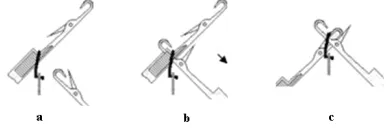
The production of multi-layer knit fabrics such as CCC-1, CCC-2 and CCC-3 cotton yarn with the linear density of 24s Ne was fed in the knit feeder. For layered fabric development, a computerized multi gauge flat knitting machine and combined yarn feed was selected like 3, 4 and 4 respectively, shown in the Table I. Q. M. Wang and H. Hu [9] was the selected yarn feed in the range of 4 – 10 for the production of glass fiber yarn composite reinforcement on a flat knitting machine. The intermediate between integral and fully fashioned garment was produced using the “half gauging or needle parking” technique. The use of only alternate needles on each bed of the flat knitting machine was used for stitch formation, The remaining needles did not participate in stitch formation in the same course, but the loops formed were kept in the needle head until employed for stitch formation again, thus freeing needles to be used as temporary parking places for loop transfer [6].For production of layered fabric and fully fashioned garment, the loop transfer stitch is essential part of the panel. The running-on bars were used for transferring of loops either by hand or automatically from one needle to another needle depending on the machine. The principle of the loop transfer is shown in the Figure 1.
FIGURE. 1. Principle of loop transfer.
(a)The delivering needle is raised by a cam in the carriage. The loop is stretched over the transfer spring. (b)The receiving needle is raised slightly from its needle bed. The receiving needle enters the transfer spring of delivering needle and penetrates the loop that will be transferred. (c)The delivering needle retreats leaving the loop on the receiving needle. The transfer spring opens to permits the receiving needle
to move back from its closure. Finally, loop transference is completed.
TABLE I. Machine & Fabric parameters.
Knitting machine Flat knitting machine Make M/s STOOL Company Model CMS 822 Machine Gauge 7.2 – 14 Total Number of
Needles 1175 Working width 50”
Software used STOLL M1.PLUS 5.1.034 Samples Multi layer fabrics
CCC - 1 3X24
s Ne Cotton/3X 24s Ne Cotton/3X 24s Ne
Cotton CCC - 2 4X 24
s Ne Cotton/4X 24s Ne Cotton/4X 24s Ne
Cotton CCC - 3 4X 24
s Ne Cotton/4X 24s Ne Cotton/4X 24s Ne
Cotton
Fabric Development
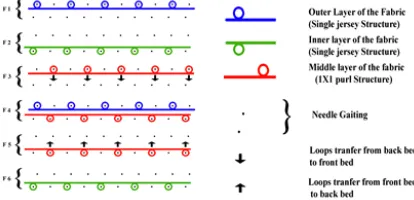
Using STOLL M1.PLUS 5.1.034 software the needle selection pattern was simulated is shown in Figure 2. In Figure 3, feeder 1, 2 and 3 are used for the formation of three layer fabric (inner-single jersey, middle-1X1 purl and outer-single jersey) respectively. With knit stitches the outer and inner layer knit fabrics are formed by means of selecting the alternate working needles in each bed. But the middle layer fabric is formed by free needles in each bed with the help of loop transfer and knit stitches.
FIGURE 3. Needle diagram for the multi-layer knit fabric.
TESTING
The produced multi layer knit fabric was given a relaxation process and the following tests were carried out. The knitted fabric properties are given in Table II. and the cross sectional view of the fabrics is shown in Figure 4.
Stitch Density
The courses and wale density of the samples in outer, middle and inner layer were calculated individually in the direction of the length and width of the fabric. The average density per square centimeter was taken for the discussion.
Loop Length
In outer, middle and inner layers of various combinations in multi layer fabric, 20 loops in a course were unraveled and the length of yarn in cm (LT) was measured. From the LT value the stitch length/loop length was measured by using
Stitch length/loop length in cm (L) = (LT)/20 (1)
The average loop length (cm) was taken and reported in Table II.
Tightness Factor (K)
The tightness of the knits was characterized by the tightness factor (K). It is known that K is a ratio of the area covered by the yarns in one loop to the area occupied by the loop. It is also an indication of the relative looseness or tightness of the knitted structure. For determination of TF the following formula was used
Tightness Factor (K) = √T/l (2)
Where T= Yarn linear density in Tex, l = loop length of fabric in cm. The TF of three layers (outer, middle, and inner) were calculated separately is given in Table II.
TABLE II. Multi-layer knitted fabric parameters.
Water Vapor Permeability (WVP)
The fabrics were conditionedfor 24 hours in standard testing condition. Seshadri S. Ramkumar et al. [13] elected the best method to analyze Moisture Vapor permeability. The evaporative dish method based on British Standard, BS 7209 was used to determine the water vapor permeability (MVTR) of the multi layer knit fabrics. The MVTR in g/m2/day was calculated from.
MVTR= 24 M/At (3)
where,
M - Loss in mass of the assembly over the time period t in grams
t - Time between successive weighing of the assembly in hours and
A - Area of the exposed test fabric (0.0054 m2)
Air Permeability (AP)
Air permeability is the rate of air flow passing perpendicularly through a known area under a prescribed air pressure differential between the two surfaces of a material of textile fabrics [12].The air resistance values of the multi layer knitted fabrics were measured individually by using the Kawabata evaluation system (KES-FB-AP1 Katotech Co, Ltd). The air resistance value of KES was converted into Frazier type tester values using the following relationship:
Air permeability (ft3/ft2.min) = 24.58 / R (4)
FIGURE 4. Cross Sectional view of Multi-layer knit fabric.
RESULTS AND DISCUSSION
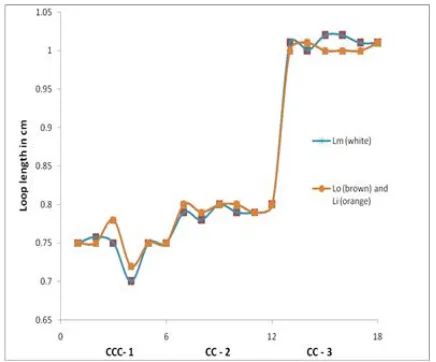
Knitted fabric quality depends on its stitch length. If the length of yarn in a loop increases, the fabric become porous, and if it decreases the fabric become tighter. The Figure 5 shows the CCC multi layer fabric loop length (cm) measured in the relaxed condition. In these fabrics, the mean loop length for the inner and outer layer (single jersey) was found to be equal, but the average loop length of the middle layer and other layers (1X1 purl) was as shown in Table II.
FIGURE 5. Variation of fabric loop lenth.
This may be due to the torsion and bending forces involved in forming single jersey fabric being high, but in double jersey fabric these forces are lower [10]. Even though, there is a presence of dissimilar structures in a layered fabric, t-test shows there no significant difference between the loop lengths. At alpha 0.05 the t-value is less than t-Critical for fabrics CCC-1 (0.601<2.228), CCC-2 (1.342<2.262), and CCC-3(2.236<2.262).
FIGURE 6. Variation of fabric densities with the loop length.
Influence of Loop Length on WPC and CPC
The dimensional properties of the knit fabrics are based on the number of wales per unit length and the number of courses per unit length. The multi layer CCC fabrics’ wpc and cpc for the various loop length are shown in Figure 6. It was observed that there is a inverse relationship between multi layer fabrics knitted with variations in loop length and loop densities. When loop length increases the wpc and cpc decreases. Regression analysis also confirmed that the correlation of cpc with loop length is more highly significant (R2 values 0.949, 0.926, and 0.971 for outer, middle, and inner layer respectively) than that of wpc with loop length (R2 values 0.889, 0.675, and 0.874 for outer, middle, and inner layer respectively). The jamming occurs between yarns in the direction of course and has more influence on wpc. There is a significant influence of tightness factor on wpi, as reported by Q.M. Wang et al [9] from their work.
Influence of Loop Length on Tightness Factor
FIGURE 7. Variation of tightness factor with the loop length.
A regression analysis was done between CCC-1 and CCC-2; it shows R2 = 0.293 and 0.413 for middle and other layers. So the tightness factor had obviously no dependence on loop length alone. The value K is dependent on the yarn linear density, and the combination yarn feed in multi layer fabrics. And between the fabrics CCC-2 and CCC-3, shows that the correlation will be perfect R2 = 0.999 for all the layers.
Water Vapor Permeability (WVP)
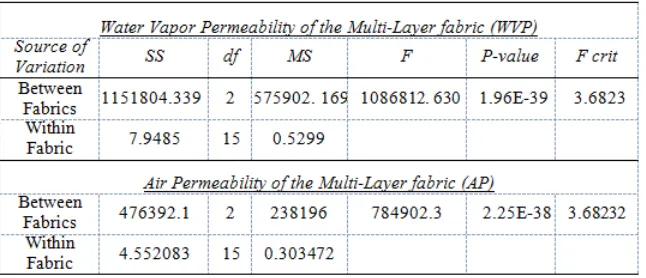
The water vapor permeability of the multi layer knit fabrics were analyzed and shown in Figure 8. It can be observed that a linear trend is followed between water vapor permeability and loop length. With increases in loop length, there is less resistance per unit area, so, the permeability property of the fabric also increased. Anova data show increases in loop length yield a significant difference in the water vapor permeability of the multi fabrics [F (2, 15) > F crit]. The regression analysis was done between CCC-1and CCC-2 and CCC-2 and CCC-3 for studying the influence of the number of yarn feeds. R2 values shows 0.755 for both comparisons. The water vapor permeability of the fabric is highly influenced by the length of the loop in the fabric and less by the number of yarn feed in the fabric.
Air Permeability (AP)
The air permeability of the multi layer knit fabrics was analyzed and is shown in Figure 8. It can be observed that the air permeability of the CCC-1, CCC-2, and CCC-3 fabrics is linear with loop length.
FIGURE 8. Water Vapor Permeability & Air Permeability of fabric.
As loop length in the fabric increased, air permeability also increased. The Anova- single factor analysis also proves that there is a significant difference at 5 % significance level between the air permeability characteristics of multi layer fabrics produced from various loop length [F (2, 15) > F crit] shown in Table IV. To study the influence of the combination yarn feed, the regression analysis was done between CCC-1 and CCC-2 and CCC-2 and CCC-3. It shows R2 =0.757. So, the air permeability of the fabric is may not be dependent on the number of yarns fed, but more influenced by the loop length.
CONCLUSIONS
TABLE III. Permeability Characteristics of Multi-layer knit fabrics.
TABLE IV. ANOVA single factor data analysis.
For multi-layer fabric produced with various basic structures (single jersey and 1x1 purl), the change of loop length between the layers has no significant difference.
The wpc and cpc had an inverse relationship with the loop length produced from CCC combination multilayer fabrics.
The combination yarn feed is an important factor affecting the tightness factor and loop lengths of the individual layers in knitted fabrics.
The water vapor and air permeability properties of the multi layer knit fabrics were highly influenced by the change in loop length followed by the combination yarn feed.
REFERENCES
[1] Mario de Araujo.; Raul Fangueiro and Maria José Geraldes.; Developing Fibrous Multifunctional Structures Fortechnical Applications.; AUTEX Research Journal, Vol. 5, No1, March 2005.
[2] Ke Baozhu.; Zhang Weiyuan.; The Optimal Design of Three-layer Plated Fabrics.; Fibres & Textiles in Eastern Europe.; January/March 2007, Vol. 15, No. 1 (60).
[3] Qing Chen.; Jintu Fan.; Manas Sarkar & Gaoming Jiang .; Biomimetics of Plant Structure in Knitted Fabrics to Improve the Liquid Water Transport Properties.; Textile Research Journal, Vol 80(6): 568–576. [4] Manas Sarkar.; Jintu Fan.; Yu-cheung Szeto.;
Xiaoming Tao .;Biomimetics of Plant Structure in Textile Fabrics for the Improvement of Water Transport Properties.; Textile Research Journal, May 2009, Vol 79,7.
[5] Md Abounaim.; Gerald Hoffmann.; Olaf Diestel.; Chokri Cherif.; Development of Flat Knitted Spacer Fabrics for Composites using Hybrid Yarns.; Textile Research Journal, May 2009, Vol 79,7.
[6] Terry Brackenbury.; “Knitted Clothing Technology.; Blackwell Science ltd, 1992 [7] H Cebulla.; O Diestel and P Offermann.; Fully
Fashioned Biaxial weft knitted fabrics.; AUTEX Research Journal, Vol 2, No 1 March 2002.
[9] Q. M. Wang and H. Hu.; Geometrical and Dimensional Properties of Plain Knitted Fabrics Made from Glass Fiber Yarns for Composite Reinforcement.; Journal of industrial textiles, Vol. 37, No. 2—October 2007.
[10] J.J.F. Knapton.; F.J. Ahrens.; W.W. Ingenthron and W. Fong.; The Dimensional Properties of Knitted Wool Fabrics: Part II: 1x1, 2x2 Rib, and Half-Cardigan Structures.; Textile Research Journal, October- 1968.
[11] GAV Leaf.; Practical statistics for the textile industry part-I & II; The Textile Institute, 1984.
[12] Air Permeability, Standard Test Method for Air Permeability of Textile Fabrics, ASTM D737-96.
[13] Dr. Seshadri S. Ramkumar et al.; Relationship Between Cotton Varieties and Moisture Vapor Transport of Knitted Fabrics, Journal of Engineered Fibers and Fabrics, Volume 2, Issue 4 – 2007.
AUTHORS’ ADDRESSES Kanakaraj P
Ramachandran R
PSG College of Technology Peelamedu
Coimbatore, Tamil Nadu 641 004 INDIA
Dasaradan B S
Angel College of Engineering and Technology Tirupur 641 665