R E S E A R C H
Open Access
Screening for depressed mood in an adolescent
psychiatric context by brief self-assessment
scales
–
testing psychometric validity of WHO-5
and BDI-6 indices by latent trait analyses
Eva Henje Blom
1,2*, Per Bech
3, Göran Högberg
1, Jan Olov Larsson
4and Eva Serlachius
1Abstract
Background:Major depressive disorder is prevalent in the adolescent psychiatric clinical setting and often comorbid with other primary psychiatric diagnoses such as ADHD or social anxiety disorder. Systematic
manual-based diagnostic procedures are recommended to identify such comorbidity but they are time-consuming and often not fully implemented in clinical practice. Screening for depressive symptoms in the child psychiatric context using brief, user-friendly and easily managed self-assessment scales may be of clinical value and utility. The aim of the study is to test the psychometric validity of two such scales, which may be used in a two-step screening procedure, the WHO-Five Well-being Index (WHO-5) and the six-item version of Beck’s Depression Inventory (BDI-6).
Method:66 adolescent psychiatric patients with a clinical diagnosis of major depressive disorder (MDD), 60 girls and 6 boys, aged 14–18 years, mean age 16.8 years, completed the WHO-5 scale as well as the BDI-6. Statistical validity was tested by Mokken and Rasch analyses.
Results:The correlation between WHO-5 and BDI-6 was−0.49 (p=0.0001). Mokken analyses showed a coefficient of
homogeneity for the WHO-5 of 0.52 and for the BDI-6 of 0.46. Rasch analysis also accepted unidimensionality when testing males versus females (p > 0.05).
Conclusions:The WHO-5 is psychometrically valid in an adolescent psychiatric context including both genders to assess the wellness dimension and applicable as a first step in screening for MDD. The BDI-6 may be recommended as a second step in the screening procedure, since it is statistically valid and has the ability to unidimensionally capture the severity of depressed mood.
Keywords:Well-being, Adolescent major depressive disorder, Rasch analyses, Mokken analyses, Brief self-assessment scales, BDI-6, WHO-5
Introduction
Major depressive disorder (MDD) is the most prevalent psychiatric disorder in teenagers across cultures [1]. In teenagers MDD is highly comorbid with other psychiatric disorders such as generalised anxiety disorder, social anx-iety disorder and ADHD and may have a negative impact on the prognosis and treatment outcome of the comorbid
disorder if not identified and treated [1]. Systematic manual-based diagnostic procedures have been shown to help identify comorbid disorders in child and adolescent psychiatry [2] but are often time-consuming and not fully implemented in clinical practice. We suggest that screen-ing for depressive symptoms usscreen-ing brief, user-friendly self-assessment scales in the child psychiatric context may be of additive clinical value and utility. A salutogenic scale has an obvious advantage in avoiding repetitive questions concerning negative affect and negative life experiences that may be discouraging for the patient and is therefore suggested as a first step when screening for depressive * Correspondence:[email protected]
1
Department of Clinical Neuroscience, Karolinska Institutet, Retzius väg 8, A2:3, Stockholm 17177, Sweden
2
Psychiatric Research Unit Mental Health Centre North Zealand, Dyrehavevej 48, DK 3400, Hillerød, Denmark
Full list of author information is available at the end of the article
symptoms. We have focused on the WHO-5 as the initial screening instrument for the measurement of subjective well-being [3], see Appendix 1. Recently, Hall et al. exam-ined the clinical validity of widely used well-being scales and identified the five-item WHO-5 scale as having the highest content validity when compared to scales with a much larger number of items such as the 22-item Psy-chological General Well-Being Index, the 36-item Medi-cal Outcome Short Form (SF-36) or the 100-item World Health Organisation Quality of Life Scale (WHOQoL) [4]. In the follow-up discussion with mental health experts, Hall et al. state that it is often difficult to avoid the use of items reflecting either symptoms of illness or side-effects of medi-cation such as sleep problems or concentration problems [4]. As a second step in the screening procedure, when the WHO-5 shows a score below a certain cut-off, an inventory specifically measuring the pure depressive symptom sever-ity should be used. For this purpose we have focused on the short, six-item version (BDI-6) of the Beck Depression In-ventory [5], see Appendix 2 in which six core items have been selected from the original version of Beck’s Depression Inventory to capture MDD unidimensionally in a brief for-mat [6], thus avoiding unintentionally screening for symp-toms which might be side-effects of medication. The aim of this study is to investigate the psychometric properties of the brief self-rating scales WHO-5 and BDI-6 in a clinical context of teenagers with MDD with or without other comorbid psychiatric diagnosis by item Rasch and Mokken analyses. A two-step screening approach is based on the fact that the positively phrased items (WHO-5) measure when “the wind begins to get taken out of the sails”, in other words an ultra-short screening before the syndrome of depression is in operation. The negatively phrased items (BDI-6) measure the cognitive theory of depression.
Method
Self-assessment scales
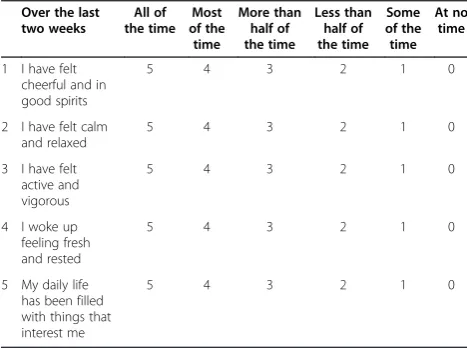
The WHO-Five Well-being Index (WHO-5) was derived from a larger rating scale developed for a WHO project on quality of life in patients suffering from diabetes [7]. During the first psychometric evaluation 10 of the ori-ginal 28 items were selected due to the homogeneity they had shown across the various European countries partici-pating in this study [7]. Because positive psychological well-being has to include positively worded items only, these 10 items were then reduced to five items (WHO-5) which still covered positive mood, vitality and general interest. The five items are: (a) being in good spirits, (b) feeling relaxed (c) having energy (d) waking up fresh and rested, (e) being interested in things. Each of the five items is rated on a 6-point Likert scale from 0 (= not present) to 5 (= constantly present). The theoretical raw score ranges from 0 to 25. Thus, higher scores mean bet-ter well-being. The raw score is obtained by adding the
figures in the boxes. A score below 13 indicates poor well-being and is an indication for testing for depression, as is the case if the patient has answered 0 to 1 on any of the five items [3]. In order to monitor possible changes in well-being, the percentage score is used. The percent-age value is calculated by multiplying the score by 4 and thus obtaining a scale from 0 (worst imaginable well-being) to 100 (best imaginable well-well-being). Convention-ally > 50 is interpreted as indicating no depression, 30– 50 mild depression and < 30 moderate depression. A 10% difference indicates a significant change [8]. Appendix 1 contains the full version of the items. The six items of the BDI-6 index were derived from the original version of Beck’s Depression Inventory BDI-21 in a clinical valid-ation study [6], using experienced psychiatrists as index of validity, to capture major depressive disorder (MDD) in a brief format. In this process, 12 items were shown to follow the global severity index of the experienced psychiatrists. However, many of these 12 items had local dependency. Hence, the BDI items 1 (sadness), 2 (pes-simism) and 4 (lack of satisfaction) showed a very high local dependency. Moreover, item 5 (guilt), item 3 (sense of failure) and item 6 (sense of punishment) also had a very high local dependency. On the other hand, the selected items in the BDI-6 have a high clinical corres-pondence to MDD, without being related to each other. The BDI-6 has not yet been tested or validated in a child psychiatric population. The six items are: (1) feelings of sadness, (5) feelings of guilt, (11) being irritable, (13) hav-ing decision problems, (15) ability to work and (17) feel-ing tired. When this study was designed, the BDI-II had not yet been validated for the Swedish version, while BDI-A1 was in use. The six BDI-6 items were retroactively extracted from the full 21-item A1 version. The BDI-6, as used in this study, thus contains six items on a 4-point scale yielding a total score by summation of the indi-vidual items of 0–18 p (0 p means no depression and 18 p maximum depression score). The conventional cut-off scores for BDI-6 are < 6 no depression, 6–7 mild depres-sion, 7 moderate depression. Appendix 2 contains the full version of the items.
Data collection procedure
diagnosis of MDD and the ones who had a clinical diag-nosis of MDD, which was not validated by DAWBA. Patients with severe autism or psychotic symptoms were not included in the study. The subjects had on-going treatment contact (median duration 11 months) at one of 13 outpatient psychiatric clinics for children and ado-lescents situated in the centre of Stockholm, its suburbs and in smaller towns nearby. The subjects completed the self- assessment forms at the open psychiatric units. An endeavour was made to collect all data on one occa-sion, but in some cases new appointments had to be made to complete all stages of the procedure. This involved testing one subject at a time under the supervi-sion of one or two assistants. A randomly sorted pack of forms was handed to each subject, who was then free to choose in which order to complete them.
Psychometric analyses
Both Mokken and Rasch methods are based on item re-sponse theory, thus assuming: (a) unidimensionality, meaning that for the items that form a scale there is assumed to be a dominant single latent trait that deter-mines how the questions are answered, for WHO-5 per-ceived wellness and for BDI-6 depressed mood, (b) local stochastic independence of the items in a scale meaning that a specific individual’s response to items in a scale is dependent on the individual’s level of the trait being measured so that the score of one item is not explained by the score of another item. Local stochastic independ-ence (conditional independindepend-ence) should be distinguished from the problem of the clinical local independence of items. Statistically, local independence is concerned with how different item scores are stochastically related through independence for any fixed level of depression. Any specific item response is consequently determined solely by the location on the dimension [10] and the score level for the specific patient. However, clinically we are dealing with local independence as a measure (cor-relation) of the extent to which the score on one item can automatically predict the score on another item. The full BDI-21 contains, for example, many such logic-ally correlating items, as discussed by Greenberg [11], and finally (c) monotonicity, referring to the probability of the score of the item increasing as the level of the la-tent trait increases [12,13]. Invariant item ordering is one of the key features and a basic principle underpin-ning the item response theory models. In these models it is stipulated that items with lower prevalence have to be preceded by items with higher prevalence for all patients under consideration [14]. The Rasch model provides a method for nonlinear transformation of ordinal raw scores to interval measures and allows the raw scores from different items representing different severity to be summated [15]. Estimated by means of the
single-parameter Rasch model, the locations (item single-parameters) of the theoretical range of the latent dimension of depression at which the prevalence of items can be placed are illustrated in the tables. We used the RUMM 2030 program (Andrich D, Sheridan BE, Luo G. RUMM2030. version 5.1. Perth, WA: RUMM Laboratory Pty Ltd; 2010) to estimate the item locations.
Mokken analysis is considered a useful way of investigat-ing the behaviour of items in scales in relation to varyinvestigat-ing levels of the latent trait, and the coefficient of homogen-eity is considered to indicate unidimensionality if > 0.40. The Mokken analysis has been frequently applied to psy-chological self-assessment questionnaires [13]. In accord-ance with the Mokken model, the listing of the individual items is determined by the mean item scores. In the Mok-ken scale analyses we used a program for polytomous items created by Molenaar et al. [16]. Both the parametric Rasch item response model and the non-parametric Mok-ken model are only relevant to use if the scales under examination (WHO-5 and BDI-6) have acceptable clinical validity. The psychometric validation by Rasch and Mok-ken is a validation of the measurement aspect answering the question whether the total score is a sufficient statistic. The rationale of using both Rasch and Mokken ana-lyses rather than one or the other is that the Mokken model shows the coefficient of homogeneity which is easy to understand, but with the Rasch model we can check the influence of external factors, e.g. gender.
Results
“somatic”items with the lowest rankings. The Rasch ana-lysis also accepted unidimensionality when testing males versus females (p > 0.05). The coefficient of homogeneity for the BDI-6 was 0.46. Table 3 shows the means (rankings) for the Mokken analysis of the BDI-6. The two “somatic items”(17 and 15) showed the highest rankings, indicating that they are present in low to moderate degree of depressed mood and the“psychological items”(13, 1, 5, 11) showed the lowest, indicating that they are only present in a more severely depressed state. Table 4 shows the Rasch analysis with the items of “psychological asthenia” or “ap-athy”having the highest prevalence (items 17 and 15). The Rasch analysis also accepted unidimensionality when test-ing males versus females (p > 0.05). The correlation (Spear-man) between BDI-6 and WHO-5 was−0.49 (p=0.0001).
Discussion
This study shows that the brief self-assessment scales WHO-5 and BDI-6 have a satisfactory statistical validity in a sample of adolescents of both genders with a clinical diagnosis of major depressive disorder (MDD) with or
without comorbidity of other psychiatric disorders. The Mokken analysis of the WHO-5 scale shows a coefficient of homogeneity of 0.52 indicating unidimensionality of the latent trait of wellness; the analysis of BDI-6 showed a coefficient of homogeneity of 0.46, indicating that the total score is a sufficient measure of the pure dimension of depressed mood. These findings confirm the statistical validity of using the WHO-5 as a first step in a screening procedure for depressed mood among adolescent psychi-atric patients. The total score WHO-5 and BDI-6 showed an inverse relationship of -0.49 (p<0.0001) indicating that the two scales partially overlap, but that the wellness di-mension captures other aspects of well-being than the absence of depressed mood. Therefore, BDI-6 is needed as a brief scale that adequately measures the dimension of depressed mood as a second step when the WHO-5 is below a certain cut-off. However, we do not suggest this procedure as an alternative to a proper manual-based diagnostic interview, which would capture other comor-bid psychiatric disorders in addition to MDD, but rather as a convenient and user-friendly complementary way to screen specifically for depressed mood in situations when the diagnostic interview is too time-consuming, impractical or inappropriate to use. Such situations may be when the patient fails or refuses to cooperation or when it is too much an effort for the patient to manage a diagnostic interview. In such cases it is an advantage to have brief self-assessment scales with a salutogenic focus
WHO-5
BDI > 50
No depression
30- 50 Mild depression
< 30 Moderate depression
< 6 No depression
7 8 5
7 – 8 Mild depression
2 6 7
= 30.3%
> 8 Moderate depression
5 5 21
= =
% 5 . 1 5 %
2 . 8 1
Figure 1ROC analysis showing the results of WHO-5 and BDI-6 of the total subjects (N=66) with clinical diagnosis of major depressive disorder.
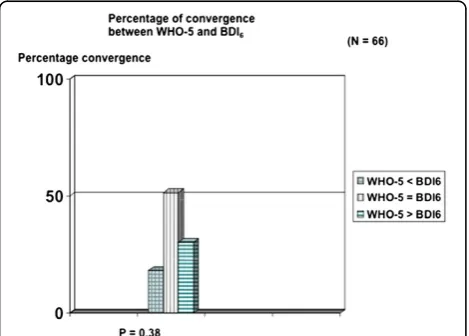
Figure 2 Showing the percentage of convergence between WHO-5 and BDI-6.
Table 1 Mokken analysis of WHO-5 showing the means and items (rankings)
Item 1 Item 2 Item 5 Item 4 Item 3
Good spirits
Relaxed Interested in things
Fresh and rested
Energy
2.22 (1) 1.84 (2) 1.70 (3) 1.12 (5) 1.52 (4)
Coefficients of homogeneity*
0.11 0.52 0.40 0.53 0.49
as a first screening tool. The brief scales may of course be used for purposes other than for screening. The WHO-5 can be used across diagnoses to assess well-being as an aspect of quality of life, either on specific occasions such as intake and after treatment or in session-by-session assess-ment, i.e. treatment monitoring [17]. The WHO-5 scale has been chosen in this study because it specifically aims to measure positive well-being, in contrast to other short scales for the measurement of quality of life focusing on other aspects of health status including morbidity, self-care, pain etc. The BDI-6 as a unidimensional measure of depressive symptoms is valid for assessment of treatment outcome in MDD. Interestingly, the BDI-6 items of sad-ness, guilt and irritability were reported more frequently as the severity of depressive symptoms increased, whereas tiredness and decreased ability to work had the highest ranking, indicating that these symptoms are present even when the depressed mood is mild to moderate. The same tendency was found from a wellness perspective with the WHO-5. This indicates that depressive symptoms present themselves in a certain sequence so that in a mild form the dominant symptoms are tiredness and subjectively reduced ability to work and when the severity increases feelings of sadness, guilt and irritability occur. This data supports the theory of Hamilton that mental illnesses, especially depres-sion, manifest themselves, so that the patients are the first to experience a disturbance of their subjective well-being. Subsequently, family relationships and later their wider so-cial adjustment are impaired, often with increasingly nega-tive impact on their global functioning [18].
The study population was limited to patients with mild to moderate depression and did not include any hospita-lised psychiatric patients, which limits the generalisabil-ity of the results to the full spectrum of adolescent psychiatric patients. The self-assessment forms were dis-tributed in a random order to prevent systematic errors,
but there could still be an effect of having to complete several different questionnaires. The BDI was presented to the subjects as the full 21-item BDI-1A version and the items of the BDI-6 were retroactively selected. Con-sequently, we cannot be certain that the scoring of the six items would have been identical if the BDI-6 had been presented instead of the full-items version. A few subjects occasionally mark some items of the BDI-21 be-tween the specified numbers of 0–4, so that the scores had to be interpreted as half numbers (0,5; 1,5; 2,5). We therefore used a 0–6 Likert scale in the analyses, but in the Mokken mean scores we went back to a 0–3 Likert scale by dividing the scores by 2 for comparison with the conventional BDI studies.
Conclusions
We conclude that the WHO-5 is psychometrically sound and applicable in an adolescent psychiatric context of clinically depressed teenagers to assess the dimension of wellness. The WHO-5 scale has the advantage of a salu-togenic approach and could be used as an initial screen-ing instrument for depressed mood in a clinical context. The BDI-6 may be recommended as a second step in the screening procedure since it is statistically valid and adequately captures the severity of MDD.
Appendix
Appendix 1 WHO (Five) Well-being Index (1998 version)
Please indicate for each of the five statements which is clos-est to how you have been feeling over the last two weeks (Table 5).
Table 4 Rasch analysis of the BDI-6 showing the locations (ranks)
Item 17 Item 15 Item 13 Item 1 Item 5 Item 11
Tiredness Work Decision problems Sadness Guilt Irritability
- 0.26 (1) - 0.23 (2) 0.03 (3) 0.13 (4) 0.16 (5) 0.17 (6) Table 2 Rasch analysis of WHO-5 showing the locations
(ranks)
Item 1 Item 2 Item 5 Item 4 Item 3
Good spirits Relaxed Interested in things Fresh and rested Energy
−1-13 (1) - 0.26 (2) - 0.22 (3) 0.31 (4) 1.30 (5)
Table 3 Mokken analysis of the BDI-6 showing the means and items (rankings)
Item 17 Item 15 Item 13 Item 1 Item 5 Item 11
Tiredness Work Decision problems
Sadness Guilt Irritability
1.54 (1) 1.48 1.21 (3) 1.14 (4) 1.12 (5) 1.00 (6)
Coefficients of homogeneity*
0.49 0.49 0.48 0.40 0.44 0.47
*The corresponding coefficient of homogeneity for the total score of BDI-6 (=0.46).
Table 5 WHO (Five) Well-being Index (1998 version)
Over the last two weeks
All of the time
Most of the time
More than half of the time
Less than half of the time
Some of the time
At no time
1 I have felt cheerful and in good spirits
5 4 3 2 1 0
2 I have felt calm and relaxed
5 4 3 2 1 0
3 I have felt active and vigorous
5 4 3 2 1 0
4 I woke up feeling fresh and rested
5 4 3 2 1 0
5 My daily life has been filled with things that interest me
Appendix 2 The BDI-6 subscale for depression
1.
A. I do not feel sad (0 p) B. I feel sad and depressed (1 p)
C. I feel constantly sad and depressed and feel unable to get out of it (2 p)
D. I feel so blue and unhappy that I cannot bear it (3 p)
5.
A. I don’t feel particularly guilty (0 p)
B. I feel bad or unworthy a good part of the time (1 p) C. I feel quite guilty (2 p)
D. I feel constantly as though I am guilty and worthless (3 p)
11.
A. I am no more irritable now than I ever was (0 p) B. I get annoyed or irritable more easily than I used to (1 p) C. I feel irritated all the time (2 p)
D. I get irritated about things that did not use to irritate me at all (3 p)
13.
A. I make decisions about as well as ever (0 p) B. I try to put off making decisions (1 p)
C. I have great difficulty in making decisions (2 p) D. I cannot make any decisions at all anymore (3 p)
15.
A. I can work about as well as before (0 p)
B. It takes extra effort to get started at doing something (1 p) C. I have to push myself very hard to do anything (2 p) D. I can’t do any work at all (3 p)
17.
A. I don’t get more tired than usual (0 p) B. I get tired more easily than I used to (1 p) C. I get tired from doing anything (2 p) D. I get too tired to do anything (3 p)
Competing interests
All the authors declare that they have no competing interests.
Authors’contributions
EHB was the“project leader”for the study, responsible for the data collection, and wrote the first draft of the manuscript. PB contributed with statistical analyses and references to the WHO-5 and BDI-6. GH contributed to the original outlines of the project literature search. JOL was responsible for psychometric references and for methodological issues. ES contributed to the recruitment and diagnostic issues of the clinical sample and was responsible for the overall design of the study. All the authors contributed to and have approved the final manuscript.
Acknowledgements
Funding for this study was obtained from the Osher Centre for Integrative Medicine at Karolinska Institutet, public health grants from Stockholm County Council, the Swedish Society of Medicine, the National Board of Health and Welfare, the Söderström–Königska Foundation and the Stockholm Centre for Psychiatric Research and Education. None of these had any involvement in the collection, analysis or interpretation of the data, in writing the report, or in the decision to submit the paper for publication. Thanks to patients and staff at the clinics who have contributed to this study.
Author details
1Department of Clinical Neuroscience, Karolinska Institutet, Retzius väg 8,
A2:3, Stockholm 17177, Sweden.2Psychiatric Research Unit Mental Health Centre North Zealand, Dyrehavevej 48, DK 3400, Hillerød, Denmark.
3Department of Women’s and Children’s Health, Building H2:00 Karolinska
University Hospital, 171 76, Stockholm, Sweden.4Department of Women’s and Children’s Health, Karolinska Institutet, Retzius väg 8, A2:3, Stockholm 17177, Sweden.
Received: 16 April 2012 Accepted: 5 December 2012 Published: 11 December 2012
References
1. Angold A,et al:Comorbidity.J Child Psychol Psychiatry1999,40(1):57–87. 2. Lauth B,et al:Implementing the semi-structured interview Kiddie-SADS-PL
into an in-patient adolescent clinical setting: impact on frequency of diagnoses.Child Adolesc Psychiatry Ment Health2008,2(1):14.
3. Bech P,et al:Measuring well-being rather than the absence of distress symptoms: a comparison of the SF-36 Mental Health subscale and the WHO-Five Well-Being Scale.Int J Methods Psychiatr Res2003,12(2):85–91. 4. Hall T,et al:Examining functional content in widely used Health-Related
Quality of Life scales.Rehabil Psychol2011,56(2):94–9.
5. Beck AT, Ward CH, Mendelson M, Mock J, Erbaugh J:An inventory for measuring depression.Arch Gen Psychiatry1961,4:561–571. 6. Bech P,et al:The clinical effect of clomipramine in chronic idiopathic
pain disorder revisited using the Spielberger State Anxiety Symptom Scale (SSASS) as outcome scale.J Affect Disord2009,119(1–3):43–51. 7. Bech P, Gudex C, Johansen KS:The WHO (Ten) Well-Being Index:
validation in diabetes.Psychother Psychosom1996,65(4):183–90. 8. Ware J: InQuality of Life and Pharmacoeconomics in Clinical Trials. 2nd
edition. Edited by Spilker B. Philadelphia: Lippincott Williams & Wilkins; 1995. 9. Blom EH,et al:The differentiation between depressive and anxious
adolescent females and controls by behavioural self-rating scales.J Affect Disord2010,122(3):232–40.
10. JR DA:The theory and practice of item response theory. New York: Guilford Press; 2009.
11. Greenberg G:Manufacturing Depression: the secret history of a modern disease. London: Bloomsbury Publishing PLC; 2010.
12. Hagquist C:Evaluating composite health measures using Rasch modelling: an illustrative example.Soz Praventivmed2001,46(6):369–78. 13. Watson R,et al:Item response theory: How Mokken scaling can be used
in clinical practice.J Clin Nurs2011.
14. Licht RW,et al:Validation of the Bech-Rafaelsen Melancholia Scale and the Hamilton Depression Scale in patients with major depression; is the total score a valid measure of illness severity?Acta Psychiatr Scand2005,111(2):144–9. 15. Hagquist C:The psychometrsic properties of the self-reported SDQ. An
analyses of Swedish data beased on the Rasch model.Pers Indiv Differ 2007,43(5):1289–1301.
16. Molenaar IW:MSP: A Program for Mokken Scale Analysis for Polytomous Items, Version 3.0: User's Manual. Groeningen, The Netherlands: IEC ProGAMMA; 1994. 17. Weisz JR,et al:Youth Top Problems: using idiographic, consumer-guided
assessment to identify treatment needs and to track change during psychotherapy.J Consult Clin Psychol2011,79(3):369–80.
18. Hamilton M: InPsychopharmacology: a generation of progress. 1st edition. Edited by Alberto DM, Lipton MA, Killan KF. New York: Raven press; 1978.
doi:10.1186/1477-7525-10-149