
PRELIMINARY DESIGN OF HIGH-RISE
BUILDING’S TECHNIQUES
Lovneesh Sharma1,
Research Scholar, Civil Engineering Department, Chandigarh University Gharaun , Mohali (Punjab), India
Swati Pathak2,
Research Scholar, Civil Engineering Department, Shimla University, Shimla (H.P) India
ABSTRACT - The development of tall structures has recently been restricted in India. Changes in the public arena as of late, identified with urbanization, financial aspects and compositional guidelines have anyway brought about a more prominent enthusiasm for the development of elevated structures. When planning elevated structures, challenges are confronted which frequently can be slighted when planning lower structures. In this paper, a procedure which can be utilized in the primer structure procedure of tall structures is created. The philosophy depends on romanticized estimation models and glorified limited component models, particularly centered around the dynamical properties, common frequencies and increasing velocities of the structure. The report will depict how these figuring can be utilized to make the primer structure of elevated structure and still acquire sensible outcomes. The work is centered around structures with an auxiliary framework comprising of a solid center with the likelihood of including outriggers. The paper likewise features the diverse marvels identified with tall structures that should be considered in the starter arrange, or later, in the plan procedure.
Keywords: High rise building, Shear wall, Bracings, Preliminary Design Process 1. INTRODUCTION
The high buildings can be defined in many ways, if the building height is greater than the maximum firefighting equipment it can be called as high rise building because of fire regulations [1]. When structuring tall structures, challenges are confronted which regularly can be dismissed when planning lower structures? These may incorporate torsion of the structure and influencing because of dynamic burdens. Because of the absence of tall structures in Sweden, the information of how to manage these issues is restricted. This paper spread the means to make in the fundamental plan, when diverse alternatives for basic frameworks are considered and unpleasant measurements are chosen. The investigation demonstrates that an admired pillar model of the structure with changing firmness will give adequate outcomes for the starter plan.
2. HIGH-RISE BUILDINGS Structural design process
There are a wide range of approaches to characterize what an elevated structure. A city organizer will frequently characterize it as a structure that obviously juts over the encompassing structures. On the off chance that the tallness of the structure bigly affects the departure or if the stature of the structure is more prominent than the most extreme reach of firefighting gear it tends to be known as an elevated structure due to flame guidelines. A structure is then frequently considered a tall structure when dynamic burdens ends up significant. By and large terms, an adaptable structure can be thought to be influenced by powerful loads while an inflexible structure is accepted not to. The criteria for an unbending/rigid structure is when the fundamental frequency of the structure is under 1HZ [2].
3. STRUCTURAL SYSTEMS
1. Rigid frames
For structures with a genuinely low stature, an unbending edge can be utilized. An unbending edge comprises of segments and braces with minute opposing associations. It opposes sidelong loads with the bowing opposition of the segments and shafts. When structuring structures with minute opposing casings, the span of the sections and bars are regularly constrained by the twisting firmness and not by the heap limit. The high twisting firmness is expected to constrain the float because of horizontal burdens [3]. Moreover the conduct of the structure relies upon the plan of the associations, if a major turn between the pillar and segment is permitted, the horizontal influence of the structure will expand quickly and cause issue with the solace in the structure. Steel or cement can be utilized for this sort of framework. For steel, the most extreme proper stature is around thirty stories and for cement around twenty stories.
Figure 2: Rigid frame [4].
2. Shear walls
Shear dividers have a high opposition in their very own plane and are utilized to oppose parallel burdens. Shear dividers can oppose toppling minutes, shear powers and furthermore torsion on the off chance that they are appropriately set in the structure. Shear dividers can be utilized in various courses in figure 3. By associating shear dividers a coupled shear divider is gotten. The dividers are coupled by putting pillars between the shear dividers as appeared in figure 4. This is a successful method to incredibly expand the parallel solidness of a structure, this sort of framework is powerful up to 40 storey [2].
Figure 3: Shear walls [4].
Figure 4: Coupled shear walls [2]
3.Core and outrigger systems
The center can restrict parallel, vertical and torsional loads. This system is effective up to 45 stories. Additional vertical weights are taken by fragments [2]. Focus can be enhanced with an outrigger structure to inconceivably manufacture its bowing solidness. The outrigger itself involves solidified floors high up in the structure. The robustness can for example be made with dividers, several accounts high[2]. These outriggers are related with areas that reach out along the edge of the structure to the virus earth. At the point when the structure is exposed to parallel burdens they are opposed with pivotal powers in the outside sections and the minute in the center is diminished. Outriggers will decrease the horizontal removals of the structure because of bowing.
Figure 5: Outrigger system [5].
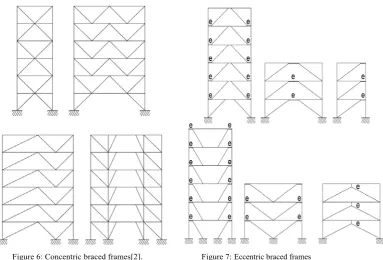
4. Braced frames
Figure 6: Concentric braced frames[2]. Figure 7: Eccentric braced frames
CHALLENGES RELATED TO HIGH RISE BUILDINGS 1. Natural frequencies
The three first regular frequencies for a structure are typically the influence in the two bearings (x-and y-heading) and the torsional influence (around the z-pivot). Ordinarily, computation of the regular frequencies is made by a PC program which can deal with the eigen esteem examination. Some essential angles to consider while computing the characteristic recurrence are the mass appropriation and the firmness. The mass and firmness at each floor are required. The damping proportion depicts how the swaying of the structure rots after it has been irritated. As of now there is no chance to get of registering the damping proportion of a structure, an esteem is picked dependent on experience[6].
Figure 8: Displacement in building when subjected to a UDL
2. P-DELTAEFFECT
In tall structures, the P-delta impact can bigly affect the upsetting minute. The P-delta impact is a second request impact and is brought about by the hub constrain and the uprooting of the structure. When planning elevated structures in seismic zones this impact is of considerably more noteworthy significance because of the influencing of the structures. In the event that the influencing of the structure is vast and therefore makes an extensive removal, the upsetting minute could make harm the structure. To stay away from harm or breakdown because of the P-delta impact, the sidelong solidness or the quality of the structure must be expanded [7].
Figure 9: P delta effect [8]
3. SOFT STORY COLLAPSE
Tall structures regularly have less dividers in the base floors to make progressively open spaces, thus lower firmness in contrast with higher up in the structure. Sidelong loads can make the primary and story breakdown while the remainder of the structure opposes the heaps and stays standing.
Figure 10: Soft story collapse [9]
4. DAMPING
A framework can, contingent upon the measure of damping, be named underdamped, fundamentally damped or overdamped. In figure three bends have been plotted to demonstrate the conduct of the distinctive frameworks after an underlying relocation. An underdamped framework will waver before grinding to a halt. All structures are underdamped and the basic damping is essentially identified with the structure material of the basic framework, the basic damping is for the most part ζ = 0.1 or underneath[10].
4. CALCULATION METHODOLOGY
5. CONCLUSION
The approach introduced in the paper demonstrates an extremely disentangled technique that can be utilized in the primer plan process. To make an admired pillar model of the structure with fluctuating firmness will give adequate outcomes for the fundamental plan. To figure avoidance shapes, there is an insignificant distinction between utilizing a consistently disseminated burden. To associate the fundamental structure to a lower side-building will have a perceptible effect on the solidness, anyway the situation of the side-side-building will influence the firmness. For this situation the side-building changed the solidness 21% on the off chance that it was set opposite to the fundamental structure.
REFERENCES
[1] G. Graighead. High-Rise security and fire safety. Butterworth-Heinemann, 2009.
[2] B.S. Taranath. Reinforced concrete design of tall buildings. CRC Press, 2010.
[3] M. Halis Gunel and H. EmreIlgin. A proposal for the classification of structural systems of tall buildings. Building and Enviornment.
2006; 42(7): 2667-2675.
[4] Moment frame. http://www.nexus.globalquakemodel.org/gem-buildingm taxonomy/overview /glossary/moment-frame--lfm.
[Accessed: 2016-03-21].
[5] S. Fawzia and T. Fatima. Deection control in composite building by using belt trussand outriggers system. International Journal of
Civil, Environmental, Structural,Construction and Architectural Engineering. 2010; 4(12): 414-419.
[6] B.S. Taranath. Structural Analysis and Design of Tall Buildings: Steel and Composite Construction. CRC Press, 2012.
[7] B.J. Davidson, R.C. Fenwick, and B.T. Chung. P-delta effects in multi-storey structural design in Earthquake Engineering, Tenth
World Conference. pages 3847-3852, Balkema, Roterdam, 1992.
[8] What is p-delta analysis? https://risa.com/news/what-is-p-delta-analysis-risatech-risa3d/. [Accessed: 2016-02-22].
[9] T. Oleson. Faking quakes at full scale: Giant shake tables simulate earthquakes to make buildings safer.
http://www.earthmagazine.org/article/faking-quakes-full-scale-giant-shake-tables-simulate-earthquakes-make-buildings- safer. [Accessed: 2016-05-13].
[10] A.K. Chopra. Dynamics of structures-Theory and Applications to Earthquake Engineering. Prentice-Hall,
[11] J.Y. Kim, J.K. Park, D.Y. Kim, and S.D. Kim. Evaluations of structural dynamic properties using wind-induced responses. In:
Proceedings of annual conference of Korean Society of Steel Construction (KSSC). pages 125-128, 2007.
[12] Q.S. Li, Y.Q. Xiao, C.K. Wong, and Jeary A.P. Field measurements of typhoon effects on a super tall building. Engineering Structures.
2004; 26(2): 233-244.
[13] M. Nicoreac and J.C.D Hoenderkamp. Periods of vibration of braced frames with outriggers. Procedia Engineering. 2012; 40: 298-303
[14] M. Burton, K. Kwok, P. Hitchcock, and R. Denoon. Frequency dependence of human response to wind-induced building motion.
Journal of Structural Engineering. 2006; 132(2): 296-303.
[15] Anwade B. A., Aher B. S., Barate D. A., Raghuvanshi S. & Kuralkar S., 2018, Seismic Analysis, Design and Comparative Study of
RC Structure Using Different Codes, International Research Journal of Engineering and Technology, Volume: 05, Issue: 04, pp-4984-4990.
[16] Chandrika S. M., Swamy S. B., 2018, Effect Of Damper Locations On Behaviour Of Plan Irregular Steel Structure Subjected To
Dynamic Loading, International Research Journal of Engineering and Technology, Volume: 05, Issue: 06, pp-674-680.
[17] Gaikwad S. P., Tolani K. K., 2015, Study Of Dynamic Effect On Unsymmetrical Building (Rcc & Steel), International Journal of
Research in Engineering & Advanced Technology, Volume 3, Issue 3, pp-104-109.
[18] Malviya N., Pahwa S., 2017, Seismic Analysis of High Rise Building With IS Code 1893-2002 And IS Code 1893-2016, International
Research Journal of Engineering and Technology, Volume: 04, Issue: 11, pp-2115-2119.
[19] Natarajan S., Veeraragavan S., 2016, A Review on Analysis and Design of Shear Walls in High Rise Irregular Building, International
Journal of Scientific engineering and Technology Research, Vol-05, Issue-05, pp-808-815.
[20] Rahman A.S., Deshmukh G., 2013 “Seismic Response of vertically Irregular RC Frame with Stiffness Irregularity at Fourth Floor”
![Figure 2: Rigid frame [4].](https://thumb-us.123doks.com/thumbv2/123dok_us/9670882.1495012/2.595.227.373.573.737/figure-rigid-frame.webp)
![Figure 4: Coupled shear walls [2]](https://thumb-us.123doks.com/thumbv2/123dok_us/9670882.1495012/3.595.188.398.393.615/figure-coupled-shear-walls.webp)
![Figure 10: Soft story collapse [9]](https://thumb-us.123doks.com/thumbv2/123dok_us/9670882.1495012/5.595.221.345.325.488/figure-soft-story-collapse.webp)
